

MediaGPT | MEDIA INDUSTRY ANALYSIS
Medill's State of Local News 2026 finds news deserts up to 238 counties, the largest one-year rise in five years, and 75% of 678 local TV newsrooms in the hands of 10 chains
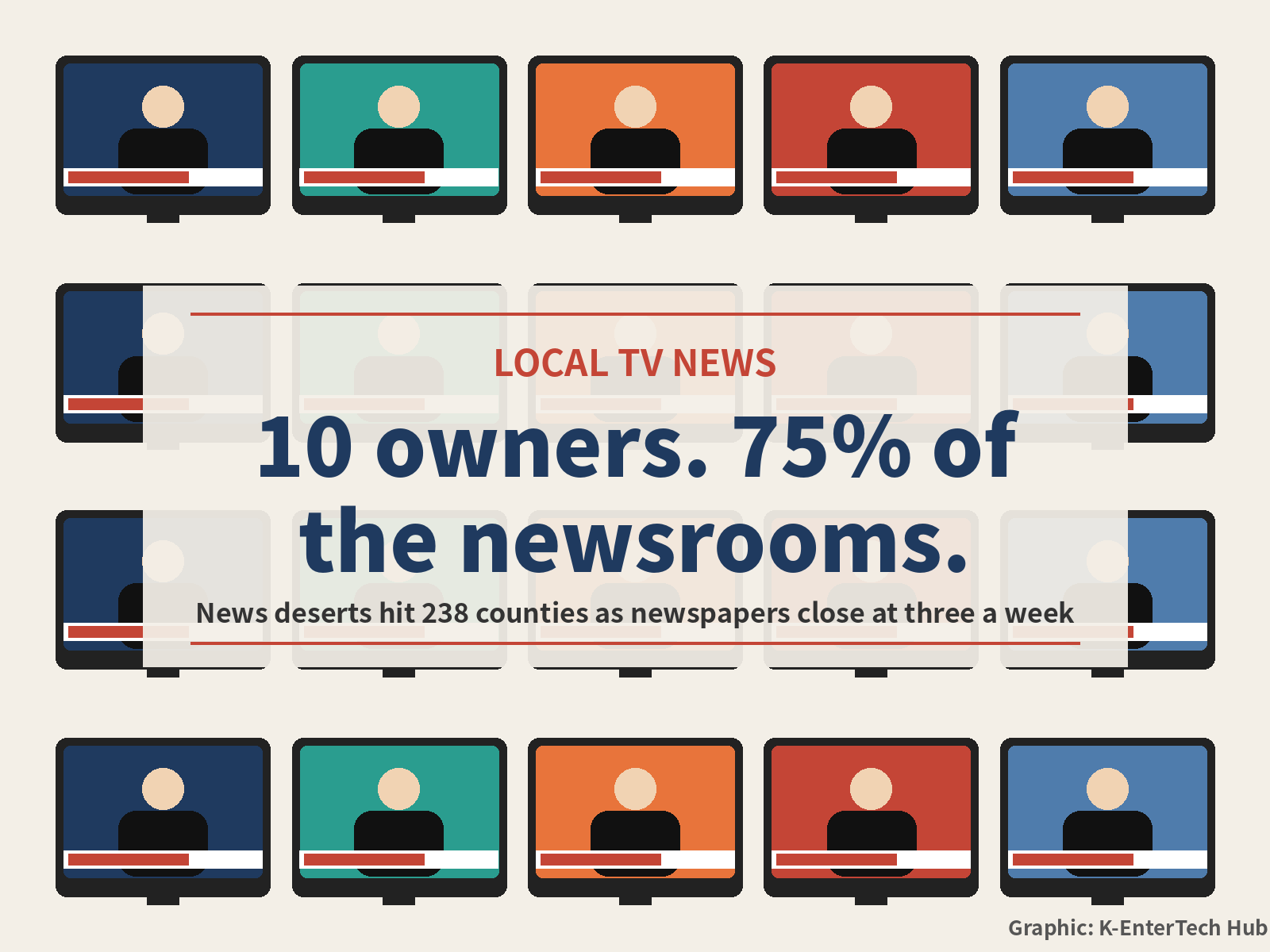
Graphic: K-EnterTech Hub, based on Medill figures
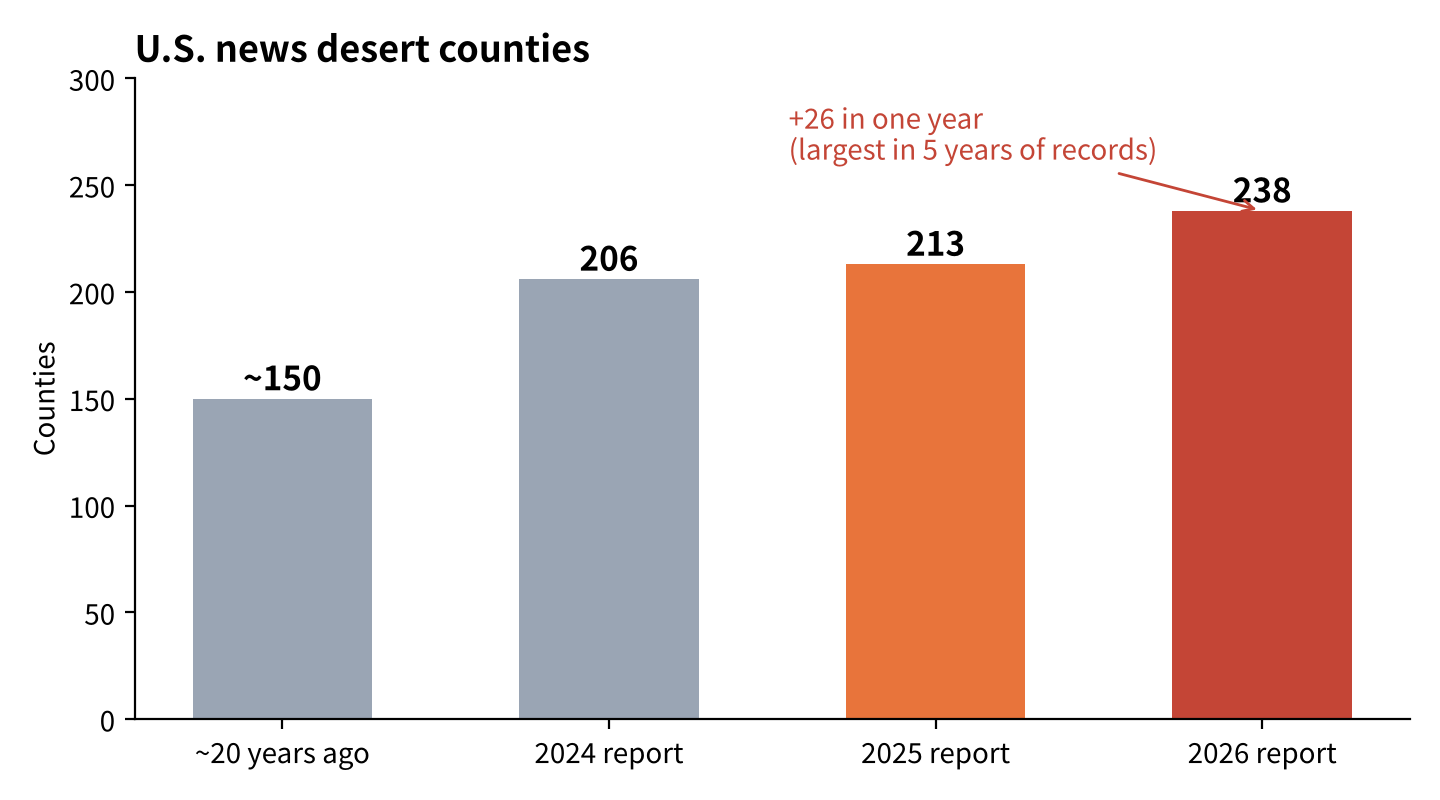
The number of U.S. counties with no locally based professional news source rose by 26 in the past year to 238, according to the State of Local News 2026 report released Oct. 13 by Northwestern University's Medill Local News Initiative. It was the largest one-year increase since Medill began keeping records five years ago, the school said.
Over the same period, 170 newspapers closed or merged, about three a week and most of them rural. More than 425 papers changed hands, up 75% from the year before. Digital traffic to the websites of 100 of the largest local newspapers fell 50% over four years, a decline Medill said coincided with growing consumer use of AI platforms.
For the first time, the report also took a census of local commercial television newsrooms. Of the 678 it counted, three-quarters belong to the 10 largest broadcasting chains, compared with less than a quarter of local newspapers held by the 10 biggest publishers. Because most TV newsrooms are in large and medium-sized markets, adding them did almost nothing to the news-desert count.
"In recent years, we've seen a steady erosion of the local newspaper industry, but that ballooned into a landslide this year," said Tim Franklin, the John M. Mutz Chair in Local News at Medill. "We've seen growth in local news startups, and that's great. But their numbers are not coming close to replacing what's being lost." On television, he told Axios: "We're seeing the economic disruption that hit newspapers a decade and a half ago now hitting local television in a big way."
238 news deserts, up from about 150 two decades ago
This is the fifth annual Medill survey, a months-long, county-by-county review covering local newspapers, digital-only sites and networks, ethnic media, local commercial TV newsrooms, public broadcasters and content creators. In all, researchers tracked nearly 8,400 professional news producers.
Twenty years ago, about 150 of the country's 3,144 counties were news deserts. Last year's report counted 213; this year's counts 238. Nearly 1,500 more counties have only one local source left. Together, that leaves 47 million Americans with limited or no access to local news.
Newspapers close at about three a week, mostly small owners
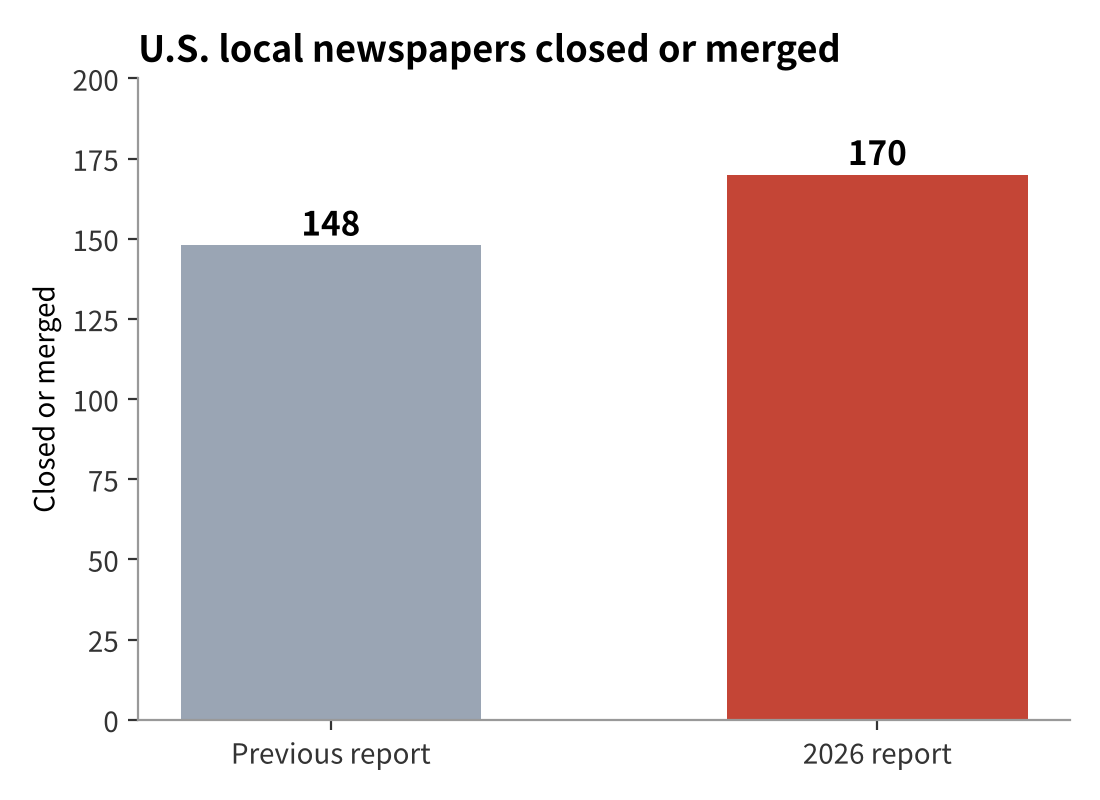
Source: Medill State of Local News (2025, 2026), Axios
The 170 closures and mergers compare with 148 in the previous report, an increase of about 15%. Newspaper employment fell 8%, or more than 7,500 jobs, and nearly 80% of newspaper jobs have disappeared since 2005. Newsprint costs are up about 18% nationally, roughly five times inflation, Axios reported.
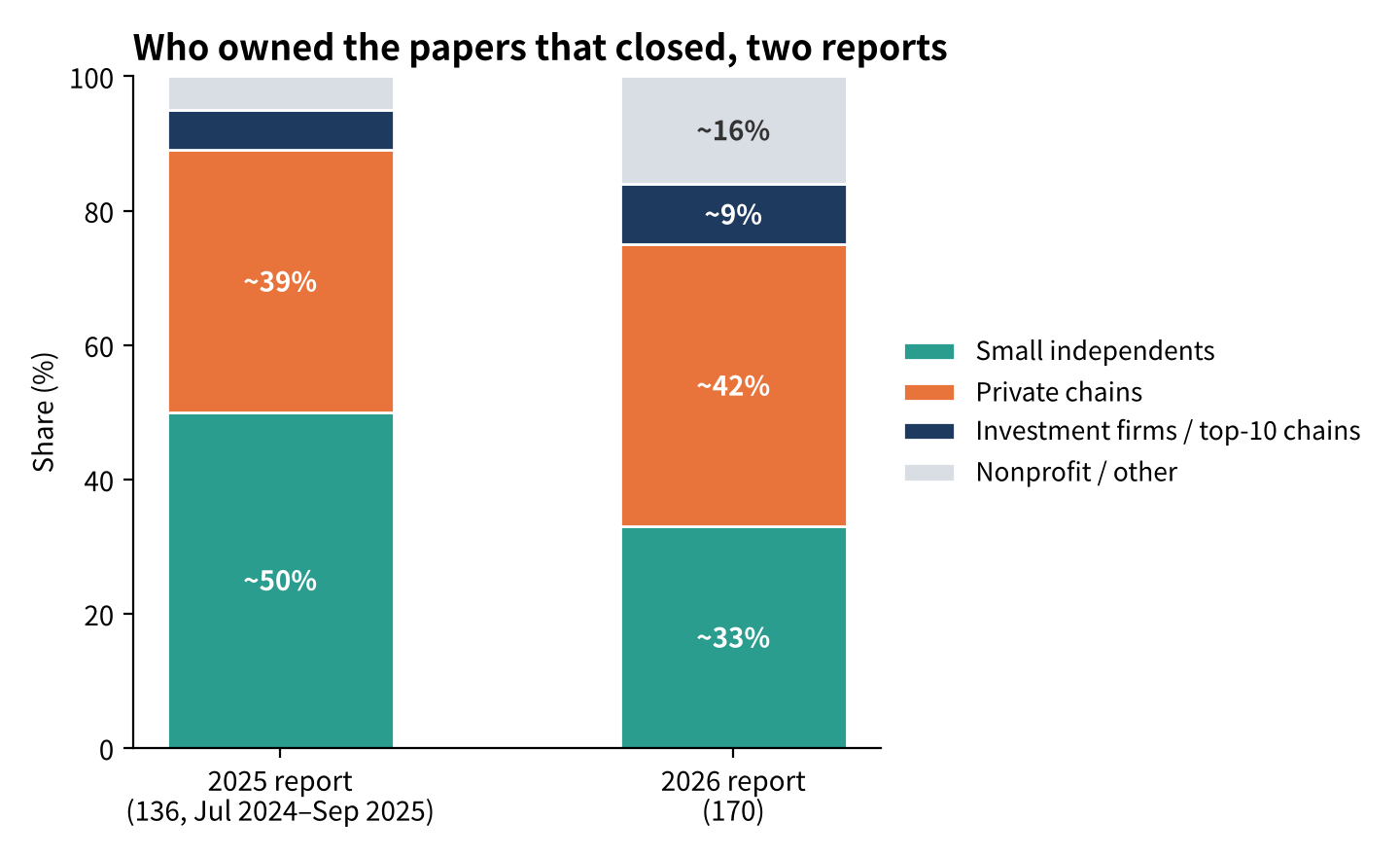
The two reports group owners differently; categories combined. 2026 shares drawn from Medill's "under 10%", "more than 40%" and "roughly one-third". Source: Medill, Axios
Last October, Axios reported on 136 closures and mergers between July 2024 and September 2025. Half of them (68) came from independents owning five or fewer papers, and only eight from investment firms. This year, the 10 largest chains accounted for under 10% of closures. Midsize private chains accounted for more than 40%, and small independents for roughly a third.
Zach Metzger, director of the State of Local News Project, told Poynter the finding cuts against two decades of attributing news deserts mainly to investor-led mega-mergers. "They're the most passionate about their publications, and even those folks are beginning to throw up their hands," Franklin told Axios last year of the independent owners.
Web traffic to big local papers down 50% as AI use grows
Medill's analysis of the websites of 100 of the largest local newspapers found traffic down by half in four years, over the same period in which consumers turned increasingly to AI platforms. When a search that used to end on a news site ends in an AI answer instead, the visits that fed digital advertising and subscription sign-ups go with it.
678 TV newsrooms counted: Gray 124, Nexstar 107, Sinclair 70
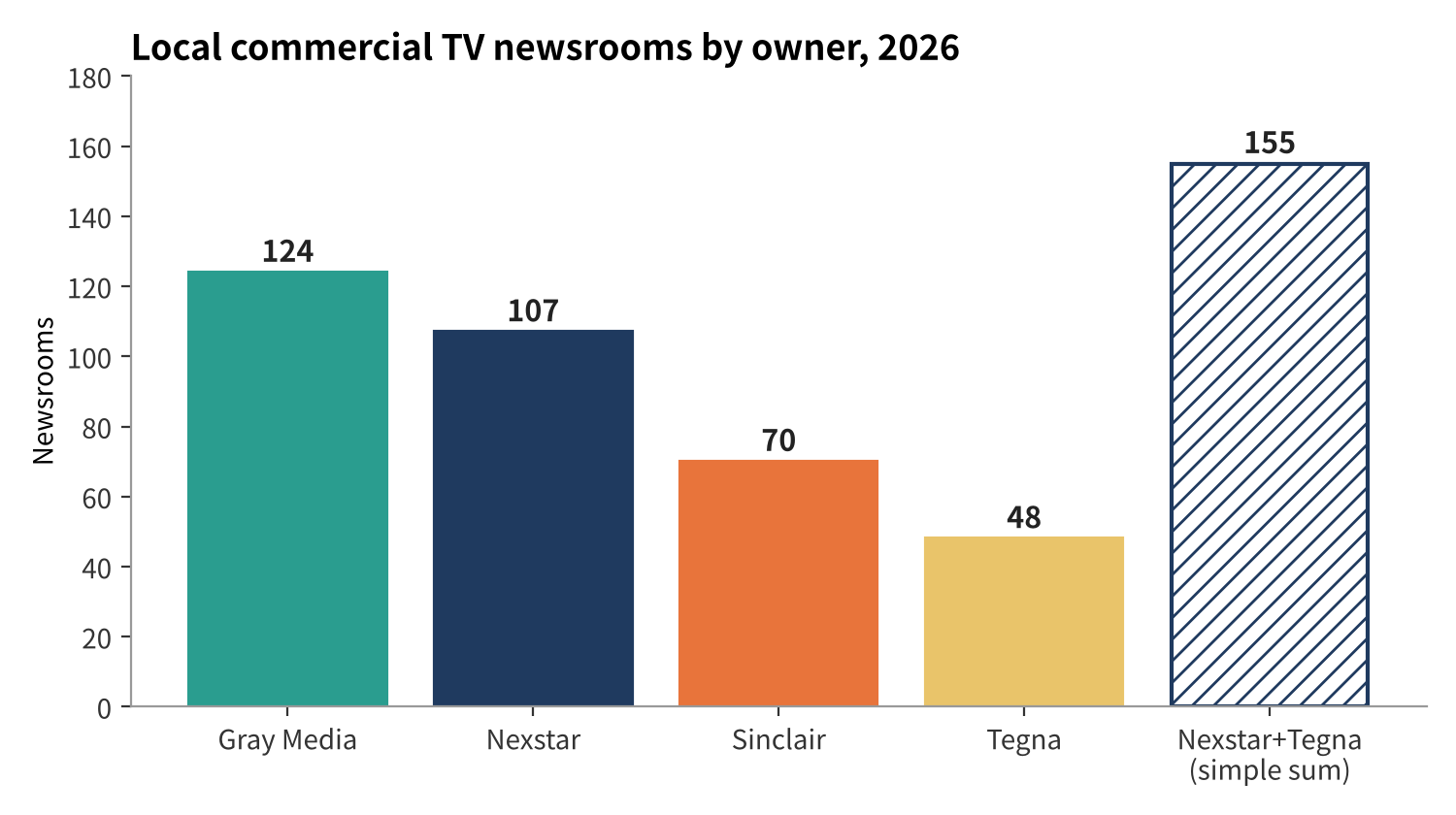
Medill counted editorial operations rather than licensed stations, so a newsroom feeding several channels is counted once. Axios' Sara Fischer broke the total down by owner on Oct. 14: Gray Media with 124 newsrooms, Nexstar with 107 and Sinclair with 70. The report finds the five largest owners control more than half of all newsrooms and the 10 largest control 75%. New York has the most newsrooms of any market, nine, followed by Boston, Houston, Philadelphia and San Francisco with eight each.
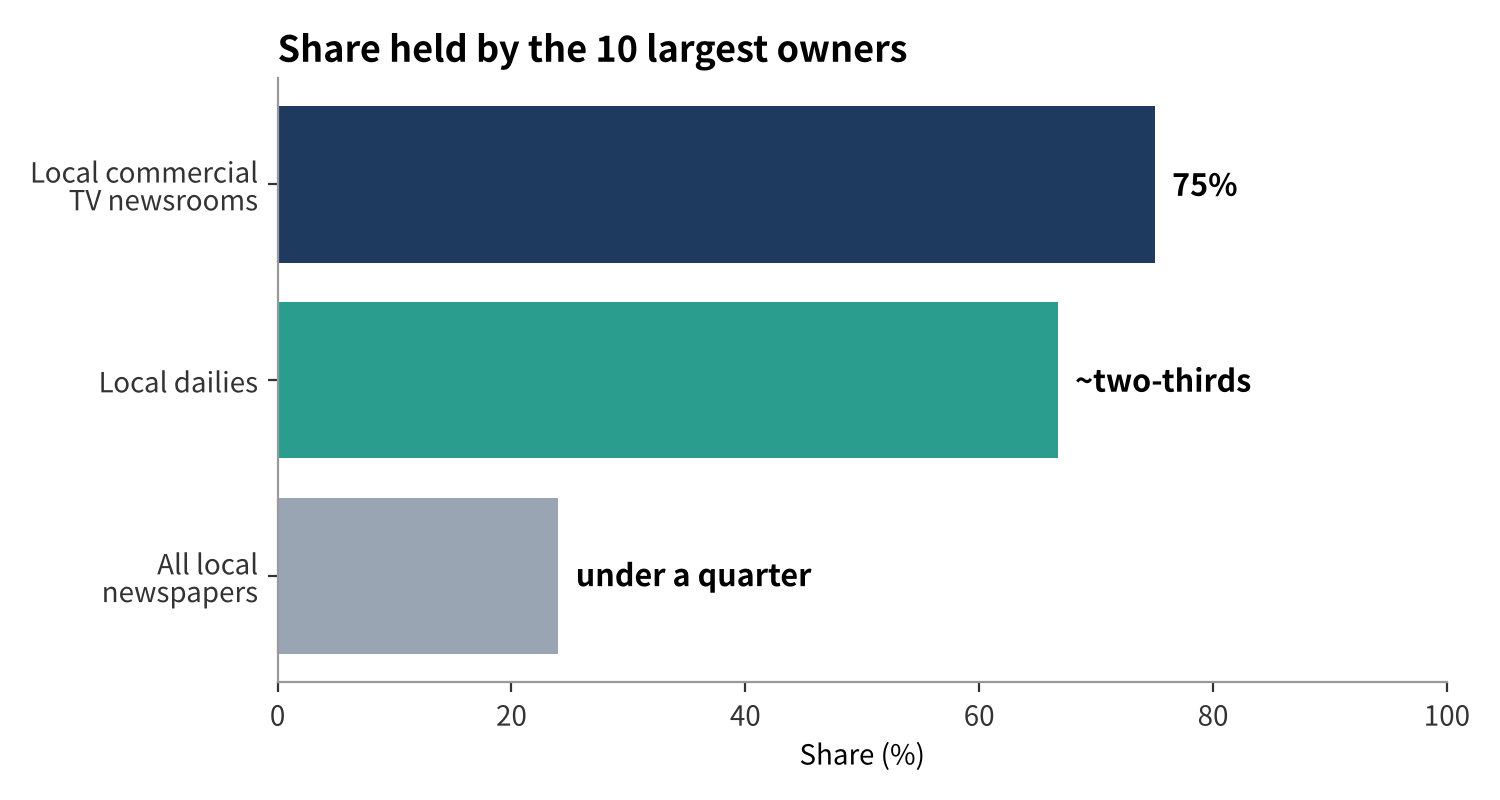
Newspapers, weeklies included, are spread across thousands of owners. TV stations change hands as licensed signals with network affiliations, and one group can run stations in dozens of markets. The market leader kept buying this year. Gray's second-quarter investor deck shows it bought stations in seven markets from Allen Media Group, among others, and completed a cash-free swap with Scripps on May 15. Outside the Nexstar-Tegna headlines, Medill counted at least 10 local TV newsrooms lost to other mergers this year.
"This is an election year, which helps mitigate some of the other revenue losses. But things are getting tight financially in the local TV news business, and that's contributing mightily to consolidation in the industry," Franklin told Axios. Metzger said the FCC's decision to waive the broadcast ownership cap, combined with that economic pressure, could set off a new wave of consolidation.
Nexstar's $6.2bn Tegna deal: FCC waiver, then a court freeze
Nexstar agreed in August 2025 to buy Tegna for $6.2 billion including debt. On March 19, 2026, the FCC's Media Bureau approved the deal and waived the rule barring any owner from reaching more than 39% of U.S. TV households. Bloomberg reported that Nexstar had said the combined company would reach 80% of TV households across 44 states; the FCC required six station sales. Nexstar closed the same day. The two are the second- and fourth-largest owners of local TV newsrooms, and 33 of Tegna's 48 newsrooms overlap with Nexstar operations.
Nexstar agreed to pay $22 a share in cash for all of Tegna's stock, Axios reported on Aug. 19, 2025, with the $6.2 billion value including Tegna's net debt and transaction costs. The price was a 31% premium to Tegna's 30-day average through Aug. 8; the shares had closed at $20.18 the day before. Tegna's board approved unanimously. Barring forced divestitures, the combined company would run 265 stations in 132 of the country's 210 TV markets.
By stations and household reach, as measured by BIA Advisory Services, Nexstar is the largest local broadcaster, Sinclair third and Tegna fourth. Counted by newsrooms, as Medill did, Gray moves to the top, because many Nexstar stations share an editorial operation.
Axios framed the deal as a test of the Trump-era FCC. Chair Brendan Carr had long argued for repealing local broadcast ownership rules; the Biden administration had killed Tegna's $5.4 billion combination with Standard General in 2023. A week before the announcement, Sinclair opened a strategic review of its broadcast business, 178 stations in 81 markets, and reports the night before said Sinclair was interested in merging with Tegna, which Axios suggested may have hastened the Nexstar announcement.
FCC rules cap any owner's reach at 39% of U.S. households and bar owning more than one of the top four stations in a single market. The FCC waived the national cap in March; Deadline reported it also allowed Nexstar to own more than two stations in a market.
Eight state attorneys general, led by California and New York, and satellite operator DirecTV sued on the eve of the approval. On April 17, Chief Judge Troy Nunley of the Eastern District of California issued a preliminary injunction. NPR reported his finding that "integration efforts are exactly those that would make it more difficult to divest TEGNA stations, as they will eliminate competition and result in newsroom layoffs and shutdowns." According to The Desk, the order bars Nexstar from folding Tegna's stations into its own operations and from laying off workers while the case proceeds.
On appeal, Nexstar has asked for a narrower order rather than its removal. The Desk reported that its May brief sought to limit the injunction to markets where both companies own Big Four network affiliates. When the approval came, Nexstar chief executive Perry Sook said, "We are grateful to President Trump, Chairman Carr and the DOJ" (Deadline). Anna Gomez, the FCC's lone Democrat, objected that the deal was approved without a full commission vote.
Same script, two channels: duplication in 39% of markets in 2019
University of Delaware researchers Danilo Yanich and Benjamin Bagozzi compared three months of newscast transcripts from 861 stations in fall 2019 (report). Station pairs sharing at least half their news content, excluding sports, weather and ads, turned up in 84 of 210 markets, or 39%. Those markets held about 41 million TV households, 37% of the national total. Nexstar controlled the most duplicating pairs (22%), followed by Gray (17%), News-Press & Gazette (8%) and Sinclair (6%). Stations tied by service agreements duplicated at twice the rate of stations that were merely co-owned, the university said.
On Medill's podcast, researchers described a market home to one of the country's largest public universities. Sinclair-owned WGFL laid off its local news staff there and switched to a nationally syndicated newscast, leaving a single commercial TV newsroom. Local coverage can shrink while the number of stations stays the same.
Public radio spared for now; 75 startups; 7% of creators cover local issues
A wipeout of local public radio after last year's federal defunding of public broadcasting has been averted for now, Medill said, largely because of a surge in donations and money from philanthropies such as the Knight Foundation. Seventy-five local news startups opened in the past year, most of them digital-only, and nearly 300 in five years. The overwhelming majority are in urban and more affluent areas.
Of 1,500 creators Medill reviewed across platforms, only about 7% cover local issues in their communities, and fewer still do original reporting.
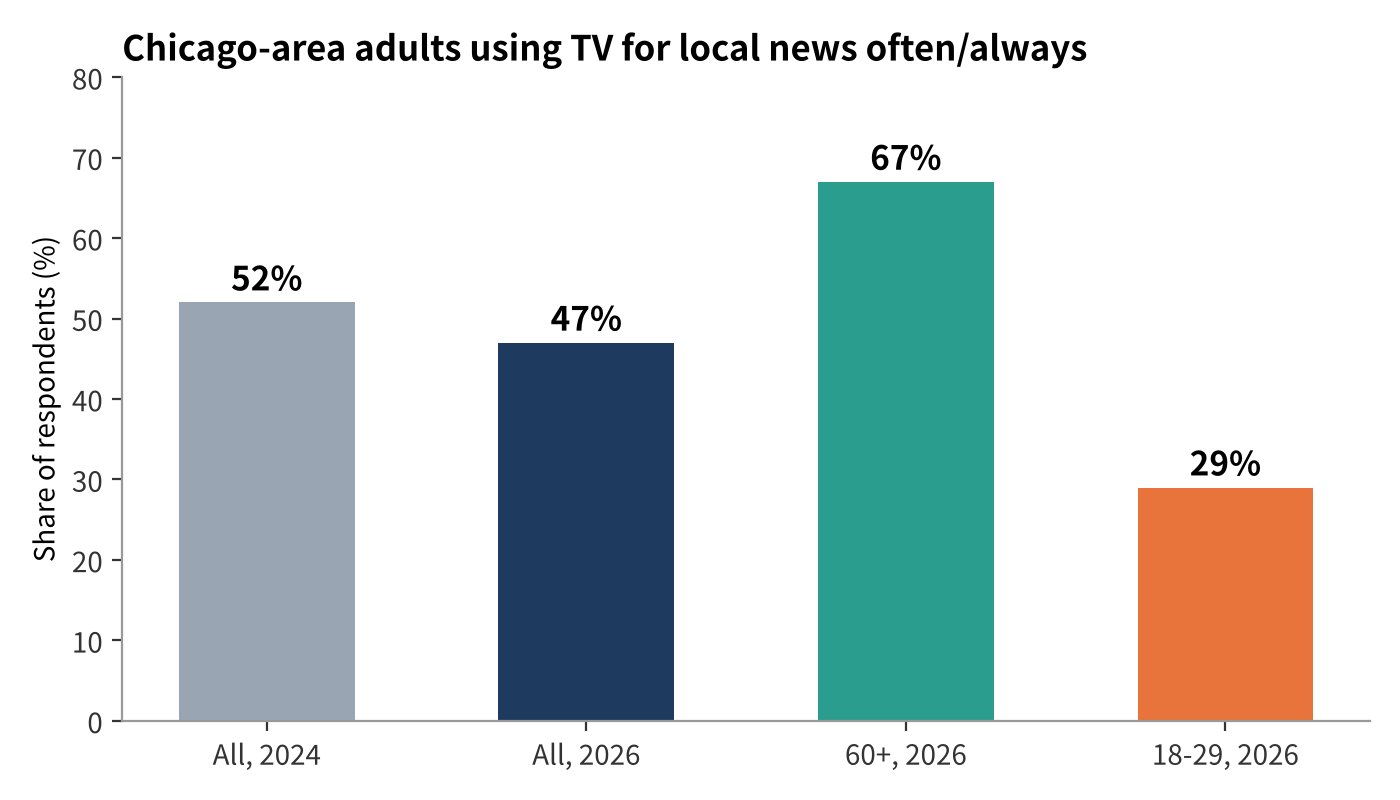
In a Medill survey of 1,223 Chicago-area adults, the share using TV for local news often or all the time fell from 52% in 2024 to 47% in 2026, NewscastStudio reported: 67% among those 60 and older, 29% among 18-to-29-year-olds. Forty-four percent of the younger group get local news daily from content creators.
Korea: local broadcasters' ad revenue down ₩122bn in four years
At the National Assembly's audit of the Korea Communications and Media Commission (방송미디어통신위원회) on Oct. 12, Rep. Lee Yeon-hee (이연희) of the Democratic Party said ad revenue at regional and small broadcasters fell ₩122.2 billion (about $83 million), or 40.3%, over four years. She cited a shrinking ad market, the shift of spending to digital and weak local economies (Digital Daily, Gangwon Shinmun).
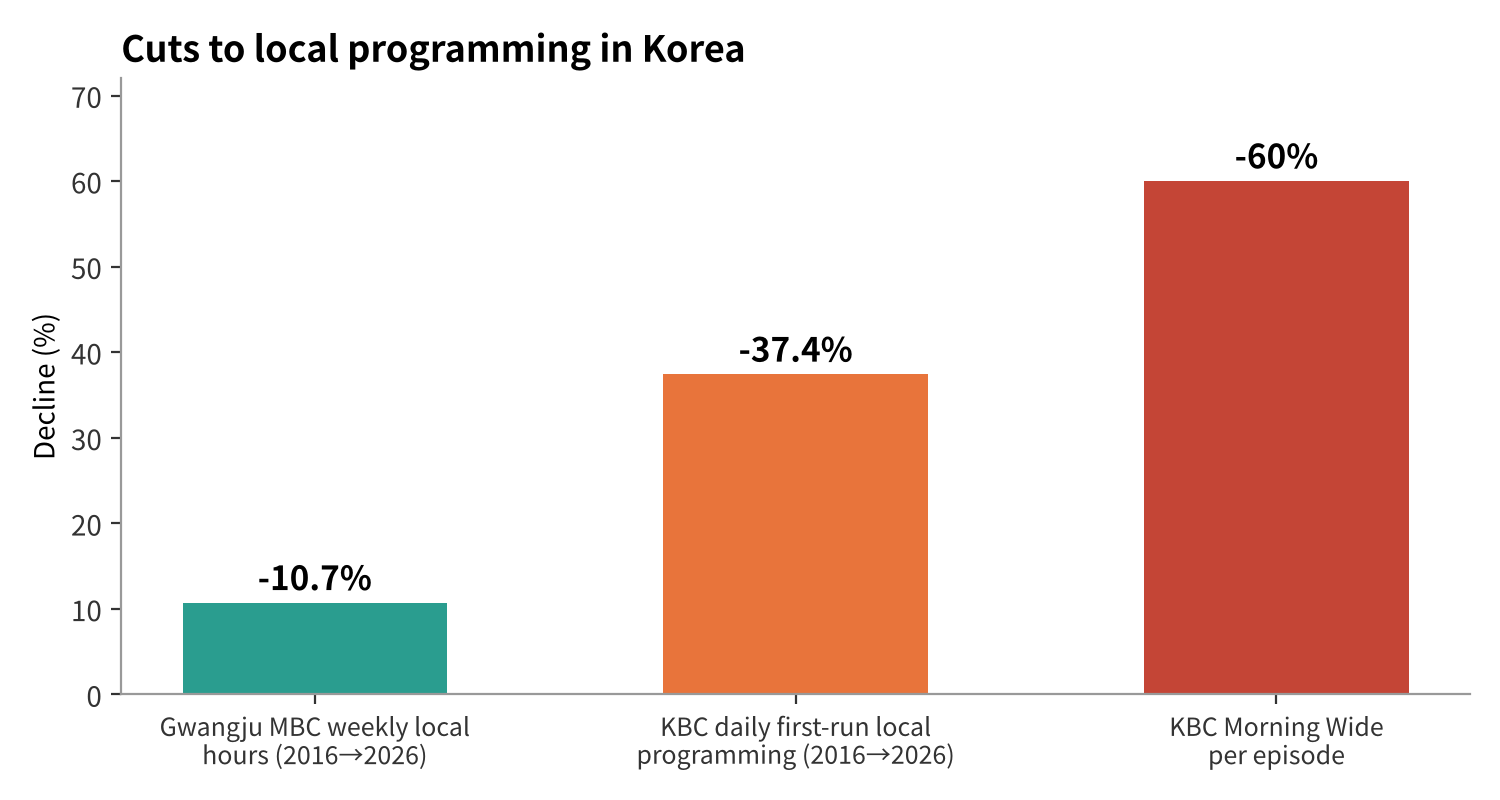
Korea's regional terrestrial broadcasters operate under a licensing and relicensing regime in which mergers between operators are rare, so falling revenue shows up first as cuts to the schedule rather than as consolidation. Rep. Lee Hoon-ki (이훈기), analyzing commission data, said Gwangju MBC's weekly local programming fell 10.7% between 2016 and 2026, from 1,455 to 1,300 minutes, with non-news program types down from 15 to 11. Kwangju Broadcasting (KBC) cut daily first-run in-house programming 37.4%, from 198.5 to 124.3 minutes, and trimmed its morning local newscast from 50 minutes to 20 (iNews24). Kim Yeon-sik (김연식), a journalism professor at Kyungpook National University, has said terrestrial broadcasters are sharply reducing individual local news as they regionalize operations (Aju Business Daily).
Korea has consolidation precedents. The former Korean Broadcasting Commission recommended regional MBC mergers in 2004 and 2007, and Jinju MBC and Masan MBC were combined into MBC Gyeongnam (MBC경남). In 2015 MBC called regionalization a matter of survival for its affiliates, on condition that multiple local studios be kept; the union opposed it as workforce restructuring (Edaily, Apr. 26, 2015). The U.S. allowed consolidation through a federal waiver and then saw it frozen in court; in Korea, regionalization has moved slowly amid labor-management disagreement while schedules have shrunk.
Korea's broadcast ad spend seen down 13.8% in 2025; online at 59%
Korea's 2025 advertising spend survey, released Jan. 8 by the Korea Communications and Media Commission and KOBACO, put total 2024 ad spending at ₩17.13 trillion (about $11.6 billion), up 3.5%. Broadcast advertising fell 5% to ₩3.22 trillion, an 18.8% share. Terrestrial broadcasters' ad revenue fell 7.2%, from ₩1.33 trillion to ₩1.23 trillion. Online advertising rose 7.9% to ₩10.1 trillion, 59% of the total (Journalists Association of Korea, PD Journal). Estimates for 2025 show broadcast down 13.8% to ₩2.77 trillion and online up 6.1% to ₩10.72 trillion, cutting broadcast's share to 16.1%.
U.S. local stations cushion advertising with retransmission fees from pay-TV distributors, and that leverage is what DirecTV challenged in the Nexstar-Tegna case: according to NPR, the plaintiffs argued Nexstar could use the added stations as bargaining power. In Korea, the revenue loss at regional and small broadcasters surfaced at the audit as an advertising figure: the 40.3% four-year decline Rep. Lee Yeon-hee cited.
Google AI summaries cut news clicks from 2.3bn to 1.7bn; Korean outlets share the route
The Korea Press Foundation's 2026 Overseas Media Trends report found that after Google began showing AI Overviews above search results, traffic to top news sites fell by as much as 79% (Newspim, Apr. 8). The "zero-click" rate, where users read the summary and never visit a site, rose from 56% in May 2024 to 69% a year later, and clicks to news sites fell from 2.3 billion to 1.7 billion. That runs in the same direction and period as the 50% traffic drop Medill measured at large U.S. local papers. Korean regional papers and broadcasters hoping to offset print and broadcast losses online depend on the same search-and-portal route.
Nexstar-Tegna in 132 markets, Gray 117, Sinclair 81: fewer U.S. doors for Korean content
For Korean companies trying to supply programs or channels to U.S. local broadcasters, concentration means fewer counterparties. If the Nexstar-Tegna merger proceeds, one company will run 265 stations in 132 markets; Gray operates in 117 markets and Sinclair has 178 stations in 81 markets. Where programming is set at group level, a few group contracts can open many markets at once, and a stalled negotiation with one group can close dozens together. The group-level news sharing the Delaware study documented is also a route by which content scheduled once goes out on many stations.
A depleted fund, and a case for funding news output, not stations
Lee Hoon-ki said deposits in the Broadcasting and Communications Development Fund fell from ₩180 billion in 2021 to ₩27.9 billion in 2025, with accumulated borrowing near ₩1.8 trillion (The300). Rep. Seo Cheon-ho (서천호) of the People Power Party noted that Korea's 86 cable operators carry local news and disaster broadcasts yet pay a 1.5% levy, against about 0.5% for regional MBC affiliates and private regional broadcasters, and have no legal basis for support. Commission chair Kim Jong-cheol (김종철) said regional broadcasting sustains democratic public debate and needs public support, adding that support for reporting and investigative work, and a media voucher, are under review.
Medill's method, counting newsrooms rather than stations and news sources county by county rather than outlets nationally, is relevant to how Korea designs that support. Where one newsroom fills several channels, the number of broadcasters can hold steady while local reporting shrinks, and the Delaware study found duplication tracked contractual ties more than ownership. Tying support to production measures, such as hours of in-house local news and reporting staff, would make losses from regionalization or reliance on network programming visible in the data. U.S. public radio replaced lost federal money with donations and foundation grants; whether Korean regional broadcasters have any comparable private route is a question the funding debate has yet to take up.
The commission's 2027 budget proposal of ₩297.7 billion, up 13.2%, increases production support for regional and small broadcasters and adds vouchers for AI production tools and support for AI-made short-form content (MTN). An audiovisual media services bill introduced in June by Rep. Choi Min-hee (최민희) defines public broadcasting in a way that covers Seoul MBC but leaves out its 16 regional affiliates, a Kyunghyang Shinmun columnist noted. The same column praised "Korea's Dulle-gil" (한국의 둘레길), a documentary eight regional MBC stations co-produced under a shared format while each reported on its own region, gaining scale without merging newsrooms. With young Americans getting local news from creators, short-form support is likely to work only if distribution is planned alongside production.
Outlook: the Ninth Circuit, and a non-election 2027
If the Ninth Circuit narrows the injunction, Nexstar could begin integrating Tegna where the two do not overlap; if the appeal fails, TV Technology reported, integration could wait until a jury trial in 2027. Either way, the FCC's waiver of the 39% cap stands as a reference point for the next deal.
The election-year cushion Franklin described applies to this midterm year and disappears next year, while newspapers face closures and falling digital traffic at once. "The industry of local news has changed so much in so short a time, and this is forcing everyone — publishers, funders, consumers and lawmakers — to develop new strategies for sustainability," Metzger said. This year's 75% top-10 share, from Medill's first TV census, becomes the baseline against which next year's report will measure what consolidation removes.
In Korea, the audit gives way to the 2027 budget debate and a wider review of media funding, and the Fourth Regional Broadcasting Development Plan, covering 2024 to 2026, expires this year and needs a successor. The open question is whether regional broadcasting support stays tied to broadcasters or shifts to the volume of local news produced.