
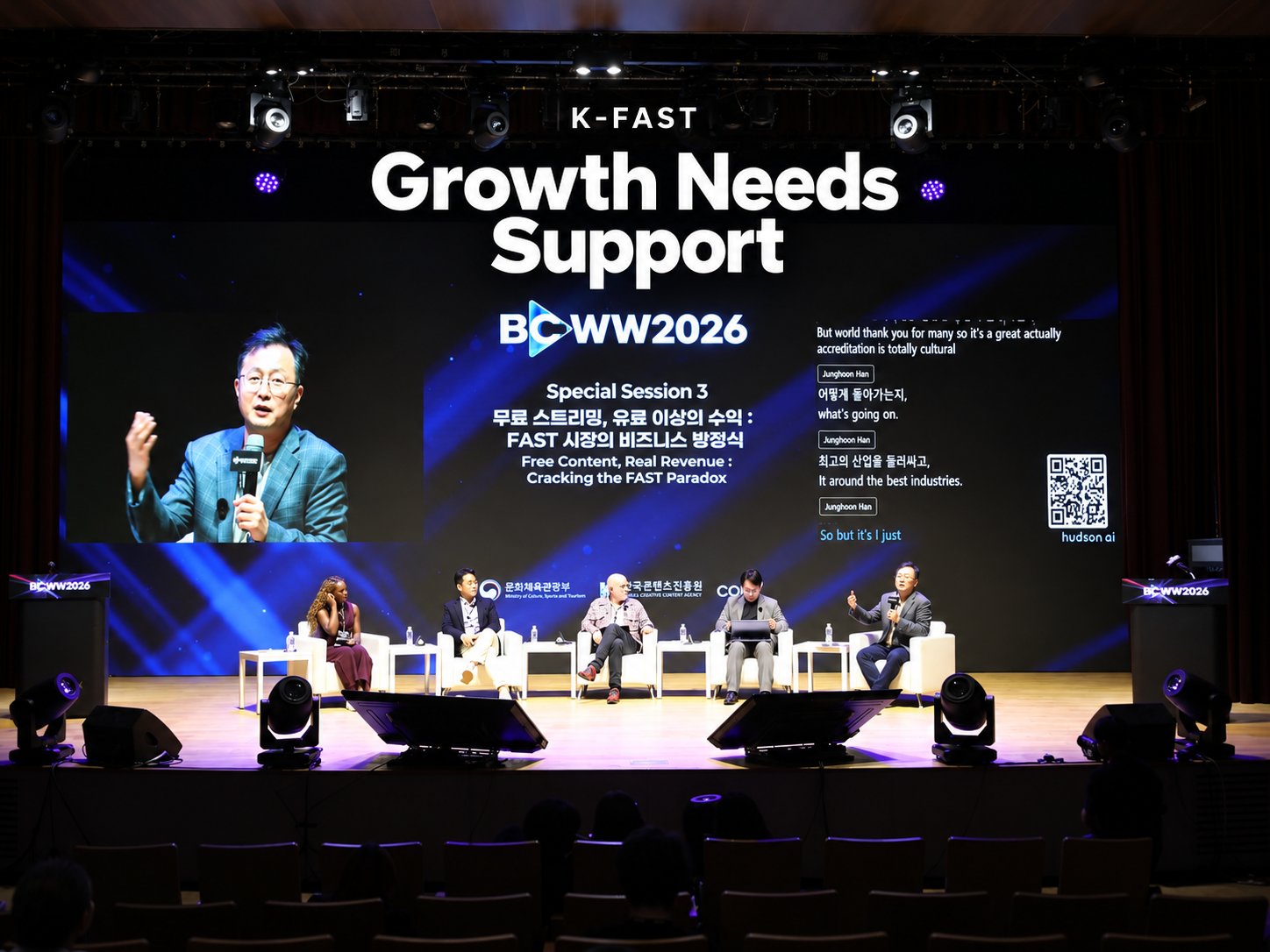
K-FAST | Global Distribution
20 AI-dubbed channels reach 100 million cumulative viewers in 22 countries… Europe wants local-language versions, North America wants ad sales… Government channel support falls from KRW 8 billion to about KRW 920 million
Cannes and Los Angeles
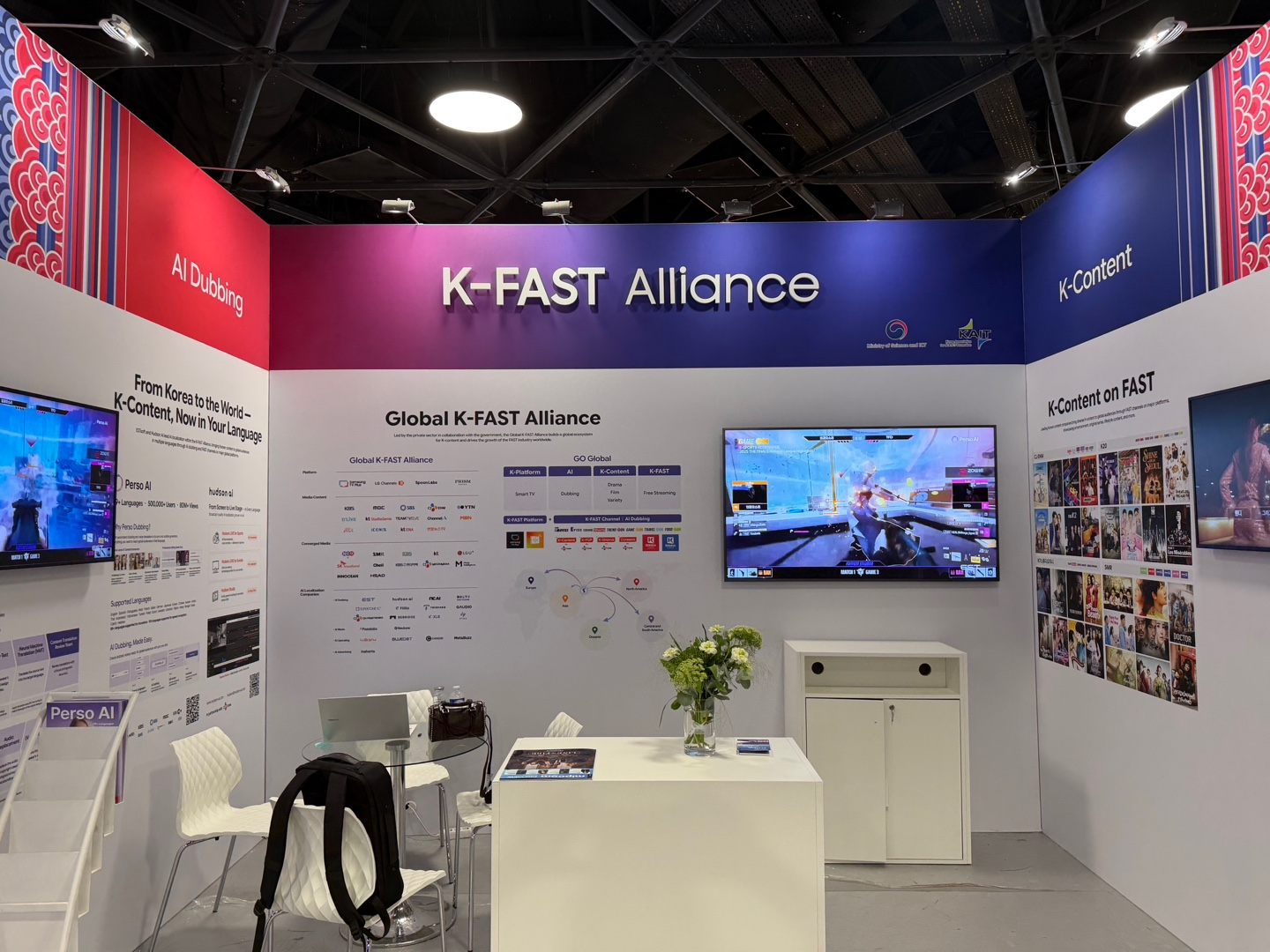
Within a month, Korea's FAST industry made back-to-back trips to North America and Europe. At MIPCOM 2026, the international TV and content market that opened in Cannes, France, on Oct. 12, the Global K-FAST Alliance set up a booth and AI dubbing company Hudson AI held a showcase with live interpretation. The day before the opening, K-EnterTech Hub hosted a roundtable with European distribution experts on what it takes for Korean content to enter Europe. Earlier, on Sept. 28, Smart Media Rep (SMR), CJ ENM, K20 and KT Studio Genie held "2026 K-FAST NIGHT in LA" in Los Angeles to meet North American advertisers.
The results show in the numbers. Twenty AI-dubbed channels supported by the Ministry of Science and ICT (MSIT) and the Korea Association for ICT Promotion (KAIT) have been airing since November 2025 on Samsung TV Plus and LG Channels in 22 countries, including the United States, Canada and Mexico. By the end of April they had about 100 million cumulative viewers, according to a Newsis report on the government's July results briefing. Alliance membership grew from 22 to 82 companies in just over a year.
Private channels are moving even faster. FAST channel operator NEW ID said in its October newsletter that cumulative viewing time had passed 840 million hours and that annual viewing time would grow 15-fold, from 20.1 million hours in 2021 to about 300 million hours this year. Free ad-supported streaming TV (FAST) offers scheduled channels funded by ads rather than subscriptions, making it an easy entry point for first-time viewers of Korean content. Korean-made smart TVs around the world give it a solid base.
Support, however, is moving the other way. The 20 channels were built with KRW 8 billion from the 2025 supplementary budget, but the program was dropped entirely from the 2026 government budget proposal. MSIT requested it as a continuing program, but the fiscal authorities saw it as a new program that needed a preliminary eligibility review, Newsis reported from last October's parliamentary audit. The support disclosed this year covers four flagship channels, about KRW 920 million in government grants, roughly one-ninth of last year.
The MSIT 2027 budget briefing released on Aug. 31 has no separate item for FAST or AI dubbing support. Because the programs differ in scope, it cannot be said that the entire FAST-related budget has fallen, but visible support has shrunk sharply just when local sales and language expansion are needed. Meanwhile, the concentration on Netflix is deepening. With broadcasters cutting schedules and production, dependence on global streamers keeps growing in a vicious cycle, Maekyung Economy noted, and Korean producers are relying on Netflix even more, Edaily reported. FAST, which lets broadcasters reach overseas viewers directly through their own channels, is one of the few routes that can ease that concentration. That is why the industry says support is urgent.
The homework from Cannes and LA is clear. The Europeans at MIPCOM wanted local-language versions country by country, but K-FAST channels are dubbed in only three languages, English, Spanish and Portuguese, tailored to the Americas. The LA event put ad agencies and brand managers at the center of its guest list. “Demand for K-content in the North American FAST market has been confirmed, but touchpoints that turn it into business opportunities are still lacking,” an SMR official said. “We hope an event that brings platform and advertising people together will lead to real business discussions.” SMR said North America accounts for more than 80% of the global FAST market, ZDNet Korea reported.
Language expansion and an ad-sales base are both only just getting started. If support is cut now, just as results begin to appear, it will be hard even to take the first step.
K-FAST Alliance booth at MIPCOM… AI dubbing and FAST channels on the same walls
The K-FAST Alliance booth on the MIPCOM floor gave each of its three walls a different theme. The center wall carried member logos and the line "The private sector leads and the government cooperates to build a global ecosystem for K-content." The left wall, labeled "AI Dubbing," featured ESTsoft's Perso AI and Hudson AI explaining their localization workflow under the slogan "From Korea to the World — K-Content, Now in Your Language." The right wall was filled with posters of Korean content distributed on FAST. Korean companies were active beyond the booth as well. CJ ENM, a co-host of the LA event, gave the AI keynote on MIPCOM's main stage on opening day, and its subsidiary TVING signed a simulcast deal for new titles with the Middle East's MBC Group.
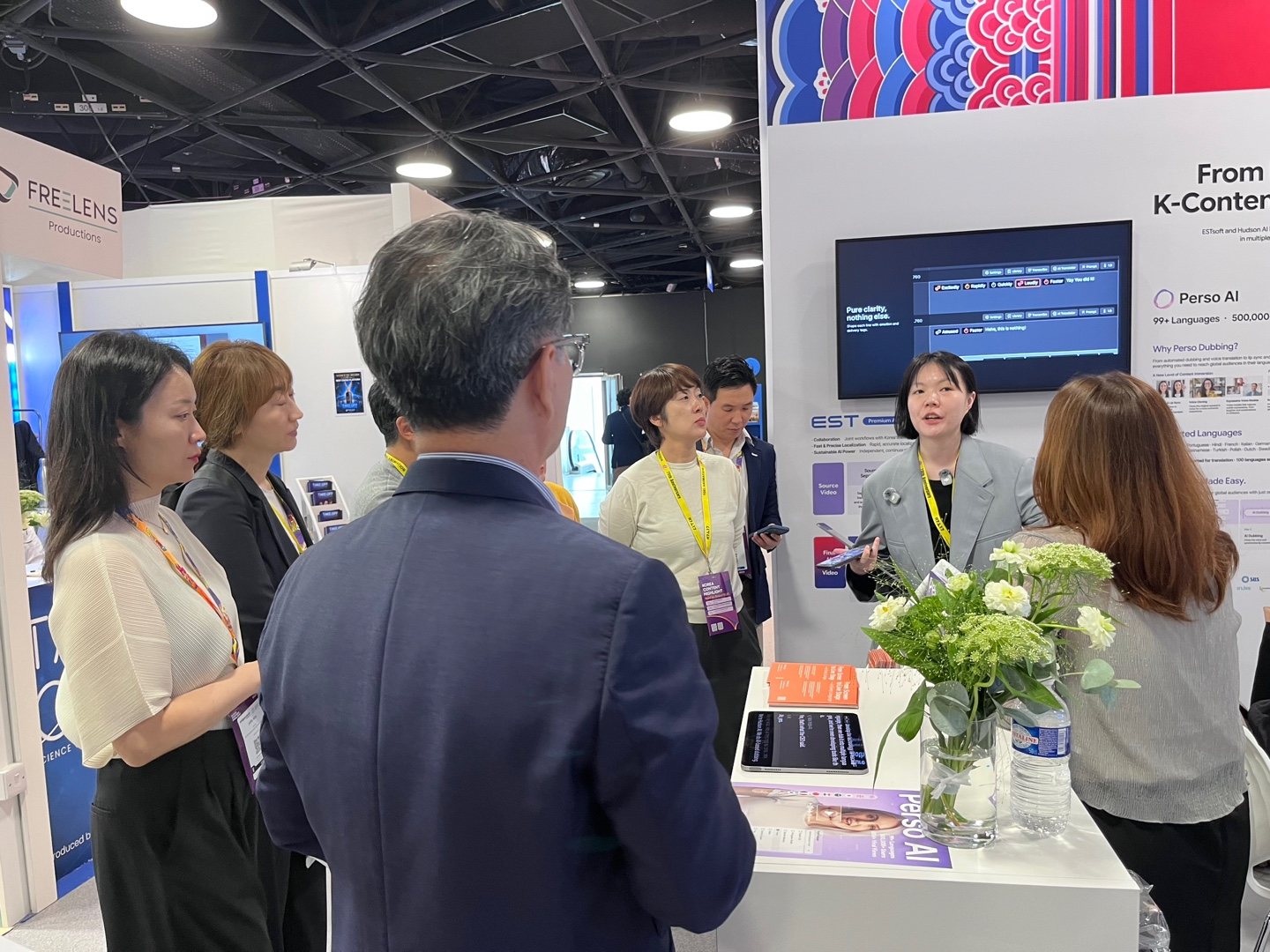
A CEO, Hudson AI Hyunjin Shin(Second to right) explains an AI dubbing workflow to visitors at the K-FAST Alliance booth during MIPCOM. Photo: Hudson AI
Visitors watched a dubbing editor in which the voice delivery of each line can be adjusted. The screen displayed tags that set emotion and speaking style. The feature ties directly to what Shin Hyun-jin, CEO of Hudson AI, demonstrated at the roundtable the day before the opening. The booth's message did not end with a content catalog. How quickly and consistently content can be supplied in the language a buyer wants has become part of the distribution pitch.
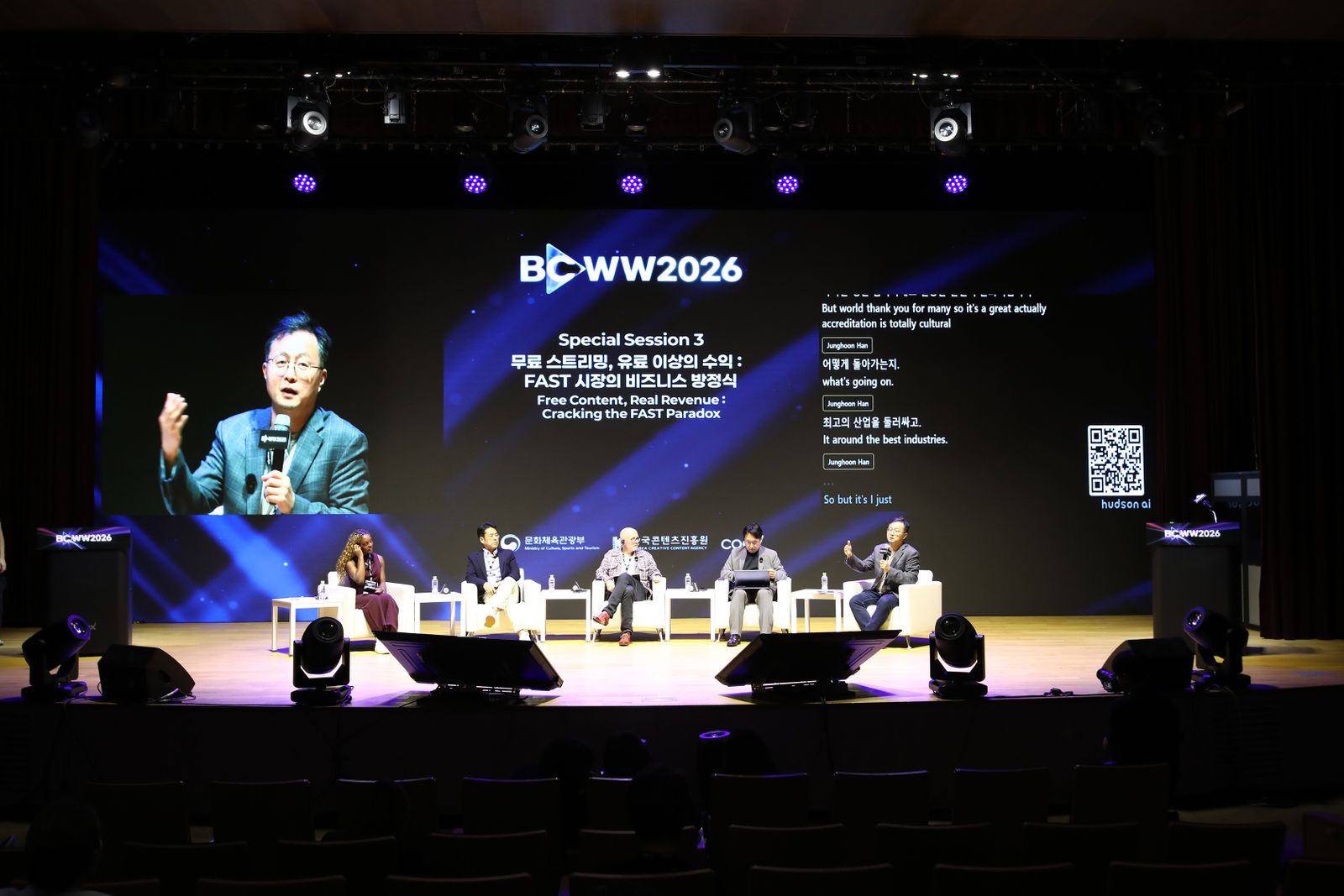
The distribution discussion had begun a day earlier, on Oct. 11, at the K-EnterTech Hub roundtable at the Palais des Festivals in Cannes. Karina Rompa, head of Media Hansa and formerly of Rakuten TV, said FAST, with no subscription fee, can be a gateway for European viewers discovering Korean content for the first time. To supply local broadcasters and telcos, however, content must fit each country's language and distribution structure. The market is growing too. According to a 3Vision forecast, FAST revenue in Western Europe will rise 76%, from $1.9 billion (about KRW 2.54 trillion) in 2026 to $3.4 billion (about KRW 4.546 trillion) in 2031.
Hudson AI: "You don't need more content, you need more languages"… AI dubs double watch time and triple click-through
Hudson AI's MIPCOM showcase deck opens with audience participation: scan the QR code on screen, choose a language and listen. Each attendee heard the presenter in their own language in real time. The first line, the same one CEO Shin used at the roundtable, read: "You don't need more content. You need more languages." It was followed by: "Content was never the limit. Language was."
The company offered three figures as evidence. AI-dubbed versions drew twice the watch time of subtitled versions, AI-localized thumbnails and titles tripled click-through rates, and total watch time across the catalog rose 180-fold. The deck cited tvN dramas "THE K2" and "Tale of the Nine Tailed" as cases. The deck does not say over what period or on which platforms the figures were measured.
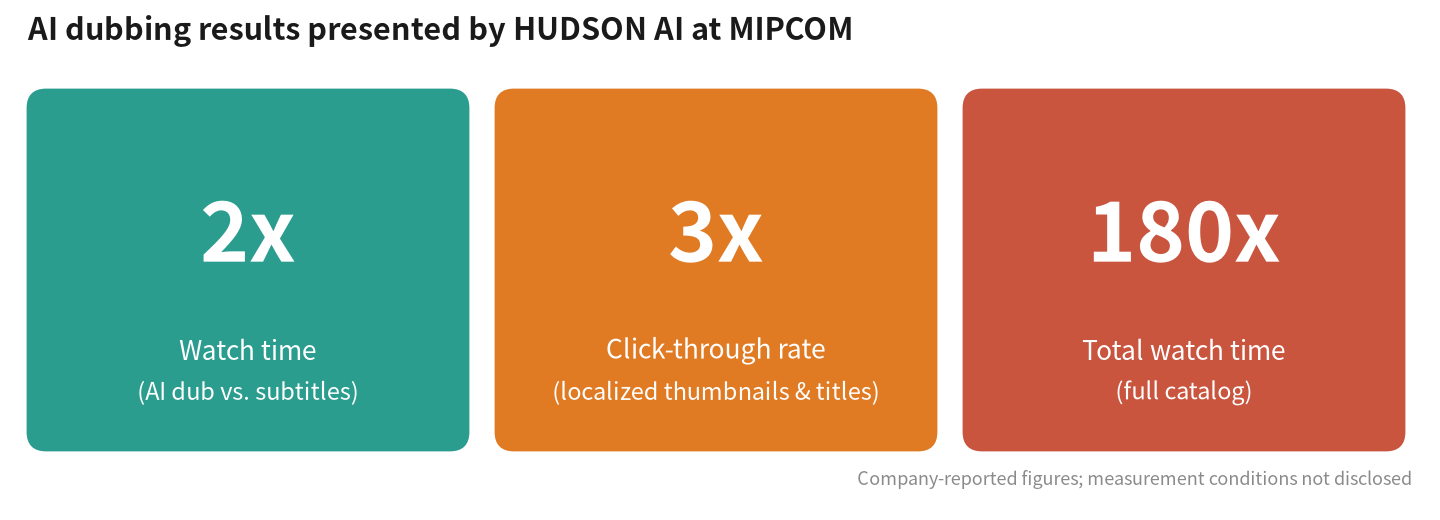
AI dubbing results presented in Hudson AI's MIPCOM showcase deck. Company-reported figures; measurement conditions were not disclosed. Source: Hudson AI
Hudson AI's next target is live broadcasting. The deck describes sports, news and live entertainment as "the most-watched hours on TV, sold in only one language at a time." The logic is that content whose value peaks at the moment of broadcast, such as music shows and award ceremonies, should be sold at that moment rather than as reruns. The company said it already runs a real-time dubbing pipeline for the Korea Baseball Organization (KBO). At the roundtable, Shin said the company has sent KBO broadcasts with real-time AI dubbing to the United States, New Zealand and Australia.

The company proposed two revenue streams to broadcasters and distributors: "Hudson Studio," which dubs and exports short-form drama and animation IP catalogs in days rather than months, and "Hudson Live," which exports sports, news and live entertainment in real time.
Cannes roundtable: Entering Europe requires local-language versions country by country… 300 operators in Poland, 70 in Latvia
The roundtable was held behind closed doors for about an hour and 20 minutes on Oct. 11, the day before MIPCOM opened, in the RX office meeting room on the first floor of the Palais des Festivals. From Europe came Karina Rompa; Inga Alika, who leads digital strategy and development at Latvian public media LSM; and Martyna Dobrzańska, head of partnerships at Poland's MediaSpurs. From the U.S. came Young Jin Park, strategy and partnerships lead at TheParks, and from the technology side, Shin.
Ms. Rompa has spent nearly 20 years in content acquisition, moving through Polish cable operator Vectra, Netia and the telco PLAY.
As head of content acquisition at PLAY, she struck partnerships with Netflix, Viaplay, HBO, Amazon Prime and CANAL+, and later led FAST channel and VOD acquisition at smart TV platform VIDAA. At Rakuten TV she handled business development and partnerships with European telcos. Alika began in content at Latvian cable operator Baltkom in 1999.
She later ran the TV business at Lattelecom (now Tet), the largest pay-TV operator in the Baltics, where she launched the OTT service Shortcut, and served as Tet's vice president of entertainment and media business until 2024. Since April 2025 she has led digital strategy at LSM (Latvijas Sabiedriskais medijs), and she also runs the consultancy Alika Media and Tech in Riga.
Dobrzańska, who previously worked at Paramount Global (formerly Viacom), NBCUniversal, Viaplay and Eleven Sports, now heads partnerships at MediaSpurs, a Warsaw-based media consultancy and distribution agency. MediaSpurs represents brands such as Euronews Polski, the music channel Music Box and German children's channel company Your Family Entertainment (YFE), placing them with telcos in Poland and Central and Eastern Europe, and it recently partnered with microdrama company COL Group.
Park leads strategy and partnerships at TheParks, a Los Angeles-based growth partner for creators and IP owners. He previously served as executive producer of English Tree, a kids' YouTube channel network with more than 5 million subscribers, and co-founded the animation studio Park Star Media, helping Korean broadcasters, studios and YouTubers expand into the U.S. From the technology side, Shin attended and demonstrated AI dubbing.
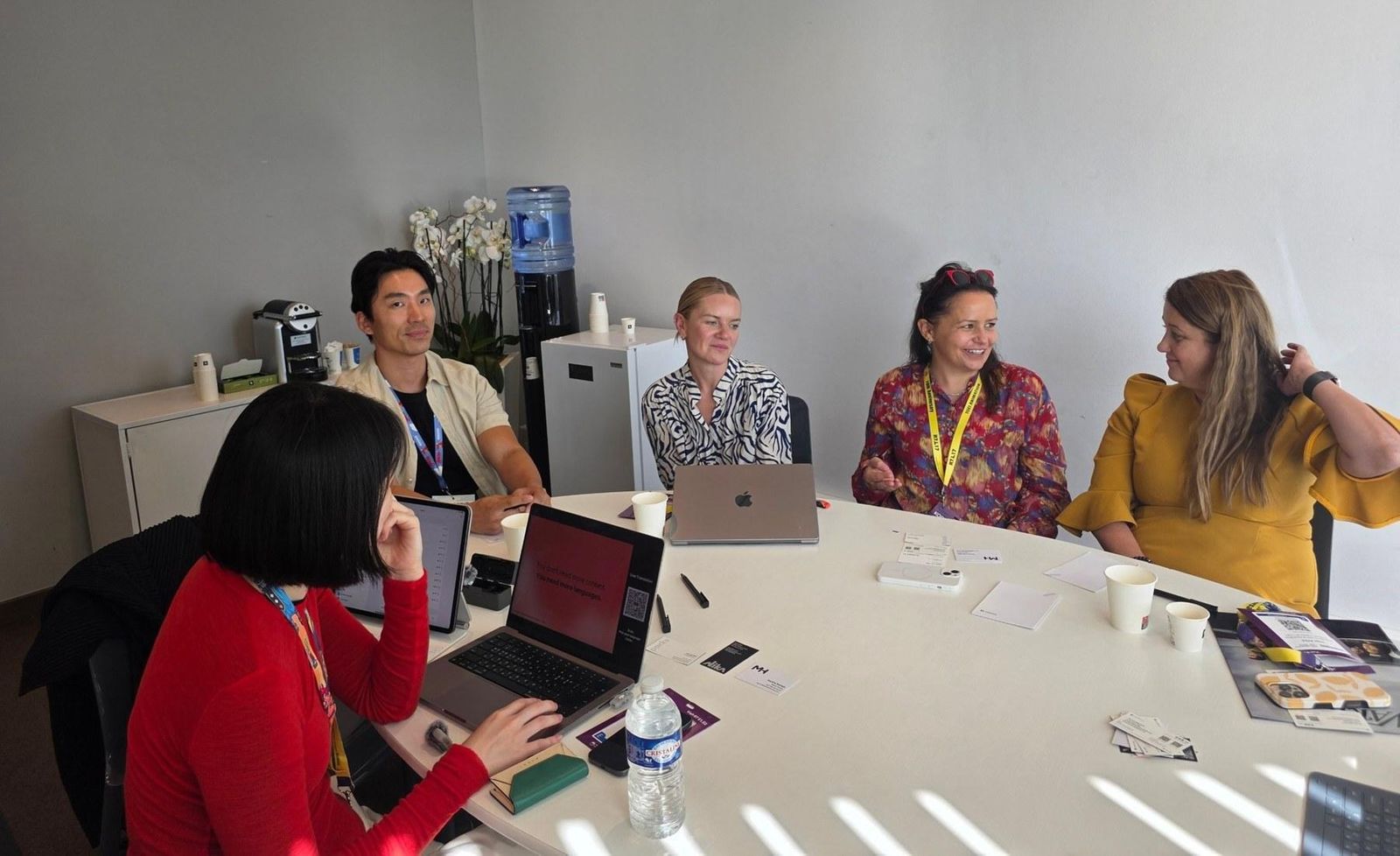
In Europe, language and distribution conditions must be assessed country by country. Roundtable participants said Poland has about 300 pay-TV operators and Latvia about 70. They also raised demand for local-language versions in Italy and Spain and the lack of server-side ad insertion (SSAI) equipment at some telcos.
Rompa proposed that Korean broadcasters launch their own channels while a media house in each country sells the ads. Alika pointed to local demand, noting that Korean content was the most pirated content in Latvia in 2019, and Dobrzańska said the Polish-language market should not be seen as small: “Polish is not that small. There is no small language.” The operator counts and demand assessments are the participants' own accounts.
The participants agreed to run a test dub of about 10 minutes in Latvian and Polish with Hudson AI. Because this year's support plan focuses on vertical drama, K-beauty, K-dance and the Americas, supplying European local languages remains a separate task to be solved.

About 80 attend LA's 'K-FAST NIGHT'… connecting with advertisers and brands in North America, home to more than 80% of the global FAST market
The LA event took place on Sept. 28 (local time), two weeks before MIPCOM. It was timed to Amagi's LA FAST conference, held the next day, Sept. 29, at the Fairmont Century Plaza, a week when North America's FAST industry gathers in LA. About 80 people from the Korean and U.S. content and media industries attended, the Korea Daily reported on Oct. 2. The Monday program began at 4 p.m. with an opening, company introductions, presentations on FAST channel businesses and FAST ad solutions, and a networking dinner.
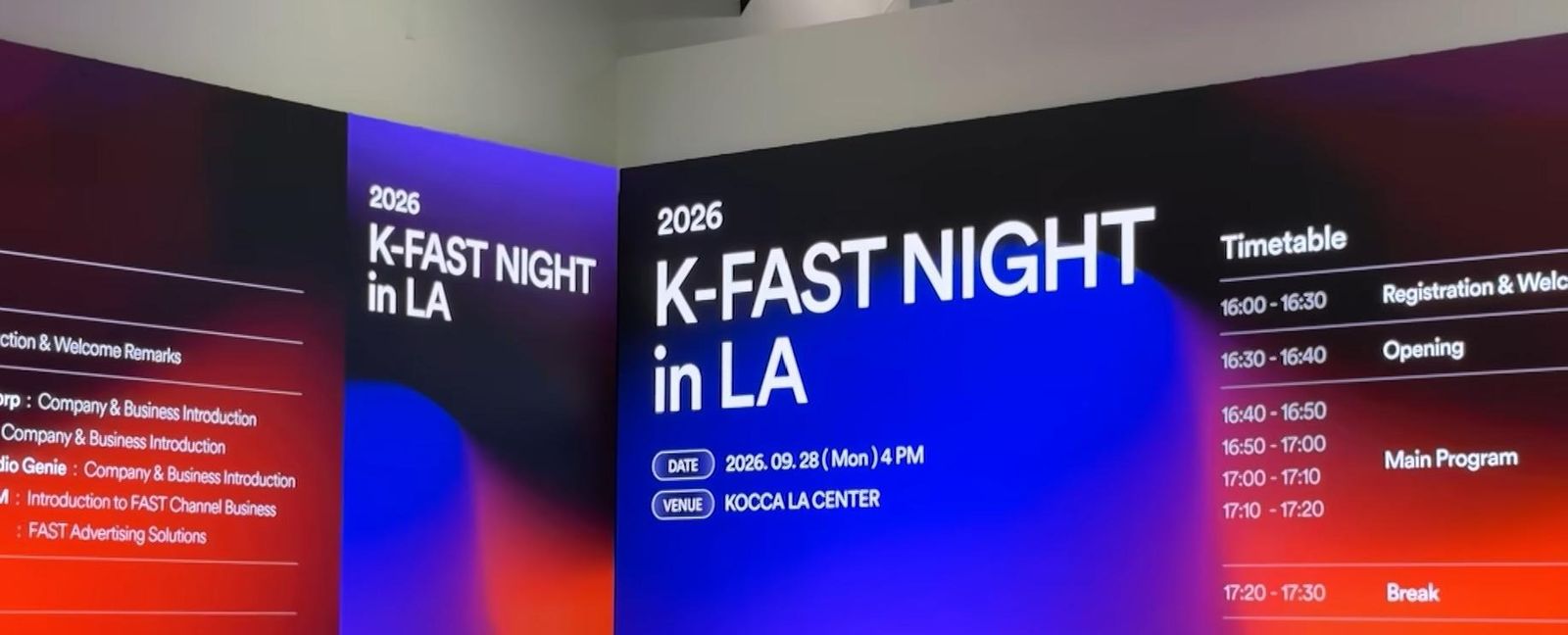
SMR introduced "Series-K," a global FAST channel that groups dramas from the three terrestrial broadcasters, including MBC, by genre such as historical, crime and medical, and romantic comedy. Popular terrestrial dramas are localized with AI dubbing and are reaching viewers in about 10 countries, according to SMR.
CJ ENM presented an advertising and marketing model that combines FAST ad inventory with the recognition of Korean content to help domestic and global brands reach overseas consumers. K20 presented its own food, travel and gaming channels and FAST originals, and KT Studio Genie outlined plans to expand its content library and channel business overseas.
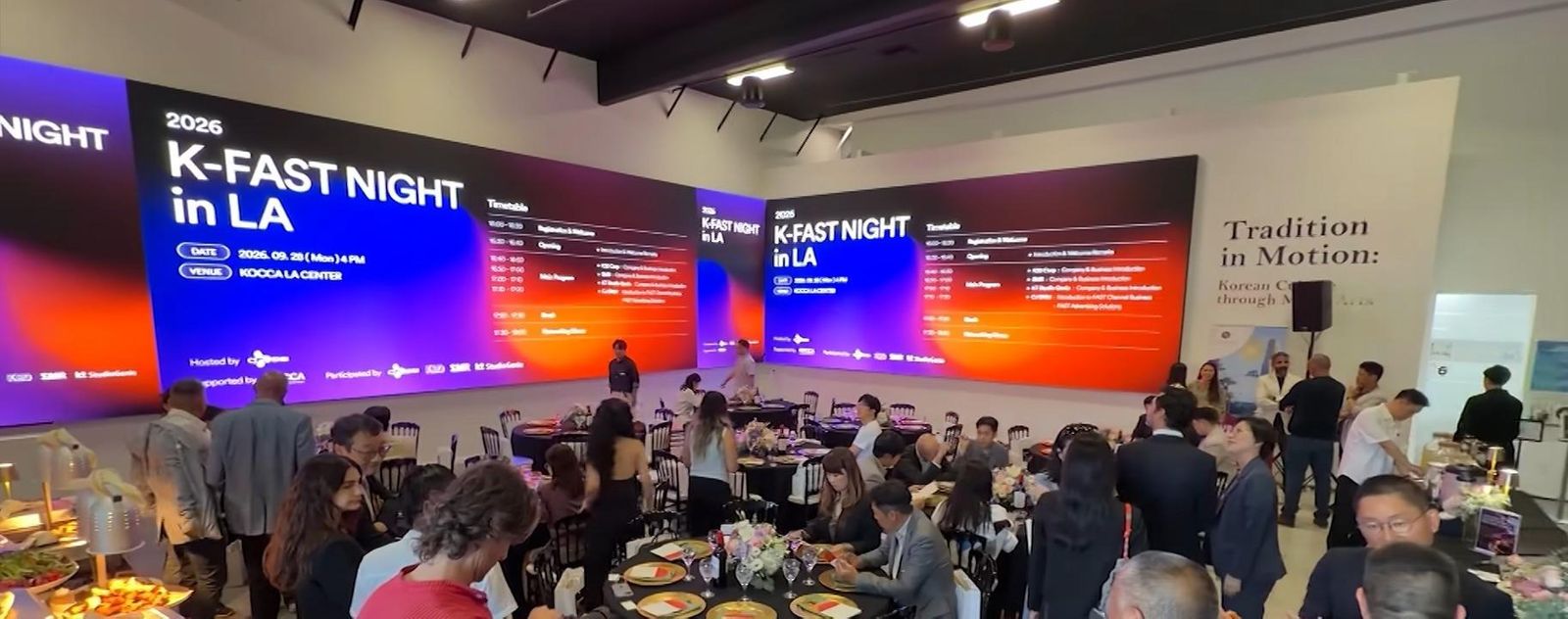
Korean and U.S. content, media and advertising professionals at the networking dinner of "2026 K-FAST NIGHT in LA" at the KOCCA LA Center on Sept. 28. Photo: MBC America
Presentations by the co-hosts of 2026 K-FAST NIGHT in LA
Sources: organizers' press release, Korea Daily (Oct. 2), Byline Network (July 27)
The event was run by S'HAMPAGNE, an LA-based business platform. Sarah Kim, CEO of S'HAMPAGNE, told the Korea Daily that her top priority was helping Korean companies meet the partners they truly need in the U.S. market.
20 AI-dubbed channels, 100 million cumulative viewers in 22 countries… alliance grows from 22 to 82 members
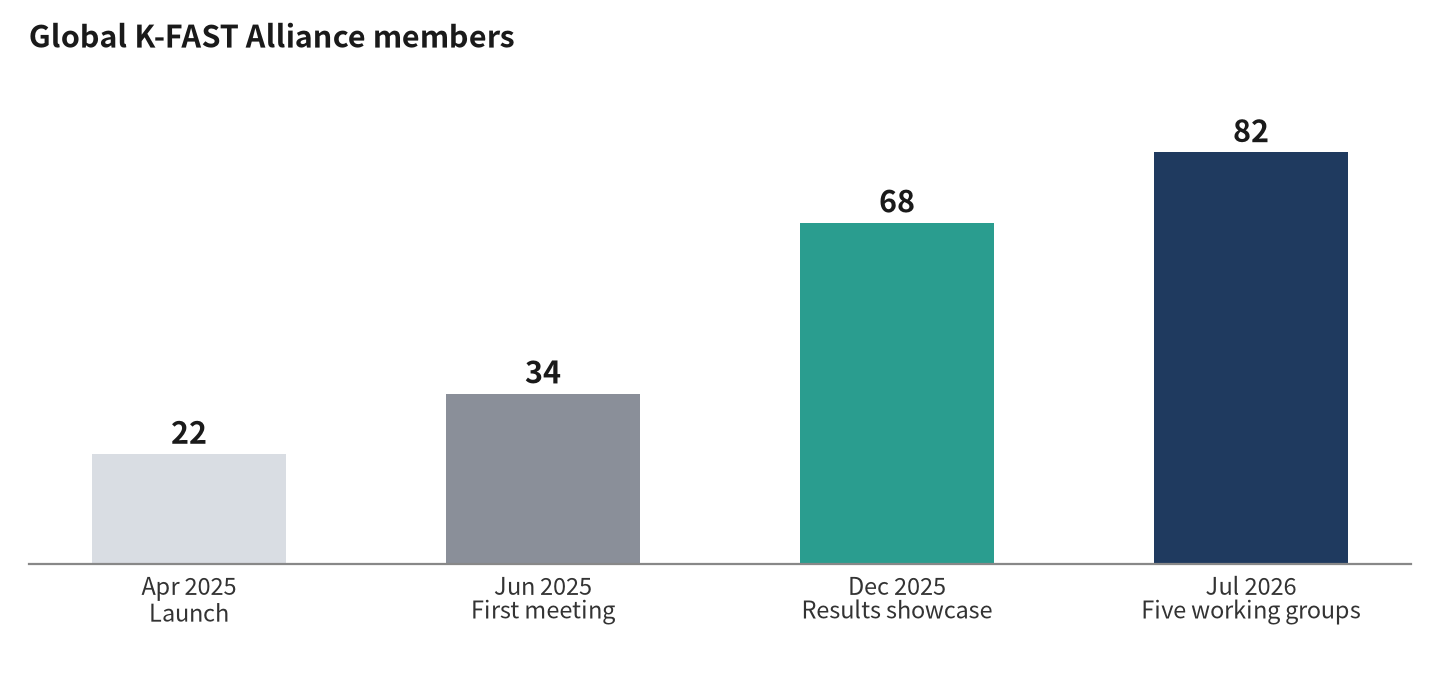
The Global K-FAST Alliance launched on April 23, 2025, with 22 members. By its first meeting in June, MBN, Cheil Worldwide and NC AI had joined, bringing the total to 34, Financial News reported. According to the outlet, Samsung Electronics, LG Electronics, the three terrestrial broadcasters, CJ ENM, JTBC, KT, SK Broadband and LG Uplus have taken part since the launch. Membership rose to 68 in December and 82 in July this year. Since this year, the alliance has operated five working groups: content and channels, technology, advertising and platforms, global, and coordination.
The channels were built with the government's supplementary budget.
Last year MSIT used KRW 8 billion in supplementary funds to select six consortia, which AI-dubbed about 1,200 Korean titles (more than 1,400 hours) into English, Spanish and Portuguese and upgraded their picture quality.
The result was 20 channels, distributed as 83 channels when duplicates across countries are counted, Digital Daily reported on Dec. 11. At the results-sharing event at the time, Choi Woo-hyuk, MSIT's director general for network policy, said the AI-dubbed channels would become a new path for Korean content to reach overseas viewers directly.
This year the genres expand. Three consortia led by Hudson AI (CJ ENM K-DANCE), ESTsoft (GENIE K-Short, TREND ON) and UN AI (K-Vibe+) took on four flagship channels, each receiving about KRW 230 million (about $170,000).
The vertical drama channel uses a "dual view" screen that fits 9:16 video to TV screens, and the K-beauty channel pairs original entertainment shows with commerce. The K-dance channel targets Mexico and the U.S. Hispanic market. Shin Hyun-jin, CEO of Hudson AI, told Money Today that localization is the key task for K-FAST's overseas expansion and that the company will keep advancing its AI dubbing technology.
K20 and KT Studio Genie are part of the ESTsoft consortium. The short-form drama channel GENIE K-SHORT launches with 3,771 episodes across 131 series, and the K-beauty channel TRENDON with 309 episodes across 15 programs.
TRENDON includes its first FAST original, "Shine on in Seoul," and beauty entertainment shows from YTN, Channel A and ENA. Targeting Spanish-speaking markets such as Mexico and Spain, the consortium formed a quality committee with the Spanish department of Hankuk University of Foreign Studies, translators and native-speaker reviewers, and drew up "neutral Spanish" dubbing guidelines, Byline Network reported on July 27. ESTsoft CEO Jung Sang-won called the program "an important base for the globalization of K-content."
NEW ID: 840 million cumulative viewing hours in 96 countries… KBS WORLD in Europe and the Middle East, live basketball
Private members' overseas results are growing quickly. NEW ID's channels are watched on 34 platforms in 96 countries, with more than 1.4 billion cumulative viewing sessions. The United States accounts for 56% of cumulative viewing time, or 460 million hours, followed by Korea, Brazil, Mexico and Europe. So far this year, viewing compared with the same period last year rose eightfold in India, threefold in Australia and twofold in Europe and Canada, the company said in its Oct. 7 newsletter marking its seventh anniversary. It also said its audience is 68% female and 75% under 55, the opposite of the typical connected TV (CTV) audience.
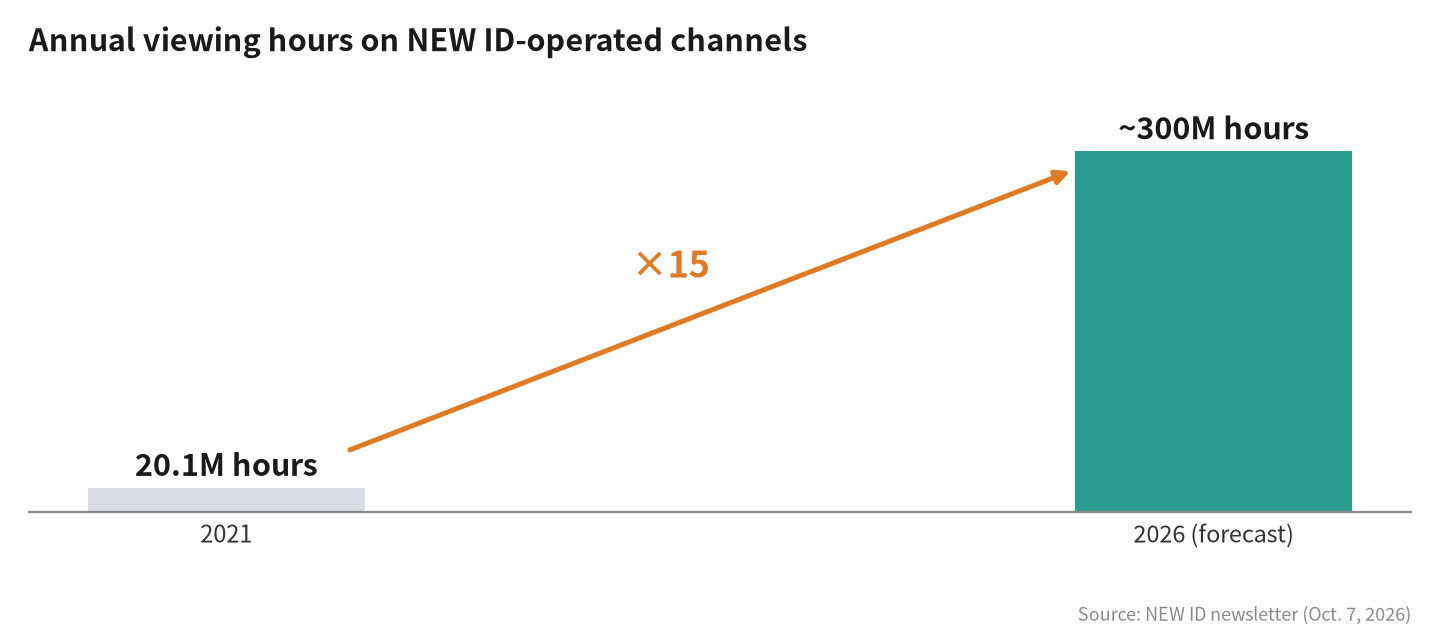
Annual viewing hours on NEW ID-operated channels. The 2026 figure is a company forecast. Source: NEW ID newsletter (Oct. 7)
The channel lineup has also broadened. In September, NEW ID began distributing KBS's global channel "KBS WORLD" to Europe and the Middle East via LG Channels. The channel airs "Music Bank" live along with recent dramas, entertainment shows and its own English news. The same month, it launched "EASL TV," the official basketball channel of the East Asia Super League, and streamed the first game of the 2026-27 season live on Oct. 3. In its July first-half newsletter, the company said its channel lineup grew about 20% year on year, average monthly unique viewers rose about 60%, and viewing time grew 108% in Europe and 231% in Oceania. Contrary to criticism that the channels rely on reruns, growth is coming from channels that have added live broadcasts and current shows.
The alliance is also growing. In August, the secretariat told members that the World K-Pop Center had joined in the media content category. In September, it surveyed members on policy needs to shape government policy and support plans, and in October it collected members' views on entering China and submitted them to MSIT for follow-up negotiations on the Korea-China free trade agreement (FTA).
KMCC meeting blames rerun-heavy schedules for low viewership… FAST policy settles under MSIT's lead
Policy responsibility is spread across several agencies. At the first FAST meeting since its launch, held on June 4, Kim Jong-cheol, chairman of the Korea Media and Communications Commission (KMCC), cited the roughly 600 million smart TVs that Korean electronics makers have shipped worldwide and Korea's content production capabilities, and said the commission would move quickly to build a K-FAST ecosystem. The meeting was attended by Samsung Electronics and LG Electronics; five channel operators including NEW ID, SMR and CJ ENM; nine broadcasters including KBS, MBC and SBS; and Hudson AI and ESTsoft. Participants proposed analyzing North American viewer preferences, planning ad-linked content based on viewing data, and having the government or platforms invest in content made specifically for K-FAST. Schedules that simply rerun old programs were cited at the meeting as a reason for Korean content's low ratings in overseas FAST markets, Dailian reported.
The division of roles has settled on MSIT. At a May 29 press briefing, Choi Woo-hyuk, head of MSIT's Office of Information Protection and Network Policy, said FAST policy has “basically been settled, to some extent, as something MSIT leads,” Digital Daily wrote.
He added that working-level consultations with the KMCC are continuing. The Korea Broadcast Advertising Corporation's Media and Advertising Research Institute also published a report in August on measures to promote the K-FAST ecosystem. Policy research and meetings continue, while channel production budgets have shrunk over the same period.
KRW 8 billion supplementary budget in 2025 → fully cut from 2026 proposal… four flagship channels and about KRW 920 million this year
The K-FAST channel program began with a supplementary budget passed in May 2025. MSIT used KRW 8 billion to select six consortia made up of six lead companies and 22 participating companies to build 20 K-channels, Digital Today reported on July 30, 2025. Because it was a supplementary-budget program, it needed separate funding to continue in the 2026 main budget.
At the National Assembly Science, ICT, Broadcasting and Communications Committee's audit on Oct. 29 last year, Democratic Party lawmaker Lee Joo-hee pointed out that the program's budget had been entirely dropped from the 2026 government proposal. Lee said it made no sense to drop a continuing program that received KRW 8 billion in 2025 on the grounds that it lacked an eligibility review. Bae Kyung-hoon, deputy prime minister and minister of science and ICT, replied that MSIT had requested it as a continuing program but the fiscal authorities saw it as a new program requiring an eligibility review. According to Digital Daily, Second Vice Minister Ryu Je-myung told the audit that the program had skipped the eligibility review because the supplementary budget was drawn up quickly, and that MSIT would keep consulting with the fiscal authorities.
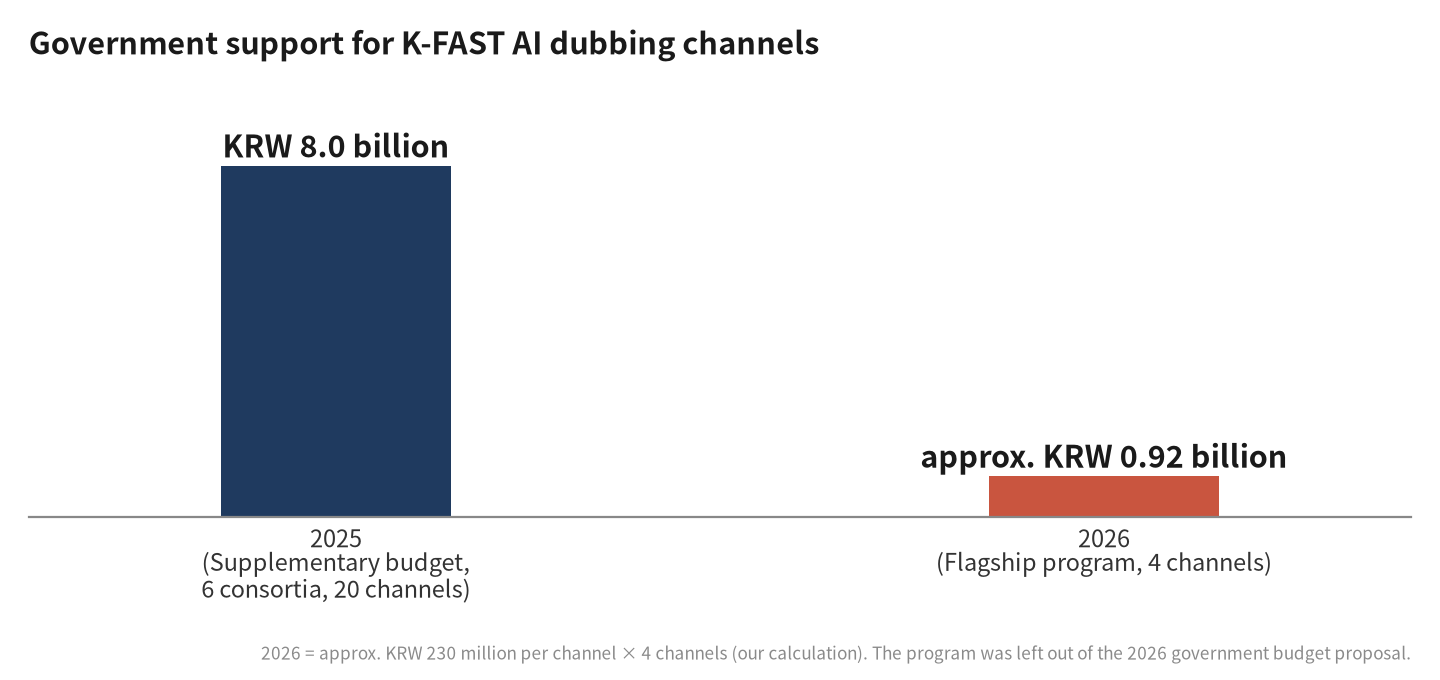
Government support for K-FAST AI dubbing channels. The 2026 figure is our calculation: the reported per-channel support (about KRW 230 million) multiplied by the number of channels (four). Sources: Digital Today, Newsis
Consortia led by Hudson AI, ESTsoft and UN AI are running four flagship channels with about KRW 230 million each. That is about one-ninth of the budget that built 20 channels last year, closer to a genre test than a large expansion of new channels. At the audit, Lee argued that support should not be delayed, noting that Samsung and LG operate about 6,800 FAST channels in about 30 countries with about 140 million users. According to data MSIT submitted to Lee, global FAST monthly users rank as follows: Fox's Tubi at 100 million, Paramount's Pluto TV at 89 million, Samsung TV Plus at 88 million, The Roku Channel at 74 million and LG Channels at 50 million.
MSIT's 2027 budget proposal, released in late August, is a record KRW 29.6476 trillion, with a sharp increase in AI investment. Yet the budget explanation published on the government's policy briefing site shows no separate item for FAST or AI-dubbed channel support. The ministry's budget has grown to an all-time high, while a program that drew 100 million viewers in 22 countries is hard to find even by name. Unless it is restored during the National Assembly's review, there is no guarantee that even this year's reduced support of about KRW 920 million will continue. AI-dubbed channels are where the AI technology the government is promoting turns into actual content exports, yet they have not won a separate place in a record AI budget. The industry worries that if support is cut just as overseas results begin to appear, channel operations and language expansion could stall, and the buyer and advertiser contacts made in Cannes and LA could fade away.
TV ad spending down 7.2% in a year… overseas FAST ads become a new revenue channel for broadcasters
The reason Korean broadcasters are investing in overseas FAST sales can be found in the domestic ad market. According to the "2025 Broadcasting and Communications Advertising Expenditure Survey" by the Korea Media and Communications Commission and the Korea Broadcast Advertising Corporation (KOBACO), online accounted for KRW 10.1011 trillion (59%) of Korea's KRW 17.1263 trillion in ad spending in 2024. Broadcast ad spending fell 5% to KRW 3.2191 trillion, and terrestrial TV alone fell 7.2% to KRW 1.2317 trillion, the Journalists Association of Korea reported on Jan. 8.
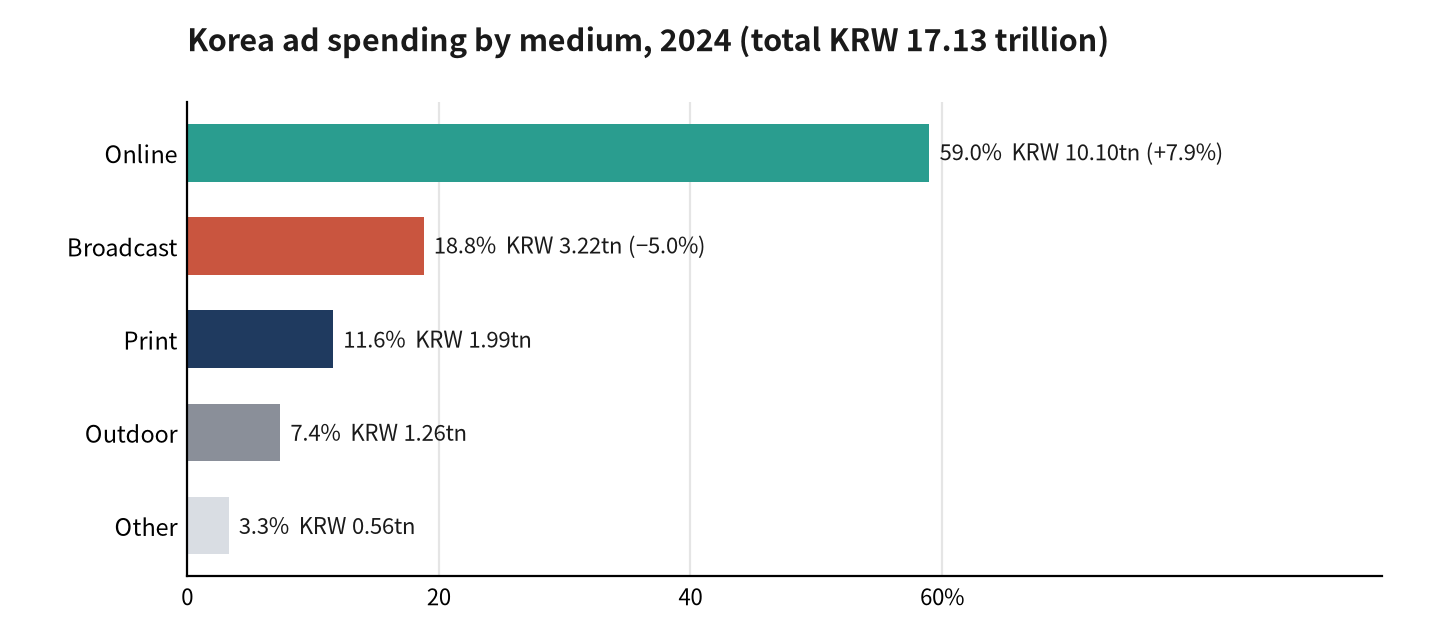
Series-K, which bundles terrestrial dramas, is an attempt to turn libraries already aired in Korea into overseas ad inventory. Samsung TV Plus has passed 100 million monthly users in 30 countries, and in January it added 24-hour terrestrial news channels including KBS News 24 and SBS No.1 News Live, Digital Daily reported. Korean broadcast channels are taking their place on platforms built by Korean companies.
Europe works differently. As the Cannes roundtable made clear, each European country has dozens to hundreds of pay-TV operators, and many telcos lack the equipment to insert FAST ads. If, as Rompa proposed, Korean broadcasters open their own channels and a media house in each country sells the ads, broadcasters can build regional ad revenue directly. In other words, the English, Spanish and Portuguese dubs and the Samsung and LG platforms that worked in the Americas will not be enough to win carriage with European telcos.
Competition has also begun on the same platforms. Samsung TV Plus commissioned its first original scripted series from the studio of U.S. creator Dhar Mann, and a dedicated Dhar Mann channel carrying the series is available in 13 countries, including the United States and nine in Europe, SamMobile reported. Korean broadcasters' library channels will compete for viewing time on the same program guides as creator channels built on brand partnerships and their own IP.
Four flagship channels to launch this year… securing a budget, disclosing ad revenue and expanding into European languages are the next tests
The K-FAST Alliance will open four flagship channels this year in vertical drama, K-beauty and K-dance. The first hurdle is the 2027 budget. Whether FAST and AI dubbing support is restored during the National Assembly's review will determine whether the channels can keep running. How far the 100 million cumulative viewers have translated into ad revenue has not yet been disclosed. With the LA event putting advertisers and brands front and center, revenue metrics are likely to become the basis for budget talks. In Europe, the first step is the 10-minute Latvian and Polish test dub that Hudson AI agreed to pursue with the roundtable participants.
According to a Statista forecast cited by Money Today, the global FAST market will grow at an average annual rate of 7.47%, from about KRW 16 trillion last year to about KRW 23 trillion in 2030. “We will spare no support to build a sustainable K-FAST ecosystem,” Nam Seok, MSIT's director general for telecommunications policy, said in July. The 100 million viewers in 22 countries, the alliance's growth to 82 members, and private channels' viewing-time gains of 108% in Europe and 231% in Oceania make a strong case for continued support. What remains is speed. The National Assembly's review of the 2027 budget, which runs through the end of the year, will decide whether K-FAST support continues. Having confirmed the language challenge in Cannes and the advertiser opportunity in LA, the industry is watching whether that promise turns into a budget.
K-EnterTech Hub supports K-FAST's effort to become one of the standards for global content distribution through on-site reporting and its overseas network.
Disclosure: K-EnterTech Hub is a member of the Global K-FAST Alliance, and its CEO Jung Hoon Han was interviewed for KOBACO's study on promoting the K-FAST ecosystem. NEW ID figures are as announced in the company's newsletters.