
KAIROS indexes 34 years of music programming and 2,880 performers — a host's spoken query on ‘The Seasons’ pulls up a 2007 duet, with production efficiency and catalog reuse as the stated case
On the August 28 broadcast of KBS 2TV's ‘The Seasons – Sung Si-kyung's Eardrum Boyfriend’ (더 시즌즈-성시경의 고막남친), host Sung Si-kyung (성시경) issued a search command to KAIROS (카이로스), KBS's in-house AI portal, live on the program.
After introducing the system to duet guest Lena Park (박정현), he said: “KAIROS, find the Lena Park and Sung Si-kyung duet.” Up came their performance of ‘Somethin' Stupid’ from episode 268 of ‘Yoon Do-hyun's Love Letter’ (윤도현의 러브레터), aired October 19, 2007.
Sung described KAIROS on air as KBS's system holding all of the broadcaster's material in one place. Looking at the retrieved stage, one of them asked whether it had been 20 years; the correction came back that it was 19. A shared memory followed — the chairs had been so high they had looked like giants.
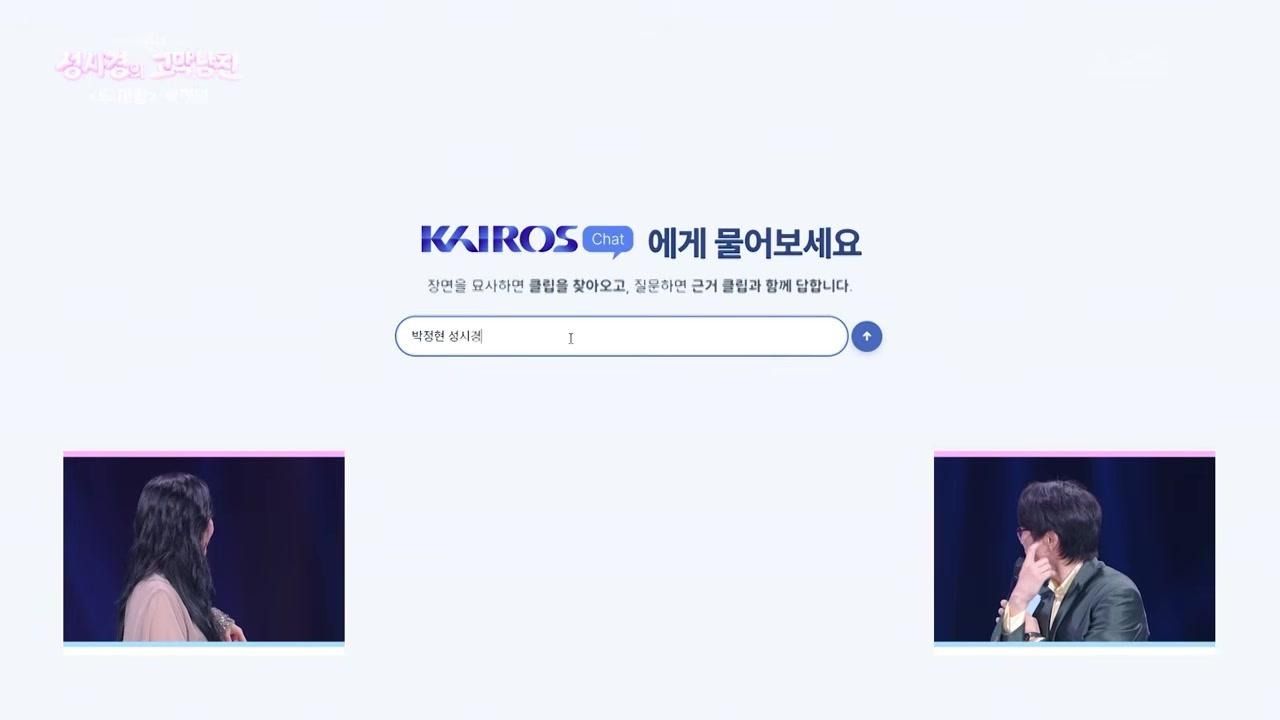
The KAIROS query screen as shown in the August 28 broadcast. Image: KBS 2TV YouTube capture
Natural-language queries, clip-level results
The prompt shown in the search box read: describe a scene and it retrieves the clip; ask a question and it answers with the supporting clip. The result list was headed “Scenes KAIROS found featuring Lena Park × Sung Si-kyung.”
Results included the 2007 ‘Yoon Do-hyun's Love Letter’ duet alongside ‘We Were So Good’ and ‘Quando Quando Quando’ from episode 121 of ‘Yoo Hee-yeol's Sketchbook’ (유희열의 스케치북), aired November 18, 2011. Each card carried the air date, episode number, song title and program name, with clip ranges such as 25:50–25:59 and 21:01–21:18. The unit returned is a scene, not a program — the point at which this departs from conventional archive search.

KAIROS search results, with air date, episode, song, program and clip time codes. Image: KBS 2TV YouTube capture
34 years of archives rebuilt as a performer-centric database
KAIROS was jointly developed by KBS's AI Innovation Unit (AI혁신단), its Media Technology Research Department (미디어기술연구부) and ‘The Seasons’ production team. It runs on 34 years of KBS music programming — from ‘Noh Young-shim's Little Concert’ (노영심의 작은 음악회) in 1992 through ‘Lee Moon-sae Show’ (이문세쇼), ‘Lee So-ra's Proposal’ (이소라의 프로포즈), ‘Yoon Do-hyun's Love Letter,’ ‘Lee Ha-na's Peppermint’ (이하나의 페퍼민트), ‘Yoo Hee-yeol's Sketchbook’ and today's ‘The Seasons.’
Faces, expressions, wardrobe, dialogue, lyrics and scene descriptors extracted by AI are fused with existing broadcast metadata — program, air date, episode — into a performer-centric database. It has learned data on 2,880 performers and presents appearance history, stages, songs and key moments on a single timeline (Ilgan Sports (일간스포츠), July 30).
Retrieval uses generative-AI retrieval-augmented generation, so the system takes planning and analysis questions as well as lookups, and selecting a result plays the footage immediately. Conventional broadcast archive search runs against human-entered text metadata; the queries KAIROS handled on air ran against the people and scenes inside the picture.

The retrieved 2007 duet from episode 268 of ‘Yoon Do-hyun's Love Letter.’ Image: KBS 2TV YouTube capture
First production use: the July 28 taping with J.Y. Park
KAIROS was first applied on a production floor at the July 28 taping of ‘The Seasons.’ It searched three decades of guest J.Y. Park's (박진영) career in real time, cueing stages from ‘Gayo Top Ten’ (가요톱텐) in 1995 and ‘Lee So-ra's Proposal’ in 1997 to match the conversation. KBS called it the first real-time application of multimodal AI search in Korean broadcast production (Ilgan Sports, July 30). That episode aired July 31.
A request at the taping for the outfit J.Y. Park wore on ‘Gayo Top Ten’ retrieved 30-year-old footage on the spot, and questions about his appearance across eras or particular expressions returned matching scenes (Sports Kyunghyang (스포츠경향), July 30). The production team said it had confirmed the potential to raise efficiency and finish quality together, and would build a more sophisticated AI production-support system and widen its use across programming (Ilgan Sports, July 30).
The two broadcasts differ in kind. July 31 was a demonstration in which AI retrieved material the production team had prepared. On August 28 the host spoke the query and the result screen went to air. The support tool became part of the program.
Portal in July, AI Production in August, security cloud with a Korean vendor
KBS released KAIROS internally on July 1, framing it as one AI per employee. President Park Jang-beom (박장범) described it as the company-wide work platform prepared to execute KBS's AI transformation since its 2025 declaration of the first year of AI broadcasting (Media Today (미디어오늘), July 2; Broadcasting Technology Journal (방송기술저널)). The name comes from the Greek word for the opportune moment.
Task-specific chatbots handle press-release analysis, issue extraction, fact-check support, interview outlines and question generation. Department-level ‘AI champs’ can build the chatbots their teams need, and to prevent leakage of internal material KBS built an independent security cloud with a Korean vendor experienced in AI solutions for public institutions (Segye Ilbo (세계일보) and Sports Kyunghyang, July 1; Broadcasting and Technology (방송과기술), August issue).
The archive-search function began as an idea from Lee Chang-soo (이창수), the KBS producer behind ‘The Seasons’: pull material sitting in storage into actual production and creative work so that the information gains value. The AI Innovation Unit and the Media Technology Research Department built it into a system. When KBS declared 2025 the first year of AI broadcasting on its 52nd anniversary that March, the stated goal was to use AI to raise program creativity and organizational efficiency and, through that, the value of the license fee (Broadcasting and Technology). Reopening 34 years of archives tests that claim on the production floor.
Suh Young-woo (서영우), head of the AI Broadcasting Innovation Unit, has described how KAIROS spreads through the company: ‘AI champs’ embedded in each department use the tools, propose what their teams need and share the results, while the unit listens for which departments need which technology and assigns and coordinates staff accordingly (Korea Journalists Association media news, October 20, 2025). Suh previously headed the Media Technology Research Department, one of the units that built KAIROS.

In early August KBS opened AI Production, a generative-AI production support unit: KAIROS supports work online, AI Production handles video production and technical support offline. More than ten announcers consented to synthetic voice development, and the news division began piloting TTS reports on ‘News 12’ (뉴스 12), where a reporter's trained voice reads the script (Edaily (이데일리) and Sports Kyunghyang, August 4).
KBS had already applied AI caption synchronization to its main newscasts in 2023 and English-language news in 2026, extending it in June to news VOD at 18 regional stations (Broadcasting and Technology, August issue). Next comes ‘Munmu’ (문무), the historical epic scheduled for November 28, where AI will augment crowds in large battle sequences and support previsualization of fire and hazardous action (Marie Claire Korea, August).
Before KAIROS came VVERTIGO — automated per-member fancams since 2019
KBS's AI production stack was built first around shooting and editing. VVERTIGO, its AI-based multiview production system, reframes a single 8K master with AI tracking and fast rendering to generate a vertical fancam for each member, replacing the practice of assigning one camera per performer.
Applied to ‘Music Bank’ (뮤직뱅크) in the summer of 2019, it has produced the per-member fancams posted to the KBS Kpop YouTube channel, and its use has widened to per-member reaction cuts in observational formats such as ‘Stars' Top Recipe at Fun-Staurant’ (신상출시 편스토랑) and ‘Nuga Nuga Jalhana’ (누가누가 잘하나) (Broadcasting and Technology).

VVERTIGO received a ministerial award from the Ministry of Science and ICT in November 2024. At CES 2025 KBS showed VVERTIGO and VVERTIGO Vision, which widens captured footage to a 180-degree field and scales it to 8K and 16K, fits smartphone and immersive-device environments from Meta and Apple, and can extend to large-format venues on the model of Cosm and Sphere, according to KBS (Edaily (이데일리), January 5).
At CES 2026 the company led with VVERTIGO PTZ, which learns a performer's face and the shooting patterns of experienced camera directors to control a pan-tilt-zoom camera in real time. KBS says it addresses the limits of conventional auto-tracking and holds a stable frame even with several people on screen; the booth demonstrated the automated framing used on the studio variety show ‘Neighborhood Husbands’ (이웃집 남편들). The exhibit ran in the KOCCA joint pavilion supported by the Ministry of Culture, Sports and Tourism (Edaily, January 5). In February KBS brought the technology onto its own floor with an AI TV Studio.
At CES 2026, Suh Young-woo, head of the AI Broadcasting Innovation Unit, said KBS aims to become an AI media-tech company rather than only a content operator, and to lead global standards for Korean content (KBS News, January 10). KAIROS extends that axis — from shooting and editing into retrieval.
Park: a return to profit is possible through AI innovation
At a third-quarter affiliate meeting on July 14, KBS president Park Jang-beom instructed staff to apply the in-house AI model KAIROS across production and management, saying a return to profit was possible through AI innovation (Insight (인사이트), July 15). With the terrestrial advertising market contracting and license-fee funding conditions changing, production efficiency has become the stated case for AI adoption.

Archive search fits that case. It cuts research hours directly and draws on assets already owned, requiring no new shooting or rights purchases. The 34 years of music programming are exclusive to KBS, which makes the result hard for an outside operator to reproduce.
Abroad, model and platform companies got there first
Scene-level video search has been commercialized abroad largely by model companies. TwelveLabs builds on its Marengo embedding model and Pegasus video-language model, processing audio, on-screen text and motion together to turn footage into structured data — scene boundaries, entities, temporal segments. At NAB Show 2026 on April 20 it introduced Pegasus 1.5, saying early testing beat Google's Gemini 2.5 Pro by 30% on aggregate segmentation quality and that the model was already in production at a major broadcast network (PRWeb, April 20). On July 1 it raised a $100 million (about 139 billion won) Series B co-led by NEA and NAVER Ventures.
Adoption appeared first in sports and news archives. Brad Boim, senior director of media management and post production at NFL Media, said in a comment published on the TwelveLabs site that reaching exact moments in games is essential to the business and that multimodal AI changes what is possible. BBC R&D has been fine-tuning an open-source LLM on proprietary data, naming archive search, transcription and recommendation as efficiency targets (Fortune, April 24, 2024). The 2025 IBC Accelerator winner was an agentic system supporting live production in real time (Feed, February 26).
SBS bought the model, KBS built the portal
Korean broadcasters split on approach. SBS combined TwelveLabs' multimodal models with its own scene-search technology to make both its corporate archive and individually uploaded footage searchable at scene level (TwelveLabs case study). KBS built its own portal and security cloud. Buying a model is faster and pushes performance gains onto the vendor, but production material leaves the building; building in-house reverses both terms.
The on-air appearance follows from that choice. What viewers saw was not only a set of results but a product interface carrying the KBS mark — an internal tool used as a public-facing brand asset.

Revenue outlook: archive SaaS, catalog redistribution, metadata licensing
What follows is not a KBS announcement but an outlook based on how public-broadcaster archive and AI businesses typically develop.
Beginning as an internal tool, KAIROS could extend into a subscription or usage-based service for broadcasters, studios and OTT platforms at home and abroad. Cutting research and edit-preparation time is a problem shared by most archive holders, and TwelveLabs' move from model and infrastructure supplier into the application layer targets the same demand.
There is an internal precedent. VVERTIGO went the route of CES exhibition and solution branding first; if KAIROS follows the same sequence, its entry point is archive search.
Catalog redistribution is the more direct path. Scene-level indexing lowers the unit cost of pulling highlights and clips, and restored or remastered archive performances can be pushed back out through FAST and OTT services, generating advertising and licensing revenue. That intersects with policy discussion on public-content archives and trading frameworks.
The index data is itself an asset. Face, expression, wardrobe and lyric metadata across 2,880 performers could feed rights-holder settlement, branded content and search APIs — with settlement standards and privacy governance as prerequisites. Supporting or co-producing other broadcasters' and studios' work through the AI Production unit is another available route.
The limits are equally clear. The first-order value of KAIROS is production efficiency and access to the archive rather than revenue, and commercializing material held by a public broadcaster requires rights settlement and AI reliability standards to be set first.
The index stops at music programming — and the results list carried duplicates
The disclosed index covers music programming and 2,880 performers. Extending it to drama, current affairs, news and sports multiplies the hours to process and the people to identify, and indexing cost rises with them. Drama carries a different density of characters and scenes per episode, and news archives run on separate systems.
Accuracy is the other practical variable. The result list shown on air carried the same October 19, 2007 episode twice as different ranges, and one card's range ended before it began. Applying the system to live or news output, where tolerance for error is narrow, calls for a separate verification step.
A 34-year archive spans several contract generations
The hard part of indexing sits in the contracts rather than in the processing volume. An archive running back to 1992 covers several generations of appearance and production agreements, most of which say nothing about AI training or indexing. Index data extracted at the level of faces, expressions and wardrobe carries likeness and personal information. None of that surfaces while the tool stays inside the building; it becomes the gating condition the moment clips are distributed externally or search output is sold.
The consent-based route KBS took with announcer and reporter voice synthesis is one procedure already in place for this class of problem. For archive indexing, how soon the broadcaster sets consent and settlement terms that separate internal use from external service will determine how fast the index can widen.
Clip extraction cost is what sets programming cost
Once an archive is indexed at scene level, pulling highlights and clips shifts from staff hours to query time. That step has been the cost driver in FAST channel programming and short-form supply. The constraint on global distribution of Korean content has not been a shortage of source material but the cost of breaking it into reusable units.
The same conditions apply outside broadcasting. Production houses, MCNs, sports clubs and live-event promoters sitting on their own footage have simpler contract structures than a broadcaster and can start faster. For technology vendors the entry point is above the model as well — interfaces that attach to broadcast workflows, metadata reconciliation, rights-information management.
What the August 28 broadcast leaves behind is not the result but the fact that the search process itself went to air. Once AI appears where viewers can see it, disclosure and labeling standards have to follow — and whoever writes those standards first also holds room to widen where the tool can be used next.
Sources
· Kim Ji-hye, ‘J.Y. Park's 30 years at a glance… The Seasons summons past stages in real time with AI’, Ilgan Sports (일간스포츠), July 30, 2026
· ‘He even knows what J.Y. Park wore on Gayo Top Ten’, Sports Kyunghyang (스포츠경향), July 30, 2026
· ‘The Seasons: KBS AI unveiled’, bnt News, July 30, 2026
· ‘KBS launches its own AI work platform KAIROS’, Media Today (미디어오늘), July 2, 2026
· ‘KBS adopts in-house AI portal KAIROS’, Broadcasting Technology Journal (방송기술저널), July 2026
· ‘KBS introduces in-house AI portal… one AI per employee’, Segye Ilbo (세계일보), July 1, 2026
· ‘KBS adopts in-house AI portal KAIROS’, Sports Kyunghyang, July 1, 2026
· ‘KBS opens AI Production… a dedicated AI production hub’, Edaily (이데일리), August 4, 2026
· ‘KBS opens AI Production, moves into AI-based broadcast production’, Sports Kyunghyang / MyloveKBS, August 4, 2026
· ‘KBS president Park calls for management improvement through AI innovation’, Insight (인사이트), July 15, 2026
· ‘KOBETA News August’, Broadcasting and Technology (방송과기술), August 2026
· ‘Introducing vVERTIGO, the AI-based multiview production system’, Broadcasting and Technology
· ‘KBS to present AI-based VVERTIGO PTZ at CES 2026’, Edaily (이데일리), January 5, 2026
· ‘KBS's VVERTIGO draws attention at CES — AI shooting trained on veteran directors' know-how’, KBS News, January 10, 2026
· ‘KBS declares the first year of AI broadcasting’, Broadcasting and Technology, March 2025
· ‘KBS to train 40–80 AI champs across divisions for AI transformation of production’, Korea Journalists Association media news, October 20, 2025
· ‘Even historical epics enter the AI era? The new period-drama contest in Munmu’, Marie Claire Korea, August 2026
· ‘TwelveLabs Unveils the Next Era of Video Intelligence at NAB Show 2026’, PRWeb, April 20, 2026
· ‘TwelveLabs Raises $100M to Build Video Superintelligence’, TwelveLabs, July 1, 2026
· ‘SBS Case Study: AI for Video Archive and Scene Search’, TwelveLabs
· Molly Flatt, ‘Move over, Black Mirror; the BBC is showing AI can be a force for good in media’, Fortune, April 24, 2024
· ‘IBC Accelerator Kickstart Day at BBC sets stage for AI-driven media innovation’, Feed, February 26, 2026
· KBS 2TV ‘The Seasons – Sung Si-kyung's Eardrum Boyfriend’, August 28, 2026 broadcast, and the official KBS YouTube clip (https://www.youtube.com/watch?v=Gb_uobc9rwE)
Quotation marks indicate reported or broadcast statements; unquoted description summarizes. Footage from ‘The Seasons’ is copyright KBS and is cited for news reporting. Conversion at 1 USD = 1,390 KRW.