

MIPCOM 2026 | STREAMING DISTRIBUTION
CJ ENM will open a TVING hub inside MBC Shahid, the biggest paid streaming service in the Middle East and North Africa, with 13 new series premiering alongside Korea across 24 markets and an exclusive window on MBC4
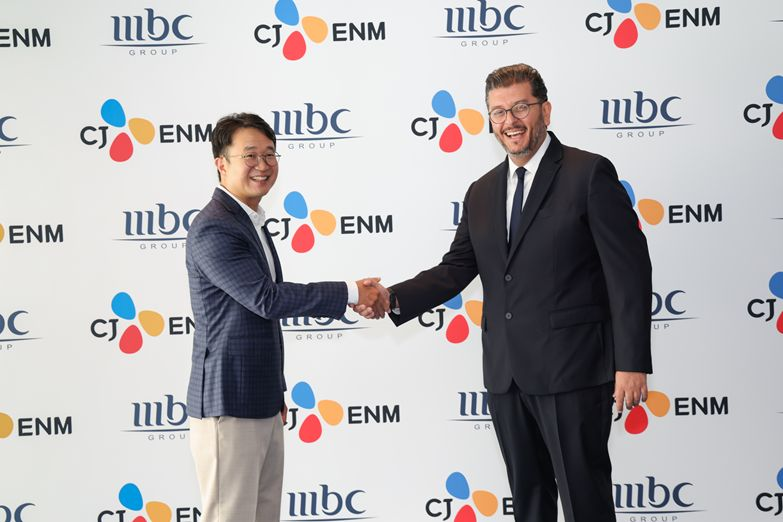
CJ ENM is opening a branded hub for its streaming service TVING (티빙) inside MBC Shahid, the largest paid streaming service in the Middle East and North Africa. The South Korean studio signed a long-term strategic partnership with Saudi Arabia’s MBC Group on Tuesday at MIPCOM in Cannes. The hub will be available in 24 MENA markets and will carry 13 new series released this year plus 20 titles from CJ ENM’s library.
New series will go up on the same schedule as their Korean broadcasts, and more titles will carry Arabic dubbing and subtitles. MBC4, one of MBC Group’s free-to-air channels, will air CJ ENM shows under a time-limited exclusive. MBC Group said the deal builds on the companies’ existing relationship, extends it across streaming and linear television, and sets up a framework for further work together in media, entertainment and production. Neither side disclosed the value or length of the deal, or when the hub will open.
The relationship began in June last year with a 20-series licensing deal. Sixteen months later, shows that were sold one at a time will sit together under the TVING name. In between, CJ ENM opened a subsidiary in Riyadh, and Shahid was renamed MBC Shahid and brought its target for full-year profit forward from 2027 to 2026.
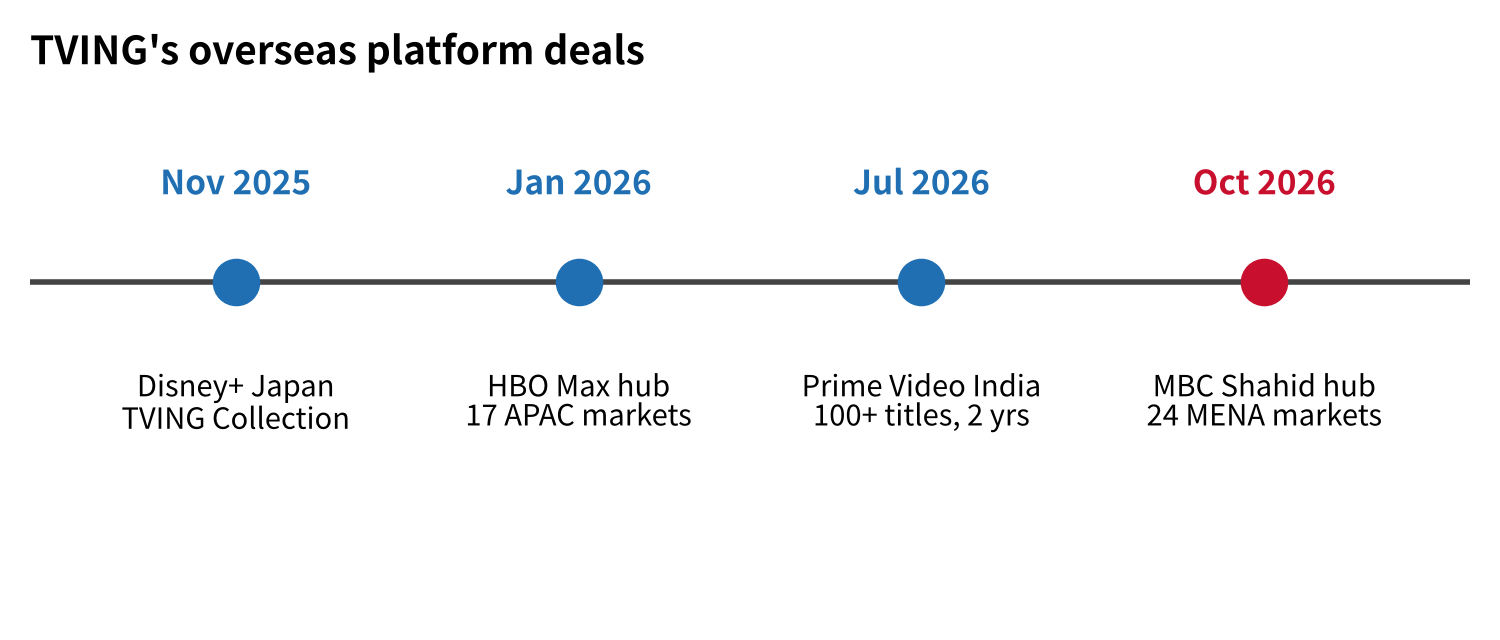
Rather than launch its own app abroad, TVING has been placing branded hubs inside large platforms that already have subscribers. It opened on Disney+ in Japan last November and on HBO Max across 17 Asia-Pacific markets in January, and in July CJ ENM agreed to supply more than 100 titles to Prime Video in India. The Middle East is the fourth outlet. TVING turned its first quarterly operating profit in the April–June period, and the company counted overseas sales among the reasons.
Thirteen new series day-and-date, led by My Bias, My Boss and The Legend of Kitchen Soldier
The slate includes tvN’s My Bias, My Boss (최애의 사원), the TVING original The Legend of Kitchen Soldier (취사병 전설이 되다), tvN’s Filing for Love (은밀한 감사), Our Universe (우주를 줄게) and The Judge Returns (판사 이한영), eToday reported. My Bias, My Boss, an office romance adapted from a webtoon, opened on August 3 with a 4.2% nationwide pay-TV rating from Nielsen Korea, according to Ilgan Sports. Filing for Love was Korea’s showcase title at Canneseries in April. TVING credited Kitchen Soldier, together with Yumi’s Cells 3, with driving net subscriber growth in the second quarter.
The partners start with “more than 13” new titles and “more than 20” library titles and will add to the selection over the life of the deal, The Hollywood Reporter reported. Every new title covered will reach Shahid when it debuts in Korea, so viewers in Riyadh and Cairo watch the same episode in the same week as viewers in Seoul. MBC4’s schedule will be announced later.
“Growth potential of Korean content in the Middle East,” says CJ ENM; MBC wants to be the gateway
“Expanding our collaboration this year to launch a dedicated TVing-branded space, following our content supply agreement last year, is a meaningful achievement that once again underscores the competitiveness and growth potential of Korean content in the Middle East,” said Kim. The hub, he added, would make it “easier and more convenient” for viewers in the region to watch premium Korean content.
“CJ ENM has played a defining role in taking Korean entertainment global, while MBC Group has built an unparalleled connection with audiences across MENA,” Alibrahim told THR. “Together, we see significant long-term opportunities across content, streaming and entertainment.” He described the deal as part of MBC Group’s strategy of partnering with leading international media companies to become a gateway between global content and Arab audiences.
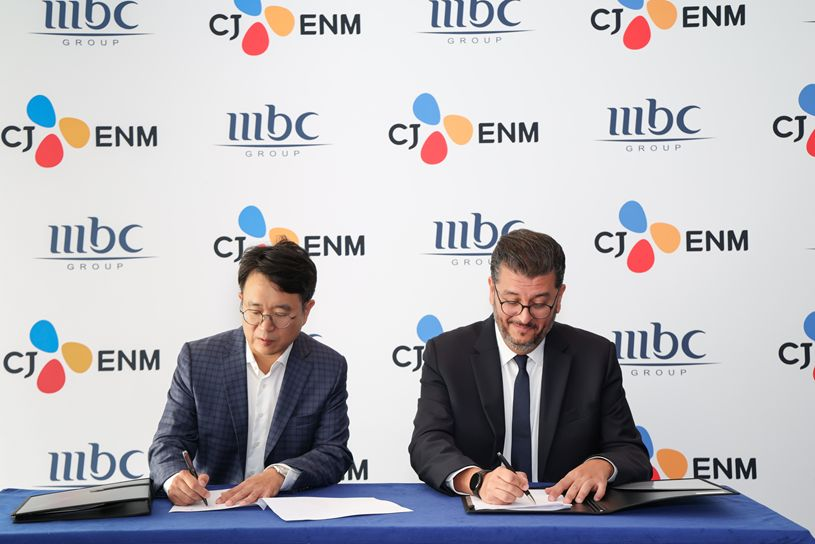
From 20 licensed titles to a hub in 16 months, with Riyadh as the base
CJ ENM’s first Shahid deal, in June 2025, covered 20 series including Lovely Runner, What’s Wrong with Secretary Kim, Goblin, Hotel del Luna and Mouse, The Guru reported. A month later it set up CJ ENM Middle East LLC in Riyadh, the first Saudi subsidiary of a Korean entertainment company. Chief executive Yoon Sang-hyun (윤상현) had already declared 2025, CJ ENM’s 30th anniversary, its “first official year of global expansion.”
The groundwork goes back further. CJ ENM signed a memorandum with Saudi Arabia’s Ministry of Culture in 2022, staged KCON in the kingdom in 2022 and 2023, and agreed a co-production and distribution pact with Saudi studio Manga Productions in 2023, Korea JoongAng Daily reported. This time the partners say they will go beyond supply into original IP development and production.
Shahid leads MENA with about 5 million paying subscribers and expects its first full-year profit
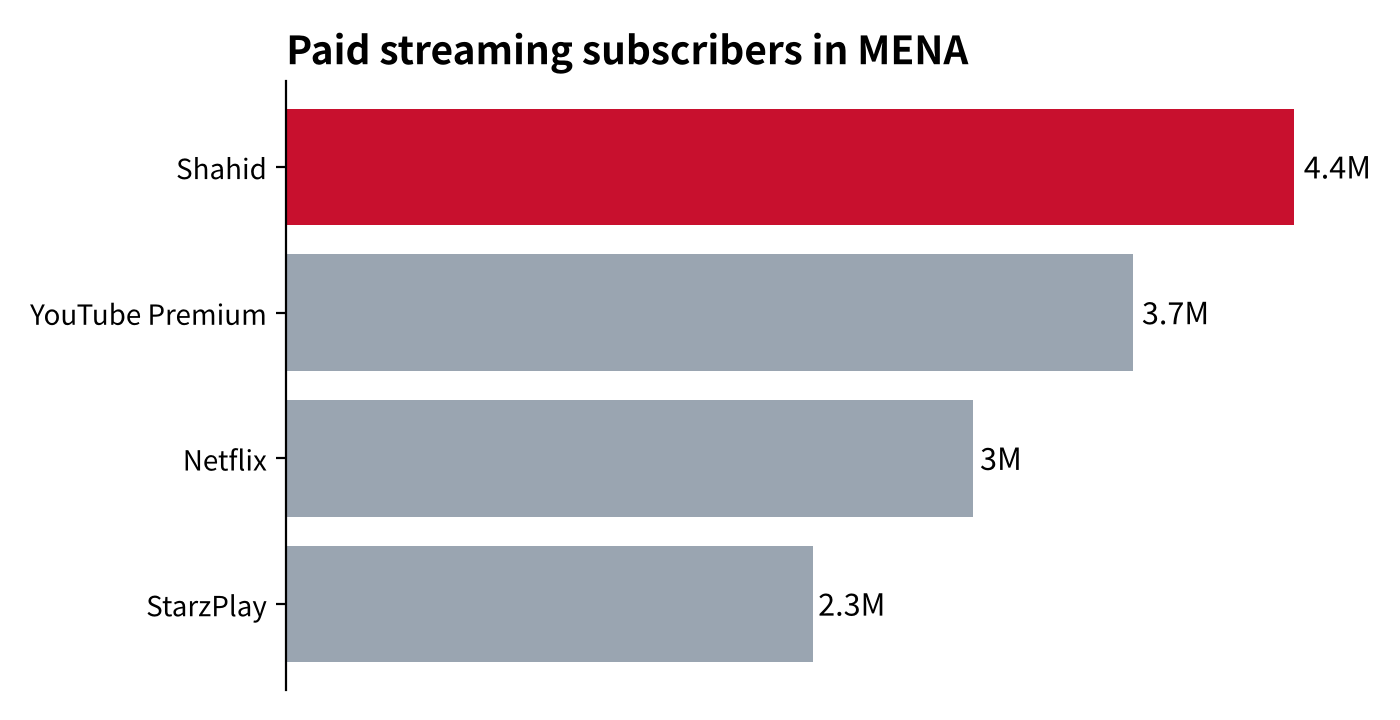
Shahid ended 2024 with roughly 5 million SVOD subscribers, up 25.6% in a year, and 18.6 million monthly users on its free ad-supported tier, according to MBC Group figures reported by Communicate Online. Research firm Omdia’s count in May 2025 put Shahid at 4.4 million, ahead of YouTube Premium (3.7 million), Netflix (3 million) and StarzPlay (2.3 million). Omdia expected MENA streaming revenue to pass $1.5 billion (about ₩2.02 trillion) by the end of 2025 and the region’s online video market to reach $8.4 billion (about ₩11.30 trillion) by 2029.
Revenue has followed. Shahid’s sales rose 26% to SAR 1.02 billion ($271 million) in the first nine months of 2025. MBC Group chief executive Mike Sneesby told Saudi business site Argaam on August 12 that SVOD revenue grew 23.3% in the first half and revenue from subscribers outside MENA 12%, and that Shahid should post a full-year profit in 2026, a year ahead of plan.
The rest of the group is contending with a weak ad market. MBC Group’s first-quarter revenue fell to SAR 1.6 billion from SAR 2 billion a year earlier, and Sneesby said advertisers had cut budgets and delayed campaigns amid regional tension. With advertising under pressure, Shahid needs products that hold subscribers, and same-week Korean drama is one.
Turkish drama on a five-year first look, Korean drama on one-off licences
Shahid’s schedule is built on Arabic originals topped up with pan-Arab, Egyptian, Gulf and Turkish shows. MBC Group signed a five-year first-look agreement with Turkish producers Medyapim and Ay Yapim at MIPCOM in 2022. Korean drama has so far come in through individual licences, such as the four KT Studio Genie (KT스튜디오지니) series placed on Shahid by distributor MediaHub. The TVING hub gives Korean drama a fixed shelf and a release calendar on the service.
The service was renamed MBC Shahid on January 2. Saudi Arabia’s Public Investment Fund became MBC Group’s majority shareholder last year. The Tadawul-listed group is unrelated to Korea’s Munhwa Broadcasting Corporation (문화방송, MBC).
Saudi viewers see K-drama as mainstream; language is where they drop off
In the Korea Foundation for International Cultural Exchange (KOFICE, 한국국제문화교류진흥원) 2026 Overseas Hallyu Survey of the Middle East, drama was the Korean content category viewers had most often watched, and in Saudi Arabia the one most often seen as mainstream. A report on KOCCA’s buyer portal WelCon analysing the survey concluded that viewers drop off because of language, not story. Citing PwC and Omdia, it noted that global entertainment and media revenue is forecast to grow only 3.7% a year through 2029, with Saudi Arabia and Türkiye among the fastest-growing markets. The new deal includes more Arabic dubbing and subtitling.
Disney+ Japan, HBO Max Asia, Prime Video India: a fourth overseas outlet in a year
TVING’s first hub opened on Disney+ in Japan last November — the first time Disney+ had given a local streaming service its own branded space in Asia-Pacific, Kyunghyang Shinmun reported. On January 2, HBO Max opened a TVING hub across 17 Asia-Pacific markets including Hong Kong, Taiwan and Southeast Asia. On July 27, CJ ENM agreed to supply more than 100 titles, 26 of them new, to Prime Video in India over two years, with Hindi, Tamil and Telugu dubs; Filing for Love, Kitchen Soldier and My Bias, My Boss are on that list too, Anime News Network reported.
A single new series can now go to Prime Video in India, HBO Max in Asia and Shahid in the Middle East. Because each platform already has paying customers, billing and local operations stay with the host. THR noted talk in the Asian industry that TVING might eventually launch on its own in key markets; CJ ENM has announced no such plan.
TVING’s first quarterly profit of ₩6 billion leans on overseas sales
TVING’s second-quarter revenue rose about 41% to ₩140.7 billion ($104.6 million) from ₩99.5 billion, and it swung to an operating profit of ₩6 billion ($4.5 million) from a ₩24 billion loss, Digital Daily reported. Monthly active users reached 9.7 million and ad revenue rose 52%. Chief financial officer Jang Hyun-kyung (장현경) told analysts on August 6 that overseas sales, on top of strong ad and subscription growth, completed the turnaround.
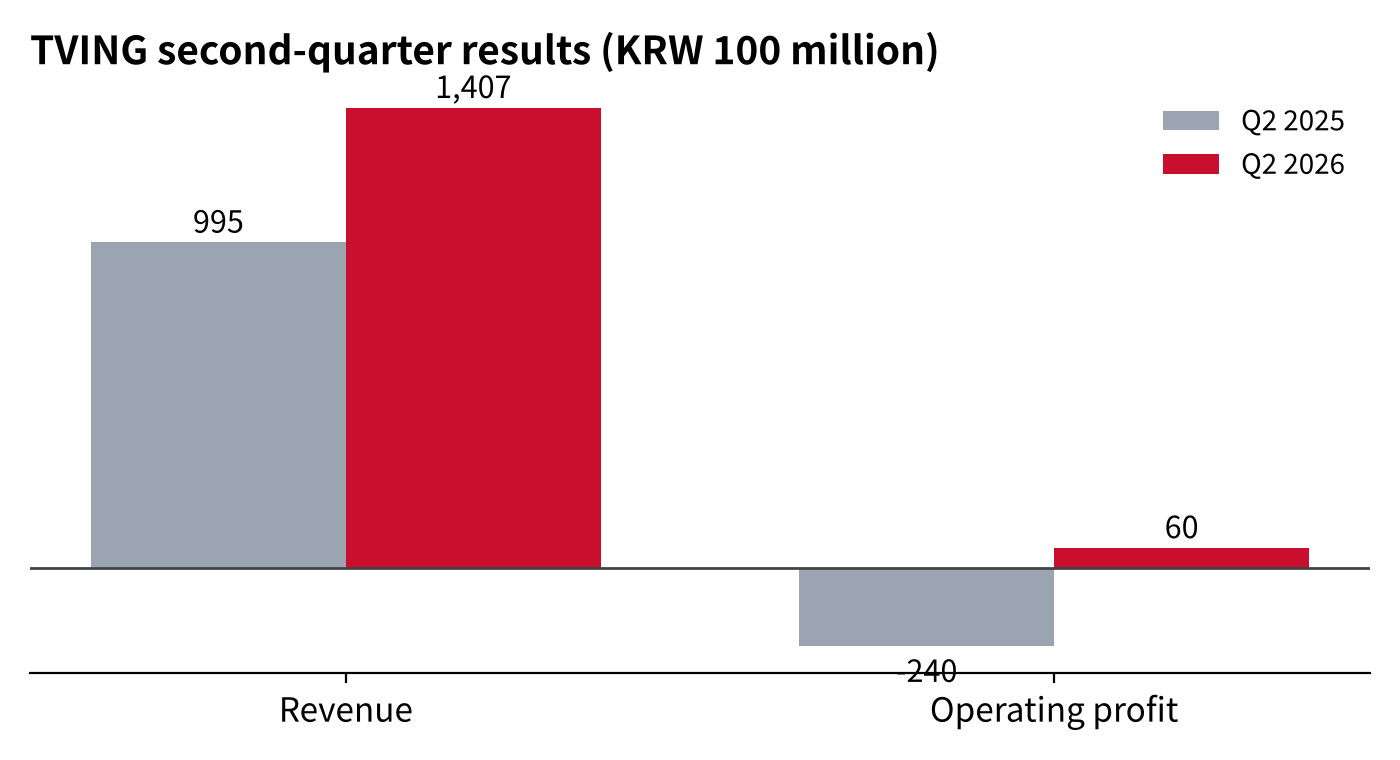
The company has warned that third-quarter profit will be weaker, as advertising slows seasonally, content costs rise and overseas sales dip for a while.
Because those sales swing from quarter to quarter, spreading them across Japan, Asia-Pacific, India and the Middle East also spreads the timing. CJ ENM is discussing advertising and content cooperation with KT and plans to press ahead with talks on merging TVING with rival Wavve (웨이브) in the second half; a merger would enlarge the Korean catalogue available for overseas hubs.
MENA streaming revenue seen near $7 billion by 2030, with about 50 million subscriptions
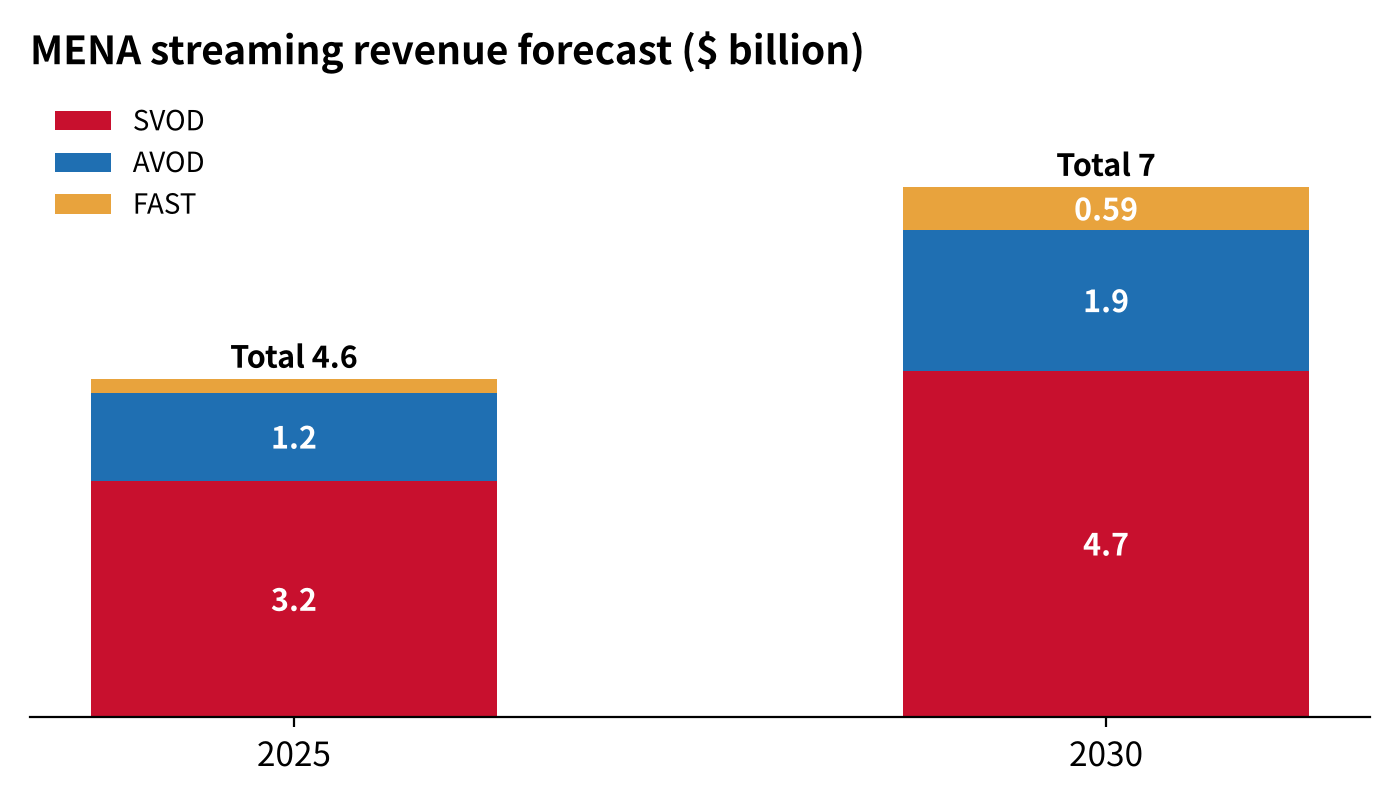
Research firm 3Vision forecast in March that streaming revenue in the region will grow from about $4.6 billion (₩6.19 trillion) in 2025 to nearly $7 billion (₩9.42 trillion) in 2030. SVOD rises from $3.2 billion to $4.7 billion, AVOD from $1.2 billion to $1.9 billion and FAST from $189 million to $590 million.
Paid subscriptions climb from about 35 million to almost 50 million, by which point roughly half of TV households would pay for at least one streaming service.
Pay-TV subscribers barely move over the same period, from 17.2 million to 17.8 million, and 3Vision says free-to-air television remains the centre of viewing.
The roughly 15 million new subscriptions will be fought over by streaming services, and exclusive or day-and-date titles are what draw them in. Research firms count different countries and categories, so the absolute figures differ from Omdia’s.
Netflix sells alongside Shahid: rival and distribution partner
In July last year MBC Group and Netflix launched a bundle in Saudi Arabia that puts Netflix, Shahid and MBC’s live channels on a single bill, sold through MBCNOW, the aggregator MBC launched in February 2025. The bundle costs more than 20% less than buying the services separately, Gulf News reported; it was Netflix’s first content bundle with a Middle Eastern media group.
Netflix is the biggest global outlet for Korean drama. Korean content took the largest share of non-English viewing on Netflix in the first half of 2026, The Korea Times reported on July 22. A Saudi viewer on the bundle will get Netflix’s Korean originals and the TVING hub on Shahid for one price. The two services compete for the same hours of Korean drama while using the bundle to keep churn down together.
Whether Shahid stays on top is another question. Digital TV Research, in a February 2024 forecast for the Arab region, expected Shahid VIP to reach nearly 6 million subscribers by 2029, ahead of Netflix at 5.6 million, with StarzPlay at 5 million and Amazon and Disney+ at 3.2 million.
Two in three new US specialty sign-ups come through Amazon Channels as storefront distribution spreads
In the US, selling inside someone else’s platform is already the main route for specialty streaming services. In Antenna’s second-quarter report, two of every three new specialty sign-ups came through Prime Video Channels, up 6 percentage points on a year earlier. Specialty gross additions through the Roku Channel rose from 566,000 in the first quarter of 2024 to 1.4 million in the second quarter of 2026, and sign-ups through YouTube Primetime Channels rose 47% year on year, The Desk reported on August 17.
Korean broadcasters tried this first. wavve Americas, a venture of KBS, MBC and SBS with SK Telecom, put its US service KOCOWA on Prime Video Channels in June 2022 at $6.99 a month. After launching in Europe and Oceania in April 2024, KOCOWA grew subscribers by an average 20% a month, The Korea Times reported last July. The storefront model the three broadcasters used under a joint brand in the US is the one CJ ENM is now using under the TVING name in Asia and the Middle East.
Storefront distribution has a churn cost. In Antenna’s data, 27% of specialty subscribers remain after 12 months, against 35% for the big services. The partners describe the TVING hub as a dedicated space within Shahid and have not mentioned a separate fee; if so, Shahid carries the retention risk and CJ ENM is paid for supply.
Korean broadcasters’ ad revenue down 31% in two years as overseas rights move to bundles
The Judge Returns is a Munhwa Broadcasting Corporation drama that premiered on January 2. TVING expanded its MBC drama and entertainment line-up from January, and CJ ENM says the show ranked third in its first week on the TVING Collection on Disney+ Japan, according to FlixPatrol. A terrestrial broadcaster’s drama is now reaching Japan and the Middle East under TVING’s name.
Korean broadcasters have mostly sold overseas rights title by title through distributors, as with the KT Studio Genie shows on Shahid. A hub sells a bundle instead: the platform gets a curated shelf and a Korean release calendar in one contract, and the supplier gets a branded space. As foreign platforms buy Korean drama this way, broadcasters with little leverage in one-off negotiations are more likely to reach overseas viewers through aggregators such as TVING.
Conditions at home push them toward overseas sales. Terrestrial broadcasters’ advertising revenue fell from ₩1.2091 trillion in 2022 to ₩927.3 billion in 2023 and ₩835.7 billion ($621 million) in 2024, down 30.9% in two years, according to the Korea Communications and Media Commission (방송미디어통신위원회) broadcasting industry survey, as reported by the Journalists Association of Korea on January 2. Online took 59% of Korea’s ₩17.13 trillion ad market in 2024, the national ad-spend survey found. The larger the overseas share of revenue, the more a broadcaster has to decide whether to sell under its own name or join a bundler’s shelf.
The MBC4 clause points to another way to sell. In the Middle East, free-to-air television still pays: MBC Group’s TV revenue rose 13.3% to SAR 863.4 million in the first half of 2025. Pairing a streaming hub with an exclusive broadcast window lets a Korean seller price streaming and broadcast rights separately in the same market. The day-and-date clause also reaches into production: subtitles in Arabic on the night of broadcast require locked scripts and translation running ahead of air dates.
Outlook: no launch date yet, and a 50-million-subscription market competing for Korean drama
The deal’s real size will show once the hub opens and MBC4 publishes its schedule. Filing for Love, The Judge Returns and My Bias, My Boss have already aired in Korea, and the later the hub opens, the fewer titles will actually go out day-and-date.
For MBC Group, the next milestone is Shahid’s first full-year profit. Sneesby told Argaam the group would keep room to reinvest in premium Arabic content, B2B partnerships and international expansion rather than chase near-term margin, and a Korean drama hub falls under partnerships. While advertising is weak, Shahid leans harder on subscriptions, and Korean series released the same week as at home are a tool against churn.
For CJ ENM, the questions are the stability of overseas sales and the size of the slate. Four outlets spread the timing of sales, but a third-quarter dip has already been flagged, and a Wavve merger would enlarge what TVING can place abroad. If the joint IP development the partners promised produces an actual show, the relationship will move from licensing to co-production.
Korean drama will reach the Middle East through three routes: titles Netflix makes or buys itself, the TVING hub inside Shahid, and one-off sales through distributors. As subscriptions approach 50 million, day-and-date Korean series are something both Netflix and Shahid want. The storefront model that became the main route into US specialty streaming is moving into Asia and the Middle East, and for Korean sellers, where a show sits and under whose name are now on the table alongside the licence fee.