

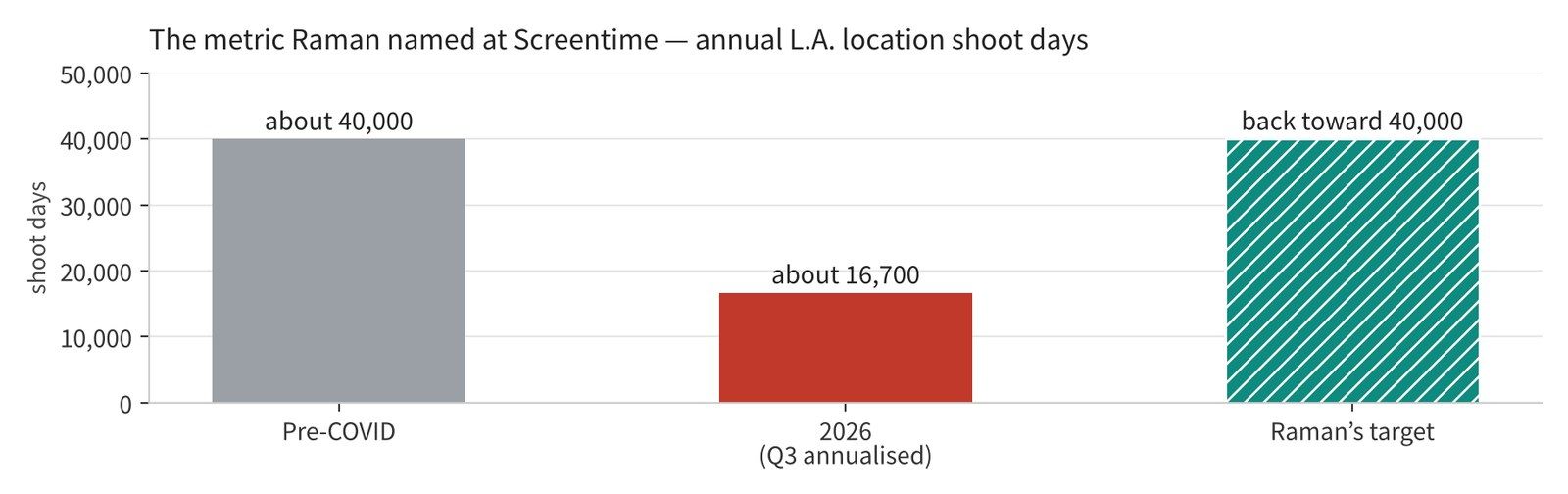
Raman beats Bass with 51.7% and names her metric at Screentime: reversing the slide in L.A. location shoot days from about 40,000 before COVID to under 20,000. Luminate counts cable series down 42% since 2019 and 122,000 U.S. production jobs gone since 2022
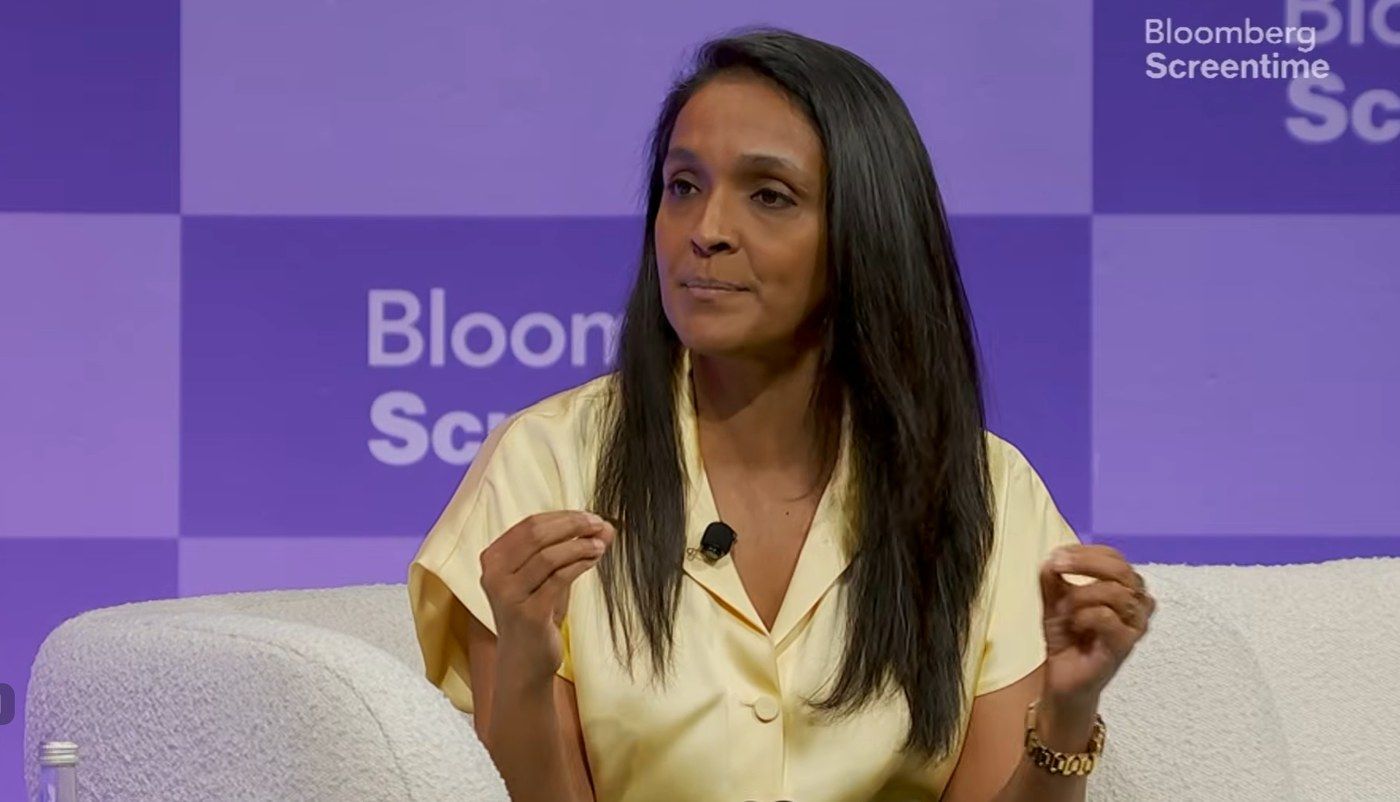
Nithya Raman has unseated Karen Bass as mayor of Los Angeles, taking 51.7% of the vote to Bass’s 48.3%, a margin of about 34,000 ballots. Bass conceded on Thursday and The Associated Press called the race the same day. Raman becomes the city’s 44th mayor and its first Asian American one.
A month before the vote she named, on stage at Bloomberg Screentime, the number she wants to be judged by. Asked what she would want to show four years out, after the moderator cited on-location film and TV shoot days falling from about 40,000 before COVID to below 20,000, Raman said reversing that decline “would really be the most important metric,” and getting back to pre-strike levels “would be incredible.” Asked whether it was achievable, she said: “I don’t know, but I think you have to dream big. Let’s increase production days year on year… And if I’m mayor, I’ll be committed to that. I’ll hold myself to those standards.”

The interview opened on news from September that American Idol is moving production from Los Angeles to Georgia — a show about chasing dreams leaving the city people move to in order to chase them. Raman’s answer drew the boundary herself: “There’s a lot about these decisions that is outside of the scope of a mayor, but I think there’s a lot more that the mayor of Los Angeles should be doing.” What she listed was long permit timelines, the additional homeowners’ association fees a production sometimes has to pay to shoot somewhere, and “costs for fire and police that other productions and other cities don’t have.”
The production count has pointed one way all year. FilmLA reported on Oct. 21 that Greater Los Angeles logged 4,171 on-location shoot days in the third quarter, down 4.8% year on year. But part of why the number will not move sits outside the city. Luminate Intelligence’s May special report, Hollywood Exodus 2026, argues that the volume of content being made in the United States is itself shrinking.
| Detail | |
|---|---|
| Election day | Nov. 3, 2026 |
| Result | Raman 51.7% / Bass 48.3%, a margin of about 34,000 votes |
| Concession | Bass conceded Nov. 5; AP called the race the same day |
| Certification | Los Angeles County Nov. 27; California Dec. 11 |
| Term | Four years, overlapping the 2028 Summer Olympics |
| Union split | The Writers Guild of America West backed Raman; IATSE and several other major unions backed Bass |
| Her own metric | Grow annual location shoot days year on year, back toward pre-strike levels |
Sources: The Hollywood Reporter, The New York Times, Bloomberg Screentime interview, county election officials. Compiled by K-EnterTech Hub

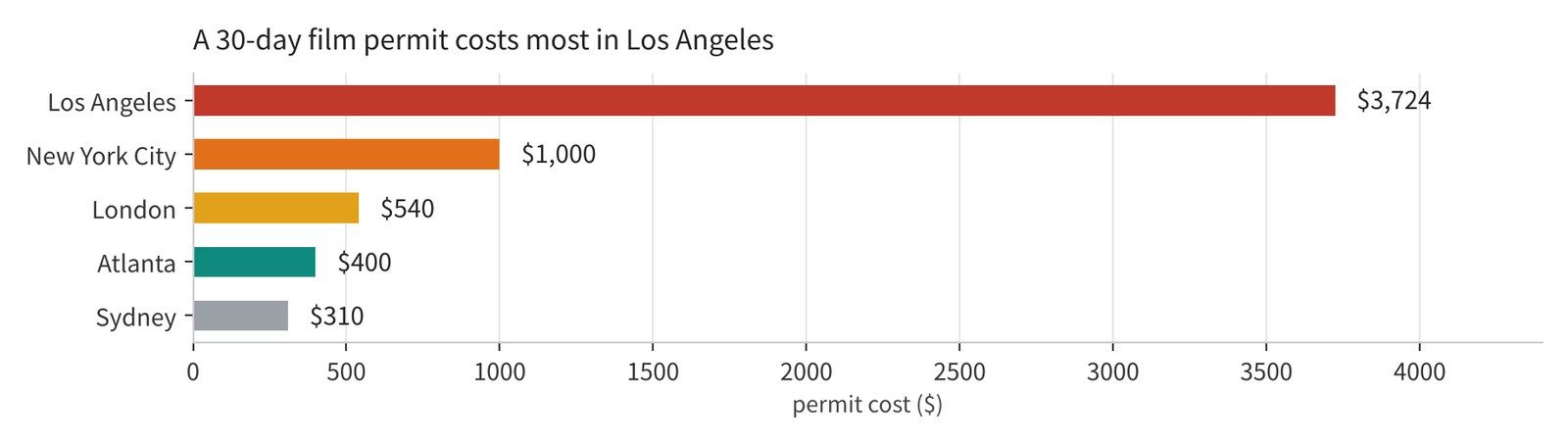
$3,724 for a 30-day permit — 3.7 times New York
On Milken Institute figures, a 30-day film permit costs $3,724 in Los Angeles against $1,000 in New York City, $540 in London, $400 in Atlanta and $310 in Sydney. Luminate cites those numbers to argue that reforms at the local level “would arguably be more effective for L.A. filmmakers than state or even federal shifts.” The friction Raman listed on stage is what that gap is made of.
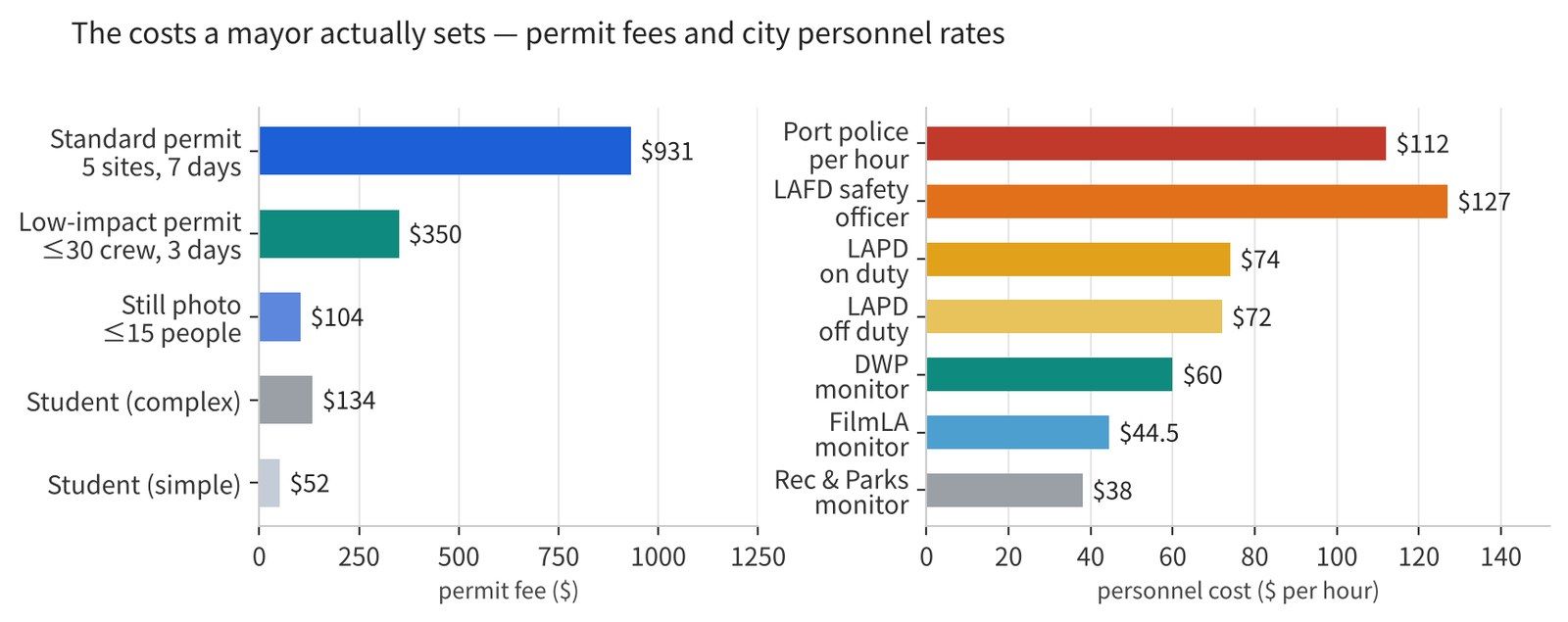
The city’s own application fees are $931 standard, $350 low-impact for 30 or fewer crew across three locations in three days, and $104 for a still shoot of 15 or fewer. City personnel costs are added and not waived: an LAFD safety officer bills $127 an hour on a four-hour minimum plus travel, an on-duty LAPD officer $74, and a FilmLA monitor $44.50. That is the line Raman meant. The Griffith Observatory fee came down from $100,000 to $30,000, FilmLA launched the low-impact tier as a pilot on April 27, and the council directed the City Attorney in March to draft a free “micro-shoot” permit that still does not exist.
| Friction Raman named | What it is | Where the power sits |
|---|---|---|
| Permit timelines | How long it takes to get a permit back | Mayoral; run through the film office |
| HOA fees | Additional homeowners’ association fees to shoot in certain areas | Neighbourhood conditions; ordinance and negotiation |
| Fire and police costs | City personnel charges other cities do not impose | City personnel rules; council vote |
| Jurisdictional conflict | Baywatch hit problems because city and county are separate jurisdictions | Mayor convenes the other jurisdiction |
| Tax credit | An uncapped credit structured to match how productions are financed | Sacramento; a mayor can only advocate |
Sources: Bloomberg Screentime interview, Oct. 1, 2026; FilmLA fee schedule. Compiled by K-EnterTech Hub
A film office inside the mayor’s office, with power to overrule departments
The pledge Raman described in most detail is a film office housed in the mayor’s office. She set three conditions for it: staff who know how productions work, staff who know how the city works, and the guarantee of mayoral power behind it. “The city is a maze,” she said. “It took me a long time to figure out what was happening, how departments spoke to each other.” She offered a shoot in her own district that needed the trash collection day moved to avoid noise, which her council office had to handle — work she wants the film office to absorb.
On authority she was blunt: “Nothing happens in the city without knowing that there is real power behind those decisions.” The office, she said, would have the full force of the mayor’s office “to be able to make decisions, to overrule departments, or to force departments to talk to each other if necessary, or to engage with other jurisdictions.” Her example was Baywatch, which ran into trouble at the beach because the city and the county are different jurisdictions. Luminate logs the same episode, noting that the dust-up over Fox’s Baywatch reboot at Venice Beach went public in April and made L.A.’s production headaches an issue in the mayoral race.
Raman acknowledged that Los Angeles runs a weaker-mayor system than New York. She pointed instead to powers written in at the last charter reform: hiring and firing department heads, setting priorities, and setting the accountability metrics by which general managers are judged. “That appointment power does not rely on the council,” she said, adding that department heads had ignored motion after motion she filed as a councilmember. Of the incumbent’s use of the office: “When you don’t use the powers that you have, you look like you don’t have them.”
“I want them to be spent in Los Angeles” — addressed to Ellison
On the Paramount–Warner merger Raman set down the fight she had backed. “The deal is essentially done. I think the last court block on it was removed, I think, yesterday,” she said. “I don’t want to be relitigating this into eternity.” Instead she addressed the buyer directly: “To David Ellison, to his co-CEO — I don’t just want those dollars that you’ve committed to productions to be spent in America. I want them to be spent in Los Angeles.” As mayor, she said, she would work with them and fight to see every one of those shoots happen in the city.
The commitment she is pointing at exists on paper. The settlement state attorneys general reached with Paramount on Sept. 21 contains a pledge to raise US production spending by at least $1.5bn, with further increases if a federal film incentive and uncapped California and New York credits pass, a commitment not to move the studio’s headquarters out of California, and a requirement to divest the 49% Miramax stake if the company fails to release 30 theatrical films a year — all subject to a force majeure clause. The unit of that pledge is America; the unit Raman wants is Los Angeles, and that is the gap she named. The same day, the WGA settled its own suit for $17.5m into the guild health plan and a bar on layoffs at CBS News’ broadcast division, saying it had not blocked the merger but had “brought more attention to the harms.”
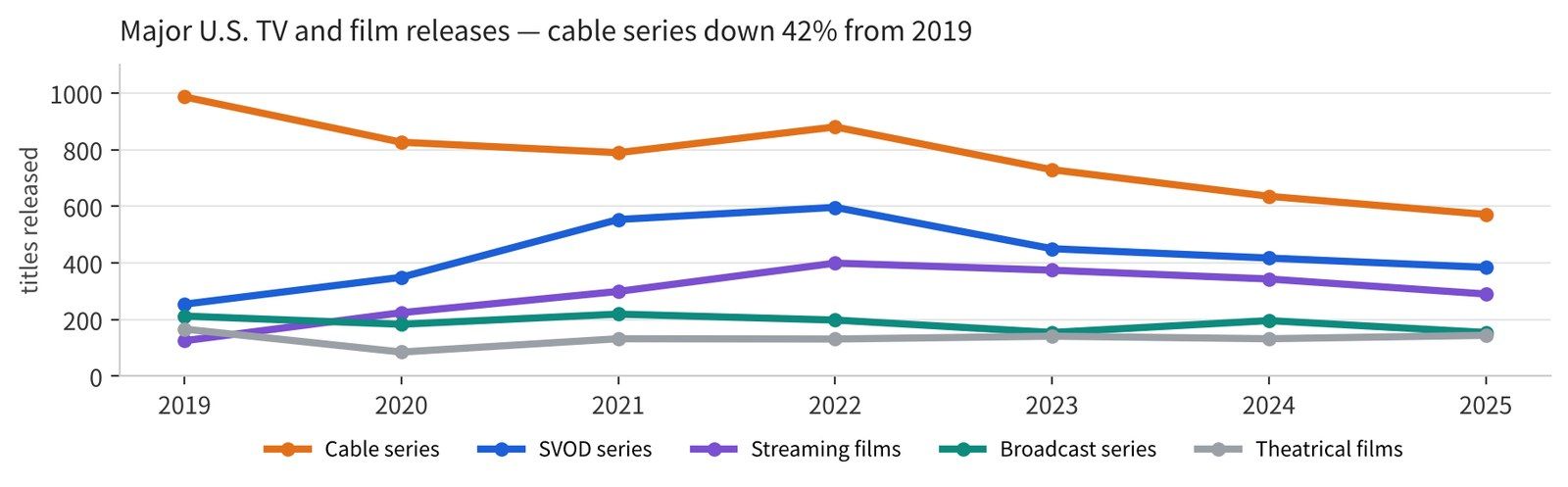
It is not only L.A.’s share that shrank — cable down 42%, streaming off 30%
Luminate’s argument turns on a sentence about its own title. “A better title for this report might be Hollywood Shrinkage,” it says: the problem is not only that less content is being made in L.A. since peak TV, but that less traditional entertainment content is being made overall. Twenty-two-episode broadcast network series have been supplanted by six-to-ten-episode streaming shows, consolidation and digital competition are squeezing the industry, and the pursuit of efficiencies is pushing studios toward offshore production centres.
The counts bear it out. Among major U.S. releases, cable series fell from 986 in 2019 to 571 in 2025, a 42% drop; broadcast series went from 212 to 154. Together, broadcast and cable have shed close to 40% of their series volume since the pandemic. Streaming turned too: SVOD series fell from 596 in 2022 to 384 in 2025 and streaming films from 399 to 290, so streaming output across film and TV is down more than 30% from its 2022 peak. Theatrical releases reached a post-COVID high of 144 in 2025 and were still 13% below 2019.
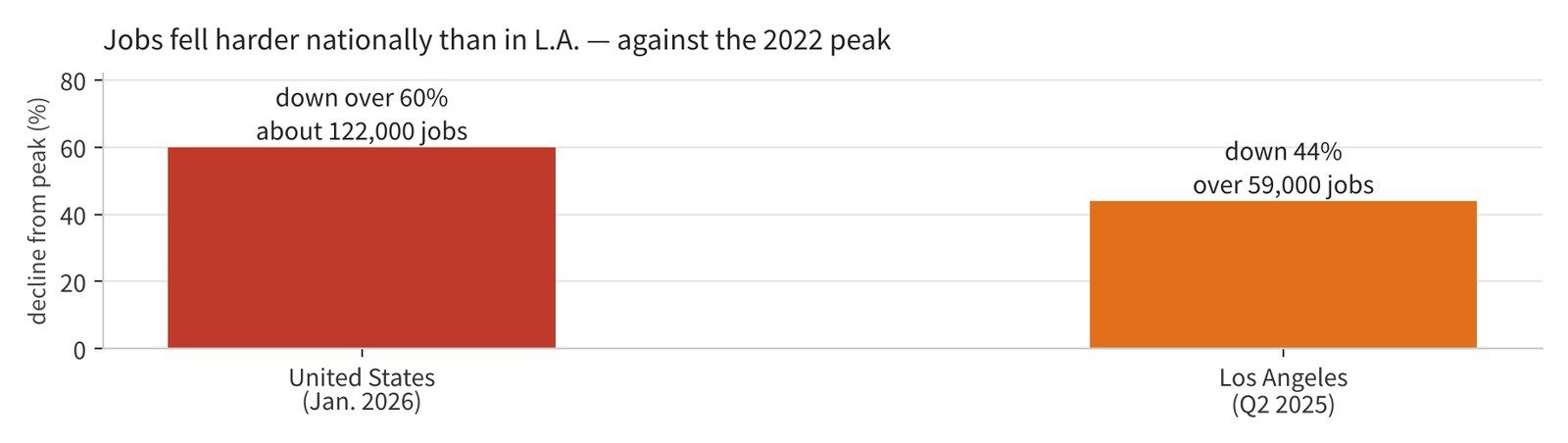
Employment fell harder nationally than locally. On Bureau of Labor Statistics data cited in the report, total U.S. film and TV production jobs as of January 2026 were down more than 60% from their 2022 peak, a loss of nearly 122,000 jobs; Los Angeles was down 44% as of the second quarter of 2025, more than 59,000 jobs. “While offshoring played a role in this decline,” the report says, “reduced overall production is arguably the bigger culprit, and it’s doubtful that a federal film and TV tax credit would revive studio output to peak levels.” It also cites pre-COVID studies finding that production incentives alone have little effect on employment, one of them tying California’s film industry jobs much more strongly to the overall U.S. labour market.
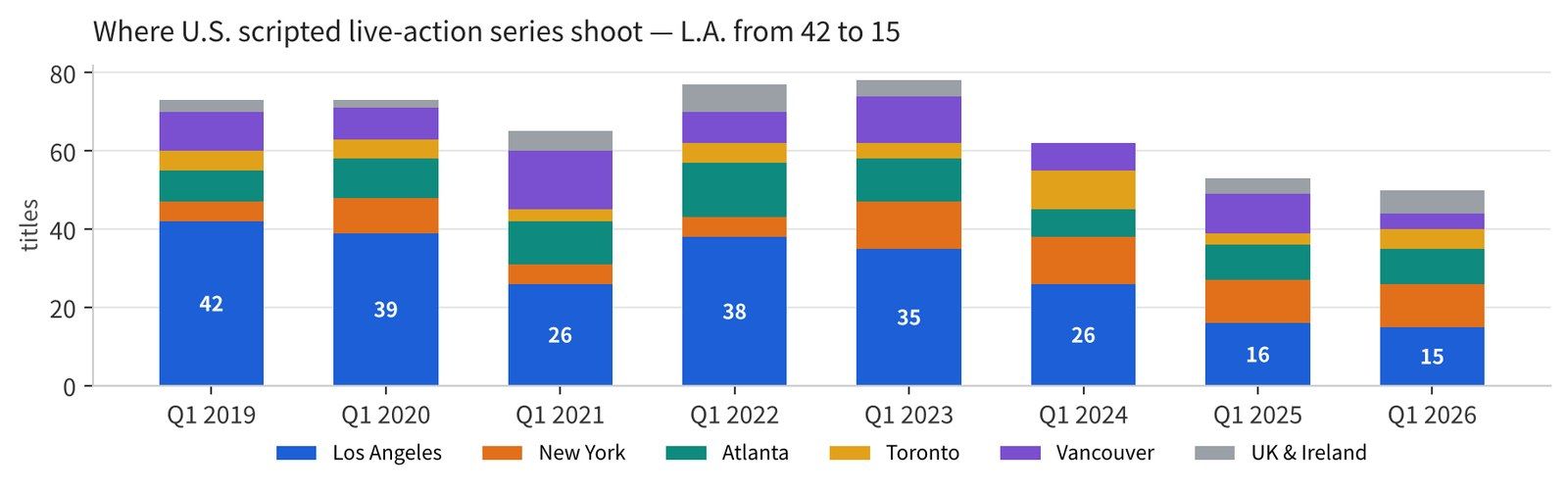
Inside that smaller market, L.A.’s share fell separately. Among U.S. scripted live-action series counted by first quarter of release, Los Angeles went from 42 titles in 2019 to 15 in 2026. Forty percent of U.S. scripted series released in Q1 2019 filmed in the city, the report notes, against less than 25% for Q1 2026. New York moved from 5 to 11 over the same span and Atlanta from 8 to 9, while Vancouver fell from 10 to 4. The UK and Ireland show up hardest in studio film: 49 titles in 2025 against Los Angeles’ 20.
127 incentive programmes — and the two California still lacks
Competition for a smaller pool has intensified. Luminate counts film and TV production incentive programmes worldwide rising from 88 in 2017 to 127 in 2026. In the United States, Wisconsin rejoined on Jan. 1, 2026, leaving 38 states plus Washington, D.C. with some form of incentive and only 12 states without one. “More jurisdictions [are] fighting for a share of a smaller pie,” the report says, and “production is becoming more splintered and diffuse.”
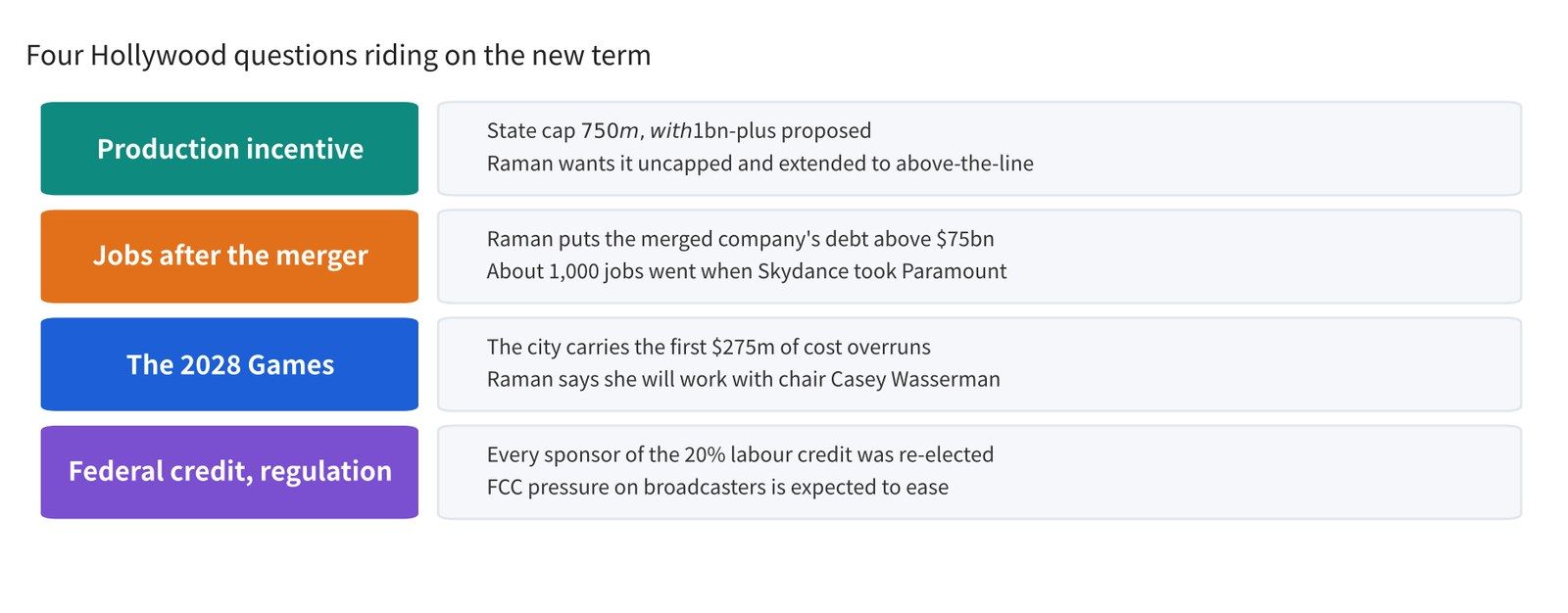
California’s own reform last year raised the base credit to 35% of qualified expenditures from 20–25%, with a 5% bonus for relocating TV series. Per-project limits on eligible expenses rose to $120m for non-independent projects and $20m for independents, and animated titles, half-hour series and large-scale competition shows qualified for the first time. The annual cap is $750m, and Governor Gavin Newsom proposed on Nov. 2 raising it to at least $1bn. Two gaps remain, both flagged in the report: above-the-line costs do not qualify, and California has no standalone post-production credit, which has contributed to visual effects work leaving the state. That is the hole behind Raman’s call for credits “structured to actually match how productions are financed.”
| Location | How the programme works | Above-the-line and post |
|---|---|---|
| California | $750m annual cap, 35% base credit, 5% bonus for relocating series; $1bn-plus proposed | Above-the-line excluded; no standalone post credit |
| New York | $800m annual cap, $100m of it for independents; programme began in 2004, five years before California | Credits both above-the-line and post-production |
| Georgia | 20% credit with no per-project or annual cap; 10% bonus for carrying a promotional logo | Reinstated a post-production credit last year |
| New Jersey | 40% credit for three “studio partner” slots, claimed by Lionsgate, Netflix and Paramount | Expanded credits for long-term facility investment |
| United Kingdom | Uncapped 34% credit | Above-the-line, including actor salaries, qualifies |
| Canada | Federal credit stacks with provincial incentives, most of them uncapped | Varies by province |
Sources: Luminate Intelligence, Hollywood Exodus 2026; California Film Commission; Empire State Development; Georgia Dept. of Economic Development. Compiled by K-EnterTech Hub
The federal piece is still a bill. The Motion Picture, Television, and Entertainment Revitalization Act, introduced Sept. 24 by Senators Tim Scott and Adam Schiff, would apply a 20% credit to labour costs with 5% bonuses to a 30% ceiling for productions costing more than $1m that shoot at least 75% of principal photography in the United States, effective after Dec. 31, 2026. Asked whether a state credit and a federal one together would be enough to change the economics, Raman said she hoped so: “the talent in this city is unmatched… if the economics could work, people would choose to shoot here every time.”
Korea’s credit also tops out at 30% — but it runs off production cost
Under Korea’s Restriction of Special Taxation Act the audiovisual content production credit runs at 5% for large companies, 10% for mid-sized and 15% for SMEs, with a top-up of 10 percentage points for the first two and 15 for SMEs where at least 80% of production spending stays in Korea — a 30% ceiling. The 2025 tax revision extended the scheme by three years and added a credit for webtoon production costs. On the headline rate, that matches the US federal bill’s 30% ceiling.
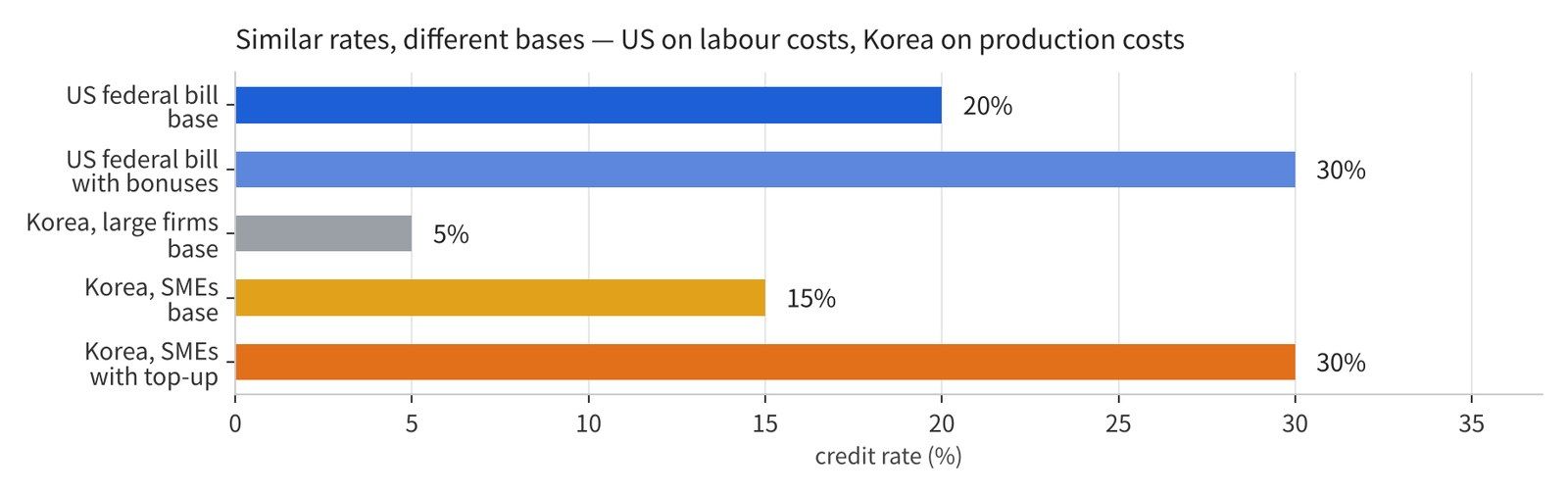
The base and the administration differ. The federal bill applies its rate to labour costs; Korea applies its rate to production costs net of marketing. The above-the-line gap Luminate flags in California does not arise in Korea, where those costs already sit inside the qualifying base, and post-production is covered for the same reason. Nor does Korea allocate an annual pot competitively as California and New York do. On design, Korea already has the items American states are retrofitting.
What is missing is the other layer. The permit timelines, fees, filming zones and jurisdictional brokering Los Angeles controls correspond in Korea to municipal film commissions and their location incentives — but no Korean data publishes a 30-day permit cost in a form that can be set beside another city’s. Nor is there a Korean equivalent of FilmLA’s quarterly shoot-day count and incentivised share. Raman could pick shoot days as her metric because that number is published on the same basis every quarter.
| United States | Korea | |
|---|---|---|
| National credit | Bill stage. 20% of labour costs, 30% with bonuses | In force. 5–15% of production costs, 30% with top-up |
| Above-the-line | Excluded in California; included in New York and the UK | Inside the qualifying base; not a live issue |
| Post-production | No standalone credit in California; Georgia restored one last year | Inside the qualifying base |
| Annual pot | State caps allocated competitively — New York $800m, California $750m | No cap; applies where conditions are met |
| Municipal layer | A 30-day permit costs $3,724 in Los Angeles, $1,000 in New York | No published permit costs comparable across cities |
| Published data | FilmLA publishes quarterly shoot days and incentivised share | No quarterly count on a comparable basis |
Sources: Luminate Intelligence, Milken Institute, FilmLA, Restriction of Special Taxation Act. Compiled by K-EnterTech Hub
| What to check | What the U.S. data shows | The Korean read |
|---|---|---|
| The denominator | Broadcast and cable series down ~40%; streaming off 30% from 2022 | A comparable annual count of Korean drama and entertainment commissions |
| Limits of incentives | Studies find incentives alone have little effect on employment | The evidence base when credit expansion is argued as job creation |
| Administrative cost | A 30-day permit costs up to 12 times more in one city than another | Published municipal permit times and fees, comparable across cities |
| Force of a pledge | The $1.5bn commitment carries a force majeure clause | Who verifies inward-investment agreements, and what follows if they lapse |
| What replaces the work | Shorter, lower-paying work — vertical dramas — expected to take up the slack | Terms for Korean short-form and vertical crews, and whether they enter the statistics |
Sources: Luminate Intelligence, Hollywood Exodus 2026; FilmLA; Milken Institute. Compiled by K-EnterTech Hub
Conclusion and outlook
Raman chose a number that is published every quarter, which makes it checkable. What moves that number, though, is split across three layers. Permit timelines, fees and jurisdictional brokering run from the mayor’s office. The credit cap and whether above-the-line qualifies belong to Sacramento; the 20% labour credit belongs to Washington. And total production volume sits in none of the three. With broadcast and cable having shed close to 40% of their series volume and streaming down from its 2022 peak, Los Angeles could win back share and still not see 40,000 shoot days.
Four things are checkable early in the term: how much of Newsom’s proposed $1bn cap survives the budget process; whether California retrofits above-the-line and post-production credits; whether the 20% federal labour credit holds its Dec. 31, 2026 effective date; and how much of the $1.5bn production-spending pledge lands in Los Angeles rather than merely in America. That last one is where Raman’s line to Ellison gets tested in figures. For Korea the first finding is that the same questions cannot yet be asked: with no quarterly shoot-day count, no comparable permit costs and no published incentivised share, any target set today has no way of being verified in four years.
Note: quotation marks carry remarks as reported or as given in the published interview; unquoted passages summarise. ₩1,341.67 to the dollar (close, Nov. 5, 2026). Vote shares are as of the Nov. 5 morning count; Los Angeles County certifies on Nov. 27. The 2026 annual shoot-day bar annualises the 4,171 third-quarter figure and will differ from the eventual annual count. The 40.3% incentivised share is FilmLA’s Q3 figure for scripted location shoot days; the 7% Luminate cites for Q1 is measured against all shoot days.