
Fandom is the thread running through the Lakers, Cosm and LiveRamp deals… for Korea, the question is how to earn money after securing venues and media rights
BRIEF Sports teams, venues, franchise IP and fan data command a premium in U.S. media deals, as investors back assets that draw fans and monetize them through tickets, rights and ads. As Korea adds venues and bids for rights, the question is who keeps the fan relationship.
U.S. media companies and investors are pouring money into businesses that meet fans directly. They are buying sports teams, investing in venues and immersive theaters, and acquiring data companies that link audiences' tastes and purchase histories. The targets differ, but the math is similar: secure a reason for fans to come, then harvest ticket, media-rights and advertising revenue from that relationship for years.
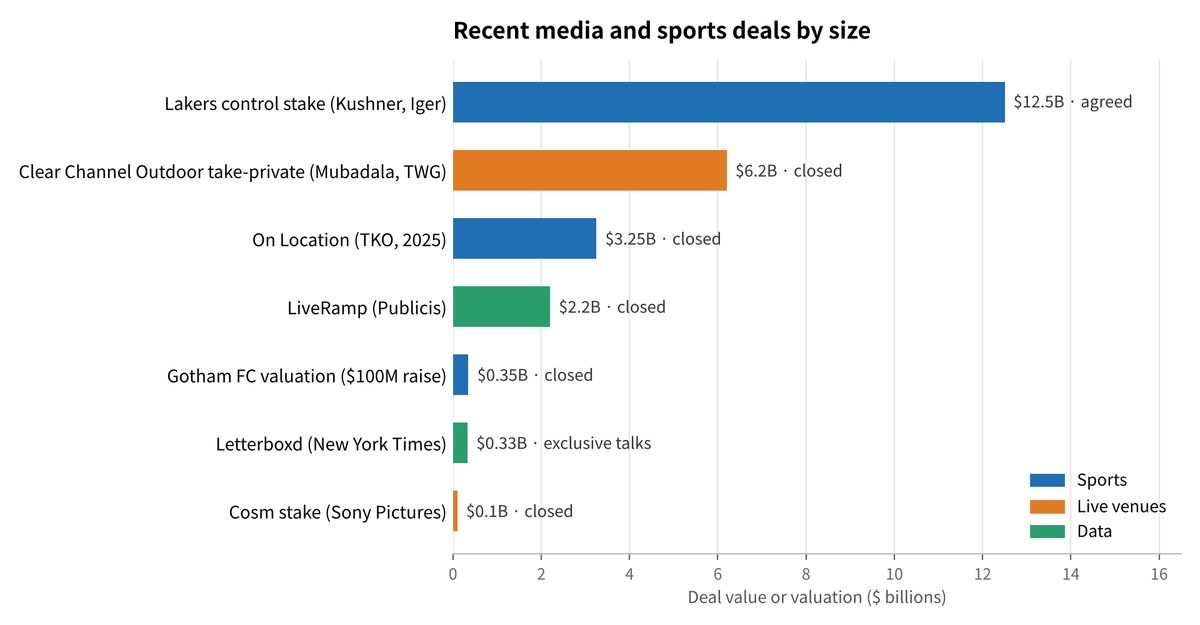
The clearest example came in August, when venture investor Josh Kushner and former Disney CEO Bob Iger agreed to buy the NBA's Los Angeles Lakers at a $12.5 billion valuation. That was 25% above the $10 billion valuation at which Mark Walter took control in October 2025, just 10 months earlier.
Axios reported on Nov. 14, citing investment bankers, that media M&A demand is converging on sports, live events, franchise intellectual property and consumer data. A popular team's game or a particular artist's concert can't be supplied elsewhere at the same time. If the owner can also sell tickets directly to fans and learn their tastes and purchase histories, a one-off hit can turn into the next sale.
Buyers are also looking beyond venues to ticketing, production technology and event hospitality and travel services. Alex Michael, global head of sports and entertainment at media investment bank LionTree, told Axios he believes in investing in offline experiences — the so-called "analog trade." Companies are widening their reach to the places where content is consumed and the customers who show up there.
Paramount Skydance completed its takeover of Warner Bros. Discovery on Oct. 6. French ad group Publicis Groupe bought data-connectivity platform LiveRamp for about $2.2 billion on Nov. 2. Sony Pictures Entertainment invested in Cosm, which runs immersive screening venues. Studio IP, the places audiences gather and the data that measures advertising results each sat at the center of a deal.
The live market grows, but valuations diverge
Revenue across cinema, live music, out-of-home advertising and trade shows reached about $149 billion in 2025, nearly double 2021, according to consultancy PwC, which projects about $174 billion by 2030. PwC partner Bart Spiegel says attending concerts and games has become "social currency" that younger consumers use to present themselves on Instagram and TikTok. Shared on social media, the experience brings in the next audience.
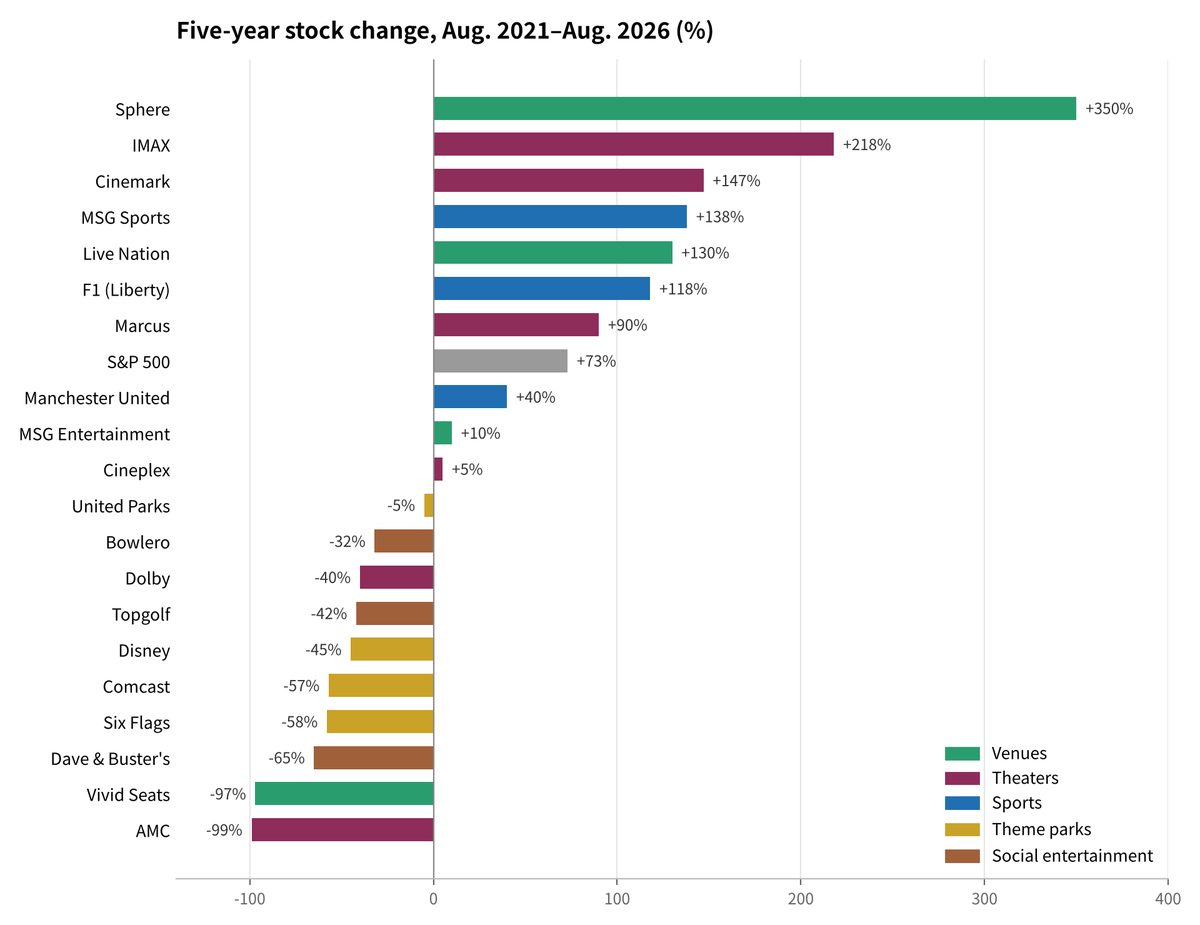
Selling in-person experiences doesn't guarantee a rich valuation, though. In an Axios comparison of stock performance from August 2021 to August 2026, the S&P 500 rose in the 70% range, Sphere about 350% and IMAX more than 200%. AMC Entertainment and ticket reseller Vivid Seats lost most of their value, and companies with theme park businesses, including Disney, Comcast and Six Flags, lagged. Six Flags saw attendance and earnings fall after raising prices, and one operator of the much-copied "Immersive Van Gogh" exhibitions went bankrupt in 2023. What separated winners from losers was whether the experience was distinctive enough for audiences to pay extra.
The price of fandom on teams and new leagues
The Lakers deal still needs NBA owner approval. Walter, the seller, joined Clear Channel Outdoor's $6.2 billion take-private in October as a co-investor. The Cadillac F1 team in which he holds a majority stake is also selling equity. Fenway Sports Group is among the suitors, The Wall Street Journal reported, and Walter's side values the team at more than $3 billion.
The money has spread to women's sports and new leagues. NWSL club Gotham FC raised $100 million at a $350 million valuation, 84% above Forbes' April estimate. New women's basketball league Unrivaled launched with a TNT Sports deal and more than 20 brand partners. The International Dance League (IDL) signed its first media-rights deal with ESPN and aired its Aug. 27 Seoul event on ESPN2 — an attempt to turn the profile of dancers who have worked with artists such as BTS into teams, seasons and regular competitions.
Why content companies are investing in screens and venues
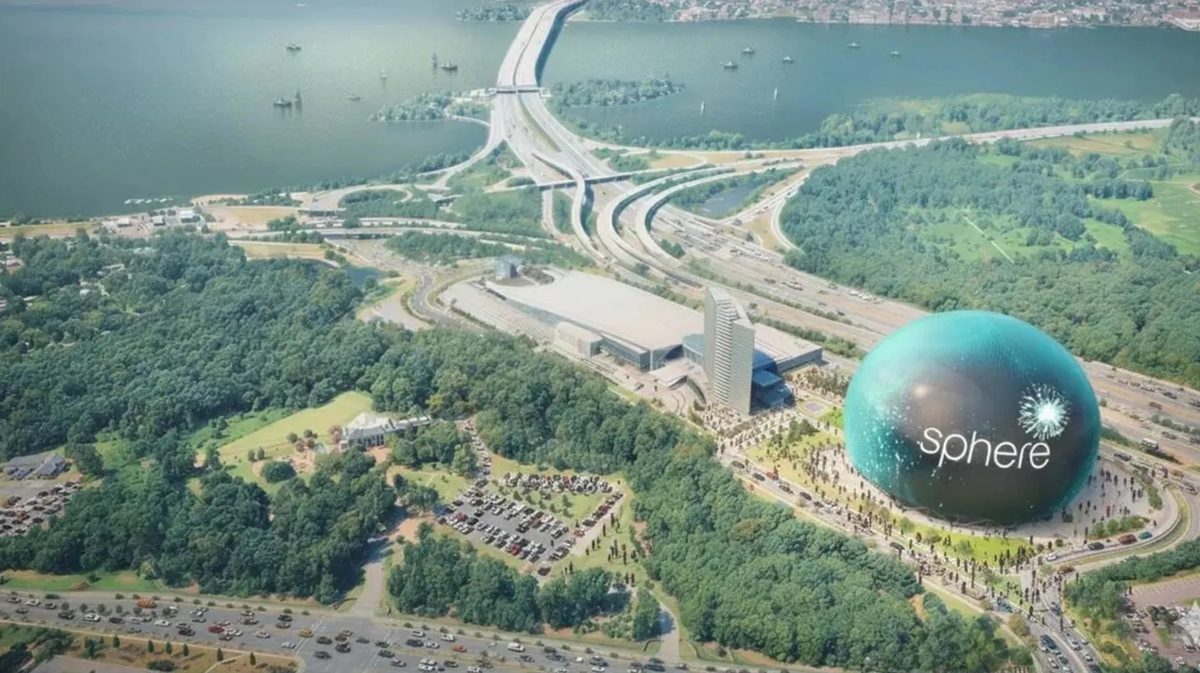
Sony Pictures made a $100 million strategic investment in Cosm on June 24. Having bought theater chain Alamo Drafthouse in 2024, it now has both conventional cinemas and immersive domes in its business base. Maryland's Prince George's County gave final approval on Oct. 27 to a 6,000-seat Sphere at National Harbor outside Washington, a $1.4 billion project backed by $215 million in county bonds. Premium screens are proving profitable too: IMAX's average U.S. adult ticket costs $20.57, more than 60% above a standard ticket's $12.75, yet Christopher Nolan's "The Odyssey" earned more than $400 million in IMAX alone.
Five new NFL stadiums in a row will have roofs… Chiefs plan a $3 billion dome in Kansas
On Nov. 11 the Kansas City Chiefs named a joint venture of Clark Construction Group and AECOM as the construction team for their new stadium in Wyandotte County, Kansas. The fixed-roof, 70,000-seat venue will begin sitework in 2027 and open for the 2031 season. Two days earlier, the state of Kansas and the Unified Government of Wyandotte County and Kansas City, Kansas, reached an agreement on the boundaries of the stadium financing district. The Chiefs will leave open-air Arrowhead Stadium, their home since 1972, for a building across the state line.
Nine NFL teams are spending about $20 billion to build or renovate stadiums. According to Sports Business Journal, starting with the Tennessee Titans' new Nissan Stadium, which opens in April 2027, the next five new NFL stadiums — Cleveland (2029), Washington, D.C. (2030), and Kansas City and Denver (2031) — will all have roofs. The $2.1 billion Nissan Stadium was fully enclosed on Oct. 9. Jacksonville is adding a canopy in a $1.4 billion renovation, though its open sides mean it will not be a true dome.
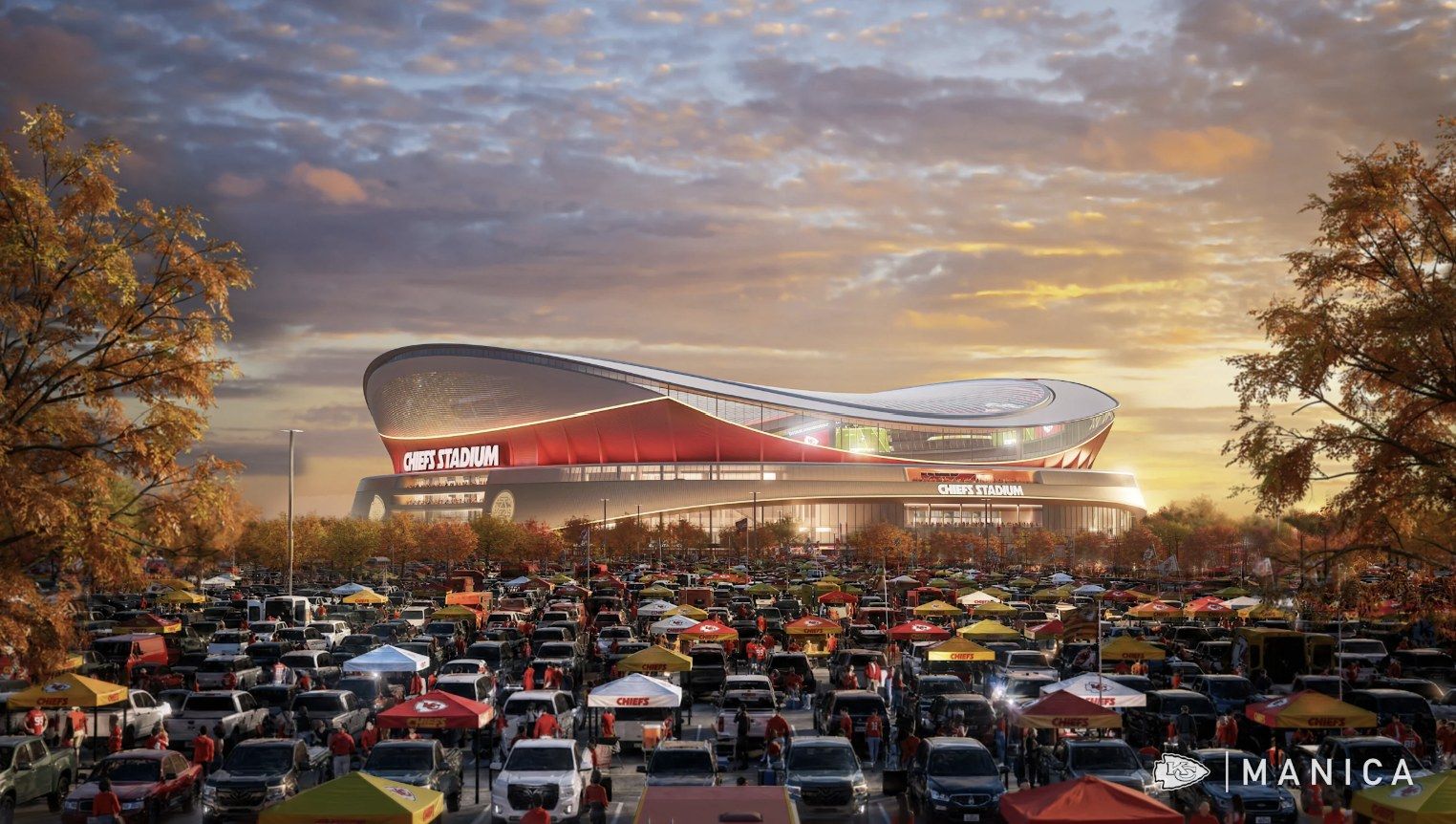
The Chiefs stadium is financed with STAR (Sales Tax and Revenue) bonds, which are repaid with new sales tax revenue generated in a defined district above current collections. After Kansas legislative leaders voted in December 2025 to let STAR bonds cover up to 70% of the cost of the stadium and surrounding development, the Chiefs announced their move to Kansas. Under the agreement with the Kansas governor's office, the project is 60% public and 40% private; the public share comes from STAR bonds and the Attracting Professional Sports to Kansas Fund, which is supported by sports-betting revenue. The Kansas City Star reports that at least $1.8 billion in STAR bonds will go to the stadium, with up to $975 million more for mixed-use development around it and in Olathe. On Nov. 5 the Unified Government commission voted unanimously to pledge local sales tax and part of its hotel tax from the area next to the stadium, a pledge it estimates at about $450 million over 30 years.
Kansas City-based MANICA is the lead designer, with HNTB as architect of record. The roof will be covered by more than 400,000 square feet of translucent ETFE panels. Unveiling the renderings in July, Chairman and CEO Clark Hunt said the stadium will "accommodate 70,000 fans, continue to be the best tailgating destination in the world and the entire building will be built for noise." The Chiefs estimate that the stadium, the Olathe headquarters and training facility, and two mixed-use districts will together support 8,500 full-time jobs and $1.5 billion in annual economic impact once complete.
Major roofed NFL stadium projects (as of November 2026)
| Team | Stadium / location | Cost | Target opening | Status |
|---|---|---|---|---|
| Tennessee Titans | New Nissan Stadium, Nashville | $2.1B | April 2027 | Fully enclosed Oct. 9; finishing work underway |
| Jacksonville Jaguars | EverBank Stadium renovation | $1.4B | 2028 | Canopy roof with open sides — not a full dome |
| Cleveland Browns | Huntington Bank Field, Brook Park (former Ford plant site) | $2.6B (plus ~$1B surrounding development) | 2029 | Site work began March 2; groundbreaking April 30; excavated ~80 ft; designed by HKS |
| Washington Commanders | Former RFK Stadium site | $4B total development (team $2.7B, D.C. ~$1.1B) | 2030 | 65,000 seats; site work began June; main construction spring 2027 |
| Kansas City Chiefs | Wyandotte County, Kansas | $3B ($4.5B with surrounding development) | 2031 | 70,000 seats; translucent ETFE roof; 60% public / 40% private; builder named Nov. 11 |
| Denver Broncos | New stadium planned | TBD | 2031 | Retractable roof planned |
| Chicago Bears | Hammond, Ind., or Arlington Heights, Ill. | TBD | 2030 target | Site undecided; Illinois bill vote possible in December |
The Cleveland Browns are building the $2.6 billion domed Huntington Bank Field on a 178-acre former Ford plant site in Brook Park, near Cleveland Hopkins International Airport. Site work began March 2, and because of the airport the bowl is being dug about 80 feet below grade. The Washington Commanders are returning to the former RFK Stadium site, their home until 1997, with a 65,000-seat stadium. The AP reports the full project, including housing and green space, will cost $4 billion, with the team paying $2.7 billion and the city about $1.1 billion.
The public bill is large. Public funding for the Titans, Browns, Chiefs and Commanders stadiums and surrounding infrastructure totals $6.3 billion, with the teams and development partners contributing at least $6.54 billion. The Chicago Bears have yet to settle on a site. The team is finishing due diligence on two sites near Wolf Lake in Hammond, Indiana, while continuing legislative talks with Illinois, the Chicago Tribune reported. Illinois Gov. JB Pritzker said a vote could come in the first week of December. If the Bears stay in Illinois, Arlington Heights, where the team bought land in 2023, is the leading candidate; either way, the team has set a goal of opening an indoor stadium by 2030.
An NFL team plays only about 10 regular-season home games a year. A roof lets a stadium host the Super Bowl, the NCAA Final Four, international soccer and major concerts regardless of weather. The Browns' dome was designed with Final Fours drawing up to 75,000 people, international soccer and concerts in mind. Super Bowl sites set through 2030 — Inglewood, Atlanta, Las Vegas and Nashville — all have roofs. To recoup the investment, the building has to be full on non-game days too.
The race for IP brings heavier acquisition debt
In studio deals, the financial burden after closing has grown along with the value of the IP acquired. The combined Skydance now owns the Paramount, Warner Bros. and Skydance film studios, Paramount+ and HBO Max, and CNN and CBS. Paramount raised $52 billion in new debt for the deal, some of it yielding nearly 9%. Yahoo also sold bonds yielding 11% to repay debt from Apollo's buyout. If more assets don't bring in matching cash, interest costs can squeeze room to run the business.
Companies are taking on that burden to secure rights that generate revenue for years. Legendary Entertainment made an offer in October for Lionsgate, owner of "The Hunger Games" and "John Wick," whose library brings in about $1 billion a year. BMG combined with Concord in September, securing a catalog of more than 4 million works. Comcast said in June it will separate NBCUniversal and Sky into a standalone public company, and an investor has proposed taking Roblox, worth about $35 billion, private. Strategies to gather rights through acquisitions are running alongside moves to restructure companies so their assets are revalued.
Data deals that connect fans' tastes and purchases
Data that shows what fans watch and what they spend money on is also a prime target. LiveRamp is a data collaboration platform linking more than 25,000 publisher domains across 14 markets. Rival ad agencies raised concerns about shared infrastructure passing into Publicis' hands, and the FTC required LiveRamp to remain neutral for five years. Ad tech company Infillion bought location-data firm Foursquare in September; linking ad exposure with store-visit and purchase data makes it easier to show advertisers what their spending achieved.
The New York Times Company is in exclusive talks to buy film fan community Letterboxd for about $330 million — more than 20 times this year's projected EBITDA. Users have grown from 1.8 million in 2020 to about 30 million. Their reviews and ratings are content that draws in other fans and, at the same time, data on film tastes. Sony and A24 also showed interest. Staying in touch with moviegoers without buying the rights to films is a different approach from buying a studio.
In Korea, what comes after building venues now matters
U.S. deal assets and Korean counterparts
| Asset type | Key U.S. deals | Korean counterpart |
|---|---|---|
| Sports teams and rights | Lakers at $12.5B (agreed); Gotham FC valued at $350M | CJ ENM exclusive KBO streaming rights (2027–2031) |
| Venues and immersive spaces | Sony Pictures' $100M Cosm investment; Clear Channel Outdoor $6.2B take-private | Seoul Arena opening 2027; national flagship concert hall site selection |
| Franchise IP | Paramount–Warner $111B merger; Legendary's offer for Lionsgate | Kakao Entertainment and SM Entertainment merge North American units |
| First-party data | Publicis–LiveRamp $2.2B; NYT–Letterboxd $330M talks | TVING's KBO viewing and subscription data (paid subscribers up 24.7%) |
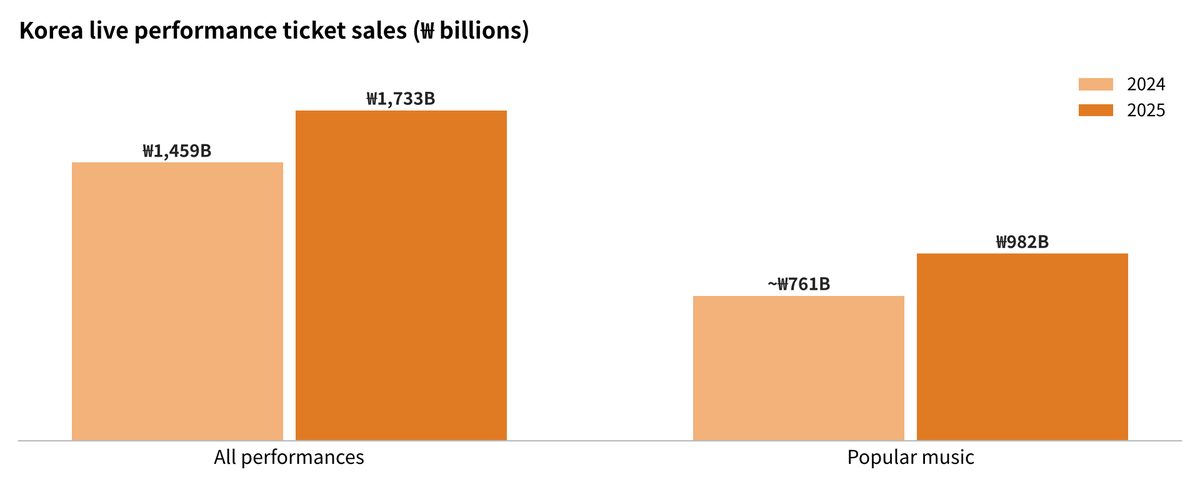
Korea's large-scale concerts and new facilities are growing together. Performance ticket sales tallied by the Ministry of Culture, Sports and Tourism and the Korea Arts Management Service through KOPIS rose 18.8% in 2025 to 1.7326 trillion won ($1.3 billion). Popular music grew 29% to 981.7 billion won ($736 million), the largest genre, led by shows of 10,000 seats or more. The average ticket price rose about 5,000 won in a year to roughly 70,000 won, and first-half 2026 pop-music ticket sales reached 452.7 billion won.
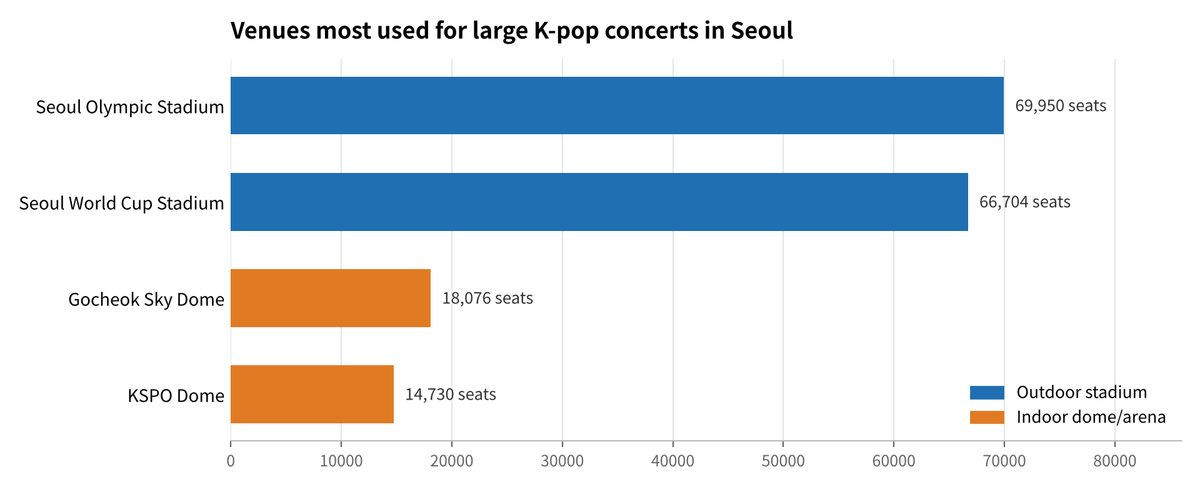
Facilities have also shifted where audiences travel. Seoul's share of national ticket sales fell from 65.1% in 2024 to 60.6% in 2025, while Gyeonggi rose from 8.7% to 14.5% and Incheon from 5.2% to 7.6%. The KOPIS report pointed to more venues and more large shows in Gyeonggi and Incheon. Big K-pop concerts have mostly been held in rented stadiums and arenas — Seoul Olympic Stadium, Seoul World Cup Stadium, Gocheok Sky Dome and the KSPO Dome. With few dedicated concert halls, available dates have been a constraint agencies must plan tours around from the start.
Seoul Arena, a dedicated pop-music venue under construction in Changdong, Seoul, is scheduled to open in 2027. Right after opening, in December, it will serve as the main stage for "Fanomenon," the K-culture festival of the presidential Popular Culture Exchange Committee. The city has proposed hosting more than 100 concerts a year, and the Ministry of Culture, Sports and Tourism is moving to choose a site for a national flagship concert hall. Since CJ Live City's arena project in Goyang collapsed, attention has turned to alternatives that ease the venue shortage.
The Jamsil sports and MICE complex faces the same test. Jamsil Baseball Stadium, opened in 1982, closed after the LG Twins–KIA Tigers semi-playoff Game 3 on Oct. 20. Seoul plans a 30,000-seat domed ballpark and a convention center 2.5 times the size of COEX. The project cleared private-investment review in July, with construction slated for the second half and completion targeted for 2032, at a cost of 3.3 trillion won. Just as Gocheok Sky Dome hosts K-pop concerts and award shows in the off-season, how many non-baseball events the new Jamsil dome can book will determine its profitability. As with NFL stadiums, the year-round operating plan matters as much as the build.
In North America, an indoor stadium of 60,000 to 70,000 seats usable even in winter will open almost every year from 2027. For K-pop acts on stadium tours, that eases seasonal limits on routing, and cities such as Kansas City, Cleveland and Nashville, which have seen few large K-pop shows, become candidates. Kansas's STAR bonds repay construction costs with future tax revenue from the commerce a stadium creates, without new taxes; if 30-year revenue forecasts miss, the public bears the burden. Korean local governments pursuing domes and arenas can compare that model when weighing fiscal risk against development benefits.
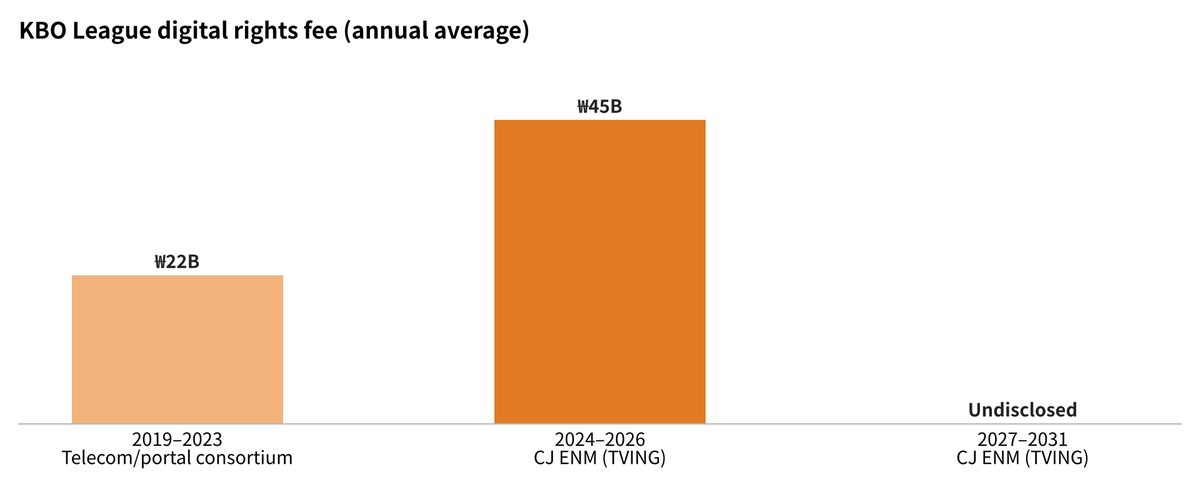
In sports rights, repeat viewing turns into subscription revenue. CJ ENM secured exclusive KBO League streaming rights for 2027–2031. The previous 2024–2026 deal was 135 billion won over three years, or 45 billion won a year — more than double the 22 billion won a year paid by the earlier telecom-portal consortium. The new deal's value was not disclosed. In 2026 the KBO League passed 10 million fans in a record-fast 565 games, and TVING's paid subscribers rose 24.7% from a year earlier. The business value of rights depends on how much sign-up and return visits they drive, not just viewing.
In music, Kakao Entertainment and SM Entertainment agreed to merge their North American units, putting the planning, production and distribution of artist IP under one organization — a move to build a structure that can keep commercializing their IP in the local market.
The same approach could apply to dance. Mnet's "Street Woman Fighter" built dance crews' profiles and fandoms; IDL runs a regular league that bundles teams, seasons, media rights and brand partners. Korean agencies and broadcasters could design businesses so that a crew's popularity carries on into concerts and competitions after a show ends, with league stakes or co-hosted events as possible routes.
Broadcasters must design their live assets beyond the broadcast
In the AI era, what matters for broadcasters is not only where they show live content but what relationship they keep with fans afterward. KBO games still air on terrestrial and sports channels, but online live streaming has centered on TVING since 2024. Game-by-game viewing histories and sign-up and churn data accumulate with whoever runs the online service. Delivering the same game, the two sides end up with very different ability to know customers and offer them the next product.
Music-show tapings, year-end award shows and big concert broadcasts are also broadcaster assets where fans gather at a set time. To carry them beyond a single airing into ticket sales, fan participation and follow-up shows, broadcasters need to settle rights and data-use terms with venues and platforms from the planning stage. Sony's Cosm investment shows a content company taking a stake in the place where it meets its audience. When co-producing with new venues and events, Korean broadcasters should negotiate not only production fees and rights fees but also ticket revenue shares, rights to follow-on businesses and the scope for using consented customer data.
Success in the next deals will be decided after closing
Major deals under negotiation or review
| Asset | Potential buyer | Reported value | Status |
|---|---|---|---|
| Letterboxd | The New York Times Company | ~$330M | Exclusive talks (reported Nov. 5) |
| LA Sparks and training facility | TBD | $700M+ (asking) | Sale process (reported Oct. 23) |
| Cadillac F1 team stake | Fenway Sports Group, others | Team valued at ~$3B | Majority-stake talks (reported Nov. 4) |
| Lionsgate | Legendary Entertainment | Undisclosed | Offer submitted (reported Oct. 20) |
| IMAX | TBD | Undisclosed | Sale review (reported May) |
| Liberty Media (F1, MotoGP) | TBD | Undisclosed | Malone voting power cut from 48% to 3% (Nov. 4) |
| SeatGeek | IPO | Undisclosed | Confidential IPO filing (reported Aug.) |
The Letterboxd talks, the LA Sparks sale, the Cadillac F1 stake talks and Legendary's offer for Lionsgate are still unresolved. IMAX's sale review and the change in Liberty Media's voting structure are also variables for the deal market. Whether negotiated prices hold through to final deals, and what operating strategies new owners bring, remain to be seen.
These deals also leave Korea's industry with work to do. Even after Seoul Arena opens and the new KBO rights deal begins, securing facilities and rights alone won't guarantee revenue. Venues need the programming capacity to fill empty dates; rights holders need services that keep fans around all season. Content producers and broadcasters must also choose between simply taking production fees and sharing in ticket and follow-on revenue. Korean content has the power to draw fans; it is time to design contracts and business structures so that it also earns from its relationship with them.
Top photo: Sphere Entertainment