

REGIONAL AX BRIDGE@KOREA | COMPANY INTERVIEW
The Daegu startup’s Gendia platform turns an industry template and one product photo into an ad film, posters and social cuts. It has passed 60,000 members since its paid launch in May and signed four export deals in Thailand and Vietnam; with a U.S. deal under discussion, the five add up to about $1.25 million.

Melaka (멜라카), an AI startup in Daegu, has taken its multimodal generative AI platform Gendia (젠디아) into Southeast Asia. It has signed four export contracts this year, two in Thailand and two in Vietnam. Together with a fifth deal under negotiation in the U.S., they are worth about $1.25 million (around 1.7 billion won).
Gendia is a software-as-a-service platform that turns a single product photo into a video ad and a poster, bringing script, image, sound and video generation into one workspace. It began charging in May and now has more than 60,000 members.
At the first Regional AX Bridge@KOREA (지역 AX 브릿지@KOREA), hosted by the Ministry of Science and ICT (과학기술정보통신부) and organized by the National IT Industry Promotion Agency (NIPA, 정보통신산업진흥원) at COEX in Seoul on October 13–14, Melaka signed a memorandum of understanding with Thailand’s Soulmate Bangkok to embed Gendia in the partner’s platform, ZDNet Korea reported on October 15.
“Most generative AI ends when you type a prompt and get one asset back. What’s different about Gendia is that you choose an outcome, not a tool,” CEO Koo Jae-ho (구재호) told K-EnterTech Hub in a video interview on October 6. Melaka’s new promotional video for Gendia leads with the same line: “You don’t pick the tool. You pick the outcome.”
Pick a template, upload one product photo, get the ad film, posters and social cuts
The video starts from a familiar problem. Every launch needs strategy, design, product shots, video, copy and social content, and while AI tools can generate assets, “assets are not a campaign.” Gendia’s answer comes in three steps. Choose a template from thousands of tested workflows organized by industry, from fashion and beauty to food, tech and lifestyle. Upload one product photo, with no studio, model booking or crew. Then Gendia’s agents generate product shots, video, voice and music in sequence and deliver the ad film along with matching posters and social cuts.
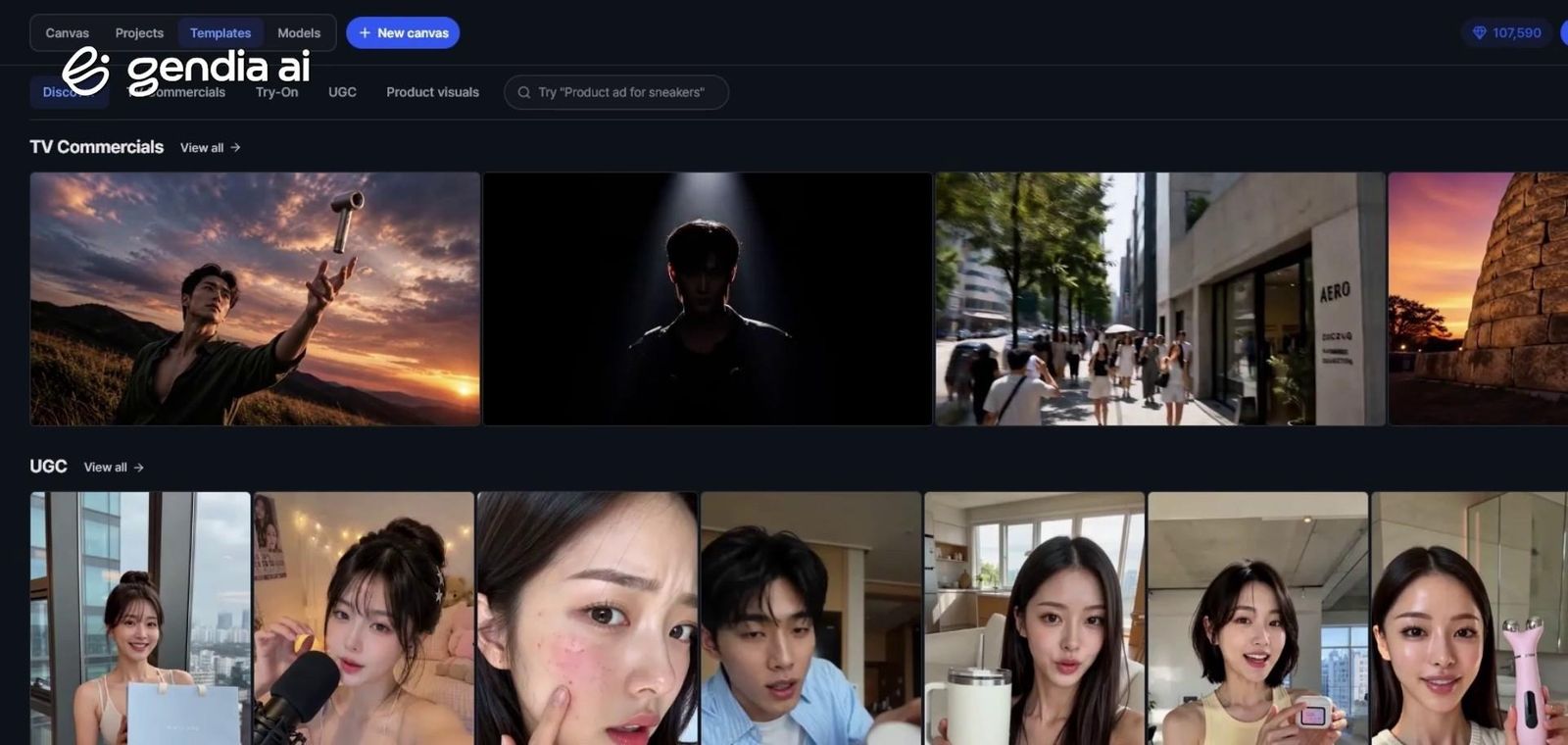
Gendia’s template library, sorted into formats such as TV commercials and UGC. Source: Melaka Gendia promotional video
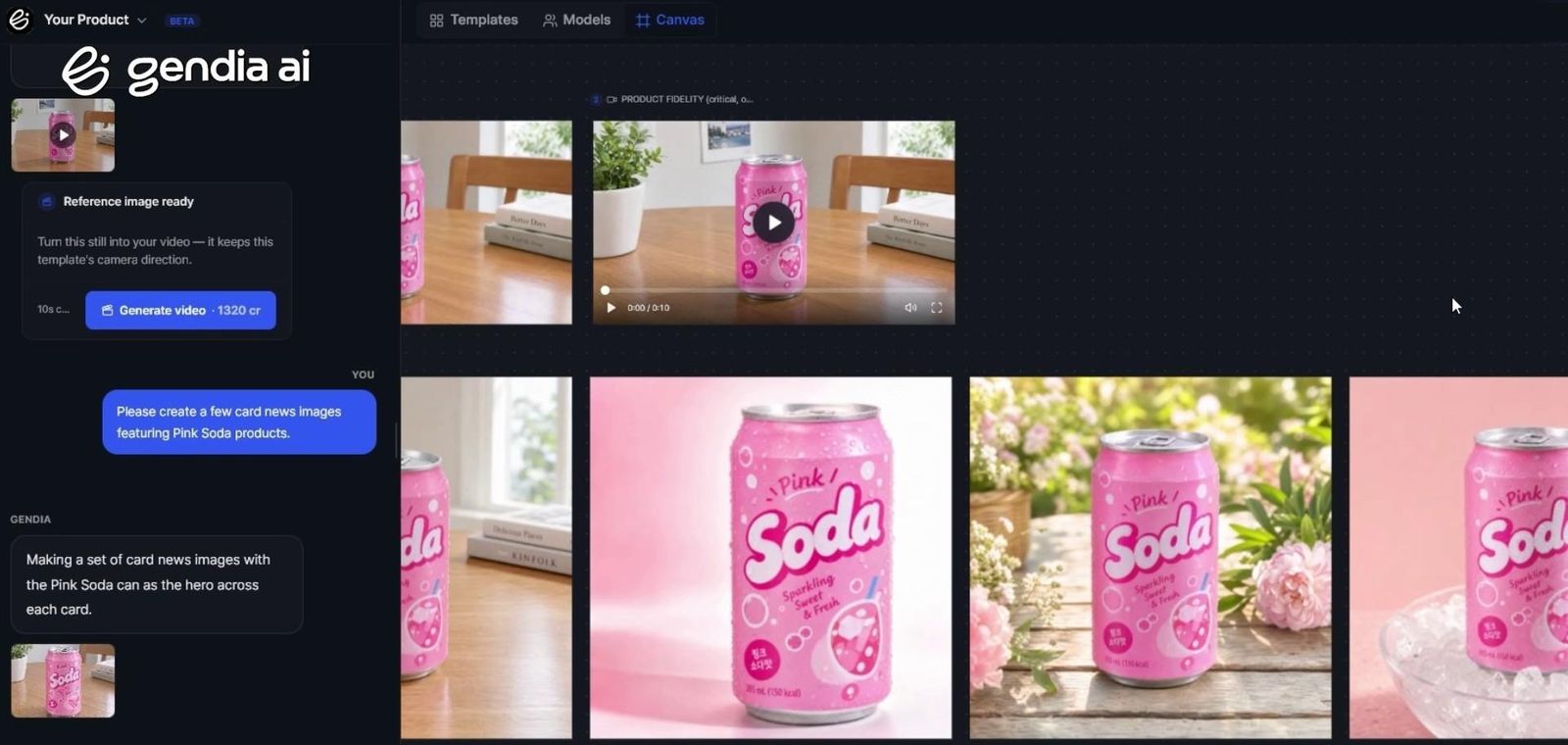
An ad film plus poster and social images generated from a single soda-can photo. Source: Melaka Gendia promotional video
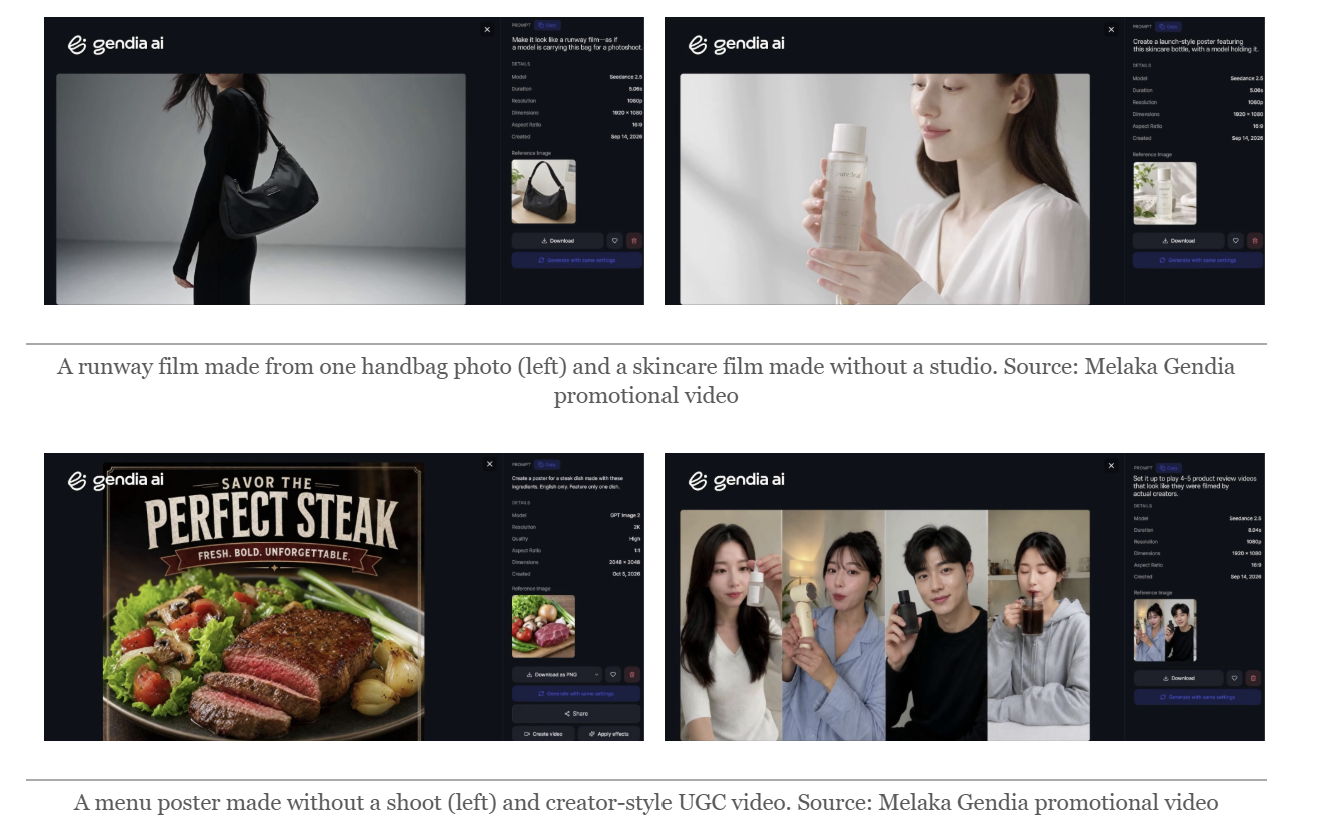
The examples change by industry: a runway film built from one photo of a handbag, a skincare film with no studio, a steak menu poster with no shoot, an ad for a washing machine, and creator-style UGC that looks shot by an influencer. These are the industry templates Koo points to as the company’s edge.
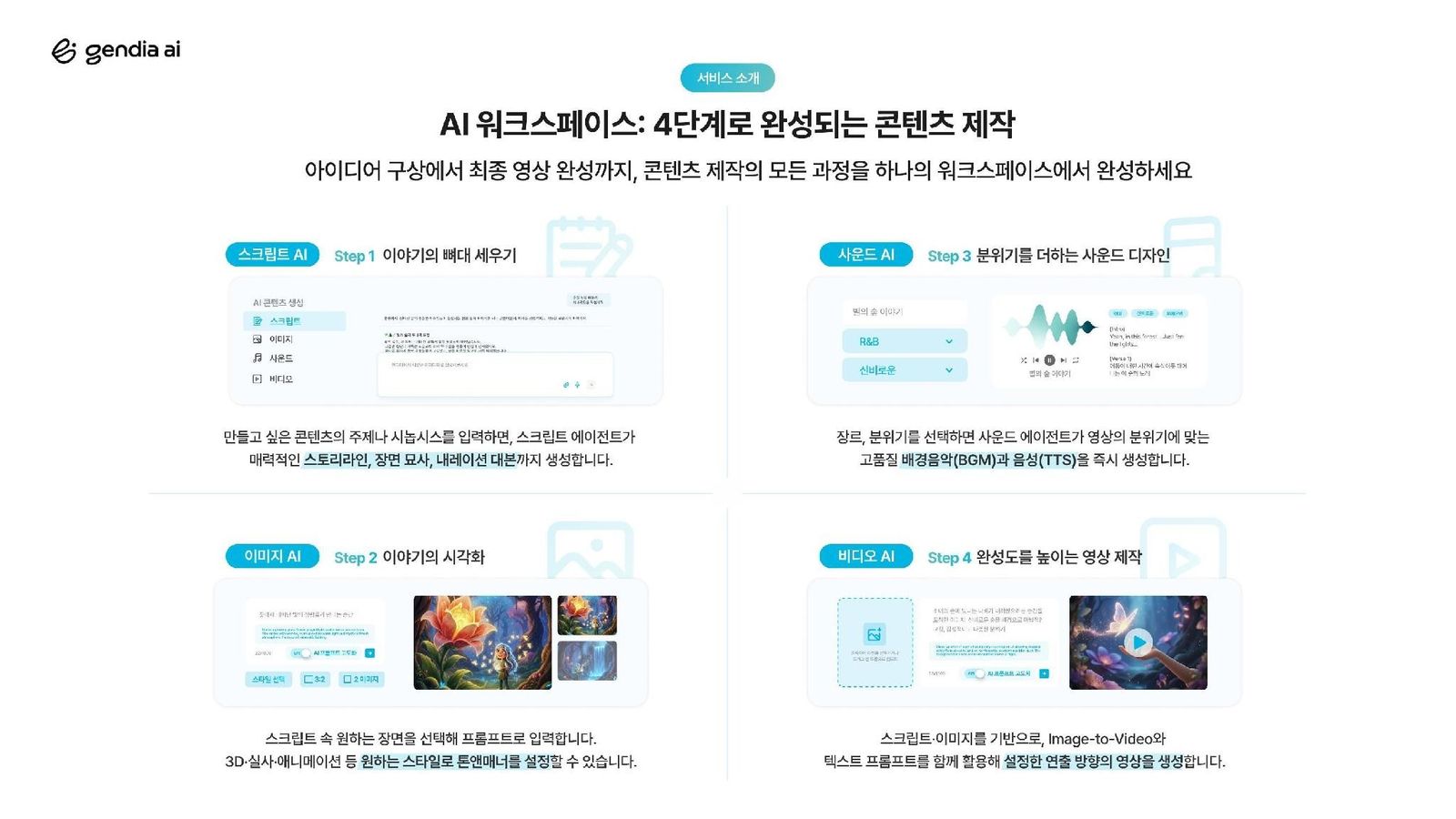
Four agents from script to video, with edits continued in Canvas
Gendia’s workspace runs in four steps, according to Melaka’s service brochure. Enter a topic or synopsis and a script agent writes the storyline, scene descriptions and narration.
An image agent renders chosen scenes in a style of the user’s choice, from 3D to photoreal to animation. A sound agent produces background music and text-to-speech voice to match a chosen genre and mood, and a video agent turns the script and images into footage using image-to-video generation.
Advertisers don’t have to walk through those steps themselves. Once they pick an industry template, an AI agent runs all four stages in order, returning a finished piece that can be refined further in Canvas, a chat-based workspace. Melaka’s website describes generation across more than 28 models, and the company says bundling the latest generative tools into one subscription cuts production costs by 40% on average. Gendia’s listing on software-review site Capterra shows four monthly plans, from $7 for Basic to $80 for Elite.
Koo puts the company’s edge in the templates. “AI has advanced so much that anyone can build a service like ours. In the AI era, I see it as a fight over prompts.” Melaka has four people who do nothing but prompt work to build templates, and Koo calls those templates, plus the ability to keep reworking results in Canvas, the company’s biggest strength.
15 million won a month from consumers, plus university and studio contracts
Subscriptions from individual users bring in roughly 15 million won (about $11,300) a month. On top of that, Melaka has been signing contracts worth 3 million to 10 million won (about $2,300 to $7,500) apiece with two universities, video production companies and small film houses; small merchants also pay. The team built Gendia in five months and now numbers 16. Alongside Gendia, it still takes outsourced development work.
Gendia at a glance. Source: interview with Koo Jae-ho (Oct. 6), ZDNet Korea
One contract, one admin console: pooled credits and up to 40% off in bulk
What underpins the university and institutional deals is group management, which the video sums up as “one contract, one admin console.” Companies and institutions buy Gendia once and run it centrally, allocating credits by team, controlling permissions and reassigning unused credits. The brochure shows a single administrator inviting many members at once from a CSV file and setting each member’s permissions and credit allowance. A live dashboard tracks credit use, and unused credits can be pulled back into a pool and reassigned with a click. Bulk purchases come with discounts of up to 40%, corporate contracting and a dedicated account manager.
Ads in five minutes, conversions up 25%: four target markets
Melaka pitches Gendia to four groups: marketers, educators, creators and online sellers. The brochure claims ad creative in five minutes and 90% less production time for marketing, lecture notes turned into short-form video with five times the engagement for education, and a 25% lift in purchase conversion for commerce. Those figures are the company’s own.
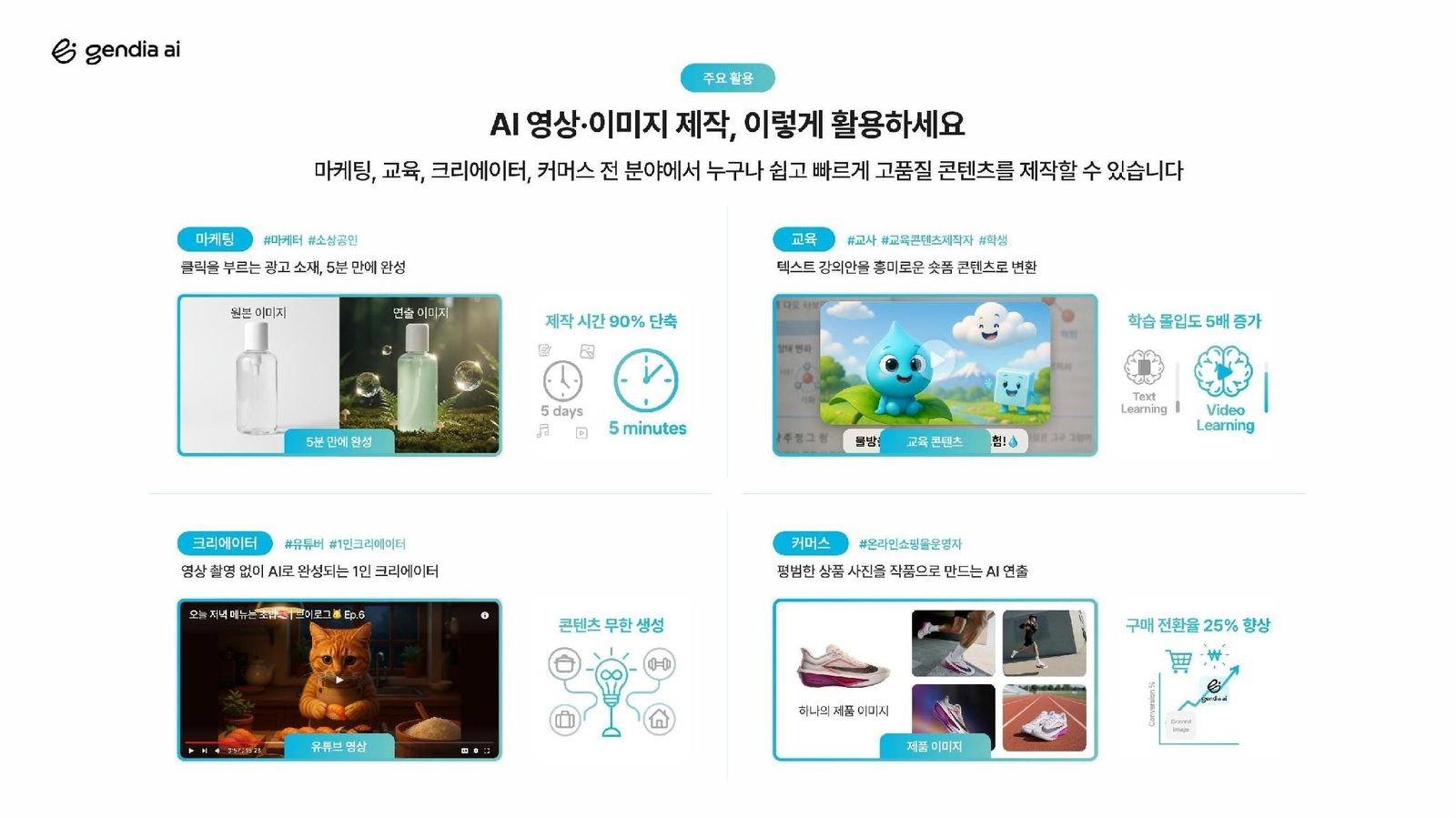
Gendia use cases and company-stated results. Source: Melaka Gendia service brochure
From musician to developer to game maker, then a pivot to Gendia
Koo started out in music before becoming a software developer. He registered the business as a sole proprietorship in 2020 and incorporated in 2022. The company began as a mobile game developer and changed direction several times. Just before Gendia, it built Grapheton (그래피톤), a Canva-style design tool aimed at schools, which did not take off. Melaka is now back in education with Gendia, working with people it met during that attempt. Koo holds a master’s in computer engineering from Kyungpook National University (경북대) and is studying global entrepreneurship at Kookmin University’s graduate school (국민대).
The company is a regular at overseas trade shows. It showed its AI content platform in the Daegu city pavilion at GITEX AI Asia 2026 in Singapore, Kuki News reported on April 23, and Koo recently returned from Techsauce in Thailand.
Thailand and the Arab market first, where global rivals are thin
The export deals take the form of platform licenses and local distribution agreements, and the promotional video bills Gendia as “already trusted beyond Korea,” citing the Vietnam and Thailand contracts and expansion across Southeast Asia.
Koo said Melaka is concentrating on Thailand and Arabic-speaking markets. In Thailand, global competitors have yet to arrive in force; in the Arab market, he said, the company’s ad-performance numbers point to a market that is still widening. Gendia now runs in 10 languages, and Melaka is registering its trademark abroad. It is also preparing a move into Vietnam and weighing whether Singapore or the U.S. should come next.
What Melaka wants from the AX program: signed deals it can point to
Koo’s first goal for the program was to formalize the Thai partnership through a signing ceremony and build a market with the buyers who attended. The second, he said, is “to turn those contracts into references so the company can grow.” “Going properly global is our goal,” he added.
Outlook: whether the Thai integration brings real users is the next test
Generative video tools compete in a market where the gap between models is closing quickly, and Koo admits a lookalike service is easy to build. Melaka is betting instead on industry templates, a workflow built around finished output, group tools for institutions and localization in 10 languages. Whether the Soulmate Bangkok integration turns into Thai users, and whether the U.S. deal closes, are the next checkpoints for its $1.25 million export plan.
Government support for that kind of path is growing. The budget of NIPA’s regional AX division is expected to top 400 billion won (about $300 million) next year, ZDNet Korea reported. Melaka, which started in Daegu and secured Southeast Asian contracts first, is a close fit for the export route the program is designed to fund.
Quotations are from Koo Jae-ho’s video interview with K-EnterTech Hub on October 6, 2026, translated from Korean, and from Melaka’s Gendia promotional video; unquoted passages summarize the interview and Melaka’s materials (service brochure, promotional video). Contract values, revenue and use-case results are figures provided by the company. Won figures converted at 1,331.4 won to the dollar, the Seoul close on October 16.