
Meta Settlement with 52 US attorneys general (approx. 27 trillion won) also makes a midnight-to-6 a.m. block and school-hours notification muting defaults; 30% of the payout releases only if YouTube and TikTok adopt the same measures
Meta ended the child-safety lawsuits brought by US state attorneys general through a settlement. The agreement was filed on August 26 with the US District Court for the Northern District of California in Oakland. Approval by Judge Yvonne Gonzalez Rogers is still pending.
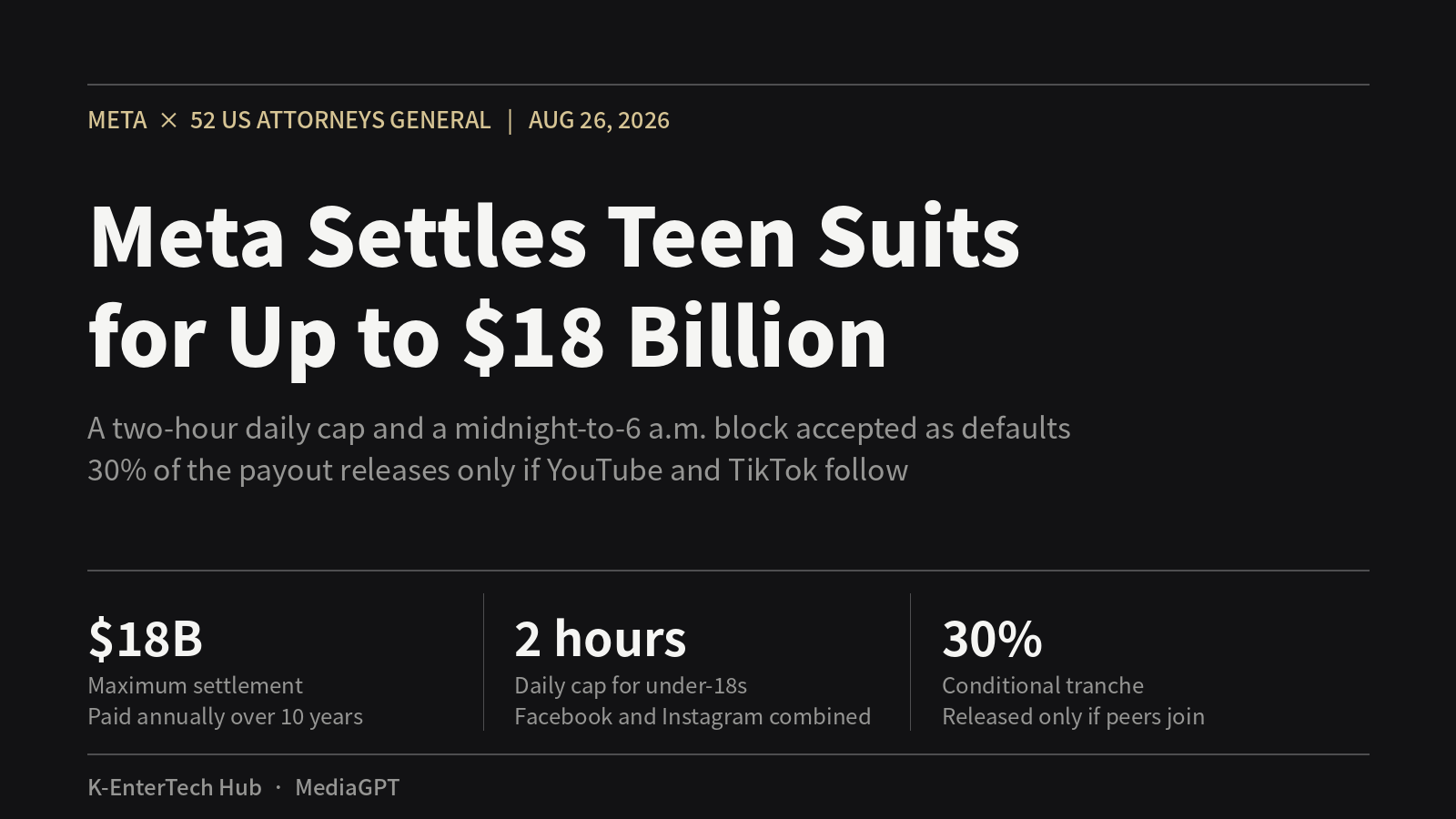
The headline figure is up to about $18 billion (approx. 27 trillion won). Court filings put the multistate settlement at $16.68 billion (approx. 25 trillion won), with a separate Texas settlement of $1 billion (approx. 1.5 trillion won) on top. Payments are spread annually over ten years. The agreement contains no admission of wrongdoing.
The agreement also carries product terms. For users under 18, a two-hour daily cap, a block on access from midnight to 6 a.m., and muted notifications from 8 a.m. to 3 p.m. all apply as defaults. Time on platform and exposure design are the inputs that feed Meta's advertising revenue. Meta reported $201 billion (approx. 302 trillion won) in revenue and $60 billion (approx. 90 trillion won) in net income for last year, according to the Financial Times (August 26).
$16.68bn multistate, $1bn Texas… the headline total differs by outlet
The total depends on who is counting. The Financial Times added the $16.68 billion multistate figure to the $1 billion Texas settlement for about $18 billion. The New York Times reported up to $17.1 billion (approx. 26 trillion won), splitting it into roughly $12 billion (approx. 18 trillion won) paid initially and $5 billion (approx. 8 trillion won) contingent. CNBC noted on August 26 that the $17.1 billion figure cited by some attorneys general includes $459 million (approx. 690 billion won) tied to the 2018 Cambridge Analytica matter, which is separate from the child-safety case. Meta's own newsroom states approximately $18 billion.
State allocations were disclosed as well. California Attorney General Rob Bonta said his state could receive $1.5 billion to $2.1 billion (approx. 2.25 to 3.15 trillion won) on court approval. New York Attorney General Letitia James put New York's share at up to $1.15 billion (approx. 1.7 trillion won), and Indiana Attorney General Todd Rokita cited up to $419.4 million (approx. 630 billion won), per Forbes and The Washington Times on August 26.
Meta's newsroom lists 52 participating jurisdictions. Florida and New Mexico are absent from the 50 states; Washington DC, Puerto Rico, American Samoa and the Northern Mariana Islands are included. The Financial Times reported that the new controls will not apply in Florida and New Mexico, and that neither will share in the payout.
Two-hour cap, midnight block, school-hours mute… product defaults written into a legal filing
The clause list Meta published reads like a product specification. The two-hour daily cap is cumulative across Facebook and Instagram, and time is counted together where Meta detects that one person holds multiple accounts. Turning the cap off requires a parent's permission.
Night Mode blocks posting and viewing of Feed, Stories, Explore and Reels between midnight and 6 a.m. School Mode mutes push notifications by default between 8 a.m. and 3 p.m., with direct messages and account security alerts exempt. Direct messaging itself is excluded from all three restrictions.
Prompts appear after every 15 minutes of continuous use and again at 60 and 90 minutes of cumulative daily use. Teens can set a non-algorithmic feed — one their recommendation systems do not personalize — as their default, and can turn off autoplay. Parents can force both settings on a teen's account. Like and reaction counts are hidden by default on both the teen's own posts and others'. Extreme makeup filters join cosmetic surgery filters on the blocked list for teens.
On age assurance, Meta committed to further investment in technology that proactively catches under-13 accounts and identifies 13-to-17-year-olds who supply an adult birthday. Meta also stated it will keep pushing for legislation requiring app stores to provide developers with verified age information — a request to move much of the verification burden onto Apple's and Google's app distribution layer.
Most terms run for ten years. The time cap and Night Mode start on a five-year commitment.
30% of the payout waits on YouTube and TikTok… a settlement built to bind competitors
The payment splits in two. Seventy percent, roughly $12.7 billion (approx. 19 trillion won), goes to participating states over ten years with no conditions attached. The remaining 30 percent, roughly $5.3 billion (approx. 8 trillion won), releases only if two conditions are both met: YouTube and TikTok implement a one-hour daily limit, Night Mode and age assurance measures; and each pays an amount matching the 30 percent figure, with half the remaining funds tied to YouTube's payment and half to TikTok's.
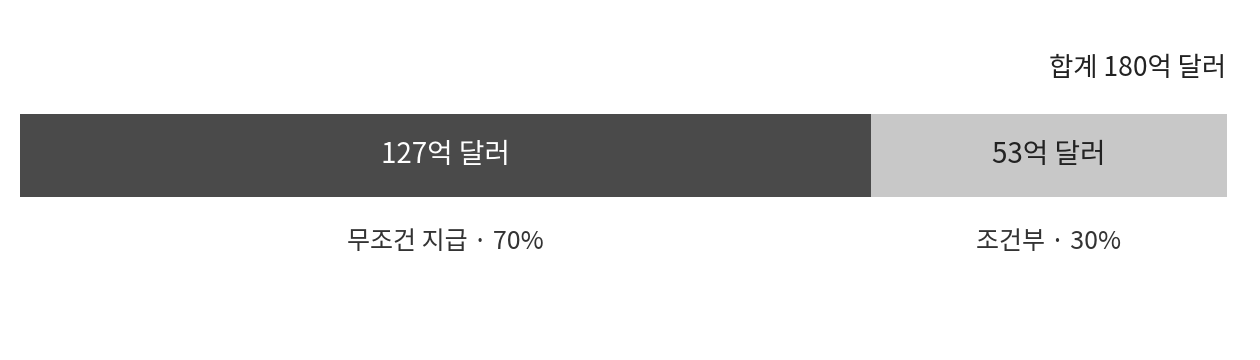
The conditional structure of Meta's payout. Thirty percent releases only if YouTube and TikTok adopt the same measures and pay matching sums. Source: Meta Newsroom, August 26, 2026
If the peers sign on, Meta's own terms tighten. The daily cap drops to one hour per app, the Night Mode window widens to 10 p.m. through 7 a.m., and the five-year commitment on both extends to ten years.
C.J. Mahoney, Meta's chief legal officer, called on TikTok and YouTube in a newsroom statement to adopt the same framework immediately, arguing that teens move across dozens of apps and that the problem therefore requires an industry-wide answer. The New York Times reported that Meta's legal team told reporters on a call that it negotiated the terms specifically to require the other companies to join, setting standards that would not single Meta out.
Meta added a public pressure campaign. Citing a post on X by New York Times reporter Mike Isaac, Yahoo Tech reported on August 26 that Meta plans to run an open letter to TikTok and YouTube as a full-page advertisement in The New York Times, The Washington Post and the Los Angeles Times (secondhand). Snap and Alphabet-owned YouTube declined to comment; TikTok did not immediately respond.
$10bn legal charge booked for Q3… stock direction reported three different ways
Meta expects to accrue roughly $10 billion (approx. 15 trillion won) in legal expense in the third quarter of 2026 related to the agreement, an item absent from the expense range given on the July second-quarter call. Other guidance ranges remain unchanged. The New York Times reported that Meta spent about $2 billion (approx. 3 trillion won) on legal challenges in the second quarter alone.
The Financial Times reported that Meta will distribute the payments annually over ten years and does not expect a significant hit to quarterly results, given the limited revenue it draws from teen users.
Reported share movement diverged. The New York Times recorded a 1.3 percent rise, the Financial Times a 1 percent lower open, and NBC Los Angeles a 4 percent premarket gain — apparently measured at different points in the session. The New York Times put Meta's valuation at $1.47 trillion (approx. 2,205 trillion won) and its most recent quarterly revenue at $60.8 billion (approx. 91 trillion won).
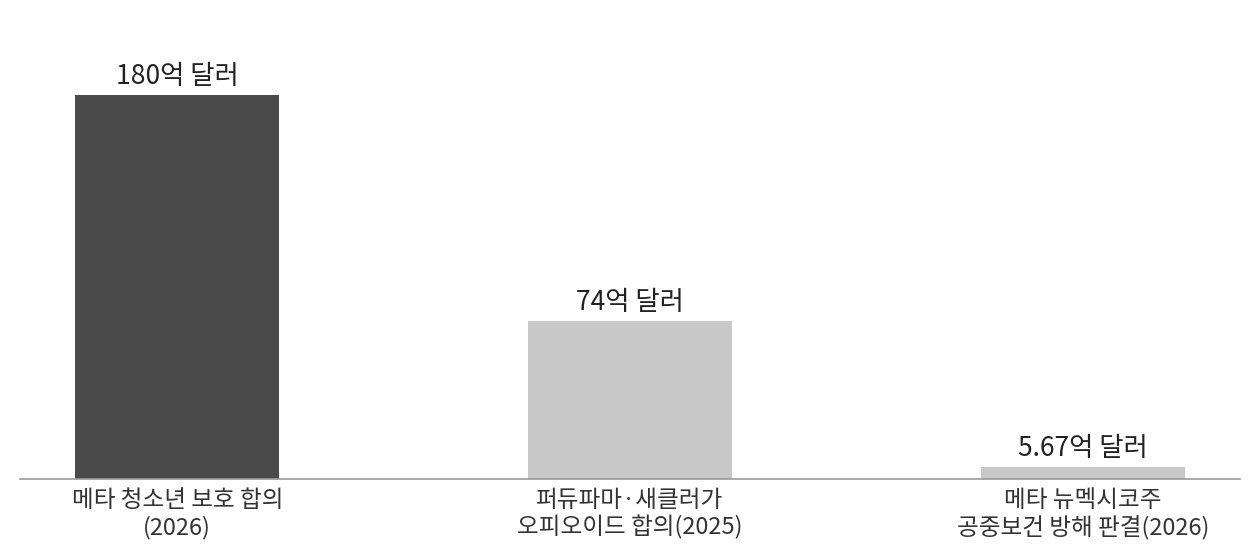
State-level settlements and judgments compared. The Purdue figure is the 2025 opioid settlement with the Sackler family; the New Mexico figure is the August 2026 public nuisance judgment. Source: Financial Times, August 26, 2026
"Roughly ten days of annual profit"… the revenue engine sits outside the deal
Assessments of the size split. The Financial Times noted the payout is more than double the $7.4 billion (approx. 11 trillion won) that Purdue Pharma and the Sackler family agreed last year over claims tied to the opioid painkiller OxyContin.
Katharina Kopp of the Center for Digital Democracy estimated the annual instalments amount to roughly ten days of Meta's annual profit. She told the Financial Times that the settlement reaches the features of Meta's platforms but not the business engine driving them.
Vincent Joralemon, director of the Life Sciences Law and Policy Center at the Berkeley Center for Law and Technology, told The New York Times the changes are substantial but not entirely new, and that some of the restrictions already exist in Europe. He did expect the experience of using these platforms as a minor to look considerably different from five years ago.
Nora Freeman Engstrom, a law professor at Stanford University, told The New York Times that Meta would not have settled unless it judged itself seriously exposed. Katie Paul, director of the Tech Transparency Project, told the Financial Times that Meta agreed to these safety measures only under litigation pressure, and that her group will watch whether the company follows through.
The agreement includes enforcement machinery. An independent social media research foundation will be established, and Meta will share consented user data with it. An independent auditor will test and report on Meta's compliance to the states annually for five years.
Meta says it will keep fighting the remaining cases. Thousands of suits from school districts and individuals remain, some scheduled for trial within months. In March, Meta and Google lost a personal injury case brought by an individual plaintiff in Los Angeles and paid $6 million (approx. 9 billion won) in damages. This month a New Mexico judge ordered Meta to pay $567 million (approx. 850 billion won) and strengthen safety features. Meta is appealing both.
Australia's under-16 ban, France's under-15 ban… a settlement landing amid legislation
The settlement arrives alongside national regulatory timetables. Australia implemented the world's first ban on under-16 social media accounts in December 2025. France passed a bill on July 21 barring under-15s from social media. Brazil passed child protection legislation in 2026 that, beyond stronger age verification and a ban on targeted advertising to minors, brought infinite scroll and autoplay themselves into the scope of regulation (주간경향 Weekly Kyunghyang, August 4; 한국기자협회 Journalists Association of Korea, May 4).
The European Union took the first step toward its own ban last month. At the US federal level, the Kids Online Safety Act has been reintroduced, strengthening privacy for minors and letting them opt out of algorithmic features linked to compulsive use (The New York Times, August 26).
Where legislation is still under debate, this settlement runs the sequence in reverse. A company and a group of prosecutors fixed the specification before the law did, and attached a financial trigger to enforce it.
The product spec a settlement wrote: seven things Korean operators should check first
The agreement Meta reached with attorneys general in 52 US jurisdictions is not a statute. The form is a settlement and it takes effect on court approval. The content, though, is a product specification. Daily usage caps, overnight blocking windows, default feed behavior and the required standard of age assurance are all written out clause by clause. The reference baseline for anyone serving the US market was fixed in the Northern District of California before it was fixed in Congress.
The conditional structure
What reaches Korean operators first is not the money but the condition. Thirty percent of the settlement, about $5.3 billion (approx. 8 trillion won), is released only if YouTube and TikTok adopt a one-hour daily cap, Night Mode and age assurance, and pay a matching sum. If those two move, US reach among under-18s reorganizes by time of day. Views that used to accumulate overnight and during school hours drop out first, and competitive density rises in the remaining windows.
Korean platforms and MCNs running US-facing short-form enter a phase where the time-of-day distribution matters more than the total view count. On Meta's own terms, the overnight block widens from midnight-to-6 a.m. to 10 p.m.-to-7 a.m., and the commitment period for the time cap and Night Mode extends from five years to ten.
Metrics and contracts need rework
Teens can select a non-algorithmic feed and turn off autoplay, and parents can set both as forced defaults. That is where traffic dependent on recommendation surfaces falls first. Hiding like and reaction counts by default removes one of the reference numbers used in influencer rate-setting. Contracts using dwell time and session length as performance metrics will not hold as written for campaigns aimed at under-18s.
Where age-verification responsibility sits
Meta said it will continue to press for legislation requiring app stores to verify age and obtain parental approval before a teen downloads an app. The core of the demand is that verified age information be handed to developers. If that direction holds, Korean operators have two options: build their own age signals, or rely on the signals the store provides. Either path runs straight into the question of how much personal data gets collected.
Broadcasters are publishers, not users
Terrestrial, general programming and cable channels distribute clips and short-form continuously through YouTube and Instagram accounts. When overnight blocking and school-hours muting take effect in the US, reach distribution on US-facing channels changes, and so does the basis for reading global channel metrics from that point on.
The premise of the regulatory asymmetry argument also shifts. Broadcasters have long operated under time-based rules through youth viewing protection hours (청소년시청보호시간대) and broadcast review regulations. Now that a platform has taken on a daily usage cap, there is a basis for presenting youth protection items on the same axis as platforms in license renewal and re-approval reviews.
The archive holder's asset is rating metadata
The settlement places under-18 accounts into 13-plus content settings, drawn from movie ratings criteria, and continues to restrict following and interaction with age-inappropriate accounts. As platforms move toward demanding age signals, the demand extends to the content side in the form of files carrying rating information.
Broadcasters already run program rating systems. Organizing rating metadata at episode and clip level widens what can be negotiated in supply talks. In commissioning, how far delivery specifications should specify age labels and time-of-day handling becomes a new clause to settle, and for commissions premised on US or European distribution that clause affects unit price.
Korea's regulatory timetable and two baselines
Kim Jong-chul (김종철), chairman of the Korea Communications and Media Commission (방송미디어통신위원회), said at a July 16 briefing to the president that the commission is examining, in stages, restrictions on social media sign-up for those under 14 and limits on exposure to engagement-driving mechanisms and algorithms up to age 19.
The commission is considering an amendment to the Network Act (정보통신망법) that would make age verification mandatory for operators and bar engagement-driving features such as infinite scroll and autoplay from being supplied to minors by default, allowing them only as an exception where a parent consents (경향신문 Kyunghyang Shinmun, July 17; 머니투데이 Money Today). Parental consent here is the condition for the exception, not the condition for the restriction.
If the US settlement reaches implementation while the Korean debate is still open, Korean operators will be meeting two baselines rather than one. On Meta's schedule, the non-personalized feed and usage prompts are due within four months, under-13 detection and general compliance within six months, and the age assurance framework within one year (Reuters factbox; Compass Vermont, August 26).
Data access is a separate item to verify
Under the agreement an independent social media research foundation will be established, and Meta will provide it with consented user data. Whether Korean broadcaster research institutes and public bodies conducting youth media research can reach that data depends on the detailed clauses of the settlement and the foundation's founding terms. That the agreement itself still awaits approval by a federal judge is a further factor to weigh.
Sources
1. Meta Newsroom, "Our Agreement With Bipartisan Attorneys General: Calling on TikTok and YouTube to Join Us in Supporting Teens", August 26, 2026. https://about.fb.com/news/2026/08/agreement-with-state-attorneys-general-supporting-teens/ — full clause list, 70/30 payment structure, Q3 legal charge, list of 52 participating jurisdictions, Mahoney statement
2. Cecilia Kang and Eli Tan, "Meta to Pay Up to $17.1 Billion in Landmark Settlement Over Social Media Addiction Claims", The New York Times, August 26, 2026. https://www.nytimes.com/2026/08/26/technology/meta-settlement-social-media-addiction-lawsuit.html — $17.1bn total, 1.3% share rise, $2bn Q2 legal spend, Engstrom / Joralemon / Benjamin comments, KOSA reintroduction
3. Tim Bradshaw, "Meta to pay up to $18bn to settle children's social media harm case", Financial Times, August 26, 2026. https://www.ft.com/content/21dcbd96-ee57-445c-a9ba-0938c49b91c0 — $16.68bn plus $1bn Texas, Florida and New Mexico opt-outs, Purdue $7.4bn comparison, Kopp and Paul comments, New Mexico $567mn judgment
4. CNBC, "Meta settles social media addiction case with California, other states for $16.7 billion", August 26, 2026. https://www.cnbc.com/2026/08/26/meta-social-media-trial-settlement.html — $459mn Cambridge Analytica component inside the $17.1bn figure, California allocation
5. Zachary Folk, "Meta Agrees To $16.68 Billion Settlement In Social Media Addiction Trial", Forbes, August 26, 2026. https://www.forbes.com/sites/zacharyfolk/2026/08/26/meta-agrees-to-1668-billion-settlement-in-social-media-addiction-trial/ — New York up to $1.15bn
6. The Washington Times, "Meta to pay $17 billion over teen safety lawsuit filed by dozens of states", August 26, 2026. https://www.washingtontimes.com/news/2026/aug/26/meta-reaches-17b-settlement-states-landmark-trial-teen-social-media/ — Indiana up to $419.4mn
7. Yahoo Tech, "Meta to impose two-hour daily usage limit for kids across Facebook and Instagram as part of $17.1 billion settlement", August 26, 2026. https://tech.yahoo.com/social-media/breaking-news/article/meta-to-impose-two-hour-daily-usage-limit-for-kids-across-facebook-and-instagram-as-part-of-171-billion-settlement-152233368.html — planned full-page open letter (secondhand, citing Mike Isaac on X)
8. CBS News, "Meta settles social media addiction suit with states for up to $17.1 billion", August 26, 2026. https://www.cbsnews.com/news/meta-settles-social-media-addiction-lawsuit/ — 2023 filing by 29 states, COPPA allegations
9. NBC Los Angeles, "Meta agrees to settle social media addiction suit with states", August 26, 2026. https://www.nbclosangeles.com/news/national-international/meta-agrees-to-settle-social-media-addiction-suit-with-states/3933841/ — 4% premarket gain, denial-of-liability language in the filing
10. KTVU FOX 2, "Meta agrees to settle social media addiction case for up to $16.8B", August 26, 2026. https://www.ktvu.com/news/meta-agrees-settle-social-media-addiction-case-up-16b — trial start date of August 18, over $2bn earmarked for California
11. Variety, "Meta to Pay up to $18 Billion in Settlement With States Over Social-Media Addiction Claims", August 26, 2026. https://variety.com/2026/digital/news/meta-18-billion-settlement-state-ags-lawsuit-social-media-addiction-1236843725/ — trigger conditions for the $5.3bn tranche
12. Editorial, "청소년 SNS 규제, 실효성 있는 제도 설계가 관건", 경향신문 Kyunghyang Shinmun, July 17, 2026. https://www.khan.co.kr/article/202607171810001/ — Kim Jong-chul's July 16 remarks, Network Act amendment plan
13. 주간경향 Weekly Kyunghyang, "'내 아이 릴스·숏폼 중독 막는다'…한국도 청소년에 'SNS 빗장' 건다", August 4, 2026. https://weekly.khan.co.kr/article/202608040600001/ — Australia December 2025, France July 21, Korean under-14 proposal
14. 한국기자협회 Journalists Association of Korea, "'문제는 플랫폼이야!'…청소년 'SNS 중독' 규제 흐름", May 4, 2026. https://m.journalist.or.kr/m/m_article.html?no=60827 — citing Korea Press Foundation (한국언론진흥재단) KPF Media Brief 2026 No. 4; Brazil's infinite scroll and autoplay provisions
15. Reuters, "Factbox: What Meta agreed to in US teen safety settlement" (published via AOL), August 26, 2026. https://www.aol.com/articles/factbox-meta-agreed-us-teen-155827000.html — phase-in deadlines: non-personalized feed in four months, broader compliance in six, age assurance in one year
16. Compass Vermont, "Vermont Wins $92.7 Million From Meta. The Two-Hour Limit for Teens Lasts Five Years", August 26, 2026. https://www.compassvermont.com/p/vermont-wins-927-million-from-meta — deadline detail, permitted age-misclassification rates (14% in year one, 10% in year two), $12.1bn minimum to states
17. California Department of Justice, "Attorney General Bonta Secures Transformative $17 Billion Settlement with Meta", August 26, 2026. https://oag.ca.gov/news/press-releases/attorney-general-bonta-secures-transformative-17-billion-settlement-meta — non-personalized feed option, auditor powers, injunction against deceptive safety claims
Attribution note: text in quotation marks reproduces remarks as reported by the cited outlet; unquoted description summarizes reporting. Remarks reaching this article through a second outlet are marked secondhand. Dollar figures carry a won conversion at 1 USD = 1,500 KRW. Settlement totals are given as each source reports them, since counting methods differ.