
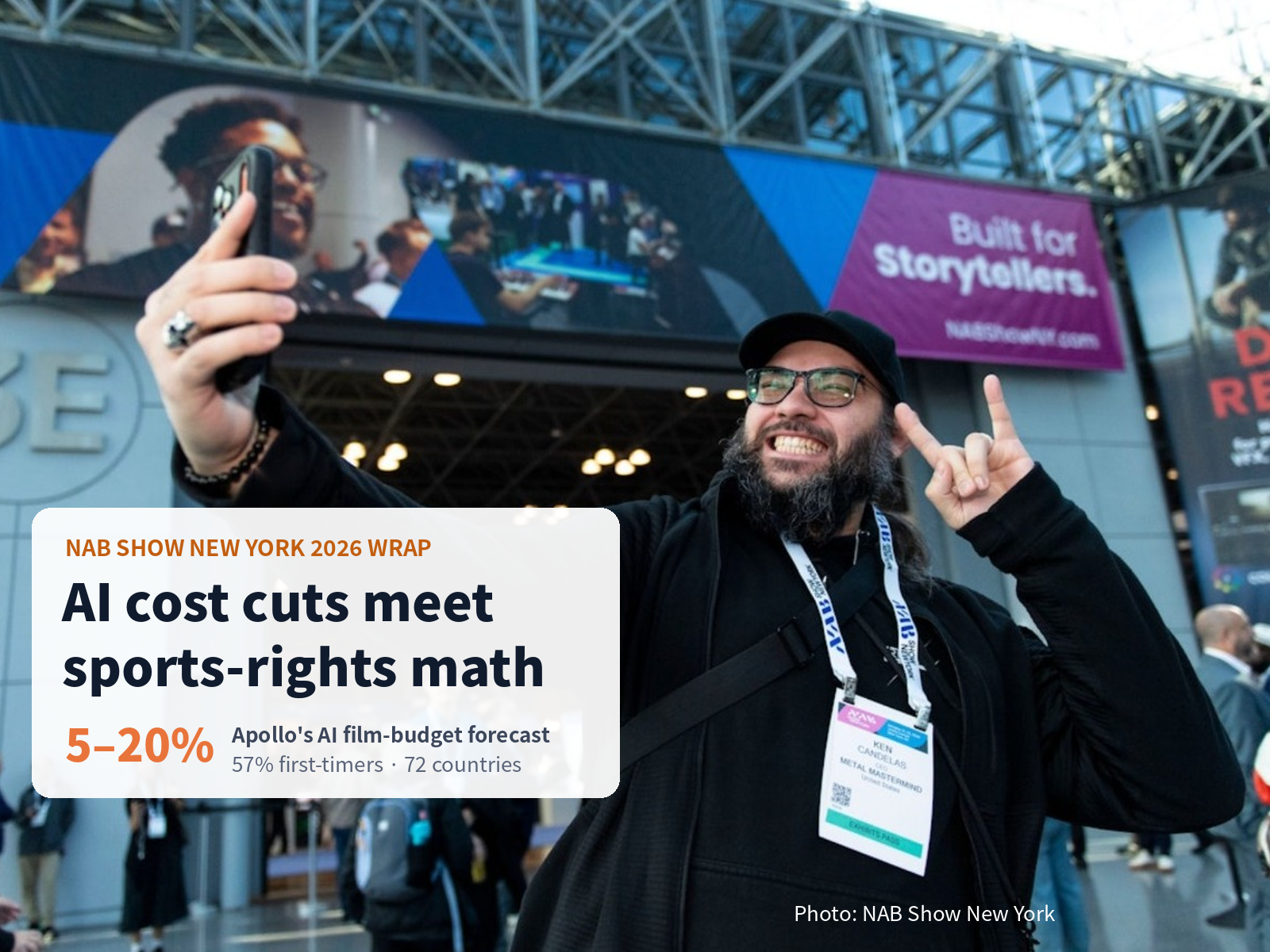
NAB SHOW NEW YORK 2026 | ANALYSIS
Apollo's Sobel sees AI trimming film budgets 5–20%; NAB's LeGeyt says sports rights pay for local news; 57% first-timers from 72 countries
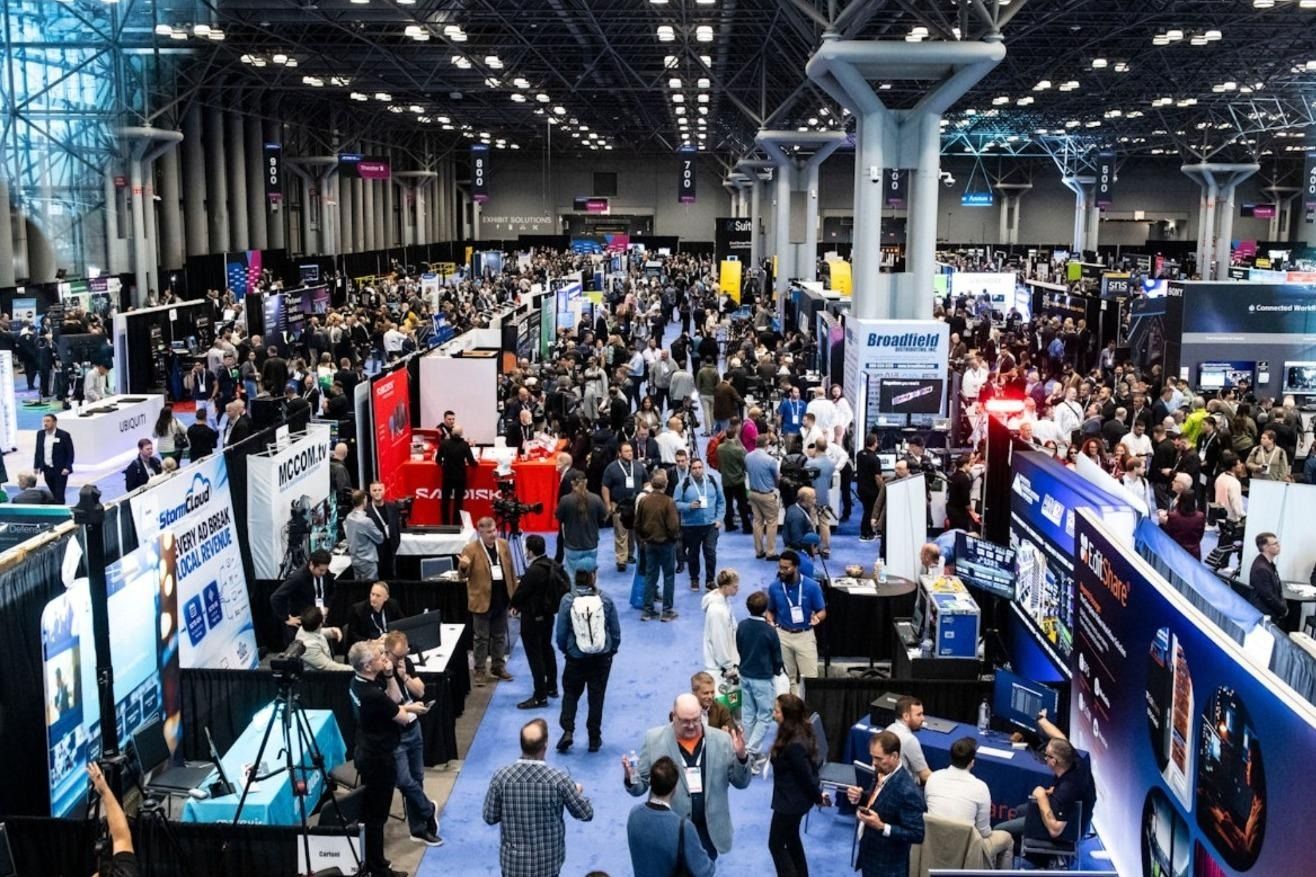
NAB Show New York 2026 wrapped its two-day run at the Javits Center on Thursday. About 57% of attendees were first-timers, and they came from 72 countries. Some 250 companies exhibited or sponsored, and the program ran 101 education sessions with 156 speakers.
The program was organized around three questions: how much AI can take out of production budgets, what live sports are worth to broadcasters, and how creators can turn audiences into durable businesses. "AI can reduce a budget for a movie 5, 10, 15, 20%," Aaron Sobel, a partner at Apollo Global Management, said on the opening day. "Not today, in a few years." The same day, National Association of Broadcasters President Curtis LeGeyt made the case that major sports rights pay for the news and local programming that stations produce.
NAB had said in September, in its opening announcement, that this year's program would lean toward investment, consolidation and monetization rather than technology demos. The opening-day panel in Theater A reflected that: Jessica Reif Ehrlich, media and entertainment analyst at BofA Securities; Eric Menell, J.P. Morgan's global head of media and communications investment banking; and Sobel shared the stage.
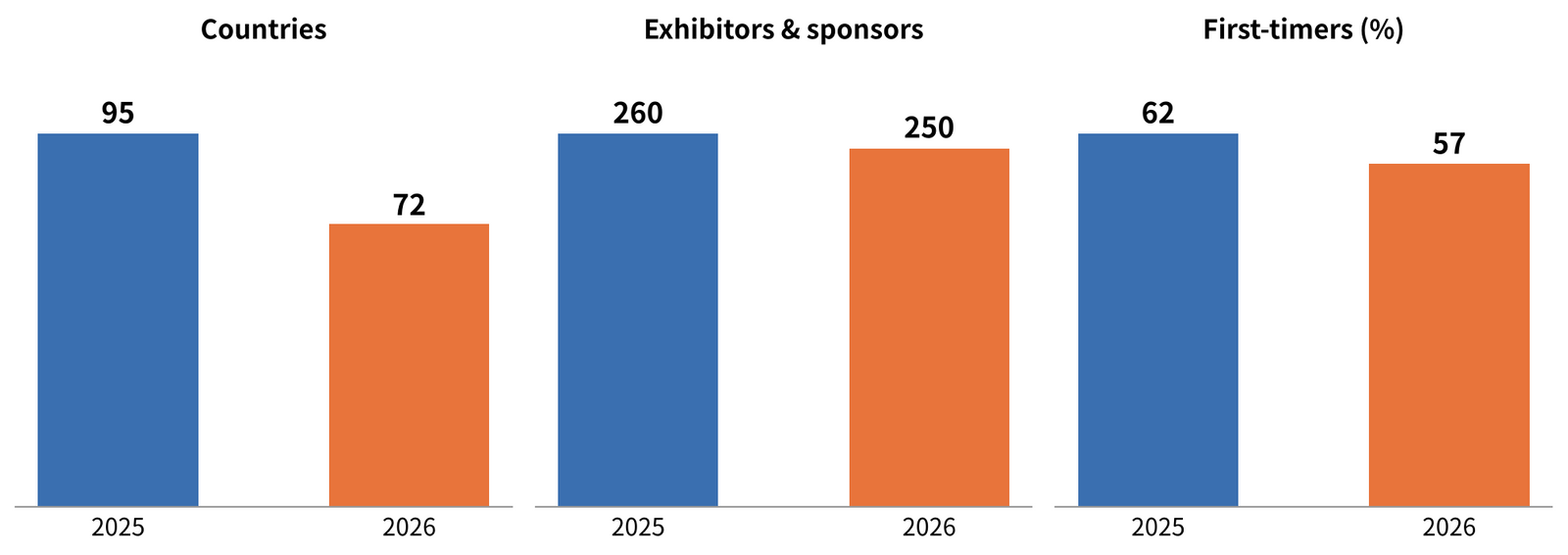
The show was smaller than a year ago. The 2025 edition drew 11,500 registered attendees from 95 countries and 260 exhibitors and sponsors, Sports Video Group reported. NAB had projected attendees from about 100 countries this year; the final count was 72. It did not release a registration figure, and the share of first-timers fell from 62% to 57%.
Apollo's Sobel: AI could cut film budgets 5–20%, "not today, in a few years"
Moderated by CNBC's Alex Sherman, "The Great Media Reshuffling" took on how media companies are splitting, selling and buying assets as linear TV revenue falls and content and sports costs climb, and what role private capital and tech companies play, according to NAB's session description. Sobel put a number and a timeline on AI's impact.
"AI can reduce a budget for a movie 5, 10, 15, 20% — not today, in a few years."
— Aaron Sobel, partner, Apollo Global Management (as quoted by NAB)
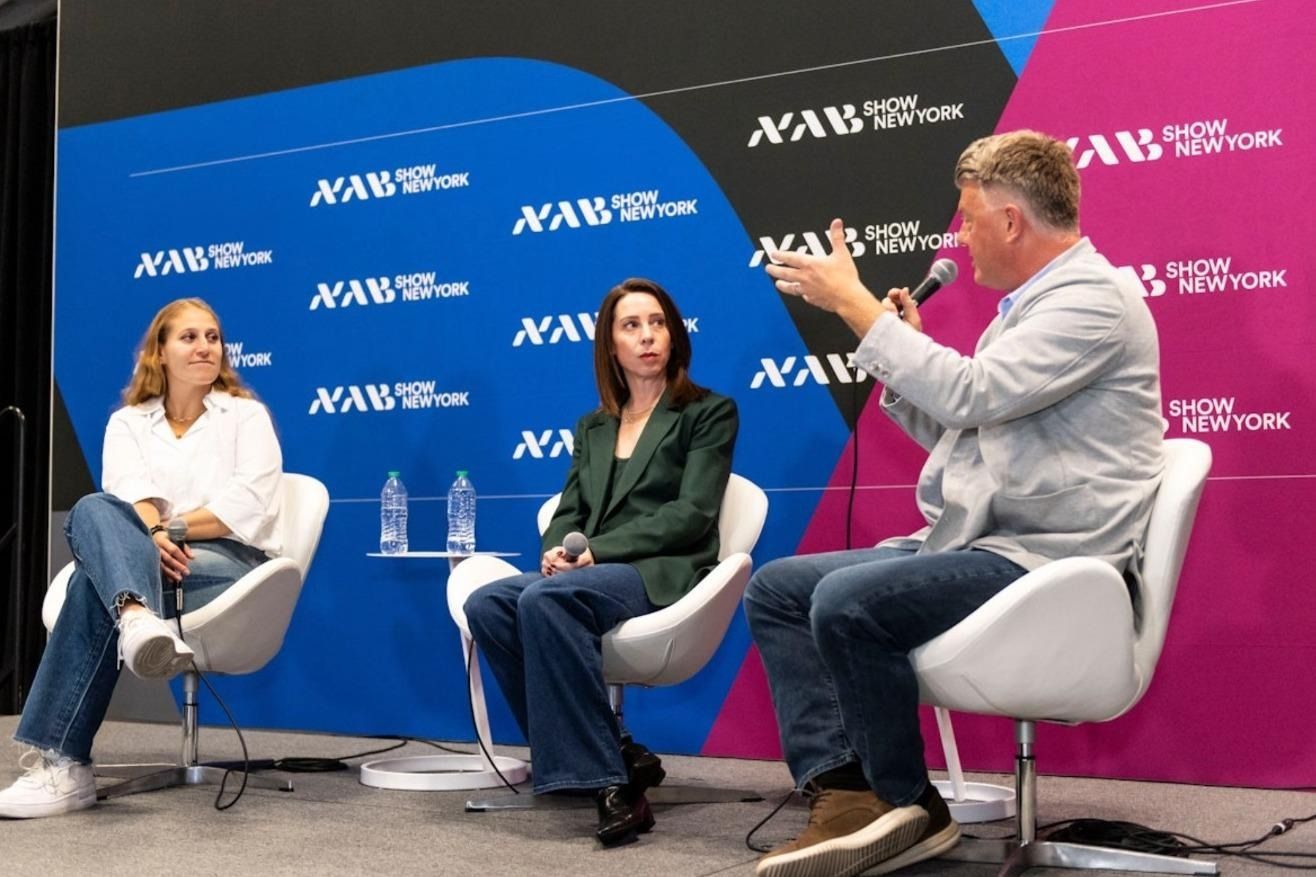
Sandi Stambaugh, a senior vice president at TD SYNNEX, cautioned that companies that bolt AI onto inefficient workflows will not fix the underlying problem.
Korean studios are already reporting numbers in the same range. CJ ENM (CJ ENM) finished "The House" (아파트), a 60-minute film whose backgrounds and visual effects were all generated with AI, for 500 million won (about $377,000), the Herald Business (헤럴드경제) reported. The period drama "Wangbi Eocheonga" (왕비어천가) combined virtual production and AI to cut costs by more than 20% and production time by more than 30%. But lead actors in Korean dramas now command 300 million to 400 million won (about $226,000 to $302,000) per episode, one of the main drivers of rising budgets. AI targets process costs such as backgrounds and effects, so star-heavy productions are unlikely to see savings of the size Sobel described.
LeGeyt: sports rights pay for local news; betting and local TV sessions follow
At "Game On: The Power of Broadcast Sports," LeGeyt argued that big rights packages fund stations' newsrooms and local programming. As network affiliates, U.S. stations air marquee events such as NFL games, collect advertising and retransmission fees, and use that money to run local news. His conversation partner, sports commentator Clay Travis, urged broadcasters to keep experimenting with new ways to build audiences rather than wait for immediate results, saying scale comes with time but also from experimentation.
Also in Theater A that day, CNN's Clare Duffy moderated "The Future of Sports Betting" with FanDuel President Christian Genetski and WFAN host Craig Carton, FanDuel's responsible gaming ambassador. They covered the convergence of betting and media, regulation and problem gambling, per the session listing.
Station-group executives gathered for the Local TV Strategies conference the same day. Finance chiefs from Cox Media Group, Hearst Television, Nexstar Media Group and Sinclair discussed investment and new businesses, and an advertising panel looked at the 2027 outlook, TV Tech reported. With the U.S. midterms on Nov. 3, stations face an off-year without political ad money in 2027.
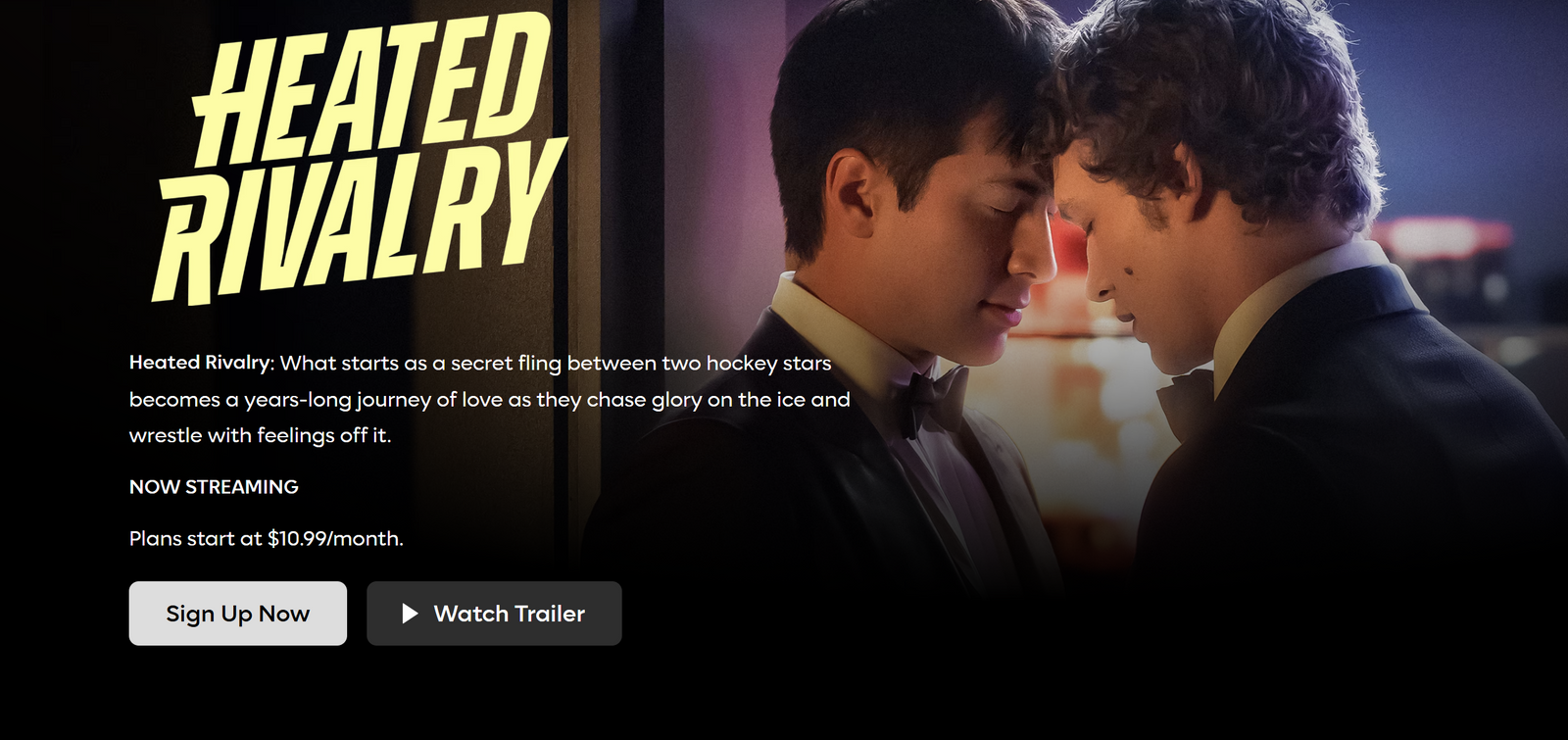
"Heated Rivalry" effect: Ledecky credits the drama with 45% more women at NHL games
New York Islanders co-owner Jon Ledecky said the hockey drama "Heated Rivalry" had increased female attendance across the NHL by 45%. The series is an original of Canada's Crave and streams on HBO Max in the U.S. The 45% figure is Ledecky's claim, not a league statistic.
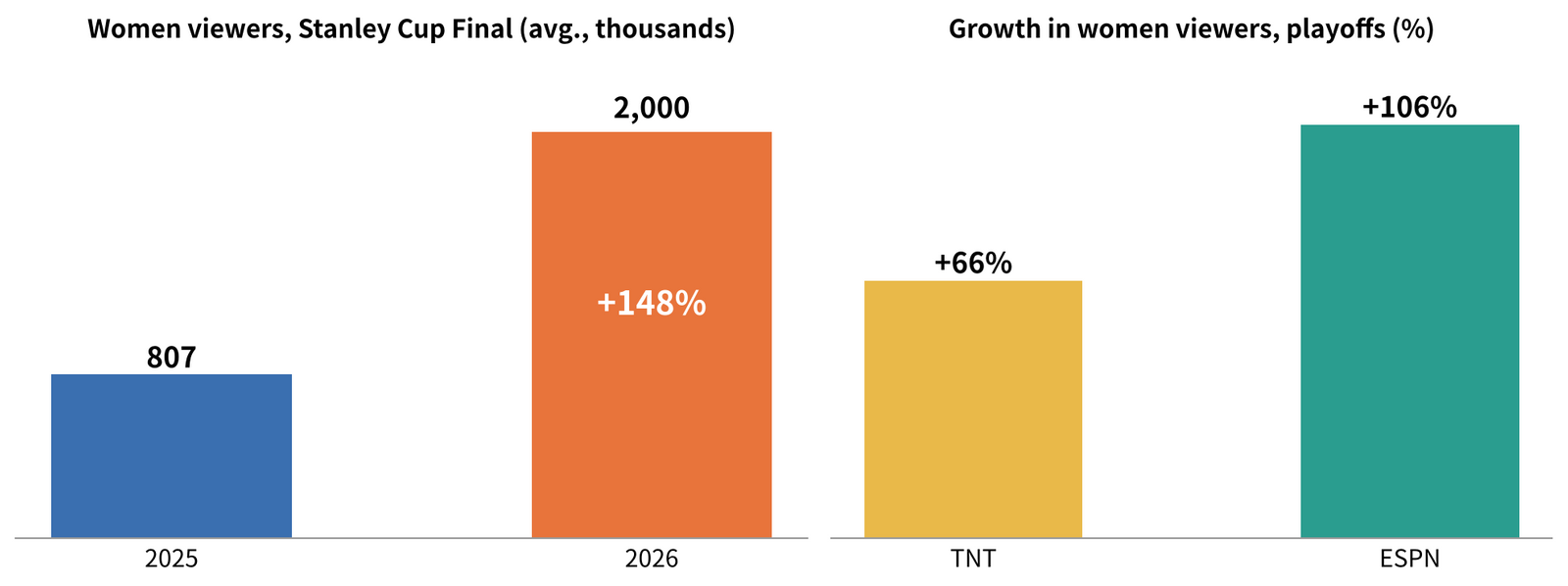
Viewing data point the same way. Women averaged 2 million viewers for the 2026 Stanley Cup Final, up 148% from 807,000 in 2025, the Associated Press reported. Female viewership of the playoffs rose 66% on TNT and 106% on ESPN, according to Sports Business Journal figures cited by Awful Announcing. A scripted show from outside the league moved attendance, which widens the room for rights holders and drama producers to work together.
Creators are "brands, not vendors"; live TV still runs on improvisation
Day two turned to creators and streaming. Christine Cotter of the agency 360i/Dentsu told advertisers to treat influencers as brands and creative partners, not as vendors handed a brief or as a tactic. Maria Stefanopoulos of ABC News' "Good Morning America" spoke for the control room: if the plan stops working at 6:58 a.m., she said, the plan on paper means nothing, and an experienced producer has to improvise.
Production gear is 42% of the floor; broadcasters are only 15% of buyers
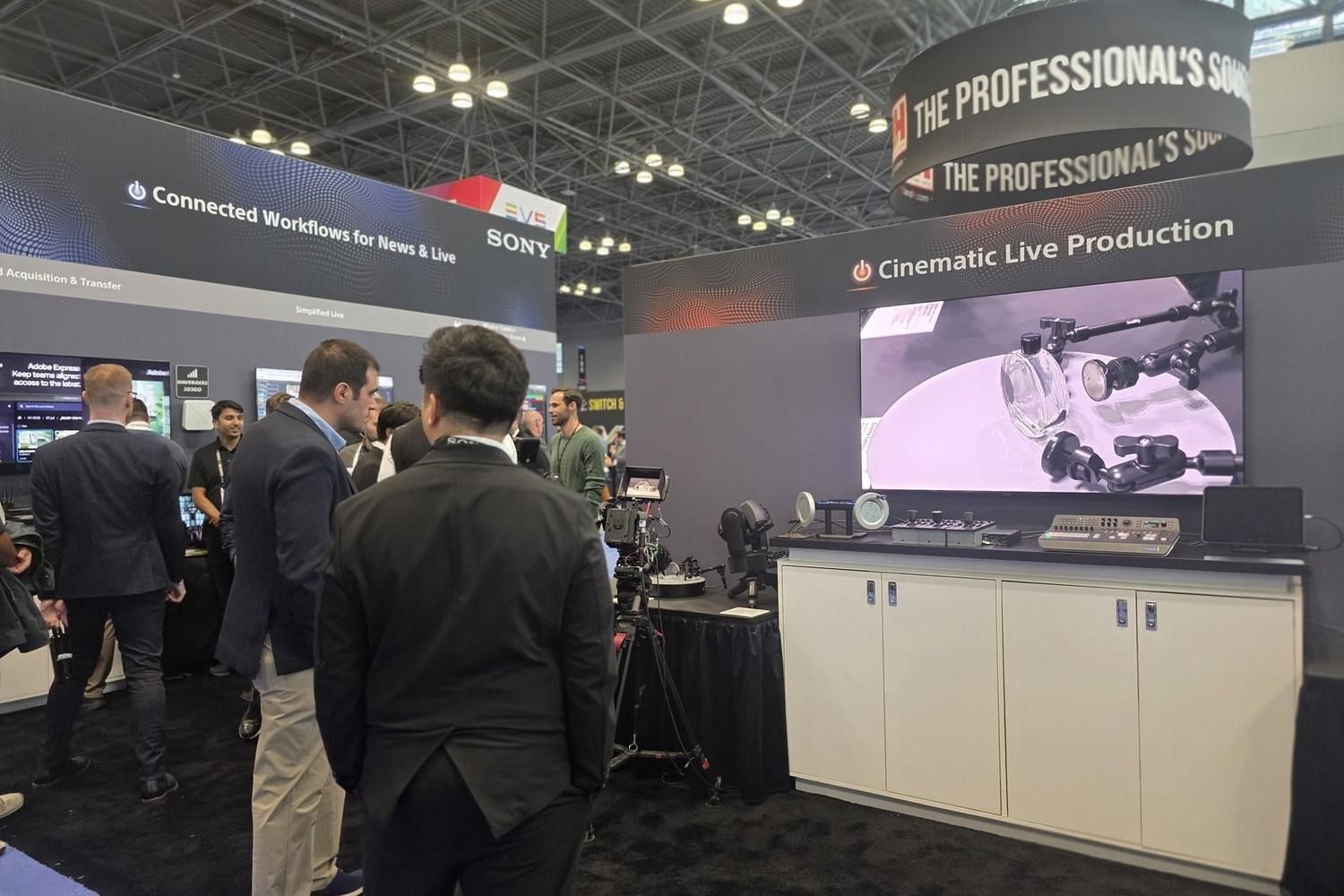
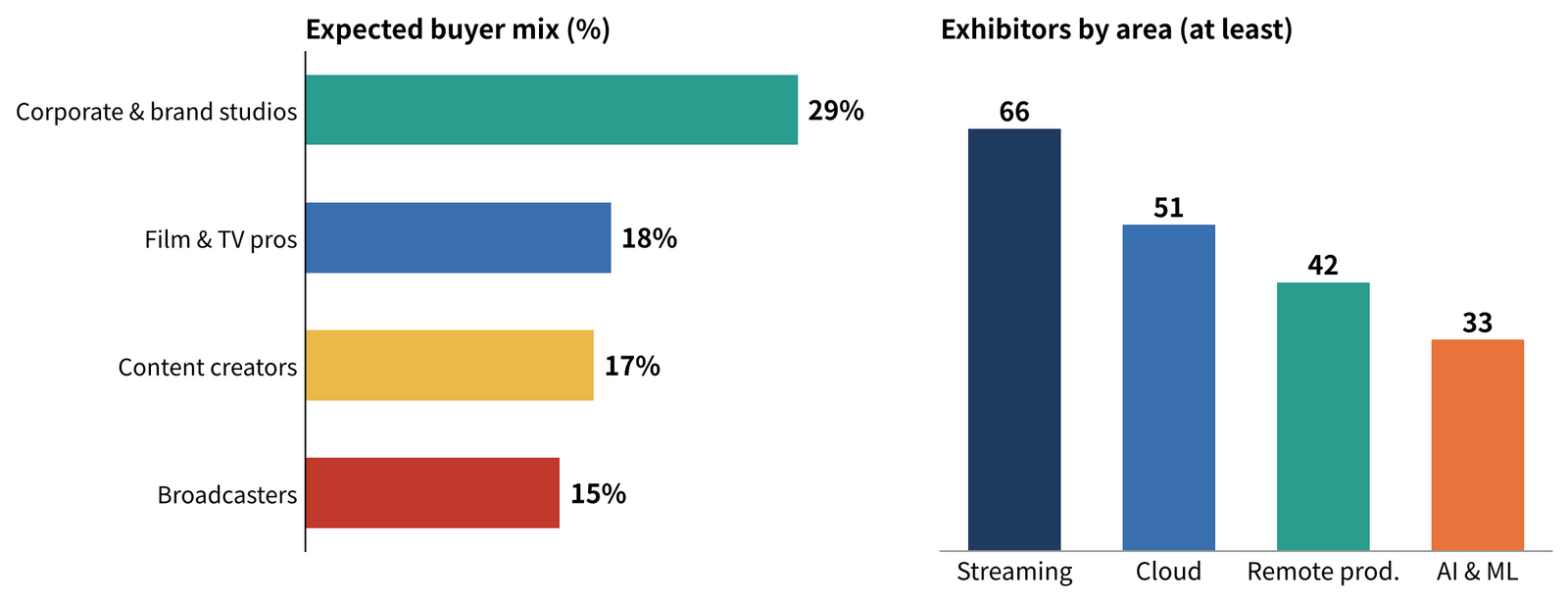
Production was the largest category on the floor at about 42% of roughly 250 companies, followed by infrastructure, IT networking and security at about 33%, NAB said in a pre-show analysis. At least 66 exhibitors were tied to streaming, 51 to cloud computing and storage, 42 to remote production and 33 to AI and machine learning. Sony Electronics, Canon U.S.A., Blackmagic Design, Grass Valley, Ross Video, Riedel Communications and Amazon Web Services were among them, and about 23% of companies were based outside the U.S.
NAB expected 80% of attendees to be buyers, including more than 3,300 executive buyers. Corporate and brand studios made up 29% of the expected buyer base, film and TV professionals 18%, content creators 17% and broadcasters 15%. In-house studios and creators now outweigh broadcasters among the people buying broadcast gear, which gives Korean equipment and software makers reason to look beyond broadcasters for customers.
Korea's TV ad spending fell by more than 1.2 trillion won in three years
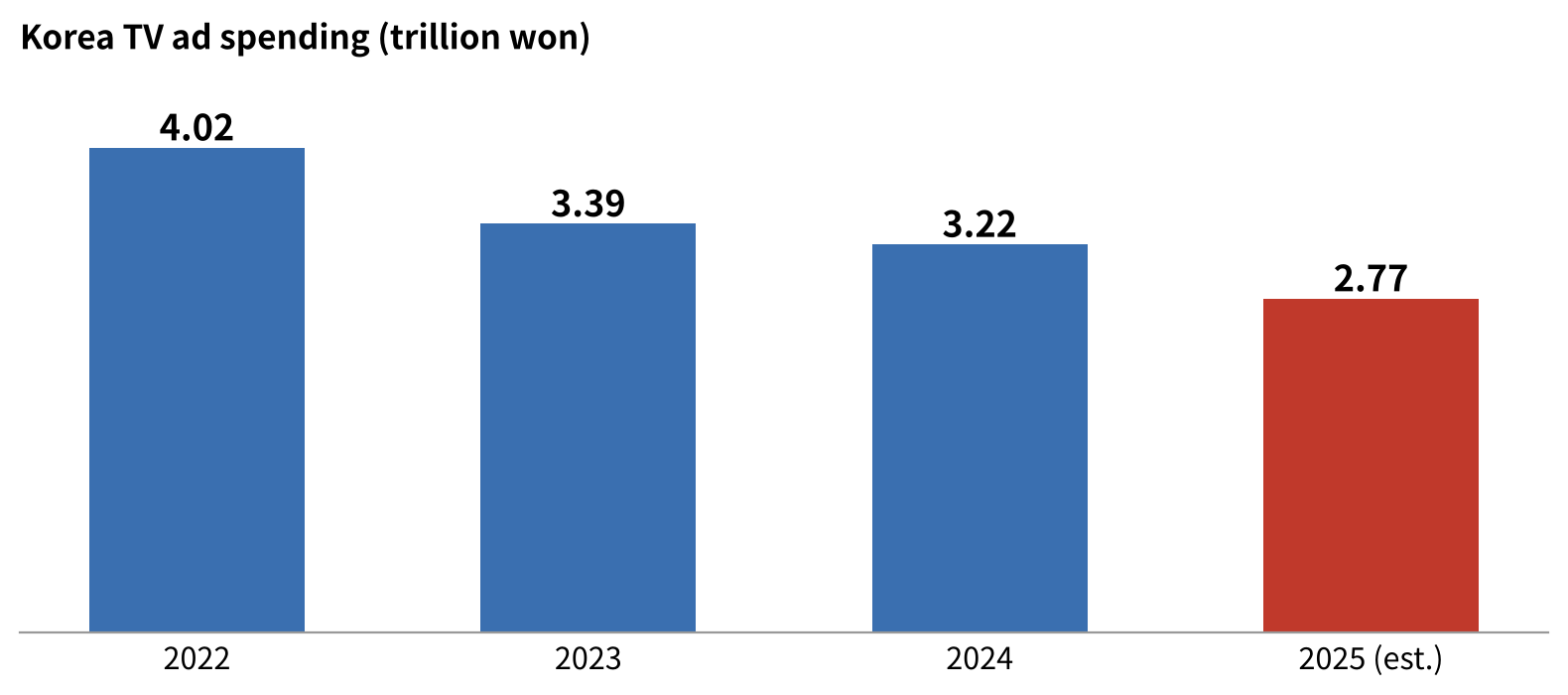
The model LeGeyt described, in which sports rights draw advertising and advertising funds local news, applies to Korean broadcasters too, but their ad base is shrinking fast. TV ad spending fell from 4.02 trillion won ($3.04 billion) in 2022 to 3.39 trillion won in 2023 and 3.22 trillion won in 2024, and is estimated to have dropped another 13.8% to 2.77 trillion won ($2.09 billion) in 2025, according to the annual survey by the Korea Communications and Media Commission (방송미디어통신위원회) and the Korea Broadcast Advertising Corp. (한국방송광고진흥공사), as reported by the Journalists Association of Korea (기자협회보). Online took 59% of total ad spending in 2024.
Rights shape ad sales in Korea as well: DB Securities (DB증권) said cable channel tvN was at a disadvantage in World Cup advertising this year because it did not hold broadcast rights. Sobel's AI savings sit on the cost side and LeGeyt's rights argument on the revenue side, and Korean broadcasters are running both calculations at once.
KBS nominee Lee Tae-hyun pitches FAST distribution, bundled ads and an AI verification team
On Oct. 20, the eve of the show, the board of KBS (한국방송공사), Korea's public broadcaster, picked Lee Tae-hyun (이태현), former chief executive of Content Wavve (콘텐츠웨이브), as its nominee for the 28th presidency and recommended him to the president for appointment, the Kyunghyang Shinmun (경향신문) reported. Lee joined KBS as a producer in 1994, ran its content business division and then led the streaming service Wavve for five and a half years from 2019. Two directors recommended by the People Power Party (국민의힘) walked out after their request to delay the vote was refused.
His management plan, as reported by Media Today (미디어오늘), calls for wider global distribution through YouTube, connected TV and FAST, turning the archive into an asset, redesigning advertising around bundled packages, and developing idle real estate. For the newsroom he proposed an AI verification team. Distribution, advertising and AI are the same three threads that ran through the New York program, though the plan as reported carries no targets or revenue projections. Lee faces a National Assembly confirmation hearing and is expected to take office in November.
Korea's pavilion goes to Las Vegas in April; New York is where the money talks
Korea's Ministry of Science and ICT (과학기술정보통신부) has run a Korean broadcast technology pavilion with NAB since 2016. This April in Las Vegas, 49 companies and institutions, including the Electronics and Telecommunications Research Institute (ETRI·한국전자통신연구원) and broadcasters, showed 12 AI-related technologies, Digital Today (디지털투데이) reported. The pavilion is built around the equipment-focused spring show and is not part of the fall New York event.
Karen Chupka, NAB's executive vice president, said the New York show's value lies in putting the people who fund content, the people who make it and the people who build the technology in one room. NAB says 80% of last year's New York attendees were purchase decision-makers. Korean companies have yet to build a path from their April exhibits to those fall conversations about investment, sports and creators.
Outlook: SMPTE Summit joins New York in 2027 as this year's forecasts face a test
Next year, NAB Show New York runs Sept. 29–30 at the Javits Center alongside the SMPTE Summit (Sept. 28–30), the annual technical conference of the Society of Motion Picture and Television Engineers. SMPTE Executive Director Sally-Ann D'Amato said the pairing will connect the people developing tomorrow's standards with those using technology in the field today. The Las Vegas show runs April 3–7, 2027.
Most of the headline numbers from this year's show were forecasts or claims: Sobel's 5% to 20% assumes a few more years, and Ledecky's 45% is not a league figure. For Korea, three things are worth checking: whether the 2026 advertising survey, due early next year, puts TV ad spending below the 2.77 trillion won estimate; whether AI savings at studios such as CJ ENM move from one-off projects into the cost structure of series production; and what targets KBS's new president attaches to FAST distribution and bundled advertising once he takes office.