
GLOBAL STREAMING | ANALYSIS
Puck reports about 5% of employees will be affected as soon as next week — roughly 800 jobs, against 450 in 2022 — ahead of third-quarter results on Oct. 20
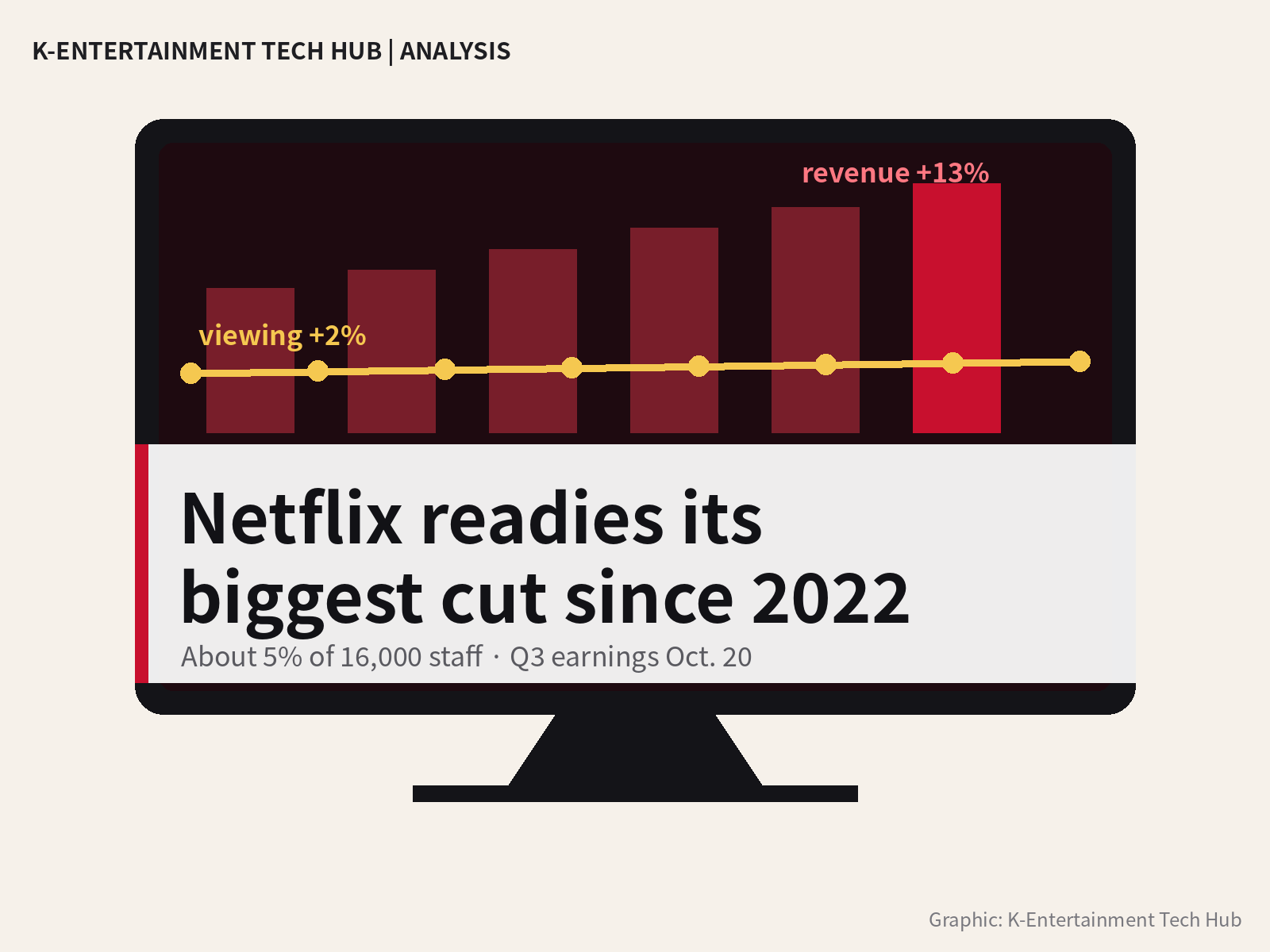
Netflix is preparing to cut about 5% of its workforce in a restructuring that could be announced as early as next week, the media newsletter Puck reported on Thursday, citing people familiar with the plans.
The company had about 16,000 full-time employees at the end of 2025, so a 5% reduction would eliminate roughly 800 jobs. About 68% of staff, or 10,900 people, work in the U.S. and Canada, Variety noted. A Netflix spokesperson declined to comment, and it is not yet clear which departments would bear the brunt.
That would make it the biggest round of layoffs since 2022, when Netflix shed about 450 people in two waves after losing 200,000 subscribers in the first quarter. The trigger this time is not subscriber losses but slowing engagement and a falling share price.
Second-quarter revenue rose 13% to $12.56bn, while viewing hours for the first half grew just 2% to 97bn. Netflix guided third-quarter revenue to $12.86bn, short of the roughly $13bn analysts expected. “Yes, overall, we’re not growing as fast as I want us to, and we’re working on making that move faster,” co-chief executive Ted Sarandos said at Bloomberg's Screentime conference in Los Angeles on Sept. 30.
Puck: cuts could come 'as early as next week'
The report came from Puck's Matthew Belloni, who described the cuts as part of a broader restructuring, according to The A.V. Club, which also cited The Hollywood Reporter as saying a reorganization could unfold over the next few months, with the stock down 20% this year. The A.V. Club put total headcount at about 17,000, implying some 850 jobs; on the 16,000 figure Netflix has disclosed, the number is closer to 800.
Smaller cuts have already come this year. TheWrap reported that Netflix let go dozens of people from its product team — less than 1% of the 6,000-strong division, with no senior executives affected — shortly after Elizabeth Stone took the group under her remit. In its Oct. 9 story, TheWrap dated those cuts to February.
2022 was about lost subscribers; 2026 is about 2% viewing growth
The 2022 reductions came in stages. In May, Netflix cut about 150 people, telling CNBC that “our slowing revenue growth means we are also having to slow our cost growth as a company.” That was under 2% of an 11,000-strong staff. Another 300, or about 3%, followed in June, CNN reported, and 30 animation employees went in September, per TechCrunch.
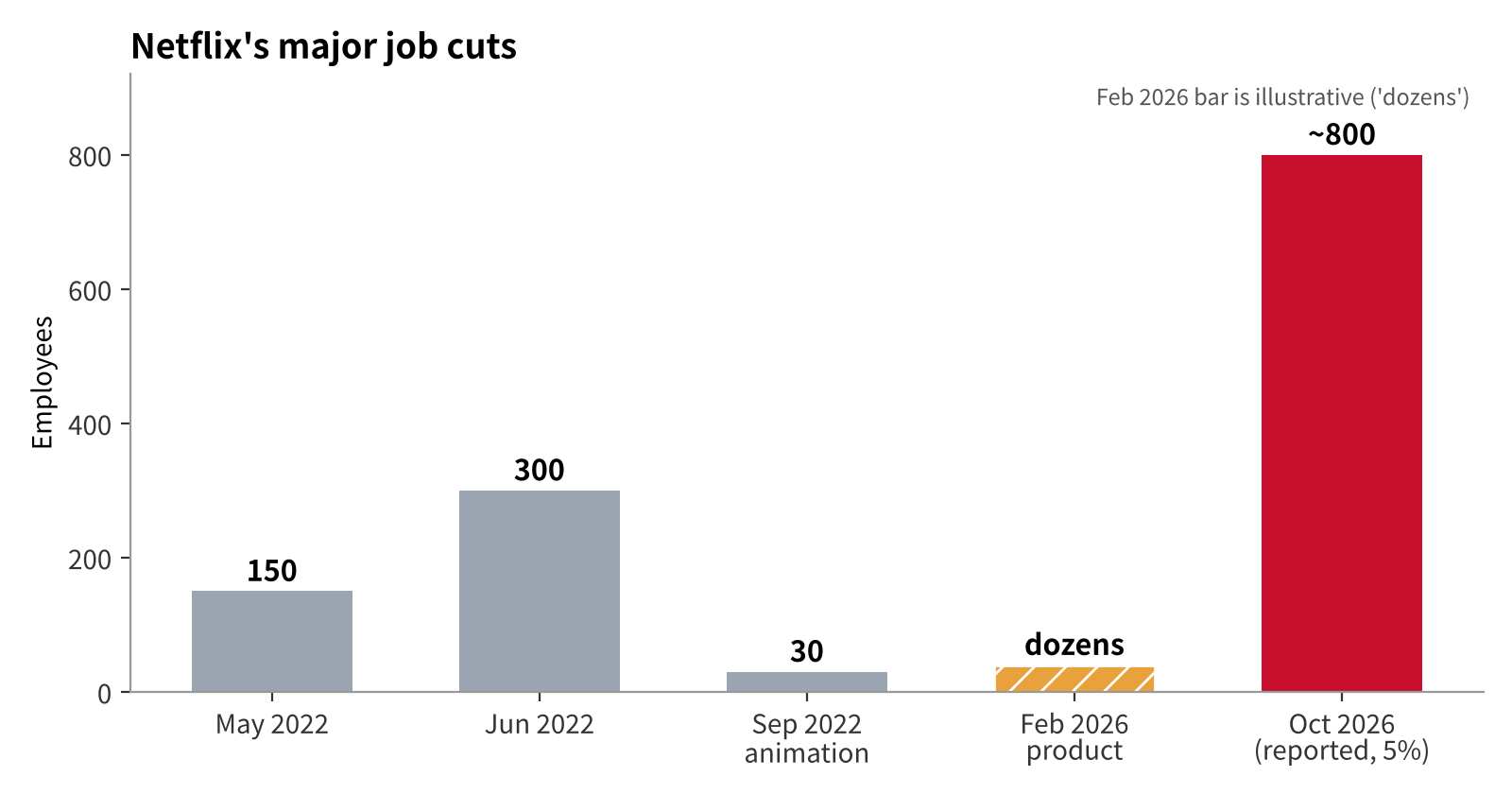
Headcount has since grown from 11,000 to 16,000, so even after a 5% cut Netflix would employ some 4,000 more people than before the 2022 layoffs. The backdrop differs too. Paid memberships reached 335.7mn in the second quarter, broadly in line with the 336.1mn consensus, according to S&P Global. In its July shareholder letter, Netflix narrowed full-year revenue guidance to $51bn–$51.4bn and held its 31.5% operating-margin target. With top-line growth easing, holding that margin leaves costs as the lever.
Revenue up 13% in Q2; Q3 guidance below consensus
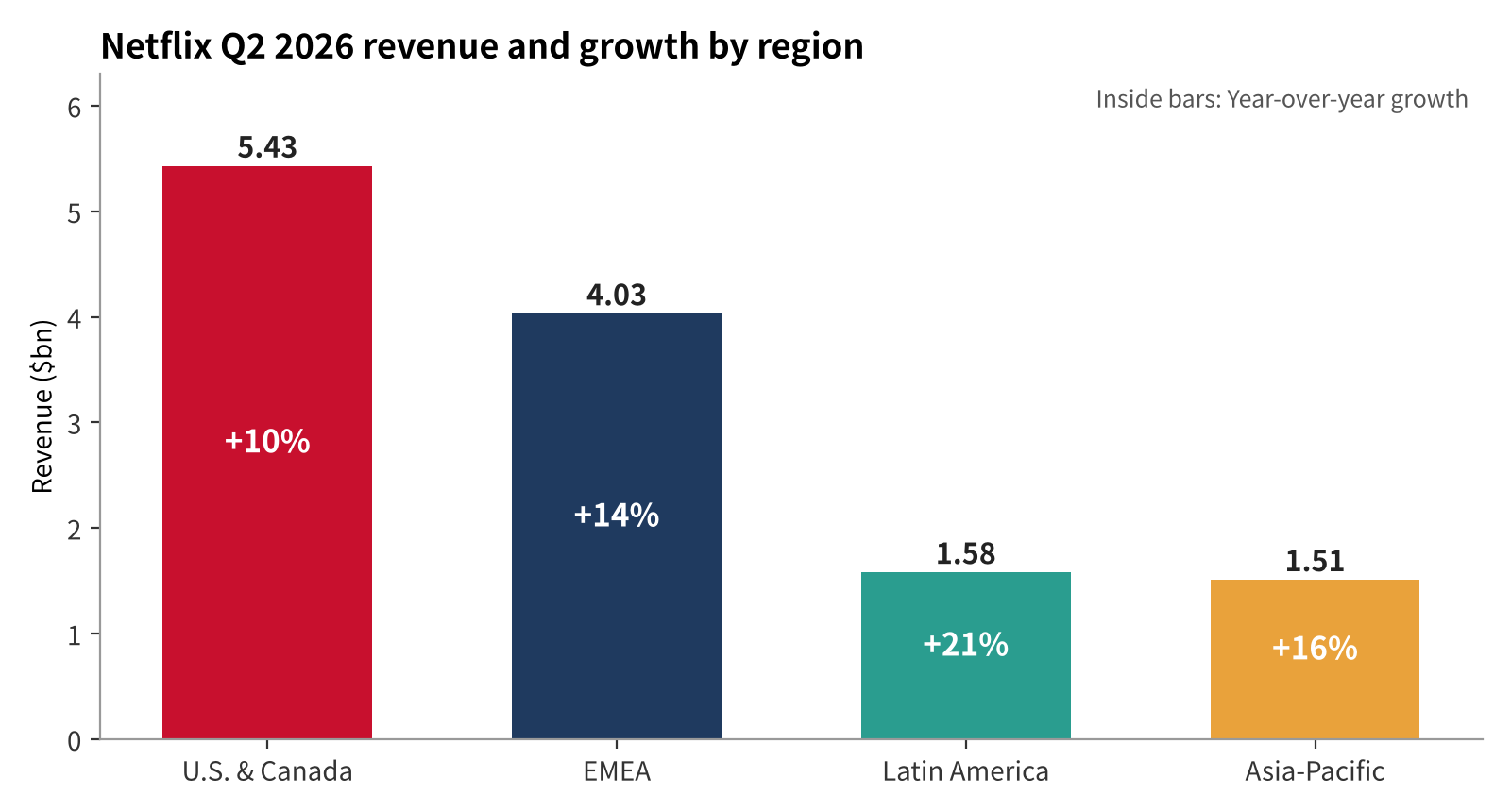
U.S. and Canada revenue rose 10% to $5.43bn in the second quarter. Europe, the Middle East and Africa grew 14% to $4.03bn, Latin America 21% to $1.58bn and Asia-Pacific 16% to $1.51bn, Benzinga reported. The home market, which accounts for 43% of revenue, grew the slowest of the four. It is that spread Sarandos pointed to when he told Screentime revenue had risen by double digits in every region.
Investors reacted to the outlook rather than the quarter. Netflix forecast third-quarter revenue of $12.86bn and earnings of 82 cents a share, against expectations of $13bn and 84 cents. The shares fell about 9% after hours, The Next Web reported.
Cash generation also weakened. Free cash flow fell 32.7% to $1.53bn as content spending rose and working-capital timing turned against the company, according to S&P Global. Advertising revenue jumped 79.8% to $618mn but came in 7.2% below estimates. Netflix kept its target of about $3bn in ad revenue for the year.
Live takes 5% of the content budget and 1% of viewing
Sarandos singled out live programming as a drag on the engagement figures. “When we do live programming on Netflix, which is a relatively new thing, we spend about 5% of our content budget on live events. They generate about 1% of our watching,” he said, as reported by Variety. With a content budget of roughly $20bn a year, that puts live spending at about $1bn.
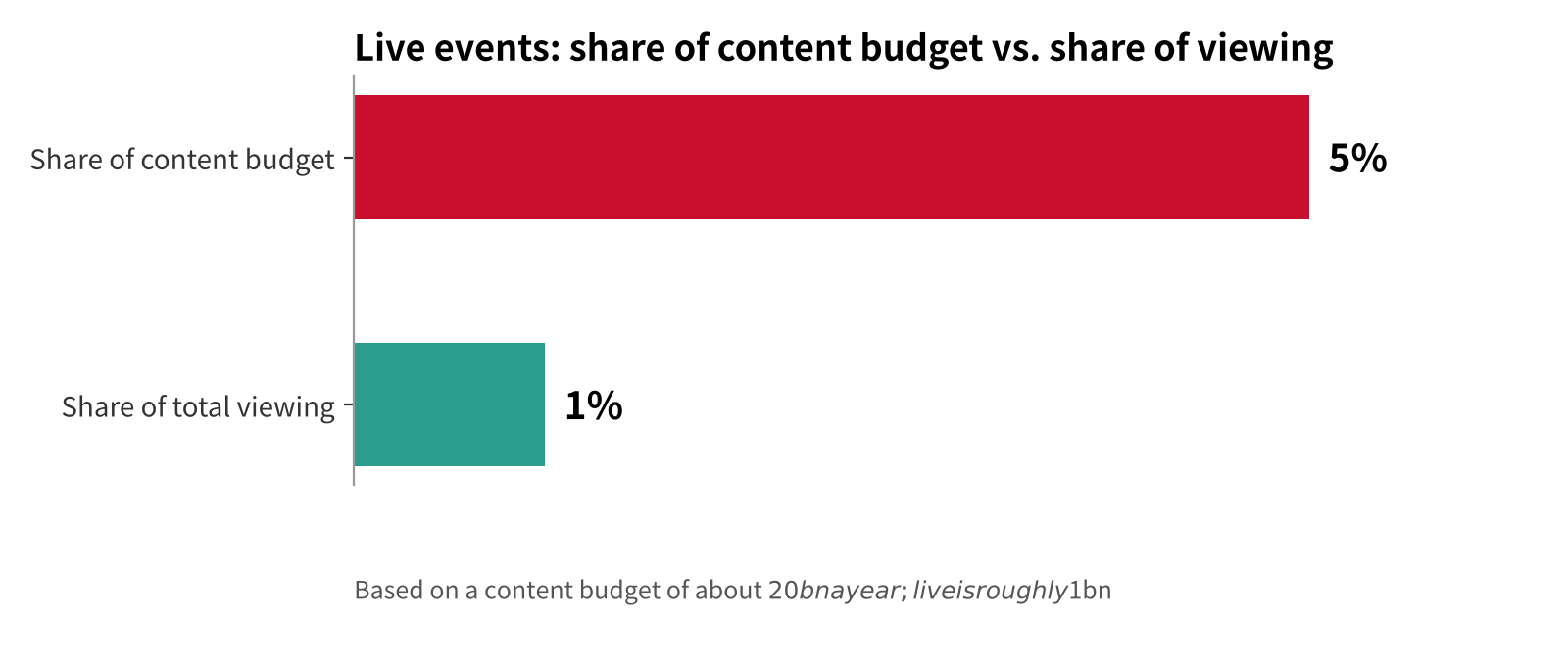
Netflix live events: share of content budget vs. share of viewing. Source: Sarandos at Bloomberg Screentime (via Variety, AFP)
He argued live should be judged on other measures. It “plays a very different role — it drives a lot of sign-ups, it's effective for retention and for advertising,” Sarandos said, according to AFP. He stressed that films and series remain the priority and said Netflix is “definitely not in the user-generated content business.” Because live lifts ad revenue while depressing viewing-hour growth, his remarks amount to a request that investors weigh it on sign-ups, churn and advertising rather than hours watched.
Shares down about 40% since the Warner Bros. bid
The share slide is tied in part to the failed takeover. In December 2025 Netflix agreed to buy Warner Bros. Discovery's studios and HBO business for $82.7bn. When Paramount Skydance came back at $31 a share, valuing the company at about $111bn, Netflix declined to match on Feb. 26. “At the price required to match Paramount Skydance's latest offer, the deal is no longer financially attractive,” co-CEOs Sarandos and Greg Peters said.
Netflix booked the $2.8bn termination fee in first-quarter other income, its 10-Q shows. Even so, the stock has fallen about 42% since the bid began, by Stocktwits' count; Deadline put the one-year decline at 40%, Cord Cutters News reported. Sarandos told Screentime he had no regrets about the attempt, TheWrap reported.
Korea's $2.5bn pledge ends this year, with no successor announced
In Korea the timing coincides with the end of a high-profile commitment. In April 2023, during then-President Yoon Suk Yeol's (윤석열) state visit to Washington, Sarandos pledged to invest $2.5bn in Korean content over four years — roughly double what Netflix had announced since entering the market in 2016. 2026 is the final year.
At ‘Next on Netflix 2026 Korea’ in Seoul on Jan. 21, the company unveiled 29 Korean series, films and unscripted titles. Kang Dong-han (강동한), vice president for Korean content, said Netflix was “faithfully carrying out the 2023 investment commitment” and that the plan was unchanged, Hankyung (한국경제) reported. He sidestepped questions about a rumoured 300mn-won cap on actor fees, and told Sports Kyunghyang (스포츠경향) that slates for the next two years were already in preparation. Netflix has not said what, if anything, will follow the $2.5bn pledge.
Korean drama supply fell to 108 titles; 8.8% of Netflix viewing is Korean
Netflix's weight in Korean production has grown as local demand has slipped. Broadcasters and streaming services supplied 108 dramas in 2024, down from 112 a year earlier, according to the 2025 broadcasting-market competition assessment released on May 15 by the Korea Communications and Media Commission (방송미디어통신위원회) and KISDI (정보통신정책연구원), Digital Daily (디지털데일리) reported. Domestic commissioning fell while global streamers' rose. Netflix supplied 30 Korean originals in both 2023 and 2024, and Korean titles made up 8.8% of Netflix's global viewing in 2024, second only to U.S. content, News Seoul (뉴스서울) reported.
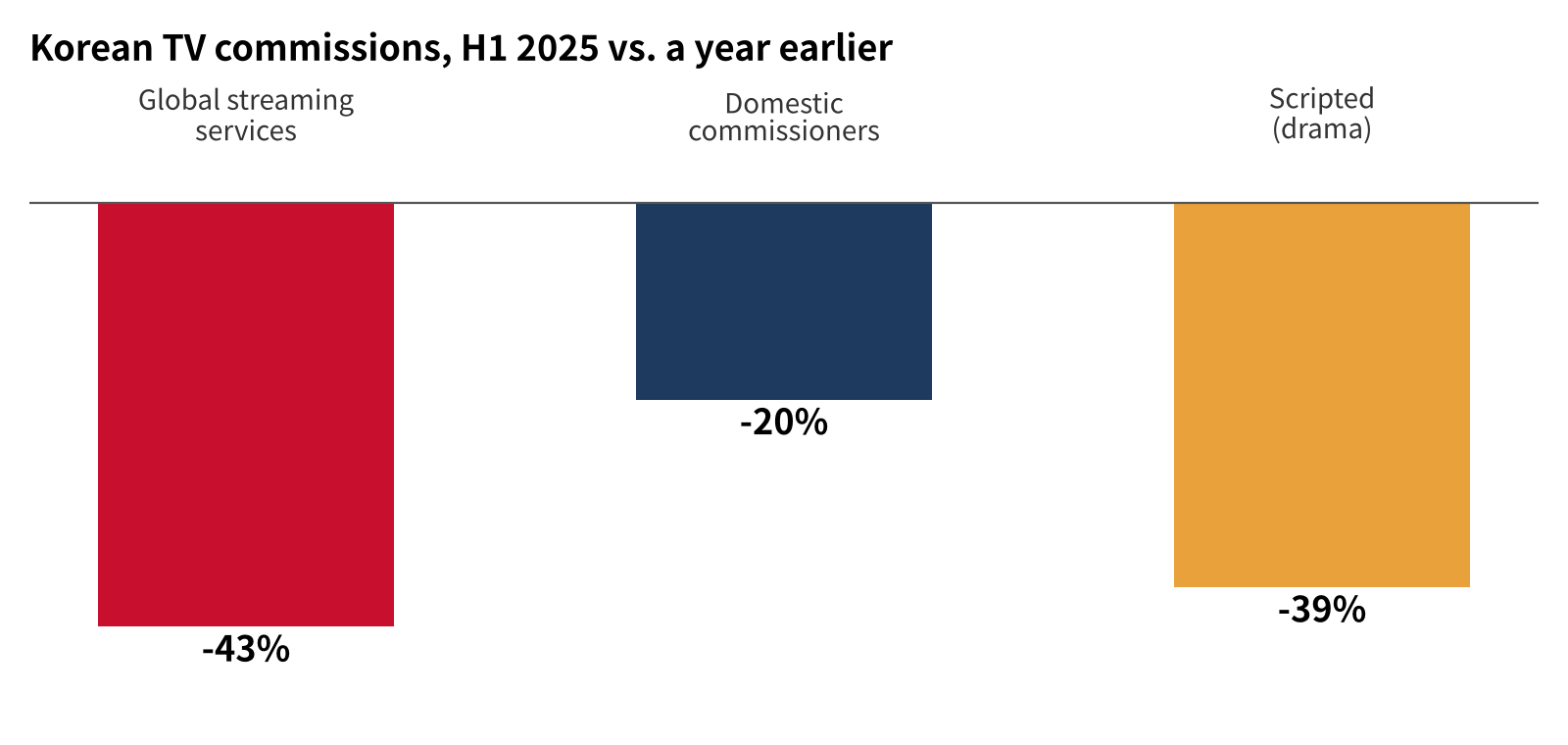
Commissioning is even more concentrated. Ampere Analysis found that in the first half of 2025, global streamers' Korean TV commissions fell 43% year on year, domestic commissions 20% and scripted 39% — and that 88% of new Korean titles announced by global streamers came from Netflix, Herald Business (헤럴드경제) reported. Ampere added that Netflix, too, was tilting away from drama toward unscripted.
Payroll, not programming budget — what Korean broadcasters and producers should watch
The reported cuts fall on payroll, not on the $20bn content budget. But the mix inside that budget is already shifting: by Sarandos' own figures, 5% now goes to live, and the growth metrics Netflix emphasises have moved toward advertising and retention. If live and ad-supported products take a larger share of the same budget, the effect on Korean drama commissions will first show up in the size of the 2027 slate.
For producers, bargaining power runs through one buyer. With Netflix behind 88% of global streamers' new Korean titles, whatever terms it sets after the $2.5bn pledge effectively become market rates — one reason talk of a fee cap drew such attention. How much a producer can sell elsewhere, through co-productions with domestic broadcasters and TVING (티빙) or sales to other international streamers, shapes the terms it can get.
For broadcasters, the point of contact is advertising. The regulator's assessment expects growth in ad-supported tiers at Netflix and TVING to increase substitution pressure on TV advertising. A Netflix that targets $3bn in ad revenue and pitches live events as premium ad inventory overlaps directly with the real-time ad market Korean broadcasters depend on. If Netflix trims staff while sustaining its live and advertising push, it becomes not only a buyer of Korean broadcasters' content but a competitor for their advertisers.
Outlook: Oct. 20 earnings will show the scale of cuts and the 2027 plan
Netflix reports third-quarter results after the market closes on Tuesday, Oct. 20 — the morning of Oct. 21 in Seoul. Sarandos and Peters are expected to address the restructuring, Cord Cutters News said. Three numbers will matter: whether revenue clears the $12.86bn guidance, whether advertising is on track for $3bn, and how much Netflix plans to spend on content next year.
Any announcement should clarify whether the cuts fall on product and technology, content teams or regional offices. With two-thirds of staff in North America, the reduction is likely to be concentrated at headquarters, but whether the Korean office is affected is not known. In Korea, the next question is whether Netflix announces a follow-up commitment around the end of the year, when the $2.5bn pledge expires. In 2022, Netflix paired its layoffs with an ad tier and a crackdown on password sharing. What new revenue levers accompany this round will feed directly into Korean producers' and broadcasters' plans for 2027.