

ANALYSIS | NETFLIX
Netflix turns to a studio veteran as growth slows
Bela Bajaria is out and Peter Rice starts Oct. 26, a day after about 1,000 job cuts, with Emmy wins at their lowest since 2016 and first-half viewing up 2%.
By Jung Han, Entertainment Tech correspondent · K-EnterTech Hub (케이엔터테크허브) | Oct. 16, 2026
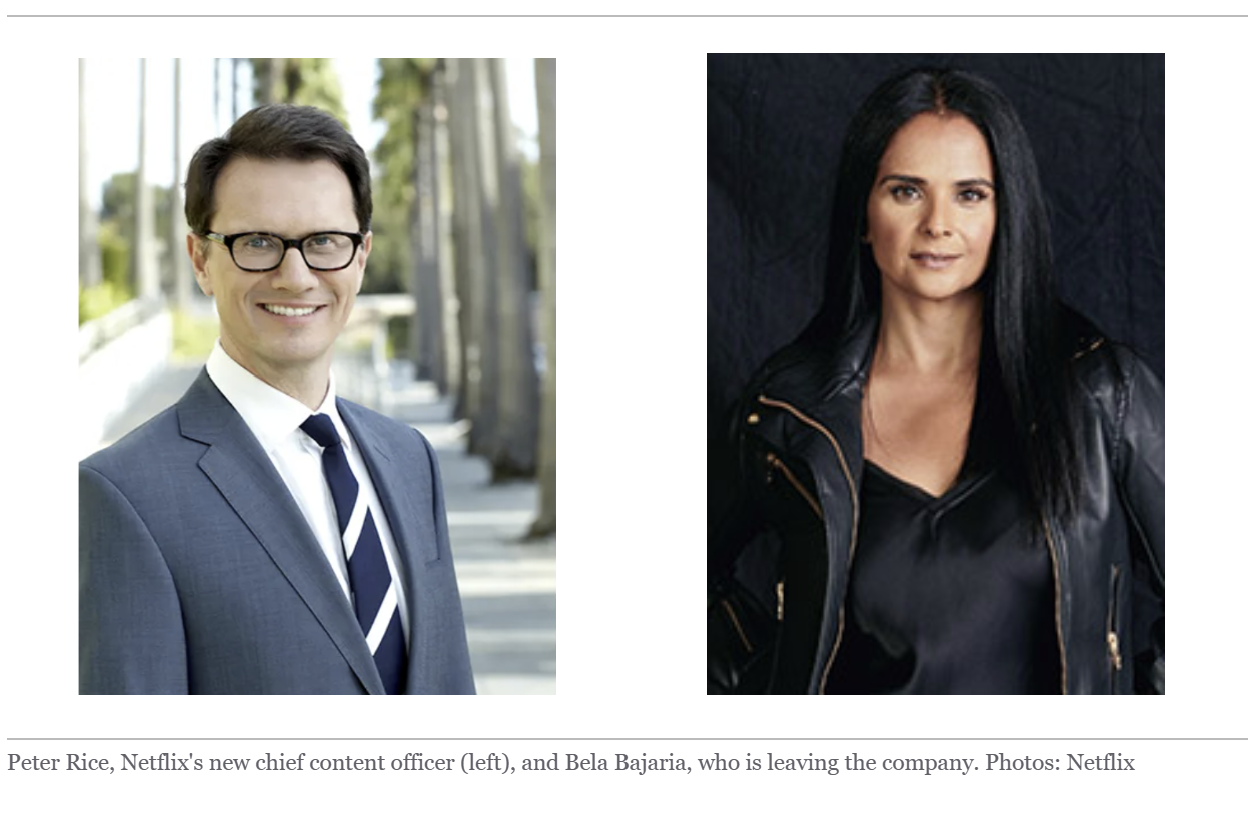
Netflix has replaced its chief content officer. On Oct. 15 the company announced that Peter Rice, former chairman of Walt Disney Television, will take the job on Oct. 26. Bela Bajaria, who joined in 2016 and has run content since 2023, leaves immediately. Rice will oversee scripted and unscripted series, film and live events in every region.
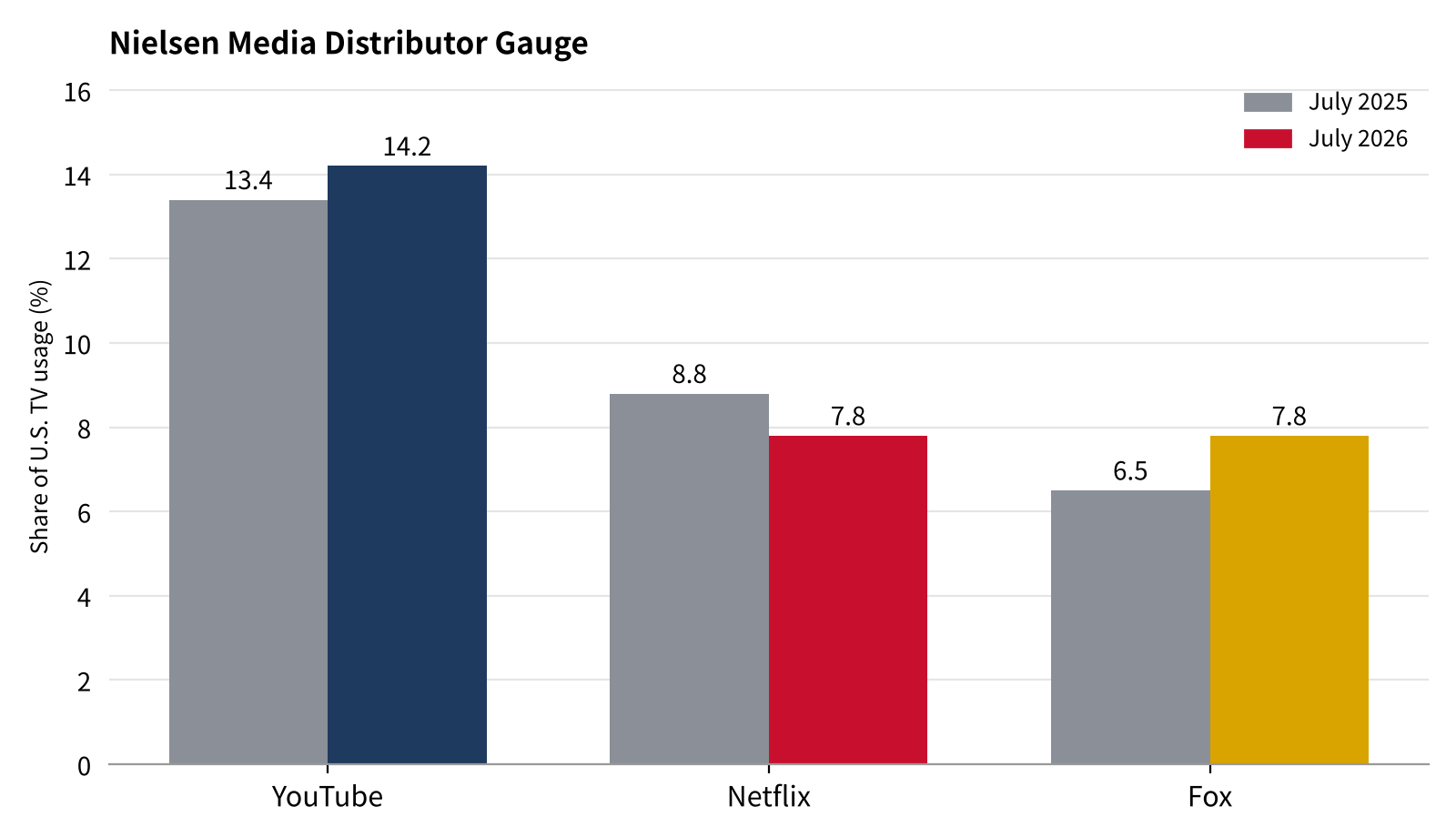
The case for the change is in the viewing numbers. Netflix's first-half report put viewing from January to June at 97 billion hours, up 2% from a year earlier. In Nielsen's Media Distributor Gauge, Netflix's share of U.S. television usage fell from 8.8% in July 2025 to 7.8% this July, while YouTube rose from 13.4% to 14.2%. Emmy wins dropped from 30 last year to 16. The shares have lost nearly 40% in a year.
The appointment came the day after Netflix said it would cut about 6% of its global workforce, roughly 1,000 jobs, its largest layoffs since 2022. It had about 16,000 full-time employees at the end of 2025. Bajaria was no exception. Co-CEO Ted Sarandos told her earlier in the week that she was out, and the company had planned to announce it the following week, The New York Times reported. Then Puck, the Hollywood trade newsletter, broke the story on the afternoon of Oct. 15 and forced the timing; Variety reported that the news spread before Bajaria could tell most of her teams.
Her successor has run both film and television. Rice made movies at Fox Searchlight, became president of 21st Century Fox and at Disney oversaw broadcast, cable, streaming and production studios together. Sarandos called him "one of the most effective at-scale operators in the entertainment industry."
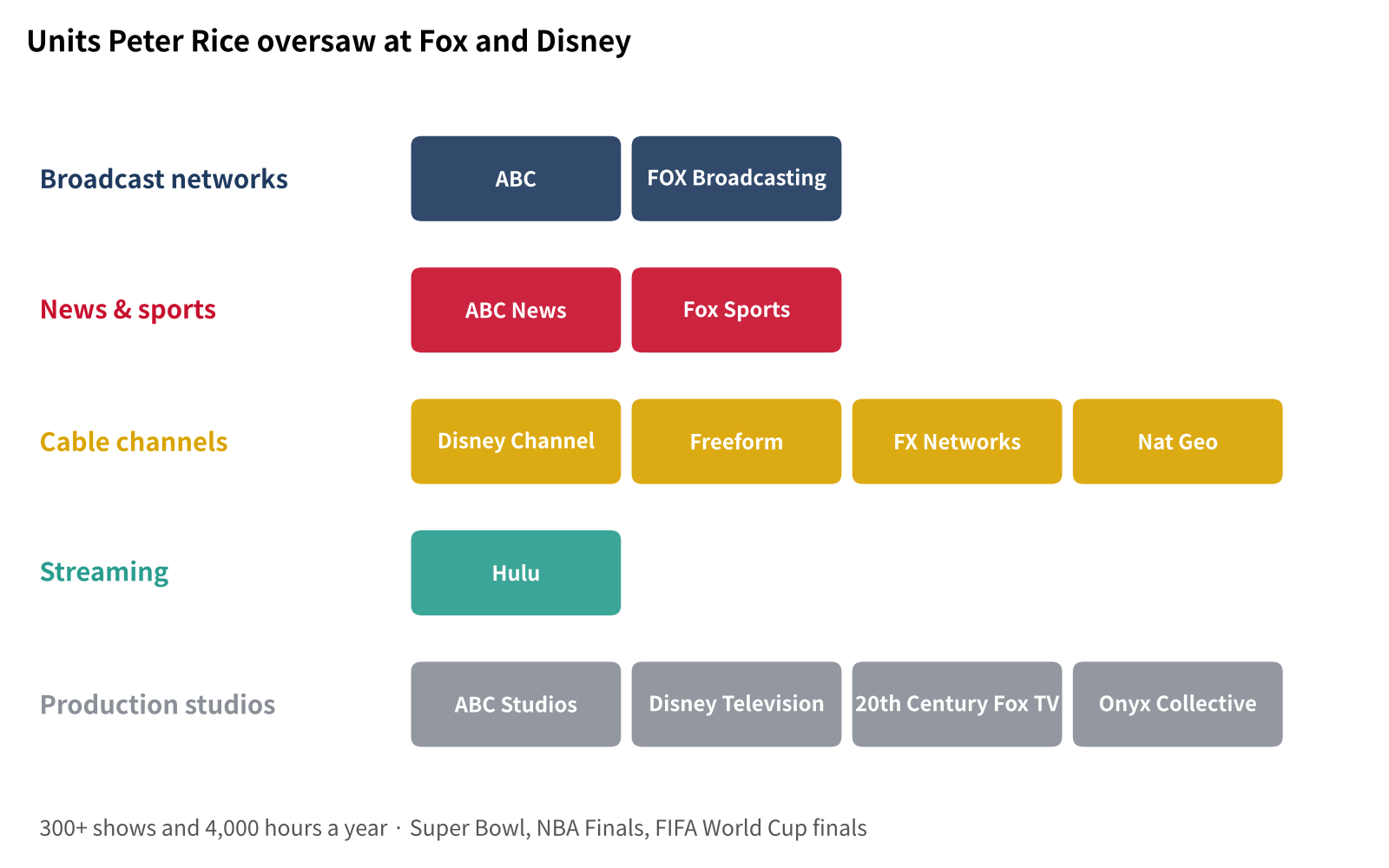
13 units and 300 shows a year at Fox and Disney, plus the Super Bowl and NBA Finals
Rice has run a wide range of operations. ABC, FOX Broadcasting, Fox Sports, ABC News, ABC Studios, Disney Channel, Freeform, FX Networks, Hulu, National Geographic, Onyx Collective, Disney Television and Twentieth Century Fox Television together produced more than 300 shows and 4,000 hours a year under him.
That era produced "The Simpsons," "American Idol," "Modern Family," "The Bear" and "Shōgun," and Rice was also responsible for Super Bowl, NBA Finals and FIFA World Cup final broadcasts and for ABC News. Disney earned 146 Primetime Emmy nominations in 2021 and 147 in 2022.
His film record goes back further. After graduating from the University of Nottingham in 1989 he joined Fox's film division and, as executive vice president of production at Twentieth Century Fox, made "Moulin Rouge" and "Romeo + Juliet" with Baz Luhrmann and "The Beach" with Danny Boyle. He was supervising creative executive on the first "X-Men."
As president of Fox Searchlight he released "Slumdog Millionaire," "Juno," "Little Miss Sunshine" and "Sideways." He went on to become president of 21st Century Fox and chief executive of Fox Networks Group, represented Fox on the Hulu board and chaired A&E Networks and National Geographic Partners.
When Disney bought most of 21st Century Fox's entertainment assets in 2019, Rice became chairman of Disney General Entertainment. Three years later, in June 2022, then-CEO Bob Chapek fired him and gave the job to Dana Walden.
Since then he has produced "Saturday Night," "Warfare" and "28 Years Later" and signed a production deal with A24. "The Social Reckoning," released by Sony Pictures last week, has disappointed at the box office. Since July 2025 he has been in charge of ceremonies and content for the LA28 Olympic and Paralympic Games.
Raised in South London, he spent nearly three decades at Fox. Industry players describe him as affable and elegant but hard to read. He likes the Socratic method in meetings, drawing out answers with questions, and is comfortable with awkward silences, the Times reported.
Rice's name had in fact been circulating as Bajaria's possible successor for weeks. It started with a lunch with Skydance co-CEO Ynon Kreiz; Variety carried an account that Kreiz wanted Rice to take over his seat on the Mattel board. Netflix appeared to be looking, too. Co-CEO Sarandos was seen lunching with HBO chief content officer Casey Bloys earlier this year, a meeting he played down at a Bloomberg event this month as merely over-publicized.
Sarandos memo: "take our slate to the next level," starting in the U.S.
Sarandos's memo to staff is more specific about why the content chief changed. He praised Bajaria but wrote that he saw "an opportunity to take our slate to the next level," singling out the United States. The Times, which obtained the memo, noted that Netflix has not found a global hit of similar scale since "Stranger Things" ended last year.
In the release Sarandos cited Rice's business sense, talent relationships and experience across TV and film. He credited Bajaria with greatly expanding unscripted programming, launching live events and sports and building a world-class film and series slate. Rice said Netflix had fundamentally changed how stories are created, shared and experienced, adding that he would build on the global team Bajaria had assembled.
Markets took the move as a change of direction, for now. Wedbush analyst Alicia Reese told Bloomberg the change was a step forward and at least a new direction (via Newspim (뉴스핌)). Puck's Matthew Belloni put weight on Rice's experience moving thousands of employees into a new organization during the Fox-Disney integration; if Netflix goes after a studio again, such as NBCUniversal as it is spun off from Comcast, that experience could be put to use.
"Scapegoat," and few revenue levers left beyond price increases
Hollywood's reaction was mixed. In a piece built on interviews with about a dozen industry insiders, Variety wrote that the word they used most was "scapegoat." Some argued that a company does not cut 1,000 people unless the business model, not the content, is in trouble; others said price increases are the only revenue lever left and asked why the content chief, rather than the CFO and CEO, should answer for that.
Prices have indeed kept rising. In March Netflix raised U.S. prices for Standard with ads to $8.99 a month (about KRW 12,100), Standard to $19.99 (about KRW 26,800) and Premium to $26.99 (about KRW 36,200), Fox 5 reported, 14 months after the previous increase.
In Korea the ad tier rose in May 2025 from KRW 5,500 (about $4.10) to KRW 7,000 (about $5.20) a month, and another increase is expected this year. With Sarandos and fellow co-CEO Greg Peters staying in place, some observers saw Bajaria as the only person who could go before third-quarter results on Oct. 20. Sarandos himself acknowledged at Bloomberg's Screentime conference in September that Netflix was not growing as fast as it wanted overall.
A decade, a $20 billion budget, two dozen offices, WWE and the NFL
Bajaria joined Netflix in 2016 from Universal Television, where she had been president, and built its unscripted team. The Times said early hits "Queer Eye" and "Nailed It!" proved Netflix could do reality as well as scripted fare like "House of Cards."
She took over international series in 2019, leading local-language originals across Europe, India, Asia and Latin America, and became head of global TV in 2020 when Cindy Holland left. Sarandos then folded English-language and international content under her, creating the largest autonomous content job in Netflix's history.
She became chief content officer in January 2023, when Peters succeeded Reed Hastings as co-CEO, with responsibility for series, film, live events, sports and video podcasts. Her annual content budget is estimated at about $20 billion (about KRW 26.8 trillion).
Under Bajaria, Netflix truly went global. It opened almost two dozen new international offices, and she was involved from the start in the WWE and NFL licensing deals that drew subscribers to the ad tier. "Squid Game" (오징어 게임), "Wednesday" and "Bridgerton" came out of this period.
It was also when Netflix leaned into live. It scheduled NFL games every season and secured the 2027 FIFA Women's World Cup and this year's Home Run Derby. Live programming fed advertising: in July Netflix kept its 2026 ad revenue target at $3 billion (about KRW 4 trillion), double 2025. WME co-chair Richard Weitz told Variety that Bajaria had driven talent recruitment, live performance and sports, and global expansion.
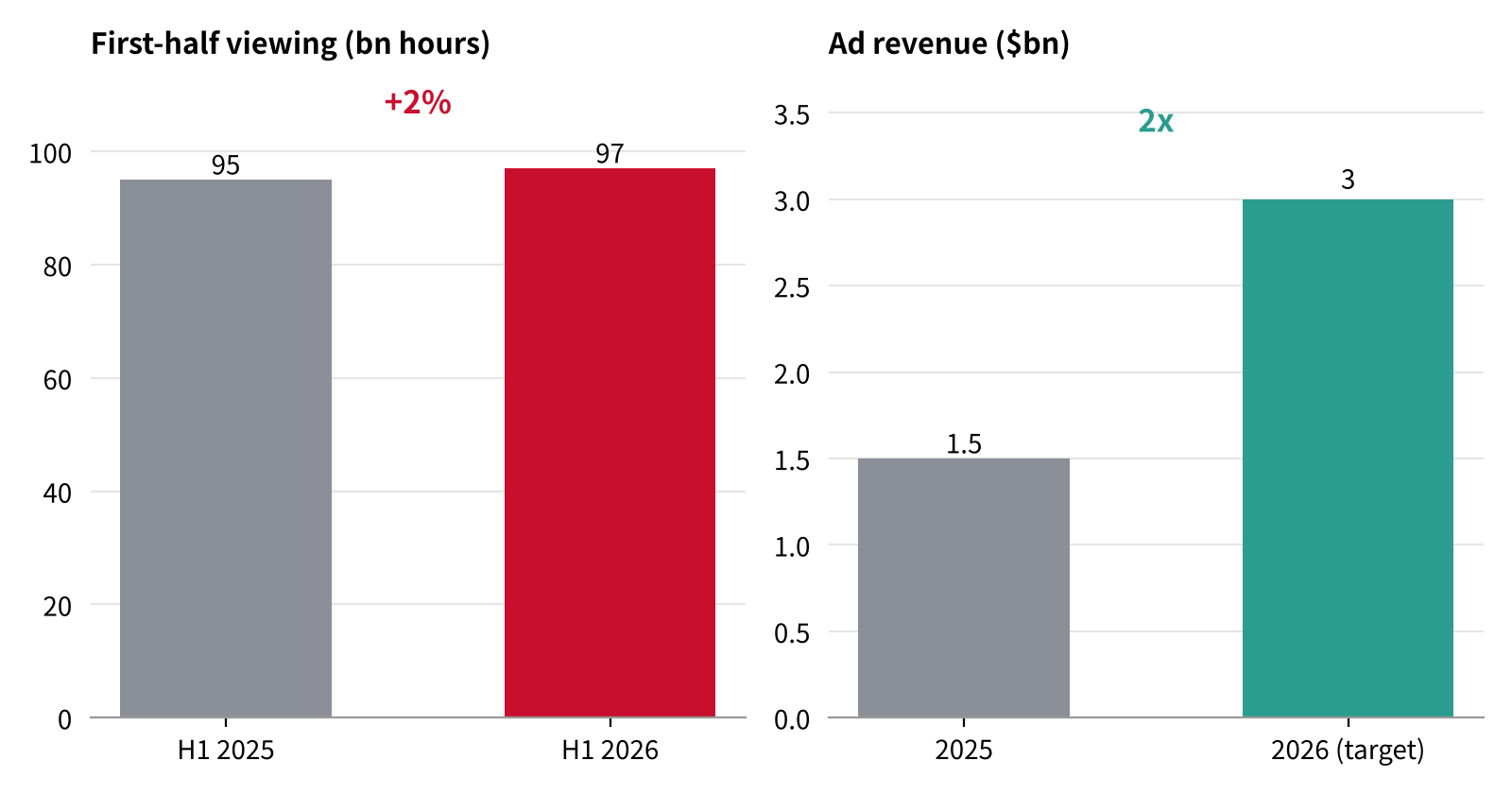
From 44 Emmys in 2021 to 16 this year; Apple TV+ 28, HBO Max 19
The spending paid off for a while. Netflix won 44 Emmys in 2021, tying the record for a single year, then 26 in 2022, 22 in 2023, 24 in 2024 and 30 in 2025.
This year it took just 16 across the Primetime and Creative Arts ceremonies. Apple TV+ led with 28 and HBO Max had 19. Variety suggested the slump may have shaken the trust between Sarandos and Bajaria. "His & Hers" and the fourth season of "Bridgerton" ranked among the year's most-watched shows, but there has not been a culture-defining hit on the scale of "Stranger Things" in some time.
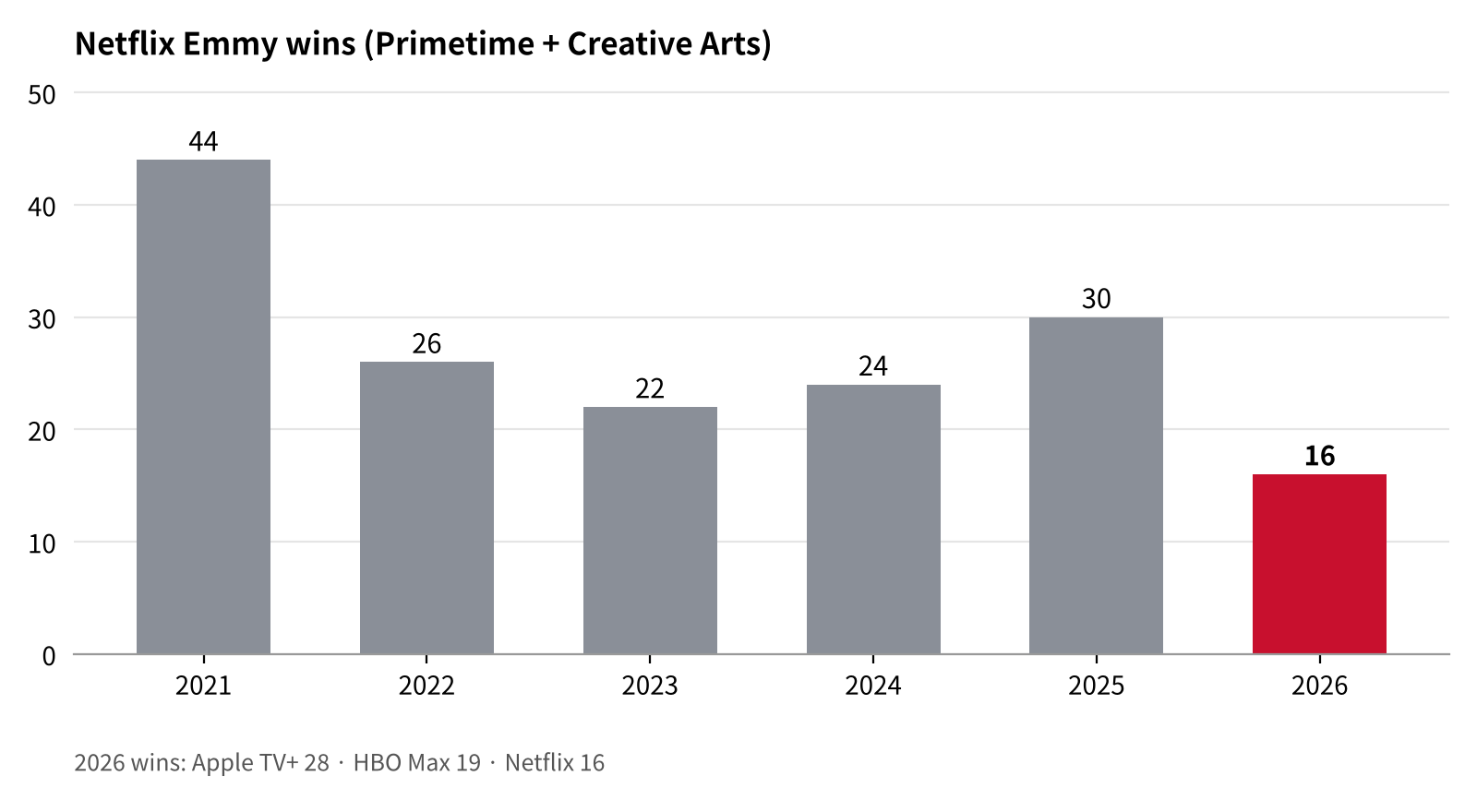
Viewing up 2%; second seasons lose 30% to 70%
Weak second seasons hurt Bajaria most. New shows are not carrying their audiences into the next season, and that is behind the slowdown. Bloomberg figures show second seasons of new scripted series drawing 30% to 70% less viewing than first seasons, and daily viewing per subscriber falling 7% in 2025 to 1 hour 33 minutes. Wells Fargo estimated daily viewing per subscriber of the top 100 originals fell 3% in the first half. Non-English titles made up more than a third of first-half viewing.
Perhaps with that in mind, Netflix will cut its engagement report from twice a year to once a year starting in the first quarter of 2027. The company said the change was meant to keep the focus on its primary financial metrics, revenue and operating profit.
Streaming takes 49% of U.S. TV time in July; YouTube 14.2%, Netflix 7.8%
In Nielsen's July edition of The Gauge, streaming accounted for 49.0% of U.S. television viewing, against 19.5% for broadcast, 18.7% for cable and 12.8% for other uses. Within streaming, YouTube led with 14.2%, nearly twice Netflix's 7.8%, followed by Disney at 4.7%, Prime Video at 4.2%, The Roku Channel at 2.9%, Peacock at 2.6%, Paramount at 2.2%, Tubi at 2.0% and Warner Bros. Discovery at 1.4%. Cable's share was a record low.
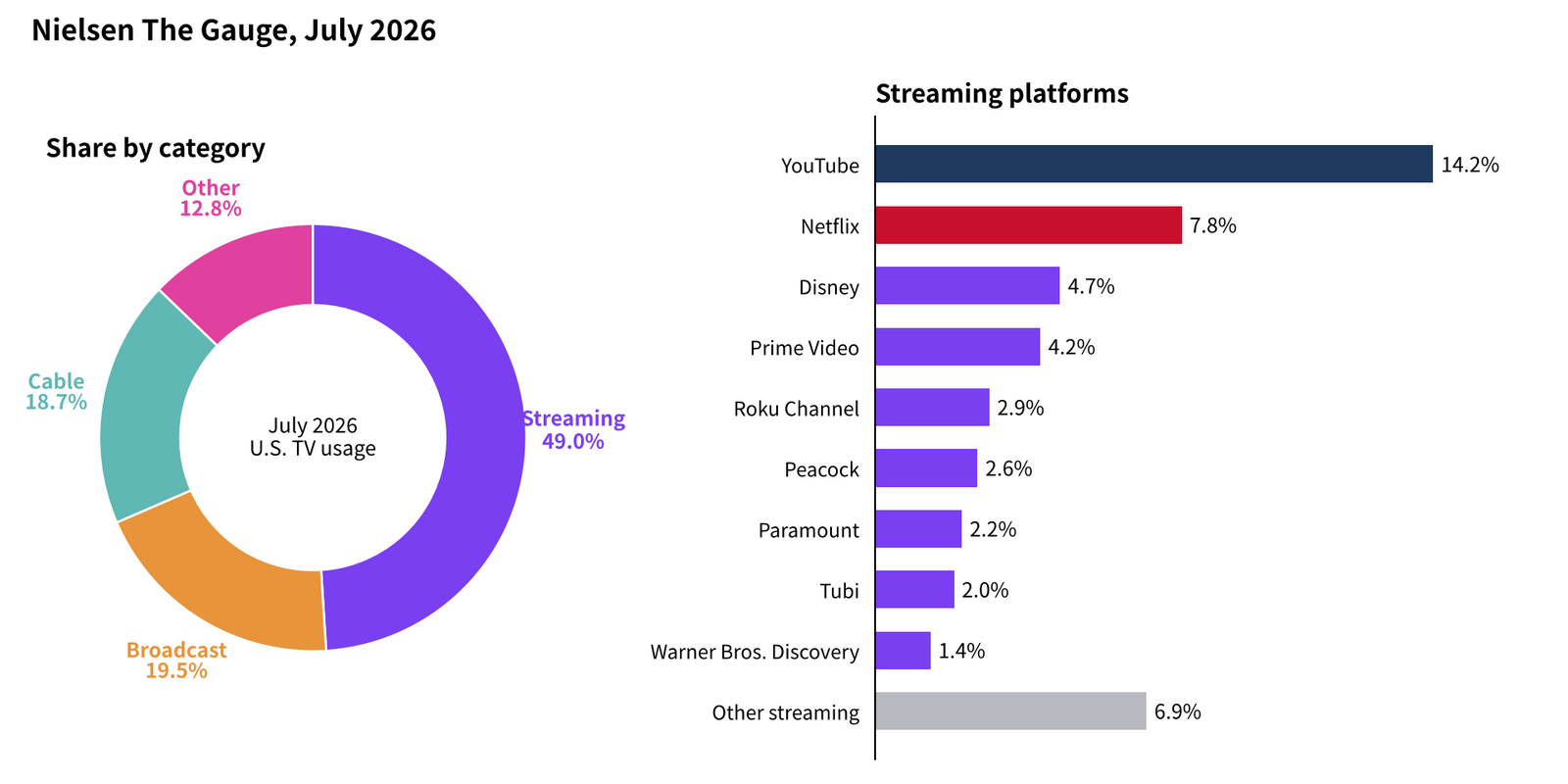
The gap between Netflix and YouTube is 6.4 points: Netflix is larger than Disney and Prime Video combined, yet smaller than YouTube alone. Last December, when the final season of "Stranger Things" was released, Netflix hit a record 9.0%. Nielsen notes that The Gauge and its Media Distributor Gauge do not reflect its currency ratings and says it is updating both ahead of the fall season.
A $12.86 billion third-quarter guide and an 11.8% one-day drop
Second-quarter revenue rose 13% to $12.56 billion (about KRW 16.85 trillion) and net income reached $3.4 billion (about KRW 4.56 trillion). The guidance is what hit the stock. Netflix's third-quarter revenue forecast of $12.86 billion (about KRW 17.25 trillion) fell short of expectations near $13 billion, and the full-year range narrowed to $51 billion to $51.4 billion (about KRW 68.4 trillion to 68.93 trillion). On July 17, the day after the report, the shares fell as much as 11.8%, the steepest drop since April 2022. Third-quarter results are due Oct. 20.
Out of the Warner race; Skydance pledges $30 billion a year on content
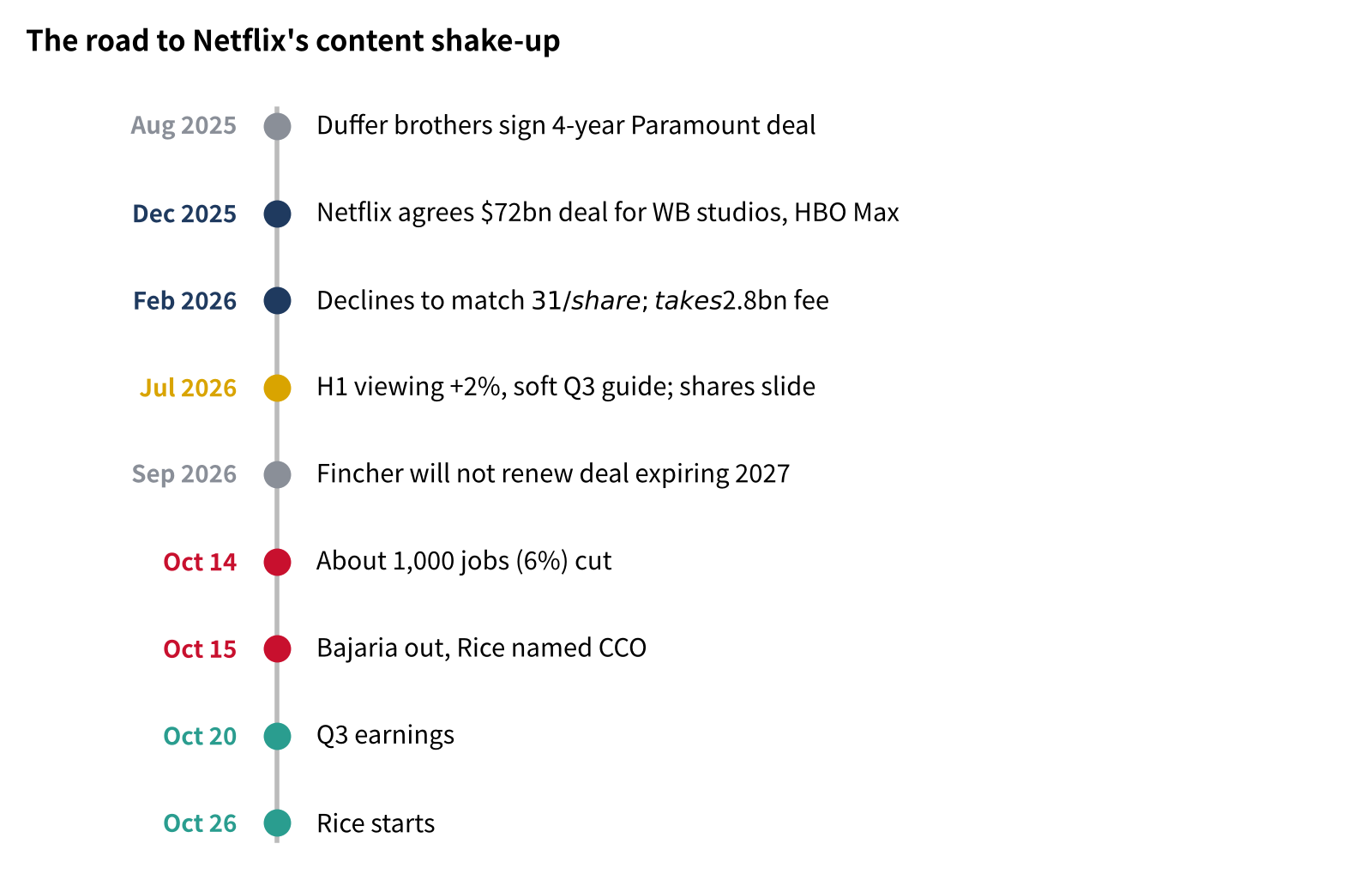
Netflix has also struggled to respond to Hollywood's restructuring. In December 2025 it agreed to buy Warner Bros. Discovery's film and TV studios and HBO Max for $72 billion (about KRW 96.6 trillion). When Paramount Skydance came in at $31 a share, Netflix declined to match in February 2026 and instead collected a $2.8 billion (about KRW 3.76 trillion) termination fee that Paramount paid on Warner's behalf.
Skydance absorbed all of Warner Bros. Discovery last week for $111 billion (about KRW 148.85 trillion), the Times reported; the Journal put the equity value at $81 billion (about KRW 108.62 trillion). David Ellison, who runs the combined company, has pledged to spend at least $30 billion a year (about KRW 40.23 trillion) on content.
Netflix shares fell during the Warner pursuit and have not recovered. Netflix is still the dominant force in streaming, but it cannot avoid a hard chase from the combined Warner-Paramount.
The Duffers to Paramount, Fincher won't renew, and talent wants theaters
Meanwhile, major creators are parting ways with Netflix. Matt and Ross Duffer, creators of "Stranger Things," began a four-year exclusive deal with Paramount in April 2026 built around large-scale theatrical films. David Fincher has decided not to renew his exclusive deal when it ends in 2027.
Netflix cancelled the American "Squid Game" series he was developing. Noah Baumbach moved to Warner Bros.' Clockwork label, and "Stranger Things" producer Shawn Levy went to Disney.
With the pressure mounting, Netflix has turned toward more theatrical releases, a move aimed at placating Hollywood. "La Bola Negra" got a 45-day theatrical window; Fincher's "The Further Mis-Adventures of Cliff Booth" opens in IMAX on Nov. 25 before streaming on Dec. 23; and Greta Gerwig's "Narnia: The Magician's Nephew" reaches theaters first in February 2027.
Bringing in Rice as chief content officer is also widely read as a move shaped by Netflix's relationship with Hollywood's creative community.
Cuts reach content executives; the fates of Jinny Howe and Dan Lin are Rice's first call
Netflix has cut staff before. This round is different because it reaches deep inside the content organization. In TV, Carolina Garcia, a director of original series for a decade, and scheduling head Andy Kubitz were let go.
In film, vice president Doug Belgrad left the same week. Unscripted casting and development executives were also on the list. Variety wrote that Rice inherits demoralized teams. The next question is the future of Bajaria's lieutenants, including U.S. and Canada scripted head Jinny Howe and film chief Dan Lin; whether Lin stays is Rice's decision.
A KRW 3.3 trillion Korea pledge ends this year, and live events from Seoul began under Bajaria
In April 2023, during then-President Yoon Suk Yeol's (윤석열) state visit to Washington, Sarandos said Netflix would invest KRW 3.3 trillion (about $2.5 billion) in Korean content over four years. This is the final year of that pledge.
Kang Dong-han (강동한), Netflix's vice president for Korean content, said at Next on Netflix 2026 Korea on Jan. 21 that the company was keeping the commitment and that Netflix would carry the risk (iMBC). He also said 210 Korean titles had reached the global Top 10 in five years, and, asked whether the Warner bid would affect Korean investment, called it an entirely separate matter. But no one knows what comes next.
Live content and events out of Korea could change in particular, since that format was perfected under Bajaria. While she was content chief, Netflix streamed "BTS Comeback Live: ARIRANG" from Gwanghwamun Square in Seoul on March 21 to about 190 countries, its first global live event from Korea, directed by Super Bowl halftime show veteran Hamish Hamilton. Outlook India, citing Netflix data, reported about 18.4 million viewers and a No. 1 ranking in 24 countries.
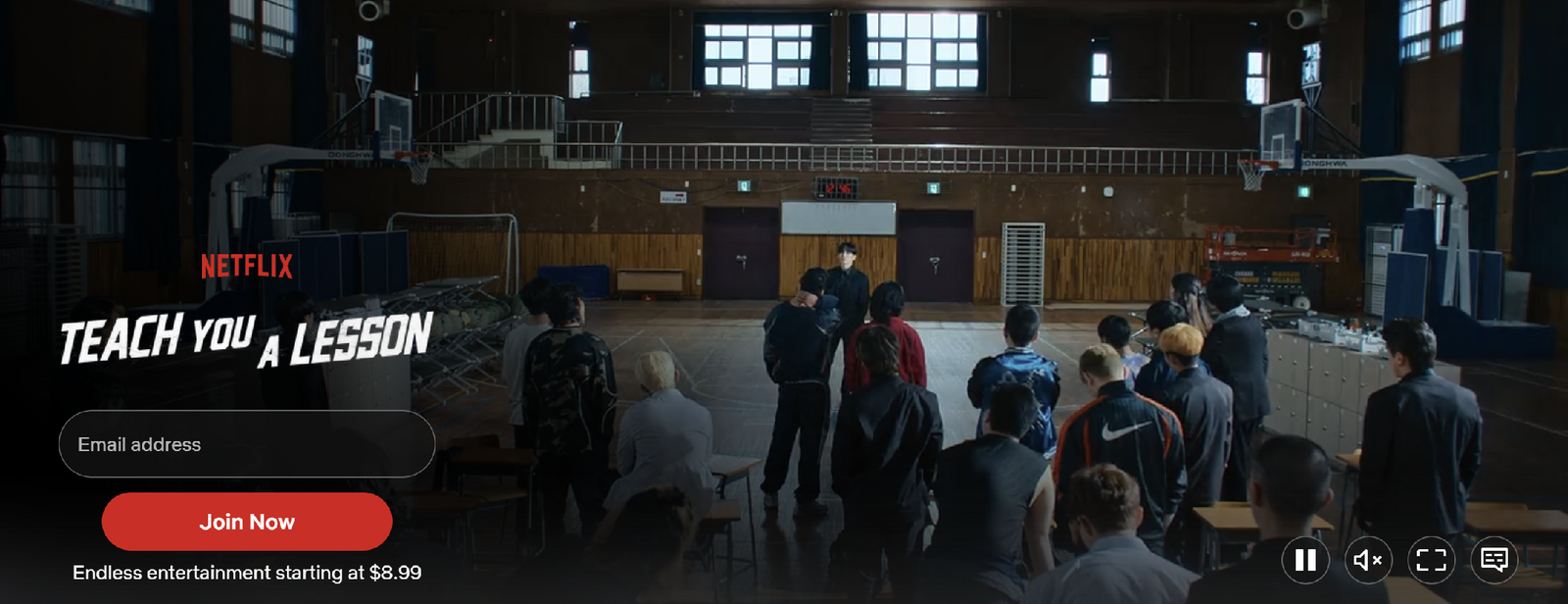
Korean titles ruled worldwide alongside Bajaria's heyday. "KPop Demon Hunters" (케이팝 데몬 헌터스) ranked fourth among films with 130 million views, and the Korean series "Teach You a Lesson" (참교육) made the TV top 10 with 48 million views.
In Korea, Netflix had 15.26 million monthly active users in February, according to Mobile Index (모바일인덱스), nearly double second-placed Coupang Play (쿠팡플레이) at about 8.32 million, rising to 15.91 million in March. An analysis of Netflix Services Korea's audit report by Democratic Party lawmaker Han Jun-ho (한준호) showed Korean revenue of KRW 1.0542 trillion (about $786 million) last year, the first time it has topped KRW 1 trillion.
The leadership change will reach the Korean operation too. From Oct. 26 the global content organization that includes the Korea team reports to Rice. Bajaria started as vice president of local-language originals and turned non-English series into global hits; Rice built his career at U.S. film studios and U.S. television networks.
Sarandos's memo named the U.S. as the slate to take to the next level. Industry experts say a bigger U.S. series budget would force a reshuffle of regional allocations. With non-English titles above a third of viewing, the size of Korean investment after 2027, the shape of the deals, and whether big live events from Korea continue are now decisions for the new regime.
Korean broadcasters with shrinking ad sales face a new decision-maker on the buying side
For Korean broadcasters, Netflix is now less a competitor than a large customer for their rights. That is why it has become hard to talk about Korean content going abroad without Netflix.
SBS is the clearest case. It signed a six-year strategic partnership with Netflix in December 2024 and since January 2025 has supplied new dramas, entertainment and factual shows plus its back catalog. Hana Securities analyst Lee Ki-hoon (이기훈) described it as unprecedented in every respect, and DB Financial Investment (DB금융투자) estimated its value at about KRW 300 billion ($224 million) over six years. Yoo Kun-sik (유건식), former head of the KBS Public Media Research Institute, told Newsis (뉴시스) that buying terrestrial rights also makes sense for Netflix because the return is good relative to the cost.
Deals have also run the other way. In December 2024 MBC put Disney+ original "Moving" (무빙) on its terrestrial schedule, billed as the first collaboration between a global streamer and a Korean terrestrial network. Content has started to flow in both directions between broadcasters and streamers.
It starts with falling advertising
Behind this is shrinking ad revenue, and terrestrial networks are working to win advertisers back. In an August buyer's guide, the Korea Broadcast Advertising Corporation (KOBACO·코바코) stressed that terrestrial TV reaches 44.73 million people a month at a cost per thousand impressions of KRW 2,927, cheaper than YouTube and Netflix. For broadcasters who can no longer live on advertising alone, selling rights to streamers has become a core source of income.
The decision-maker on the buying side is changing too, and Rice's background overlaps heavily with what Korean broadcasters own. At Disney he ran the TV business including ABC and ABC News, and across Fox and Disney he handled major sports broadcasts such as the Super Bowl, NBA Finals and World Cup finals. Live scheduling, news, and sports and concert broadcasts are the capabilities Netflix needs as it expands live. Korea's terrestrial broadcasters also hold the country's largest pool of crews and equipment for big live productions like the BTS show at Gwanghwamun.
Leverage comes from weekly schedules and libraries
If price increases are the main revenue lever, keeping subscribers matters more. Series that release a new episode every week, and live schedules, are effective at delaying cancellations. That is why Korean broadcasters' weekly dramas and entertainment shows carry value in talks with Netflix.
Library titles with strong fan bases are bargaining chips too. According to Netflix, after the fourth season of "Bridgerton" launched, viewing of earlier seasons nearly tripled compared with the second half of 2025. When new releases are weak, it is the back catalog that props up viewing hours.
Some factors could cut the other way. Projects that develop Korean IP into English-language remakes, like David Fincher's American "Squid Game," may be reconsidered under the new chief's priorities. Korean companies that hold original rights should be working out first-negotiation rights and revenue-sharing terms for remakes now.
Netflix's shift toward theatrical release could be an opening for Korea's film industry. Investors and distributors could propose windowing deals, with a theatrical run before Netflix, or co-financing from the start.
Conclusion: slowing growth, and the content chief goes first
Netflix's answer this week was 1,000 job cuts and a new content chief. First-half viewing grew only 2% from a year earlier, and its share of U.S. TV viewing slid from 9% last December to 7.8% in July. Emmy wins were the fewest in a decade, and the stock has fallen nearly 40% over the past year. With the bad news arriving all at once, the company replaced the head of its content organization first.
Some problems are beyond a personnel move. As critics in the industry point out, revenue growth now depends heavily on price increases. That structural limit stays in place whatever a new content chief does with the slate.
Rice faces three main tasks. The first is to produce more breakout shows for the U.S. and Canadian market that Sarandos singled out in his memo. The second is to win back creators who left Netflix to make theatrical films. The third is to merge two organizations if Netflix buys another studio. Netflix lost the Warner Bros. fight to Paramount Skydance, but NBCUniversal and others are mentioned as possible next targets. Rice has done all three at Fox and Disney. He was the one in charge of folding Fox into Disney.
The question left for Korea
What Korea's industry needs to weigh is how Netflix will invest from here. The four-year KRW 3.3 trillion pledge ends this year, and the follow-up plan will be drawn up under a new content chief who puts the U.S. market first.
Korean producers should prepare for a change in deal terms. Co-financing or licensing could take a larger share in place of originals that Netflix fully funds, which would reopen the question of who owns the IP. For Korean broadcasters, production capacity for live schedules and sports and concert broadcasts becomes a new bargaining chip alongside programme rights.
Outlook: earnings on Oct. 20, Rice on Oct. 26, and the first hires to watch
Netflix reports third-quarter results on Oct. 20, when Sarandos and fellow co-CEO Greg Peters are expected to explain the direction of the new content setup. Investors want to know whether the $3 billion annual ad target is within reach and whether viewing is growing again. Questions about how Netflix will grow revenue beyond price increases are likely to follow.
The yardstick for Netflix is changing too. From 2027 it will publish title-level viewing data only once a year instead of every six months, leaving outside measures such as Nielsen's The Gauge as the main basis for judging its performance.
Rice's first decisions after he starts on Oct. 26 are likely to be who runs film and U.S. series. Those two hires will show whether Netflix is shifting weight toward theatrical release and high-end scripted shows. The Korea team's reporting line and the 2027 Korea budget come after that. If Netflix buys another studio, Korean content will compete with that studio's vast library for the same budget.