
K-EnterTech Hub ANALYSIS | STREAMING
Q3 revenue of $12.87bn and a 34.6% operating margin; the 2026 ad-revenue outlook cut from $3bn to $2.7bn and Q4 growth guided to 11.5% sent shares down about 6% after hours
Netflix reported third-quarter results on Tuesday that met revenue forecasts and beat on earnings, then told investors it would miss its own advertising target for the year. Revenue rose 11.8% to $12.87 billion (about 17.1 trillion won). Diluted earnings per share came in at 87 cents, against the 82 cents analysts expected. Shares fell about 6% in after-hours trading.
The fourth-quarter outlook drove the move. In its shareholder letter, Netflix guided Q4 revenue to $13.44 billion, growth of 11.5%, against 17.6% a year earlier. Wall Street had been looking for about $13.5 billion, Variety reported, and Q3's 11.8% was the slowest growth in three years.
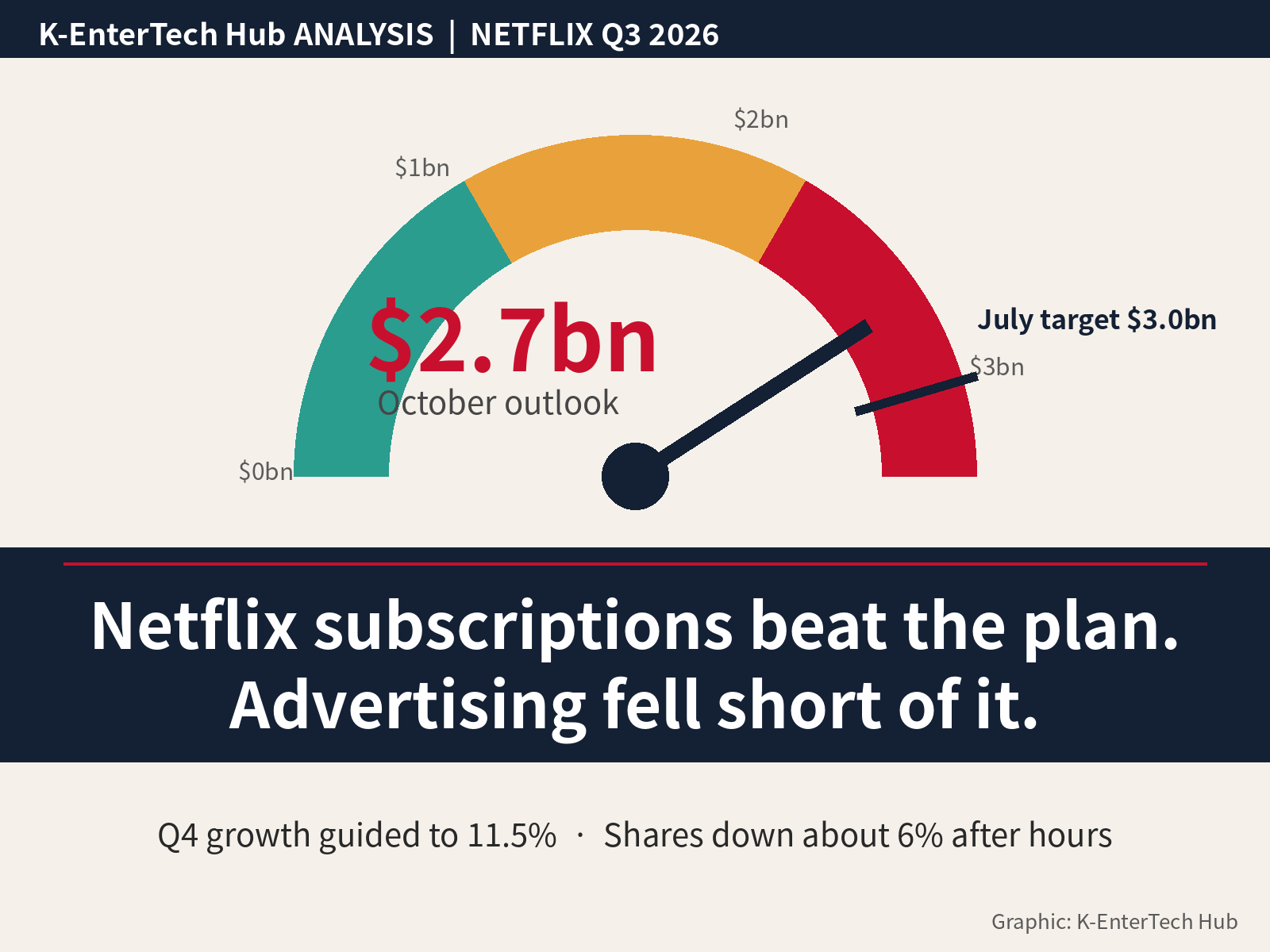
The two halves of the business moved in different directions. Subscription revenue growth outperformed the company's expectations, the letter said, while 2026 ad revenue is now expected at about $2.7 billion rather than about $3 billion because some ad product capabilities are rolling out more slowly than planned. That leaves full-year revenue guidance at $51.1 billion, 0.2% below the midpoint of the $51.0–51.4 billion range set in July.
The report landed six days after Netflix cut about 1,000 jobs, roughly 6% of its workforce, and a day after it named Peter Rice, the former chairman of Walt Disney Television, to replace chief content officer Bela Bajaria. Film chief Dan Lin and his deputy Doug Belgrad have also left, according to Variety. In South Korea, one of Netflix's largest non-English production bases, the app's monthly active users fell 4.3% in September.
Q3 operating income up 37% to $4.46bn; margin 34.6%
Operating income rose 37% to $4.46 billion and the operating margin widened to 34.6% from 28.2%, ahead of the 33.2% Netflix had forecast in July. The company attributed the beat to the timing of expenses and slightly higher revenue. Net income rose 44% to $3.66 billion.
Subscriptions did most of the work. Growth came mainly from more members and higher prices, with ad revenue and favourable currency moves adding to it. Churn improved year over year both globally and in the US and came in better than forecast. Member response to the 2026 price increases was in line with earlier price changes, the company said, as CNBC noted.
Free cash flow was $2.88 billion, up from $2.66 billion. Netflix bought back 63.9 million shares for $4.8 billion, its largest quarterly repurchase, and trimmed its full-year free-cash-flow forecast to about $12 billion from $12.5 billion, citing a real-estate transaction expected to close in Q4. It ended the quarter with gross debt of $15.3 billion and cash of $8.2 billion; debt rose about $1 billion after a bond sale to fund a $1 billion maturity due in Q4. It has $22.3 billion of buyback authorisation left and still expects cash content spending of about 1.1 times amortisation.
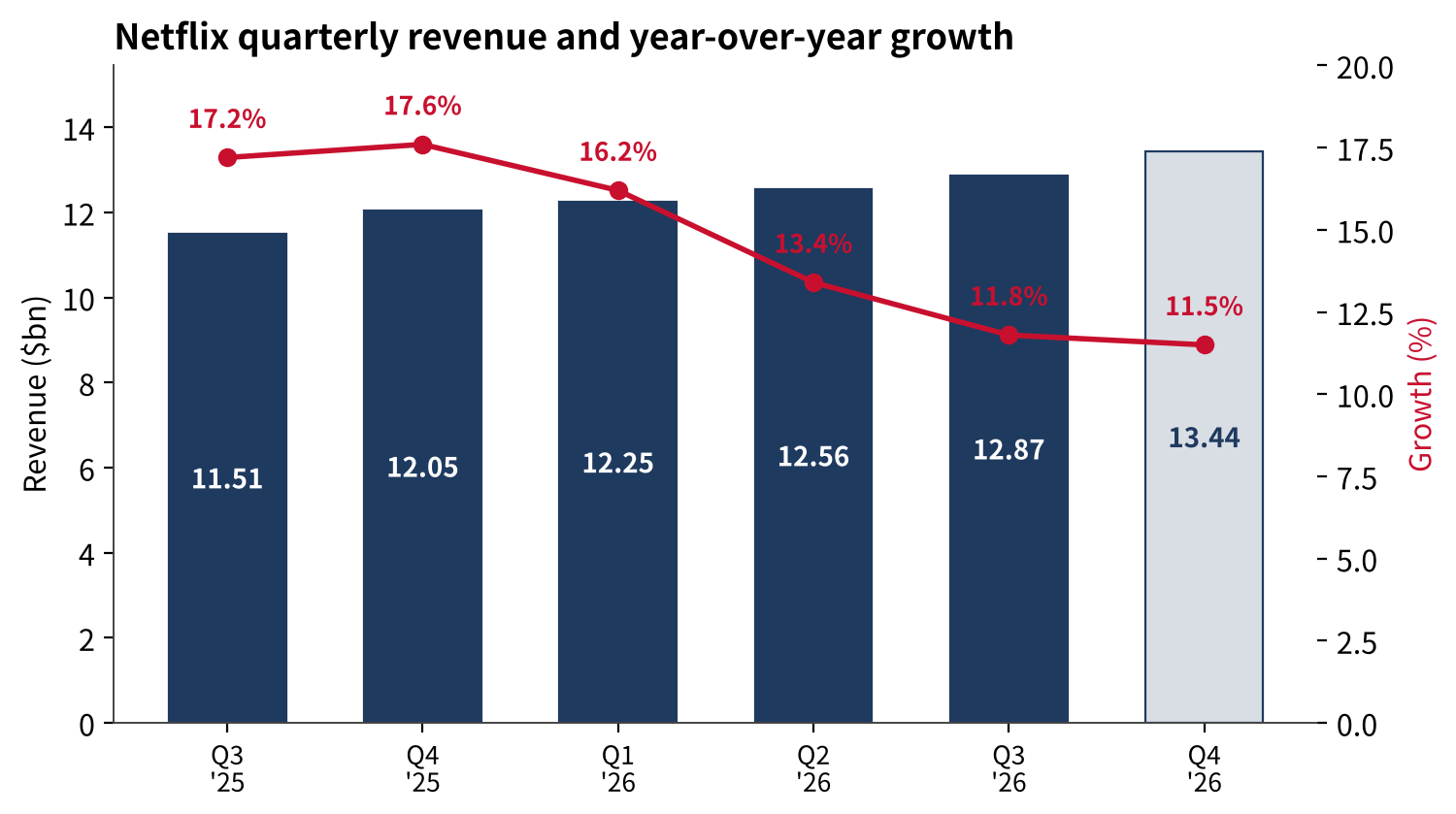
Netflix quarterly results and Q4 forecast, $ millions except EPS. Source: Netflix Q3 2026 shareholder letter
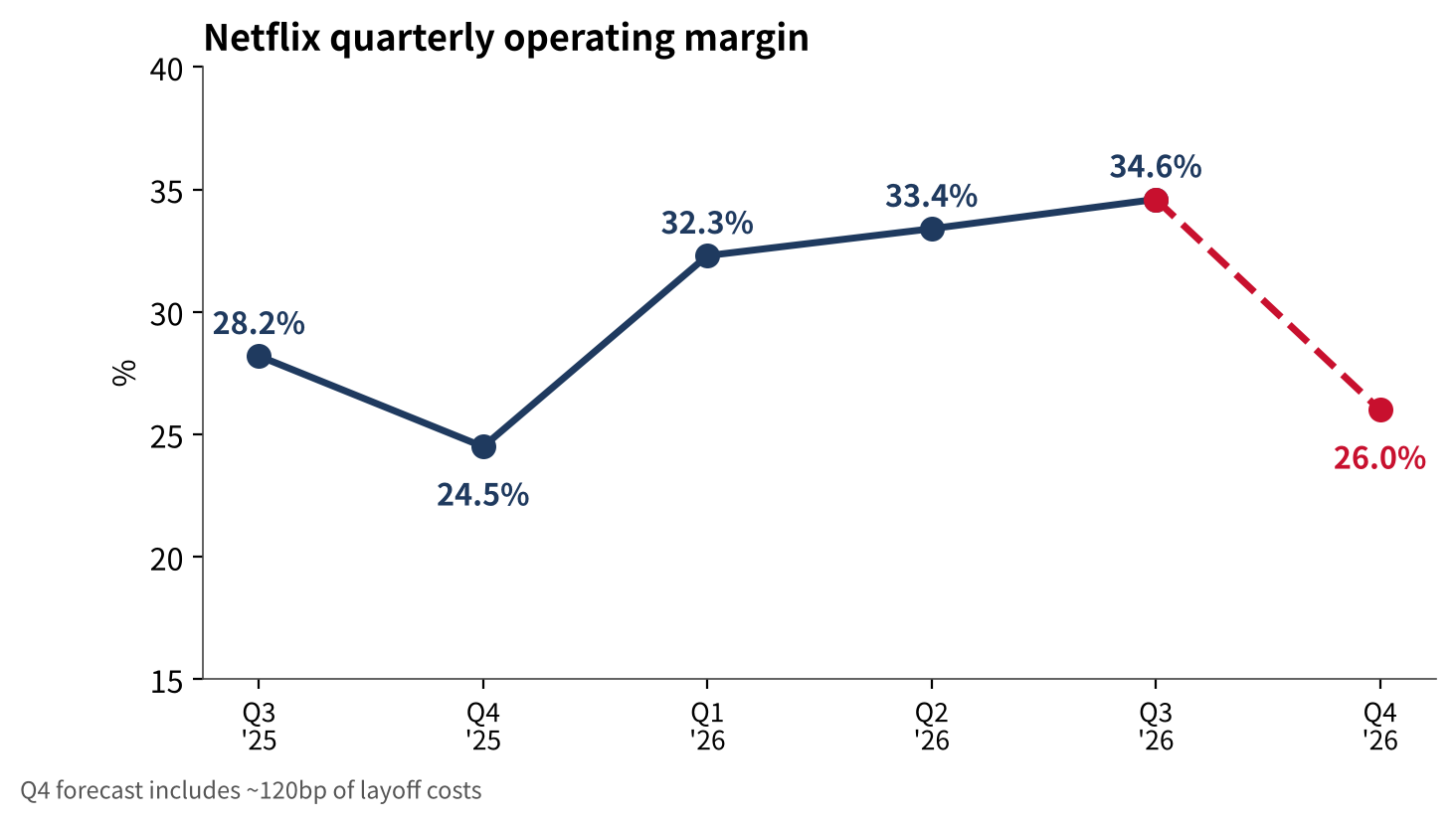
Netflix's operating margin falls from 34.6% in Q3 to a forecast 26.0% in Q4, which includes about 120bp of layoff costs. Source: Netflix shareholder letters
2026 ad outlook cut to $2.7bn as product launches slip
Netflix began the year promising to roughly double ad revenue. Its Q4 2025 letter said ad sales passed $1.5 billion in 2025, only its third year selling ads, and the July letter kept the 2026 goal at about $3 billion. The new $2.7 billion figure is about 5% of expected 2026 revenue.
"We are currently a bit behind our aggressive target for the year," co-CEO Greg Peters said on the earnings interview, according to TheStreet. He said Netflix had set big growth targets for ads and built an aggressive product roadmap to match, calling its build-out the fastest of any comparable ad stack in the industry, and blamed delays in launching new ad products and integrating partners. A modest short-term hit in exchange for a better long-term position was a good trade-off, he added.
The ads business is still growing more than 80% this year, Peters told analysts, as reported by Adweek. In Q3 Netflix extended programmatic access to its Netflix Ads Suite through globally available CTV marketplace deals, signed partnerships with MercadoLibre in Latin America and Adform in EMEA, and is adding in-DSP measurement of reach, frequency and attribution.
The ad tier will reach 15 more countries in 2027. The first group launches in March 2027: Austria, Belgium, Denmark, Ireland, the Netherlands, Norway, Poland, Sweden and Switzerland, plus Colombia, Peru and New Zealand, the last a new addition.
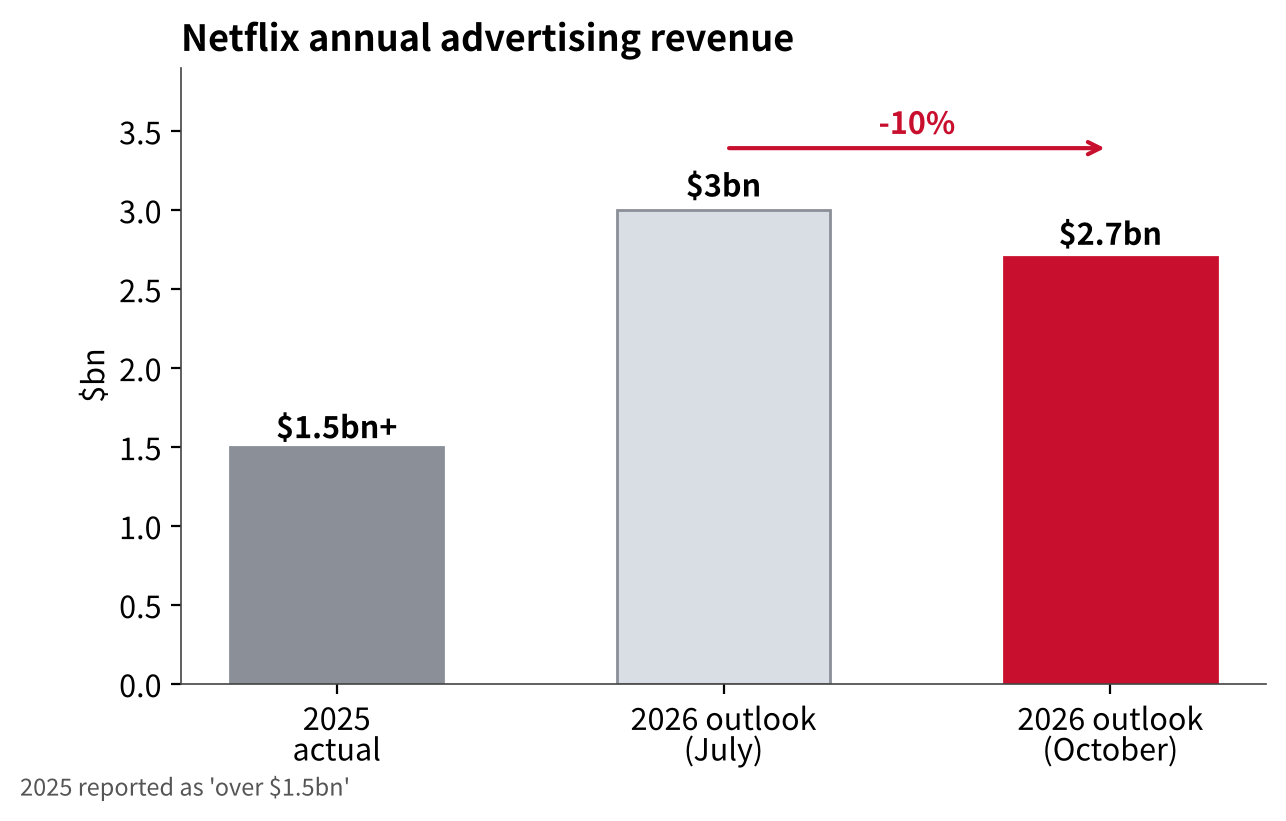
Changes to Netflix's 2026 guidance. Source: Netflix Q2 and Q3 2026 shareholder letters
Q4 margin guided to 26%, including 120bp of layoff costs
The job cuts hit fourth-quarter profit. Netflix guided a Q4 operating margin of 26.0%, which includes about 120 basis points of costs tied to the headcount reduction, still above 24.5% a year earlier. For the full year it expects a 31.5% margin, up from 29.5% in 2025, and operating income growth above 20%.
The cuts were Netflix's largest since 2022. The company had about 16,000 full-time employees at the end of 2025, the Associated Press reported, and the reductions fell mainly on product, technology, legal and HR. Netflix said the changes would let it keep investing aggressively in high-impact areas to improve the service.
Peters said the whole organisation needed to ask hard questions about where it could be more efficient and where to trim or redirect spending, TheWrap reported. Co-CEO Ted Sarandos said the strategy was unchanged and retention was healthy in every region. "Our engagement is solid," he said, "but we know that we can do better."
Viewing per member down from 66 to 49 hours a month
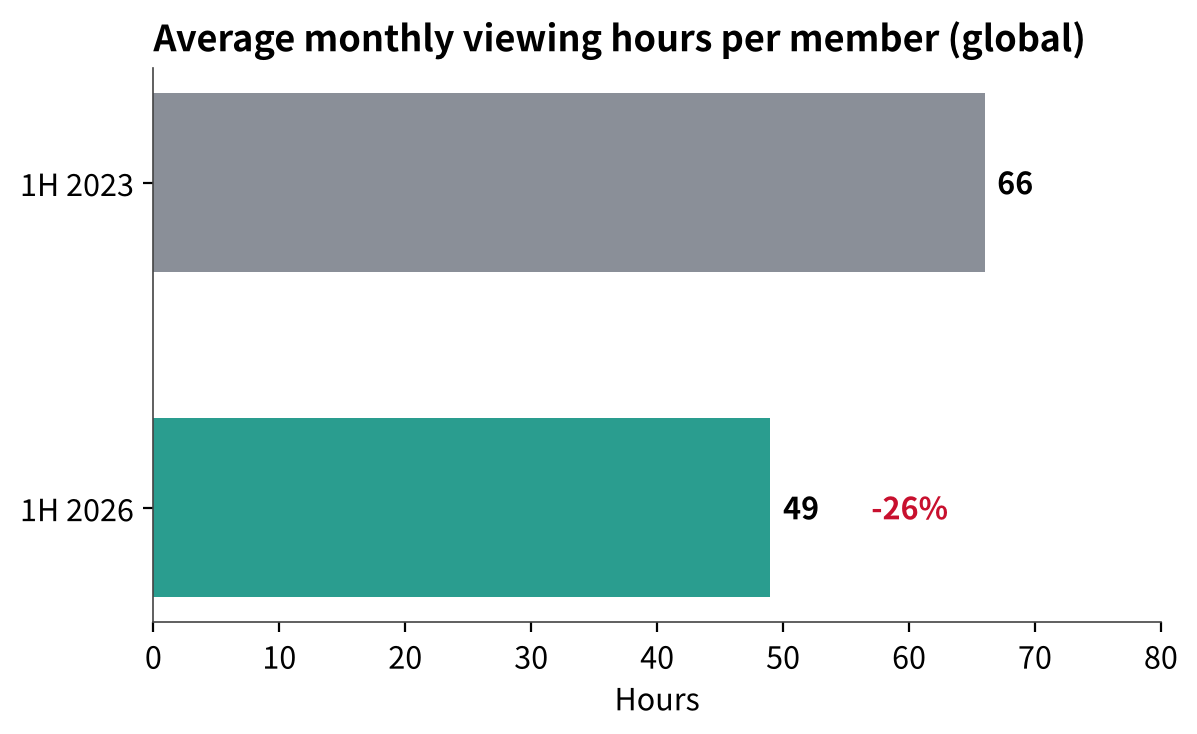
Engagement is where investor worry sits. Netflix's "What We Watched" report for the first half of 2026 showed global hours viewed up 2% year over year. Jefferies estimates, cited by Variety, put average monthly viewing per member at about 49 hours in the first half of 2026, down from 66 hours three years earlier. From 2027 Netflix will publish the report once a year, in the first quarter.
Cancellations remain low. Netflix's churn was about 2% in September, flat on August and the lowest in the industry, The Wall Street Journal reported on Tuesday, citing Antenna. The Journal also said Americans are spending less time on the service and that executives acknowledged on the call they could do better with US programming.
The letter addressed the point directly, acknowledging investor concern about view-hours growth while arguing that engagement, which it defines as the quantity, quality and variety of viewing, remains healthy. It also said Netflix wants to accelerate view-hour growth. It did not explain why management overhauled content leadership, Variety noted.
Rice starts on October 26 and will oversee scripted and unscripted series, film and live events. He previously ran Walt Disney Television and was president of 21st Century Fox. Sarandos described him on the call as an operator who works at scale and said improving talent relations was a key part of the job. Carolina Garcia, director of original series, has also left, according to Variety.
Letter: 'the one where members go first' and 'the last service they would cancel'
The letter restated the strategy: differentiated, exclusive originals that spark conversation and bring in members, paired with a broad selection of third-party programming, a strong discovery experience and global distribution. Its three priorities are delivering more entertainment value, using technology to improve the service and improving monetisation. Done well, it said, that makes Netflix "the one where members go first to look for entertainment and the last service they would cancel."
It was direct about the market. "With intense competition and an explosion of content competing for consumer attention, strategic clarity and excellent execution are critical," the letter said, adding that Netflix delivered on all three priorities in Q3 but sees room to do better. Streaming TV, film and live events account for the vast majority of spending and nearly all revenue, it said, consistent with Sarandos's "roughly 95%" figure on the call.
Rice: 30 years at Fox and Disney TV, little streaming or data experience
"We have seen an opportunity to take our slate to the next level," Sarandos said on the call, according to the Journal. He said "roughly 95%" of the programming budget goes to the core of series and films despite moves into video podcasts and games. "The core is our critical growth engine," he said.
Rice's record is in studios and networks. The Ankler, which interviewed nine executives who know him, reported on October 19 that he spent three decades at Rupert Murdoch's Fox before running Disney's television business, and was fired in 2022 by then-Disney CEO Bob Chapek. Since then he has produced Danny Boyle's 28 Years Later, which took $151 million worldwide, and Jason Reitman's Saturday Night, which took $10 million.
Colleagues described him to The Ankler as polished and talent-friendly but with limited experience of data, algorithms, global audiences and YouTube. The same piece cited Nielsen figures giving Netflix 7.8% of US TV viewing against YouTube's 14.2%.
The collapse earlier this year of Netflix's $83 billion deal for Warner Bros. Discovery's studio and streaming assets, and competition from YouTube, sit behind the slowdown. The letter said Netflix remains open to selective M&A; neither co-CEO raised the subject on the call.
$20bn content budget; more live, licensed and short-form
To lift viewing, Netflix has widened what it carries. It will spend $20 billion on content this year, according to TheWrap, and has added live events, sports rights, games and podcasts. A new licensing deal with Disney brings current and library titles; all five Ice Age films reached the global weekly Top 10, building awareness ahead of Disney's theatrical release of Ice Age: Boiling Point in February 2027. In August Netflix partnered with Take-Two on a preview of Grand Theft Auto VI.
It will release 30 films in cinemas this year, though only a handful get a traditional 45-day window, and has started reporting box-office grosses, beginning with Spain's La Bola Negra. A redesigned TV home screen, a vertical video feed in the mobile app and the acquisition of Ben Affleck's AI start-up InterPositive are aimed at discovery and production. Generative-AI workflows have been used on about 300 titles this year, mostly in post-production.
Local programming continues to carry weight. Non-English titles now account for more than a third of viewing, up from under 10% a decade ago. Japan's Plastic Beauty is on track to be Netflix's most-watched Japanese series; in India, the daily reality show Lock Upp became the most-watched title ever, view hours rose 24%, with view hours per member up low-to-mid single digits, and a first transaction-based bundle with Flipkart helped deliver record paid net additions. Revenue in India grew about 18% currency-neutral, which the letter cited as proof the core strategy works when executed well.
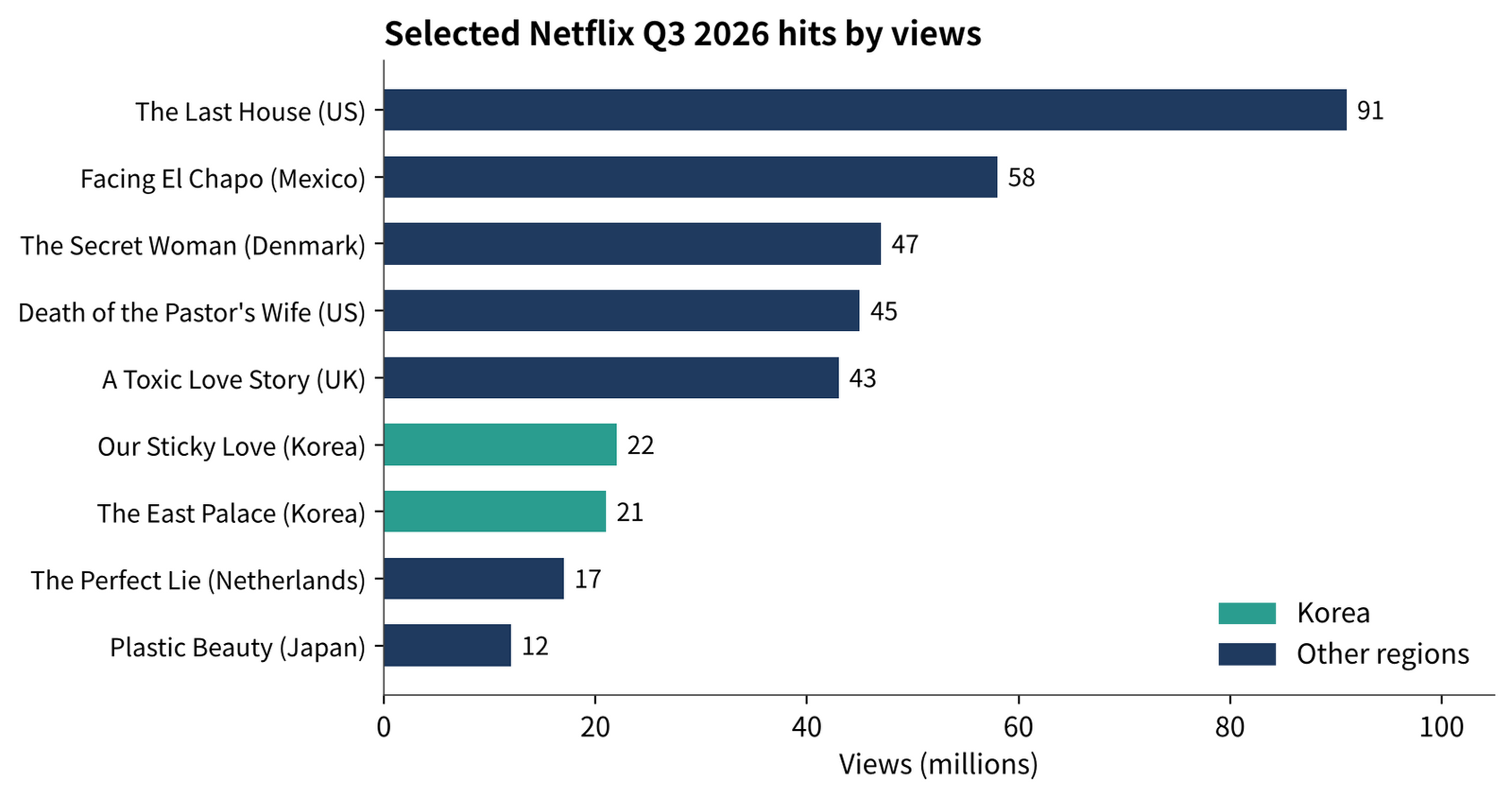
APAC revenue of $1.54bn; two Korean series lead the region's hits
Asia-Pacific revenue rose 12% to $1.54 billion, or 15% excluding currency effects, the fastest of the four regions on that basis. US and Canada grew 11%, EMEA 11% (9% currency-neutral) and Latin America 17% (12%).
Both APAC hits named in the letter are Korean: The East Palace (Donggung, 동궁) with 21 million views and Our Sticky Love with 22 million. In Q4 Netflix releases Possible Love (가능한 사랑), starring Jeon Do-yeon, which has been selected as South Korea's submission for the Academy Award for best international feature.
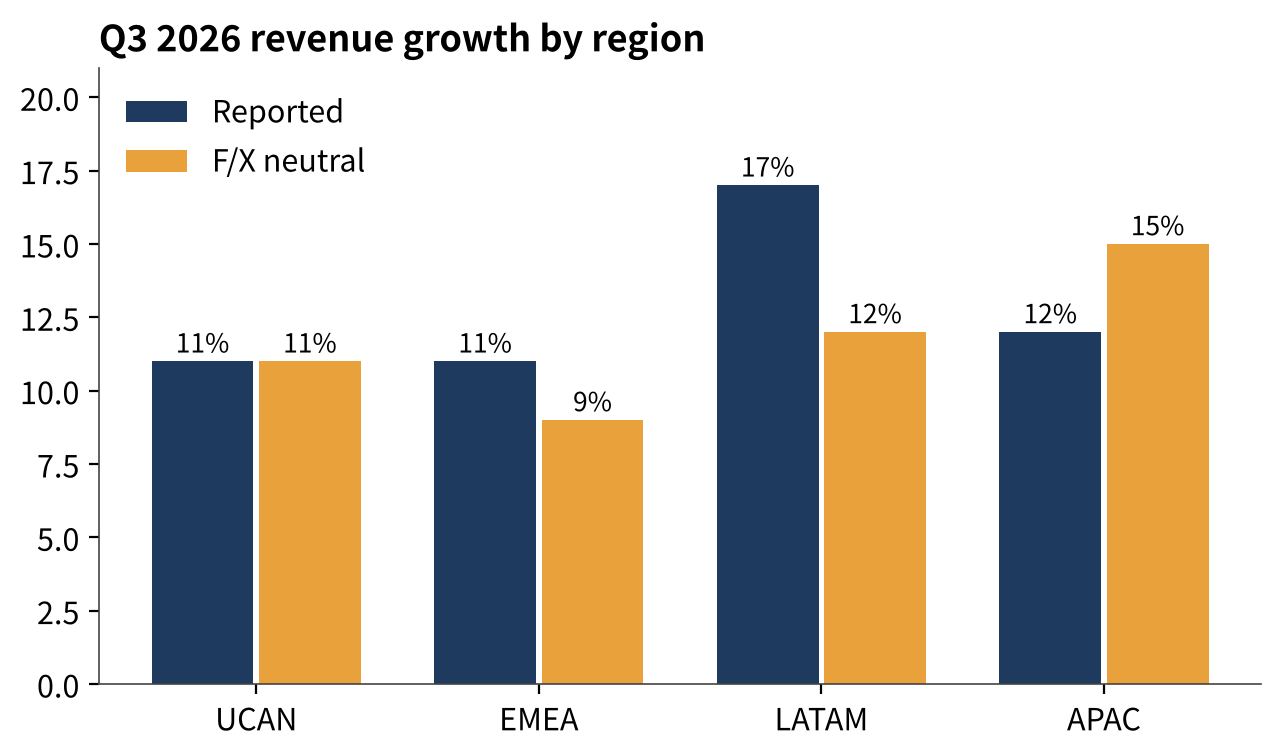
Asia-Pacific posted the fastest currency-neutral revenue growth of Netflix's four regions in Q3. Source: Netflix Q3 2026 shareholder letter
Netflix Q3 2026 revenue by region, $ millions. Source: Netflix Q3 2026 shareholder letter
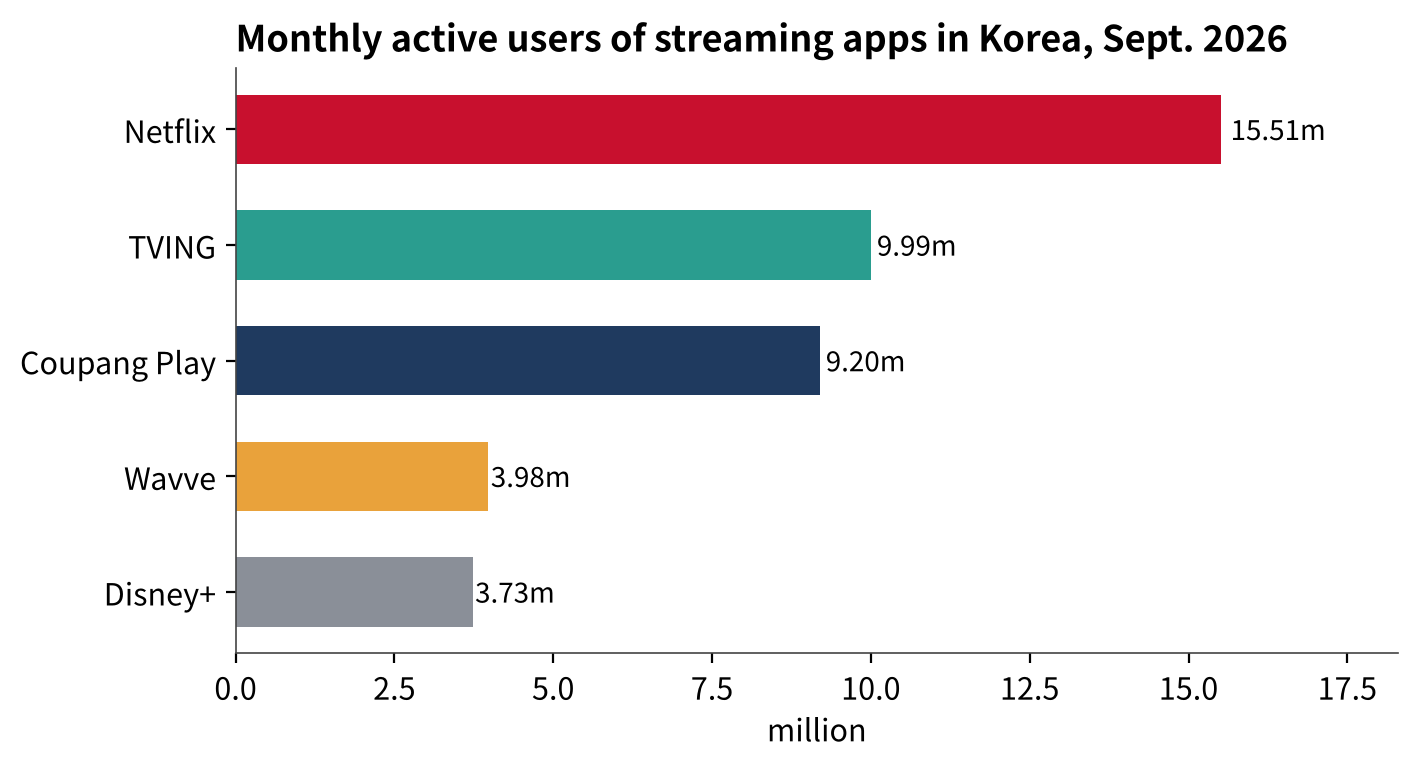
Korean MAU at 15.5m, down 700,000 in a month
Netflix's Korean usage slipped. Its app had 15,507,477 monthly active users in September, down 700,041 or 4.3% from August, according to IGAWorks' Mobile Index, as reported by iNews24 (아이뉴스24). August had been 16.21 million, Electronic Times (전자신문) reported.
TVING (티빙) rose 22.6% to 9.995 million and overtook Coupang Play (쿠팡플레이), which fell 8.6% to 9.198 million. Part of TVING's gain may reflect users opening the app to claim compensation for a personal-data breach. Wavve (웨이브) had 3.98 million and Disney+ 3.73 million. MAU counts anyone who opened an app at least once in the month and does not measure viewing time or paid subscribers.
TF1 inside the Netflix app widens the broadcaster playbook
Third-party content is central to Netflix's plan to raise viewing. With an audience approaching one billion people, the letter said, Netflix is a strong partner for studios, networks and creators.
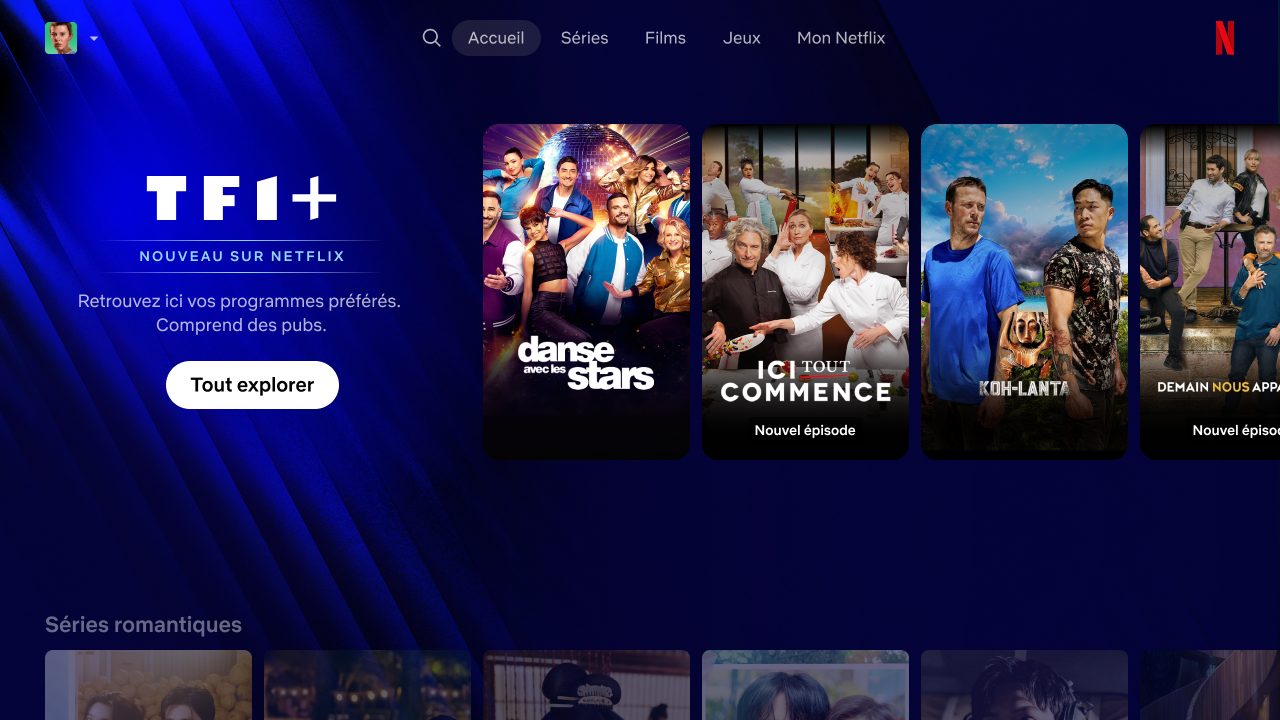
It pointed to the partnership with French broadcaster TF1 launched this summer, which puts TF1's local series, films, news and sports inside the Netflix interface and is generating incremental viewing in France, according to early metrics. In the screen shown in the letter, TF1+ sits as a row on the Netflix home page marked "Comprend des pubs" (includes ads): broadcaster programming carried inside Netflix with its advertising intact.
In Korea the closest arrangement is SBS (SBS), which in January 2025 began a six-year deal supplying new dramas, entertainment and factual shows and its library to Netflix; the value is undisclosed until the end of 2030, Newsis (뉴시스) reported. The deal pulled shows such as Running Man (런닝맨) off Wavve, while TVING has been adding MBC (MBC) titles, Hans Economy (한스경제) reported in March.
The TF1 model goes further than SBS's, because it includes news and sports. With Netflix pledging to bring in more third-party content in new ways, Korean broadcasters negotiating their next deals may find live programming, news and channel-level supply on the table alongside drama and variety rights. Live schedules and news are assets Netflix lacks, and how broadcasters price them becomes their decision.
Final year of Netflix's $2.5bn Korea pledge; Rice's team sets what comes next
In 2023 Netflix promised to invest $2.5 billion in Korean content over four years, about 3.3 trillion won at the time, and 2026 is the last of them. At its Next on Netflix 2026 Korea event in January, Kang Dong-han (강동한), vice president of Korean content, said the pledge was being honoured and that investment in Korea would not shrink, Digital Daily (디지털데일리) reported. Netflix said it would release 29 Korean originals this year.
Whatever follows will be decided under Rice, who takes charge of global content as Netflix makes cost discipline a company-wide mandate. Korean producers' strongest argument is performance: both APAC hits in the Q3 letter were Korean series, and Kang said in January that 210 Korean titles had reached Netflix's global Top 10.
Currency is another factor. The won closed at 1,328.1 per dollar on Tuesday, its strongest in about two years, Money Today (머니투데이) reported, shrinking the won value of dollar-denominated production fees.
Outlook: Q4 live events and the 2027 ad roll-out are the next tests
Netflix's quarter showed a subscription business running ahead of plan and an ad business growing fast but behind schedule. Investors reacted to the 11.5% Q4 growth guide and the ad cut more than to the quarter itself; the shares were already down 44% over the past year and 27% over six months, according to TheWrap.
Q4 brings Netflix's biggest live slate yet: the NFL's first Thanksgiving Eve game, a Christmas Day doubleheader and Tyson Fury against Anthony Joshua. David Fincher's The Further Mis-Adventures of Cliff Booth, starring Brad Pitt, the final season of Emily in Paris, The Diplomat season 4, Lupin part 4 and East of Eden also arrive. U2 will play the Thanksgiving Eve halftime show.
The next marker for advertising is March 2027, when the ad tier launches in 12 more countries and delayed ad products feed into next year's forecast. On content, Rice must name a new film chief and set terms with creators. In Korea, the size of investment after the four-year pledge and the shape of deals with broadcasters beyond SBS are the decisions still ahead. Netflix gives its 2027 outlook with fourth-quarter results in January.