Original-content share slides from a 67% peak to 55% as the streamer bets on creator content — and Korean players may be the beneficiaries
Netflix is programming a growing slate of creator-driven and YouTube-native content in a bid to look more like YouTube. But the strategy is unlikely to reverse the streamer's stalling engagement and sagging stock price, according to a new analysis by Tyler Aquilina, media analyst at Variety Intelligence Platform (VIP+).

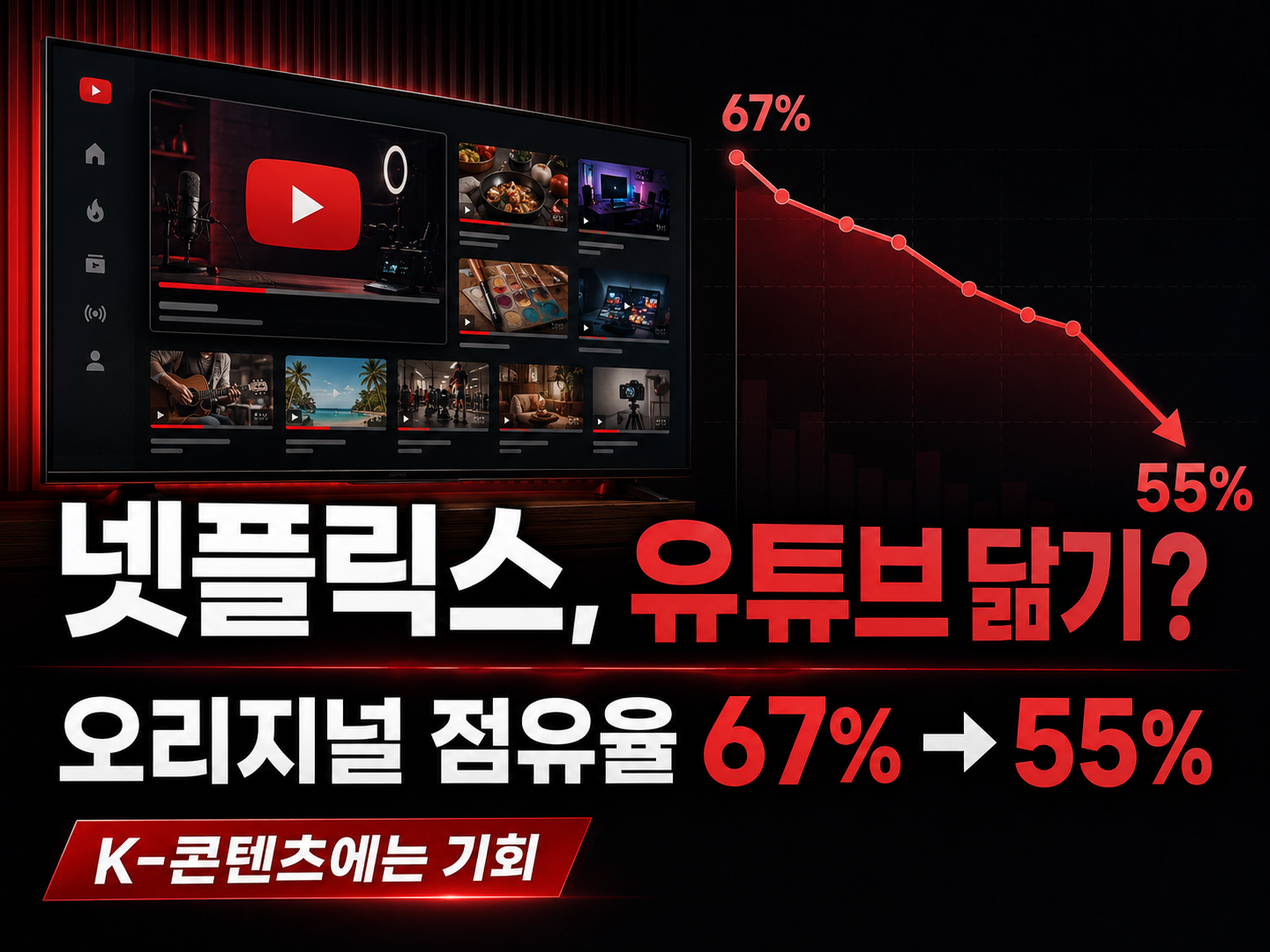
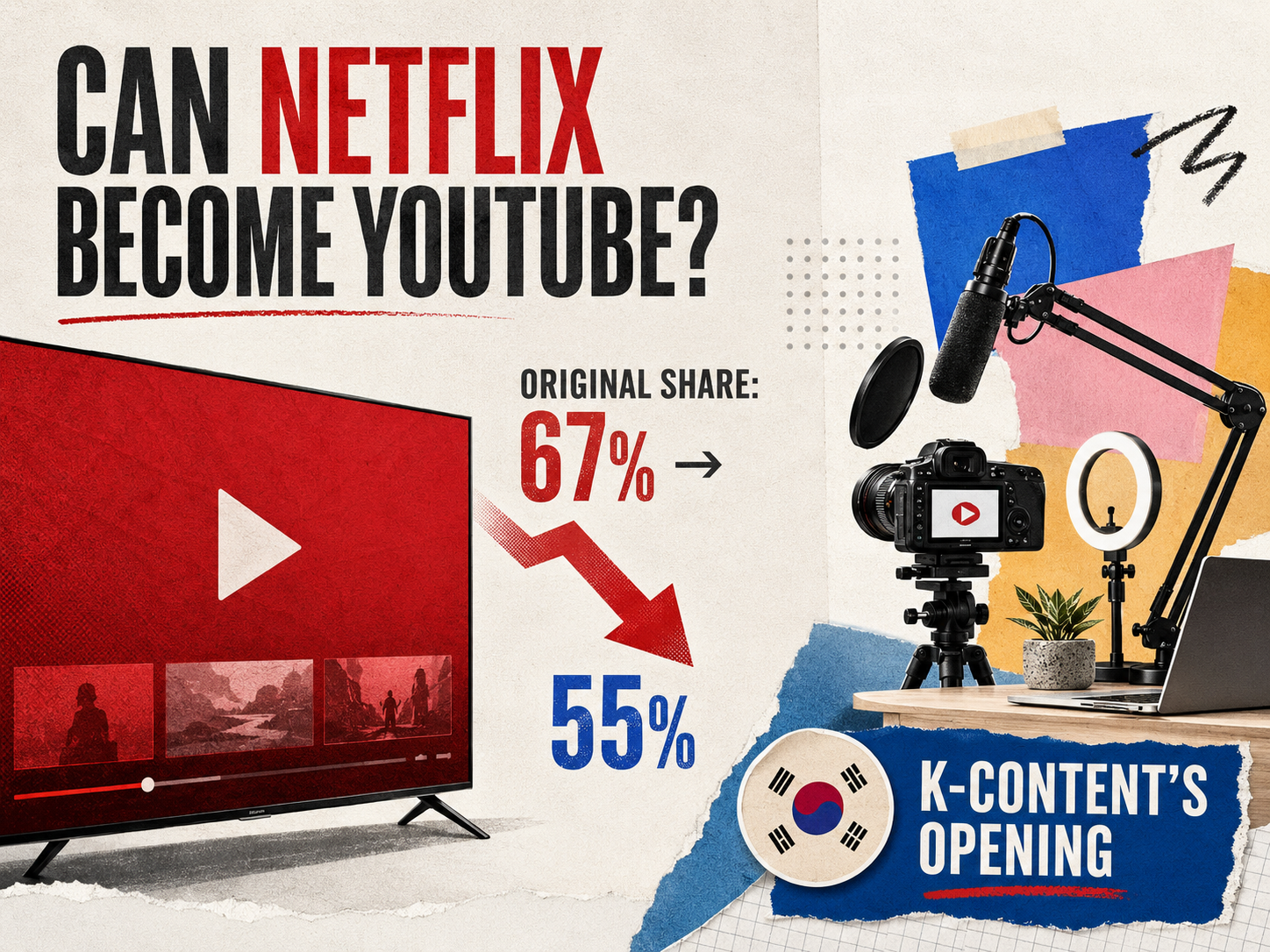
Luminate Streaming Viewership data shows Netflix's share of U.S. original-content viewing time peaked at 67% in 2023, then slipped to 66% in 2024, 62% in 2025 and 55% in 2026 year to date through July 9, as flagship series wrapped up and few new hits emerged to replace them.
YouTube, meanwhile, has held the top spot in U.S. TV-screen viewing time while generating ad revenues no traditional media company can match. That shift of viewing gravity toward the creator economy explains why Netflix is now programming YouTube content — but, in Aquilina's assessment, the move is a flashy engagement bet that won't cure what ails the company.
From Video Podcasts to YouTube Channels
Months after folding video podcasts into its service, Netflix is adding content from popular YouTube channels on a co-exclusive basis — the videos will live on both platforms — along with popular internet clips from digital publishers such as Buzzfeed and Conde Nast. For the creators involved, it is an unambiguous win: a new distribution outlet and revenue stream. For Netflix, the optics are stranger. A company that built its brand on the strategy of becoming HBO is now chasing YouTube late in the game.
The rationale sits in the numbers. In Nielsen's "The Gauge" for April 2026, streaming accounted for 47.6% of total U.S. TV viewing time — more than cable (21.6%) and broadcast (19.9%) combined. Within streaming, YouTube led all individual platforms at 13.4%. Netflix ranked second at 7.8%, nearly half YouTube's share, followed by Disney at 5.0%, Prime Video at 4.2%, The Roku Channel at 3.0%, Tubi at 2.3%, Paramount at 2.1%, Peacock at 1.7% and Warner Bros. Discovery at 1.5%.

Despite methodological questions raised about those reports this year, few dispute that YouTube is the dominant force in entertainment today. Its engagement machine throws off advertising revenue at a scale Hollywood cannot approach.
A Peak of 67%, Now 55%: The Hit Drought

Netflix share of U.S. original content viewing time (Source: Luminate Streaming Viewership (M); 2026 data is YTD through July 9)
Netflix's weakening grip on original SVOD content is showing up in the numbers.
Stranger Things and Squid Game have ended; Outer Banks, The Lincoln Lawyer and The Night Agent are all set to conclude with their next seasons. The buzziest recent streaming hits — The Pitt, Love Island USA, Landman — have largely come from rival services, alongside licensed K-content titles.
Netflix still placed six of the top 10 most-watched streaming original series in the U.S. in the first half of 2026, per Luminate's midyear report. But all six were released in March or earlier, and the platform produced few hits in the second quarter, as analyst Entertainment Strategy Guy has noted. By Netflix's own data, global engagement grew just 2% year over year in the first half — effectively a plateau. Combined with a stock price that has sagged since the company's attempted Warner Bros. acquisition, the flat viewership has pushed Netflix to look for fast levers on engagement and revenue, with YouTube-style programming as a key tactic.
The Season 2 Slump

Compounding the hit drought is a retention problem. According to Bloomberg's Screentime newsletter, Netflix is struggling to keep viewers with its shows beyond a first season. By Netflix's own first-four-weeks data, One Piece — one of the platform's most-watched shows of 2023 — lost more than 30% of its audience in season two, Beef dropped more than 70%, and The Night Agent shed 50% in season two and another 35% in season three. The latest season of Avatar: The Last Airbender, a top 2024 title, fell more than 60% over its first week.
Screentime, citing people familiar with the matter, reported that Netflix has been digging into its own data to understand the decline. The company will end The Night Agent after its next season, while renewing the comedies Running Point and The Four Seasons even though both surrendered more than half their audiences.
In the first five months of 2026, Netflix produced only two massive hits — His & Hers and the fourth season of Bridgerton, a rare show to buck the retention curve — followed by roughly four months without a major hit, during which the platform's biggest viewing week in April or May belonged to the Kevin Hart roast. Shares are down 17% this year and 40% over the past year, touching a near two-year low in late June. Time spent watching Netflix grew less than 2% last year, and the platform's share of total U.S. TV viewing has expanded more slowly than free rivals YouTube and Roku. In an April note, Bank of America said it had expected management to lay out a more compelling near-to-medium-term outlook after walking away from the Warner Bros. Discovery deal.
Screentime also offered a counterpoint: betting against Netflix has long been a losing trade. Even with rivals landing hits this year, Netflix still accounts for half of the most-watched shows on streaming, and I Will Find You, based on a Harlan Coben novel, has approached 60 million views in its first couple of weeks. As a limited series, it should sidestep the season-two curse.

Netflix's own first-half top 10 tells the same story. His & Hers led with 104 million views, followed by Bridgerton season four at 100 million and the limited series I Will Find You at 64 million. Stranger Things 5 (56 million) and Run Away (50 million) came next, with the Korean series Teach You a Lesson at No. 6 with 48 million views, ahead of One Piece season two (47 million), Man on Fire season one (40 million), Ms. Rachel season one (37 million) and The Night Agent season three (36 million). While new self-contained series and licensed titles — including K-content — filled the upper half of the chart, returning seasons slid toward the bottom.
The Adult-Audience Litmus Test: The Amazing Digital Circus
YouTube-native content has not entirely failed on Netflix. CoComelon and Ms. Rachel are genuine successes — the latter streamed for more than 200 million hours in the first half of 2026. But both are preschool titles whose audiences do not choose what they watch. The better test of whether adult viewers will follow creators onto Netflix is The Amazing Digital Circus, the popular adult-oriented animated series licensed to the platform in 2024.
Public data tracked by fan site What's on Netflix shows the series has entered Netflix's global top 10 only four times since then. In the two weeks after its final episodes arrived in June, the entire series drew 3.7 million estimated global views on Netflix, and 10.4 million across the first half of the year. On YouTube, the final episode alone had racked up 77 million views as of July 15 — less than a month after release.
Watching favorite creators on YouTube is a deeply ingrained habit, and the data suggests Netflix will struggle to break it. If the goal is instead to introduce creators to new audiences, it is fair to ask how many viewers of a channel like Good Mythical Morning have not already found it on YouTube.

Podcasts Are Struggling, Too
The podcast experiment that preceded the YouTube deals has started slowly. A Luminate analysis estimated that The Breakfast Club, reportedly the most popular licensed podcast on the platform, was drawing fewer than 2,000 daily views.
The only podcast to appear in Netflix's H1 2026 engagement report was The Rest Is Football, a FIFA World Cup recap show that — unlike other licensed podcasts — was produced as a Netflix-exclusive video version. Given the report's inclusion threshold, that implies no other podcast episode cleared 50,000 views in the first six months of the year.
Back to the Core Business: Films and TV
Aquilina argues that Netflix's focus belongs with its core business: films and television series. Creator content such as YouTube videos and podcasts, he suggests, may be distractions from it. With KPop Demon Hunters standing as the notable exception, Netflix's recent content has not resonated the way it once did. Lately, licensed titles — including Korean content — have also been outperforming pure originals.
With most of its signature hits winding down, what Netflix needs now is new blockbusters to replace them. The emerging formula for streaming hits — annual seasons, old-fashioned TV storytelling, budgets that need not be enormous — is the playbook Netflix should be running, Aquilina concludes, rather than YouTube's.
What It Means for Korean Players
Netflix's hit drought can work as leverage for K-content suppliers. That the one exception Aquilina cites is KPop Demon Hunters — and that licensed titles, including Korean content, have lately been outperforming pure originals — underscores how the strategic value of proven K-content rises precisely when Netflix is under pressure to find its next blockbusters. Teach You a Lesson, the Korean series that ranked sixth among Netflix's most-watched shows of the first half with 48 million views, is a case in point: a K-title holding the upper chart through the hit drought. The new hit formula he describes — annual seasons, traditional TV storytelling, mid-range budgets — also maps closely onto the Korean production system, which is built around short cycles and budget efficiency. IP and production capacity that can reliably deliver a season every year may command better terms from global platforms than a single oversized tentpole.

The season-two slump also reads as a development-stage lesson. If audiences bleed away as the gap between seasons stretches, any series conceived as a multi-season franchise needs a production schedule built to compress that gap from the outset. Conversely, as I Will Find You demonstrates, a limited series designed to end in one run carries no retention burden at all. The traditional self-contained structure of the Korean miniseries is a strength, not a weakness, in this landscape — and IP pitched for a seasonal format will be easier to sell with a gap-management plan attached.
For Korean creators and studios rooted in YouTube, the co-exclusive model opens an additional distribution path at the very moment Netflix is willing to pay for YouTube-native content. The Amazing Digital Circus data counsels realism, though: YouTube viewing habits are not migrating to Netflix, so a Netflix window is best treated as incremental revenue, not a replacement for the home channel — and in negotiations, preserving co-exclusive rather than exclusive terms is what protects the channel as an asset.
The April Gauge data also offers a distribution map. With streaming at 47.6% of U.S. TV viewing — more than cable and broadcast combined — the free, ad-supported tier of The Roku Channel and Tubi (a combined 5.3%) now out-rates Paramount, Peacock and Warner Bros. Discovery individually. That is evidence that FAST and AVOD carriage has become a real viewing gateway for K-content in the U.S., alongside SVOD licensing. There is a lesson for Korean streaming services and broadcasters as well. If the world's largest SVOD cannot solve stagnant engagement by programming creator content, expanding YouTube-style slates is no cure-all — resources are better concentrated on the competitiveness of core original films and series, with YouTube treated through a dual lens: a competitor for time, and a marketing and distribution channel.
출처 (Sources)
Tyler Aquilina, "Netflix's YouTube Strategy Isn't Likely to Solve Its Problems", Variety Intelligence Platform (VIP+), July 2026.
Data and charts: Luminate Streaming Viewership (M) — Netflix share of U.S. original content viewing time (65% in 2022, 67% in 2023, 66% in 2024, 62% in 2025, 55% YTD through July 9, 2026); Luminate 2026 Midyear Report; Nielsen "The Gauge", April 2026 (streaming 47.6%, cable 21.6%, broadcast 19.9%; YouTube 13.4%, Netflix 7.8%, Disney 5.0%, Prime Video 4.2%, The Roku Channel 3.0%, Tubi 2.3%, et al.), including the chart above; What's on Netflix; Netflix H1 2026 Engagement Report, most-watched-shows top 10 chart (January–June 2026) and Teach You a Lesson poster (Netflix); Entertainment Strategy Guy; Bloomberg Screentime newsletter (July 2026) — season-over-season retention data (Netflix first-four-weeks figures), stock details, and the "Season 2 Slump" chart.