Imax generated a record $1.28 billion in 2025, with Asia-Pacific contributing roughly half, while Korea faces a content-supply challenge and an opportunity in ScreenX, 4DX and premium broadcast events

Nolan’s Biggest Global Opening
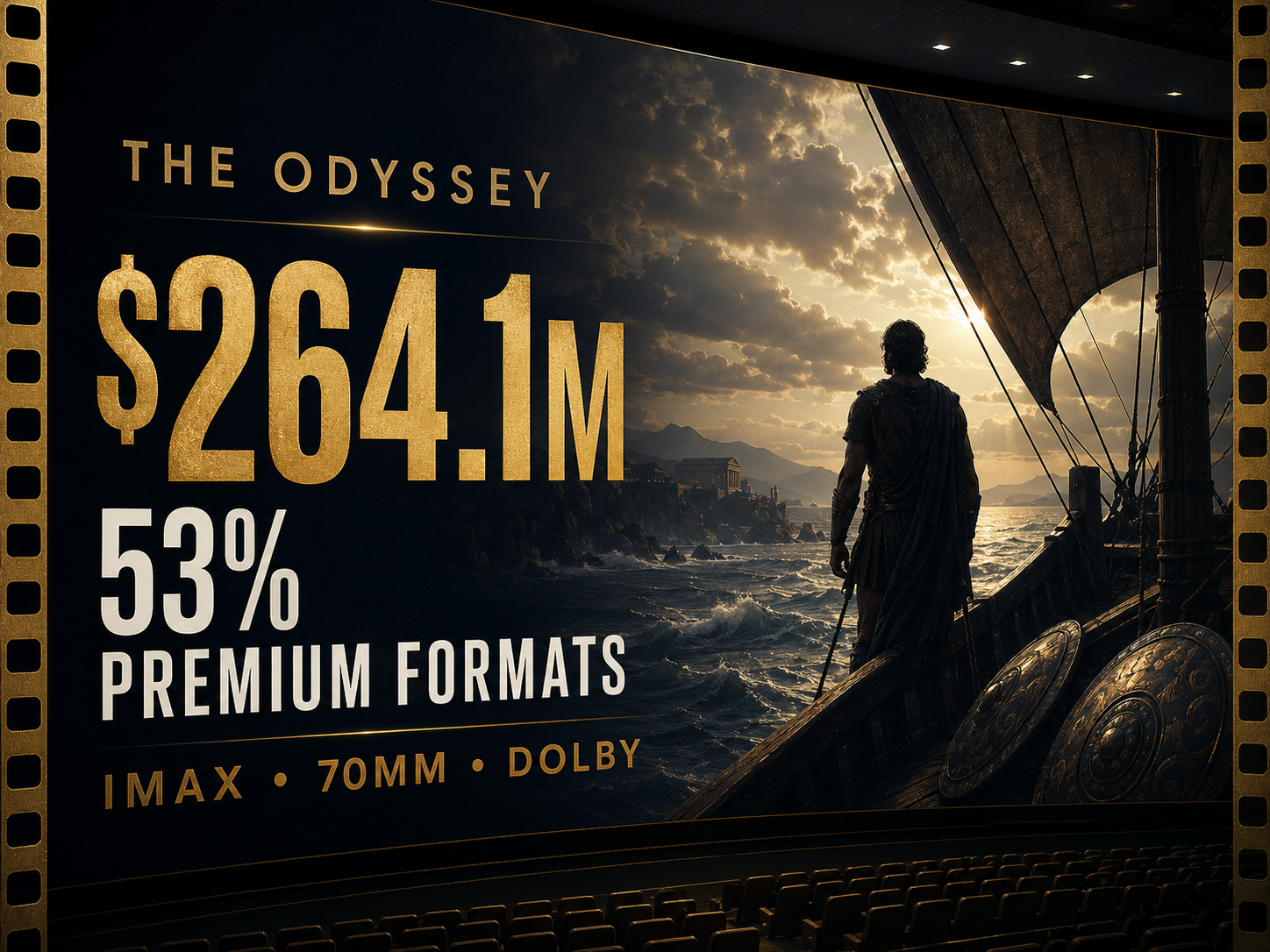
Universal Pictures and Syncopy’s ‘The Odyssey’ earned $124.5 million (approximately KRW 185.3 billion) from 3,919 North American theaters and $139.6 million (approximately KRW 207.7 billion) across 73 international markets. Its $264.1 million (approximately KRW 393.0 billion) global launch is the largest opening of Christopher Nolan’s career.
The result is about 46% above the $180.4 million (approximately KRW 268.4 billion) opening of ‘Oppenheimer.’ It also exceeded the $249 million (approximately KRW 370.5 billion) debut of ‘The Dark Knight Rises,’ without adjusting for inflation.

The More Important Number Is 53%
The composition of the revenue matters as much as the headline gross. Imax, Dolby, 35mm, 70mm and theater-branded premium large formats generated 53% of domestic ticket sales. Technology-led formats carrying higher ticket prices produced more than half of the opening-weekend business.
Imax alone delivered $51.8 million (approximately KRW 77.1 billion) worldwide, or 23% of the film’s global gross. It was the format’s second-largest worldwide opening, behind only ‘Avengers: Endgame.’ The film therefore increased the value not only of its story and cast, but also of large-format projection, screens, sound systems and specialized film infrastructure.
Technology Restores Pricing Power to Theaters
Streaming has made content widely accessible, but it cannot easily reproduce an Imax 70mm presentation, Dolby Cinema or a purpose-built premium auditorium at home. These technologies restore pricing power to exhibitors. Audiences pay more for differences in scale, resolution, contrast, sound and projection — even when the underlying film is the same.
‘The Odyssey’ is the first feature shot entirely with Imax cameras. Nolan integrated the exhibition format into the creative design at the production stage, making Imax part of the content rather than a distribution option added at the end. Scarcity also created demand: the limited network of Imax 70mm screens produced sellouts and overnight showtimes at venues including London’s BFI Imax and Pathé Odysseum Montpellier.
Premium Formats Function Like Technology IP
Imax and Dolby increasingly resemble B2B technology platforms rather than simple screening vendors. Camera certification, post-production workflows, projection equipment, sound design, auditorium standards and consumer marketing operate as an integrated system. For major releases, audiences now choose not only which film to see, but which format to buy.
That creates three assets. First is a price premium through higher average ticket prices. Second is an experience asset that can drive repeat viewing across formats. Third is scarcity: limited screens and showtimes accelerate advance sales, sellouts and social attention. The 53% premium-format share shows that all three were converted into measurable revenue.
A Director Brand Meets a Technology Brand
Nolan’s name now operates like a franchise. ‘Inception,’ ‘Interstellar,’ ‘Dunkirk,’ the ‘Dark Knight’ trilogy and ‘Oppenheimer’ built trust in large-scale original filmmaking. Imax adds a technology brand to that promise, encouraging audiences to seek the filmmaker’s intended presentation.
The combination traveled globally. India generated $7.2 million (approximately KRW 10.7 billion), the country’s largest opening for a non-franchise Hollywood production. The United Kingdom and Ireland contributed $17.4 million (approximately KRW 25.9 billion), while France delivered $13.7 million (approximately KRW 20.4 billion).
Premium Revenue Helps De-Risk Expensive Films
Universal reportedly spent $250 million (approximately KRW 372.0 billion) on production and another $125 million (approximately KRW 186.0 billion) on global marketing. At that scale, higher per-capita revenue and a long theatrical run matter as much as attendance. Premium formats lift early revenue, use sellouts to spill demand into standard auditoriums and can extend the event window.
Audience response supports that runway: the film earned an A CinemaScore, a 95%–97% Rotten Tomatoes critics score as weekend estimates were reported and an 81% “definite recommend” rating from PostTrak. It also faces limited major competition before Sony Pictures releases ‘Spider-Man: Brand New Day’ on July 31.

Imax Shifts Its Growth Center to Asia-Pacific
The success of ‘The Odyssey’ intersects with a broader shift in Imax’s global strategy. The company generated a record $1.28 billion (approximately KRW 1.905 trillion) in worldwide box office in 2025, up 40% year over year. Asia-Pacific accounted for roughly half of that total and grew nearly 80% from the prior year.

China remained the largest contributor at $407 million (approximately KRW 605.6 billion), but Asia excluding China also reached a record $230 million (approximately KRW 342.2 billion). Simultaneous records in Japan, India, Australia, Indonesia, Vietnam, Malaysia and Thailand show that Imax is moving from dependence on one dominant market toward a diversified regional growth engine.
Imax Asia-Pacific Growth Outlook
Source: Variety and Imax. KRW conversions use USD 1 = KRW 1,488 and are rounded.
Local-Language Content Creates the Flywheel
Local-language films generated $405 million (approximately KRW 602.6 billion) in Imax box office in 2025, 66% above the previous annual record. The slate is expected to expand from 67 local-language titles in 2025 to 75 in 2026. Japanese anime, Chinese spectacles, Indian epics, Southeast Asian horror and concert films are turning the network into a year-round platform rather than a venue dependent only on Hollywood tentpoles.
Japan illustrates the flywheel: more locations increase the format’s relevance to local producers, more local productions attract audiences, and stronger demand supports additional screens. India is entering its own Filmed for Imax phase with “Ramayana” and “Varanasi.” Imax is moving upstream from exhibition into local production ecosystems.
2026 Outlook: $1.4 Billion and an Asia-Heavy Backlog
Imax projects approximately $1.4 billion (approximately KRW 2.083 trillion) in global box office for 2026 and 160 to 175 system installations. Its contracted backlog stands at 434 systems, with more than 200 located in Asia-Pacific. The 2026 slate includes more than 12 Filmed for Imax titles, led by “The Odyssey” and Denis Villeneuve’s “Dune: Part Three.”
Premium-format competition is therefore evolving beyond screen count. It is becoming a platform contest that links camera technology, local-language production, auditorium retrofits, concerts and sports, and global distribution.
Why South Korea Is the Regional Outlier
South Korea is the major Asia-Pacific market that has not followed the broader upward trend because its overall theatrical box office has deteriorated. Imax has nevertheless remained more resilient than the wider market, and CGV Yongsan in Seoul consistently ranks among the five highest-grossing Imax theaters worldwide. This suggests that Korean demand has not disappeared; the constraint is a shortage of titles compelling enough to justify a premium trip.
The strategic priority is not simply to add screens. Korea needs a pipeline of Korean-language Filmed for Imax projects and a portfolio combining Imax with domestically developed ScreenX and 4DX, Dolby, K-pop, sports and premium broadcast events.
Impact on Korea’s Film and Broadcasting Industries
This trend has direct implications for Korean film and broadcasting. The issue is not simply whether Korea builds more Imax screens. It is whether content development, capture, post-production and exhibition technologies can be designed as one product — allowing Korean companies to export technology licenses alongside content rights.
1. Korean Films Need a Format-First Production Strategy
Korean films have often been adapted for premium auditoriums after completion. The next step is to consider Imax, ScreenX, 4DX, Dolby Atmos, HDR and LED cinema from the development stage. Aspect ratio, multi-screen imagery, spatial sound, motion effects and color workflows can be designed into the work, creating distinct versions and price points for standard theaters, premium auditoriums and streaming.
According to the Korean Film Council, the number of theaters and screens declined in 2025, but special-format and premium auditoriums increased to 1,232, up 80 from the prior year. The market is shifting from casual moviegoing toward trips motivated by a specific title and a specific format.
2. ScreenX and 4DX Are Exportable Korean Technology IP
Korea already owns valuable cinema technology through ScreenX and 4DX, developed by CJ 4DPLEX. Connecting those systems not only to Korean films but also to Hollywood releases, K-pop concerts, sports and esports can create installation fees, conversion and mastering revenue, auditorium licenses, box-office participation, software subscriptions and maintenance income. K-content exports can therefore expand from rights sales into technology-platform exports.
3. Broadcasting Becomes Location-Based Live Content
National and regional broadcasters can repackage sports, concerts, audition finales, awards shows and local festivals for premium theatrical distribution. Opportunities include multi-screen sports coverage in ScreenX, Dolby Atmos concert broadcasts, 4DX K-pop events, theater-linked talent-show finales and simultaneous international screenings supported by real-time multilingual captions and dubbing.
K-pop and sports may scale this market faster than films because they combine loyal fandoms, premium ticket tolerance, light-stick screenings, fan events, global simulcasts and later resale as theatrical or streaming editions. Regional broadcasters do not need to own every facility; joint production centers with exhibitors, telecom operators, concert promoters, universities and local governments are a more realistic model.
4. A Risk of Greater Production Polarization
Premium formats are not the answer for every project. Blockbusters suited to giant screens and immersive sound may attract more capital, while mid-budget films could lose ground between theaters and streaming. Large films, concerts and sports are likely to concentrate in premium cinemas; lower-budget films and dramas may move toward OTT, FAST and broadcasting; independent films may rely more on curated venues and local communities.
The appropriate response is not to force every Korean film into an expensive format. Distribution should be designed at the development stage by distinguishing theatrical, streaming and live-event projects. Public support should also recognize premium-format capture, post-production and mastering, virtual production, spatial audio and AI localization as eligible production infrastructure.
5. From K-Content to Korean Experience Technology
Korea’s opportunity extends beyond exporting more programs and films. Combining ScreenX, 4DX, virtual production, real-time graphics, spatial audio and AI-enabled subtitling and dubbing with film, television, K-pop and sports would allow Korean companies to sell both content and the technology of experiencing it. Competitiveness will increasingly depend not only on what a company produces, but on the screen, sound and spatial experience through which it is delivered.
The Industry Signal Matters More Than the Billion-Dollar Forecast
A $1 billion finish (approximately KRW 1.488 trillion) remains a projection rather than a certainty. Third-weekend competition, unusually high costs and possible adjustments to final grosses remain material factors.
The larger signal is already clear. Theaters do not compete with streaming only by offering more content. When capture, post-production, projection, sound and auditorium design are packaged as one premium product, the format itself becomes an asset that raises the value of the film. Imax, 70mm and Dolby are no longer add-ons; they are core infrastructure in the economics of a modern tentpole.
Sources
• Variety: Rebecca Rubin, July 19, 2026 — Original source
• TheWrap: Jeremy Fuster, July 19, 2026 — Original source
• Exchange-rate reference: USD/KRW 1,487.51 on July 19, 2026; conversions use USD 1 = KRW 1,488 — Original source
• Korean Film Council: “2025 Korean Film Industry Review” — https://magazine.kofic.or.kr/webzine/web2/2777/pdsView.do
• Variety: Naman Ramachandran, “Imax Charts Asia Pacific Growth Strategy,” Feb. 27, 2026 — https://variety.com/2026/film/news/imax-asia-pacific-push-record-box-office-1236674495/
Currency conversions use USD 1 = KRW 1,488 and are rounded for readability. Opening-weekend figures are estimates.