
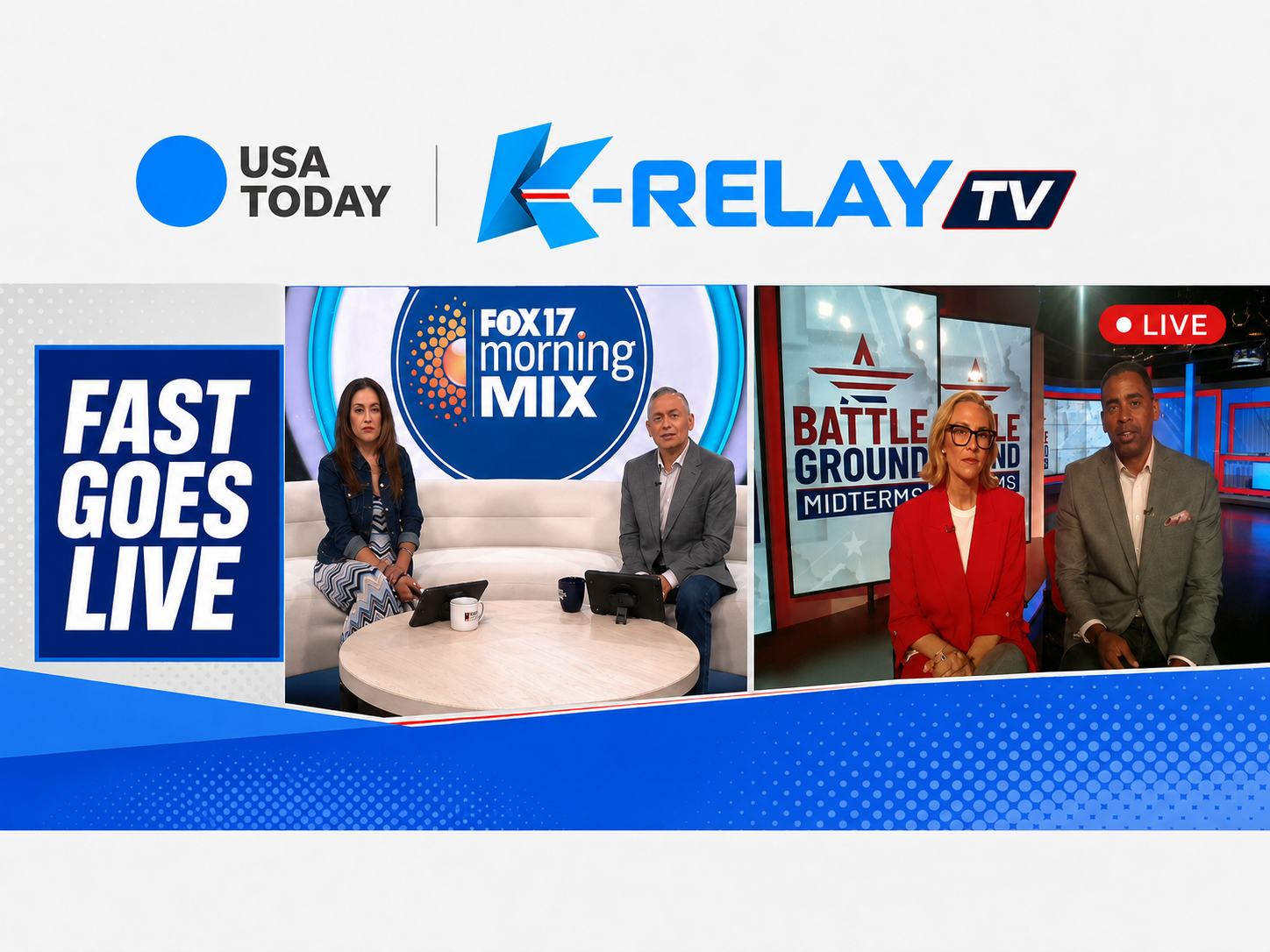
USA TODAY FAST Channel carries Fox First Run’s “Battleground Midterms” live daily at 1 p.m. ET from Aug. 31 — CTV takes $1.14bn of the $6.1bn in political ad spend booked so far
The USA TODAY FAST Channel begins streaming Fox First Run’s new political program “Battleground Midterms” on Aug. 31.
The show runs one hour daily at 1 p.m. ET. VideoElephant, which programs and operates the channel, said in an Aug. 28 release that USA TODAY is the only channel outside the Fox group scheduling the show live. It is a case of Fox handing the fixed live slot of an election program to a newspaper-brand FAST channel outside its own station group.
Fox chose the USA TODAY channel on reach and on operating structure. The channel is carried on Fire TV, Samsung, Vizio, Plex, HP, TiVo, STIRR, OrkaTV, LG, TCL tv+, FreeCast and Altice — 12 platforms in all.
Since January 2025 its programming, distribution and monetization have been run by VideoElephant rather than Gannett. USA TODAY supplies the content and the brand; scheduling, multi-platform distribution and ad operations sit with a specialist operator.
Advertising conditions line up as well. Of the $6.1bn in political advertising booked through Aug. 24 in the U.S. election cycle, ad-tracking firm AdImpact counted $1.14bn on CTV and streaming, ahead of $770m on cable (MediaPost, Aug. 25). In an election period, a one-hour live political show scheduled at the same time every day gives a FAST operator predictable appointment viewing and political ad inventory at once.

Platforms carrying the USA TODAY FAST Channel. Photo: USA TODAY FAST Channel
Only live carriage outside Fox… viewer comments and polls answered on air
“Battleground Midterms” covers the fight for control of Congress across competitive states and districts. S.E. Cupp and Bill Anderson host. Cupp is a CNN political commentator and nationally syndicated columnist; Anderson is executive producer and anchor of special projects at WTXF (FOX 29) in Philadelphia (TVNewsCheck, August 2026).
Shanta Covington is executive producer. Producing partners include the Cook Political Report and a network of local radio stations, newspapers and television stations. Hosts respond to viewer comments, questions and polls in real time during the hour.
Kritika Aswani, director of content programming and planning at VideoElephant, said in the Aug. 28 release that the daily show matches what the channel’s audience expects in timeliness, trust and insight.
Fox-affiliated local stations are promoting the show inside their own programming. FOX 17 in Grand Rapids, Michigan brought Cupp and Anderson on by remote during its morning show “Morning Mix” to flag the 10 p.m. weeknight slot on the station’s late program “The Spot.”

FOX 17’s “Morning Mix” flags the local slot for “Battleground Midterms.” Photo: FOX 17 screen capture
Fox First Run ran a limited-run political program called “Battleground” in the 2024 cycle, cleared across its own station group and a handful of outside stations (Next TV, Sept. 3, 2024).
$6.1bn booked to date… CTV passes cable
AdImpact counted $6.1bn in 2026 midterm political advertising through Aug. 24, up $1.3bn from the $4.8bn logged on July 16. By medium: broadcast $3.12bn, CTV and streaming $1.14bn, digital $937m, cable $770m, radio $124m and satellite $51m.
Republican-supported candidates and issues accounted for $2.69bn, Democratic spending $2.35bn and independent spending $1.11bn (MediaPost, Aug. 25).

CTV and streaming have passed cable. Source: AdImpact, via MediaPost
The full-season projection is $11.6bn, above both the $8.9bn 2022 midterm cycle and the $11.2bn 2024 presidential cycle. Broadcast is projected to take 48% at $5.6bn, CTV and streaming 23% at $2.7bn and digital 14% at $1.6bn. AdImpact raised its CTV projection from $2.5bn to $2.7bn on June 11.
Among station groups, Gray Television has drawn the most at $434m, followed by Nexstar Media Group ($416m), Fox Television Stations ($363m), Tegna ($350m) and Sinclair ($319m) (same report). John Link, senior vice president of data at AdImpact, said in June that spending was pacing ahead of previous cycles and that pre-booking indicated continued strength.
News and commentary FAST channels up 52.9% in a year — three times the market rate
Gracenote, part of Nielsen, counted 2,172 FAST channels globally in July 2026, up 17.5% year over year. By genre, news and commentary grew fastest at 52.9%, followed by comedy at 20.2%, entertainment at 19.7% and reality at 7.3%. Sports channels rose 13.8% to 264, while unique sports titles grew 31.2% and individual games and events 37.5%, both outpacing channel growth (NewscastStudio, Aug. 20).

News and commentary grew three times as fast as the FAST market overall. Source: Gracenote
The new channels are not only from traditional broadcasters. Business and finance, tech, political commentary, documentary journalism, weather and localized news channels have all expanded. Operators point to news updates through the day as the driver of habitual viewing and repeat sessions (Advanced Television, May 20).
Political FAST channels launch too… Crooked Media’s SANEtv lands on Amazon Prime Video
New political channels are opening in step with the cycle. Crooked Media launched its own FAST channel, SANEtv (Save America News & Entertainment Television), in April, programming “Pod Save America,” “Lovett or Leave It,” “What A Day” and “Offline with Jon Favreau” around the clock, with Amazon Prime Video as the first carriage partner (Axios, April 22; Inside Audio Marketing, April 24).
In August the company said it had acquired “FiveThirtyEight Politics,” hosted by Nate Silver, Clare Malone and Galen Druke, and will relaunch it on Sept. 9 as “Still Counting,” a weekly show covering elections alongside polling, betting markets and AI (Variety, Aug. 26).
The New York Post channel opens with roughly 150 hours of programming and plans to refresh about 20% of it each month, drawing on a group audience of nearly 62 million monthly unique visitors. Cord Cutters News reported alongside the launch that 64% of U.S. households now consume free content and that CTV advertising is forecast to reach $38bn by the end of 2026 (June 16).
NBC News streamed from the March primaries… CBS, ABC, NBC and Fox all sit on the Samsung TV Plus news row
NBC News began its 2026 midterm coverage on March 3 with the Texas, North Carolina and Arkansas primaries. Special live coverage ran on NBC News NOW at 8 p.m. ET with Kristen Welker and Hallie Jackson, while Steve Kornacki led data analysis and an extended “Kornacki Cam” streamed from 7:30 p.m. across YouTube, NBCNews.com, the app, Instagram and Facebook. The same setup was repeated through the March-to-August primary and special election nights and scales to the November midterms (NBCUniversal, March 2).
The free-channel news row is already built out. Samsung TV Plus carries CBS News, ABC News Live, NBC News NOW, LiveNOW from FOX, Scripps News and four local news channels in its news and opinion section. Scripps News is carried on Samsung TV Plus, Roku, Amazon Fire TV, Pluto TV, Apple TV, Sling, Vizio and Xumo, reporting through more than 50 bureaus tied to the Scripps local station group.

NBC News “Decision 2026” primary night coverage. Photo: NBC News via YouTube
Networks put the free channel in front and paywall cable news behind it
ABC, CBS and NBC all run free, ad-supported 24-hour news channels, carried simultaneously on their own sites, YouTube and streaming apps. Original programming averages 8 to 12 hours a day, with key reports replayed through the remaining hours (TV Plus, Feb. 21, 2025).
NBC News NOW launched in May 2019 with eight hours of daily programming and hourly updates before expanding to 24 hours (TechCrunch, March 11, 2019). CBS rebuilt CBSN as the CBS News Streaming Network in January 2022, wiring local station streams into the national schedule while keeping the free, ad-supported model; then co-head Neeraj Khemlani said the model was profitable and growing (Axios, Jan. 27, 2022). It now runs as CBS News 24/7.
Fox is structured differently. The Fox News Channel feed itself is paid, bundled into FOX One, the direct-to-consumer service launched Aug. 21, 2025 and listed at $19.99 a month. The free window is LiveNOW from FOX, operated by Fox Television Stations. Launched in 2014 as NewsNOW from FOX, it carries raw live events and press conferences with minimal anchoring and is scheduled on Tubi, Pluto TV, Samsung TV Plus, LG Channels, The Roku Channel, Xumo, Vizio and Prime Video Live TV.
The arrangement puts the free channel at the front of the news brand and leaves opinion programming behind the paywall. Pluto TV bundles CBS News 24/7, NBC News NOW, Bloomberg TV+ and Cheddar News as linear feeds; The Roku Channel carries ABC News Live, NBC News NOW, Reuters and Bloomberg TV+.
Ad loads run four to eight minutes an hour… news blocks get their own pod templates
FAST revenue turns on three variables: hours watched, CPM and fill rate. Industry guidance puts ad load at four to eight minutes per hour. CPMs are cited at $8 to $25 for general channels and $18 to $35 for U.S. premium categories such as news and true crime (MwareTV, March 6; Evrideo, March 28).
Ads are placed by SCTE markers embedded in the schedule, which signal where a break starts and how long the pod runs so server-side ad insertion can stitch in creative (Flicknexs, July 3). Longer pods raise impressions per break, but past roughly four minutes of ads in a 30-minute program, completion rates on late-pod slots collapse and DSPs deprioritize the inventory. Because pod length is fixed at the channel packaging stage and hard to change later, operators define separate pod templates for news, entertainment and kids blocks at channel creation (LtvAdx, June 4).
Fill rates diverge sharply by platform. A March audit by FASTMaster comparing the same program in the same daypart across five platforms found Pluto TV and The Roku Channel at 100% fill and Prime Video at 33%, with slate bleed from SSAI latency visible at the end of pods on Samsung TV Plus and Xumo Play (March 30). The same outlet argued in February for capping ad load at six minutes an hour and delisting channels that cannot hold 70% fill at a $10 CPM floor (Feb. 2).
Live election programming adds a variable. Unlike pre-produced content, break points follow the run of play, so pod templates cannot be fixed in advance. In a parallel arrangement like “Battleground Midterms,” where the stations and the FAST channel carry the same hour, where the breaks fall determines how revenue splits between the two windows.
Broadcast political-ad rules do not reach streaming
The FCC’s political advertising provisions — reasonable access for candidates, equal opportunities and lowest unit rate in the pre-election windows — apply to broadcast licensees. Internet-delivered services such as Hulu, Roku, Peacock, Tubi and Pluto TV are not licensees and fall outside them. Roku accepts political advertising across its FAST channels and The Roku Channel, subject to a verification process confirming the buyer is a registered campaign or committee (Adwave summary, April 7, cited second-hand).
So the same program can run on stations and on a FAST channel while the rules governing its ad sales differ by window. In a parallel arrangement like “Battleground Midterms,” that difference carries straight into pricing and sales method — and it is part of what sits behind AdImpact’s view that CTV and streaming is the only medium adding spend.
Streaming 48.5%, cable 19.5%… cable falls below broadcast in the June Gauge
Streaming took 48.5% of U.S. TV watch time in Nielsen’s June 2026 Gauge, released Aug. 18. Broadcast rose to 19.8% from 18.5% a year earlier on FIFA World Cup 2026 and the NBA Finals, while cable fell to 19.5% from 23.4% — below broadcast. YouTube held the top distributor slot at 13.8% (MediaPost and Nielsen, Aug. 18).

U.S. share of TV watch time, June 2026. Source: Nielsen, The Gauge
Nielsen said the June edition is the last produced on the existing methodology, with a recalibration arriving for the new season in September. In the Q2 2026 Ad Supported Gauge, streaming reached 48.2% of ad-supported viewing, up 1.6 points from Q1, while cable held at 25.2% (Broadband TV News, Aug. 27).
IP transport instead of satellite… Fox closed a live syndication test in May
Fox Television Stations produced “25 Words or Less LIVE” at Parlay Studios in Jersey City, New Jersey, from May 4 to May 29 and delivered more than 38 live broadcasts to 18 stations. The slot was 1 p.m. ET — the same hour “Battleground Midterms” now occupies. Meredith Vieira hosted; XR (Extreme Reach) handled syndication distribution and LTN provided IP transport and master control (TVNewsCheck, July 8).
Stephen Brown, executive vice president of programming and development at Fox Television Stations, said live programming creates opportunities for stations to engage viewers in real time (XR release, July 8). Matt Pagen, general manager of XR Media, described the workflow as a more cost-efficient alternative to satellite distribution (same release).
VideoElephant runs USA TODAY and New York Post channels across 40 platforms
VideoElephant took over programming and distribution of Gannett’s USA TODAY FAST Channel and OTT properties in January 2025, handling scheduling, distribution, reporting and monthly promotion. Cathy Kononetz, executive director and general manager of video monetization at Gannett, said the arrangement would continue building audiences on the USA TODAY Network’s OTT channel (ExchangeWire, Jan. 30, 2025).
Its managed 24/7 channel portfolio now includes USA TODAY, the New York Post, EntrepreneurTV and DogTV, distributed across 40 streaming platforms, with the format mix extended from linear FAST into AVOD and short-form VOD (Media Play News, June 12).
The New York Post launched its FAST channel in June with VideoElephant rather than building a streaming operation internally, citing the avoided investment on the technology and operations side. Preeya Naul, senior vice president of streaming partnerships and supply at VideoElephant, said FAST has become material in audience terms (Axios, June 16).
Fox buys Roku for $22bn… the distribution layer itself is being rebuilt
Fox Corporation announced on June 15 that it will acquire Roku at $160 a share in cash and Fox Class A stock, valuing Roku at roughly $22bn in enterprise value, with closing expected in the first half of 2027 subject to regulatory approval.
Fox bought Tubi for $440m in 2020; this deal adds The Roku Channel, first-party data and a direct relationship with more than 100 million global streaming households. Lachlan Murdoch, executive chair and CEO of Fox, described it as pairing live news and sports with the leading connected TV platform (The Hollywood Reporter, June 15; Fox Corporation release, same date).
That sits on the same layer as this scheduling decision. While the parent of Fox First Run — which produces “Battleground Midterms” — buys the largest U.S. connected TV platform, the show’s only live window outside the Fox group is a FAST channel run by a third party. Analysts read the deal as an advertising play. Mike Proulx, research director at Forrester, said the bigger play is advertising revenue and that the deal accelerates Fox into that shift with built-in audience scale (Poynter, June 16, cited second-hand).
THR Charts (The Hollywood Reporter, updated Aug. 27) reads Nielsen’s Media Distributor Gauge the same way: YouTube still leads, and The Roku Channel’s 3% share would move to Fox if the deal closes. Paramount — CBS plus Paramount+ — sits just below Netflix, and would add Warner Bros. Discovery’s 6% if its $111bn deal completes.
What this means for Korean content companies
The distribution terms on “Battleground Midterms” bundle station-group syndication and FAST live carriage in parallel. Korean content companies negotiating with U.S. FAST operators can put the live slot on the table as a separate right. K-content has so far entered FAST mostly as post-run scheduling of completed series.
Gannett and the New York Post both handed operation of their own branded channels to an outside company. For Korean companies planning a U.S. FAST channel, a managed-service operator is the first option to weigh against running it in house. Scheduling optimization, ad-break design and handling roughly 40 distribution platforms all turn on local operating experience.
Ad rates track the timeliness of the schedule. Fixed-time K-content live events — awards shows, concerts, fan events — become candidates for simultaneous carriage on U.S. FAST channels. That territory has been limited to YouTube and owned apps.
What this means for Korean broadcasters
Fox delivered simultaneous live feeds to 18 stations over IP rather than satellite. The same structure applies to joint scheduling among regional stations and to simulcasting network programs onto FAST. The news and current-affairs production capacity held by Korean terrestrial and regional commercial broadcasters overlaps with the fastest-growing FAST genre.
Live simulcasting starts with contract design. Talent and performer agreements have to cover simultaneous streaming and catch-up scope in advance for parallel carriage to work. U.S. syndication contracts now routinely separate the live slot from FAST scheduling as distinct rights. Korean agreements are more often built around post-broadcast VOD and clips, which opens a renegotiation window before parallel live carriage is possible.
Korean election-night coverage has run on terrestrial broadcast plus YouTube simulcast. Ahead of the 2028 general election, broadcasters need to decide whether to treat FAST as a separate window at all, and whether to attach to domestic or overseas channels.
Election archives are an asset that can be reprogrammed repeatedly on the electoral cycle. Past election-night coverage, candidate interviews, regional reports and explainers on the electoral system convert into inventory for timeline channels, issue-based clips, live analysis and special programming when the season comes around. The growth of U.S. news and commentary FAST channels is best read as the combination of that library-reuse value, demand for free ad-supported distribution and platform expansion.
Ad operations have to be designed for the FAST environment rather than ported from the existing broadcast mid-roll regime. Korean terrestrial broadcasters have been allowed to run mid-programme advertising since 2021, but that framework is a matter of broadcast regulation and programme scheduling. On FAST, hourly ad load and pod length and frequency are set against channel genre, viewing patterns, platform policy and ad demand, then executed through SCTE-35 markers with SSAI or platform-side ad insertion.
News channels in particular need a different break strategy from entertainment channels, given breaking news, appointment timing and short viewing sessions. Carrying broadcast ad breaks across untested can work against retention, ad completion, fill rate and revenue efficiency. A news FAST channel should optimize its pod templates around short, predictable breaks, a plan for unsold inventory including house promos, and platform-by-platform A/B testing.

What this means for Korean news organizations
In the U.S., the companies adding FAST news channels are print and digital publishers more than broadcasters. USA TODAY, the New York Post, Crooked Media and Billboard have entered recently, and most used a managed service rather than building internally — programming, distribution and monetization outsourced, with the publisher keeping production and brand.
Korea has run the other way around. On Jan. 29, 2026, Samsung Electronics (삼성전자) added “KBS 뉴스 24” (KBS News 24) and “SBS No.1 뉴스라이브” (SBS No.1 News Live) to Samsung TV Plus (삼성 TV 플러스), the first 24-hour terrestrial news channels on a domestic FAST platform. KBS News 24 is built around KBS 뉴스9, 뉴스12 and 뉴스광장; SBS No.1 News Live around SBS 8뉴스, 10 뉴스, 12 뉴스, 오뉴스, 나이트라인 and 모닝와이드, with rebroadcasts and clips from the prior 24 hours filling the off-hours. Samsung TV Plus separately carries JTBC뉴스, MBN뉴스, YTN, 매일경제TV, 연합뉴스TV and 한국경제TV (Samsung Electronics release, Jan. 29, 2026).
Domestic FAST news scheduling began by porting existing terrestrial and all-news cable output. What grew in the U.S. cases was not ported output but daily programming assembled for the FAST schedule. “Battleground Midterms” airs at the same hour on Fox stations and on the USA TODAY channel, but on the USA TODAY side a newspaper brand is anchoring its live schedule with a program it did not produce.
That is the open segment for Korean newspapers and wire services. Securing the live slot of an outside production as the fixed-time anchor of a channel schedule does not require an in-house studio operation. Filling 24 hours and securing one live hour a day are different cost problems. Fixed-date events — elections, National Assembly audits, corporate earnings days — fit that structure.
A FAST strategy does not end at opening one channel. U.S. operators bundle a 24-hour linear channel, AVOD and short-form VOD into a single operating agreement and grow sellable inventory by adding distribution platforms — the path VideoElephant took in scaling to 40 platforms and extending beyond linear. The order for a Korean publisher is the same: open the channel, widen distribution, then extend formats, not the reverse.
Treating YouTube as a substitute for FAST is a particularly risky call in Korea. In the Reuters Institute’s Digital News Report 2026, 49% of Korean respondents said they use YouTube for news — the second highest rate after Kenya. The survey covered 97,520 people across 48 countries, including 2,025 in Korea, and was fielded in January and February this year. Portal-centred consumption persists but has fallen from 76% in 2019 to 61% (Media Today, June 20; Green Economy News (녹색경제신문), June 21). In the Korea Press Foundation’s 2025 media audience survey, weekly news use via portals fell 1.2 points to 66.5% while news use via online video rose 11.6 points to 30.0%.
YouTube and FAST are not substitutes; they are two windows with different revenue mechanics. YouTube builds reach through algorithmic recommendation, is consumed in clips, and the platform inserts the ads and shares the revenue. FAST works off a schedule, builds appointment viewing, and the channel side decides where breaks fall and how long pods run. That is why U.S. networks run a free 24-hour channel and a YouTube presence at the same time. ABC World News Tonight picks up another 500,000 to 900,000 daily viewers on YouTube, and NBC News recorded 1.4 billion views on TikTok in Q4 2024 alone (TV Plus, Feb. 21, 2025).
Korean publishers have already shifted their YouTube programming toward live. What adding FAST requires is not more content but two pieces of design: inventory that can fill a 24-hour schedule, and the ad pod structure YouTube does not ask them to build. Mirroring a YouTube live feed straight onto FAST produces a stream with no break points — and fill rate and CPM are decided at exactly that point.
The regulatory frame is worth checking too. In Korea, election-related scheduling and advertising are designed around broadcasters under the Broadcasting Act (방송법) and the Public Official Election Act (공직선거법). Where a FAST channel sits in that structure depends on the channel form and the operator’s licensing status — the same split the U.S. has between licensees and streaming services.
Sources
· VideoElephant release, “USA TODAY FAST Channel to Stream Fox First Run’s Battleground Midterms with S.E. Cupp and Bill Anderson,” Aug. 28, 2026 (distributed by Sarfaty Communications).
· MediaPost, Wayne Friedman, “U.S. Political Ad Buys Reach $6.1B To Date,” Aug. 25, 2026. mediapost.com/publications/article/417457/
· MediaPost, “Streaming Climbs To 48.5%, Per Last Lame Duck Edition Of Nielsen’s ‘Gauge’,” Aug. 18, 2026. mediapost.com/publications/article/417308/
· Nielsen, “FOX and NBCUniversal Score with FIFA World Cup 2026 Success in Nielsen’s June Gauge Reports,” Aug. 18, 2026.
· Broadband TV News, “Major live sports events lift broadcast viewing in Nielsen’s Q2 2026 Ad Supported Gauge,” Aug. 27, 2026.
· NewscastStudio, “FAST sports programming growth outpaces channel expansion, Gracenote finds,” Aug. 20, 2026.
· AdImpact, “AdImpact Reveals 2026 Election Cycle to Reach Record $11.6 Billion in Ad Spending,” June 11, 2026; CNBC, same date.
· TVNewsCheck, “USA Today FAST Channel to Stream ‘Battleground Midterms’,” Aug. 28, 2026.
· TVNewsCheck, “FOX First Run Returns With Daily Political Program ‘Battleground Midterms’,” August 2026.
· TVNewsCheck, “Fox Stations, Extreme Reach & LTN Test Live Syndication With ‘25 Words Or Less LIVE’,” July 8, 2026; XR release, same date.
· Axios, Sara Fischer, “New York Post launches FAST channel as publishers expand into streaming TV,” June 16, 2026.
· Media Play News, “FAST30 2026: The Movers and Shakers in Free Ad-Supported Streaming TV,” June 12, 2026.
· ExchangeWire, “VideoElephant Assumes Management of the USA Today FAST Channel,” Jan. 30, 2025; TVNewsCheck, same date.
· Advanced Television, “FAST Channels TV shares 5 thriving FAST categories,” May 20, 2026.
· Next TV, “Syndication Enters a New Era With Full Slate of Multiplatform Shows,” Sept. 3, 2024.
· Axios, “Crooked Media pushes further into TV with new FAST channel,” April 22, 2026; Inside Audio Marketing, April 24, 2026.
· Variety, “Crooked Media Acquires Nate Silver’s ‘FiveThirtyEight Politics’ Podcast, Which Is Being Renamed ‘Still Counting’,” Aug. 26, 2026.
· Cord Cutters News, “Another Major News Organization is Launching a Free Live Channel,” June 16, 2026; TVNewsCheck, “New York Post To Launch Its First FAST Channel,” same date.
· NBCUniversal, “NBC News Unveils Comprehensive Cross-Platform Coverage for 2026 Midterms…,” March 2, 2026.
· Scripps News distribution page; Samsung TV Plus channel list (news and opinion row).
· Adwave, “Political Ad Compliance on CTV Platforms (2026),” April 7, 2026 (summary of FCC scope, cited second-hand).
· TV Plus (Substack), “What’s Going on with News in the Streaming World?,” Feb. 21, 2025.
· TechCrunch, “NBC’s free news streaming service NBC News Now will launch in May,” March 11, 2019.
· Axios, “CBS News bets on local with new streaming strategy,” Jan. 27, 2022.
· LiveNOW from FOX service and platform listings; FOX One pricing as listed in streaming guides, August 2026 (cited second-hand).
· MwareTV, “FAST Channel Monetization: Revenue Without Subscriptions 2026,” March 6, 2026; Evrideo, “The Complete Guide to Launching a FAST Channel in 2026,” March 28, 2026.
· LtvAdx, “CTV Ad Pod Strategy: How to Structure Breaks for Maximum Yield,” June 4, 2026; Flicknexs, “How FAST Channels Make Money Through Ads,” July 3, 2026.
· FASTMaster, “The FASTMaster FAST Ad-Fill Report,” March 30, 2026; “How the 600-Channel Strategy is Killing FAST Profitability,” Feb. 2, 2026.
· Fox Corporation, “Fox Corporation to Acquire Roku, Inc.,” June 15, 2026; The Hollywood Reporter, “Fox to Acquire Roku in $22 Billion Deal,” June 15, 2026.
· Poynter, “What Fox’s Roku acquisition says about Lachlan Murdoch’s vision,” June 16, 2026 (Forrester comment cited second-hand).
· The Hollywood Reporter, THR Charts (hollywoodreporter.com/h/charts), updated Aug. 27, 2026.
· Korea Press Foundation (한국언론진흥재단) analysis of the Reuters Institute Digital News Report 2026, June 16, 2026; Media Today (미디어오늘), June 20, 2026; Green Economy News (녹색경제신문), June 21, 2026.
· FOX 17 (Grand Rapids) “Morning Mix” segment flagging local carriage of “Battleground Midterms.”
· Samsung Electronics (삼성전자) release, “Samsung TV Plus adds the first 24-hour terrestrial news channels on a domestic FAST platform,” Jan. 29, 2026.
Attribution: text in quotation marks is a statement as reported by the outlet cited; unquoted sentences summarize reporting. Second-hand citations are marked as such in the body.
Currency note: won conversions in the Korean edition use an approximate rate of KRW 1,400 to the U.S. dollar.