
Mattel chief to join on October 5 as HBO’s Casey Bloys emerges as the likely streaming leader
For Korean suppliers, the next questions are content budgets, distribution access and IP ownership
Paramount Skydance is moving to a co-CEO structure ahead of the closing of its acquisition of Warner Bros. Discovery. David Ellison, chairman and CEO, will focus on strategy, creative direction and technology, while outgoing Mattel chief Ynon Kreiz will oversee day-to-day operations and the integration of the two companies. HBO’s leadership is emerging as the likely choice to run the combined streaming business.
The appointments will do more than divide responsibilities at the top. They offer an early indication of how the merged company intends to preserve HBO’s brand and creative independence while expanding its content offering enough to compete with Netflix and YouTube. For Korean broadcasters and producers, the consolidation brings both the risk of having fewer global buyers and the possibility of supplying a larger service that needs more programming.

Ellison takes strategy and creative; Kreiz takes operations and integration
Paramount Skydance announced on September 30 that it had appointed Mattel chairman and CEO Ynon Kreiz as co-CEO of the combined company. Kreiz is due to join on October 5, with the co-CEO role taking effect when the WBD transaction closes. Ellison, who has led Paramount on his own since its merger with Skydance in August 2025, is adding an operating partner as the company approaches completion of the approximately $110 billion acquisition.
Under the company’s announced division of responsibilities, Ellison will lead long-term strategy, overall creative direction, talent relationships, strategic partnerships, technology and capital allocation. Kreiz will be responsible for daily operations and the WBD integration. The businesses will report jointly to the two CEOs, and Kreiz will join the board after closing.
In an employee memo, Ellison wrote: “Once the WBD transaction is finalized, I always planned to partner with an executive of Ynon’s caliber. Our skills and experience complement each other, and we share a vision for what this company can become.” He said Kreiz’s co-CEO role would be “effective at closing” and added: “We still have work to do before the deal closes, and nothing changes until it does.”
Ellison described Kreiz as a “proven builder and operator, who shares our vision and cares deeply about our creative mission.” He added: “There’s nobody I’d rather have standing next to me as we take this next step.” In the company’s announcement, Kreiz said he was excited to work with Ellison on a next-generation media and entertainment company, bringing together premium content and iconic brands at global scale.
An IP executive takes on the integration
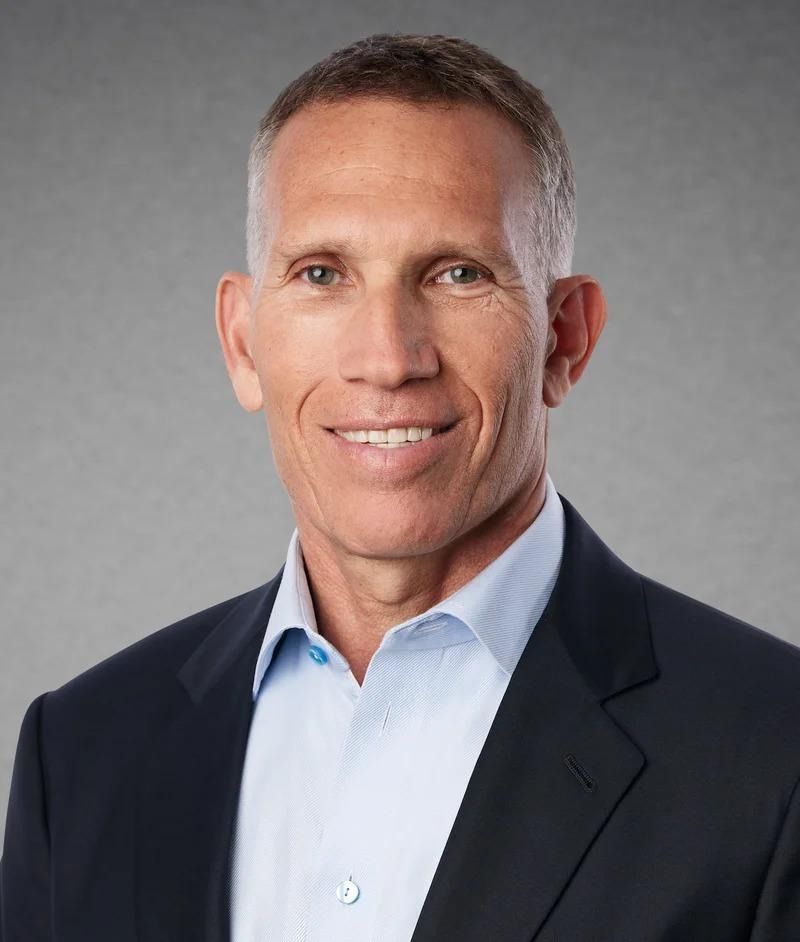
Kreiz has led Mattel since 2018, expanding the toy company’s brands into film and other entertainment businesses. Warner Bros.’ Barbie, based on Mattel’s flagship property, generated more than $1.4 billion worldwide in 2023. Masters of the Universe, released in June this year, was a box-office disappointment.
His strategy has centered on properties that already have an audience and can support multiple businesses. In 2024, Kreiz said Mattel’s entertainment approach was “ultimately about big brands, franchises that move the market, with built-in fan bases.” Before Mattel, he ran Maker Studios, a major YouTube multichannel network, and independent television producer Endemol Group.
Mattel announced that Kreiz would step down on October 2 and that former Condé Nast CEO Roger Lynch would succeed him as chairman and CEO. Lynch’s chairmanship takes effect on October 2, with his CEO appointment effective on or before November 2. Mattel director Judy Olian said: “Ynon leaves an invaluable legacy of transitioning Mattel from a toy manufacturer to a leading IP-driven play and family entertainment company.” Mattel shares had fallen more than 24% over the preceding 12 months and declined 4% on the day Kreiz’s departure was announced.
At Paramount, the senior operating position had remained vacant since Jeff Shell’s exit in April. Ellison appointed the former NBCUniversal CEO as president when the Paramount acquisition closed in August 2025. Shell stepped down as president and a director on April 8 after becoming embroiled in a $150 million lawsuit brought by professional gambler Robert Cipriani.
The lawsuit alleged that Shell had shared sensitive information relating to the Paramount acquisition. The dispute was later settled. The Hollywood Reporter reported that Kreiz would provide operational leadership alongside Ellison, whose background is in creative production. The appointment therefore goes beyond filling a vacancy: it places responsibility for a large integration at co-CEO level.
Holland’s departure points to an HBO-led streaming business
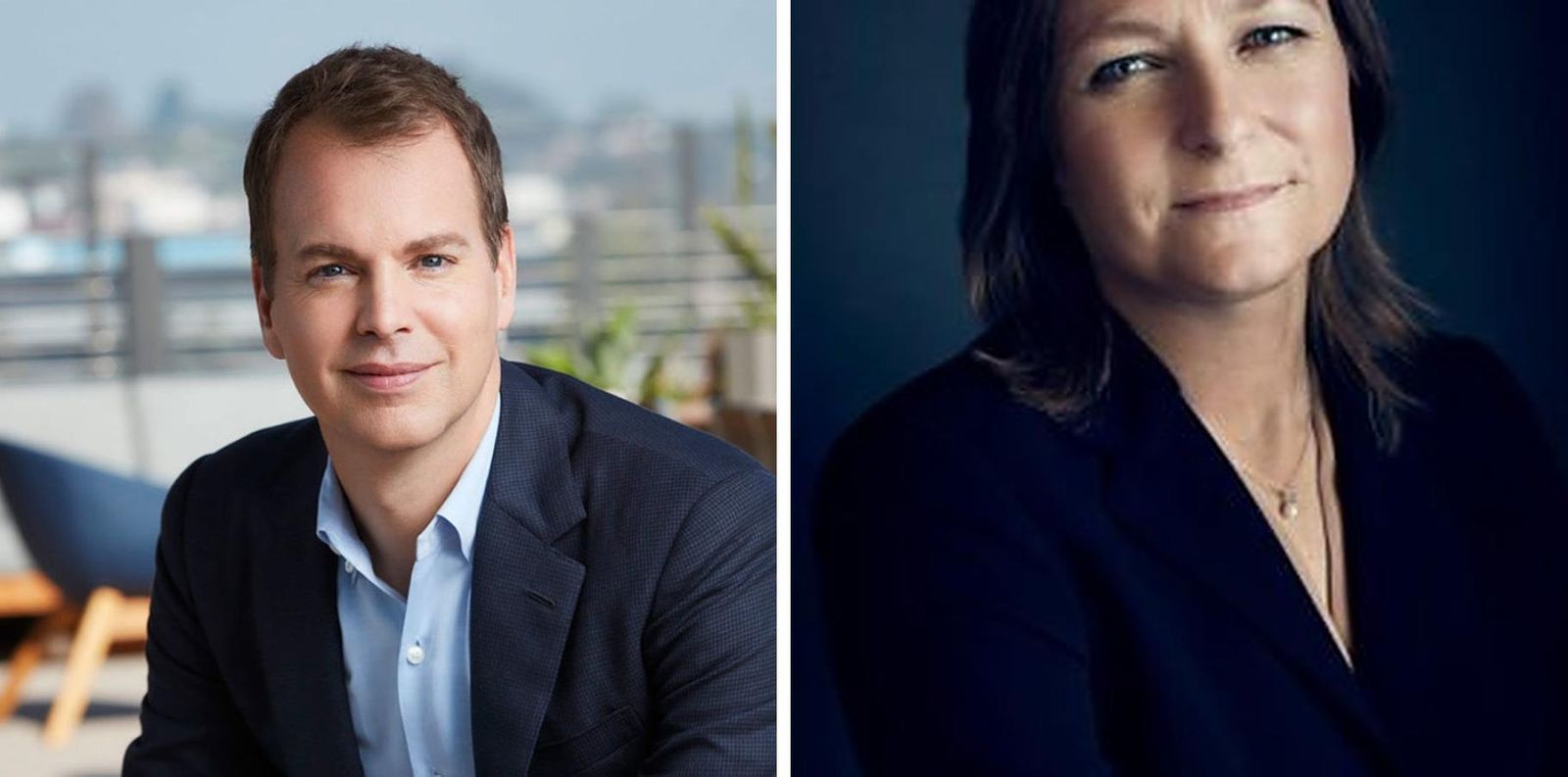
Cindy Holland left her role as Paramount’s streaming chief on September 29, a day before the Kreiz announcement. Variety reported that HBO chairman and CEO Casey Bloys was likely to oversee the entire streaming business after the merger, including Paramount+ and HBO Max. Bloys’ appointment has not yet been formally announced.
In her farewell memo, Holland wrote: “As David readies for the next phase of his vision, we’ve discussed my role and the future of the combined businesses. David is optimizing for HBO stability as we move into this next chapter, and I fully support that.” She said the team had the leadership and expertise to manage the transition and that “today will mark my last day here.” The memo did not name Bloys. Ellison described Holland as “one of the most exceptional executives in our industry.”
An HBO-led structure would be consistent with the position Ellison outlined after reaching the acquisition agreement. At an investor presentation on March 2, he said HBO should retain its identity and emphasized the strength of its brand. He described HBO as a central asset of the business and pledged the resources and independence it needed to continue doing what it does best.
The consumer-facing services, however, are intended to become one. “We do plan to put the two services together, which today gives us a little over 200 million direct-to-consumer subscribers,” Ellison said. The approach would preserve HBO’s identity as a content brand while combining the services and their technology. The combined service does not yet have an announced name.
Holland spent 18 years at Netflix, including nine as vice president of original content. She led teams behind House of Cards, Stranger Things, The Crown and The Queen’s Gambit. In her memo, she said the goals established when she joined Ellison’s team in January 2025 were to advise on the WBD acquisition, integrate and transform Paramount+ while reviving Pluto TV, and build an exceptional team. “In just over 12 months, I’m proud to say we accomplished all three,” she wrote.
Some of the technical groundwork is already in place. Paramount moved its free ad-supported streaming television service Pluto TV, BET+ and Paramount+ onto a common technology platform. The Next Web characterized the work as preparation for the eventual integration of HBO Max.
Bloys’ remit and Perrette’s role remain in focus
Bloys joined HBO in 2004 as a director in its independent productions division. He became president of HBO’s series, late-night and specials programming in 2016, chief content officer of HBO and HBO Max in 2020, and chairman and CEO in 2022. HBO has already passed through AT&T’s acquisition of Time Warner in 2018 and the WarnerMedia-Discovery merger in 2022. Completion of the Paramount deal would bring another change of parent company.
Bloys’ HBO contract is due to expire in 2027. On March 23, he had lunch with Netflix co-CEO Ted Sarandos at a Hollywood restaurant. The Daily Beast, citing Page Six, reported that both companies confirmed the meeting. The meeting alone does not establish that a move or a decision about his future was under consideration.
The operating structure of the combined streaming business remains unsettled. Variety also reported speculation that JB Perrette, who oversees WBD’s streaming operations and games, could work with Bloys to lead HBO, HBO Max and Paramount+. Other divisional appointments have yet to be formally announced.
A subscriber base above 200 million, with improving profitability
Both streaming businesses have been increasing subscribers and improving profitability ahead of the integration. In its first-quarter shareholder letter, released in May, WBD reported a streaming subscriber base above 140 million and a year-end target of 150 million.
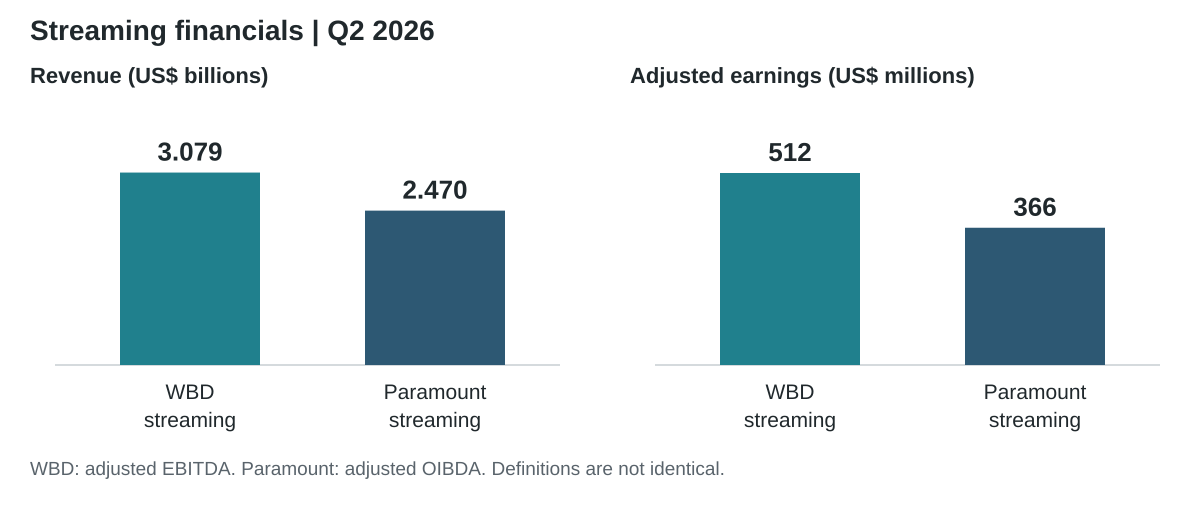
WBD’s second-quarter streaming revenue, announced on August 6, was $3.079 billion, up 10% excluding foreign-exchange effects. Adjusted EBITDA increased 63% to $512 million. Advertising revenue was $306 million, and approximately 40% of subscribers were on an ad-supported plan.
Paramount+ ended the second quarter with 81.6 million subscribers, an increase of 2 million from the previous quarter. Paramount’s streaming division generated $2.47 billion in revenue, up 9%, while adjusted OIBDA rose 44% to $366 million. Churn was at its lowest level since launch, although the company forecast that third-quarter Paramount+ subscribers would remain broadly flat sequentially.
Using the reported revenue and adjusted earnings figures produces a margin of approximately 17% for WBD streaming and 15% for Paramount streaming. These are not identical accounting measures: WBD reports adjusted EBITDA, while Paramount reports adjusted OIBDA. The percentages should therefore be read as an indicative comparison, not a fully like-for-like measure.
Under Holland, Paramount+ greenlit more than 40 new and returning series. Landman became its most-watched series, while Dutton Ranch set a record for an original series debut. In sports, Paramount signed a seven-year, $7.7 billion UFC rights agreement with TKO in August 2025. UFC Freedom 250 drew the largest audience for a Paramount+-exclusive live event.
Adding the two subscriber totals does not establish how many unique customers the combined service would have. Customers subscribing to both services would need to be counted only once, and the figures cited here cover different reporting dates. The eventual customer base will also depend on how duplicate accounts, bundles and plan migrations are handled.
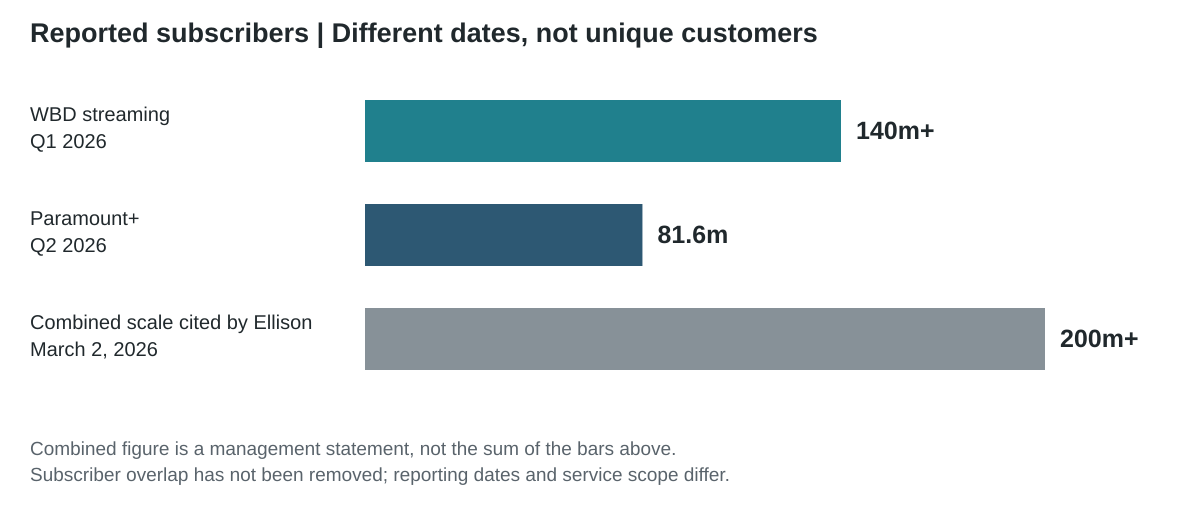
Subscriber figures reported at different dates. The combined figure is Ellison’s March 2 statement, not a deduplicated total or a calculation from the other two bars. Sources: WBD, Paramount and NewscastStudio.
Court approval remains a closing hurdle
Paramount agreed to acquire WBD on February 27 for $31 a share in cash. The process included a hostile approach, a competing bid from Netflix, and litigation involving 12 states and Hollywood writers. WBD shareholders approved the transaction on April 23. The U.S. Justice Department approved it on June 12, followed by the European Commission on July 22.
On September 21, Paramount reached a settlement with 12 states led by California Attorney General Rob Bonta. The settlement terms call for 30 theatrical releases annually for the first two years after closing and 32 annually for the following three years. They also require at least $300 million a year in additional U.S. television and film production spending over five years, alongside editorial independence committees at CBS and CNN.
Judge Araceli Martínez-Olguín of the U.S. District Court for the Northern District of California deferred a decision on the settlement at a September 24 hearing. Senator Cory Booker, the Block the Merger coalition and the Latino civil rights organization LULAC were among those opposing the agreement.
A delay carries a financial cost. Forbes reported that Paramount would owe WBD $7 million a day if the transaction did not close by October 1. Ellison expected closing within two weeks of the hearing, but the timetable remained dependent on the court process and other closing requirements. Kreiz’s co-CEO appointment likewise takes effect upon closing.
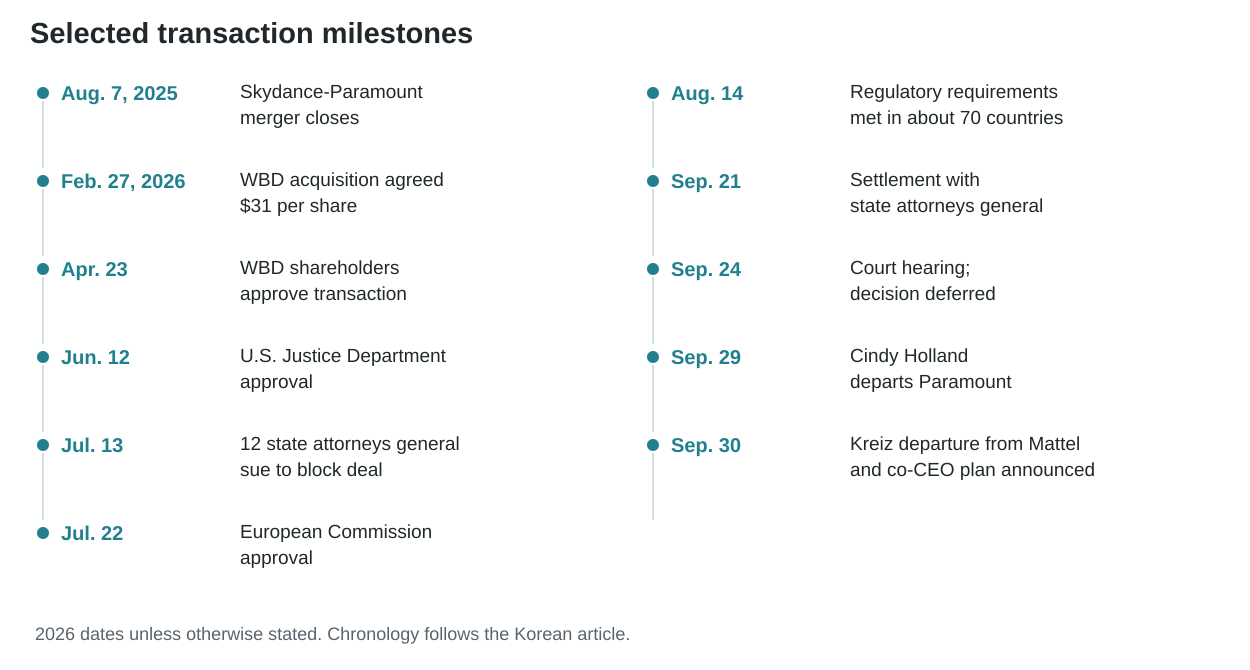
Selected milestones in the Paramount-WBD transaction, as described in the Korean article. Sources: company announcements and reporting cited in the text.
Greenfield: the services need substantially more content
The strategic question is what happens after scale has been achieved. On the September 30 episode of Business Insider chief correspondent Peter Kafka’s Channels podcast, LightShed Partners analyst Rich Greenfield said: “They have their laser sight on Netflix. They want to be Netflix.” In his view, buying Warner Bros. offered Paramount a faster route to Netflix’s scale and importance than investing solely in its existing business.
Greenfield also questioned how the services would be combined. “Is it all one? Do they raise the price to accommodate all of the HBO content? Do they keep the HBO brand?” he asked. Pointing to the concentration of Paramount+ viewing around Taylor Sheridan shows and children’s programming such as SpongeBob SquarePants, he said: “But if everyone is watching the same thing, it’s very hard to train an algorithm.”
“There isn’t that much diversity on Paramount Plus. There isn’t that much on HBO Max either,” Greenfield said. He argued that “both of these streaming services are undernourished and need a lot more content to win engagement and time spent per day.” Owning major hits is not the same as consistently serving a wide range of tastes. Simply combining two catalogs may not be enough to generate the viewing time and return visits the business needs.
Greenfield also discussed the potential for generative AI to change the cost of supplying video. He said near-instant generation of a minute of video already existed in laboratory settings, and estimated that mass deployment could become economically feasible “within the next 12 to 18 months.” That is his forecast, not an established timetable for commercial adoption.
His proposed answer is to operate as a platform for outside content. “If you’re trying to win, you’re going to have to be a platform. I don’t think any of these companies are going to be able to create enough content on their own,” he said. He also argued that, from a child’s viewing perspective, 30 minutes of a Sheridan series costing $30 million an episode competes with 30 minutes of creator-made video.
Kreiz has experience on that side of the business. Maker Studios aggregated YouTube channels and sold advertising and brand partnerships, and he negotiated its sale to Disney. That background, however, should not be mistaken for an announced strategy. The combined company has not set out how it might incorporate creator video or other externally produced programming.
In Korea, Coupang Play distributes while CJ ENM produces and partners
Both companies have relied on Korean partners rather than launching all their services directly in the market. WBD said in its first-quarter update that HBO Max had reached its major target markets following launches in the United Kingdom, Germany and Italy. It had not launched a standalone service in South Korea.
Wavve carried HBO programming exclusively in Korea from 2021 until its agreement ended in mid-2023. Coupang Play began exclusively offering more than 60 HBO and HBO Max original titles on March 21, 2025. Paramount+ entered Korea through a branded hub on TVING in June 2022, but closed that hub on June 18, 2024, while Paramount’s sale negotiations were under way. It has been available as an add-on service through Coupang Play since October 29, 2025.
CJ ENM has worked with both companies on production and international distribution. It signed an investment and production partnership with ViacomCBS, now Paramount, in 2021. The relationship included co-production plans for A Bloody Lucky Day and Queen Woo and distribution through Paramount+ across 27 countries.
CJ ENM signed a multiyear strategic partnership with WBD on October 16, 2025. The agreement established a TVING-branded hub on HBO Max in 17 Asia-Pacific markets and provided for joint investment in and production of Korean dramas. Perrette represented WBD in the announcement.
The TVING hub includes programming from MBC and JTBC as well as tvN. Dear X, one of its initial titles, was reported to have ranked first in 108 countries on the separate distribution platform Rakuten Viki. The publicly announced partnerships involve co-production and branded content hubs. Individual IP ownership arrangements and ancillary rights have not been fully disclosed, so the term “co-production” alone does not establish which rights a Korean producer retains.
One Sheridan episode can cost as much as a Korean drama season
Production economics help explain why Korean programming could be relevant to a combined service seeking more content. The $30 million per episode figure Greenfield cited for a Sheridan series is equivalent to approximately KRW40.7 billion. It should not be treated as an average for all American television dramas.
The Korean article’s cost comparison puts average Korean drama budgets in the KRW2 billion-plus range per episode. For a 16-episode series, that implies approximately KRW32 billion to KRW46 billion, broadly comparable to the cited cost of one high-budget Sheridan episode. In a July 4 column for Hankyoreh, Kim Yoon-ji, a senior researcher at the Export-Import Bank of Korea’s overseas economic research institute, put U.S. broadcast and cable drama costs at a minimum of $5 million an episode. She argued that even some of Korea’s largest total production budgets amounted to only one or two episodes of a U.S. production.
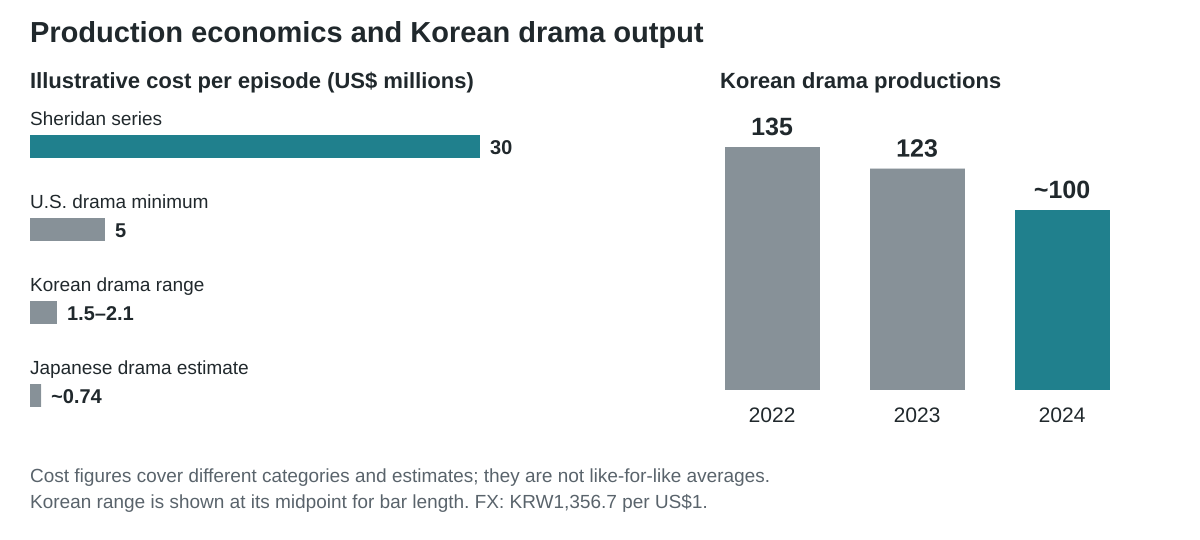
Illustrative production-cost comparisons and the decline in Korean drama output. The figures describe different production categories, not a like-for-like global average. Sources: Business Insider, Hankyoreh and Invest Chosun.
If Greenfield’s assessment of the services as undernourished is right, the combined business needs more than a handful of flagship titles. It needs programming that serves a wider range of viewers. Korean drama could be one way to increase programming volume relative to production spending, although a lower price alone does not determine a purchase. Audience demand and title-level performance still have to support the economics.
Netflix has already committed substantial investment to Korean content. In 2023, Sarandos announced a four-year, $2.5 billion commitment, equivalent at the time to approximately KRW3.3 trillion. He also said more than 60% of Netflix members worldwide watched Korean content.
Korean production output, meanwhile, has been contracting. According to Invest Chosun, the number of dramas produced fell from 135 in 2022 to 123 in 2023 and approximately 100 in 2024. Big-budget titles continued to become more expensive, with reported budgets of KRW70 billion for Disney+’s Tempest, KRW65 billion for Moving and KRW50 billion for Netflix’s When Life Gives You Tangerines. The same report put Japanese drama costs at approximately KRW1 billion an episode, below Korean levels.
Those trends cut in different directions for Korean suppliers. Fewer buyers can weaken negotiating leverage, but a smaller supply of competitive titles can increase the value of individual properties. Conversely, buyers may turn to less expensive alternatives from Japan or other markets. The key is not simply how many dramas Korea produces, but whether suppliers can deliver the titles a platform needs at an acceptable price and on a reliable schedule.
U.S. production commitments do not guarantee Korean acquisitions
Paramount’s settlement with the 12 states requires at least $300 million a year in additional U.S. film and television production spending over five years. The reported terms do not separately guarantee budgets for overseas productions or acquisitions of foreign programming. A commitment to spend more in the United States is therefore not a commitment to buy more Korean content.
In March, Ellison supported a $6 billion merger-synergy target and identified corporate overhead, the integration of HBO Max and Paramount+ technology, and cloud operations as sources of savings. “We aim to integrate HBO Max and Paramount+, which will lead to a simplification of our technology infrastructure. There are significant savings to be realized here, as well as in our cloud operations,” he said. He did not identify content-budget reductions as a savings category in that explanation.
International acquisitions remain a matter for management’s programming and budget decisions. If the priority is to add variety and volume quickly, the company could expand finished-program acquisitions and co-productions. If integration costs and profitability pressures dominate, it could delay purchases or reduce commitments. Korean suppliers should therefore pay more attention to actual acquisition budgets and commissioning plans than to the headline synergy target.
Buying rights, or buying the IP?
The structure of the contract is another important variable for Korean producers. Netflix’s practice of financing Korean originals while securing IP rights has prompted debate over producers’ participation in downstream revenue. When asked about the issue in 2023, Sarandos said creators and producers received industry-leading compensation.
Kreiz has negotiated from the IP owner’s side of the table. Mattel retained the Barbie property while working with Warner Bros. on the film, partnered with Amazon on Masters of the Universe, and worked with Apple on Matchbox. His emphasis on major brands, franchises and established fan bases reflects an approach that extends beyond the success of one production to sequels, consumer products and other media.
That experience does not automatically favor Korean suppliers. Kreiz may be familiar with co-production structures that share rights with an IP owner. Equally, the combined company may seek to own promising properties it believes can become long-term franchises. The perspective from which he negotiated at Mattel and the rights he may seek at Paramount are separate questions.
CJ ENM’s existing relationships with Paramount and WBD already provide frameworks for co-production and branded-hub distribution. Korean broadcasters and producers can build on those arrangements, but should decide title by title whether to sell exhibition rights, share investment and ownership, or consider an IP transfer. Unresolved ownership of underlying rights and ancillary rights between a broadcaster and a producer can constrain an international negotiation.
Korean broadcasters need a supply proposition and a rights strategy
For Korea’s broadcasting and media industry, the merger is more than a change in the number of buyers. Combining acquisition teams can change the people who receive pitches, the programming criteria they apply and the terms they offer. Suppliers need to be ready to discuss not only the price of an individual title but also season-level commitments, delivery schedules and the potential for follow-up seasons.
Distribution channels matter as well. MBC and JTBC programming already reaches HBO Max’s Asian markets through CJ ENM’s TVING hub. If the hub expands into other territories on the combined service, participating broadcasters could gain wider reach. At the same time, a larger share of their business could depend on CJ ENM rather than direct sales. Territory-by-territory exclusivity, revenue settlement and the retention of direct-sales rights will require attention. Individual pricing and contract structures are not public and should not be assumed to be uniform.
The merger could also affect Coupang Play’s competitive position in Korea. The service carries both HBO programming and Paramount+. Whether the combined owner continues licensing and local partnerships or eventually launches directly will matter to Coupang Play’s access to overseas content.
IGAWorks’ Mobile Index June figures put TVING at 9.69 million monthly users and Coupang Play at 8.85 million. Coupang Play lost 260,000 users as the European football season ended. Given the fluctuations associated with sports calendars, reliable access to imported drama can be one element in encouraging repeat visits and sustained usage. That makes the combined company’s Korean strategy and future renewal terms worth watching.
Broadcast clips, short-form video and creator programming may also become relevant. YouTube’s average monthly usage time in Korea reached 113.6 billion minutes during January-May 2026, more than 20 times Netflix’s 5.61 billion minutes. If the broader embrace of third-party content advocated by Greenfield becomes an actual business strategy, suppliers could find opportunities beyond completed drama series. That remains a scenario rather than an announced initiative.
To prepare, broadcasters need to distinguish full-program exhibition rights from international rights to clips and short-form derivatives. They also need to check whether performer agreements, music licenses and archive-footage permissions cover such reuse. Where those rights have not been secured, separate negotiations or contract amendments may be necessary.
The first slate will reveal the Korean-content strategy
Once the court approves the settlement and the transaction closes, Kreiz’s co-CEO role takes effect. The streaming leadership structure, including Bloys’ remit and Perrette’s position, may become clearer around that point. Reported expectations about appointments should still be distinguished from formal announcements.
At service level, the unanswered questions include branding, pricing, duplicate subscriptions, Pluto TV’s position and how sports rights such as UFC will be packaged. On the content side, the business must preserve HBO’s identity while winning more of viewers’ time. It will need both the ability to create premium programming and the ability to maintain a broad, consistent supply of content.
Korean companies should watch three decisions: whether the combined business buys exhibition rights or seeks IP ownership; how far it expands its branded-hub relationship with CJ ENM; and whether it retains local partnerships in Korea or enters the market directly. Each choice would affect producers, broadcasters and domestic platforms differently.
The merger alone does not guarantee a wider market for Korean programming. But if the larger service needs a more diverse catalog, suppliers with competitive titles and clearly established rights could gain an opening. Acquisition budgets, the first programming slate and actual contract terms will show whether that opportunity is real.
Editorial note: This English edition follows the reporting date and scope of the Korean article. Major English-language quotations were checked against accessible original reporting; where original wording could not be confirmed, statements are rendered as indirect speech. It is not a comprehensive new fact-check of every figure or development. Currency comparisons retain the Korean article’s September 29 exchange rate of KRW1,356.7 per U.S. dollar. Subscriber dates and adjusted earnings definitions differ, as noted in the text and charts.