
K-ENTERTECH HUB | STREAMING EARNINGS
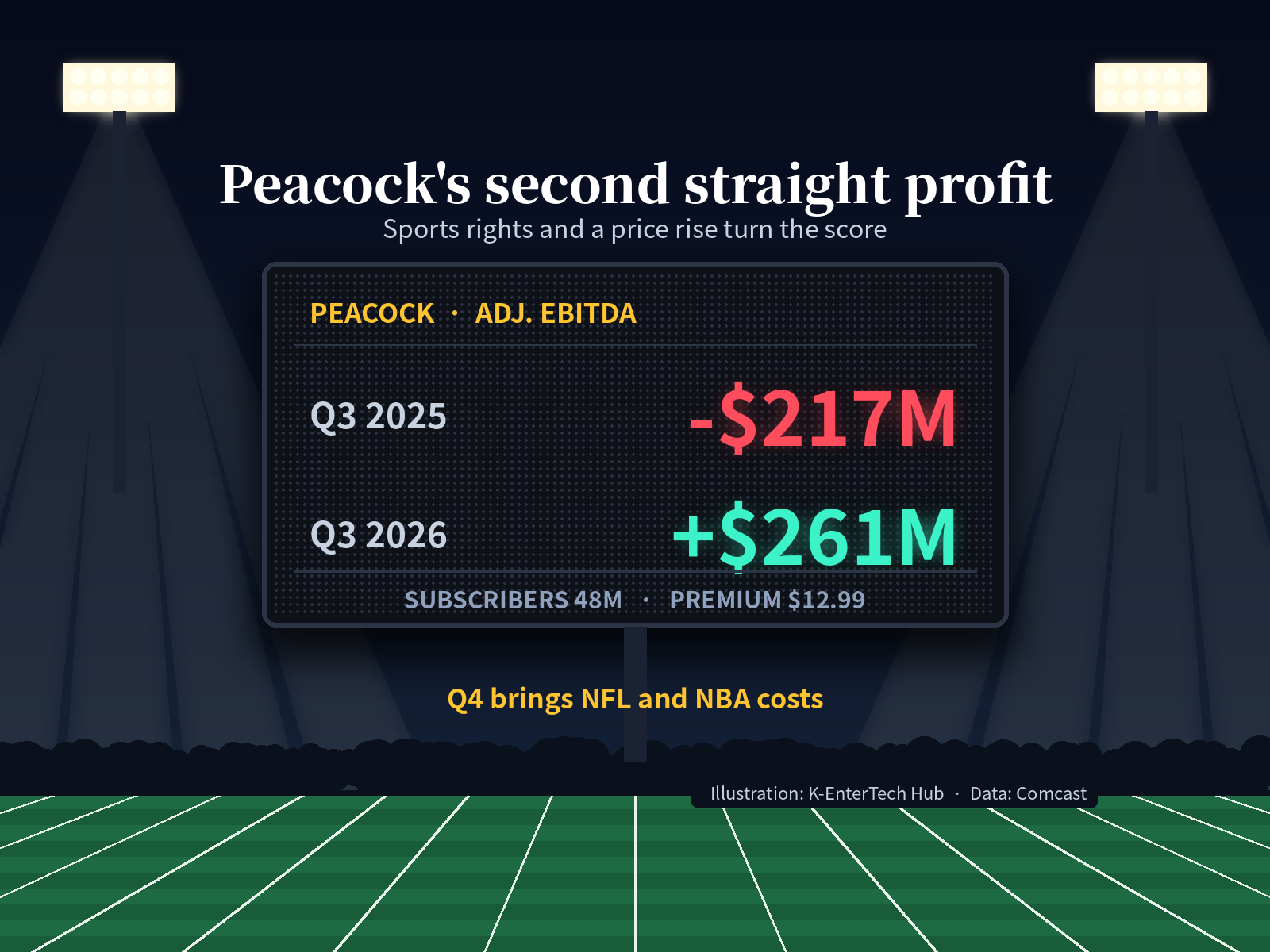
$261 million in third-quarter adjusted EBITDA as revenue climbs 34% with subscribers flat at 48 million; Comcast cuts cable jobs and books a charge of more than $1 billion ahead of the NBCUniversal spin-off
Peacock, Comcast's streaming service, turned a profit for a second straight quarter. Comcast reported third-quarter results on Thursday, showing Peacock with $261 million in adjusted EBITDA against a $217 million loss a year earlier. Revenue rose 34% to $1.8 billion from $1.4 billion.
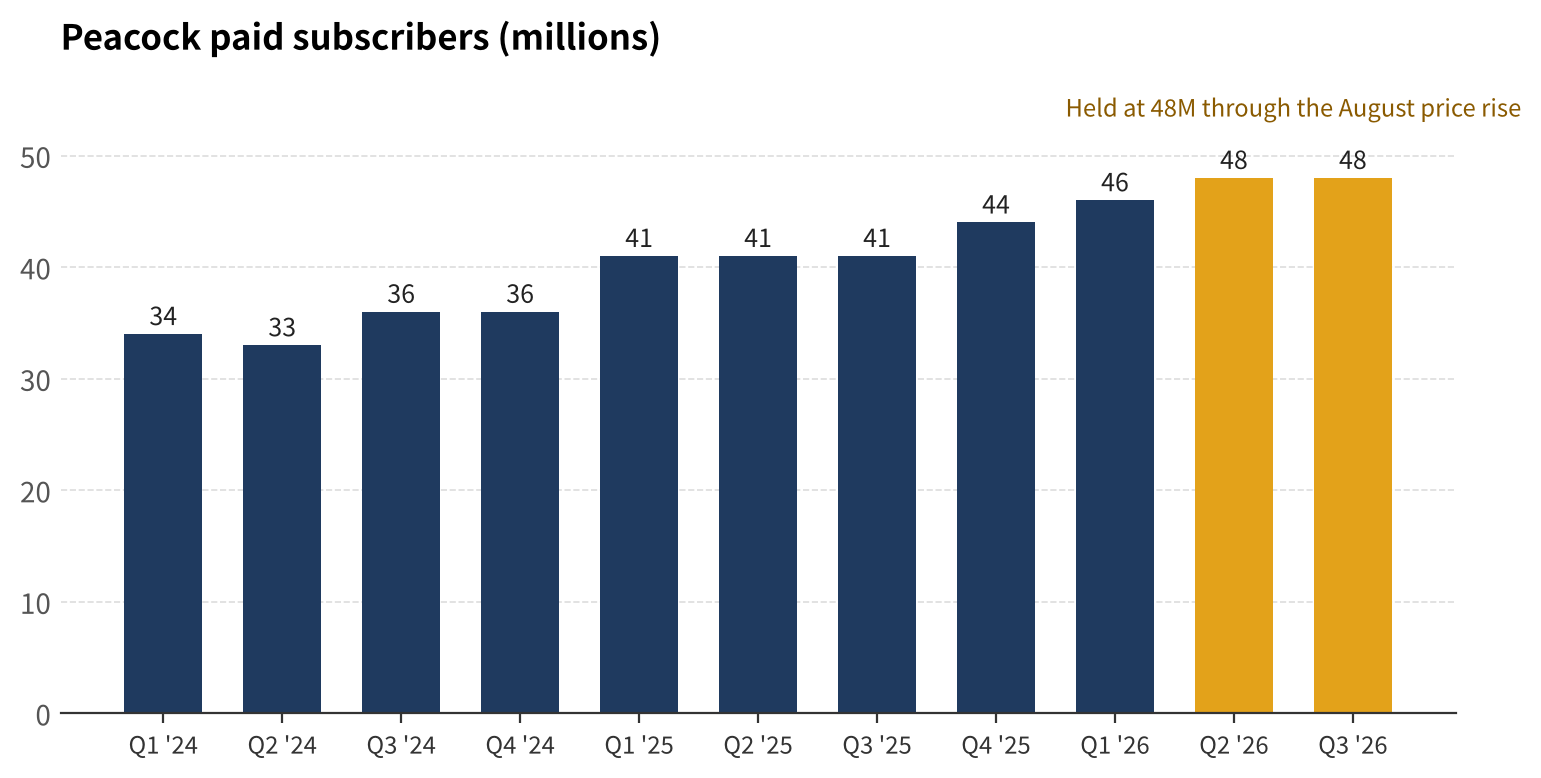
The gain came from what each subscriber pays rather than from more subscribers. Paid subscribers were 48 million, unchanged from the second quarter and up 7 million, or 17%, from a year ago. Peacock raised the price of every plan by $1 to $3 on Aug. 18. Comcast said domestic distribution revenue rose on higher average rates and more paid subscribers, while Peacock's programming costs fell. Dividing quarterly revenue by subscribers gives roughly $12.50 a month per subscriber, about 10% more than the $11.40 of a year earlier.
Peacock launched in July 2020. Between the first quarter of 2023 and the first quarter of this year it lost a combined $6.06 billion in adjusted EBITDA over 13 straight quarters, with the loss widening to $552 million in the fourth quarter of 2025 when NBA rights costs began. On Thursday's analyst call, Comcast co-CEO Mike Cavanagh cautioned that "the quarters ahead can get lumpy, depending on when rates kick in for different properties," according to The Hollywood Reporter.
Comcast's next growth lever is distribution through other companies' subscriptions. Starting early next year, U.S. YouTube Premium members get Peacock Premium at no extra cost. "We are interested in doing this with others as well," Cavanagh said, adding that the company wants such bundles to be "additive to the business." The parent company also said it will take a charge of more than $1 billion in the fourth quarter as it prepares to spin off NBCUniversal, Variety reported. The job cuts will fall on cable, broadband and wireless, not NBCU. "We are fundamentally redesigning our organization," CFO Jason Armstrong said.
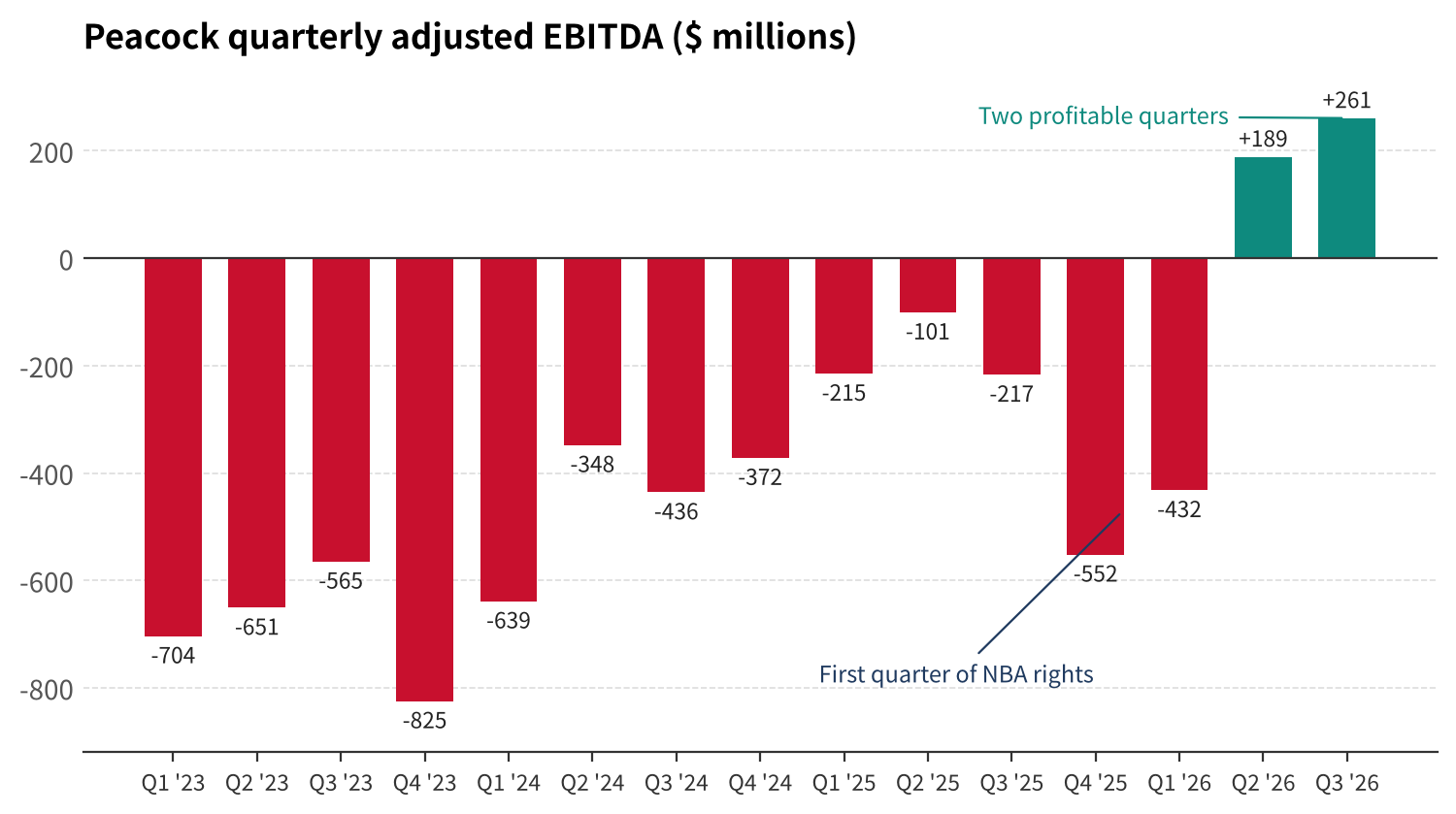
Peacock lost money for 13 straight quarters from early 2023 before turning profitable in the second quarter of 2026. Source: Comcast quarterly filings
Media profit up more than $500 million as Peacock leads
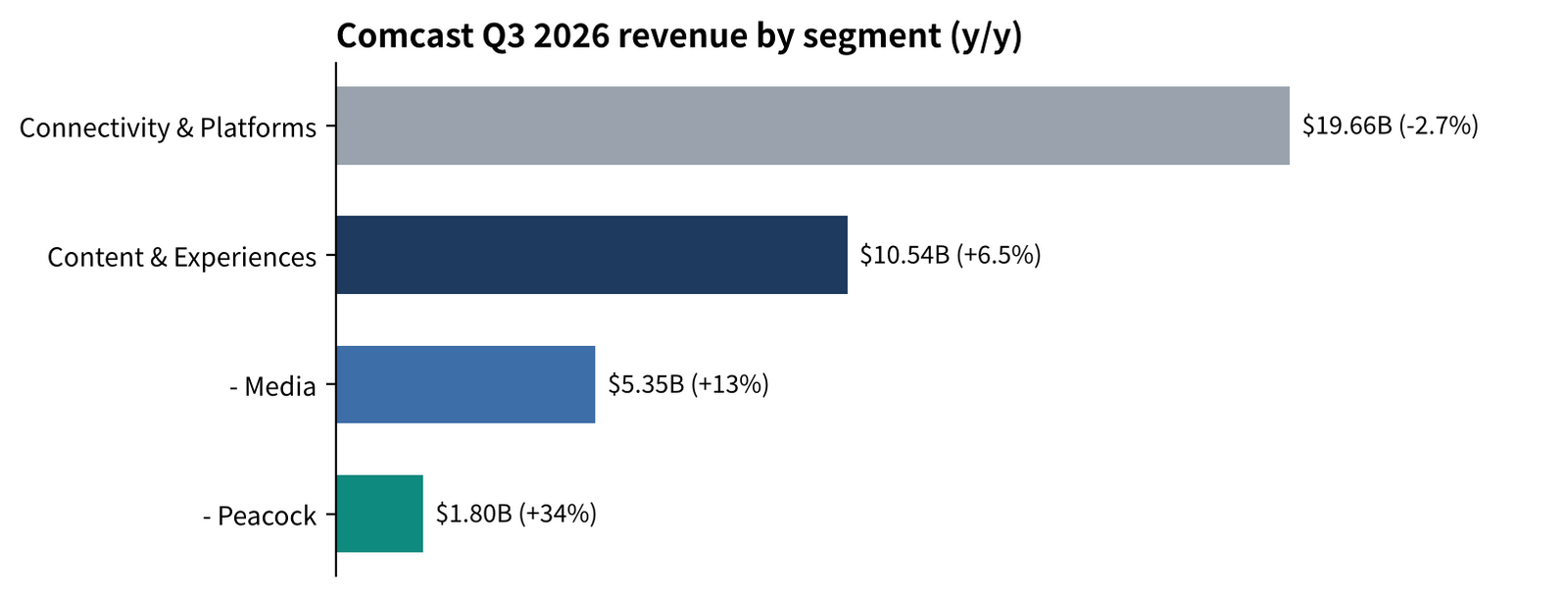
Peacock sits inside the Media business of Comcast's Content & Experiences segment. Media revenue rose 13% to $5.35 billion and adjusted EBITDA increased by more than $500 million to $769 million; executives said on the call that Peacock was the primary driver. Content & Experiences revenue grew 6.5% to $10.54 billion, with adjusted EBITDA up 29% to $1.8 billion.
The profit came from distribution more than advertising. Excluding the World Cup, domestic advertising revenue was flat because Peacock's gains were offset by lower ad revenue at NBCU's networks. Domestic distribution revenue rose on Peacock's higher rates and subscriber count, and programming costs fell at Peacock and the international networks, partly offset by World Cup costs.
Studios revenue slipped 1.1% to $2.96 billion, with adjusted EBITDA of $402 million. Christopher Nolan's "The Odyssey" became Universal's highest-grossing film ever and pushed the studio past $5 billion at the global box office this year; "Minions & Monsters" and Focus Features' horror film "Obsession" also contributed in the quarter.
World Cup adds $664 million in incremental advertising over two quarters
The World Cup carried the first profitable quarter. According to The Hollywood Reporter, the tournament contributed $440 million in incremental media revenue in the second quarter. With the final games airing on Telemundo and Peacock in the opening days of the third quarter, it added another $224 million of incremental advertising, for $664 million across both periods. Comcast noted that Peacock's third-quarter figures include World Cup amounts.
Viewing moved the same way. In Nielsen's July Gauge, Peacock took 2.6% of all U.S. TV time, up 0.3 points from June, as its viewing rose 15% in a month; June's share was 2.3%. NBCU-Versant ranked second among media distributors at 9.2%, behind YouTube's 14.2%.
The fourth quarter has no World Cup, but it carries the NFL regular season and the second season of NBA rights. On the second-quarter call, executives warned that profitability would vary with the timing of sports schedules and releases.
Prices up as much as $3 a month; subscribers hold at 48 million
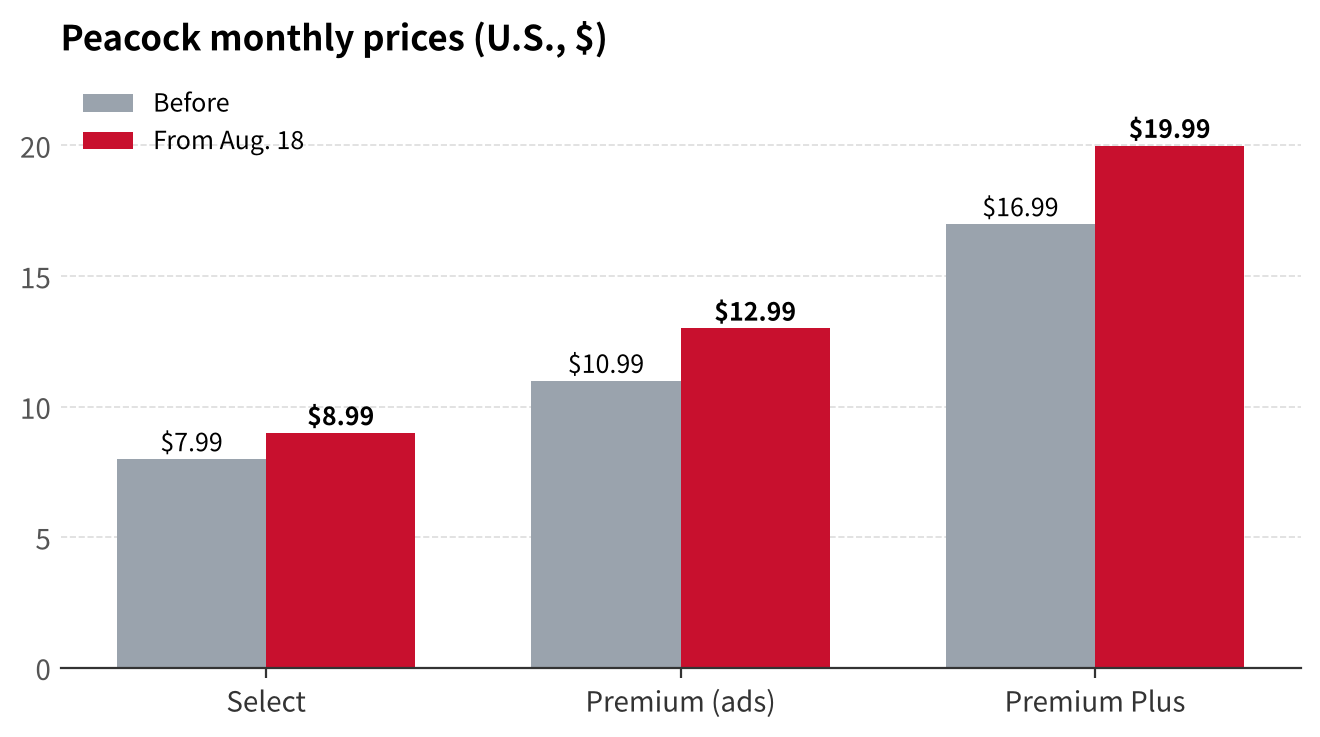
Peacock raised all three plans on Aug. 18. Per TVLine, the ad-supported Premium tier went from $10.99 to $12.99 a month, ad-free Premium Plus from $16.99 to $19.99, and Select from $7.99 to $8.99. Annual plans rose by up to $30. New subscribers paid the higher rates immediately; existing customers moved to them on their first billing date on or after Sept. 17.
It was the fourth increase in four years, Cord Cutters News noted; the previous one, in July 2025, added $3 to both Premium tiers. Señal News pointed out the timing — just before the Premier League kickoff, weeks before the NFL regular season and two months before the NBA tipped off — a stretch in which live sports keep subscribers from leaving.
On the call, management said paid subscribers "remained stable sequentially, demonstrating strong retention even as we began implementing a price increase earlier in the quarter."
Pricing is doing the work across the sector. Netflix on Oct. 20 reported third-quarter revenue of $12.87 billion and a 34.6% operating margin. The difference is that Peacock is pushing its increases through on the strength of sports rights rather than a global subscriber base.
YouTube Premium bundle — and subscribers who count before they sign in
NBCU and YouTube announced a multiyear global partnership on July 26. Its centerpiece puts ad-supported Peacock Premium inside U.S. YouTube Premium at no extra charge from early 2027, which NBCU called Peacock's largest wholesale distribution deal to date, StreamTV Insider reported. The agreement also renews YouTube TV's carriage of NBCU networks, makes NBC Sports a production partner for select live events on YouTube, deepens ad-tech work through FreeWheel, expands Universal+ and Hayu internationally, and widens YouTube's distribution on Comcast's Xfinity and Xumo.
LightShed Partners analyst Richard Greenfield told MediaPost that NBCU believes only a small fraction of U.S. YouTube Premium members already take Peacock, so the deal "should add millions of subscribers." The same article put U.S. YouTube Premium at an estimated 20 million to 22 million subscribers. YouTube Premium costs $15.99 a month.
How fast those subscribers appear depends on how Comcast counts them. Its second-quarter 10-Q says partner-sold subscribers are counted under the terms of each arrangement: some when they activate an account, others when Peacock is made available as part of a bundle, whether or not they activate it. Once the YouTube bundle starts, the subscriber count can jump while revenue per subscriber falls toward the wholesale rate — a different metric from the one that drove this quarter's profit.
NBCU and Sky to split off by mid-2027, with Cavanagh in charge
Comcast said on June 29 that it would spin off NBCUniversal and Sky in a tax-free transaction. Cavanagh will run the standalone NBCU; Michael Angelakis, Comcast's former CFO and head of investment firm Atairos Group since 2015, will become CEO of the remaining Comcast. The separation of most cable networks (excluding Bravo) into Versant closed in January.
On Thursday, Cavanagh said the spin-off remains on track for mid-2027, CNBC reported. "While there is still significant work ahead, we have a clear path to completion and remain focused on creating two companies with the strategic flexibility, financial strength and leadership to compete and grow independently," he said. Co-CEO Brian Roberts spoke of employees' "energy and excitement" about the move, Deadline reported, adding that Cavanagh, a former banker with deep M&A experience, is expected to explore a range of options once he runs the new company. Peacock goes into that company as its growth business, with two profitable quarters behind it.
Connectivity revenue down 2.7%; the $1 billion-plus charge includes cable job cuts
The restructuring charge sits on the side of Comcast that stays behind. "We expect to have a significant charge in the fourth quarter related mostly to our transformation efforts, and I would quantify that at over $1 billion," CFO Jason Armstrong said. "We are fundamentally redesigning our organization," he told analysts, according to Deadline. "We've already made important leadership changes across customer experience, growth, and marketing. We're simplifying our organizational structure to move faster, improve execution, and operate more efficiently." He called it a set of "cost actions that'll facilitate a fast start into 2027" rather than "a cost-cutting exercise," Variety's Todd Spangler reported.
Bloomberg first reported the job cuts on Oct. 21. Variety, citing two people familiar with the plans, said the scope is still being set team by team and the cuts target cable, broadband and wireless rather than NBCU; Comcast gave no figure or timing. It had about 179,000 employees at the end of 2025. Last year Comcast elevated Steve Croney to CEO of Connectivity & Platforms and hired former Expedia and Apple executive Jon Gieselman as chief growth officer for its residential business, which has focused on customer service and flexible packages at different price points.
Connectivity & Platforms revenue fell 2.7% to $19.66 billion. Broadband net losses narrowed to 376,000 from 475,000 a year earlier, with wireless and business services offsetting part of the decline. Total Comcast revenue dropped 6% to $29.29 billion, reflecting the Versant separation, while net income rose 3.5% to $3.44 billion. Adjusted earnings per share of $1.07 beat the $0.98 consensus, Investing.com noted.
AI is part of the staffing math. "We've already reduced customer service contact rates by roughly 20% and eliminated more than 30 million service interactions year to date versus the prior year," Armstrong said. On competition, Cavanagh said of satellite broadband such as Starlink: "While satellite is not yet a material factor, we recognize the importance of anticipating emerging forms of competition." Comcast shares rose 4% in late trading Thursday but remain down 18% this year; Charter Communications is down 46%.
In Korea, TVING posts its first quarterly profit
A Korean streaming service has also crossed into profit. TVING (티빙) reported second-quarter revenue of 140.7 billion won ($106 million), up 40%, and operating profit of 6 billion won ($4.5 million), its first quarterly profit since launch. Aju Business Daily (아주경제) attributed it to live content led by professional baseball and rising ad revenue — the same sports-led path Peacock took with the NFL, NBA and World Cup.
User numbers are mixed. Mobile Index (모바일인덱스) put September monthly active users at 15.5 million for Netflix (down 4.3%), 9.99 million for TVING (up 22.6%), 9.2 million for Coupang Play (쿠팡플레이, down 8.6%), 3.98 million for Wavve (웨이브) and 3.73 million for Disney+. iNews24 (아이뉴스24) noted that TVING's jump may include users who opened the app only to claim compensation for a June data breach; MAU counts anyone who launches the app once.
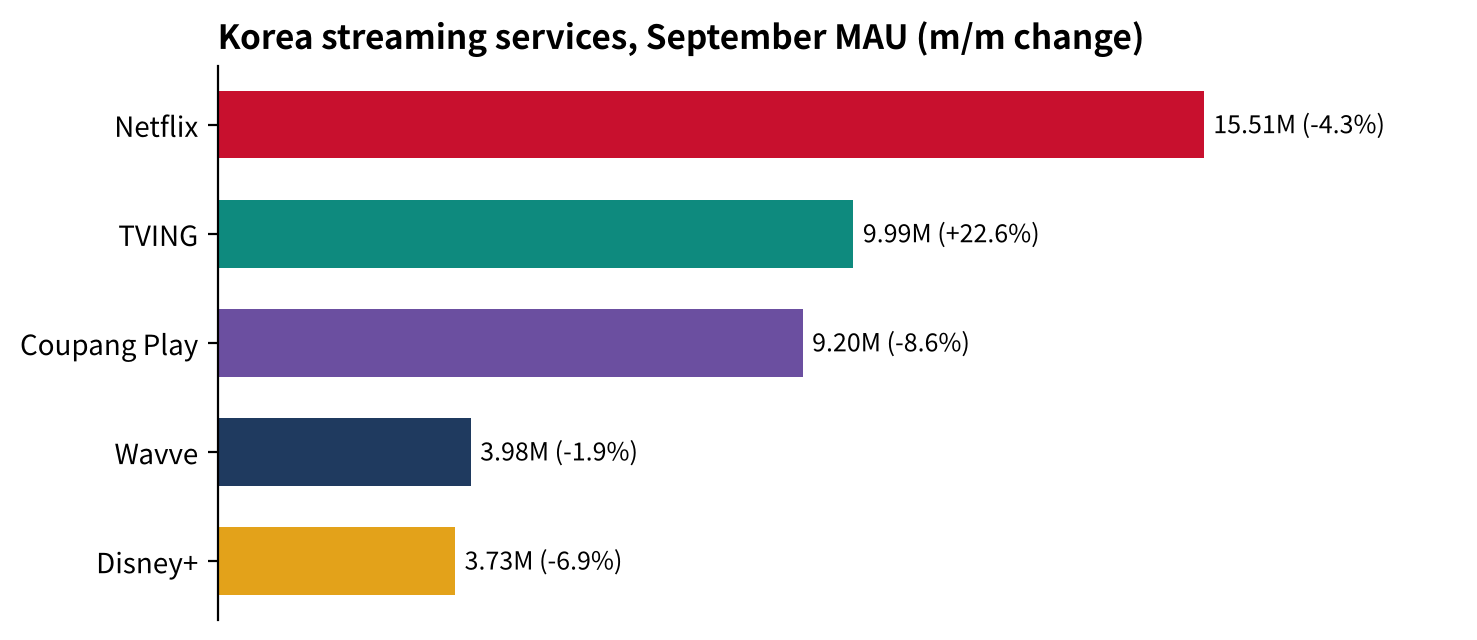
TVING was the only major Korean streaming service to gain users in September. Source: Mobile Index via iNews24
TVING-Wavve price freeze ends this year; merger stalled for three years
The pricing lever Peacock pulled is locked for Korean players until year-end. When the Korea Fair Trade Commission (공정거래위원회) conditionally approved the TVING-Wavve combination on June 10, 2025, it required both to keep current prices through 2026, Byline Network (바이라인네트워크) reported. Their joint Double pass runs from 7,000 won ($5.30) with ads to 19,500 won ($14.70) for Premium; Energy Economy (에너지경제) reported that pricing after this year is undecided.
The merger, agreed in a memorandum in December 2023, is still unresolved. Every shareholder except KT Studio Genie (KT스튜디오지니), TVING's second-largest holder with 13.54%, has agreed; KT has withheld support over the impact on its IPTV business, Herald Business (헤럴드경제) reported. NewsWay (뉴스웨이) said Thursday that differences between KT and CJ ENM still block a shareholder deal.
Peacock timed its increase just before the Premier League, NFL and NBA seasons opened, and its subscriber count held through that stretch. TVING's KBO season ends in October, so if Korean services gain pricing freedom next year, the live schedule they pair a price rise with may decide how many subscribers they lose.
Korea's pay-TV base falls to 36.15 million as cable sheds 156,000
The pressure behind Comcast's cuts is visible in Korea's pay-TV market too. The Korea Communications and Media Commission (방송미디어통신위원회) said on May 29 that pay-TV subscribers totaled 36,150,070 in the second half of 2025, down 76,030 from the first half, Digital Daily (디지털데일리) reported. IPTV rose by 120,735 to 21.54 million, while cable (SO) fell by 155,820 to 11.94 million and satellite by 40,945 to 2.68 million.
KT (케이티) leads with a 25.24% share, followed by SK Broadband's IPTV at 18.51%, LG Uplus at 15.82% and LG HelloVision at 9.38%. KT, the No. 1 pay-TV operator and TVING's second-largest shareholder, is withholding support for the TVING-Wavve merger over its IPTV business. Comcast is splitting its pipes and its content into two companies so each can make its own investment calls; in Korea, a network operator still sits on the shareholder register of a streaming service and sets the pace of change on the content side.
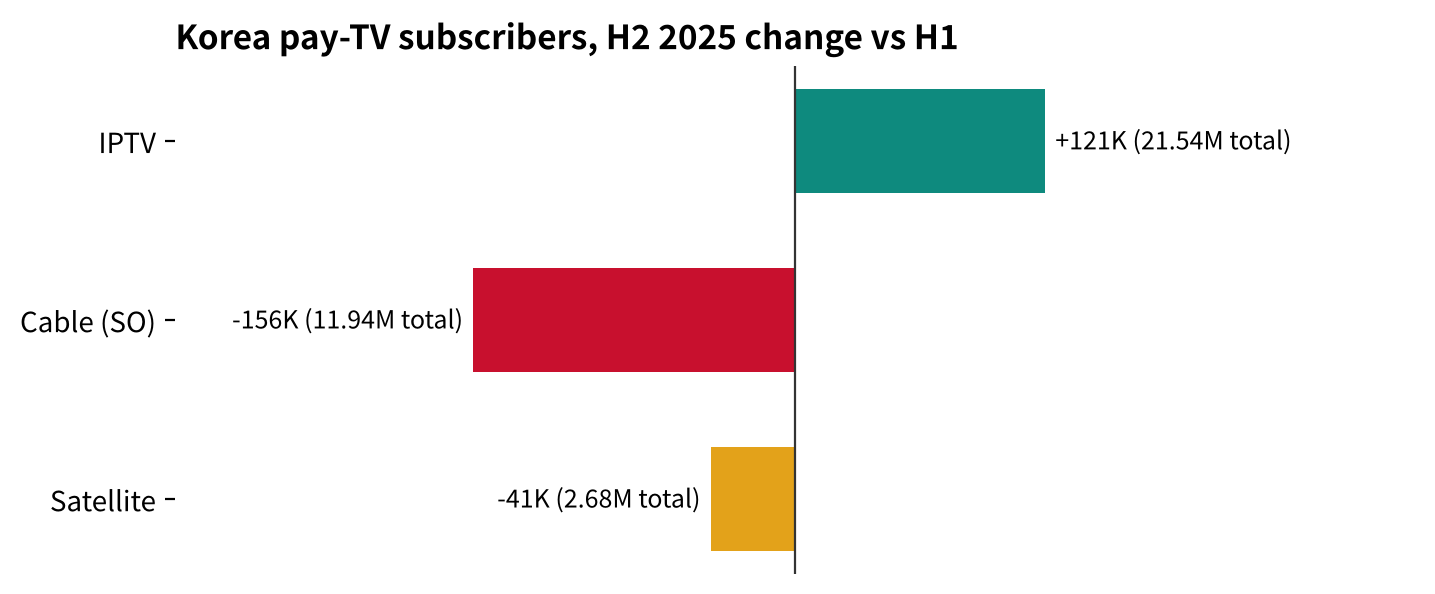
Only IPTV grew in Korea's pay-TV market in the second half of 2025. Source: Korea Communications and Media Commission via Digital Daily
NBC uses its rights on air and on Peacock; Korean broadcasters split the windows
Peacock's profit rests on sports rights bought by broadcast network NBC. "Sunday Night Football" averaged 23.5 million viewers across NBC and Peacock last season and was primetime's No. 1 show for a 15th straight year; the NBA, which began in the fourth quarter of 2025, also airs on both (Comcast Q4 release). One set of rights produces broadcast advertising, streaming subscription and ad revenue, and now wholesale revenue from YouTube.
The library works the same way. On Thursday, the top slot on Peacock's home screen carried all eight seasons of NBC's "Brooklyn Nine-Nine," a comedy Fox launched in 2013 and ran for five seasons before NBC picked it up in 2019 and ended it with season eight in 2021. Shows the network aired fill Peacock's marquee, and the home menu puts Sports and Channels next to Movies and TV Shows.
Korean terrestrial broadcasters have split those windows. TVING has held the KBO's wired and wireless streaming rights since 2024. SBS (에스비에스) signed a six-year partnership with Netflix in December 2024, and its live channel and VOD left Wavve on Oct. 1, 2025, Green Economy (녹색경제신문) reported. SBS's streaming revenue comes from a Netflix supply deal rather than from Wavve, in which the terrestrial networks are shareholders.
In the NBCU-YouTube deal, Peacock is both a direct-to-consumer platform and a product placed inside a larger subscription. YouTube accepted wholesale terms because of live sports such as the NFL, NBA and Olympics and NBC's schedule. Korea already has membership bundles — Netflix's ad tier inside Naver Plus Membership (네이버플러스 멤버십), Coupang Play inside Coupang's Wow membership — but no terrestrial broadcaster has packaged its channels and sports rights for wholesale into such a bundle.
Outlook: NFL and NBA costs hit Q4; the bundle changes the metrics in 2027
Peacock's fourth quarter loses the World Cup advertising and takes on NFL and NBA costs. With last year's fourth-quarter loss at $552 million, whether Peacock makes it three profitable quarters in a row depends on how much of those rights costs the price increase covers — the swing Cavanagh flagged in advance. Comcast's consolidated fourth quarter will also carry the restructuring charge of more than $1 billion. The Comcast left behind after the split will compete with fiber, fixed wireless and satellite while rebuilding its cost base through job cuts and AI-driven customer service.
Once the YouTube bundle starts early next year, Peacock's subscriber count can rise sharply because some bundled accounts are counted when the service is made available. Revenue per subscriber may fall toward wholesale rates, which makes distribution revenue and adjusted EBITDA, not subscriber totals, the numbers to watch. After mid-2027, Peacock will have to earn its profit inside a standalone NBCU, without the cash flow of the cable business behind it.
For Korea, 2027 is the year to test the same options. The TVING-Wavve price freeze lifts, and the merger and KT's decision will set the range of pricing and bundling strategies. Broadcasters face the question of whether they can build contracts that put their sports rights and schedules into both their own streaming and outside bundles. Six years after launch, Peacock reached profit by combining price, sports rights and outside distribution in one business.
Korean won figures use 1,324.2 won to the dollar, the Oct. 22, 2026 Seoul close (Money Today). Conversions are approximate.
Revenue per subscriber is a simple calculation: quarterly revenue divided by period-end paid subscribers and three months. Peacock revenue includes NBC Sports Network revenue tied to shared programming.