
Top Senate GOP super PAC nearly triples streaming and social spend to more than $200 million; 2026 midterm ad spending hits a record $11.87 billion
The top Senate GOP super PAC tripled streaming and social spend to $200M+. Streaming has no public file or candidate lowest rate. Midterm ad spend hit a record $11.87B; CTV took 22%. Korea's election law does not name streaming or YouTube as ad venues either, leaving the same gap before 2028.
The Senate Leadership Fund, the top super PAC backing Senate Republicans, spent more than $200 million (about ₩271 billion) on streaming and social media ads this election cycle, nearly three times what it spent last cycle.
Axios first reported the figure on Nov. 2. In some states, streaming and social platforms took half of the group's budget. Axios pointed to three draws: tighter audience targeting, the ability to negotiate rates directly with platforms, and freedom from the disclosure rules that govern broadcast.
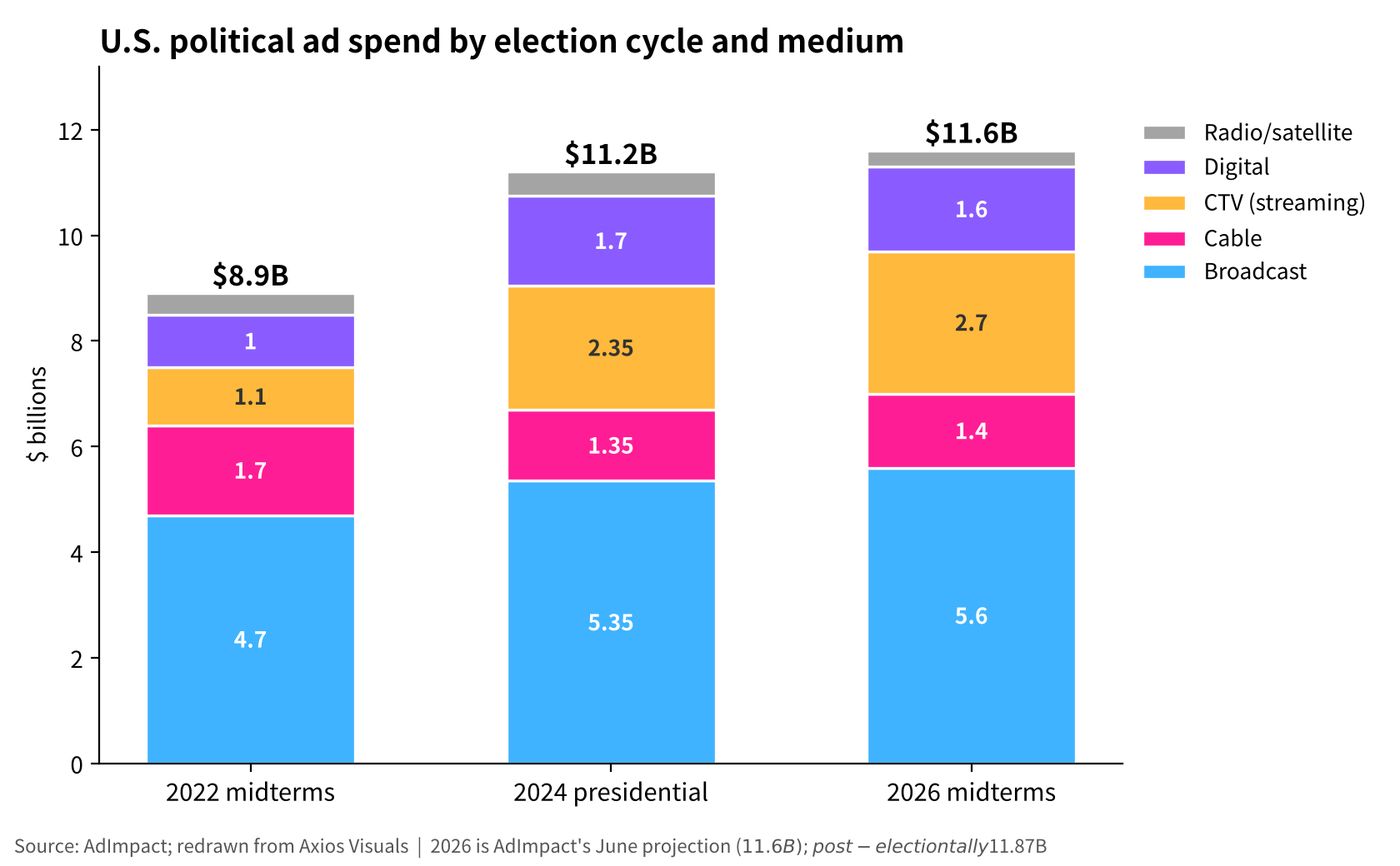
Total political ad spending for the 2026 midterm cycle reached $11.87 billion (about ₩16.1 trillion), according to AdImpact, topping the $11.2 billion record set in the 2024 presidential cycle, The Current reported on Nov. 4. Connected TV took $2.6 billion, or 22% of the total, more than double its 2022 level.
Broadcast still captured close to half the money, at $5.6 billion to $5.8 billion. But the budgets added this cycle by super PACs and by nonprofits that do not disclose donors, so-called dark money groups, went to streaming, where there is no public file and no lowest unit rate.
Korea is not immune. Its Public Official Election Act (공직선거법) limits ad buying to candidates and nominating parties, blocking outside groups from purchasing election ads. But the law's venue rules center on broadcasting and news sites; ad-supported streaming services such as Netflix and TVING (티빙), and YouTube, are not named as venues. There is no mechanism to record who pays for what political message there. With National Assembly elections due in April 2028, money of untraceable origin could flow into streaming in Korea as well.
SLF puts $200 million into streaming and social, half its budget in some states
Allies of former Senate GOP leader Mitch McConnell founded SLF in 2015. In April the group told The New York Times it planned to spend around $350 million (about ₩475 billion) in 2026 on television, digital and streaming ads and other operations, FactCheck.org noted. The $200 million-plus figure includes money spent through Texas PAC, according to Axios's correction.
One Nation, the SLF-aligned nonprofit that does not disclose its donors, was the single largest political advertiser in August at $51.8 million, The Desk reported. SLF received $24.29 million from One Nation in June alone, according to watchdog Issue One.
Outside money surged late in the race. In September, President Donald Trump's MAGA Inc. and the Senate GOP-aligned Texas PAC unleashed a roughly $150 million (about ₩203 billion) ad blitz in key races, NPR reported, buying TV, streaming and digital ads.
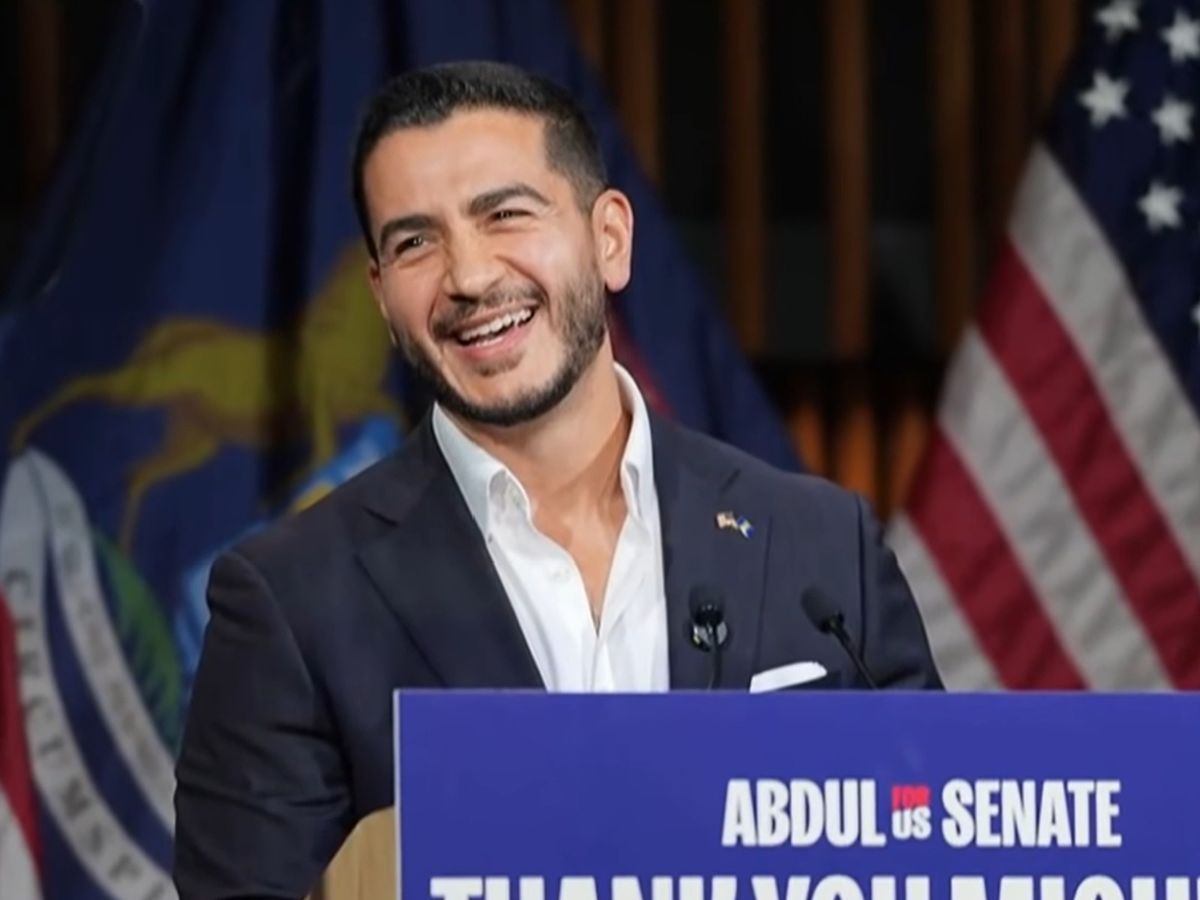
Senate Majority PAC, the leading Democratic Senate super PAC, declined to give a streaming figure. "Senate Majority PAC invested more this cycle in digital communications than any previous cycle, running digital campaigns in 12 states," communications director Lauren French told Axios.
Lowest rates and public files apply to broadcast only; streaming is negotiated
Federal law entitles legally qualified candidates to a station's lowest unit rate in the 45 days before a primary and the 60 days before a general election. Outside groups do not get it, and often pay several times what a campaign pays on broadcast TV and radio. Online, super PACs can bargain directly.
Disclosure works differently, too. Broadcast stations must log every political ad request, including sponsor, airtime and price, in the FCC's online public inspection file. Hulu, Roku, Peacock and Tubi are not broadcast licensees and fall outside those rules. Platforms can and do reject political ads under their own standards, compliance firm AdWave notes, and those policies can change close to Election Day. A few states, including Washington, require digital and streaming sellers to keep political ad records.
Efforts to close the gap have stalled at the federal level. The FCC's 2024 proposal to require on-air disclosure of AI-generated content in political ads would not have reached streaming or social media, which sit outside the agency's jurisdiction, The Desk reported; broadcast and cable groups argued it would tilt the field toward online advertisers. On Dec. 1, 2025, the Campaign Legal Center petitioned the FEC to state explicitly that rules covering "television" and "broadcast, cable, or satellite" communications also cover streaming. Bills to extend broadcast-style transparency to digital ads have mostly failed in Congress.
Party committees get the candidate rate after June Supreme Court ruling
Party spending changed too. On June 30 the Supreme Court ruled 6-3 in NRSC v. FEC that federal caps on party spending coordinated with candidates violate the First Amendment, overruling a 2001 precedent, the FEC said. The National Republican Senatorial Committee used the ruling to coordinate ad buys with campaigns and gain access to the candidate rate, Axios reported.
After the ruling, parties held the advantage in broadcast buys priced at the lowest unit rate, while super PACs and dark-money groups held it in streaming, where prices are negotiable and targeting is precise.
Broadcast holds $5.6 billion; 71% of traditional-TV political spend ran in sports
By volume, broadcast remains the largest medium. AdImpact's June projection put broadcast at $5.6 billion (about ₩7.6 trillion), or 48% of the total, with CTV at $2.7 billion (23%), digital at $1.6 billion and cable at $1.4 billion. CTV's share has risen every cycle, from 12% in 2022 to 21% in 2024.
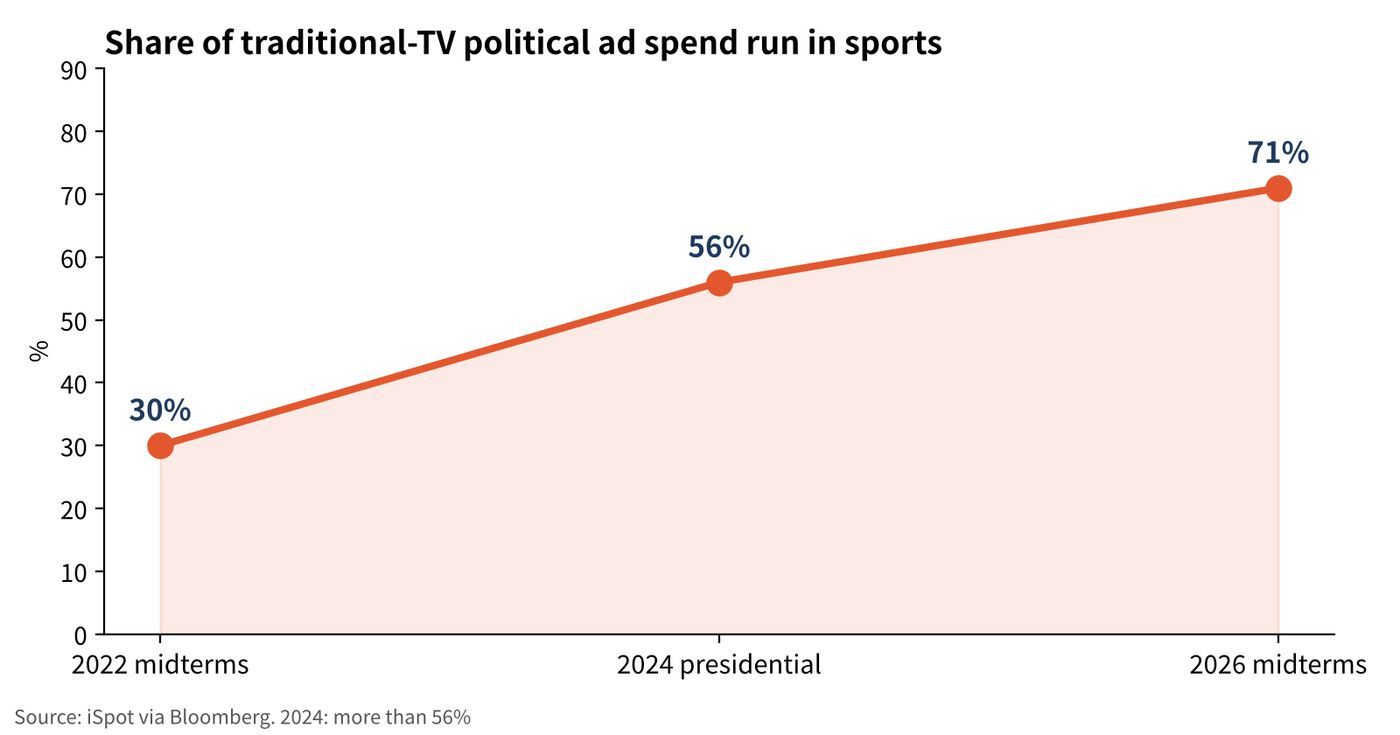
Within traditional TV, the money concentrated in live sports. Seventy-one percent of traditional-TV political spending this cycle ran during sporting events, up from 30% in 2022 and more than 56% in 2024, according to iSpot data reported by Bloomberg. The NFL and college football took most of it.
Programmatic data show the same pull toward CTV. PubMatic analyzed 2 billion political impressions transacted on its platform from Aug. 31 to Oct. 12 and found CTV accounted for 86% of spend, rising to as much as 92% in competitive markets. "CTV is the fastest growing channel for political ad spend on our platform," Sue Wu, PubMatic's global associate vice president of marketing research, told The Current.
Korea regulates the buyer, but streaming and YouTube sit outside its venue rules
Korea's election law has not kept pace either. The Public Official Election Act restricts the buyer rather than the medium: only candidates and nominating parties may place broadcast and internet election ads, and internet election advertising by anyone else is prohibited.
Costs are reported to the National Election Commission (중앙선거관리위원회) as campaign expenses, so the U.S. route by which donor-anonymous groups buy ads at scale is closed from the start.
Korea also has a rate rule. The fee a candidate pays to use broadcast facilities for campaign speeches may not exceed the lowest commercial rate in the same time slot, under the election management form, a provision with the same intent as the U.S. lowest unit rate.
The medium-side rules, however, are built around broadcasting and news sites. In the June 3 local elections, candidate banner ads on regional newspaper sites fell sharply from previous years, the Journalists Association of Korea (기자협회보) reported on May 28. Critics have noted since the 2020 general election that there is no clear review standard for election content distributed only on YouTube and other social platforms.
| U.S. broadcast | U.S. streaming (CTV) | Korea broadcast | Korea internet/streaming | |
|---|---|---|---|---|
| Who may buy | Candidates, parties, super PACs, nonprofits | No limit | Candidates, nominating parties | Candidates, nominating parties only |
| Candidate rate | Lowest unit rate, 45/60 days | None (negotiated) | Speech-fee cap at lowest commercial rate | No rule |
| Public record | FCC online public file | No federal duty (some state laws) | Campaign-expense reporting | Campaign-expense reporting |
| Venue rules | Licensed broadcasters | Platform policy | Broadcast facilities | Centered on news sites; streaming not named |
U.S. and Korean political-ad rules compared. Sources: FCC rules, AdWave, Public Official Election Act, press reports
Korea's broadcast ad deregulation took effect Oct. 16, citing the streaming gap
In Korea, the regulatory gap with streaming has so far driven policy on commercial ads. Revised enforcement rules under the Broadcasting Act from the Korea Media and Communications Commission (방송미디어통신위원회) took effect on Oct. 16, SBS Biz reported. They raise each channel's daily ad cap to 20% of airtime, scrap per-program limits and allow mid-roll ads in programs of 30 minutes or more. The commission estimated the mid-roll change alone at about ₩50 billion (about $36.9 million).
The rationale was the gap with YouTube and Netflix, which are classified as value-added telecom operators and are not bound by broadcast rules on ad volume, mid-rolls or product placement, Kyunghyang Shinmun (경향신문) reported. Broadcast ad revenue fell 12.3% last year to ₩2.0134 trillion (about $1.48 billion), and terrestrial ad revenue dropped 56%, from about ₩1.9 trillion in 2015 to about ₩800 billion in 2024, according to the same report.
The U.S. case shows the same gap opening on public-interest obligations. U.S. broadcasters had to disclose political ad rates and buyers, while streaming, without those duties, absorbed outside-group budgets: so-called dark money. Korean broadcasters' case for lighter commercial rules and the question of extending public obligations to streaming are two sides of one issue. Dark money could become a problem in Korea, too.
Terrestrial TV remains at the center of elections. MBC's local-election results special drew 8.3% nationwide (Nielsen Korea), the highest of any election program. Just as U.S. broadcasters held political dollars through live sports, live programming such as elections and sports underpins Korean broadcasters' leverage with advertisers.
Outlook: streaming disclosure is the next fight, and Korea's 2028 vote faces the same gap
In the U.S., whether the FEC acts on the CLC petition and how much streaming platforms disclose about their political ad policies will be open questions heading into the 2028 presidential cycle. Axios noted that streaming gives super PACs more freedom while handing platforms more power to set the rules: each service, not the law, decides whether to accept an ad and what record to keep.
Korea holds National Assembly elections in April 2028. With Netflix, TVING and other services running ad-supported tiers, the law still does not say how streaming fits as a venue for election ads. Dark money is not only an American problem.
Limiting ad buying to candidates blocks the U.S. super PAC route. But political ads and content run on streaming and YouTube, which the law does not name as venues, sit outside its record-keeping system. Whether to recognize streaming as an election-ad medium, and if so whether to impose broadcast-style rate and record duties, is a question broadcasters and streaming services will have to answer together.