Livestream Commerce Enters Its $3.7 Trillion Era — and TV Is Changing With It

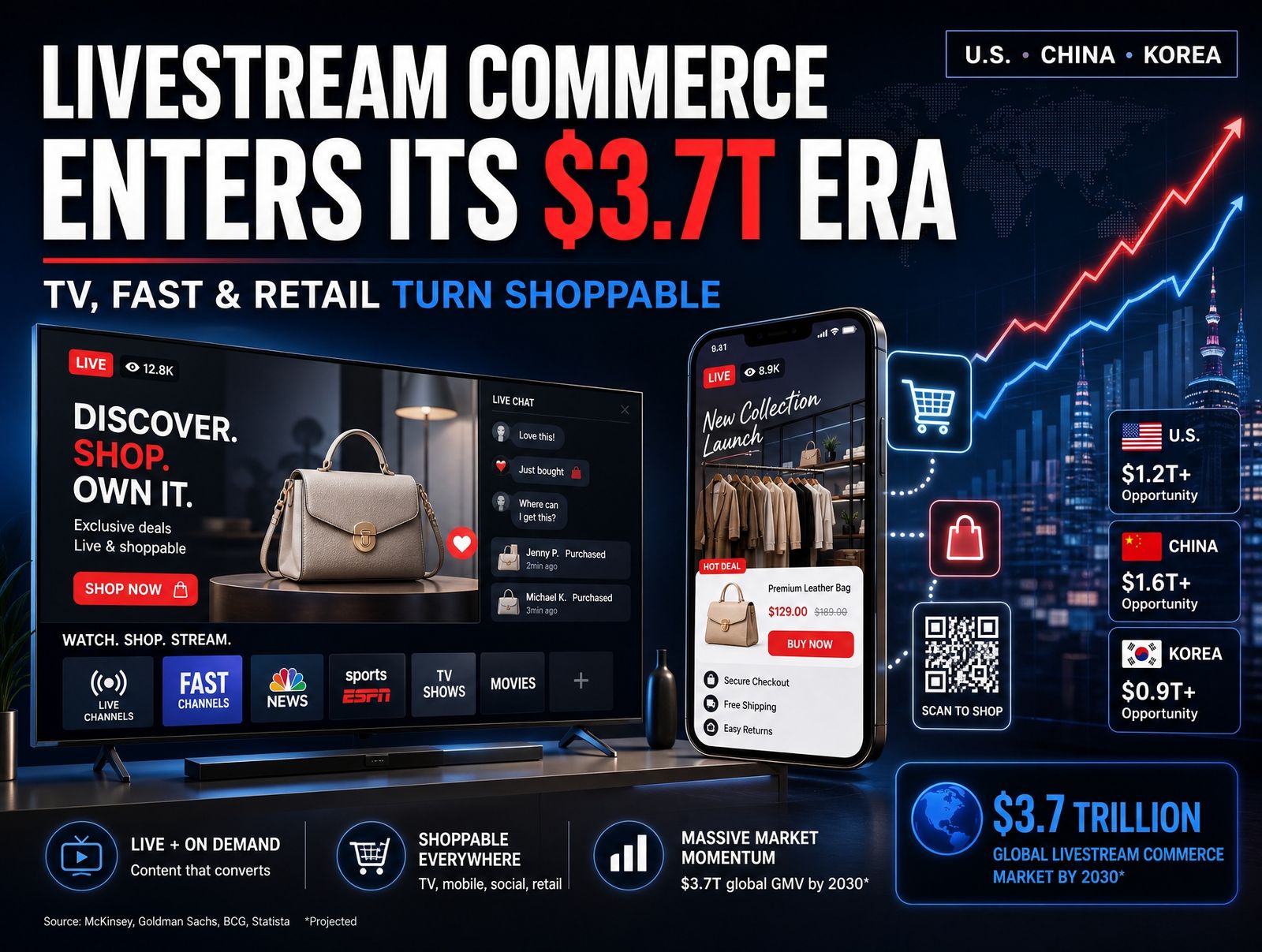
As livestream commerce heads toward $3.7 trillion by 2030, U.S. broadcasters, retailers, and FAST platforms are pivoting to shoppable content — and Korea faces the same shift amid a TV home-shopping slump.

Livestream Commerce Enters Its $3.7 Trillion Era — and TV Is Changing With It

The U.S. market is set to triple to $680 billion by 2030 as China keeps its lead. TikTok Shop and Whatnot drive the growth, while broadcasters and retailers turn to shoppable series, FAST channels, and morning-news shopping to find new revenue.

The U.S. live-shopping market is projected to more than triple, from $200 billion in 2026 to $680 billion by 2030, as retailers, creators, and streaming platforms adopt formats that fold entertainment, product discovery, and checkout into a single screen. With viewing shifting from traditional TV to video-first social media, a market that spent years failing to replicate China's livestream boom has finally entered a genuine growth phase.

라이브 커머스 3조 7000억 달러 시대… TV도 바뀐다
라이브 커머스, 2030년 3조 7000억 달러(약 5470조원)로 커지는 가운데 미국의 방송사·유통·FAST 플랫폼이 쇼퍼블 콘텐츠로 돌아서고, 한국도 TV홈쇼핑 침체 속에 같은 재편

The change does not stop online: broadcasters are pulling commerce into shoppable series and morning-news shopping segments and reworking their business models. Korea is no exception — as advertising and viewers drain away, terrestrial broadcasters lean on deregulation and TV home-shopping is squeezed toward collapse by carriage fees, while livestream commerce pushes into the gap on its way past a 6-trillion-won (about $4 billion) market.

Ark Invest analysts Nicholas Grous and Varshika Prasanna frame livestream commerce as the revival of 1970s American home shopping, now moved from television to video social media — the same mix of real-time demos, a trusted personality, and instant purchase. Ark projects the global market growing from $1.7 trillion this year to $3.7 trillion by 2030, an annual rate of about 24%. China still accounts for most of it at $2.4 trillion, while the U.S. grows fastest, at roughly 47% a year, to $680 billion. The figures line up with what Axios reported.

Global livestream commerce sales forecast, 2023–2030. Source: Ark Invest.

Shoppable Entertainment Expands Across TV and Retail

The trend is moving onto television, and legacy media companies are among the most visible movers. On June 11, NBCUniversal launched Shop What Happens, a shoppable Bravo digital series sponsored solely by Target. Inspired by the format of Watch What Happens Live with Andy Cohen, the summer weekly brings Bravo cast members — Cynthia Bailey, Ariana Biermann, Lindsay Hubbard, Michelle Saniei, and Nia Sanchez — together with host Daryn Carp for talk and games on fashion, entertaining, beauty, travel, swim, and seasonal trends, while viewers buy the featured Target products on the spot.

Shop What Happens, the Target-sponsored Bravo shoppable series. Source: NBCUniversal.

The series streams on Peacock, YouTube, and TikTok, with clips on Instagram; on the Peacock mobile app and TikTok it is optimized as vertical video. On living-room Peacock, QR codes handle shopping, while text- and click-to-shop let viewers buy on-screen products via the mobile app, YouTube, TikTok, and Instagram. New episodes ran weekly for five weeks from June 14. NBCUniversal advertising-and-partnerships president Karen Kovacs framed it as widening what is possible when premium content, fandom, and commerce meet. NBCUniversal, the first company to bring ShoppableTV to market, says engagement rose 378% and purchases climbed 60% year over year when storytelling, IP, and talent were combined.

Walmart is pushing the content-commerce blend from the connected-TV (CTV) advertising side. On June 23 it agreed to acquire Vibe.co, a self-serve CTV ad platform for small and mid-sized advertisers, through its Walmart Connect commerce-media arm; terms were undisclosed, with closing expected within fiscal 2027. Walmart plans to combine Vibe.co with its commerce audiences, closed-loop measurement, and a media ecosystem that includes the VIZIO smart-TV business it acquired, making CTV advertising accessible to smaller advertisers and marketplace sellers without large media teams. The deal extends Walmart Connect's CTV reach after partnerships with Magnite, Yahoo DSP, and Google DV360.

Commerce Moves Onto FAST Channels

Free ad-supported streaming TV (FAST) is becoming another stage for commerce. As subscription streaming keeps raising prices and more viewers accept ads in exchange for free channels, FAST platforms such as Roku and Samsung TV Plus are layering shopping on top of advertising and data. Because making devices earns little on its own, they are working to route viewers' attention straight into transactions.

Samsung added Amazon Live — a shopping-focused channel — to Samsung TV Plus, which has more than 100 million monthly active users and the top smart-TV share in North America. Alongside celebrity and creator livestreams, cultural moments, and originals such as In Bed with Paige DeSorbo, Pick Your Prize, and Shopping Court, the channel carries deal segments tied to Amazon shopping events and everyday deal streams.

The core is 'Shop the Show': scan the on-screen QR code and browse and buy featured products in the Amazon Shopping app in real time, joining live chats without interrupting the stream. Samsung TV Plus global head Salek Brodsky called it a content-to-commerce strategy, and Amazon Shopping Videos VP Wayne Purboo described putting live entertainment and easy Amazon shopping on the biggest screen in the home.

Ads themselves have become storefronts. In June 2026, Samsung Ads and Amazon Ads launched interactive ads that let viewers add products to an Amazon cart with the remote while watching FAST content on Samsung TV Plus. Products from Amazon marketplace sellers get an on-screen 'Add to Cart' button; other brands get action buttons such as 'Send to Phone' or 'Sign up.' Samsung had also opened its smart-TV home screen to programmatic buying via The Trade Desk and Google DV360, running on Magnite's infrastructure.

Rivals are on the same path. Roku teamed with Amazon's demand-side platform (DSP) in a partnership that reaches 80% of U.S. CTV households, and streaming firm FreeCast launched Test Drive Live — a shoppable FAST channel pairing unboxings, demos, and reviews with instant purchase — on Roku and elsewhere, selling below retail through direct deals with makers and sellers and pitching itself as unlike the cable shopping channels of the past. Creator content is a commerce conduit too: creator-content viewing on The Roku Channel rose nearly 80% per household year over year. As price-weary subscribers move to free channels, and QR codes and remotes turn the living-room TV into a checkout, FAST is growing into a commerce market that goes beyond advertising.

Shopping Creeps Into TV News

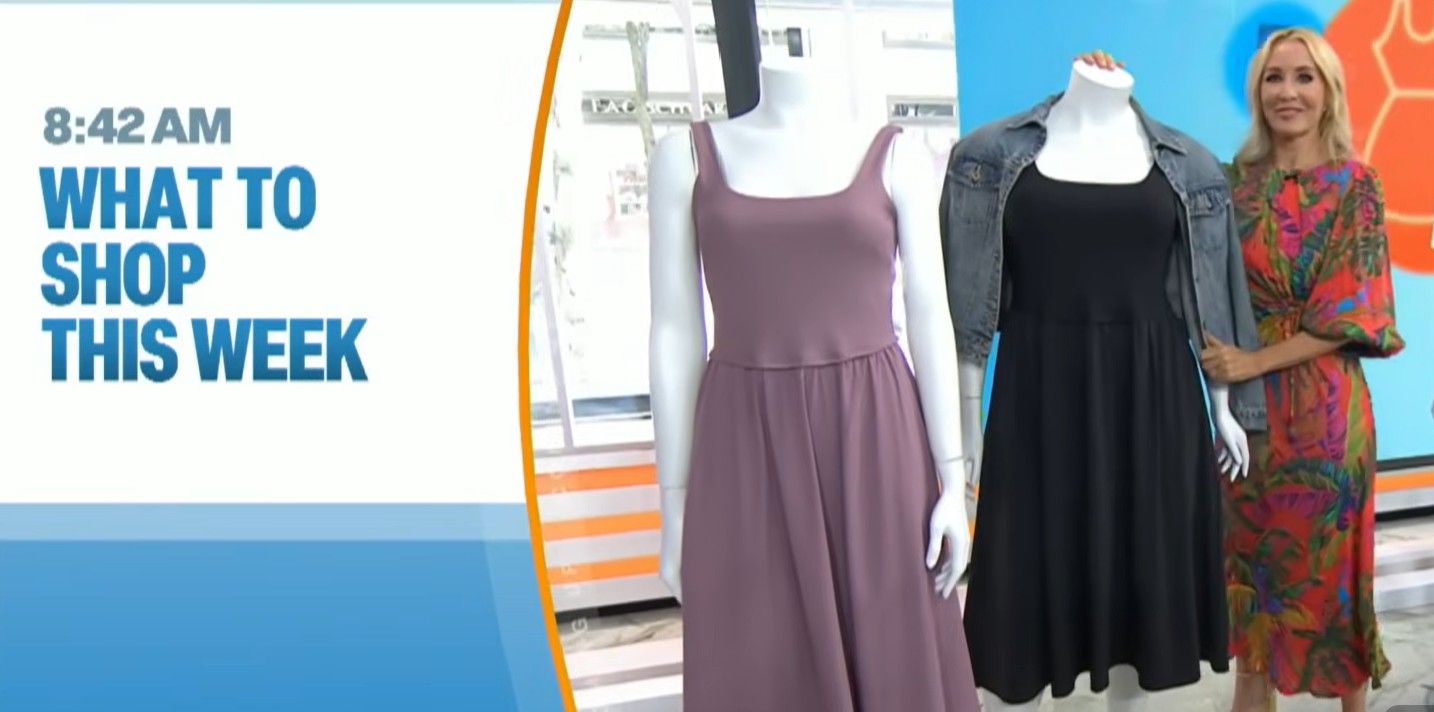
The logic of livestream commerce has entered morning news and talk shows. Per the Los Angeles Times, shopping segments on NBC's Today, ABC's Good Morning America, and CBS Mornings have grown sharply in recent years. Scan the on-screen QR code and you are taken to a dedicated e-commerce site to order directly, with the program keeping 20% or more of the revenue.

A contributor or expert usually presents the household goods, fashion, or personal-care items; the anchor rarely does the selling, but their presence works as a seal of approval. The segments have spread to The View, The Jennifer Hudson Show, Entertainment Tonight, and Inside Edition, and to local stations, whose owners sign deals with firms that match them to brands.

A 'Shop Today' segment on NBC's Today; the on-screen QR code (lower left) lets viewers buy featured products instantly. Source: NBC News.

What sustains the spread is a broadcast slump. As streaming pulls viewers away, broadcast and cable TV ad spending fell 23% from 2022 to $51 billion in 2025, and cord-cutting is eroding carriage fees. Networks and stations have cut newsrooms to protect margins, and daytime syndication has shrunk — NBCUniversal exited the market and canceled Access Hollywood and The Kelly Clarkson Show. Against that backdrop, a single four-minute shopping segment is said in the industry to earn well into eight figures. E-commerce already makes up 21.8% of U.S. retail purchases, per the Commerce Department.

Trust is the basis for leaning on these segments. NBC research found 94% of Today viewers trust the show's product recommendations. Brian Meehan, co-founder of the Connecticut firm Knocking, which embeds e-commerce into TV and digital content, called it the savior of media if done right. Magid EVP Bill Hague said stations are filling local-news hours — expanded in place of syndicated talk — with these segments, since the same audience can carry more revenue; his firm's research finds viewers do not see the practice as lowering newscast quality. Former CBS News president Andrew Heyward said he is fine with a better blender helping pay for an investigative reporter.

These segments sit on a wider continuum in which editorial content becomes a gateway to shopping. Former NBC News consumer reporter Jeff Rossen recently pitched online deals for Tegna's local stations, and the products he demonstrated sold briskly on the trust he built as a journalist. The New York Times takes a cut of sales through its Wirecutter review site, and Los Angeles Times book reviews link to Bookshop.org for a commission. Heyward said consumers have grown used to editorial as an entry point to online shopping.

Direct selling is an old format. In 1978, a radio station in Clearwater, Florida, took 112 electric can openers from an advertiser who could not pay, and owner Bud Paxson had an anchor auction them live; they sold out fast.

The resulting 'Suncoast Bargaineers' moved to a Tampa cable outlet in 1982 and grew into the national Home Shopping Network. Networks tried direct selling repeatedly — NBC lent its name to the 1990s cable channel ShopNBC — but the format took hold when Today introduced Steals and Deals in 2010. Presented mainly by Jill Martin, the segment now runs about 350 shopping spots a year with 30 contributors, distributed across digital, social, newsletters, and mobile, and is said to generate more than $500 million a year.

A 'Steals and Deals' segment on NBC's Today (Craig Melvin and Jill Martin). Source: NBC News.

▶ Related video: NBC Today full episode (July 20, 2026) — Official TODAY on YouTube

Showing products inside programming has been familiar since Oprah Winfrey's 'favorite things,' said Candi Carter of Cistus Media, which handles e-commerce for Tegna; brands do it for visibility, she said, paying no integration fee while earning sales revenue. Authenticity is the crux: network journalists appear but do not sell, and CBS News, working with Knocking, has talent test products beforehand. Meehan noted that when CBS Mornings co-host Nate Burleson tries a massager and reacts with delight, none of it is scripted.

Competition followed. ABC's Good Morning America answered in 2011 with Deals and Steals, now running daily on GMA, GMA3, and The View, with Tory Johnson hosting since launch. CBS News, long protective of its journalistic legacy, was last in, entering in 2022 after COVID-19 depressed ad revenue and as then-parent Paramount pressed to improve its books ahead of a sale; CBS Deals has become a key revenue driver for the struggling news division. The trickiest part at launch was the disclosure language telling viewers the network stands to benefit; Meehan recalled that after long talks with lawyers, it settled on wording that the network may receive promotional or financial consideration. Selling trust carries risk — disgruntled viewers hurt both product and broadcaster — so Knocking accepts returns for up to six months, and Heyward said everyone involved has a stake in honesty and a good experience.

China Still Leads

China built livestream commerce into the front line of its retail revolution on the back of a mobile-first culture and an influencer economy. With 99% of Chinese internet users online via smartphone, mobile became the main channel for both entertainment and product discovery, and 85% of consumers who see an influencer recommendation go on to buy. Pairing live demos with a trusted personality, China's livestream commerce grew about 73% a year from 2019 and reached roughly 60% of the country's e-commerce in 2024 — a market worth about $900 billion.

Livestream commerce sales forecast by region, 2025–2030: China dominates. Source: Ark Invest / Axios.

By platform, ByteDance's Douyin (China's TikTok) leads at 88% usage, followed by Alibaba's Taobao Live at 61% and Xiaohongshu (Little Red Book) at 22%; Kuaishou is another major player. These platforms stitch together in-app purchase, easy payments, and logistics, and blend entertainment, promotions, and flash sales to turn shopping into a social experience.

Most-used livestream commerce platforms in China. Source: Ark Invest (McKinsey 2023).

On categories, the pandemic pushed groceries to the top, with farmers live-streaming produce to stay afloat — a sign of how much consumers value seeing and hearing about fresh goods in real time. By share of respondents, groceries led at 54%, followed by clothing at 45%, footwear at 33%, skincare at 30%, and haircare at 26%.

Most-purchased categories via livestream commerce in China (share of respondents). Source: Ark Invest (McKinsey 2024).

The U.S. Opens Up Fast

In the U.S., momentum showed in 2024, when TikTok Shop outsold both Shein and Sephora. Even so, livestream commerce is still only about 5% of U.S. e-commerce, far below China's 60%.

A shift in viewing habits underpins the growth. Per Emarketer, the number of U.S. social-network users has climbed steadily and recently passed the number of linear-TV viewers. As audiences grow comfortable in a video-first environment and more open to interactive content, shoppable livestreams have a natural place to take root.

U.S. social-network users vs. linear-TV viewers, in millions. Source: Ark Invest (Emarketer).

By age, China skews toward 25–34 (30%), while the U.S. spreads more evenly, with 25–34 (28%) joined by 45–60 (25%). Older viewers who grew up with QVC and HSN gravitate to YouTube and Facebook, while younger ones shop live on TikTok and Instagram.

Age breakdown of frequent livestream commerce users (China vs. U.S.). Source: Ark Invest (McKinsey 2024).

Current platform numbers are steep. TikTok Shop's live-shopping sales rose more than 80% in 2025, and live-shopping GMV doubled in the first half of 2026. More than 1,600 creators each cleared $1 million in annual sales on TikTok Shop in 2025. Whatnot, built around auctions and collectibles, logged $8 billion in live sales that year — more than double the prior year — with users watching an average of 98 minutes of live shows a day. TikTok Shop Americas' Patrick Nommensen said U.S. e-commerce-intent searches on TikTok Shop topped 103 billion last year.

How Livestream Commerce Works

Livestream commerce leans on devices that hold attention and drive conversion. Auction-style events create competitive tension, while flash sales and limited runs manufacture urgency and impulse buying. Live demos come with buy-now links, and hosts pull in viewers with giveaways, exclusive discounts, and live Q&A. Ark's Grous says live shopping poses the question of whether online shopping can be made fun — a contrast with traditional retail's focus on making it maximally easy.

Sellers do more than list products: they tell the story behind an item, show how it feels, and answer questions on the spot — closer to a favorite neighborhood shop than a conventional online store. Whatnot CRO Armand Wilson credits community-building for the platform's growth, from Funko Pops to Pokémon and sports cards, fashion, and fresh food. Brands also gain real-time analytics; when engagement spikes on a particular feature, a host can spend more time on it mid-broadcast.

A brand playbook has settled in as well: collaborate with influencers or subject-matter experts who resonate with the target audience and turn them into active participants; cut friction with buy-now buttons and direct links; and use exclusive offers and giveaways to spur real-time purchases. Reading which product features draw response, then tuning the next show's lineup and messaging, has become part of one continuous loop.

What Still Holds the U.S. Back

Still, the U.S. trails China on consumer behavior and infrastructure. Grous notes American shoppers are used to Amazon and other traditional platforms, while Chinese e-commerce grew up mobile-first and slid naturally into social commerce. Joy Tang, founder and CEO of creator platform Markable, says logistics matter too — live shopping works best when sellers can ship large inventories immediately. TikTok has expanded logistics, including end-to-end 'Fulfilled by TikTok,' and Nommensen says logistics remains a major area of investment.

Seen From Korea

Korea is moving the same way. Per commerce-analytics firm Lababa Data Lab, the domestic livestream commerce market grew from 2 trillion won in 2022 to 3 trillion in 2023 and 3.5 trillion in 2024, then to 4.7 trillion won (about $3.2 billion) in 2025, up 35% year over year, and is projected to top 6 trillion won in 2026. 2025 marked a turn from scale to efficiency: broadcasts (178,239) and views (4.34 billion) fell 14.9% and 15.2%, but major-platform livestream sales rose 37.1% to 1.78 trillion won, and average sales per broadcast jumped 61.6% to 9.98 million won. Digital appliances alone drew about 40% of sales (706.9 billion won), a sign of high-consideration goods pulling the market.

Traditional TV home-shopping faces pressure much like the U.S. broadcast business. Per the Korea TV Home Shopping Association's 2025 industry report, the seven domestic operators' transaction value fell 5.1% to 18.5 trillion won last year — a fourth straight annual decline, and still below the 20-trillion-won line it first broke through in 2024. Broadcast revenue slid to 2.62 trillion won, the lowest since 2012, as TV audiences shrank and spending moved to mobile. The customer base is aging: women in their 60s rose 5.1 points to 29.9% of buyers, while higher-spending women in their 40s and 50s fell 6.9 points to 36.9%.

A uniquely local burden is the carriage fee. Last year the seven TV home-shopping operators and five data-home-shopping (T-commerce) operators paid 2.44 trillion won in carriage fees — 34.1% of pay-TV operators' broadcast revenue — and for the seven TV players alone, 73.4% of broadcast revenue went to carriage fees, a structure often described as paying 73 won of every 100 earned just for a channel slot. T-commerce, which leaned into mobile, rebounded with 774.3 billion won in 2024 revenue, up 1.6%, and the government is weighing deregulation to lift T-commerce's live-broadcast ban and screen-ratio limits.

On mobile, Mirae Asset Securities expects Naver Shopping Live and YouTube to dominate. Naver runs an open-platform strategy that opens live broadcasting to small merchants on its Smart Store, while the TV side looks to deregulation and carriage-fee reform for a way out. The same content-commerce reshaping that has U.S. broadcasters bolting commerce onto news and entertainment to offset ad losses is underway in Korea.

Between Commercialization and Regulation

The trend leaves homework for Korean broadcast regulation. The government has signaled that it sees no reason to keep 'discriminatory' rules on terrestrial broadcasters' advertising and sponsorship, and has pushed to amend the Broadcasting Act — shifting from a positive-list regime that names what is allowed to a negative-list one that names only what is banned, and easing virtual, embedded, and mid-program advertising. The aim is to undo the 'reverse discrimination' that has left terrestrial broadcasters more heavily regulated than comprehensive-programming (jongpyeon) channels and pay TV. As the split reactions to the deregulation news showed, operators' interests diverge sharply.

The more rules loosen, the louder the question of how far to allow TV's commercialization. Korea is unlikely to simply import the U.S. model of commerce entering news and current-affairs programming, given content and scheduling rules premised on public interest and fairness, and given different expectations of public versus commercial broadcasters.

How to align the regulatory framework is contested too. Terrestrial and jongpyeon channels have faced different rules on ownership and scheduling; loosening advertising and sponsorship in tandem would give operators carrying different public-service obligations the same room to commercialize. Whether it makes sense to hold public-service-heavy terrestrial broadcasters and commercial jongpyeon to the same commercialization standard — or, conversely, to keep different rules in an era when the lines between media have blurred — divides opinion. Either way, dividing regulation by the label of the vessel, terrestrial or jongpyeon, is back on the table.

Content review is the more delicate area. The more selling mixes with editorial and news content on one screen, the more viewer protection, free expression, and industry growth collide over how far to allow sponsorship disclosure and commercial expression, and how to signal it. In the U.S., too, broadcasters spent a long time working out disclosure language. If commerce and broadcasting fully converge in Korea, the standards for disclosure and content review will have to be settled alongside the pace of deregulation.

Sources

1. Ark Invest, “Livestream Commerce Is Reviving Home Shopping,” Nicholas Grous and Varshika Prasanna, Mar. 26, 2025. https://www.ark-invest.com/articles/analyst-research/livestream-commerce-reviving-home-shopping

2. Axios, “U.S. live shopping expected to triple as retailers compete with China,” Kerry Flynn (data: Ark Invest).

3. NBCUniversal, “NBCUniversal Expands Shoppable Entertainment with New Digital Bravo Series ‘Shop What Happens,’” Jun. 11, 2026. https://www.nbcuniversal.com/article/nbcuniversal-expands-shoppable-entertainment-new-digital-bravo-series-shop-what-happens-sponsored

4. Walmart, “Walmart to Acquire Vibe.co to Expand Access to Connected TV Advertising,” Jun. 23, 2026. https://corporate.walmart.com/news/2026/06/23/walmart-to-acquire-vibe-co-to-expand-access-to-connected-tv-advertising

5. Los Angeles Times, “Why e-commerce pitches are creeping into TV news,” Stephen Battaglio, Jul. 19, 2026.

6. Deadline, “Amazon Live FAST Channel Joins Samsung TV Plus Lineup…,” Dade Hayes, Mar. 31, 2026. https://deadline.com/2026/03/amazon-live-shopping-fast-channel-samsung-tv-plus-1236770229/

7. FAST / shoppable CTV (add’l) — Samsung Ads & Amazon Ads remote-enabled interactive ads and Samsung TV Plus coverage (C21Media, StreamTV Insider, TV Tech, ppc.land, etc.); FreeCast “Test Drive Live” (BusinessWire); Roku Advertising.

8. Korea data & policy — Lababa Data Lab (livestream commerce); Korea TV Home Shopping Association, “2025 TV Home Shopping Industry Status”; Korea Communications Commission media-industry survey; Mirae Asset Securities; government plans on terrestrial ad/sponsorship deregulation (Media Today, etc.); broadcast ownership-regulation research (KISDI).