
MediaGPT | Streaming pricing analysis
U.S. streaming prices rose 11.8% in the past year, three times the long-run cable average. Sports rights supply the justification, ad tiers and bundles hold subscribers, and in Korea the strategy after the price freeze is the open question.
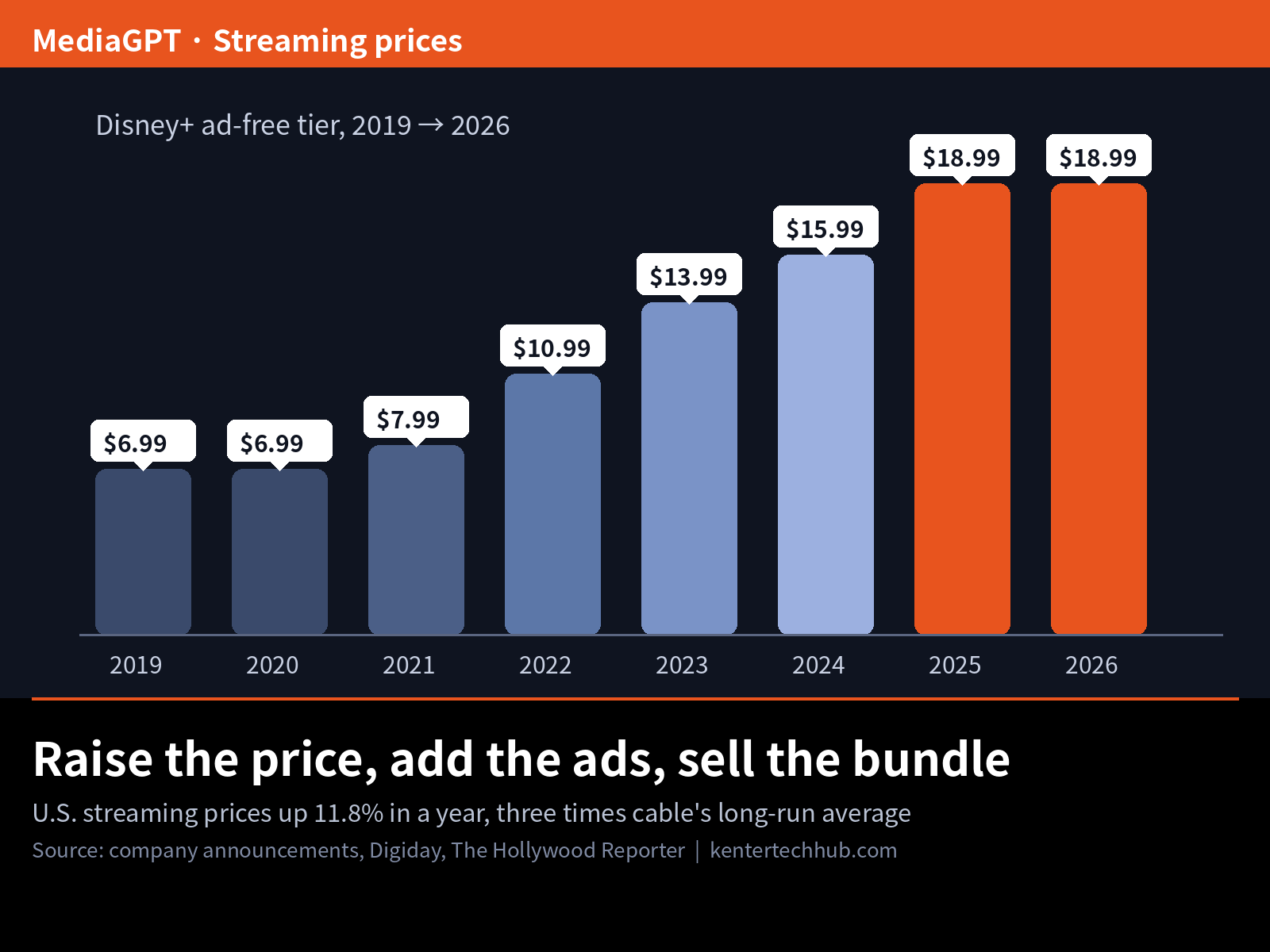
Disney+'s ad-free tier, which launched in 2019 at $6.99 a month (about 9,500 won), now costs $18.99 (about 25,800 won). Five increases have lifted the price 172%. The option of watching ads to save on the subscription did not hold its original price either: Peacock's ad-supported plan rose from $4.99 (about 6,800 won) at launch to $12.99 (about 17,700 won). Viewers who accept ads now pay more than the ad-free plan cost three years ago.
The change in streaming goes beyond how much more expensive it has become. What matters more is where subscribers are moved after a price goes up.
Viewers who want no ads pay a higher subscription. Viewers who find the price too high are offered an ad tier. Those who cannot justify paying for each service separately are offered a bundle. As long as the subscriber stays on the platform, the company collects revenue somewhere among subscription fees, advertising and bundled products.
That is the pattern running through U.S. pricing decisions this year. A price increase changes the price list, and at the same time it reshapes which product subscribers choose and how the platform makes money.
Streaming replaced cable, and its prices rise faster
Digiday compiled price changes for nine major U.S. streaming services since 2019 from company announcements and news coverage on September 16. Netflix and Disney+ have each raised their main ad-free tiers five times. Apple TV costs three times its launch price, and Peacock's reduced-ad tier has doubled. These are not one-off adjustments by a few services; the pattern repeats across the market.
The pace also exceeds cable television's. The Hollywood Reporter's September 9 tally put the streaming price increase over the past 12 months at 11.8%. The steepest year was 2023, at 17.7%. Using Bureau of Labor Statistics data, the same outlet calculated the long-run annual average increase for cable and satellite at 3.9%, excluding the spike immediately after deregulation in the late 1980s. The periods differ, but recent streaming increases run at roughly three times the long-run cable average.
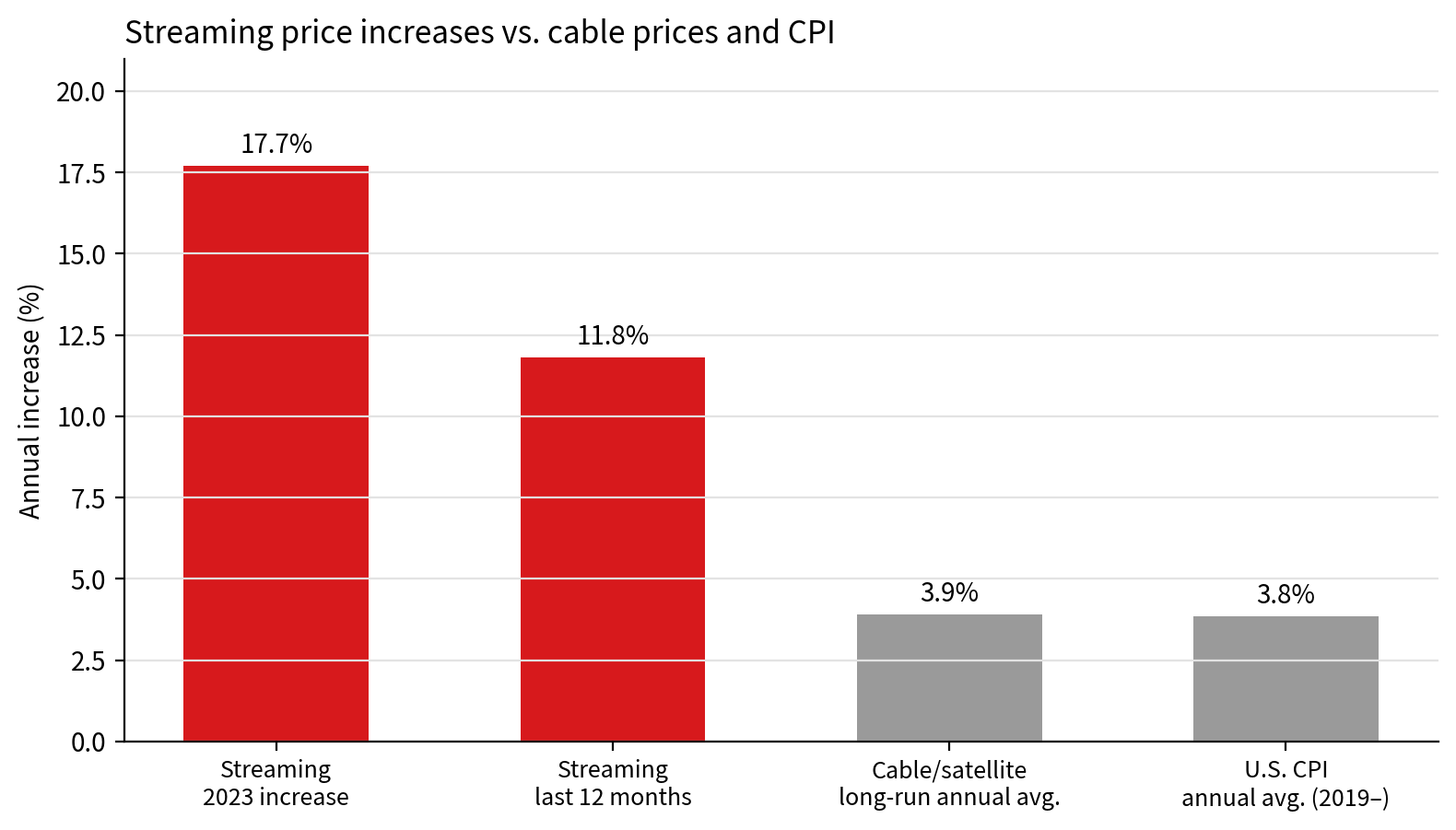
The gap against general inflation is also wide. Forrester estimated that the average ad-free streaming price rose 54% from 2021 to 2025, against cumulative inflation of 16% over the same period as cited by Variety. A separate tally by The Verge put the average ad-free price at $16 in 2025, up from $9 in 2020, a 78% rise. The size of the increase varies with the sample and the period, but the direction is the same: streaming subscriptions rose faster than prices in general.
Government statistics show the same movement. In the December 2025 CPI release of January 13, 2026, the streaming video category rose nearly 20% year on year while overall inflation slowed. Consumer reaction centres on price: in a September 2025 YouGov survey, 66% of people who had cancelled a streaming service cited price, and 74% named price as a key factor in choosing one.
Subscribing to several services makes the burden more visible. By The Hollywood Reporter's count, all eight major services on ad-free plans cost about $151 a month (about 205,000 won), above the $83 (about 113,000 won) average U.S. cable package the Financial Times calculated in 2023. A simple sum of streaming services and a past cable average differ in composition and timing, so the comparison should not be read as a like-for-like price or as average household spending. Even so, the assumption that a hand-picked set of streaming services would come in cheaper than cable can no longer be taken for granted.
Disney+ five times, Apple TV tripled: increases have become routine
Netflix's U.S. Standard plan went from $10.99 to $12.99 in January 2019, then to $13.99 in October 2020, $15.49 in January 2022, $17.99 in January 2025 and $19.99 (about 27,200 won) in March this year. The most recent increase came 14 months after the previous one. Premium costs $26.99 (about 36,700 won). Netflix told Variety the changes let it reinvest in quality entertainment as it delivers more value to members.
Disney+'s increases came with a change in product structure. The ad-free plan went from $6.99 at launch to $7.99 in 2021, $10.99 in 2022, $13.99 in 2023, $15.99 in 2024 and $18.99 in 2025. In December 2022 the company raised the existing plan and launched a $7.99 ad-supported plan on the same day. The product that kept the old price was not the existing one but a new one with ads. Hulu's no-ads plan rose four times from $11.99 in 2019 to $18.99 in October 2024 and was left out of the October 2025 round.
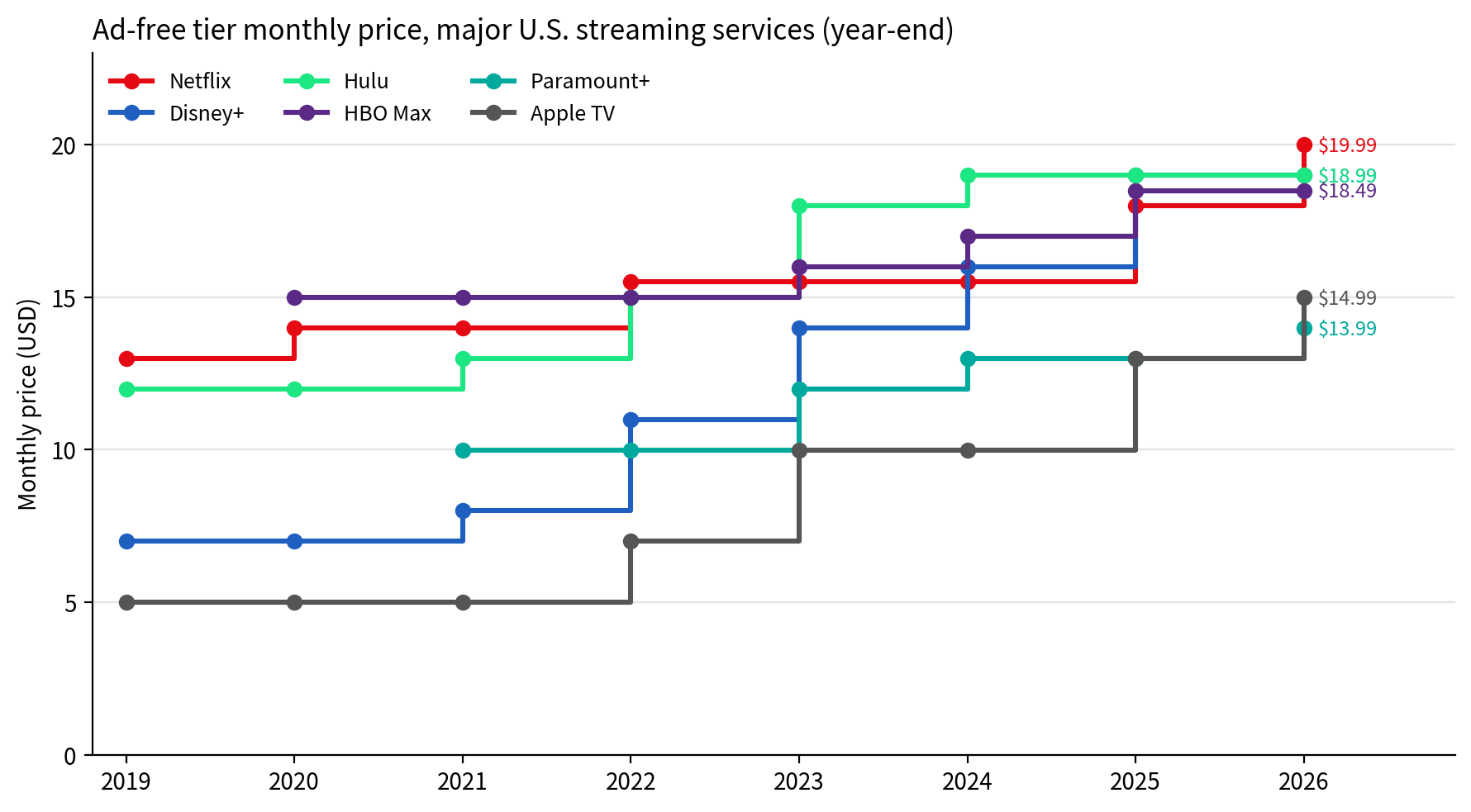
Apple TV moved faster still. It launched in November 2019 at $4.99 and rose to $6.99 in 2022, $9.99 in 2023, $12.99 in 2025 and $14.99 (about 20,400 won) in August this year, tripling over four increases. Apple gave no reason. The Information reported in March 2025 that Apple TV loses more than $1 billion (about 1.36 trillion won) a year and is the only unprofitable service in Apple's portfolio.
Other companies moved the same way. Peacock Premium Plus went from $9.99 in 2020 to $19.99. HBO Max rose three times from $14.99 in 2020 to $18.49 (about 25,100 won). Paramount+ Premium started at $9.99 in 2021, absorbed Showtime and was adjusted to $13.99 (about 19,000 won) in January this year. The size of the increases varies by company, but adding content and features while holding the original price has become rare.
Ad tiers rise too: the low price was never a permanent promise
The ad-supported tier is the fallback for subscribers who might leave over a price increase. The lower price that comes with accepting ads is not fixed either.
Peacock Premium with ads launched at $4.99 in 2020 and moved through $5.99, $7.99 and $10.99 to $12.99 in August this year, a cumulative 160%. When NBCUniversal added $3 in July 2025 it tested a "Select" tier at the old $7.99 price carrying only NBC and Bravo programming: keeping the price meant narrowing the content. Select has now risen to $8.99. Existing subscribers pay the new rates from their first billing date on or after September 17.
Ad tiers rose at other services as well. Netflix's went from $6.99 in 2022 to $8.99 (about 12,200 won) this year; Disney+'s from $7.99 in 2022 to $11.99 (about 16,300 won) in 2025. Hulu with ads doubled from $5.99 in 2019 to $11.99 in 2025. Paramount+ Essential went from $4.99 to $8.99, and HBO Max's ad tier from $9.99 to $10.99. Ad tiers are cheaper than ad-free plans, and they are raised on their own schedule.
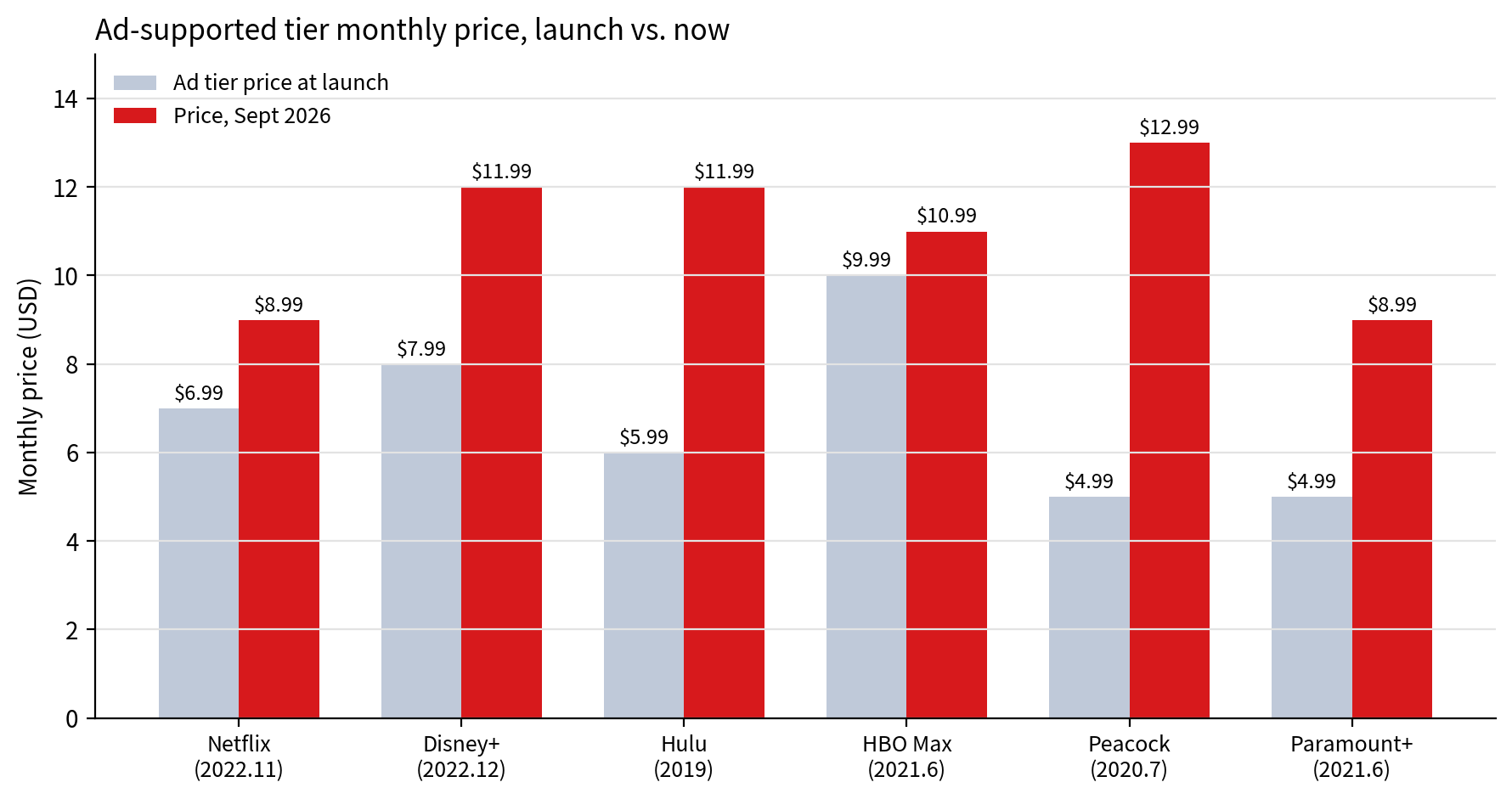
Ad-supported tier price at launch and in September 2026. Launch month of the ad tier in parentheses. Source: company announcements
The subscription fee is not the only cost. Time spent watching ads is rising. Ampere Analysis found ad minutes per hour on major U.S. streaming services rose an average of 18% between January and August this year. Paramount+ carried the most at 9.01 minutes an hour, and Netflix's load rose from 1.40 to 2.44 minutes, the steepest increase.
New sign-ups still go to the ad tier. Netflix said more than 55% of new sign-ups in the fourth quarter of 2025 chose the ad plan. Antenna counted 4 million net ad-tier additions in the U.S. in the first quarter of this year, with 60% of new subscriptions on ad plans. More subscribers moved down from ad-free plans than up from ad tiers, and ad-free plans lost more subscribers than they gained.
From the company's side, the ad tier is more than a discount. It keeps subscribers who cannot carry the higher fee inside the service while generating advertising revenue on top of the subscription. A subscriber trading down to a cheaper plan is not necessarily a smaller relationship with the platform.
Sports supply the justification, bundles hold the subscriber
The most specific reason companies give for raising prices is content investment, and large sports rights are the asset that explains both the size of the spend and the reason to keep subscribing.
Paramount Skydance flagged its January increase in the November 2025 shareholder letter alongside the seven-year, $7.7 billion (about 10.47 trillion won) exclusive UFC deal and a five-year, $1.5 billion (about 2.04 trillion won) deal with the creators of South Park. The letter also listed more than $1.5 billion in incremental programming investment this year and a plan for 15 films a year, and framed the increase as funding for a better user experience and a stronger slate. Paramount+ also said it would phase out U.S. free trials, changing not only the price but the point at which paid billing begins.
Peacock's August increase came ahead of the NFL season in September and the NBA season in October. ESPN raises ESPN Unlimited from $29.99 to $31.99 (about 43,500 won) on September 17, a year after launch. Prices move at the moment sports content raises the value of the service.
One difference matters here. ESPN raises the standalone plan but leaves the $36 (about 48,900 won) bundle with Disney+ and Hulu unchanged, and according to Sports Media Watch four in five ESPN Unlimited subscribers are on that bundle. A standalone increase does not land on every subscriber equally; it narrows the gap between standalone and bundle and makes the bundle relatively more attractive.
The same design appears across Disney's products. Disney+ with ads costs $11.99 on its own, and the ad-supported bundle with Hulu costs $12.99: one more dollar adds a second service. The Disney+, Hulu and ESPN Select bundle costs $19.99 with ads and $29.99 without. The price list is built so that standalone increases lead to bundle sign-ups.
In this structure the standalone price and what subscribers actually pay have to be read separately. A standalone plan can get more expensive while bundle subscribers feel less of it; in exchange, several services are tied to one payment, and dropping one service means deciding whether to cancel the whole bundle.
Sports are not the only background to price changes. Netflix is expanding live events and video podcasts alongside its increase. Apple said services revenue in its fiscal third quarter rose 12% to $30.7 billion (about 41.73 trillion won) while the segment's gross margin fell more than a percentage point; increases for Apple Music in July and Apple TV in August followed. Content expansion and margin management are both feeding into pricing.
U.S. streaming price increases in 2026. Source: company notices, Variety, Deadline, 9to5Mac, Sports Media Watch
Korean prices are half the U.S. level, but the pressure to raise them is not
Price levels differ in Korea. Netflix Standard costs 13,500 won a month (about $9.90), half the roughly 27,200 won that the U.S. price of $19.99 converts to. Netflix raised Korean Standard from 12,000 to 13,500 won and Premium from 14,500 to 17,000 won (about $12.50) in November 2021 and has held both since.
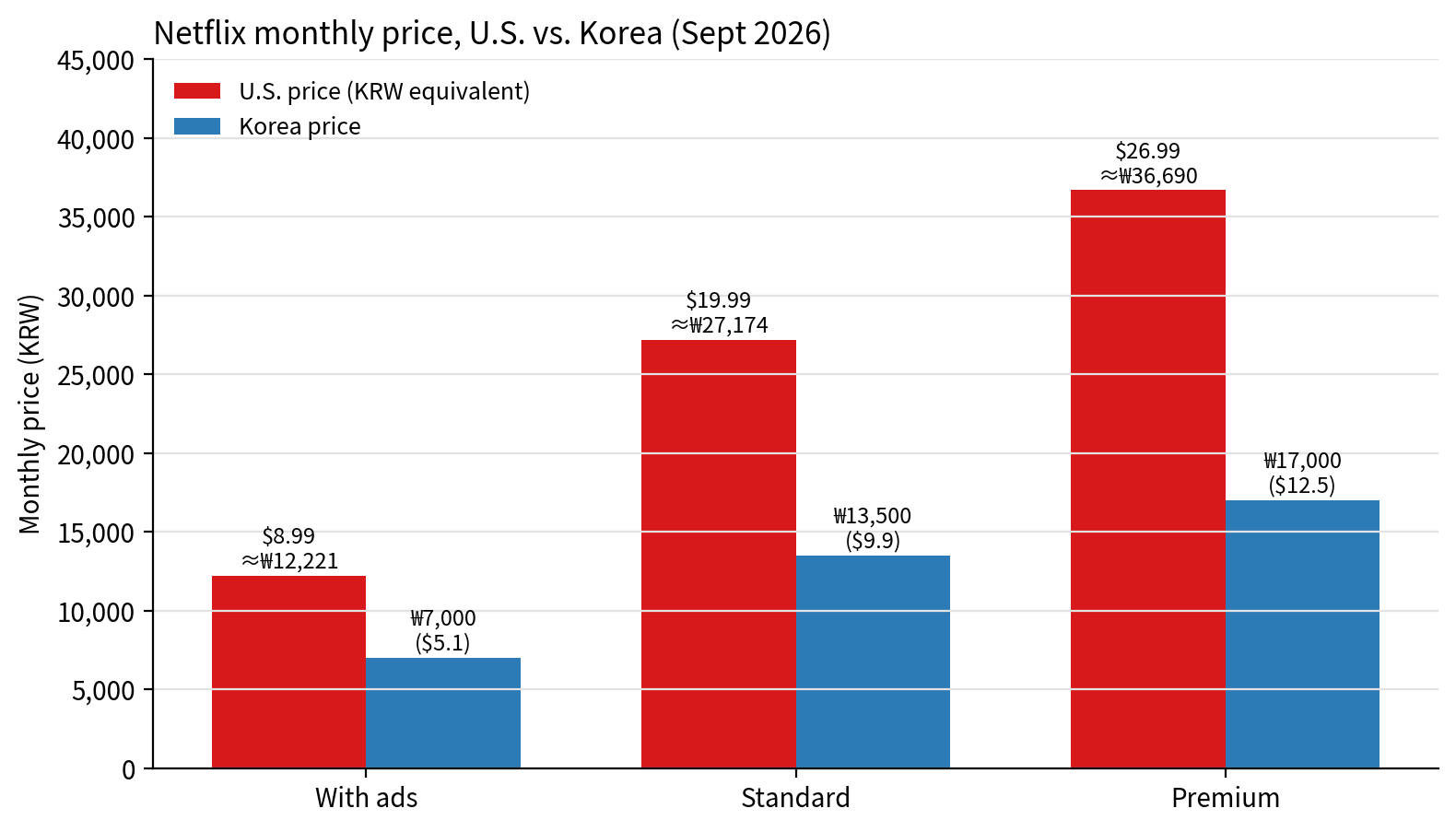
U.S. prices converted at the Seoul FX market reference rate of 1,359.40 won per dollar on September 15, 2026. Source: Netflix U.S. and Korea plan pages
Not every product was frozen. In May 2025 Netflix raised the ad-supported Standard plan from 5,500 to 7,000 won (about $5.10), a 27.3% increase, and the closed Basic plan from 9,500 to 12,000 won. Netflix told the Korea Economic Daily (한국경제) at the time that Korea has the lowest rate and frequency of price increases among the markets it serves. It kept the main ad-free plans and adjusted the ad tier and the legacy low-price plan.
Korean operators also face a regulatory condition. When the Korea Fair Trade Commission (공정거래위원회) approved the TVING (티빙)–Wavve (웨이브) combination through shared executives on June 10, 2025, it ordered both companies to maintain their current plans until December 31, 2026. Prices through the end of this year and the pricing strategy companies choose afterwards therefore have to be read separately; the end of the freeze does not by itself set a schedule for increases.
TVING's web-billed prices are 5,500 won for the ad-supported Standard plan, 13,500 won for Standard and 17,000 won for Premium, though it raised in-app prices for new subscriptions on February 23. Wavve runs four plans from 5,500 won with ads to 13,900 won for Premium, and the TVING–Wavve double pass costs 7,000 won with ads or 9,500 won for Slim. Comparing prices means separating not only standalone from bundle but web billing from in-app billing.
Monthly prices for new subscribers, September 2026. Membership-bundled and separate sports products are shown apart from standalone subscriptions. Source: company plan pages
Rights costs moved first: in 2027 the whole price list is the variable
It cannot be assumed that Korean operators will raise prices as steeply as their U.S. counterparts. But the sports-rights costs cited as grounds for U.S. increases are already growing in Korea.
CJ ENM disclosed on August 6 TVING's exclusive online rights to the KBO League for 2027 through 2031. The amount was not disclosed; SBS Biz reported it at about 450 billion won (about $331 million) over five years, against 135 billion won for the previous three-year deal. Divided by contract length, the new deal averages 90 billion won a year, double the previous 45 billion, a sharper change than the headline totals suggest. The new figure is reported, not disclosed. Coupang Play's (쿠팡플레이) six-season Premier League deal was reported at 420 billion won in total, or about 70 billion won (about $51 million) a year.
On the revenue side, advertising already carries weight. TVING posted second-quarter revenue of 140.7 billion won (about $103.5 million) and its first quarterly operating profit of 6 billion won, with advertising revenue up 52.2%. How far subscriptions can be raised is one variable; how much advertising revenue can be grown from the existing subscriber base is another.
Bundling structures that hold subscribers are also in place in Korea. Netflix's ad tier is included in Naver Plus membership at 4,900 won a month, and the TVING–Wavve double pass and carrier bundles offer prices distinct from standalone plans. Subscribers weigh not only the price of each streaming service but the memberships and mobile plans they already use.
The gap between ad and ad-free prices is worth watching. Netflix Korea's 7,000-won ad plan is about 52% of the 13,500-won Standard plan; in the U.S., the $8.99 ad plan is about 45% of the $19.99 Standard plan. The ratios differ, but both markets attach a substantial discount to accepting ads. How cheap the ad tier stays, how much ad time grows and what goes into the bundle are pricing decisions as important as the subscription fee itself.
So what to watch in Korea in 2027 is not only whether standalone prices rise. It is how the gap between ad and ad-free plans changes, whether sports content carries a separate fee, whether bundle discounts hold, and how much ad exposure increases.
In the U.S. case, the streaming revenue model does not rest on any single price. Ad-free viewing carries a higher price, price-sensitive viewers are absorbed into ad tiers, and multi-service customers are held in bundles. Sports and wider content investment supply the grounds for adjusting that system.
The next competition in streaming does not end with how much content a service secures. It turns on how that cost is divided among subscriptions, advertising and bundles, and how much value is left so that subscribers do not leave. In a market that began with the promise of being cheaper than cable, companies now compete on how to keep viewers choosing a service that costs more.
Notes
Exchange rate: 1,359.40 won per dollar, the Seoul FX market reference rate at the 3:30 p.m. close on September 15, 2026 (Money Today, Steel & Metal News). Won figures are rounded.
Price basis: monthly prices as applied to new U.S. subscribers; existing subscribers see increases one to two months later. Annual plans, promotions and carrier bundles are excluded. Netflix's 2019 base is the $10.99 Standard price in effect before the January 2019 increase, matching Digiday's tally. The $151 figure for eight ad-free services is The Hollywood Reporter's September 9 tally; the set of services is as defined in that article.
Quotation convention: text in quotation marks is a reported statement or notice; unquoted text summarizes reporting. Ampere, Antenna, YouGov and Forrester figures are cited via Business Insider, Antenna's own report, eMarketer and Variety respectively.
Sources
Digiday, Tim Peterson, 'Future of TV Briefing: Every major streaming subscription price increase since 2019', Sept 16, 2026 — https://digiday.com/future-of-tv/future-of-tv-briefing-every-major-streaming-subscription-price-increase-since-2019/
The Hollywood Reporter, 'Streaming Is Raising Prices Faster Than Cable Ever Did', Sept 9, 2026 — https://www.hollywoodreporter.com/business/business-news/streaming-inflation-raising-prices-cable-1236691404/
The Hollywood Reporter, Alex Weprin, '"Streamflation" Is Real: U.S. Inflation Data Shows Soaring Price of Streaming Video Services', Jan 13, 2026 — https://www.hollywoodreporter.com/business/business-news/streamflation-is-real-us-government-data-streaming-video-1236472184/
Variety, 'Streaming Prices Continue to Balloon: Is "Streamflation" at a Breaking Point?', Sept 11, 2026 — https://variety.com/2026/tv/news/streaming-price-increases-2026-streamflation-breaking-point-1236859025/
Variety, Todd Spangler, 'Netflix Raising U.S. Prices for Second Time in Less Than Two Years', Mar 26, 2026 — https://variety.com/2026/tv/news/netflix-raising-prices-second-time-in-a-year-1236700999/
CNBC, 'Netflix raises prices across all streaming plans', Mar 26, 2026 — https://www.cnbc.com/2026/03/26/netflix-raises-prices-across-all-streaming-plans.html
NBC News, 'Netflix to hike prices on standard and ad-supported streaming plans', Jan 21, 2025 — https://www.nbcnews.com/business/consumer/netflix-hike-prices-standard-ad-supported-streaming-plans-rcna188716
Peacock Help Center, 'Price Increase', Aug 2026 — https://www.peacocktv.com/help/article/price-increase
Deadline, 'Peacock Hikes Prices Across All Subscription Plans', Aug 18, 2026 — https://deadline.com/2026/08/peacock-raises-prices-across-plans-1237044536/
Los Angeles Times (via Yahoo), 'Peacock increases subscription price by $3 a month', Jul 17, 2025 — https://www.yahoo.com/news/peacock-increases-subscription-price-3-201115593.html
9to5Mac, Chance Miller, 'Apple announces price increase for Apple TV and Apple One subscriptions', Aug 28, 2026 — https://9to5mac.com/2026/08/28/apple-announces-price-increase-for-apple-tv-and-apple-one-subscriptions/
MacRumors, 'Apple TV Streaming Service Receives Price Increase', Aug 28, 2026 — https://www.macrumors.com/2026/08/28/apple-tv-price-increase/
TechCrunch, 'Apple TV+ price jumps 30% to $12.99 monthly', Aug 21, 2025 — https://techcrunch.com/2025/08/21/apple-tv-price-jumps-30-to-12-99-monthly
CBS News, 'Disney raising streaming prices for Disney+, Hulu and ESPN', Sept 23, 2025 — https://www.cbsnews.com/news/disney-streaming-price-hikes/
TechCrunch, 'Disney is raising the price of Disney+, Hulu subscriptions next month', Sept 23, 2025 — https://techcrunch.com/?p=3049255
TechCrunch, 'Disney is increasing the price of its ad-free Disney+ subscription to $10.99', Aug 10, 2022 — https://techcrunch.com/?p=2370232
Variety, 'Paramount+ to Hike U.S. Prices in January 2026', Nov 11, 2025 — https://variety.com/2025/tv/news/paramount-to-hike-prices-in-early-2026-1236574467/
Variety, 'ESPN Streaming Plan Price Increase Effective in September 2026', Aug 2026 — https://variety.com/2026/tv/news/espn-streaming-price-increase-espn-unlimited-1236841594/
Sports Media Watch, 'ESPN Unlimited sets first price increase', Aug 2026 — https://www.sportsmediawatch.com/2026/08/espn-unlimited-first-price-increase-september/
eMarketer, 'Streaming price hikes make ads the new main event', Mar 2026 — https://www.emarketer.com/content/streaming-price-hikes-make-ads-new-main-event
eMarketer, 'Streaming's ad-free tier is getting pricier by the year', Oct 2025 — https://www.emarketer.com/content/streaming-s-ad-free-tier-getting-pricier-by-year
The Independent (via AOL), 'Streaming services now cost more than cable TV', Aug 2023 — https://www.aol.com/news/streaming-services-now-cost-more-082024342.html
Korea Economic Daily (한국경제), Choi Ji-hee, 'Netflix raises ad-supported plan from 5,500 to 7,000 won', May 9, 2025 — https://www.hankyung.com/article/202505092251i
ET News (전자신문), 'Netflix raises ad plan 27%', May 9, 2025 — https://www.etnews.com/20250509000129
Seoul Economic Daily (서울경제), 'TVING–Wavve merger approved on condition prices hold through end-2026', Jun 10, 2025 — https://www.sedaily.com/article/14076762
Money Today (머니투데이), 'Won/dollar closes up 12.1 won at 1,359.4', Sept 15, 2026 — https://www.mt.co.kr/economy/2026/09/15/2026091515343525913
TVING, Wavve, Disney+ Korea and Coupang Play plan pages (checked Sept 2026); CJ ENM disclosure, Aug 6, 2026; Financial News (파이낸셜뉴스), Oct 8, 2025; SBS Biz, Aug 2026