
K-EnterTech Hub Analysis | Media M&A
99.9% of voting Fox Class B shares and 81.5% of Roku's voting power back the $22 billion deal, which now waits on a Justice Department second request before a targeted first-half 2027 close
Shareholders of Fox Corporation and Roku approved Fox's $22 billion acquisition of the streaming-platform company at separate special meetings on Wednesday, Oct. 14.
Of the 197.48 million Fox Class B voting shares cast, 197.36 million were in favour, with 71,891 against and 45,001 abstaining. At Roku, 241.04 million votes backed the merger agreement, equal to 81.5% of outstanding voting power. The outcome there was never in much doubt: founder and chief executive Anthony Wood and related entities control a majority of Roku's votes and had signed an agreement to support the deal.
The timetable now belongs to the U.S. Department of Justice. The DOJ sent both companies a "second request" for documents and data on Sept. 8, which extends the Hart-Scott-Rodino waiting period until 30 days after Fox and Roku have substantially complied. Fox still expects to close in the first half of 2027.
What the antitrust review turns on is where Roku sits. Roku is the No. 1 TV streaming platform by hours streamed in the U.S., Canada and Mexico and reaches more than 100 million households worldwide. A company that owns news and sports networks is buying the operating system through which its competitors' streaming services reach the TV, and Democratic lawmakers and rival programmers have argued Fox could favour its own content and Tubi on Roku's screens. As Fast Company noted, the deal would be the first time a major media company has had full control of a major streaming TV platform.
Fox Class B holders vote 99.9% in favour; Murdoch calls it "transformative"
At the Fox meeting, executive chair and CEO Lachlan Murdoch called the acquisition a "transformative transaction" that pairs Fox's live sports and news with Roku's streaming distribution and technology platform, TheWrap reported. What Fox Class B holders actually approved was the issuance of roughly 144 million new Fox Class A shares to Roku stockholders. Because the issuance exceeds 20% of Fox's outstanding stock, Nasdaq listing rules required a shareholder vote, Cord Cutters News explained.
Roku published its certified tally the same day in a filing with the Securities and Exchange Commission. An advisory vote on merger-related executive pay passed with 99.3% of the votes present.
Special meeting results, Oct. 14, 2026. Source: Fox and Roku SEC filings
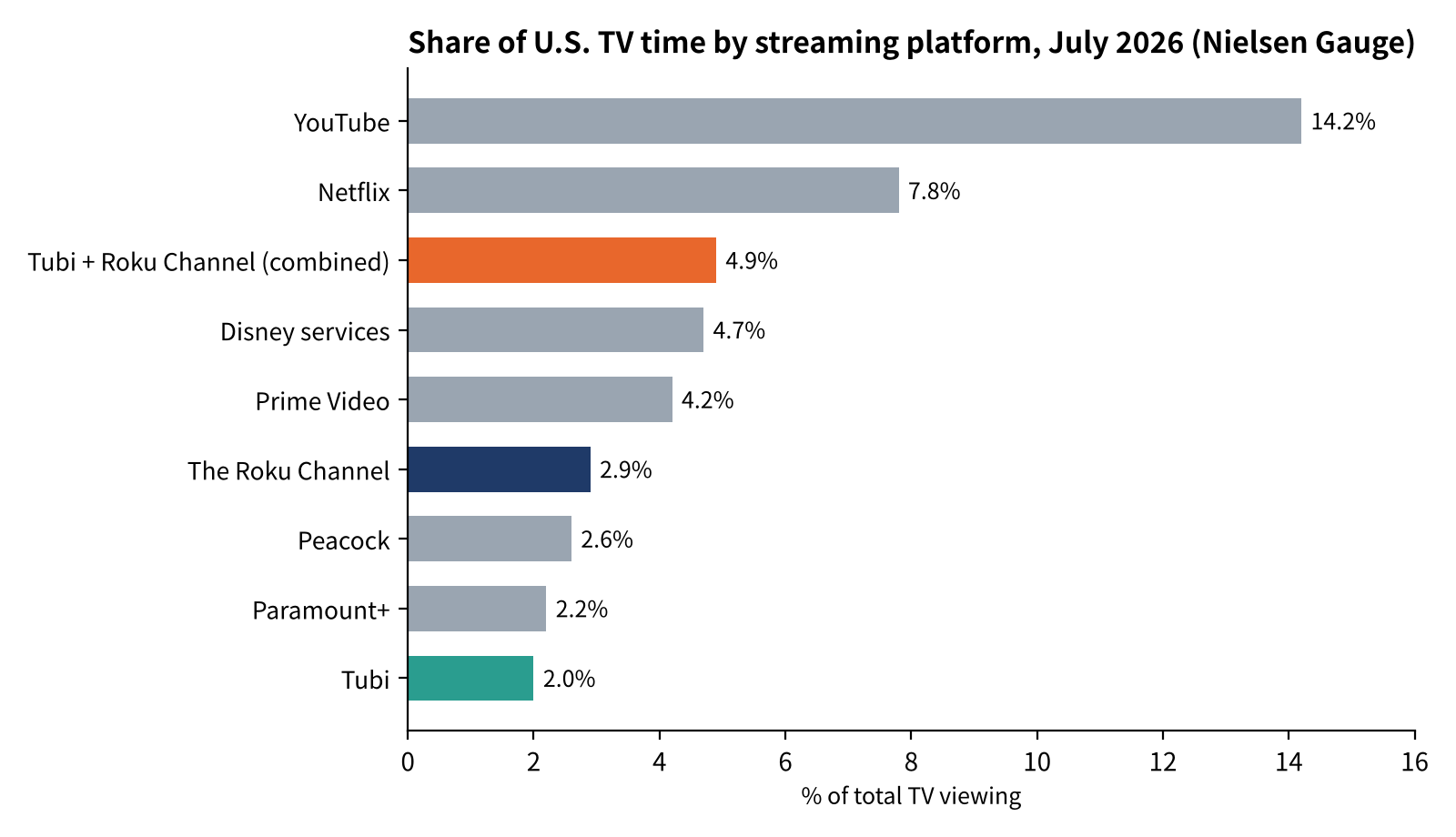
$160 a share: $96 in cash plus 0.9693 Fox Class A shares
The terms are unchanged from the June 15 announcement. For each Roku share Fox will pay $96 in cash and 0.9693 Fox Class A shares.
The Fox press release valued the stock component at $64, using a reference price of $66.03, Fox's 10-day volume-weighted average as of June 10, for a total of $160 a share. The cash portion comes to about $14.2 billion, according to Variety, and Fox lined up $12 billion of committed bridge financing from Morgan Stanley. The Hollywood Reporter put Fox's new borrowing for the deal at $8 billion.
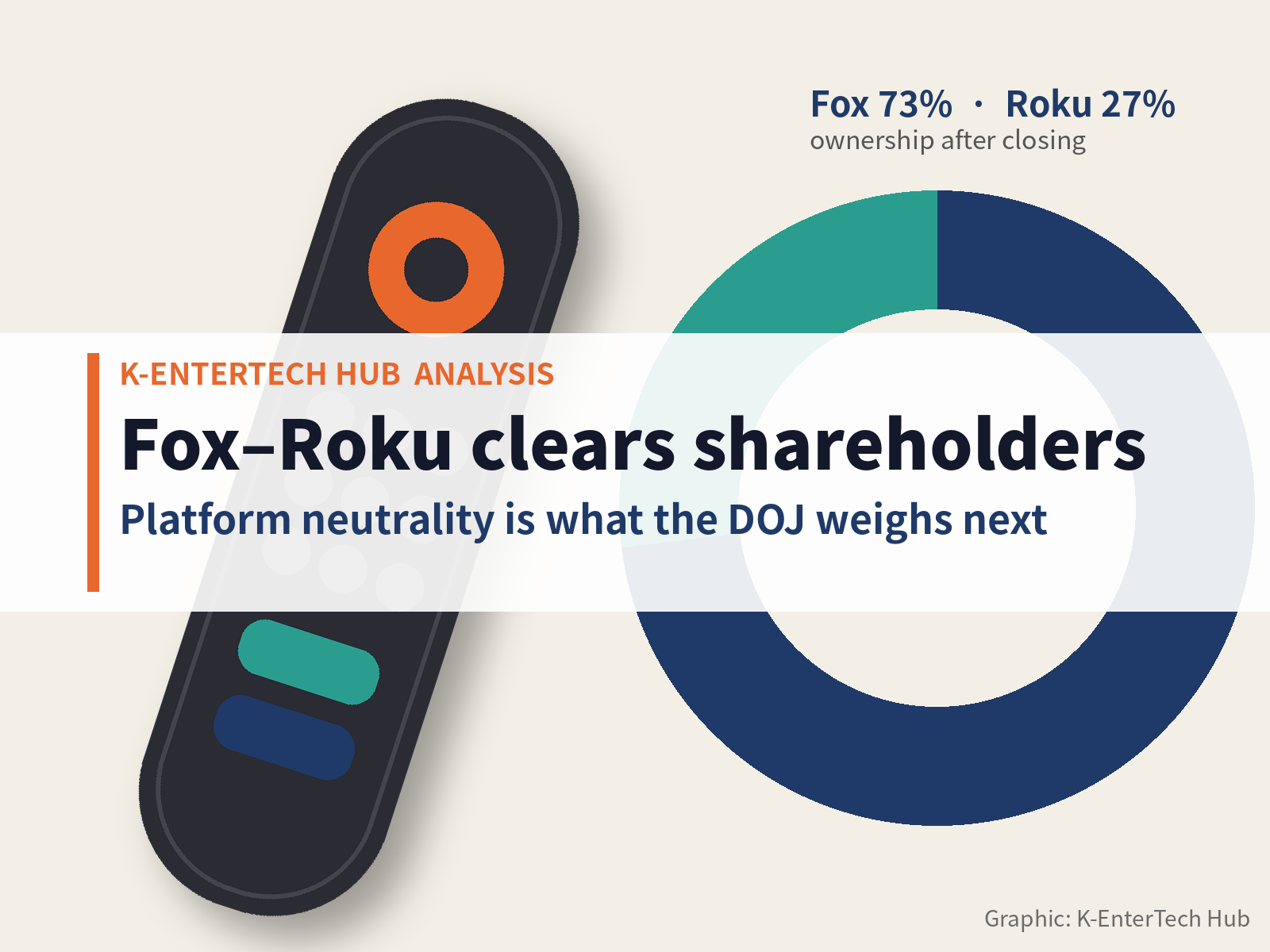
Fox is targeting about $400 million a year in cost savings and says the deal will add to free cash flow per share by the second full fiscal year after closing. Existing Fox holders will own about 73% of the combined company and Roku holders about 27%, and Wood will join Fox's board. The Hollywood Reporter also carried an analyst's reminder that Fox sold its 6 million Roku shares at $58 apiece in 2020 to help pay for Tubi.
Tubi plus The Roku Channel: 4.9% of TV time, behind only YouTube and Netflix
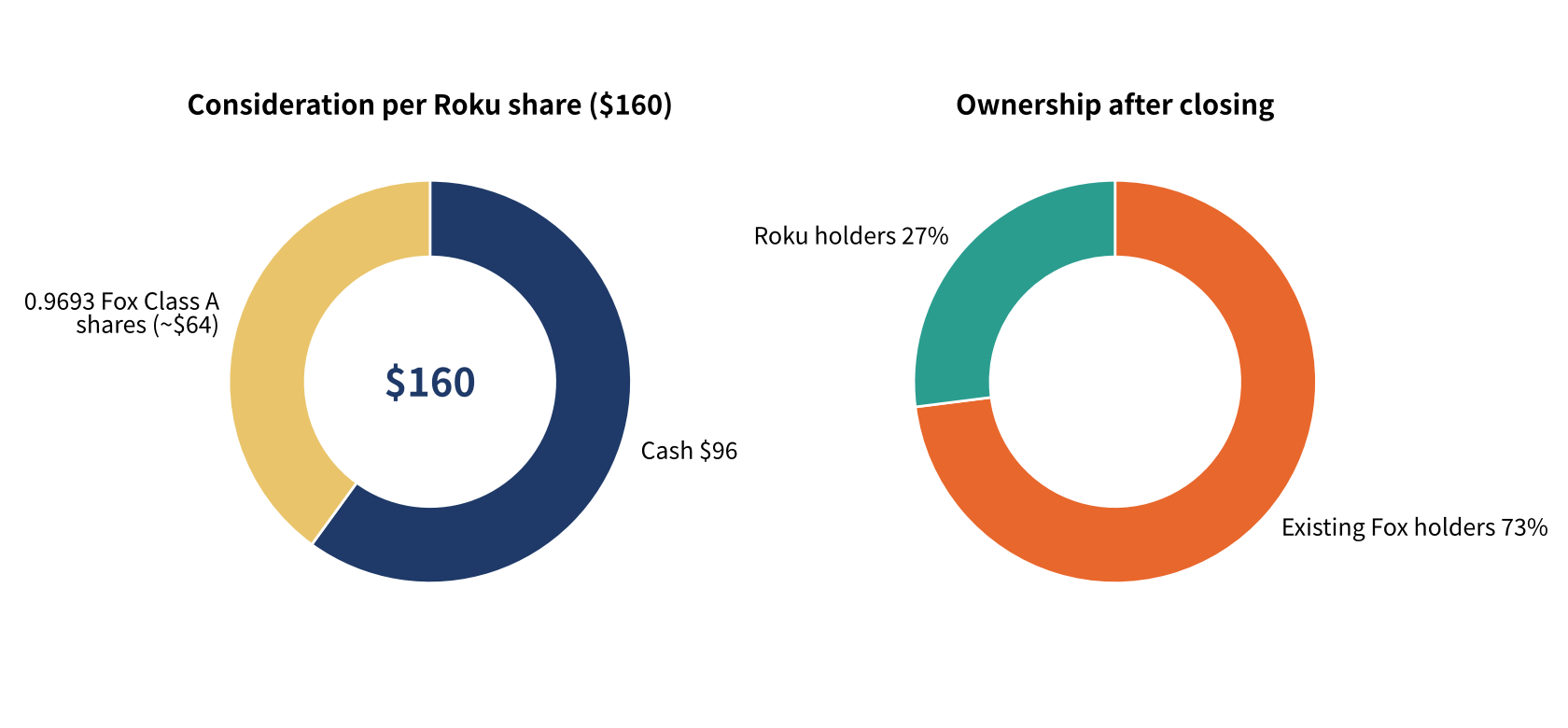
In Nielsen's July 2026 Gauge, The Roku Channel accounted for 2.9% of all U.S. TV viewing and Tubi for 2.0%. Together that is 4.9%, behind YouTube (14.2%) and Netflix (7.8%) and ahead of Disney's combined services (4.7%), Cord Cutters News calculated. On Nielsen's Media Distributor Gauge, which groups viewing by parent company, Fox drew 7.8% in July, level with Netflix; adding Roku's 2.9% takes the combination to 10.7%. TheWrap said that would make it the third-largest media distributor in the U.S., after YouTube and the combined Paramount-Warner Bros. Discovery. Fox's July figure includes World Cup viewing.
Tubi's revenue grew 35% in Fox's fiscal fourth quarter (April–June), on a 17% rise in total viewing time, and the service ended the fiscal year with 110 million monthly active users. In June, Murdoch told investors that "it's too early to say, but our expectation is fully that you keep the services separate," noting that only about a third of the two audiences overlap.
TheWrap's analysis found that roughly 90% of Tubi viewing is on-demand, while more than 80% of Roku Channel viewing comes from its live FAST channels. Fast Company was sceptical: if Roku promotes both services to 100 million homes, it argued, the overlap will only grow, and insisting on separation reads more like a way to sidestep antitrust concern.
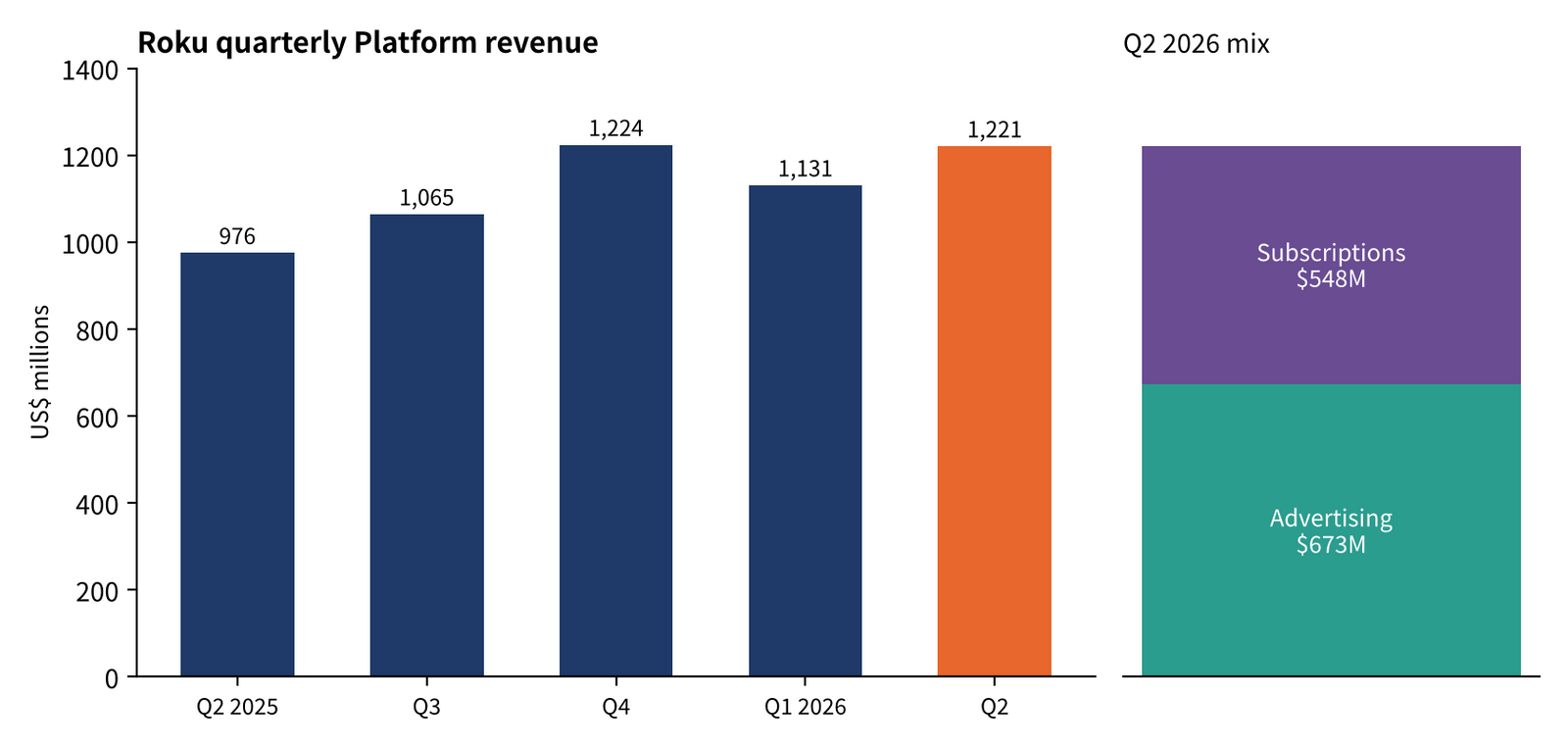
Roku Platform revenue reaches $1.22 billion in Q2, with ads up 25% and subscriptions up 26%
Roku's total revenue rose 22% year on year to $1.35 billion in the second quarter of 2026. Platform revenue, which combines advertising and subscriptions, climbed 25% to $1.22 billion: advertising rose 25% to $673 million and subscriptions 26% to $548 million. Net income of $164 million was a quarterly record, and trailing 12-month free cash flow reached $704 million. Streaming hours grew 7% to 37.9 billion, and The Roku Channel was the No. 2 app on the platform by engagement in the U.S., the shareholder letter said. With the deal pending, Roku held no earnings call and gave no outlook.
What Fox is buying, above all, is advertising data. EMARKETER senior analyst Ross Benes told CBS News that the deal would more than double Fox's annual connected-TV ad revenue. EMARKETER argued that first-party viewing data and device-level identity from Roku's operating system would put Fox in the same targeting conversation as Amazon and Google. The same note cited Omdia figures showing Roku OS with 31% of smart-TV shipments in 2025, a share projected to fall to 13% by 2029 as Walmart's onn TVs switch operating systems.
A Democratic letter and a DOJ second request centre on self-preferencing
The antitrust case was made first on Capitol Hill. On July 17, Sen. Elizabeth Warren, Rep. Becca Balint and other Democrats wrote to Associate Attorney General Stanley Woodward urging the department to "closely scrutinize" the deal. They argued that the combined company would have an incentive to "preference and steer" Roku's 100 million streaming households toward Fox news, sports and entertainment, and that its integrated viewing data could help it gauge how much customers would pay and raise prices, TheWrap reported. Removing Roku as an independent company could also weaken competition in free ad-supported streaming and open the door to fees on services that are free today, the letter said, according to The Desk.
Semafor broke the news of the second request on Sept. 8, reporting that rivals fear Fox will favour its own content and that the move, while not unusual, suggests scepticism about how the merger would affect consumer access to streaming. TechCrunch pointed to the Murdochs' ties to President Trump and framed the review as a test of how closely the DOJ examines politically sensitive mergers. Fox and Roku have pledged to run Roku as "an open, partner-friendly platform."
New ID (뉴 아이디) runs about 400 K-content FAST channels across 30 platforms, Tubi among them
Folding Tubi and The Roku Channel into one company changes who Korean content suppliers negotiate with in the U.S. New ID (뉴 아이디), which began as an in-house venture at the Korean studio NEW, operates about 400 FAST channels built mainly on Korean content across some 30 platforms, including Samsung TV Plus, LG Channels, Amazon Prime Video, Paramount's Pluto TV and Fox's Tubi, VentureSquare (벤처스퀘어) reported on Aug. 14. The company said first-half 2026 revenue had already reached 86% of its full-year 2025 total, with exports above $7.5 million. It launched its kids' channel TOONY PLANET (투니 플래닛) on The Roku Channel in April 2023.
The Desk has noted that Fox has yet to say whether it will license content and live channels for the two apps separately or as a bundle. A bundled approach would put Korean channel suppliers across the table from the two largest U.S. FAST services at once. And because Murdoch has said Fox will sell advertising across both, the revenue-share terms Korean suppliers receive would follow a single company's sales model.
Korea's 20 K-FAST channels reach 22 countries through Samsung and LG TV platforms
Korean government money is in the same market. Under the "AI-dubbed K-FAST" programme run by the Ministry of Science and ICT (과학기술정보통신부) and the Korea Association for ICT Promotion (한국정보통신진흥협회, KAIT), some 1,200 Korean titles (about 1,400 hours) were dubbed into English, Spanish and Portuguese and packaged into 20 channels.
Distributed since December through Samsung TV Plus and LG Channels in 22 countries including the U.S., Canada and Mexico, the channels had reached a cumulative 100 million viewers by the end of April, Digital Daily (디지털데일리) reported on July 9. This year three consortia led by Hudson AI (허드슨에이아이), ESTsoft (이스트소프트) and UnAI (언에이아이) are building four more channels, with about ₩230 million ($173,000) in support per channel.
That the programme's outlets are concentrated on Korean TV makers' platforms is where it meets the Fox-Roku deal. Fox wants Roku because a TV operating system and the free channel service built into it hold both the viewing data and the ad sales, and Samsung's Tizen and LG's webOS occupy the same position. Once the deal closes, the two largest outlets outside the TV makers' own platforms through which Korean suppliers reach U.S. FAST viewers will belong to one company.
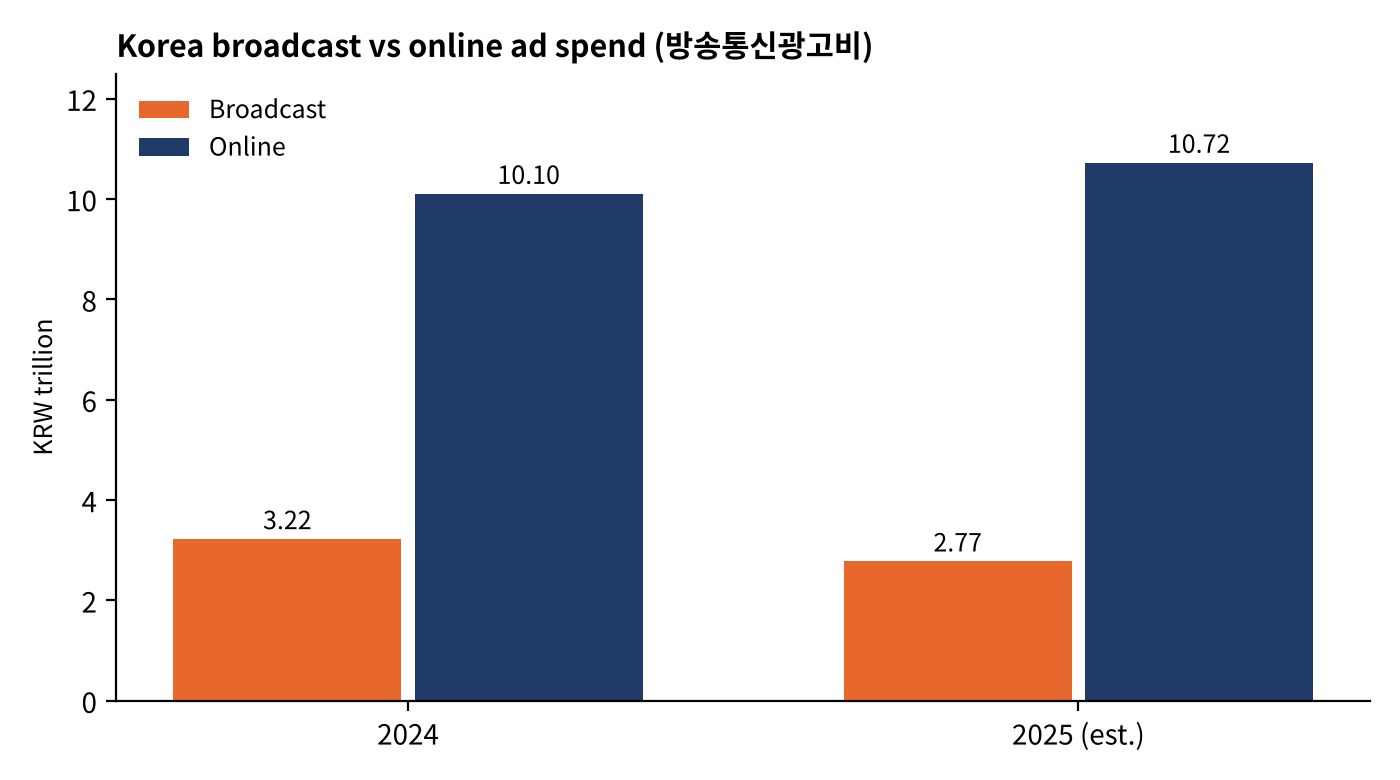
Korean broadcast ad spend falls 13.8% to ₩2.77 trillion, and broadcasters own no TV platform
In the 2025 Broadcasting and Communications Advertising Expenditure Survey released in January by the Korea Communications and Media Commission (방송미디어통신위원회) and the Korea Broadcast Advertising Corporation (한국방송광고진흥공사, KOBACO), broadcast advertising fell 5% to ₩3.22 trillion ($2.42 billion) in 2024 and was estimated to drop a further 13.8% to ₩2.77 trillion ($2.09 billion) in 2025, Asia Economy (아시아경제) reported. Online advertising was projected at ₩10.72 trillion, or 62.1% of the total. In a companion survey of advertisers, "accuracy of target reach" was the top reason for buying streaming ads, cited by 53.4%, The Herald Business (헤럴드경제) reported.
Fox is itself a broadcaster, with a broadcast network and cable news and sports channels. It bought Tubi in 2020 to move toward data-driven ad sales, and now it is buying a platform that owns the TV screen and the data behind it.
Korean terrestrial and general-programming channels reach viewers through IPTV and cable set-top boxes and through manufacturers' smart TVs, and the data and ad inventory generated on those screens belong to the telecom operators and the TV makers. When Korean broadcasters go abroad with FAST channels, the counterparties are again platforms: Samsung and LG, or Tubi and Roku. In a market where advertisers move money on targeting accuracy, the places Korean broadcasters can build data of their own come down to their own streaming apps and the data-sharing clauses they can write into FAST distribution contracts.
Outlook: a first-half 2027 close, then the NFL and a reshuffle of channel deals
Thirty days after Fox and Roku substantially comply with the second request, the DOJ can clear the merger, settle on conditions, or sue to block it. The lawmakers' letter and Semafor's reporting point to the same issue: whether Fox content and Tubi get favoured placement and recommendations on Roku's home screen. Whether Fox's "open, partner-friendly platform" pledge becomes a binding condition is the next variable in the deal.
Sports rights holders are watching too. An analyst quoted in TheWrap's analysis suggested that Fox's balance-sheet strength and the speed at which the combined company can pay down debt may embolden the NFL to renegotiate its post-2029 media-rights options before the end of 2026. With Roku, Fox could bring both a broadcast network and a 100-million-household platform to that table.
For Korean content suppliers, the months before closing are a window to review terms. Renewal dates on separate channel deals with Tubi and The Roku Channel, revenue-share formulas and the scope of viewing data they receive could all be reset to fit the combined company's sales model. Seoul's K-FAST programme currently relies on Samsung and LG platforms; whether to add Fox-Roku, about to become the largest FAST operator in the U.S., is a question for next year's programme design. For Korean broadcasters, how much viewing data they get back from overseas FAST deals bears directly on their leverage with advertisers.
Won conversions use the Seoul foreign-exchange market close on Oct. 19, 2026: $1 = ₩1,330.3. Text in quotation marks is speech or filing language as reported; unquoted attributions summarise reporting. Nielsen's Gauge measures shares by streaming platform and its Media Distributor Gauge by parent company; the 4.9% figure sums the former, the 10.7% figure the latter.