

MIPCOM 2026 | K-ENTERTECH HUB ROUNDTABLE, CANNES
At a closed-door roundtable on the eve of MIPCOM, European and US distributors described markets split into hundreds of operators, from Poland's 300 to Latvia's 70, each wanting its own language. Hudson AI demonstrated AI dubbing, and offered to test it in Latvian and Polish
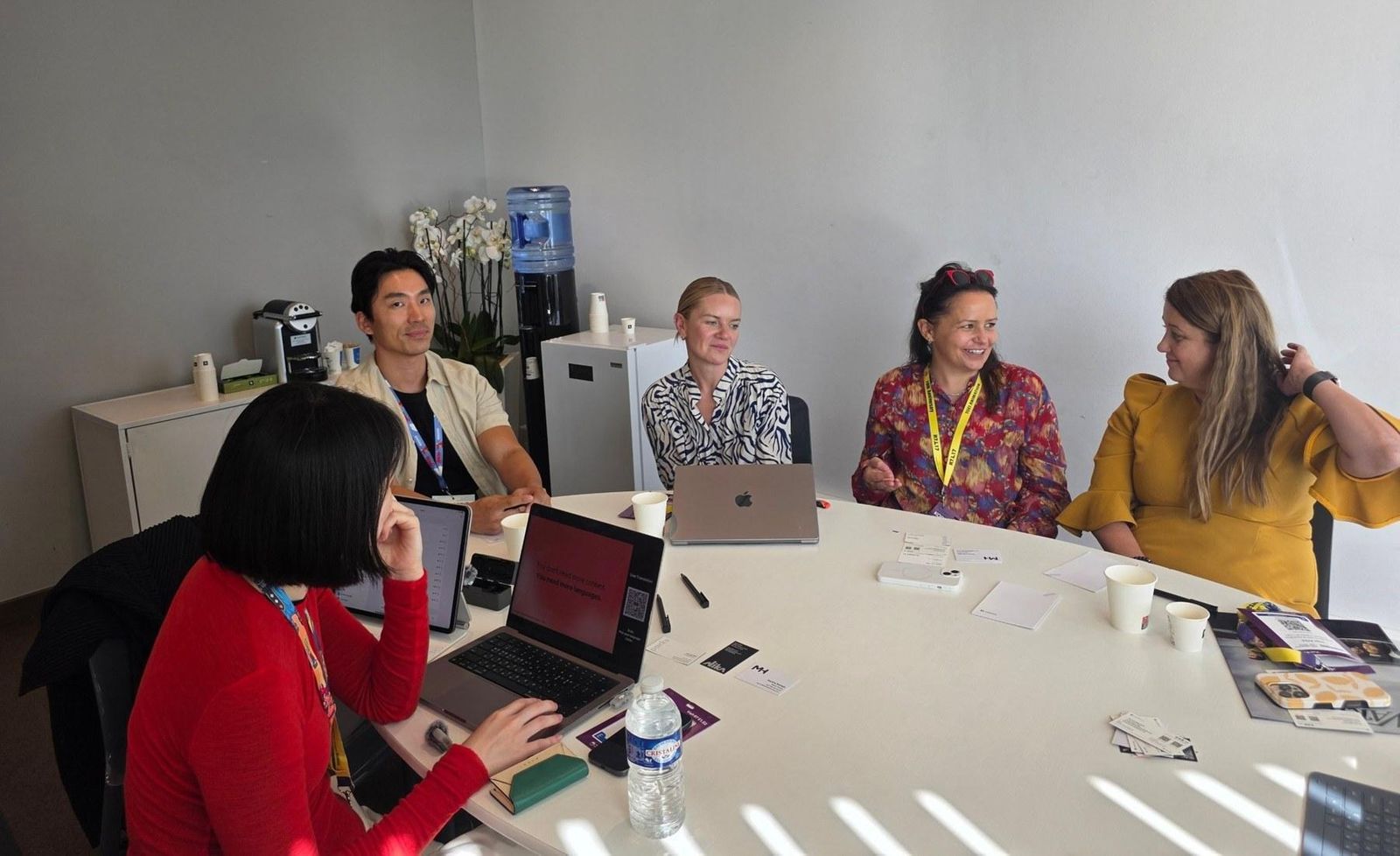
K-EnterTech Hub (케이엔터테크허브) hosted a closed-door Korean Content & Entertainment Tech roundtable in Cannes on October 11, the day before MIPCOM 2026 opened. The session took place in an RX meeting room on the ground floor of the Palais des Festivals and ran for about 80 minutes. It was billed as an information exchange, not a sales event. Around the table were European and US distribution specialists and Hudson AI (허드슨에이아이), a Korean AI dubbing company.
The Europeans' advice to Korean content owners was to put shows on free ad-supported streaming (FAST) channels first, build an audience there, and only then open a premium window on subscription services. Every step, they said, depends on having the show in the viewer's language. Polish partners will not buy without Polish. In Latvia, a channel cannot carry Russian audio unless a Latvian version comes with it.
The reasons are structural. Europe is a patchwork of national markets. Poland has about 300 pay-TV operators and Latvia, a much smaller country, about 70. Viewers in Italy and Spain expect local-language versions. Many telcos still run legacy delivery systems without the server-side ad insertion (SSAI) and programmatic advertising they need to launch FAST channels.
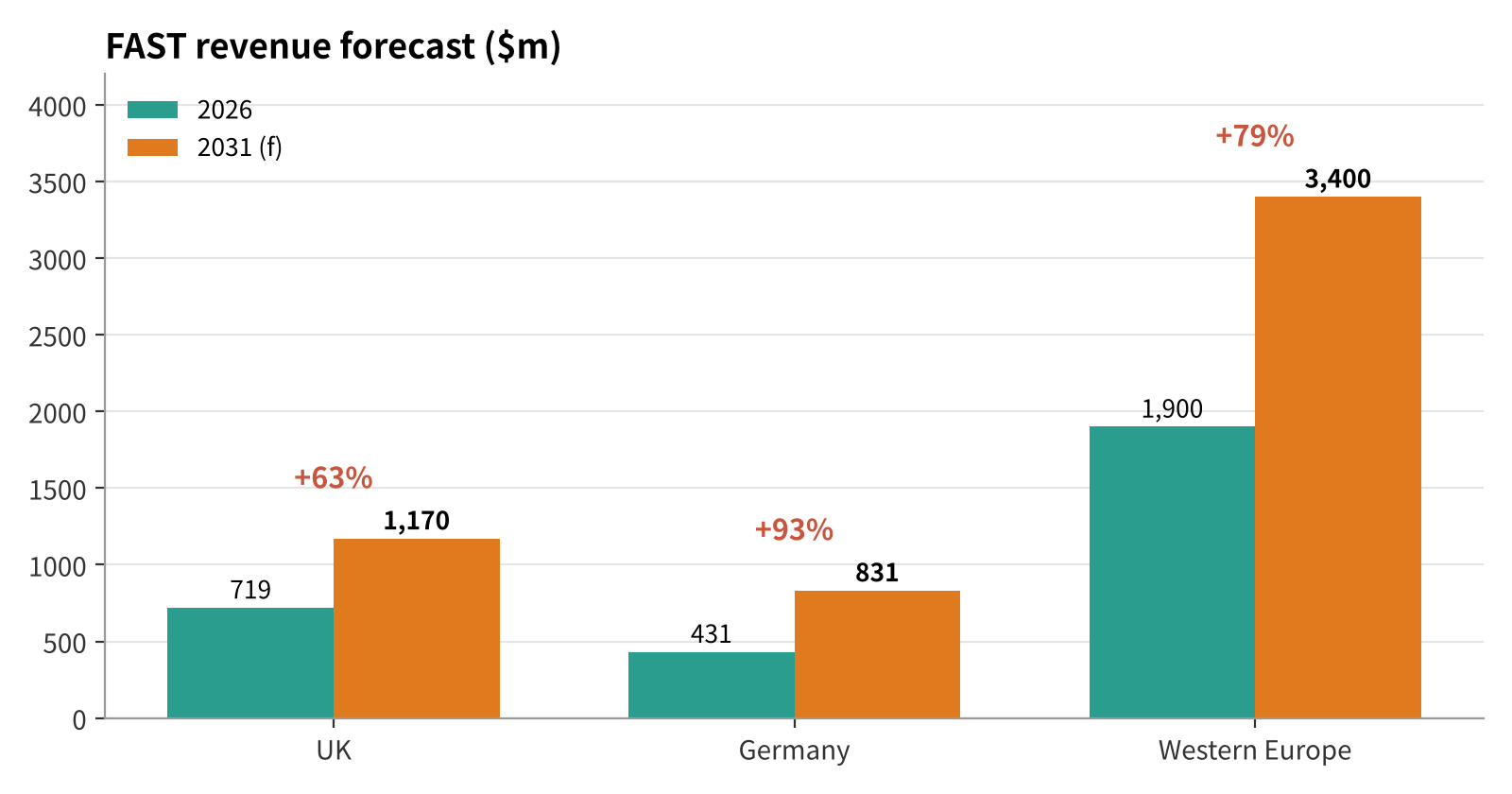
A free channel, on the other hand, removes the barrier for viewers who have never seen a Korean drama. FAST has "no blocker," said Karina Rompa, founder of Media Hansa, who until recently sold Rakuten TV to European telcos. Research firm 3Vision forecasts Western European FAST revenue will grow 76%, from $1.9 billion in 2026 to $3.4 billion in 2031.
Demand for Korean content is not in question; in 2019 it was the most pirated content in Latvia. Language and access are the bottlenecks, and newcomers to the Latvian market are unwilling to pay for localisation. Shin Hyun-jin (신현진), Hudson AI's chief executive, demonstrated a dubbing tool that supports more than 80 languages, and proposed a test of about ten minutes in Latvian, Polish or other Eastern European languages.
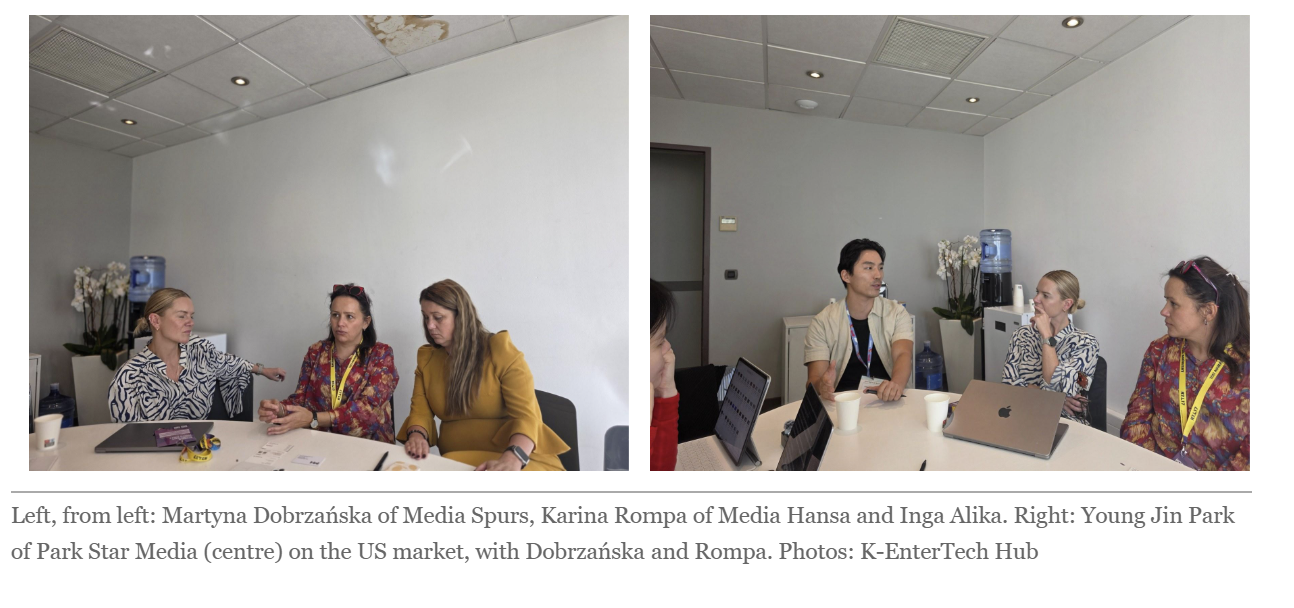
Rompa told the host she would come with Inga Alika from Latvia, and Martyna Dobrzańska of Warsaw agency Media Spurs joined at her suggestion. Their own introductions filled in the rest. Rompa spent 15 years buying content for pay-TV platforms, handling partnerships with Netflix, HBO, Amazon and Viaplay, then two years selling Rakuten TV to telcos; she founded the consultancy Media Hansa two years ago and is about to take charge of content acquisition for the TV operating system Titan OS.
Alika spent more than 20 years in cable content acquisition and building a Latvian telco's pay-TV and advertising business, and for the past three years has advised companies, including Latvia's public broadcaster, on digital strategy. Media Spurs is a boutique agency that helps international media companies launch in Poland and Central and Eastern Europe, representing news, music, series and sports channels in deals with telcos and TV operators. Young Jin Park (박영진), co-founder of Park Star Media, works with IP owners and brands in Korea and China, helping Korean broadcasters, comics companies and YouTubers expand into the US.
Main participants at the K-EnterTech Hub roundtable in Cannes
Source: K-EnterTech Hub; participants' self-introductions
Who said what
Rompa: FAST has "no blocker"; Western Europe's FAST revenue forecast to rise 76% in five years
Rompa spent 15 years acquiring content for pay-TV platforms, doing deals with Netflix, HBO, Amazon and Viaplay, then two years distributing Rakuten TV's products to European telcos, work she recently wrapped up. She runs Media Hansa, a consultancy in Warsaw, and is about to take charge of content acquisition for Titan OS, an independent smart-TV operating system used by set makers smaller than Samsung and LG.
The FAST-first sequence came up in this outlet's trend briefing, which proposed starting existing Korean titles on AVOD and FAST. Inga Alika, a media and streaming strategy consultant from Riga who runs Alika Media and Tech, pushed back: why not a subscription platform like Netflix? Rompa took the question.
For people who have never watched Korean content, she said, a free channel has "no blocker," and she called FAST the "discovery" stage. Services such as Rakuten Viki already gather Asian content in Europe, but viewers have to go looking for them. Once a free audience exists, a premium SVOD window can follow.
The US and Europe started from different places, Rompa noted. America never had a free-to-air tradition, which is why FAST grew so large there. Europe does have one, but FAST is now growing faster. Cord-cutters still want something to watch, she said, and that is pushing viewing toward free channels.
3Vision's forecast has Western European streaming revenue rising 41%, from $53.3 billion in 2026 to $74.9 billion in 2031. FAST grows 76% and AVOD 53% over the period, outpacing SVOD at 35%. In Spain, 35% of online adults watch FAST at least monthly, Omdia found, against 26% in the UK, 25% in Germany and 17% in France.
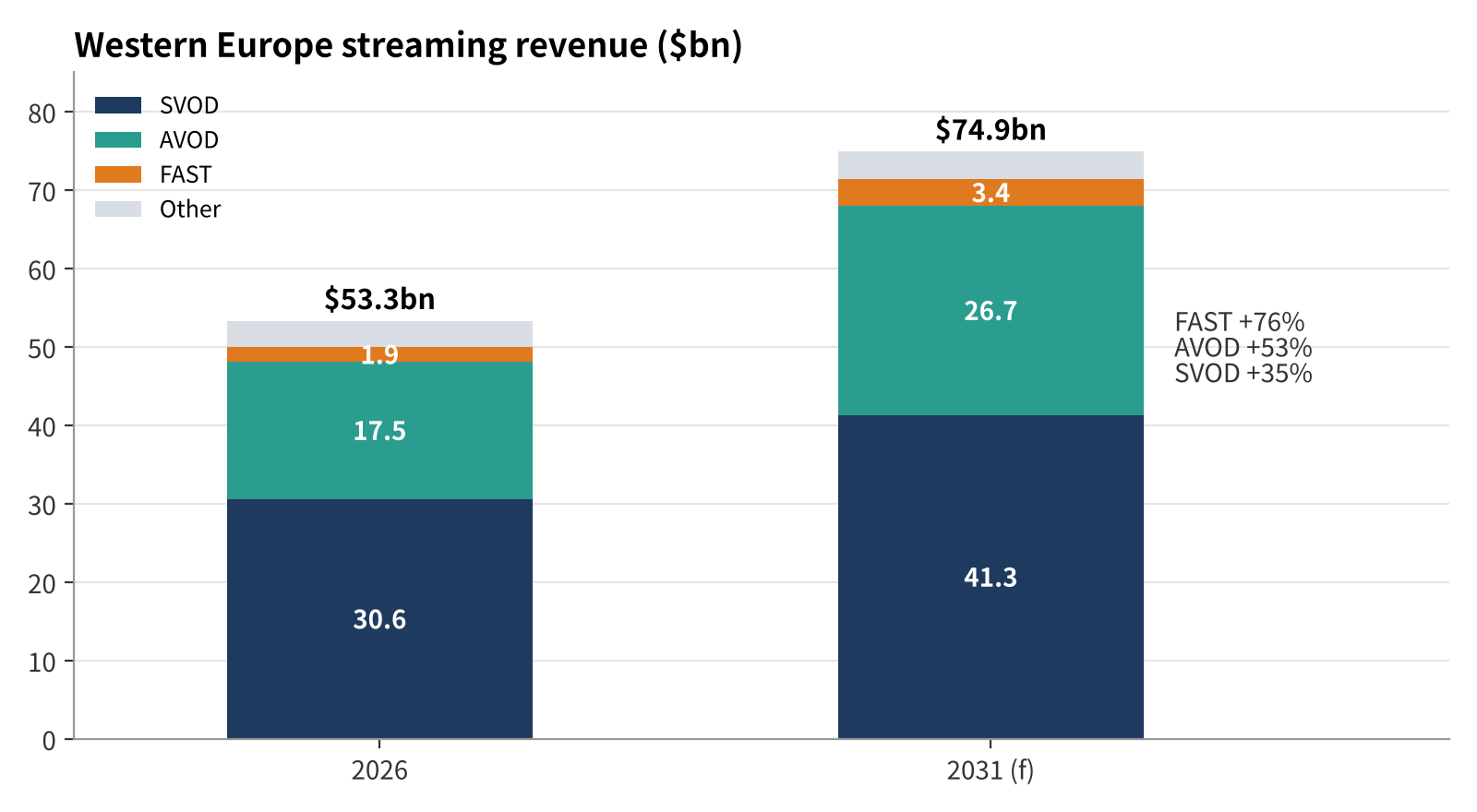
Western Europe streaming revenue forecast; FAST grows fastest, at 76% between 2026 and 2031. Source: 3Vision via Señal News, August 17
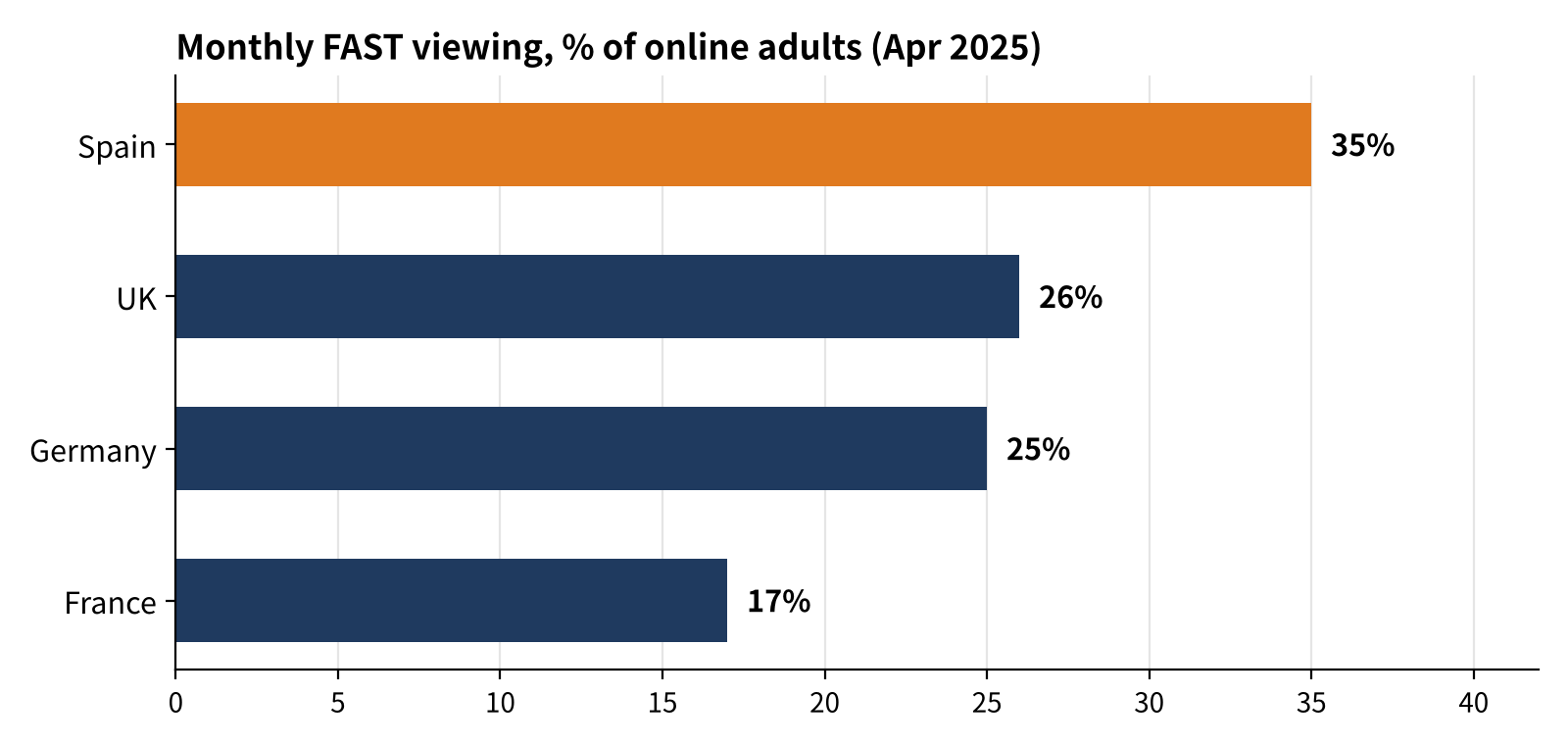
Share of online adults watching FAST at least monthly, April 2025. Source: Omdia
300 operators in Poland, 70 in Latvia; Italy and Spain won't buy without a local dub
Poland alone has about 300 operators, said Martyna Dobrzańska, head of partnerships at Media Spurs, a boutique TV agency in Warsaw that helps international media companies launch in Poland and Central and Eastern Europe. The agency represents news, music, series and sports channels and does deals with telcos and TV operators. It uses AI to take a German-language kids' animation into Polish and has just begun selling microdrama. Rompa added that a handful of those 300 matter most, with a long tail behind them.
Alika spent more than 20 years on the corporate side, first buying content for cable TV, then building a Latvian telco's pay-TV and advertising business. For the past three years she has worked independently on digital strategy, including for Latvia's public broadcaster. Latvia, she said, has about 70 smaller operators, with perhaps two majors splitting most of the market. Larger countries such as Germany are far less fragmented, Rompa pointed out.
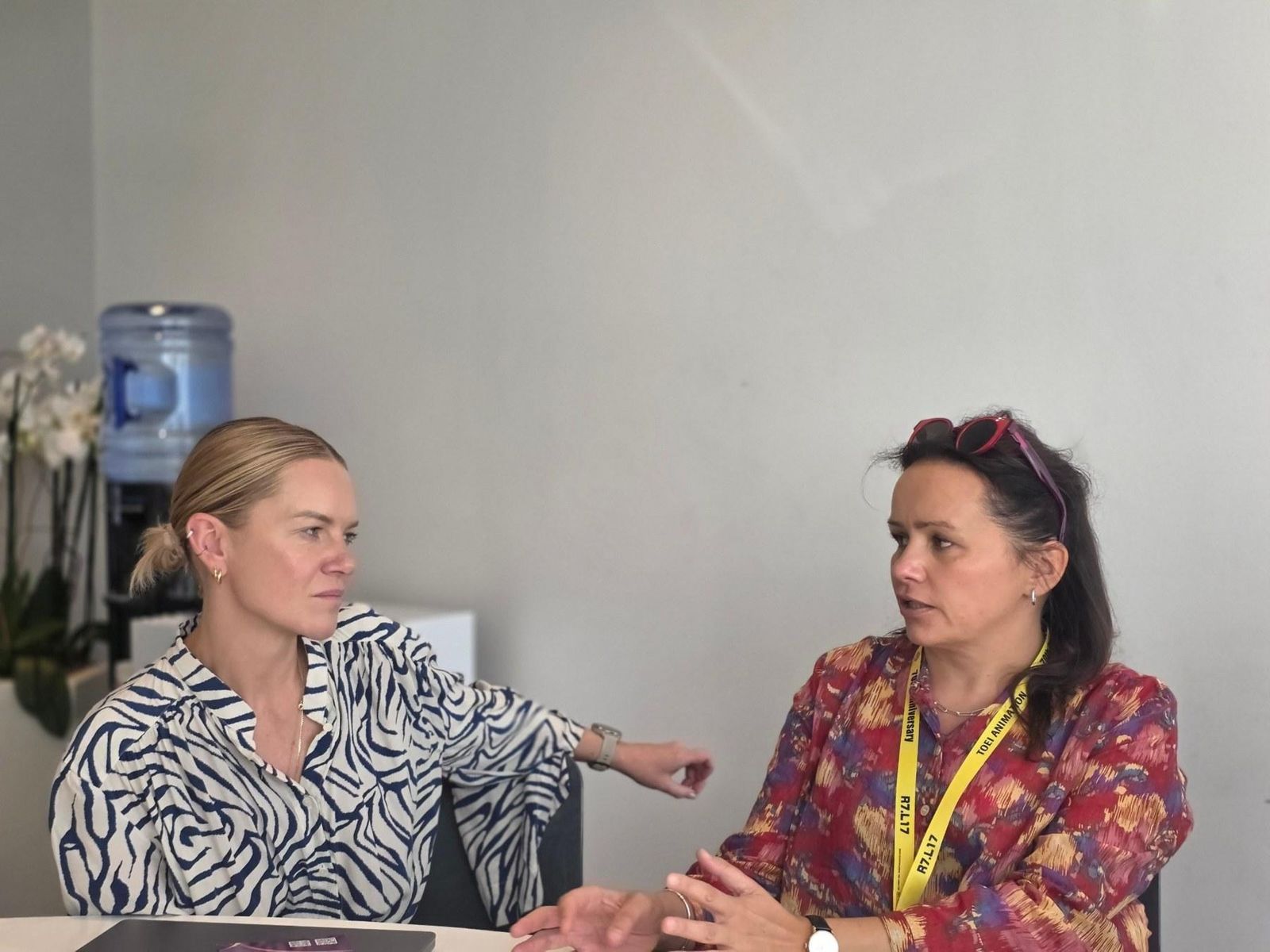
In Italy and Spain a local-language version is a must, Rompa said, while viewers in the Netherlands and Scandinavia are comfortable in English. In France, Canal+ has handled most distribution and acted as gatekeeper, though that is changing. Italy needs an Italian speaker who is known in the market. Alika noted that the leading connected-TV platform varies by country; across Europe as a whole, Rompa said, Samsung is number one.
Asked by this outlet what Korean companies need to get into Europe, Rompa started with understanding the local environment and choosing the right local agent, because European business runs on relationships.
But "there are a lot of agents which are doing their job like 20 years ago," she warned. Korean sellers need partners who understand new technology and are creative about promotion and bundling. She outlined three routes: direct to consumer; producers, who are becoming gatekeepers for slices of the market; and telcos, which hold subscriber data and know which product to put in front of whom.
Entry conditions by European market
Source: K-EnterTech Hub MIPCOM 2026 roundtable recording, Cannes, October 11. Remarks summarised.
Telcos without SSAI can't run FAST; Rompa floats a Korean channel with ads sold by local media houses
Many European telcos still have no FAST channels in their line-ups, Rompa said, and some face technical barriers: they deliver content on old systems and lack the SSAI servers needed for ad insertion or programmatic sales. That, she suggested, leaves room for a joint venture.
Her other idea was a channel play.
A Korean broadcaster or rights holder could launch a pay-TV channel or a standard free-to-air channel, and the experienced media houses that exist in every country could sell the airtime. TV spots, she pointed out, command higher prices than FAST CPMs, and a linear channel would also reach viewers who already pay for content.
In the Baltics, cable operators and telcos are launching their own programmatic ad sales, Alika said, and they are interested in FAST because it adds advertising revenue on top of subscriptions and refreshes their content offer.
Her caveat: "Localisation is always key." In Western Europe, the UK and Germany lead FAST revenue; 3Vision expects the two to account for nearly 60% of the region's total by 2031.
Korean content topped Latvia's piracy charts in 2019; after Brazilian telenovelas and Turkish dramas, Korean romance
When her company monitored piracy in 2019, Alika recalled, Korean content ranked first, ahead of every Hollywood title, and around that time they even launched a Korean content channel. She sees two strands of demand: K-pop among younger viewers, and romantic drama, which does not have to be microdrama. European tastes moved from Brazilian telenovelas to Turkish series, she said, and are now turning to Korean romance.
Rompa described K-pop dance crews crowding a Korea branding event in Warsaw, and the same scene in Czechia; K-pop concerts sell out every time, she said. When she asked her teenage niece why she watches Korean dramas, the answer was that the characters have "that kindness" and are good to each other.
For European telcos and pay-TV operators, reaching younger audiences is very hard, Alika said, and that is where Korean content gets their attention. Canal+ already distributes Korean titles, Rompa added, and the Deutsche Telekom group is exploring the area.
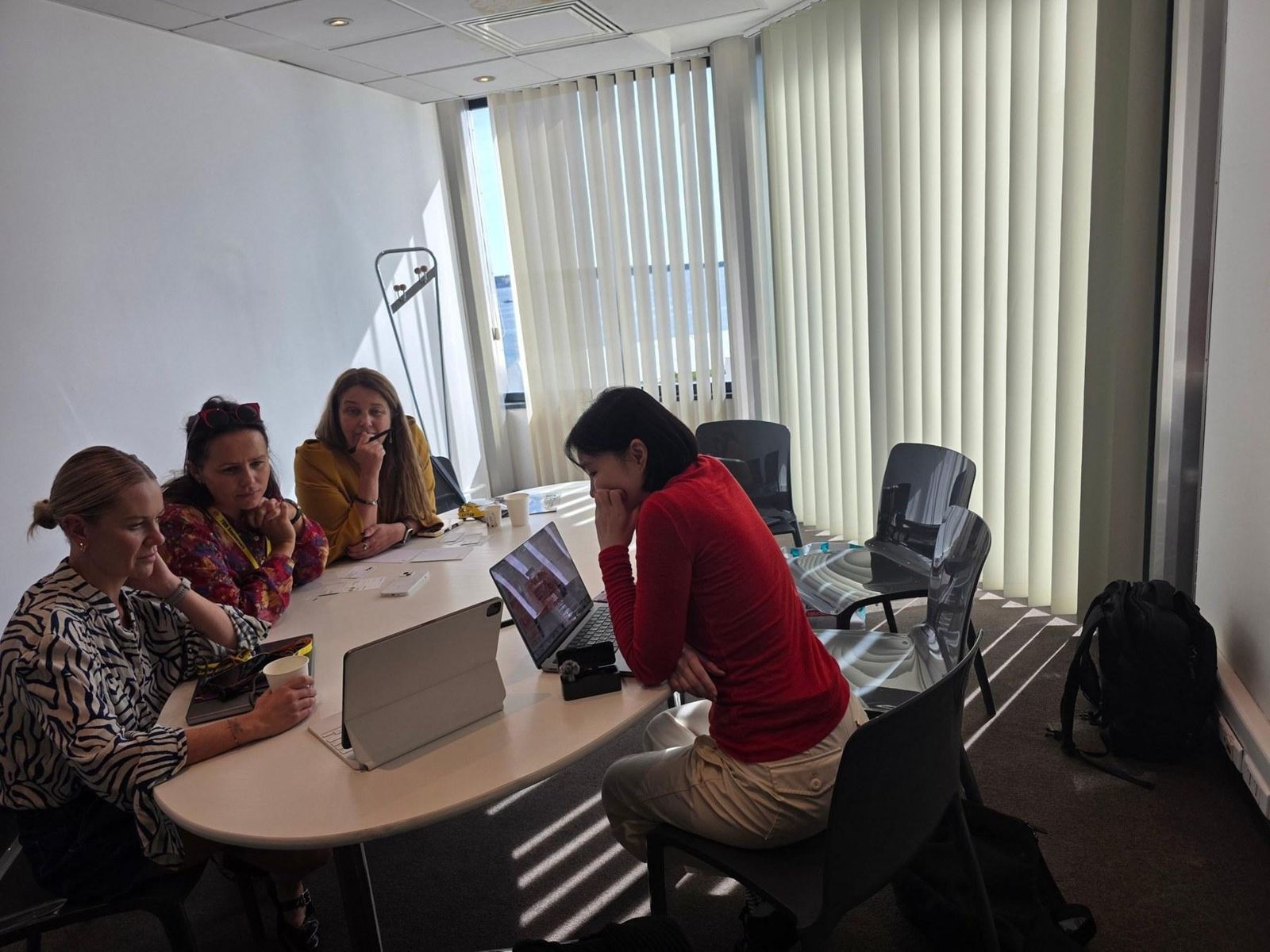
Young Jin Park (박영진), co-founder and executive producer of Los Angeles studio Park Star Media, which helps Korean broadcasters, comics companies and YouTubers expand into America, said broadcasters and platforms there show strong interest in Korean content, helped by K-pop, K-food and K-beauty.
Animation is the exception. Korea makes high-quality animation, he said, but "sometimes they really skimp on" the English dub, which falls short of what US broadcasters and parents expect. His company already uses AI dubbing tools to relaunch Korean-only YouTube channels in English, Spanish, Indonesian and Japanese.
Hudson AI demos dubbing in 80-plus languages, with sobs and laughter directed line by line
Shin said Hudson works with CJ ENM, SBS and KOCOWA (코코와), among Korea's leading media companies, on English, Spanish and other versions. The demo opened with the English version of a CJ ENM drama the company has dubbed into Japanese, English and Spanish. Then came a Japanese dub of the children's series Pororo (뽀로로), which Hudson has also voiced in Portuguese, English and Spanish; an Italian dub of the English-language film Charade; live dubbing of a Korean baseball broadcast; and real-time interpretation for meetings. When Korean speech came out in Russian and Polish, the Europeans at the table rated the translation highly.
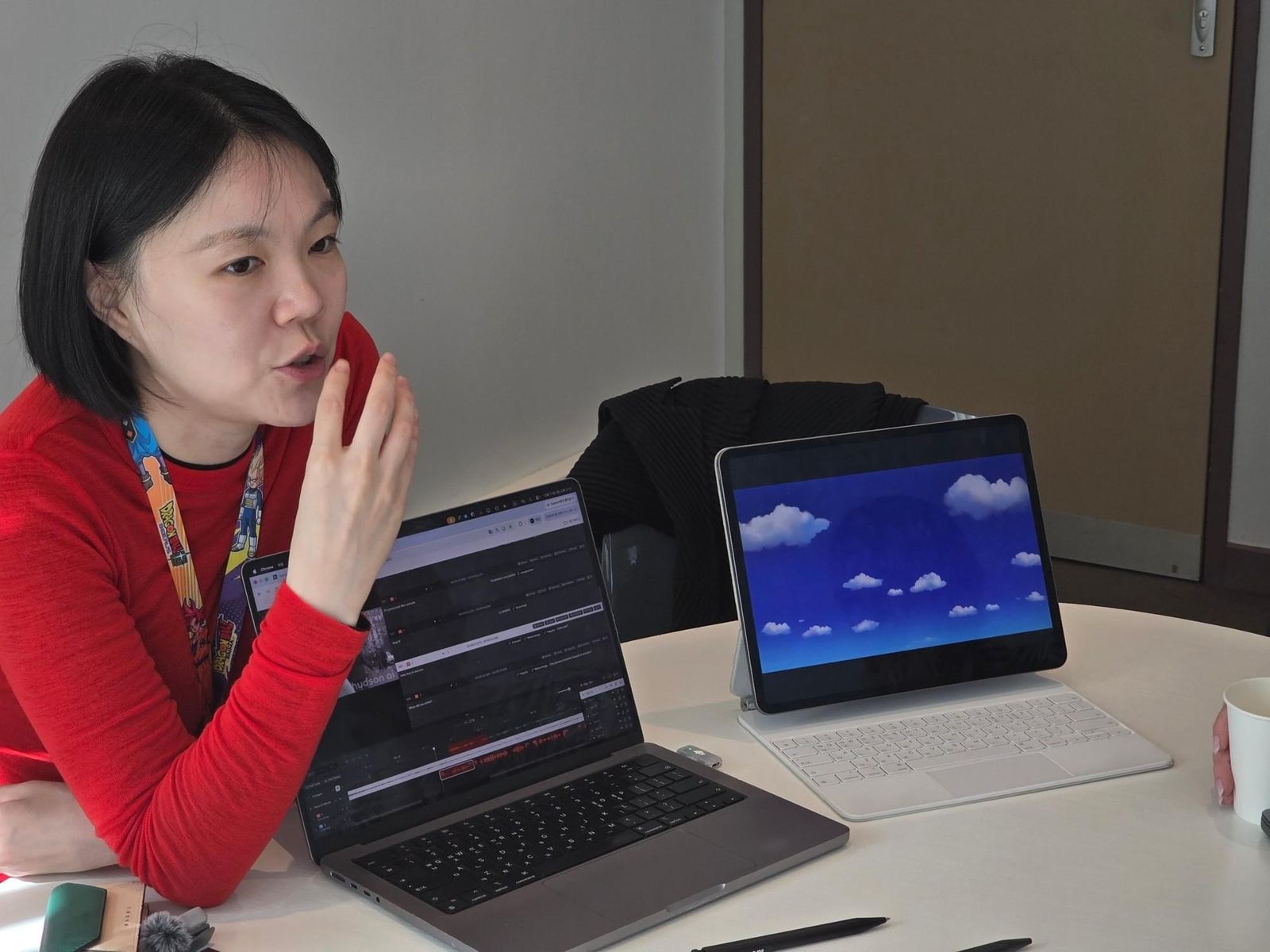
Hudson Studio, the company's tool, uses in-house audio AI to separate dialogue, transcribe, translate in context and synthesise speech, with lip-sync on top.
Shin's pitch is that it carries the original performance into the dub. Each line can take a direction such as "lovely" or "annoyed, shouting," and non-verbal sounds such as sobbing and laughter come through. To tackle uneven quality, the company is building "agentic localisation," in which the AI grades its own acting and translation and flags lines to fix; in the demo, lines it judged acceptable turned green. The slide on Shin's laptop summed up the pitch: "You don't need more content. You need more languages."
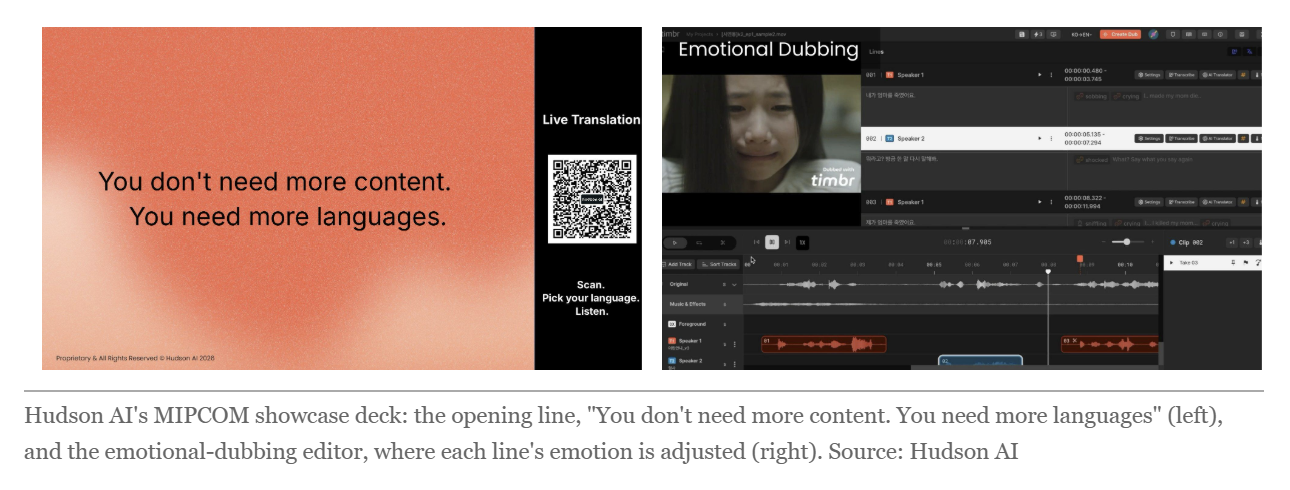
The company processed 30 dramas, or 500 hours of broadcast dubbing, in about three months, Byline Network reported in February. A Ministry of SMEs and Startups AI programme matched it with LG Electronics, and the two released English, Spanish and French dubs of the drama The Tale of Lady Ok (옥씨부인전) to European viewers on LG Channels. Park Hyung-se (박형세), a president at LG Electronics, told Newsis the work took over 60% less time than conventional dubbing.
The AI companies on the market floor struck a similar note. Most AI newcomers in Cannes sold themselves as ways to streamline and monetise the business of buying and selling content rather than as makers of AI shows, Deadline wrote in its October 15 takeaways; the question, the trade site said, has moved from whether to use AI to how.
Hudson AI at a glance
Sources: roundtable demo (October 11), Byline Network (February 25, 2026), Newsis (March 27, 2026).
"Really very high quality": Europeans react to emotional dubbing and live interpretation
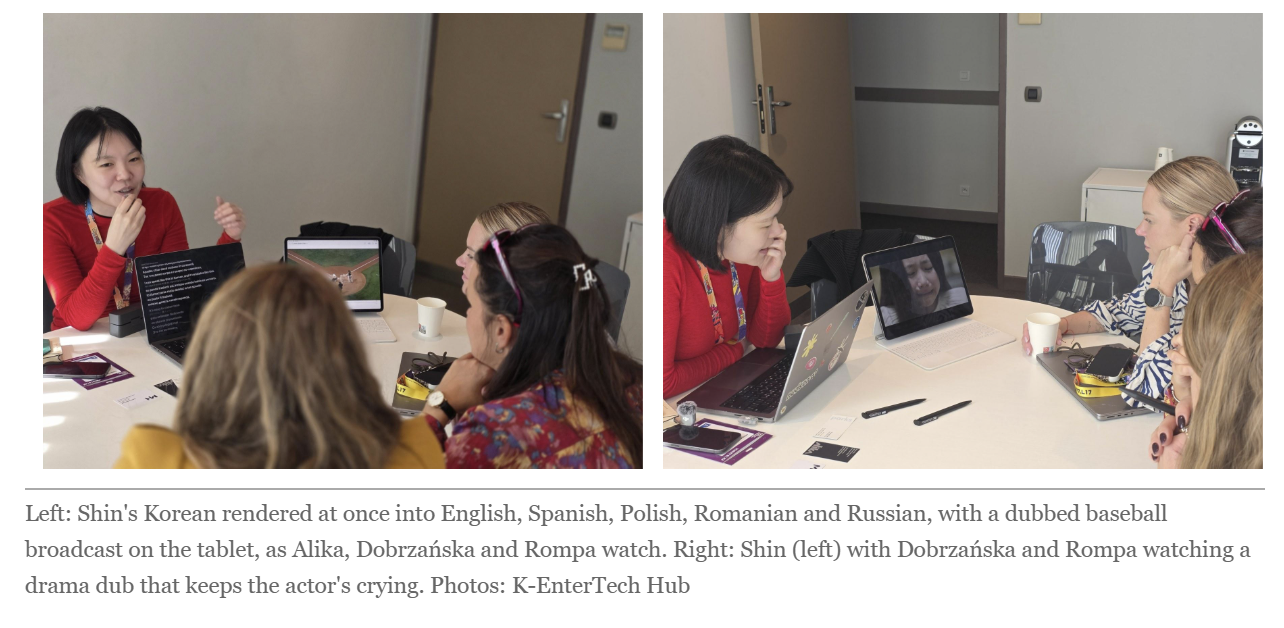
The Europeans reacted as the demo went on. Alika called the Japanese Pororo "very amazing" and the emotion-matched drama dub "impressive". After hearing the tool render sobbing and other non-verbal sounds she said: "It's really very high quality. Now we only need to check if you have our own languages." When Shin's Korean came out in Russian and Polish in real time, Alika called it "impressive" and Dobrzańska said: "It's a really good Polish."
The strongest reactions came where the technology met local business problems. When Shin described live sports dubbing and her work with Japanese broadcasters on minor sports, Alika said it was "great to see the live events".
Producing original, Latvian and Russian versions at once, she added, would be a "game changer" for many local channels. Park pointed to dubbing as the weak spot for Korean animation in the US, saying the right tools and proper-quality voices are what parents and buyers look for first.
"Every language is not small": ten-minute Latvian and Polish test dubs proposed
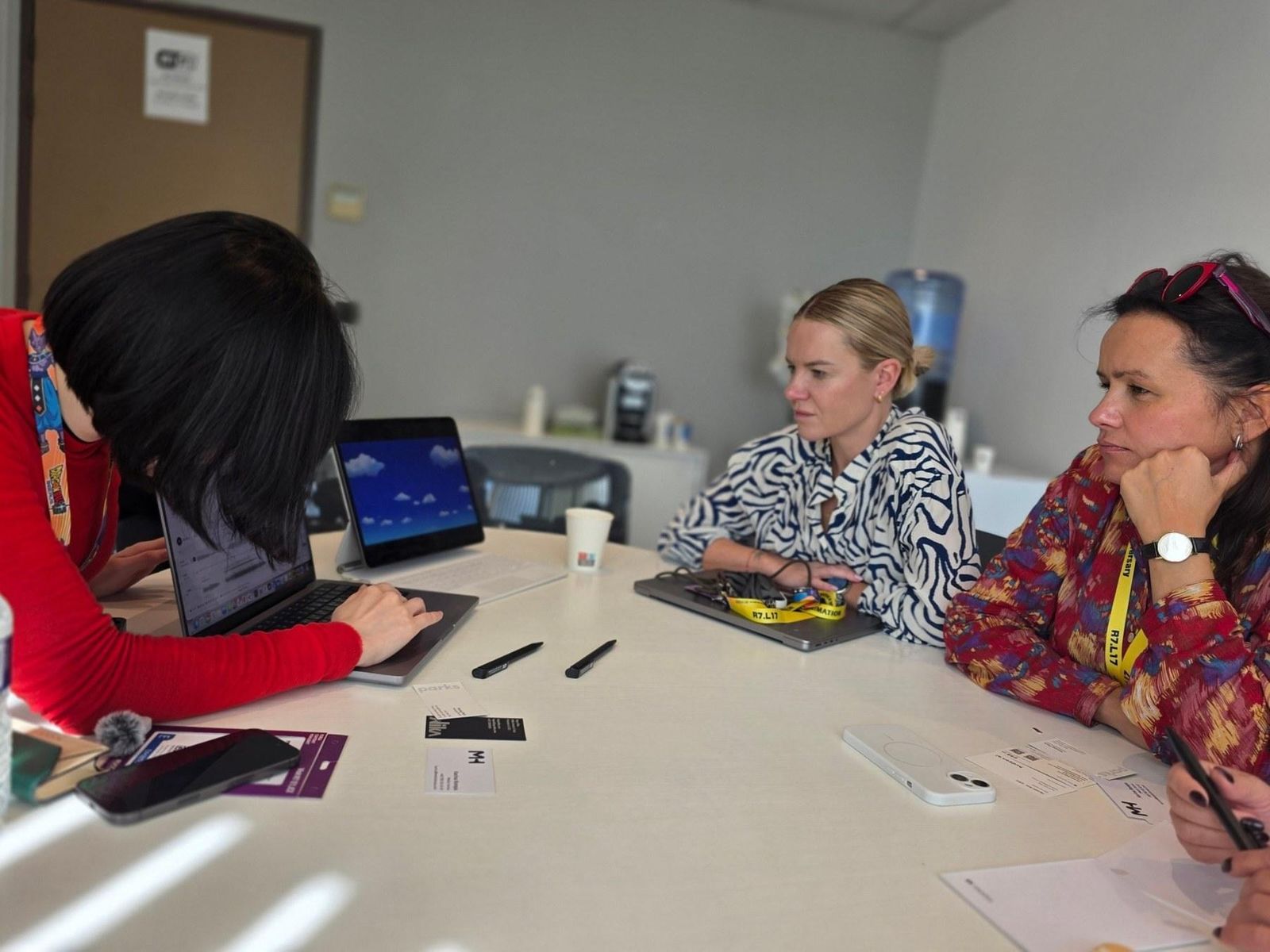
"It's always a problem with AI dubbing companies that they are not able to support the smaller languages," Alika said as soon as Shin had introduced the company, asking about Latvian. Shin said Hudson can technically handle more than 80 languages, but translation and acting quality vary. Its strongest are those with the biggest dubbing demand: Korean, Japanese, Chinese including Taiwanese, English, Latin American Spanish, Portuguese, German and French.
When Shin lumped Polish in with the smaller languages, Dobrzańska objected: "Polish is not so small. Every language is not small." Just less widely spoken, she said. Alika had come straight from lunch with a local telco that was still looking for exactly this kind of solution.
Latvian law bars Russian voiceover unless a Latvian version is also offered, Alika explained, and the country has a large Russian-speaking population. Producing the original, Latvian and Russian together "would be a game changer" for many local channels. Newcomers do not want to invest in localisation, she said, and when a dominant local player pays for it, the rest of the market goes without. Shin offered a simple test on a vertical drama, animation or drama clip of about ten minutes, with the Europeans judging the translation.
Hudson sells two ways: a subscription tool for live dubbing or drama dubbing without human review, and an end-to-end service with native-speaker quality control on every title, so a Latvian version would be checked by a Latvian speaker. Asked about competitors, Shin named ElevenLabs, whose founders are Polish, which drew a reaction from the Polish side of the table.
Hudson has already dubbed Korean baseball live for viewers in the US, New Zealand and Australia, Shin said. Dobrzańska's agency has just started distributing five sports channels that are not localised, including snowboarding and surfing. When Shin mentioned Hudson's work with Japanese broadcasters who want to localise minor sports, Dobrzańska said she was meeting them the next day and would raise the possibility. Her partners, she repeated, need it in Polish.

20 K-FAST channels in 22 countries reach 100 million viewers, dubbed into English, Spanish and Portuguese
Shin said Hudson was co-hosting stand R8.C7, registered under ESTsoft (이스트소프트), during MIPCOM, and participants said they would pick up the conversation there. On the market floor the two companies presented their AI dubbing under the banner of the Global K-FAST Alliance, led by Korea's Ministry of Science and ICT (과학기술정보통신부) and the Korea Association for ICT Promotion (KAIT, 한국정보통신진흥협회).
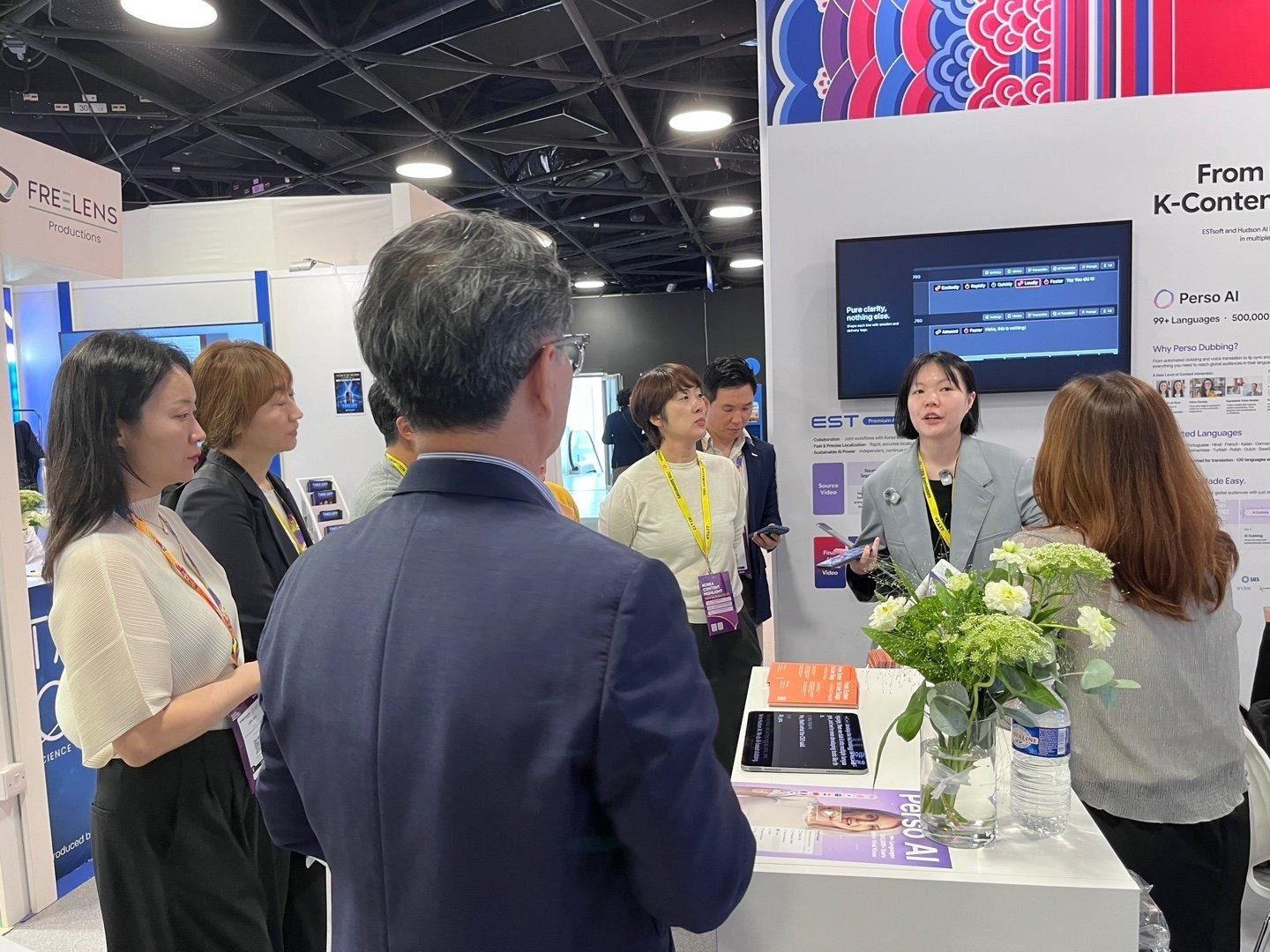
The alliance launched in April 2025 with 22 companies and now has 82, organised into five working groups. Last year members used AI to dub about 1,200 Korean titles, some 1,400 hours, into English, Spanish and Portuguese, creating 20 K-FAST channels, Newsis reported on July 9. The channels have run since December 2025 on Samsung TV Plus and LG Channels in 22 countries, including the US, Canada and Mexico, and passed roughly 100 million cumulative viewers by the end of April 2026.
his year three consortia, led by Hudson AI, ESTsoft and UN AI (언에이아이), were picked to build four flagship channels in vertical drama, K-beauty and K-dance, with about 230 million won ($172,000) per channel.
"Through the K-Alliance, we will accelerate the overseas expansion of K-content with AI-based dubbing technology," Shin told Digital Today at the time, calling localisation the key task for taking K-FAST into wider markets. So far the K-FAST dubs have been in the languages of the Americas. The languages the Europeans asked for in Cannes, Polish and Latvian, are the ones the programme has not reached, and the proposed test dub targets that gap.
This year the consortium Hudson leads took on CJ ENM's K-Dance flagship channel, and the genre came up in Cannes too. "Everybody wants to win a younger audience, so it's a great potential for K-dance," Alika said. With European telcos and pay-TV operators struggling to reach younger viewers, K-pop and K-dance channels could be candidates for their line-ups.
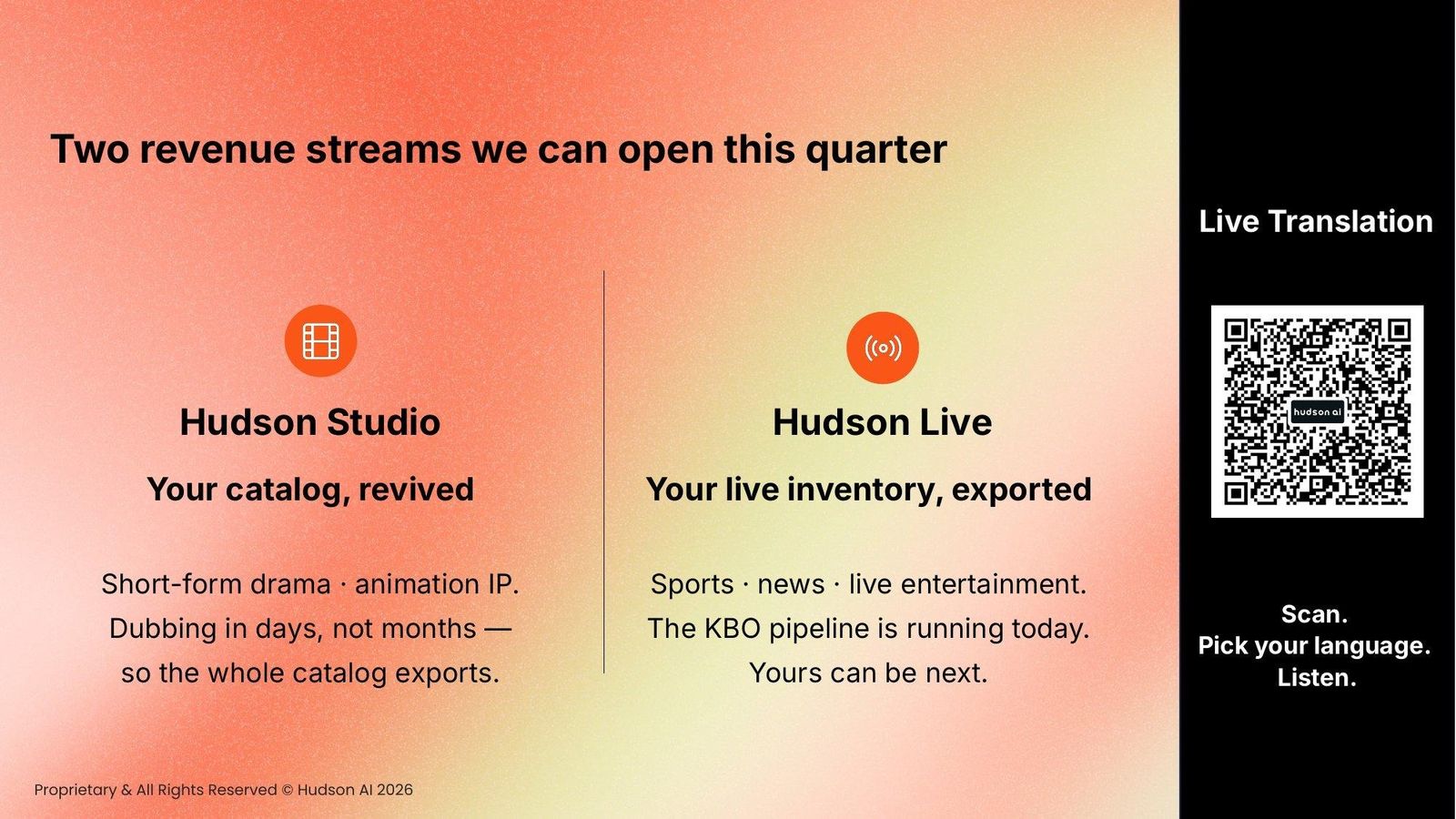
The two revenue streams Hudson AI pitched to broadcasters and distributors: Hudson Studio, which dubs catalogues in days, and Hudson Live, which exports sports, news and live entertainment in real time. Source: Hudson AI
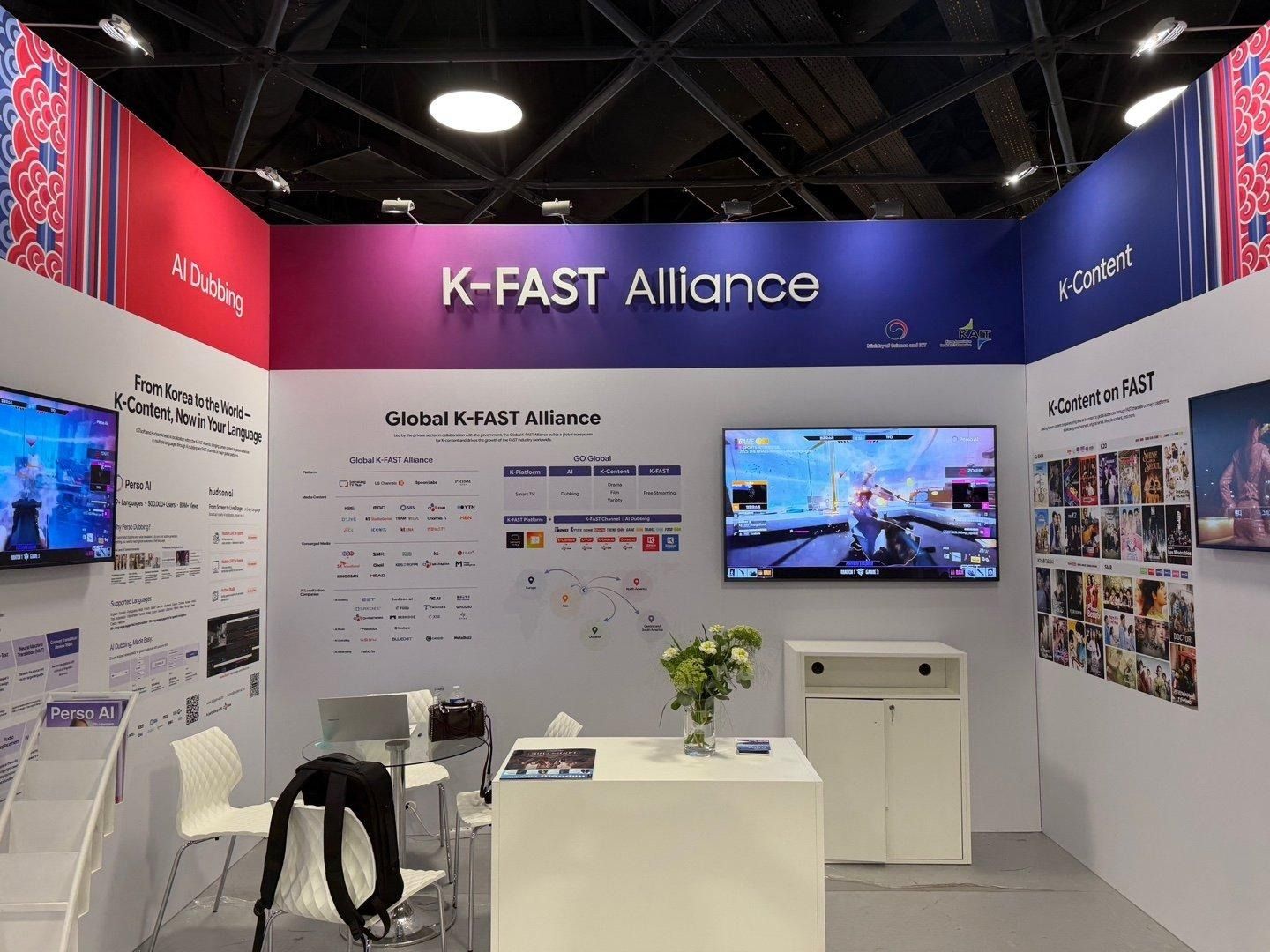
In North America, Korea's broadcasters are working their own sales channels. Smart Media Rep (SMR, 스마트미디어렙), the digital ad sales house affiliated with Korea's terrestrial broadcasters, co-hosted K-FAST Night in LA with CJ ENM, K20 and KT Studio Genie (KT스튜디오지니) at the Korea Creative Content Agency (KOCCA, 한국콘텐츠진흥원) LA Center on September 28.
About 80 Korean and US content and media professionals attended, The Korea Daily reported. The evening was timed to the Amagi FAST conference, and SMR pitched Series-K, a global FAST channel that packages the three terrestrial networks' dramas by genre and uses AI dubbing to reach more countries. Demand for Korean content in North American FAST "has been confirmed, but touchpoints to turn it into business are still lacking," said Jeon Seung-hoon (전승훈), chief executive of SMR in an announcement carried by ZDNet Korea, which put North America's share of the global FAST market at more than 80%.
Microdrama: struggling in Korea, AI-swapped actors for the US, tighter rules in Europe
Nordic and Baltic operators want microdrama and vertical video, Alika said: the region has advanced digital infrastructure, streaming is the dominant technology and linear TV is in decline. Dobrzańska's agency plans to sell microdrama to Polish telcos and TV platforms. Park asked why the format has not caught on in Korea.
This outlet's answer was that Korean viewers are used to premium drama, that much of the microdrama on offer is Chinese, and that a Korean platform launched two years ago with investor money is now struggling. Shin said some Korean vertical studios targeting the US, one of the format's biggest markets, use AI to change their Korean actors' appearance for American viewers, and that the head of one Korean platform told her it was looking for studios that can make AI short dramas on low budgets. Alika countered that with stricter AI rules, that approach would be trickier in Europe. She had heard a Korean company offer to adapt existing stories with a local actor's likeness, if the actor would sign over the rights.
On the MIPCOM stage the same day, Dhar Mann says universal stories travel; his CEO sees an opening for local distributors
That evening Dhar Mann was on the MIPCOM stage collecting The Ankler's inaugural Future of Entertainment Award. He has 170 million followers across platforms, and Dhar Mann Studios has deals with Disney, Fox Entertainment and Samsung TV Plus, The Ankler wrote the next day. Stories about karma and kindness, Mann said in the onstage conversation, work in India, Korea and Africa alike, and dubbing into more languages is widening his opportunities with global brands.
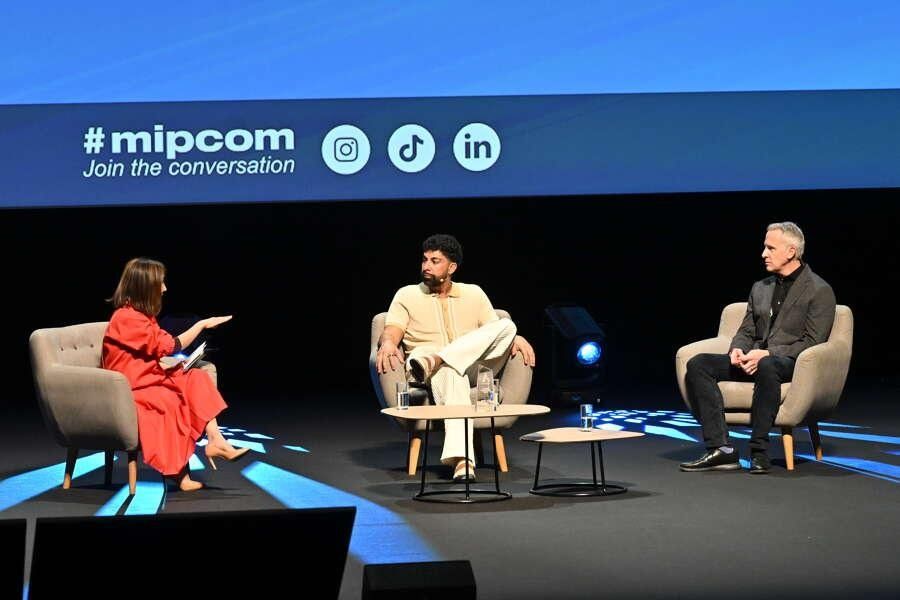
Samsung TV Plus was the first traditional platform to give Dhar Mann Studios a premium original deal; until then, Mann said, everything the company made was funded by YouTube AdSense. The anthology Unlikely Romances is being followed by a second series, Unlikely Families.
The Dhar Mann channel runs in 13 countries, SamMobile reported in May: the US, Canada, Australia and New Zealand, plus France, Germany, Austria, Belgium, the Netherlands, Sweden, Switzerland, Ireland and Portugal, nine in Europe. It is the FAST route into European homes that Rompa recommended for Korean content, taken by an American creator.
Sean Atkins, the studio's chief executive, said creators have enormous global reach but still lack relationships with local broadcasters and distributors. That gives local distributors a chance to lock up rights to premium creator content and compete with the global streaming services. Audiences want what they love available everywhere, he said, pointing to how Friends grew bigger as it spread across channels. At the roundtable, the Polish side named the same two conditions for getting onto local telco line-ups: a local-language version and a local distribution partner. A full report on the Mann conversation is published separately.
Korea's broadcast exports hit $1.26bn; finished-show licensing now needs a dub in every language
Korea's content exports reached a record $14.08 billion (about 18.82 trillion won) in 2024, with broadcasting and video accounting for $1.26 billion, according to the culture ministry's (문화체육관광부) industry survey as reported by Herald Economy. As this outlet's briefing noted, a decade ago Korean broadcasters sold finished dramas country by country; the model is shifting, with SBS signing directly with Netflix in December 2024. The European conditions add language to the equation. In a market like Poland, with hundreds of operators and a firm local-language rule, titles that arrive dubbed can get into talks with telcos. Where newcomers will not pay to localise, as in Latvia, the seller who brings the dub may hold the advantage.
Ken Oh, chief executive of CJ ENM Studios, said in the MIPCOM opening keynote conversation on October 12 that Korean drama budgets per episode have tripled in five to six years, ContentAsia reported. Recouping that means selling each show into more countries and more languages, the same arithmetic behind Hudson's slogan. Native-speaker review costs money, though, and quality varies by language, so sellers will likely need to decide market by market how much a dub is worth.
Korean broadcast ad spend falls 5% to 3.22 trillion won; overseas FAST and channel ads offer another revenue line
Korea's total ad spend was 17.13 trillion won ($12.8 billion) in 2024, according to the 2025 broadcast and telecom advertising survey by the Korea Media and Communications Commission (방송미디어통신위원회) and the Korea Broadcast Advertising Corporation (KOBACO, 한국방송광고진흥공사), as reported by the Journalists Association of Korea's weekly (한국기자협회보). Online advertising rose 7.9% to 10.1 trillion won ($7.56 billion), 59% of the total. Broadcast advertising fell 5% to 3.22 trillion won ($2.4 billion), and terrestrial broadcasters' ad revenue dropped 7.2% to 1.23 trillion won ($920 million).
In North America, K-FAST channels reach viewers through Korean-made platforms, Samsung TV Plus and LG Channels, and SMR is putting Series-K in front of local platforms and advertisers. For broadcasters whose domestic ad revenue is shrinking, overseas FAST is a way to earn advertising money abroad. Europe works differently. Rompa's model has a Korean broadcaster open a channel and a local media house in each country sell the ads, filling the gap left by telcos without ad tech and earning TV rates rather than FAST CPMs. Where SMR, which sells terrestrial broadcasters' digital ads at home, has organised its own sales push in the US, Europe would require a local media-house partner in every country.
Competition for Samsung TV Plus shelf space in Europe is also rising. Samsung TV Plus is launching four BBC Studios channels, BBC Lifestyle, BBC History, BBC Food and an EastEnders channel, in 11 European markets, C21Media reported on October 12, MIPCOM's opening day. Dhar Mann's channel is already in nine European countries. Korean channels will be vying for the same screens, and as Park noted, high picture quality will not sell a show if the dub falls short of what buyers expect. Korea now has a foothold in Poland: Rompa said she was glad KOCCA had recently opened an office in Warsaw.
Test dubs still a proposal; Rompa points to NEM in Dubrovnik in June
What came out of the afternoon is still at the proposal stage. Shin offered to run a test dub of about ten minutes in Latvian, Polish or other Eastern European languages, and the Europeans said they would look at the translation quality once there was something to see. No title, schedule or price has been set. Dobrzańska said she plans to pitch Korean content and microdrama to Polish telcos and TV platforms, said she would mention AI localisation of minor sports to the people she was meeting the next day, and said she would drop by Hudson's stand.
Rompa pointed to NEM, the market held each June in Dubrovnik, Croatia, as the next door into Central and Eastern Europe, and said KOCCA had been in talks about organising a Korean pavilion there. Alika called NEM "a MIPCOM for Central and Eastern Europe," with more and more tech companies attending. It is also adding territories, Rompa said, with a Turkish pavilion and Western European companies making the trip.
Polish and Latvian are languages K-FAST has not yet covered. Whether the test dubs happen, and whether they would lead any Polish or Baltic operator to consider a line-up, is still open. The Europeans kept returning to three conditions: the quality of the local-language version, the cost of native-speaker review on every title, and operators' ad-insertion systems for FAST. All three would have to be met before Korea's AI-dubbed channels could move beyond the Americas into Europe's smaller language markets.
The format itself drew comment. "It's a nice format. You don't rush, and you learn more," Alika said, and Dobrzańska said it was good to meet at the start of the week, before the meetings pile up. Rompa suggested scheduling the next session earlier so more buyers can attend; some invitees were only arriving in Cannes that day or had meetings already booked.