

57% of U.S. 18–24s find films and shows on short-form; bots now 54% of web traffic / Seven streaming services launch vertical feeds as the shift heads to CES 2027

Fifty-seven percent of Americans aged 18 to 24 now find new movies and TV shows through short-form video, more than the 55% who browse recommendations, genres or trending lists inside streaming apps. It is the first U.S. age group in which short-form ranks as the top discovery source, according to Luminate's October special report, Social Media & Entertainment Discovery.
The same month, Axios's 124-page Media Trends Executive 2026 Annual Report tracked the same shift across the internet. Bots will make up 54% of global web traffic in 2026, overtaking humans at 46%. Monthly visits to top U.S. news sites have fallen from more than 70 million in 2024 to 47.6 million, and search referrals dropped from 18 million to 11 million a month in a year. Chatbots send just over 160,000.
Both reports point to the same place. The first encounter with content has moved from the search box and the programme guide to algorithmic feeds and AI answers. That is why U.S. streaming services added vertical short-form feeds to their apps one after another between March and August 2026 — and why the topic runs straight into the entertainment programme at CES 2027 in Las Vegas in January.
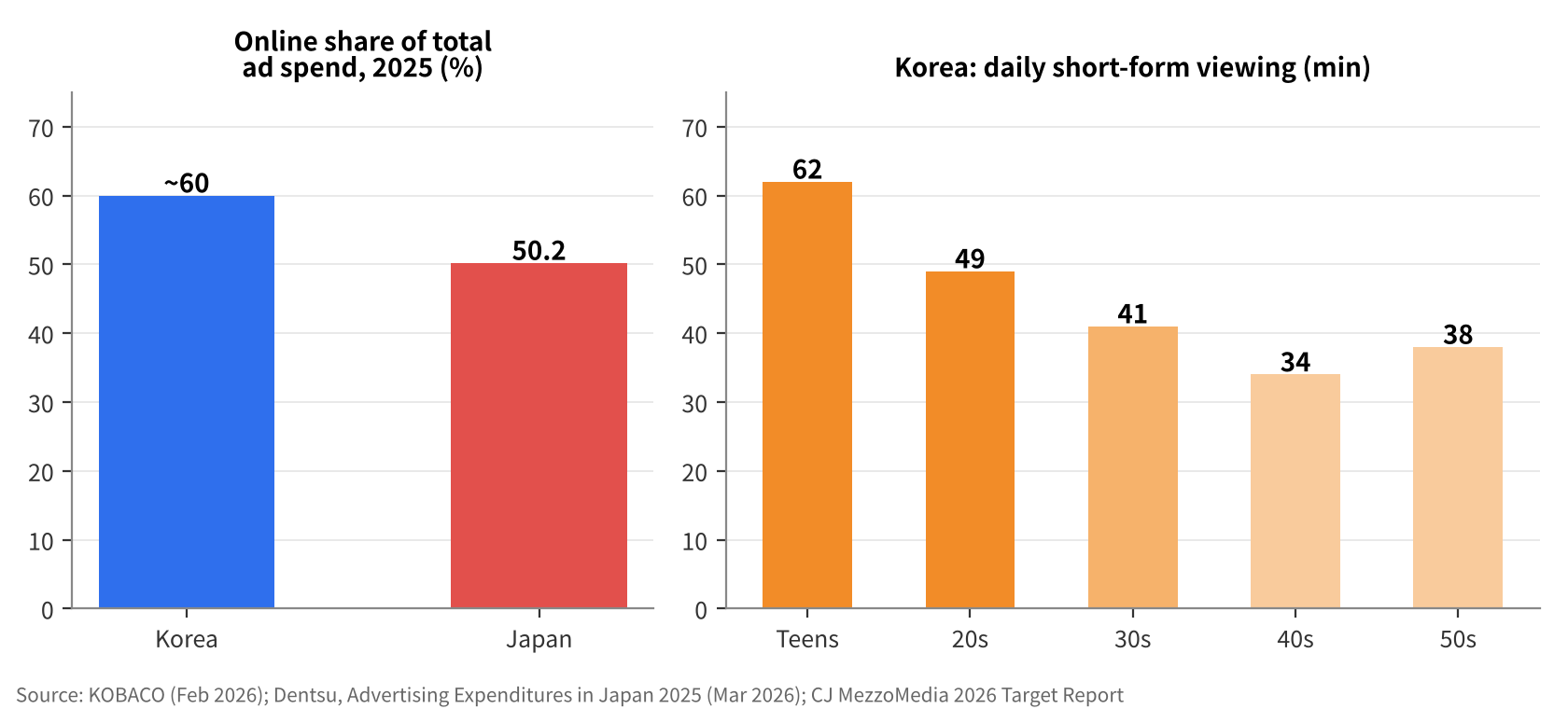
South Korea faces the same conditions. Korean teenagers spend an average of 62 minutes a day on short-form video, and about 60% of Korea's ad spending went online last year. Netflix announced plans to bring its Clips feed to Korea, and TVING (티빙) has run a comedians' short-form league.
Short-form takes 26% of 18–24s' weekly media time, vs. 12% for over-55s
Luminate surveyed 2,000 Americans aged 13 and over in May 2026 (Entertainment 365, Wave 17) and 8,105 across the first half (Music 360). People aged 18–24 spend nine hours a week on TV series, six on films, 11 on music and nine on short-form video. Short-form is 26% of the four, more than double the 12% for those 55 and older, and more young adults say they watch short-form video than films.
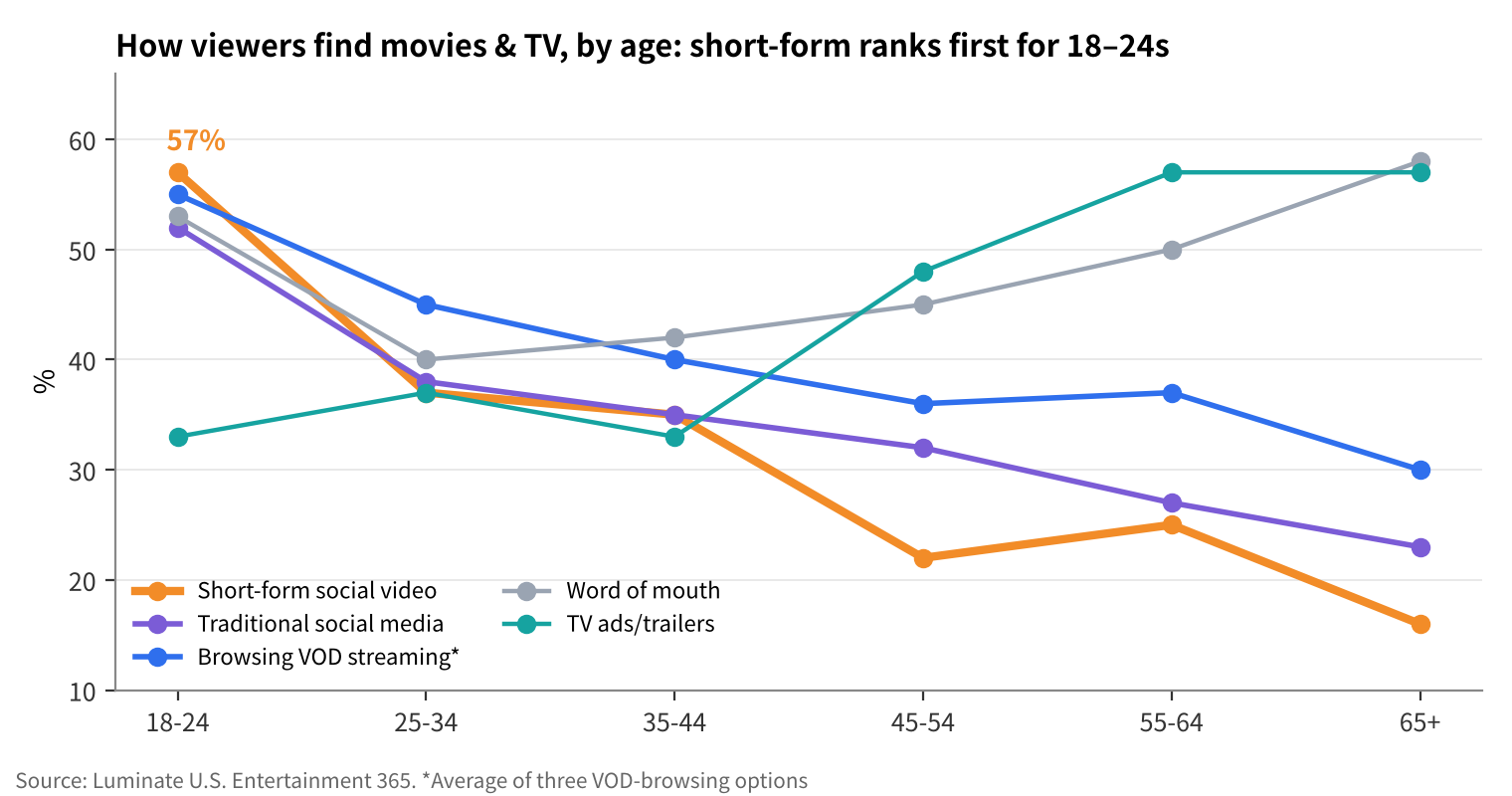
The audiences who buy cinema tickets are the most likely to find films on social. Among people who saw three or more films in a theatre in the past three months, 42% discover movies on short-form video, nine points above all viewers (33%). For 18–24 frequent moviegoers, the figures are 67% for traditional social and 62% for short-form.
65% of frequent concertgoers discover music on social, ahead of streaming
In music, the fans who spend the most do the most discovering on social. Among people who attend four or more live music events a year, 65% find new music and artists on traditional social media — ahead of streaming services (63%) and 28 points above the average listener (37%). After discovering music on social, 58% of listeners play the artist's other songs and 44% add them to playlists. Among 18–24s, 39% look up what they found on services such as Spotify.
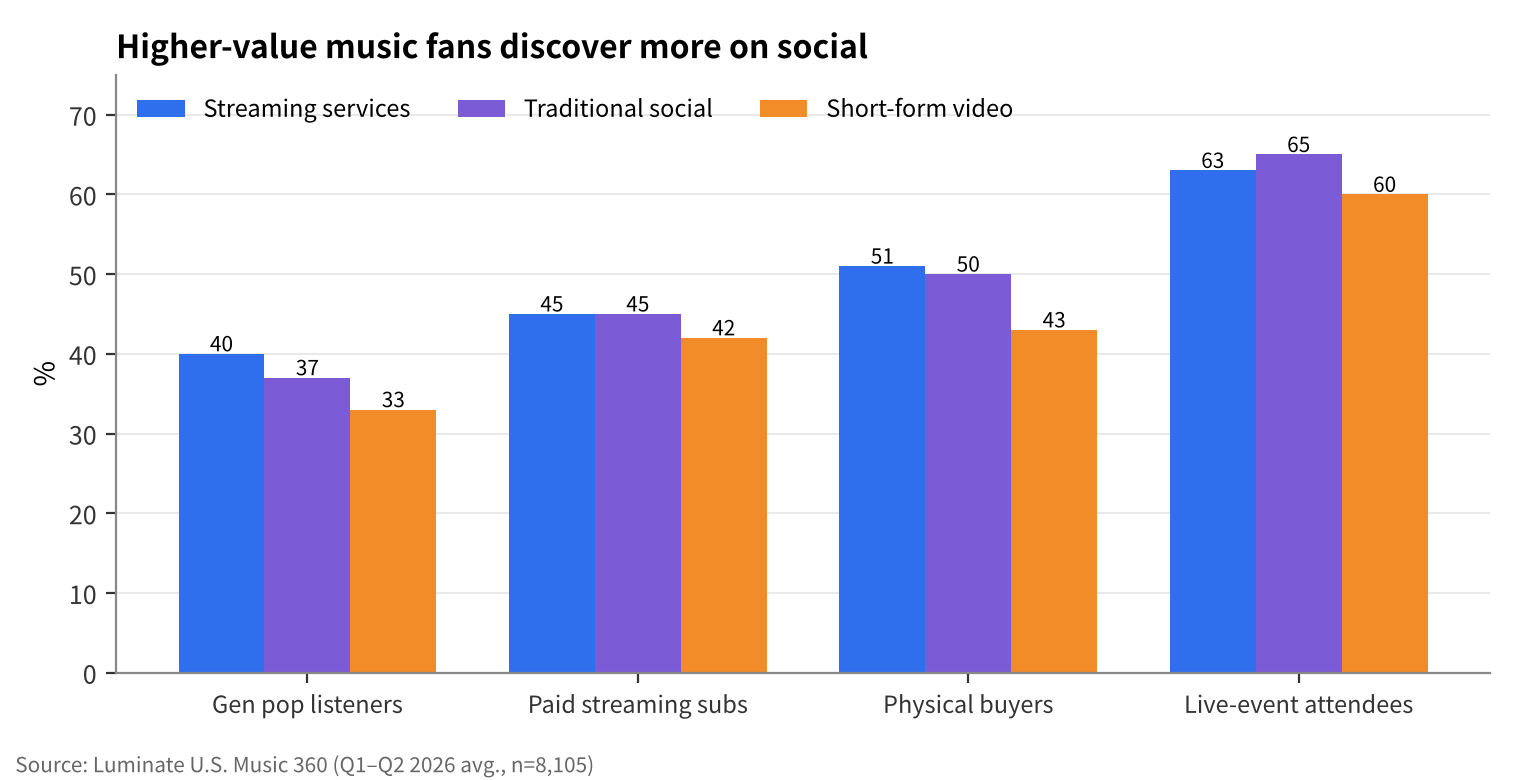
Luminate Intelligence analyst Audrey Schomer writes that social and short-form platforms are both destinations that absorb time and gateways that start fandom for a title or an artist. They are where companies first meet the fans most likely to convert.
Disney+, Netflix and Peacock roll out vertical feeds in six months; Disney partners with TikTok
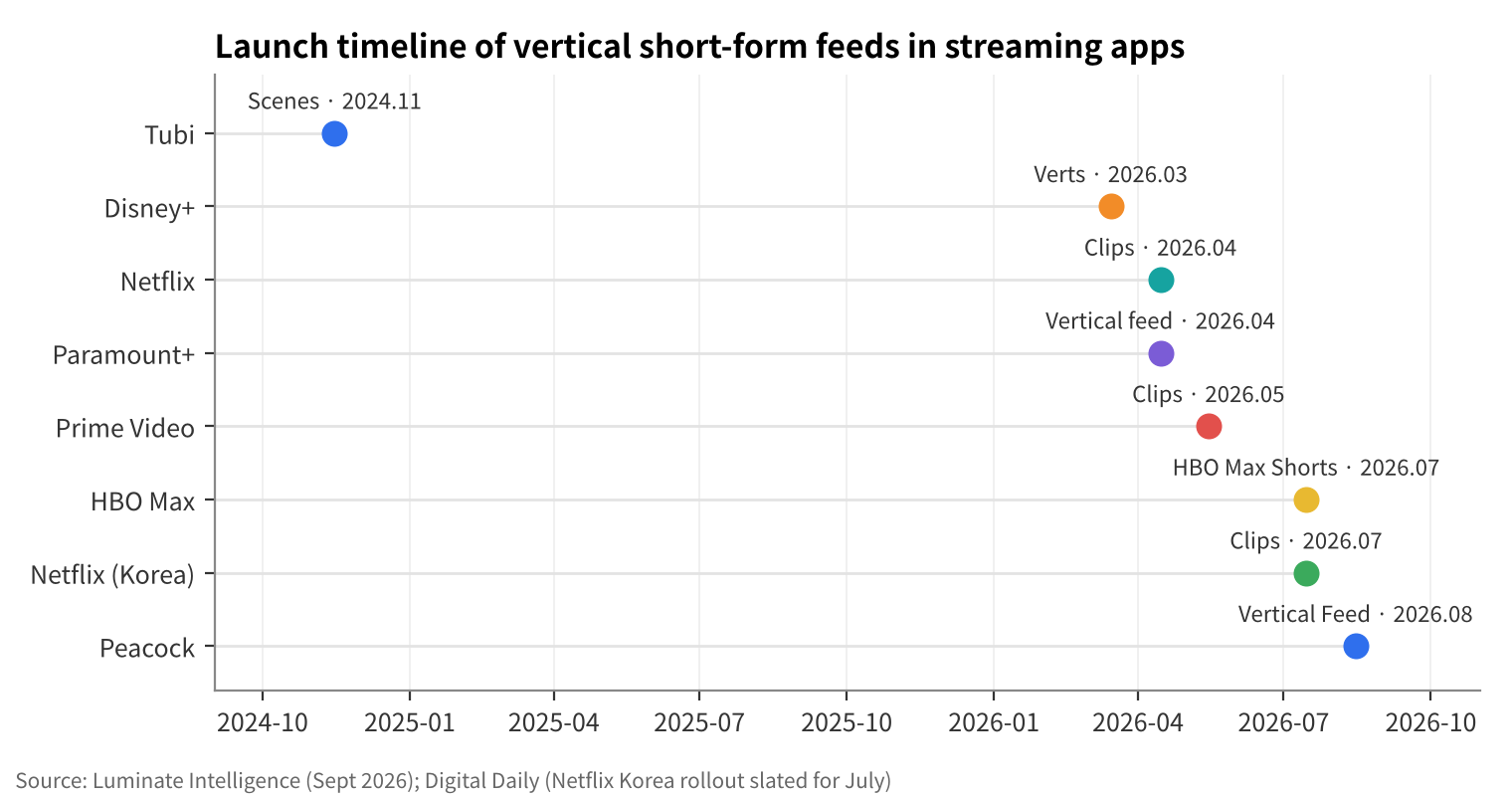
Streaming services are building discovery into their apps. Disney+ launched Verts in March, Netflix Clips in April, Prime Video Clips in May, HBO Max Shorts in July and Peacock's Vertical Feed in August; Paramount+ opened a sports and news clip feed in April, and Tubi started earlier with Scenes in November 2024. Disney previewed vertical video at its Tech + Data Showcase at CES 2026 and shipped Verts two months later. In August it partnered with TikTok so creators can post videos featuring Marvel, Pixar and Star Wars characters to both TikTok and Verts.
Nielsen put streaming at 49.0% of U.S. TV time in July 2026, while cable fell from 38% in 2021 to 18.7%. In the August Gauge, released October 22, YouTube alone reached a record 15.8% of TV time. Short-form feeds and the TV screen are competing for the same viewing hours.
299 AI deals vs. 107 lawsuits as content rights move to usage-based pay
As search turns into AI answers, the market for content rights is moving too. Axios counts 299 content deals between AI companies and media against 107 lawsuits, with OpenAI on 24, Google on 20 and Meta on 14. Payment is shifting from one-off training fees to compensation based on actual use. Cloudflare data show crawls per referral in July 2026 at 1,200 for Anthropic, 695 for OpenAI and 5 for Google.
Advertising follows the screen. eMarketer expects U.S. CTV ad spending to reach $47.6 billion in 2028, passing linear TV at $43.7 billion. Live entertainment revenue has nearly doubled since 2021 to $149 billion, and U.S. sports rights, at about $30 billion, have doubled in a decade. Axios argues that once discovery moves to feeds and AI, curated taste and in-person experience hold their price: "Taste + Trust is the new moat."
Korean teens watch 62 minutes of short-form a day; online takes 60% of ad spend
CJ MezzoMedia's 2026 Target Report finds daily short-form viewing in Korea above 30 minutes in every age group: 62 minutes for teens, 49 for people in their 20s and 41 for their 30s. KOBACO's market review puts 2025 ad spending at ₩17.27 trillion (about $11.9 billion), with roughly 60% online and broadcast down about 13%; it cites the move to streaming services, YouTube and short-form. In Japan, Dentsu reports internet advertising passed half of total ad spend (50.2%) for the first time in 2025, led by vertical video ads on social platforms.
Korean streaming services have started using short-form as a discovery tool. Digital Daily (디지털데일리) reported on June 24 that Netflix would bring Clips to Korea in July. TVING added vertical Shorts in 2024 and from June 22 ran a Comedy Short League in which comedians competed with 192 short videos over 12 weeks. Plays on Naver Clip in November 2025 were about 2.5 times a year earlier, according to Nasmedia (나스미디어). An industry official told Digital Daily that short-form has become the starting point of content consumption, not a rival to streaming services.
For Korean broadcasters and producers, the open question is what happens after discovery. With broadcast advertising shrinking, they need to manage rights and vertical edits at the scene level and build their own routes from clips to full episodes, tracks, concerts and merchandise. If frequent concertgoers discover more on social, data on who discovered a clip — rather than raw views — can guide K-pop tours and fan products. Setting terms and prices for training, search citation and generated output before AI negotiations begin belongs in the same sequence.
CES 2027 opens with Digital Hollywood on Jan. 5, with sessions on creators, short-form and AI rights
CES 2027 runs January 6–9, 2027, at the Las Vegas Convention Center and the Venetian Expo; the Consumer Technology Association bills it as the show's 60th edition. Entertainment starts a day earlier with Digital Hollywood at ARIA on January 5. In its 28th year as a CES conference partner, it will cover cinematic AI, the creator economy, streaming, microdramas and Hollywood IP. The CES schedule lists sessions including Creators Go Hollywood and Streaming, The Creator Economy, Podcasts: A Media Realignment.
K-EnterTech Hub will run the CES 2027 Entertainment Tech Insight Tour with smartcms during the show, a tour dedicated to entertainment technology. It combines content- and C Space-focused exhibition tours (half-day or full-day), an Entertainment Tech conference on January 7 and networking meetings with local companies. On-site conference attendance is free, and the tour, networking and speaking slots can be booked separately. Participants receive an analysis of the January 5 Digital Hollywood sessions. Drawing on its new report, K-EnterTech Hub plans to focus on conversion metrics for vertical feeds, AI-agent shopping and CTV commerce ads, AI content labelling and copyright deals, and creator studios and microdramas.
Outlook: 2027 will be decided after discovery
Put the two reports side by side and the 2027 battleground comes into view. Feeds and AI have taken discovery, and streaming services spent 2026 pulling those feeds inside their apps. The next step is where discovered audiences are sent and how that movement is turned into revenue. In Luminate's data, most people who discover on social go elsewhere to watch or listen; in Axios's, the assets that held their price were live events, sports and catalogue IP.
Korean companies start with an advantage: K-pop concerts, fandoms and screen tourism already turn discovery into on-site revenue. But because the first touchpoint sits in the feeds of Netflix, YouTube and TikTok, companies that are slow to manage scene-level assets and capture discovery data risk handing the capture stage to the platforms as well. CES 2027 is likely to be the first place U.S. media companies show how they will measure the vertical feeds they built in 2026 — and what they plan to sell through them in 2027.