

Tubi CEO Anjali Sud takes over on Jan. 1 as Jennifer Witz steps down after about 25 years; subscribers hold near 33 million while ads and video podcasts grow
SiriusXM named Anjali Sud, CEO of FAST service Tubi, its chief from Jan. 1, 2027, as Jennifer Witz leaves. Subscribers have stalled near 33 million amid smartphone streaming competition. Sud grew Tubi past 110 million users; FAST revenue is forecast to hit $11 billion by 2030.

SiriusXM has picked Anjali Sud, chief executive of Fox’s free ad-supported streaming (FAST) service Tubi, as its next CEO. The company said in a statement on Monday that Sud will take over on Jan. 1, 2027.
Jennifer Witz will leave the CEO role and the board at the end of Dec. 31. She has spent about 25 years at the company, nearly six of them as chief executive, and will stay on as an adviser through the end of 2027.
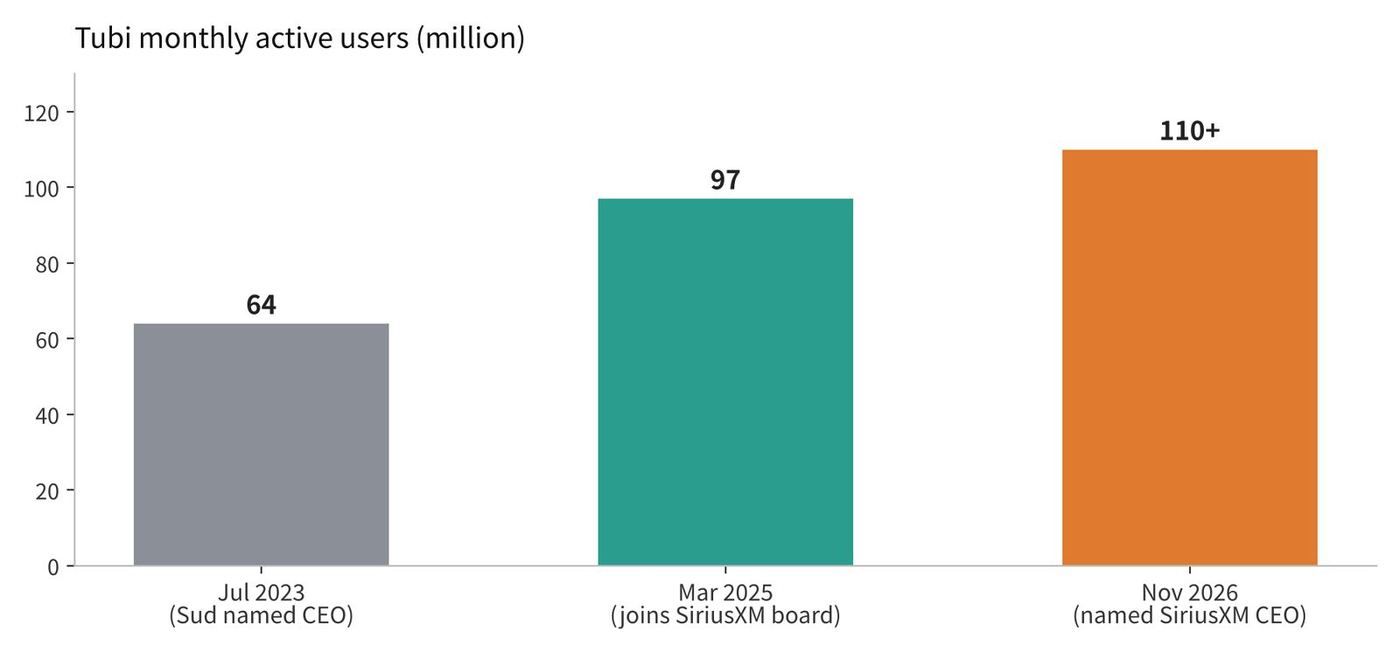
Sud, 43, has sat on the SiriusXM board as an independent director since March 2025. Since taking over Tubi in September 2023 she has lifted its monthly active users from 64 million to more than 110 million. Before that she ran Vimeo and took it public. Her exit from Tubi became public on Nov. 6, the day Fox closed its $22 billion purchase of Roku.
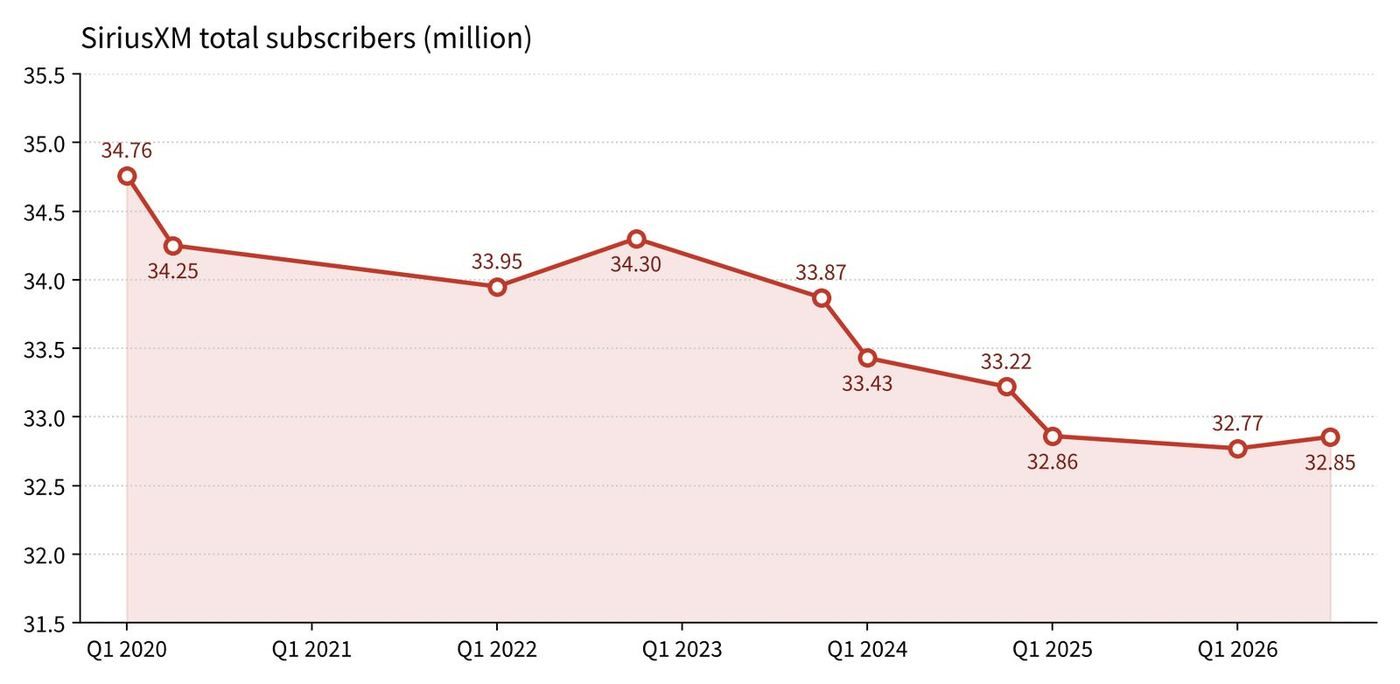
SiriusXM’s subscriber base has sat around 33 million for six years, slipping from 34.76 million in the first quarter of 2020 to 32.85 million in the third quarter of 2026. The company has grown profit through pricing and churn control, and pushed its ad business outward with exclusive YouTube audio sales and video podcasts. “In her previous roles, she scaled audiences, expanded platforms, and led businesses supported by both advertising and subscription models,” said Greg Maffei, chairman of the board.
Stock down 68% in three years, $9.7 billion in debt: the board turned to Tubi’s 100 million-user record
Witz gave one reason for leaving: “now is the time for a transition.” The company described it as her own decision. Investors looked at subscribers and the share price. SiriusXM has not topped 35 million subscribers since 2020, and revenue has fallen for three straight years since 2023.
The Motley Fool noted that monthly churn has stayed in a stable 1.5% to 1.7% range, so the shrinkage comes from weak new-customer acquisition. Its explanation is that more drivers now use Spotify, Apple Music and YouTube in the car through Apple CarPlay and Android Auto. SiriusXM revamped its app in 2023 to reach listeners outside the car, an effort The Hollywood Reporter said did not take off as hoped.
The shares fell 68% in the three years to November 2025, according to a Motley Fool analysis published by Nasdaq. They traded near $20 in January and have since recovered to about $31.90 after the CEO announcement. Debt stood at $9.7 billion, about 140% of market value as of February. Berkshire Hathaway is the largest shareholder with roughly 37%.
The stock rose in premarket trading on Nov. 9 after Bloomberg first reported the plan to name Sud. After the formal announcement it fell as much as 2.6% before paring losses to $31.90, StockStory reported. The board cited her experience running both ad-supported and subscription businesses; Tubi passed $1 billion in annual revenue under Sud, according to Benzinga.
The board did not cite FAST market growth directly. In the announcement, Maffei pointed to Sud’s record of scaling audiences, expanding platforms and running businesses built on both advertising and subscriptions, plus her knowledge of SiriusXM’s strategy as a director. Tubi is the core of that record. Its monthly users grew from 64 million to more than 110 million during her three years; it turned its first profit in the July–September 2025 quarter, and its ad revenue rose 35% in the latest quarter. The release itself credits her with making Tubi a leading entertainment destination. Some investors saw the choice of a streaming executive as a positive signal for a company with stagnant subscribers, Investing.com reported.
From board seat to CEO in 20 months: $2.6 million salary, $10 million sign-on stock
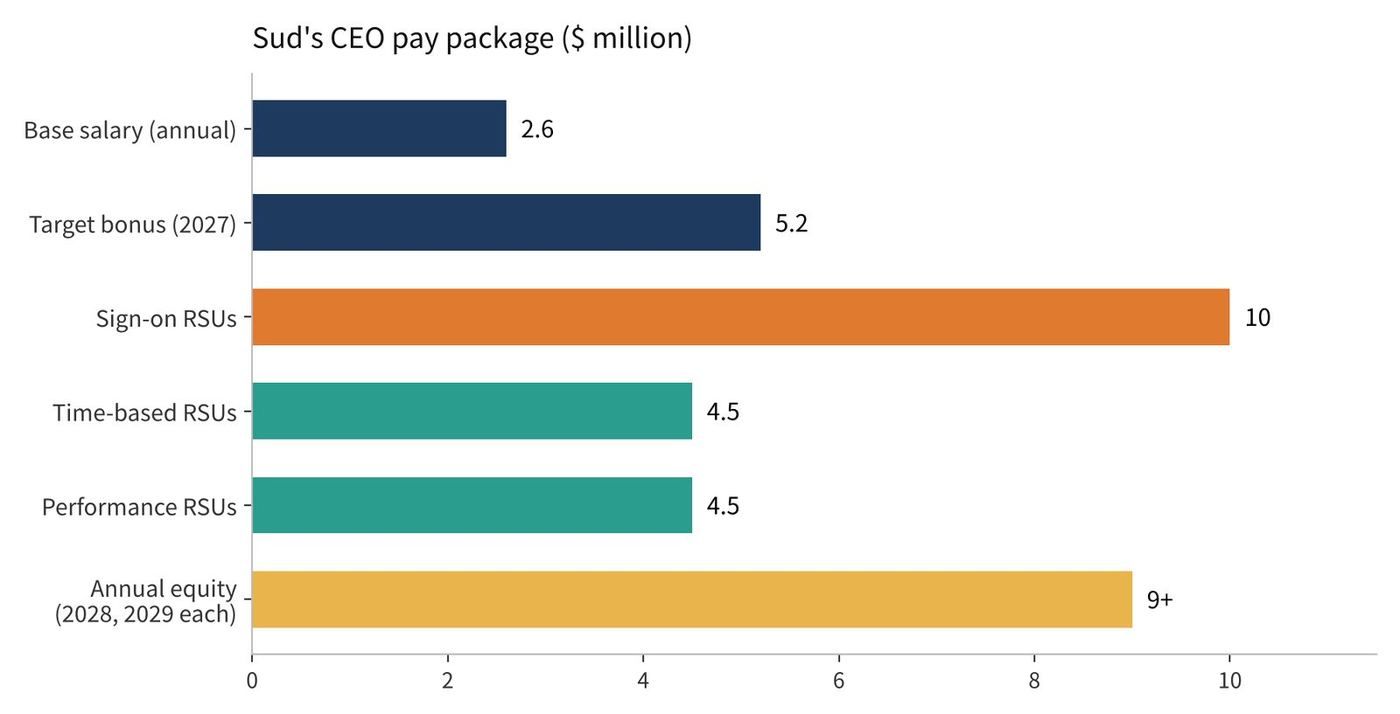
Under the employment agreement described in an SEC filing, Sud’s term runs from Jan. 1, 2027 to Dec. 31, 2029, renewing for a year at a time unless either side gives 90 days’ notice. Her base salary is $2.6 million a year and her target bonus is twice that, $5.2 million, with the 2027 bonus paid at no less than target.
The centerpiece is a $10 million sign-on grant of restricted stock units, one-third vesting on the grant date and the rest on the first and second anniversaries of her start. She also gets $4.5 million in time-based RSUs vesting over three years, $4.5 million in performance RSUs measured over 2027–2029, and annual equity of at least $9 million in each of 2028 and 2029. She keeps her board seat.
Witz remains eligible for her 2026 bonus, and her vested options stay exercisable for their remaining term. During her 2027 advisory year she will receive $175,000 a month, up to $2.1 million.
Sud grew up in Flint, Michigan, and holds degrees from Wharton and Harvard Business School. She worked at Amazon from 2010 to 2014, rising to director of marketing, and earlier at Time Warner. She joined Vimeo in 2014 and was CEO from July 2017 to August 2023. She also sits on the boards of Dolby Laboratories and Change.org.
Tubi’s counterparties are also changing. Korean companies supplying programming and FAST channels to Tubi now deal with Pete Distad, CEO of Fox’s direct-to-consumer group, and Mike Bidgoli, Tubi’s new president. Lisa Holme, head of content for The Roku Channel, also reports to Distad and works with Adam Lewinson’s Tubi content team, bringing the two largest U.S. free ad-supported streaming services under one programming line. Ad sales stay with Fox advertising president Jeff Collins.
Tubi users rose from 64 million to 110 million; Sud leaves as Fox closes Roku

On Nov. 6 Fox set up Fox Digital Platforms, a reworked version of Tubi Media Group. Paul Cheesbrough is co-chair and CEO, with Roku founder Anthony Wood as co-chair, Variety reported. Beneath them sit Roku under CEO Mustafa Ozgen; a direct-to-consumer group of Tubi, Fox One and Frndly TV under CEO Pete Distad; Red Seat Ventures under Chris Balfe; and fintech Credible under Robert Humann.
Sud’s departure was disclosed in the restructuring memo, which said she had decided to take “a new role outside the company” and credited her team with taking Tubi “from a challenger brand to a free streaming force.” Mike Bidgoli was promoted to Tubi president, reporting to Distad. Roku Media president Charlie Collier, general counsel Chris Handman and AdRise executive Robyn Peterson are also leaving.
Fox completed the Roku deal the same day. Announced in June, it won shareholder approval last month and cleared Justice Department antitrust review, closing well ahead of Fox’s first-half 2027 guidance, StreamTV Insider reported. Roku holders receive $95.30 in cash plus 0.9799 Fox Class A shares per share, and Fox expects about $400 million a year in cost synergies within two years.
“Our top priority for the combined company is to continue to relentlessly serve audiences and partners, while reinforcing the openness and choice that is the essence of the Roku platform,” said Fox CEO Lachlan Murdoch. Wood said the company’s mission “doesn’t change today. What does change is our reach and resources.” Roku is the TV gateway for more than 100 million streaming households worldwide.
Fox Digital Platforms sets five goals: free-plus-paid bundles and performance ads
The full staff memo from Cheesbrough and Wood, published by The Hollywood Reporter, says Tubi Media Group has become Fox Digital Platforms with Roku added, and sets five goals: grow connected TV device sales and platform share; lead free ad-supported streaming with movies, TV, podcasts and creator content; build a bundling ecosystem for premium subscriptions; win in performance advertising through ad tech and data; and expand in the U.S. and abroad. For the first 100 days the unit runs as three teams — Roku, direct-to-consumer and the Office of the CTO — while a long-term structure is set.
Distad, a former Apple executive, developed and launched the FOX One subscription service. “Bringing free and subscription services together creates opportunities to better serve viewers, connect audiences, and build smarter bundles,” the memo says. Tubi’s leadership reports to Bidgoli, an early Tubi investor who ran product and engineering. Holme will coordinate content investment with the Tubi team, and the memo says Roku’s open platform will remain open.
Support functions were also set. CTO Melody Hildebrandt keeps IT, security and cloud and coordinates AI adoption across Fox. Gil Fuchsberg becomes chief strategy officer, overseeing retailer and TV-maker deals. The memo notes that creator business Red Seat Ventures has two shows in YouTube’s top five, and credits the departing Peterson with unifying ad inventory and measurement across the portfolio.
Fox’s streaming strategy is to own both live content and the platform. Announcing the deal on June 15, CEO Lachlan Murdoch said Fox reoriented around live news and sports in 2019 and bought Tubi in 2020, calling Roku the combination of “the most valuable live content portfolio in video consumption with the preeminent streaming platform through which America watches it.” Fox said the deal makes it the third-largest company in U.S. television by share of viewing; MediaPost put the combined share at 9.9% in Nielsen’s April distributor rankings.
The results back it up. Fox’s fiscal 2026 revenue rose 5% to more than $17 billion and EBITDA reached a record $3.9 billion. Murdoch said on the earnings call that Tubi now generates ten times the revenue it did when Fox bought it; Tubi turned its first profit in the July–September 2025 quarter. In fiscal Q1 2027 (July–September 2026), Fox revenue rose 22.3% to $4.57 billion, Tubi ad revenue grew 35% and viewing time 23%. About 97% of new FOX One subscribers were not existing pay-TV customers, and Fox expects Tubi to reach EBITDA margins of about 20% over time.
Tubi revenue up tenfold since acquisition, first profit; 70% of users outside pay TV
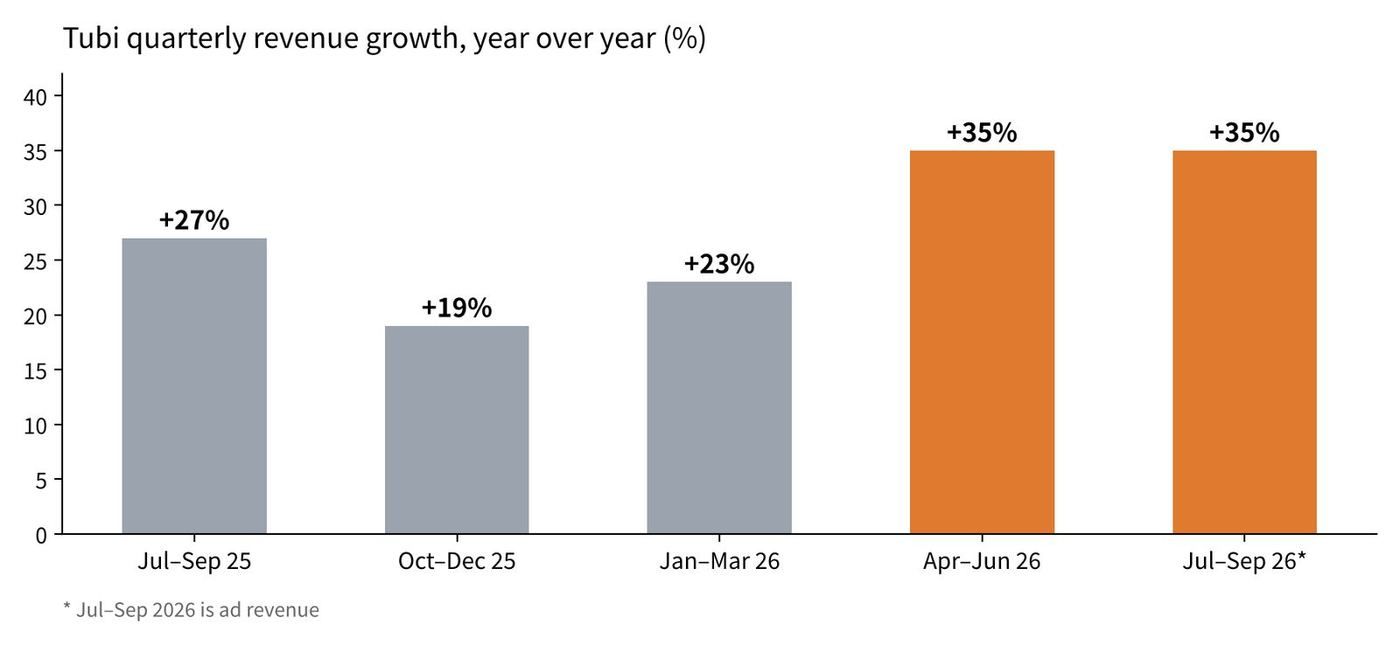
Under Sud, Tubi grew both scale and profit. Revenue rose 27% in the July–September 2025 quarter as Tubi posted its first profit. Growth then ran at 19% in October–December, 23% in January–March 2026 and 35% in April–June, and ad revenue rose 35% in July–September. Murdoch said in August that Tubi’s revenue is ten times what it was when Fox bought it in 2020. Monthly users stood at 110 million at the end of June.
Tubi’s audience sits largely outside pay TV. “70% of Tubi’s user base are cord cutters or cord nevers. This is higher than any of our competitive set,” Murdoch said in February. Tubi has brought in more than 17,000 episodes from over 220 creators to hold younger viewers, and its World Cup hub drew more than 20 million viewers during the 2026 tournament. Fox expects Tubi’s EBITDA margin to reach about 20% over time.
FAST revenue to grow from $6 billion to $11 billion by 2030; Roku Channel and Tubi hold 4.8% of TV time
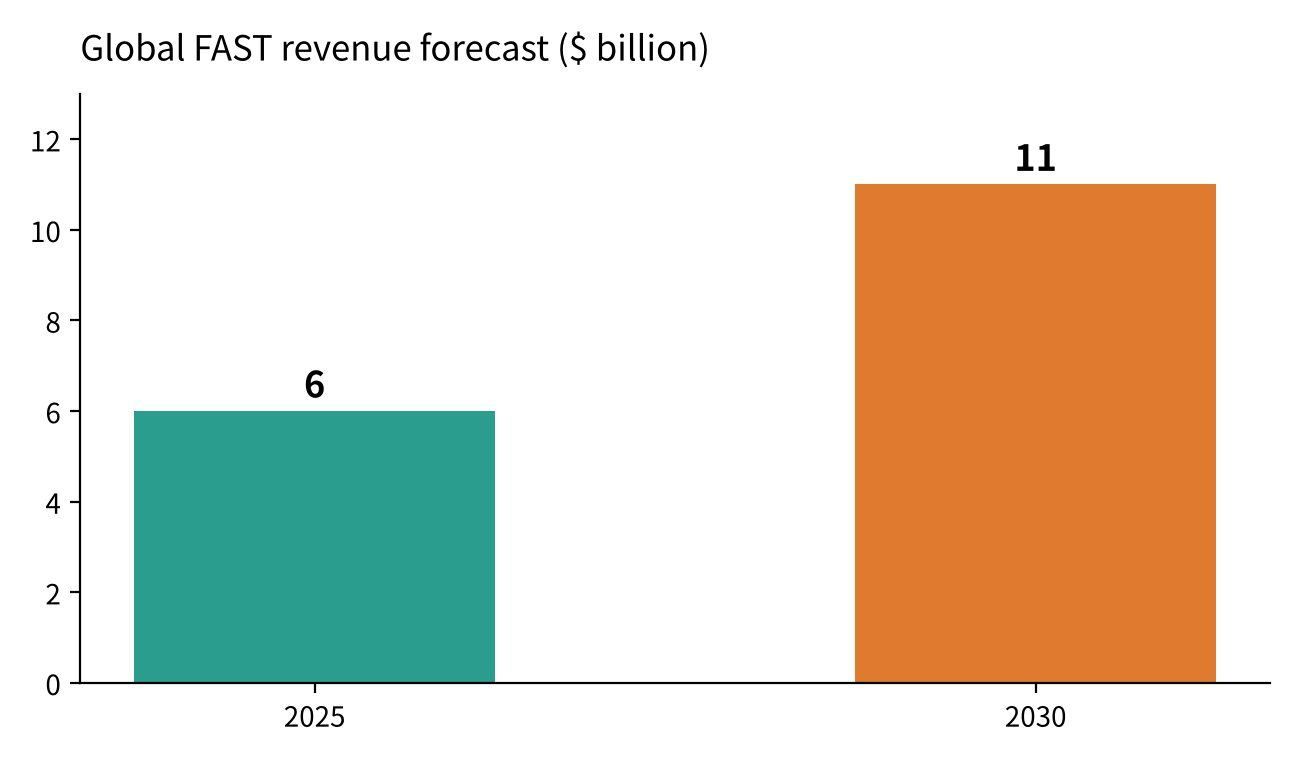
Tubi is a leading free ad-supported streaming TV (FAST) service, offering films, series and live channels free in exchange for ads. Omdia forecast in December that global FAST revenue will rise from $6 billion in 2025 to $11 billion in 2030, with the U.S. generating 80%.
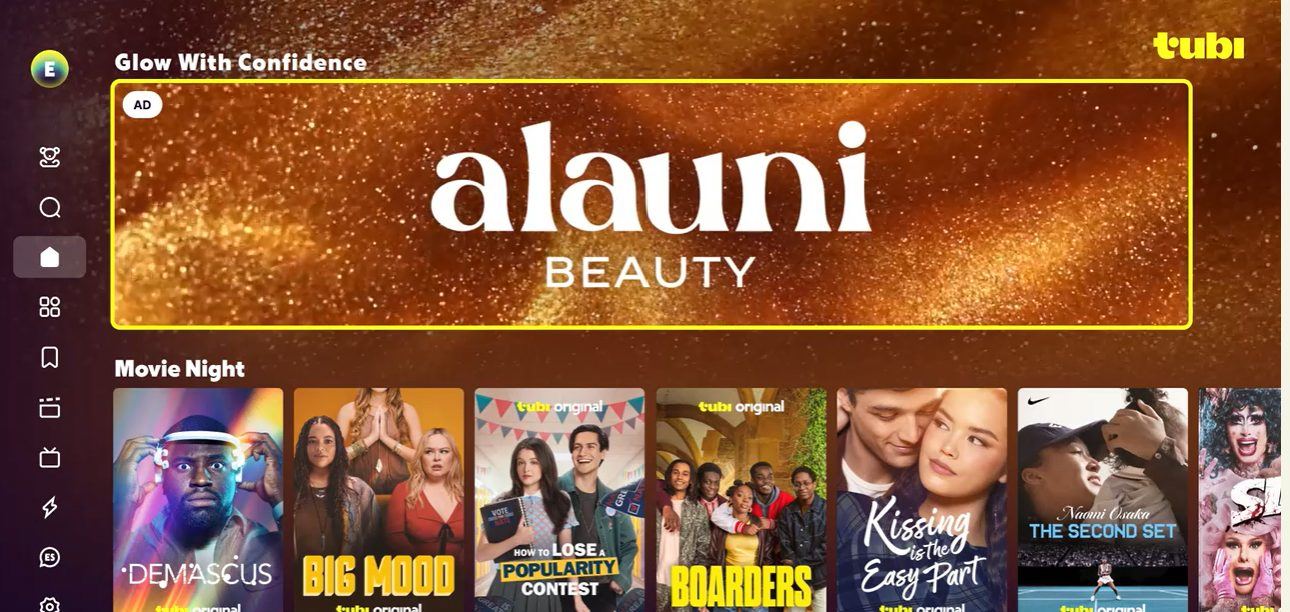
Tubi has also widened its ad formats. The pause ad, which fills the screen when a viewer stops playback, is the clearest example. At the May 2025 NewFronts Tubi added animated pause ads with sound-off looping video. At this March’s NewFronts it unveiled interactive pause ads with carousels, polls and trivia, along with Scene Sense, which shows cast and music details on a paused scene, and Connected Conversions, which links TV ad exposure to mobile purchases via QR codes, push notifications and email. Tubi said then that viewers stream about 1 billion hours a month. Performance advertising is also one of the five goals in Fox’s memo.

Viewing is growing too. Global FAST viewing hours rose 55% year over year in Amagi’s June Airtime Report. Nielsen’s Gracenote counted a 31.2% rise in FAST sports titles and a 37.5% rise in individual games and events in the third quarter, against 13.8% growth in sports channels.
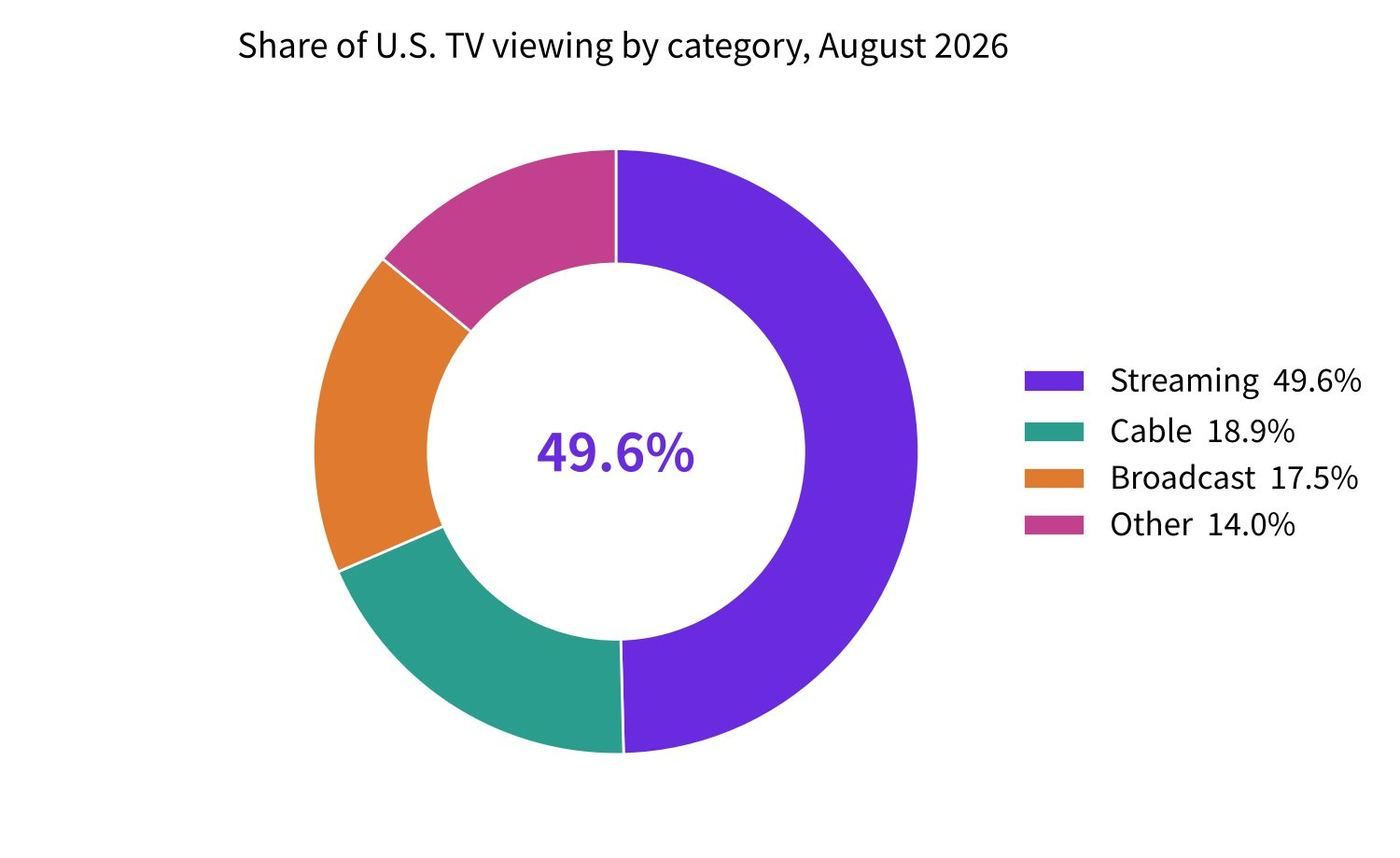
In Nielsen’s August report, streaming took 49.6% of U.S. TV time, cable 18.9% and broadcast 17.5%. Total TV usage fell 4.4% in August, and broadcast viewing dropped 14% from July, costing it 2.0 share points. Streaming usage fell 3.2%, but less than TV overall, so its share rose 0.6 points. Among media distributors, Fox ranked sixth with 5.6%.
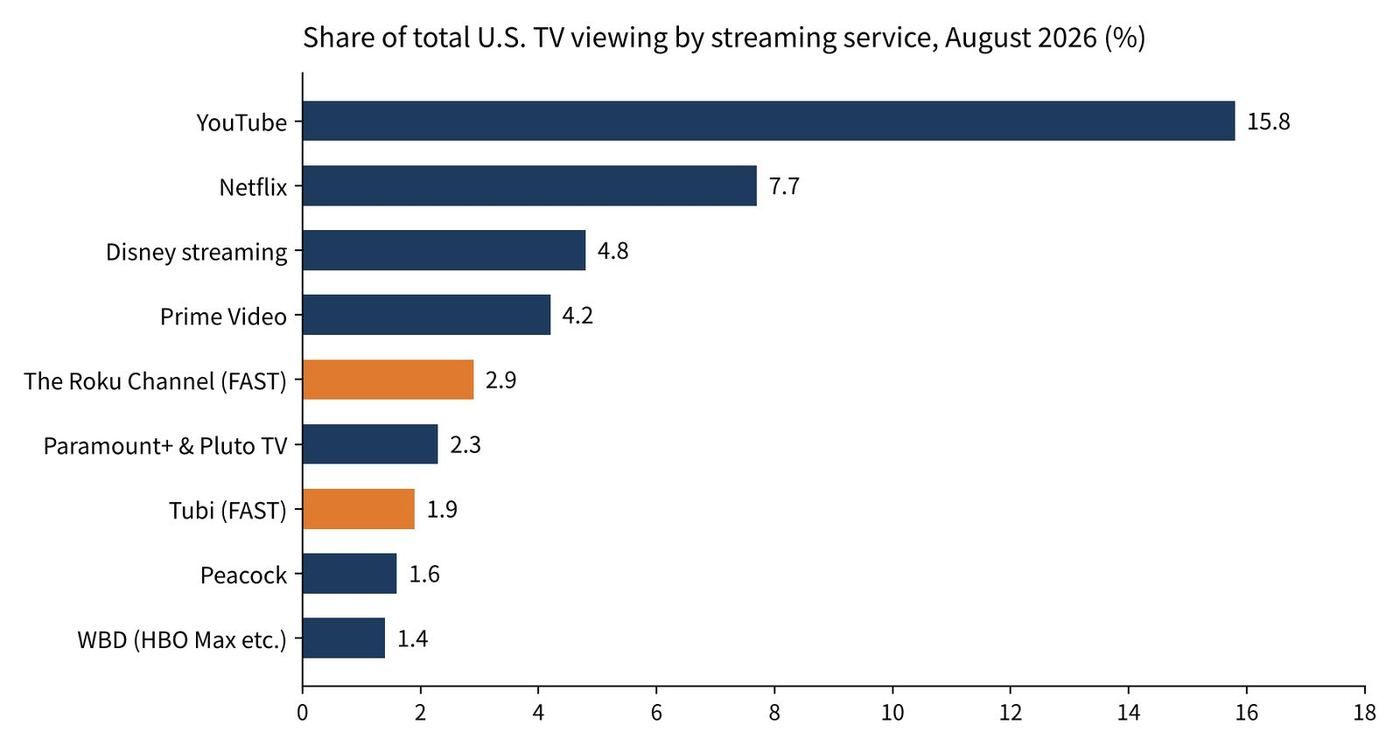
In Nielsen’s August Gauge, The Roku Channel took 2.9% of all U.S. TV viewing and Tubi 1.9%. Together, 4.8% equals Disney’s streaming share and tops Prime Video’s 4.2%. Netflix had 7.7% and YouTube a record 15.8%. Nielsen adjusted Tubi’s measurement parameters in June and is still assessing the impact; Tubi’s high is 2.3% in April. September and October will be published together after a methodology change.
Tubi simulcast Fox’s Super Bowl LIX free in February 2025, drawing an average 13.6 million viewers and a peak of 15.5 million. Game-day programming reached 24 million unique viewers and brought in more than 8 million new registrations. Tubi also ran its own spot, “Cowboy Head”. It showed a library-driven FAST service working as an outlet for major live sports.
Korea’s FAST policy targets the same market. The Ministry of Science and ICT (과학기술정보통신부) and KAIT (한국정보통신진흥협회) built 20 AI-dubbed K-FAST channels with about 1,200 titles, carried since December 2025 on Samsung TV Plus and LG Channels in 22 countries including the U.S., Canada and Mexico. Cumulative viewers reached about 100 million by the end of April. Membership of the Global K-FAST Alliance (글로벌 K-FAST 얼라이언스) has grown from 22 companies to 82, and four channels — vertical drama, K-beauty and K-dance among them — are being added this year.
“The US is the world’s largest FAST market, and Korean content is the most in-demand non-English content globally,” Omdia’s Maria Rua Aguete said at a K-FAST event in New York last November. K-FAST channels rely mainly on TV-maker platforms. With the two most-watched U.S. FAST services now inside Fox, Korean channel companies looking for wider U.S. carriage face one negotiating counterpart — Fox’s DTC group — for both.
32.85 million subscribers, the same 33 million band since 2020
In third-quarter results released Oct. 29, SiriusXM reported 32.854 million total subscribers, including 31.26 million self-pay. Self-pay subscribers rose by 5,000, against a loss of 40,000 a year earlier. Monthly churn fell to 1.5% from 1.6%, and average revenue per user was $15.18.
Revenue slipped less than 1% to $2.15 billion while net income rose 7% to $317 million. Adjusted EBITDA increased 3% to $694 million and free cash flow 14% to $293 million. SiriusXM raised its full-year outlook for a second straight quarter, to $8.55 billion in revenue, $2.65 billion in adjusted EBITDA and $1.4 billion in free cash flow, while warning that self-pay trends could be tougher in the fourth quarter.
Maffei credited Witz with expanding in-car penetration and the 360L platform, record customer satisfaction and low churn, the exclusive YouTube ad partnership and a podcast network. The Hollywood Reporter noted that a streaming app aimed at listeners outside the car did not take off as hoped, leading the company back toward in-car listening and several rounds of cost cuts. Witz did not take the stage at SiriusXM’s advertiser event in early October.
Q3 ad revenue $456 million; satellite radio’s share $37 million
Subscriptions and advertising come from different parts of the company. SiriusXM-segment subscriber revenue was $1.5 billion in the quarter, while that segment’s ad revenue fell 5% to $37 million on softer news and direct-response demand. Pandora and off-platform ad revenue rose 0.7% to $419 million, according to The Desk. Of $456 million in total ad revenue, $419 million, or 92%, came from outside satellite radio.
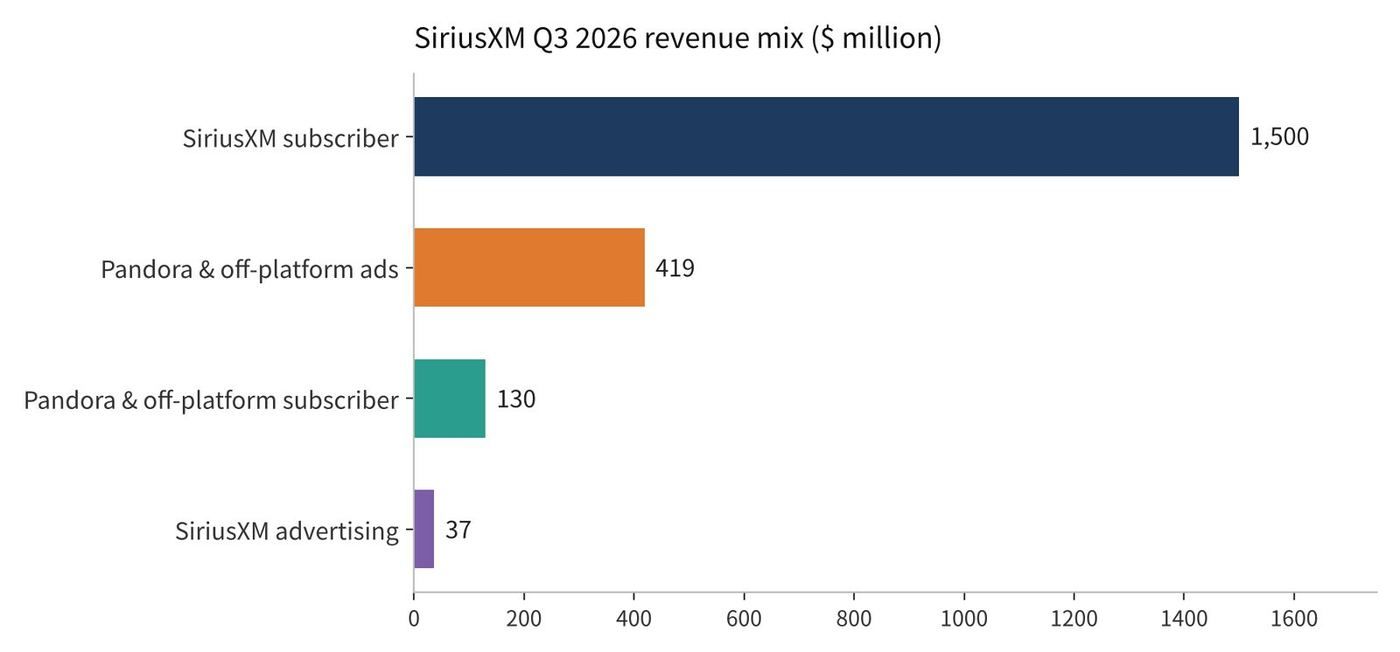
The company is pushing that ad business into inventory it does not own. On April 22 SiriusXM Media became YouTube’s exclusive U.S. audio ad representative, selling guaranteed audio impressions against audio-first listening on YouTube and YouTube Music — podcasts, music and talk — from this fall, using AdsWizz technology. SiriusXM says the combined reach is 255 million monthly listeners, about 90% of Americans aged 13 and older.
Podcasts point the same way. SiriusXM signed SmartLess, Alex Cooper’s Call Her Daddy and, in October 2025, MrBallen, and kept Howard Stern despite retirement talk. On the Q3 call, video and social podcast ad sales more than doubled year over year for a third straight quarter, and average listening time rose 5%.
“Premium audio experiences will be more important than ever to the future of entertainment, and I believe SiriusXM can evolve to lead that future,” Sud said, pledging to “expand value for our subscribers, advertisers, artists, creators, talent, partners, and shareholders.”
K-pop is app-only in the U.S.; Korean suppliers to Tubi and Roku now face one Distad line
SiriusXM’s ties to Korean content remain thin. Its SiriusXM K-Pop channel runs in the app only (channel 705), going out on satellite during special windows such as May’s Asian American and Pacific Islander Heritage Month, while K-pop hits also play on Hits 1. In 2022 Seoul music startup Space Oddity (스페이스오디티) brought its weekly chart show “K-pop Radar” to SiriusXM.
The YouTube deal touches Korea more directly. Because it covers all audio-first listening on YouTube and YouTube Music in the U.S., K-pop listening and Korean creators’ podcasts by U.S. users fall inside the inventory SiriusXM Media sells. A U.S. advertiser buying audio spots against that listening now buys them through SiriusXM Media.
A broadcaster’s second pipe: Fox built Tubi as Korean terrestrial ad spend halved
Fox owns one of America’s four big broadcast networks. As broadcast viewing shrank, it used Tubi to reach people who don’t pay for TV. Big events like the Super Bowl and the World Cup went out on both the network and Tubi; library and creator content went free and ad-supported; and advertising shifted toward performance products measured through QR codes and mobile purchases. The result: Tubi revenue up tenfold and ad revenue up 35%.
Korean terrestrial TV ad spending fell 51.1% from ₩1.8976 trillion ($1.42 billion) in 2014 to ₩927.3 billion ($690 million) in 2024, according to the government’s broadcasting and communications advertising survey (방송통신광고비 조사). Korean broadcasters’ K-FAST channels are suppliers to TV-maker platforms such as Samsung TV Plus and LG Channels, which keep the ad sales and viewer data. Fox differs in owning the platform, Tubi, and with it both ad sales and viewing data. SiriusXM likewise offset shrinking ads on its own satellite channels by selling Pandora, podcast and YouTube inventory. Both companies grew ad revenue from audiences and inventory beyond their own channels.
Outlook: first tests are Q4 subscribers and YouTube ad results
Sud’s first report card will come with first-quarter 2027 results. With management already flagging a harder fourth quarter for self-pay subscribers, subscriber numbers will be judged first. The YouTube representation began this fall, making 2027 its first full year, and her performance RSUs are measured over the same 2027–2029 window as her contract.
After its push to stream beyond the car fell short, SiriusXM’s board chose an executive who built a free, ad-supported video service to more than 100 million users. How far she shifts the mix toward advertising, podcasts and third-party inventory while holding the in-car subscription base is the main variable in SiriusXM’s 2027 strategy. Fox, meanwhile, has folded Tubi and Roku into one unit. For Korean content companies, the decision-makers they face in both U.S. free streaming and audio advertising are changing at the same time.