

MEDIA M&A | ANALYSIS
The Paramount–Warner Bros. Discovery merger closes after a ninth offer and a jump to trial following a July court freeze; Fitch cuts the company to 'BB' on about $80 billion of net debt

The Warner Bros. lot in Burbank, California, where Skydance held its first employee town hall. Photo: WSJ video still
Paramount Skydance completed its acquisition of Warner Bros. Discovery on Tuesday. The combined company is called Skydance Corp. The deal is valued at $111 billion (about ₩149.14 trillion) including assumed WBD debt. Skydance's Class B shares began trading on the New York Stock Exchange under the ticker SKYD the same day, and WBD shares were delisted from Nasdaq.
At a press conference on the Paramount lot, chairman and chief executive David Ellison said Paramount Pictures and Warner Bros. will keep their own release slates and relationships with creators, while Paramount+ and HBO Max will be moved onto a shared technology base and combined into a single service. The company has annual revenue of nearly $70 billion (₩94.05 trillion).
Ellison's case for the deal is that the old studios failed to change themselves. "How we got here to a place where Paramount could be acquired and Warner Bros. could be acquired is the businesses didn't disrupt themselves over a decade ago," he said at the press conference, as reported by TheWrap. "They allowed Netflix to disrupt their business. They allowed Amazon Prime Video to come and disrupt their business." Ellison took control of Paramount in August 2025; 14 months later he has put two of Hollywood's five major studios under one roof. For Warner Bros., it is a third owner in eight years, after AT&T in 2018 and Discovery in 2022.
Net debt stands at about $80 billion (₩107.49 trillion). Fitch cut both companies to BB on the day of closing. Skydance says it will cut more than $6 billion (₩8.06 trillion) a year in costs within three years and bring net debt to adjusted EBITDA down to 3x by the end of 2029. Thousands of employees at the former Paramount and WBD are expected to lose their jobs over the coming months.
$31.02 a share in cash, plus $41.9 million for running late
WBD shareholders received $31.01666668 a share in cash (about ₩41,700): the $31 agreed in February plus a ticking fee of $0.00277778 a share for each day after Sept. 30, a formula WBD disclosed on Sept. 30. At roughly $7 million (₩9.4 billion) a day from Oct. 1, the fee cost Paramount an extra $41.9 million (₩56.3 billion).
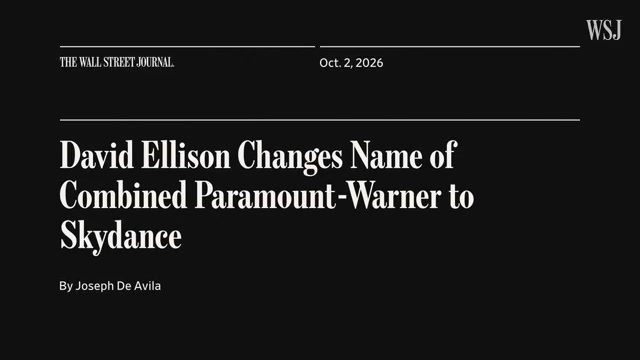
The $47 billion (₩63.15 trillion) of equity came from Class B shares priced at $12 (about ₩16,100), bought by Oracle co-founder Larry Ellison, RedBird Capital Partners, LionTree and the sovereign wealth funds of Saudi Arabia, Qatar and Abu Dhabi. Bank of America, Citigroup and Apollo Global Management led the borrowing, which Yahoo Finance put at $41.4 billion of bonds and an $8.5 billion term loan. The Ellison family and RedBird hold all of the Class A stock and with it 100% of the voting power. The Skydance name was first reported by The Wall Street Journal on Oct. 2.
No. 1 at the box office from 2007 to 2013… three owners in eight years
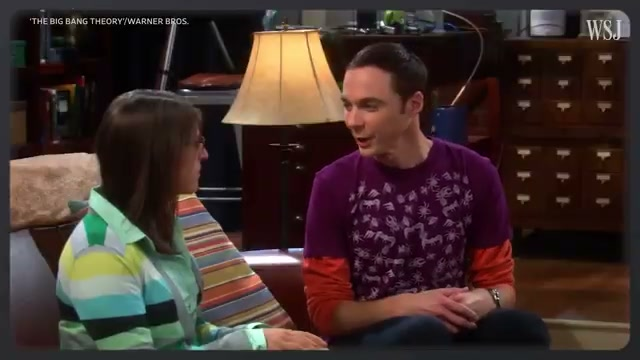
Warner Bros. was founded in 1923 by four Warner brothers. Its films run from "Casablanca" and "A Clockwork Orange" to "Barbie" and "A Minecraft Movie," and it built the Harry Potter franchise; on television it supplied "Friends," "ER" and "The Big Bang Theory" to the broadcast networks. In its "What Went Wrong" video, "Why Warner Bros. Is Being Sold for $81B," the Journal notes that Warner Bros. finished first at the U.S. box office every year from 2007 to 2013, when there were six major studios, and has not finished first since 2016.


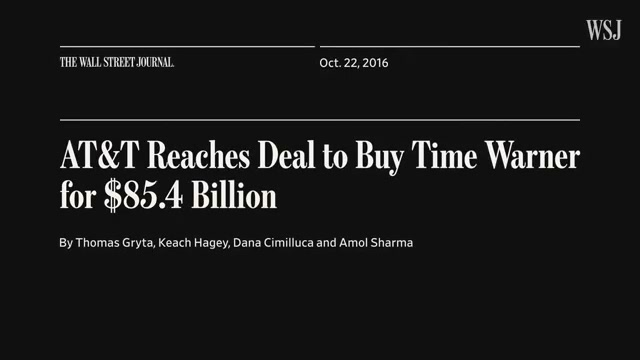
Time Warner agreed on Oct. 22, 2016 to sell itself to AT&T for $85.4 billion (₩114.74 trillion), and the deal closed in June 2018. AT&T planned to distribute Warner Bros. and HBO content through its wireless network. The Journal says cost reviews, layoffs and a pivot to streaming followed, and the studio's standing as the place top talent wanted to work began to slip.
The Journal singles out "Project Popcorn" in 2021 as the turning point.
During the pandemic, Warner Bros. released its entire 2021 slate in theaters and on HBO Max on the same day. HBO Max gained subscribers, but directors, actors and producers who prize theatrical release pushed back. Christopher Nolan made his next film, "Oppenheimer" (2023), with Universal Pictures. The Journal says Warner Bros. has released about half as many films in the 2020s as before.
Four years after buying it, AT&T spun off WarnerMedia and merged it with Discovery, creating WBD in April 2022. Discovery had grown on low-budget reality shows such as "MythBusters" and "Man vs. Wild," and its core business was shrinking with cord-cutting. HBO Max absorbed Discovery+ content and became Max in May 2023, then went back to HBO Max in July 2025. Citing Nielsen, the Journal says Warner Bros. had the lowest TV viewing share among the major streaming companies in July.

A Discovery Networks reality series. Photo: WSJ video still / Discovery Networks
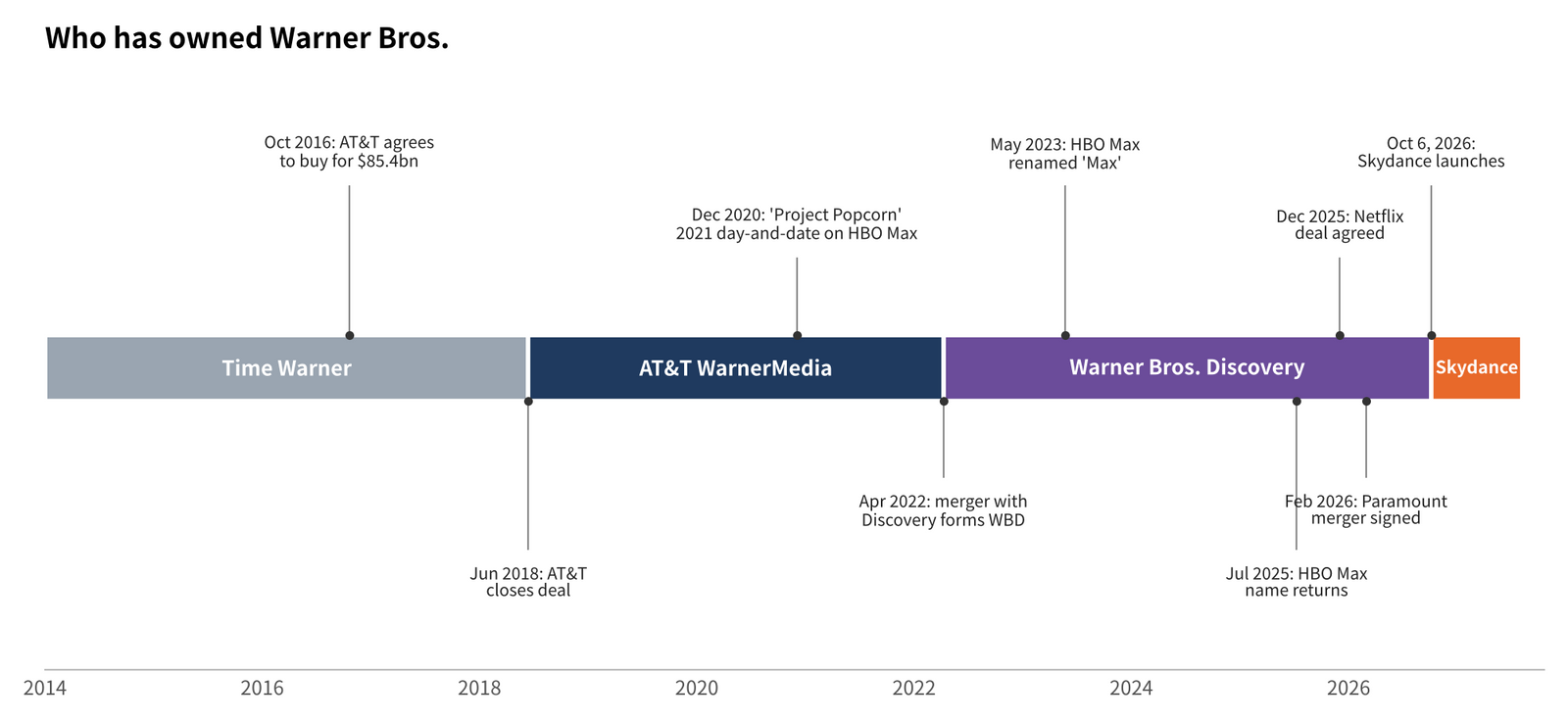
Warner Bros. has changed hands three times since 2018. Source: The Wall Street Journal; company announcements
A WBD spokesperson told the Journal its films accounted for three of the top 10 grossers in both 2024 and 2025, and that HBO Max, with tens of millions of subscribers worldwide, was expected to generate about $1.5 billion (₩2.02 trillion) this fiscal year. Debt did not fall as fast. The Journal says the smaller Paramount could afford Warner Bros. because Ellison had raised capital with the backing of his father, Larry Ellison.

.
The Journal's verdict is that Warner Bros. put short-term streaming growth ahead of the long-term value of its brand to filmmakers and audiences, and that this led to the sale. AT&T and Discovery both justified their deals by the need for scale against Netflix and Amazon.
From $19 a share to $31… Netflix walked away after the ninth offer
Ellison already had Warner Bros. in mind when he took control of Paramount, the Journal reported on Tuesday. His first offer, in September 2025, was $19 a share (about ₩25,500), and WBD chief executive David Zaslav rejected the first few. When WBD put itself up for sale, Netflix agreed on Dec. 4 to buy the studios and HBO Max at an enterprise value of $82.7 billion (₩111.12 trillion) (timeline).
Ellison raised his price, took his bid directly to shareholders and threatened a proxy fight, and Trump allies lobbied on his behalf. On his ninth offer, Netflix declined to match. On Feb. 26, 2026, WBD's board judged the $31-a-share bid superior, and the merger agreement was signed the next day. The price was 63% above Ellison's first offer. The Journal puts the purchase at $81 billion (₩108.83 trillion).
A July court freeze, a jump to trial, and $650 million a quarter on the line
Regulatory strategy fell to chief legal officer Makan Delrahim, who as Trump's first-term antitrust chief led the Justice Department's unsuccessful attempt to block AT&T's purchase of Time Warner in 2018. Ellison set up a war room on the Paramount lot and reviewed strategy daily with Delrahim and a few other executives. Jon Leibowitz, who chaired the Federal Trade Commission under President Obama, joined as an outside adviser. Approvals from the Justice Department, the EU, the U.K. and China came relatively smoothly.
The states were another matter. California Attorney General Rob Bonta and 11 other state attorneys general, including New York, Connecticut and Colorado, sued, alleging illegal consolidation in theatrical films and basic cable channels, and in late July a judge issued a temporary restraining order halting the deal. Rather than spend months fighting over an injunction, Ellison agreed to keep the companies apart and went straight to a trial on the merits, set for next March. If the deal did not close by the end of September, Paramount owed WBD shareholders $650 million (₩873 billion) a quarter in ticking fees, a bill that could approach $2 billion (₩2.69 trillion) by trial. A loss at trial could have killed the deal.

Ellison worked the politics himself. He met California Governor Gavin Newsom more than once and warned that the company would move to another state if the deal was blocked. Paramount discussed a move with officials in Tennessee.
Bonta called the threats bluster and blackmail, but people close to Ellison told the Journal they were real. In early August, Ellison hired Actum, the consulting firm founded by former California Assembly Speaker Fabian Núñez; its partners, former Sen. Barbara Boxer and former Los Angeles Mayor Antonio Villaraigosa, also helped. Newsom publicly urged both sides to settle and privately pressed Bonta to negotiate.
Most theater chains that had worried about the deal came around once Ellison promised at least 30 releases a year and favorable terms on theatrical windows. The two sides settled in late September. According to The State AG Report, the terms are 30 releases a year for five years, at least $1.5 billion (₩2.02 trillion) more in domestic film production and $47.5 million (₩63.8 billion) for workers who lose their jobs because of the merger.
Each missed film costs $30 million (₩40.3 billion), paid to guild health and pension funds, and shortfalls can force the sale of Miramax. Films must stay in theaters for at least 45 days before streaming. The settlement does not require the company to stay in California, but it said it would remain a Los Angeles company and keep both the Warner and Paramount lots. A federal judge approved the settlement on Oct. 1.
"Now let's be honest. It wasn't easy to get here," Ellison told employees at a town hall on the Warner Bros. lot on Tuesday. "At times it was downright ugly." He added: "I'd do it all over again in a heartbeat" (from a transcript viewed by the Journal).
Paramount+ at 81.6 million, HBO Max past 140 million… one app is a long-term goal
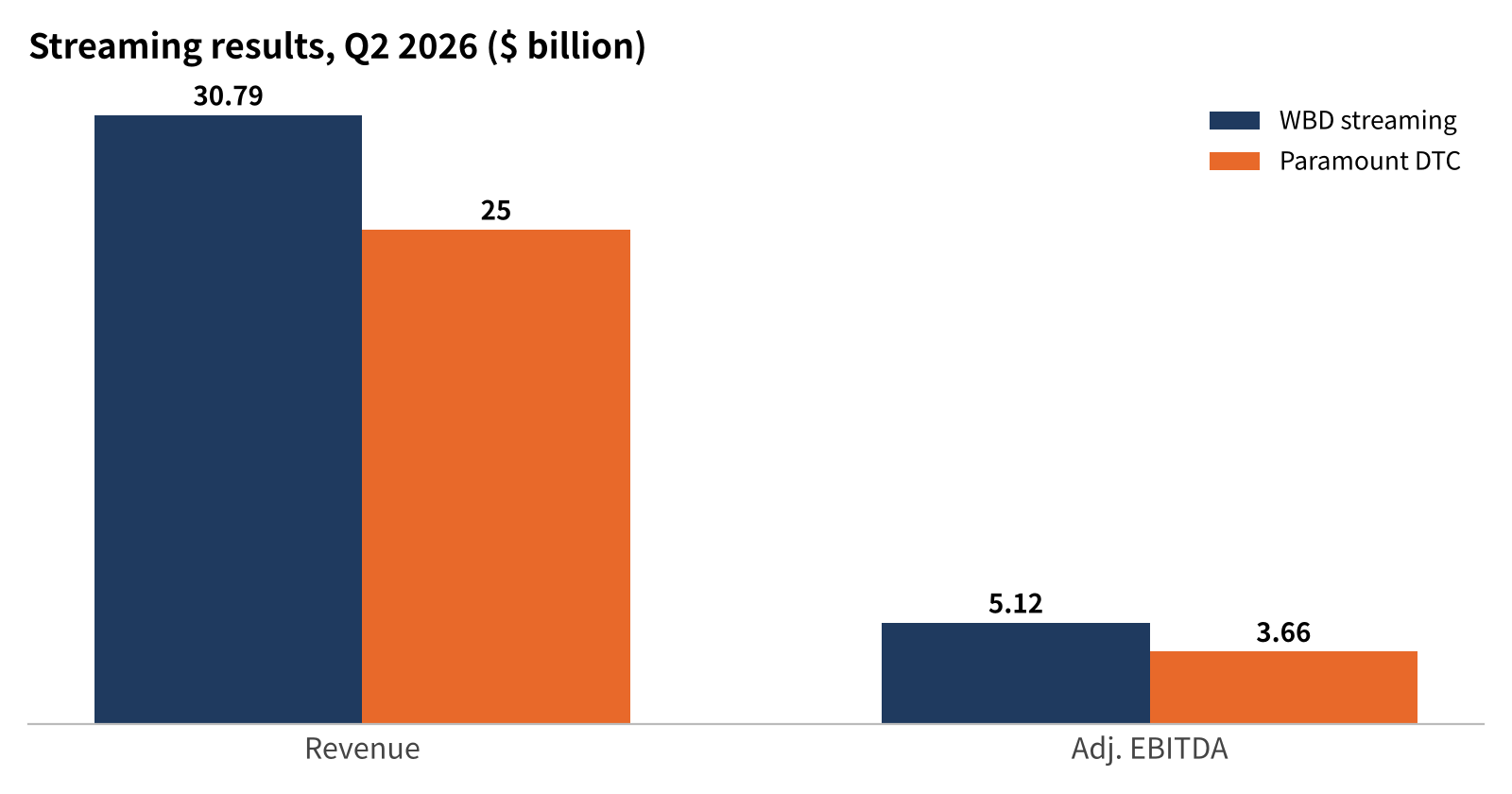
Paramount+ added 2 million subscribers in the second quarter to reach 81.6 million. Paramount's direct-to-consumer revenue rose 9% to $2.5 billion (₩3.36 trillion), and adjusted EBITDA climbed 44% to $366 million (₩492 billion) (Cord Cutters News, Aug. 4).
WBD's streaming unit posted second-quarter revenue of $3.079 billion (₩4.14 trillion) and adjusted EBITDA of $512 million (₩688 billion). HBO Max passed 140 million subscribers in the first quarter and is aiming for 150 million by year-end. International ad revenue rose 73% excluding currency after launches in Germany, Italy, the U.K. and Ireland (Cord Cutters News, Aug. 6).
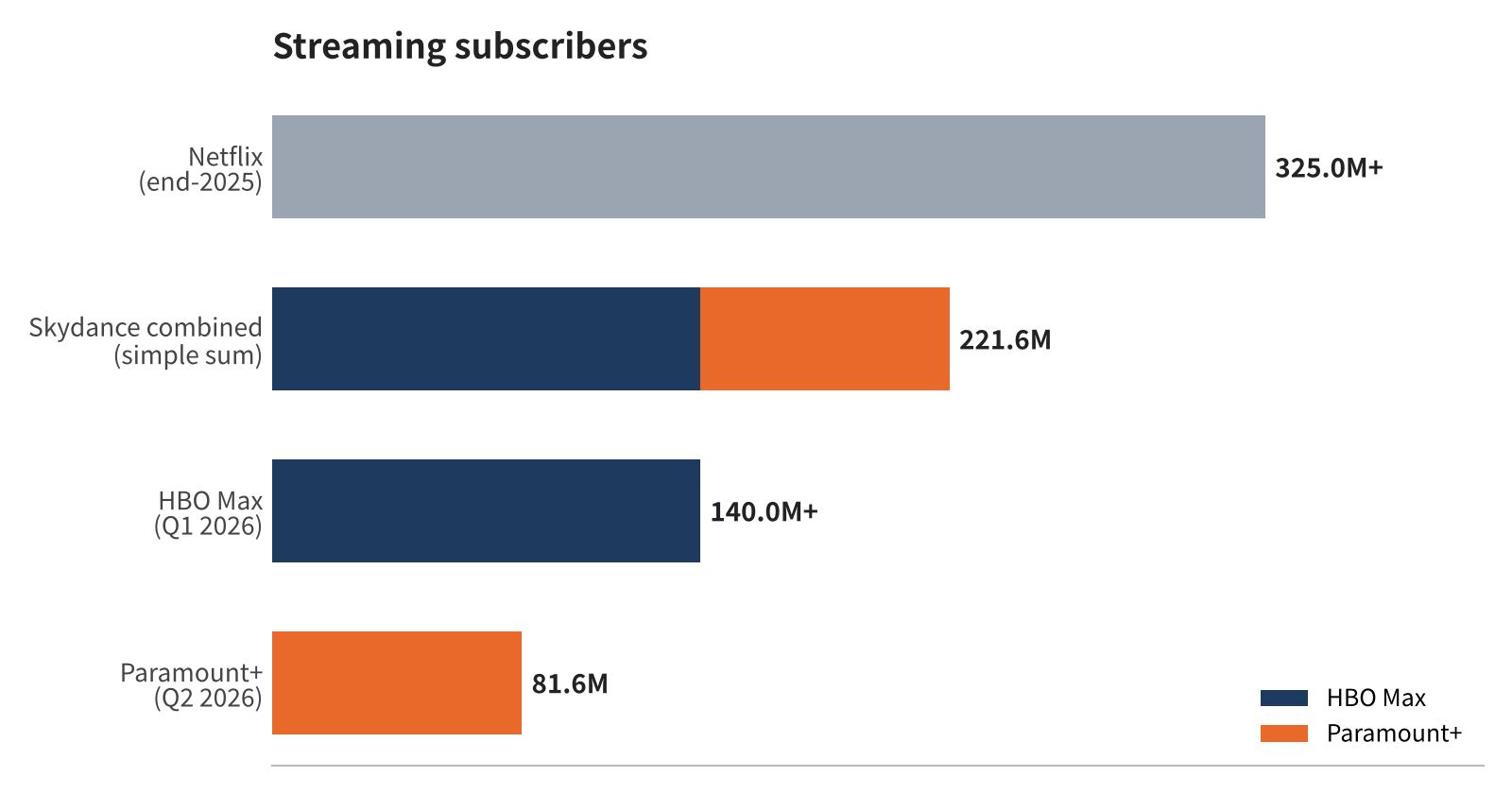
Added together, the two services reach 221.6 million, more than 100 million short of the 325 million paid memberships Netflix reported at the end of 2025.
That figure does not remove people who pay for both, so a combined service could end up smaller. Ellison first set out the plan on an investor call in March, saying the combination "gives us a little over 200 million direct to consumer subscribers," and repeated the figure on Tuesday, saying it lets Skydance "compete with the Disneys and Netflixes and Amazons" (The Hollywood Reporter).
No timetable has been given. Ellison said that "long term" the services would be combined, but "it'll take a period of time to do that, so I think in the immediate you will see them operated separately." He said that "given the way AI technology and other things have progressed, we think we can actually accelerate" the work, noting that Paramount had just done it in-house; Paramount has already put Paramount+ and the free ad-supported Pluto TV on one platform. A bundle of the two services will come "in the relatively short term," he said, without details.
Casey Bloys, who now oversees all of Skydance's streaming, spoke last week at Bloomberg's Screentime event about keeping the services separate and bundling them. He declined to comment on what would happen but said the HBO Max–Disney bundle had been "very successful" and that something similar "would make a lot of sense" (The Hollywood Reporter). In March, Ellison said "HBO should stay HBO." The company has not announced the structure of the combined service.
Separate film slates, release dates coordinated by genre and audience
"The plan is to keep the studios independent creatively, so that each studio will have its own slate, its own relationship, its own opportunities, and then we will choreograph the release schedule to optimize by genre, by audience demographic," co-CEO Ynon Kreiz said at the press conference. Kreiz, Mattel's chairman and CEO since 2018, was named co-CEO on Oct. 1. He runs day-to-day operations and integration; Ellison keeps long-term strategy, creative direction, technology and capital allocation (NewscastStudio).
Ellison promised franchises alongside original films and called Warner Bros.' "Sinners" his favorite movie of last year. Both lots will be kept, with one "probably" used for film and the other for television and streaming. CBS Studios, Warner Bros. Television and Paramount Television Studios now sit in one company. "When it comes to the TV studios, it's about scale. We're not looking to reduce output or production," Kreiz said. No specific plan was offered for the cable networks. On CNN and CBS News, Ellison said: "We believe in complete editorial independence," adding that the company had not "talked to any political leader of any party about news."
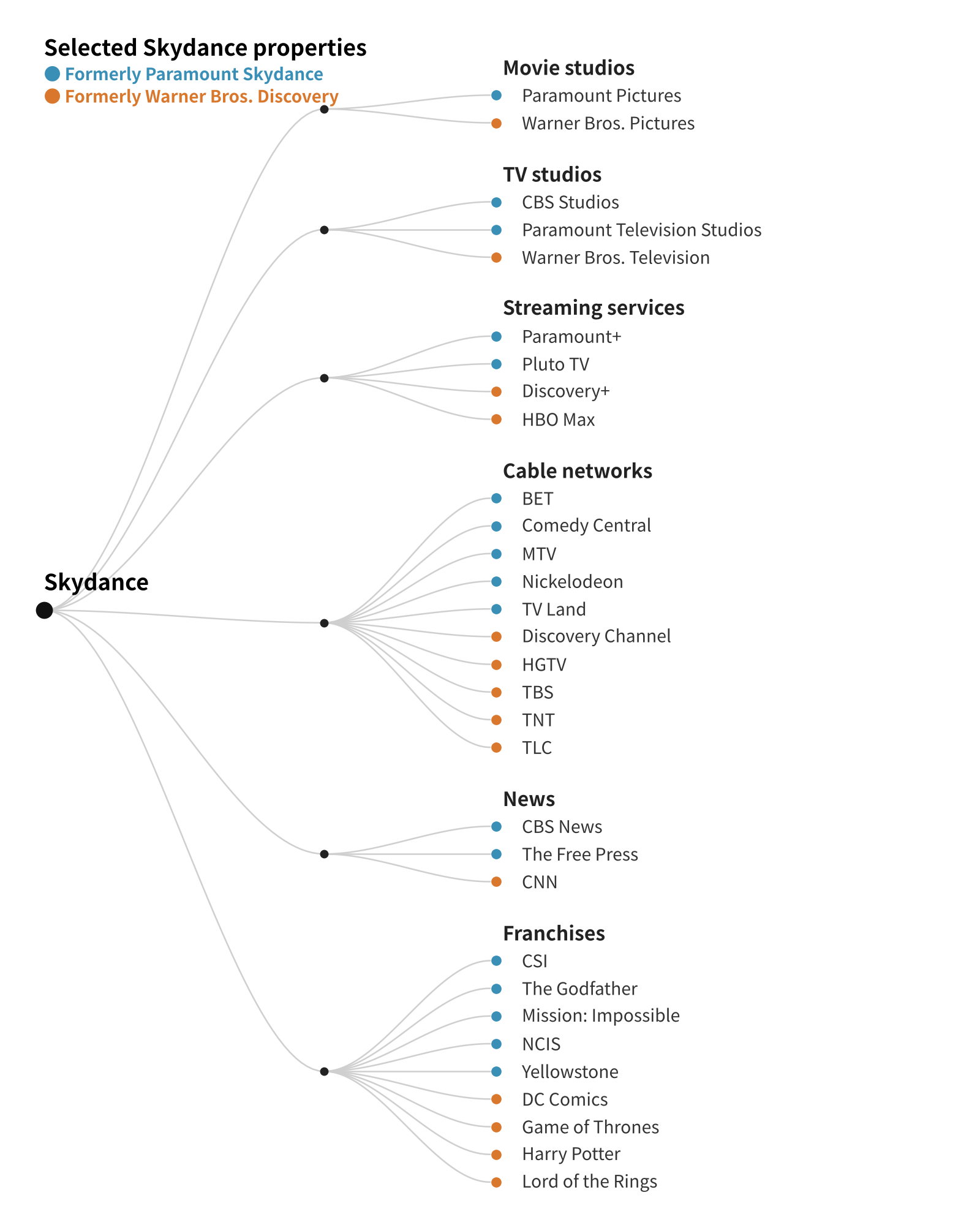
The Journal's map of Skydance's main properties counts two film studios, three TV studios, four streaming services, ten major cable networks and three news outlets. One-time rivals such as Nickelodeon and Cartoon Network now share an owner. Only Paramount+ and HBO Max have been named for combination; nothing has been said about Pluto TV or Discovery+. Paramount's "Mission: Impossible," "The Godfather," "Yellowstone," "NCIS" and "CSI" now sit alongside WBD's DC Comics, "Game of Thrones," "Harry Potter" and "The Lord of the Rings." The fates of Batman, Superman, the Teenage Mutant Ninja Turtles, Harry Potter, CNN and CBS News now rest with Ellison, the Journal wrote.
HBO's Bloys and WBD's Perrette co-run streaming; Zaslav is out
Under the leadership team announced on Oct. 5, streaming is run jointly by Casey Bloys, co-chair and chief content officer of Skydance DTC, and JB Perrette, co-chair and chief business officer. Bloys ran HBO; Perrette ran WBD's streaming business. Perrette also co-chairs the TV group with George Cheeks. Dana Goldberg and Josh Greenstein co-chair the film group, James Gunn and Peter Safran co-run DC Studios, and news is led by CNN chairman Mark Thompson and CBS News editor-in-chief Bari Weiss.
Zaslav, chief financial officer Gunnar Wiedenfels and Warner Bros. film co-chairs Mike De Luca and Pam Abdy are not joining the new company, The Spokesman-Review reported on Oct. 5. Emerson Collective founder Laurene Powell Jobs and Activision founder Bobby Kotick are joining the board.
Net debt of $80 billion, leverage near 7x… Fitch flags 'significant execution and integration risks'
S&P, Moody's and CreditSights estimate Skydance's net debt at about 7x adjusted EBITDA in 2026 and 2027 (Variety). The company's target is 3x by the end of 2029. It says savings will come mainly from technology integration, procurement, marketing and real estate. Kreiz said a multi-year plan supports $30 billion to $40 billion (₩40.31–53.74 trillion) of annual content spending while lifting free cash flow above $10 billion (₩13.44 trillion) by 2030.
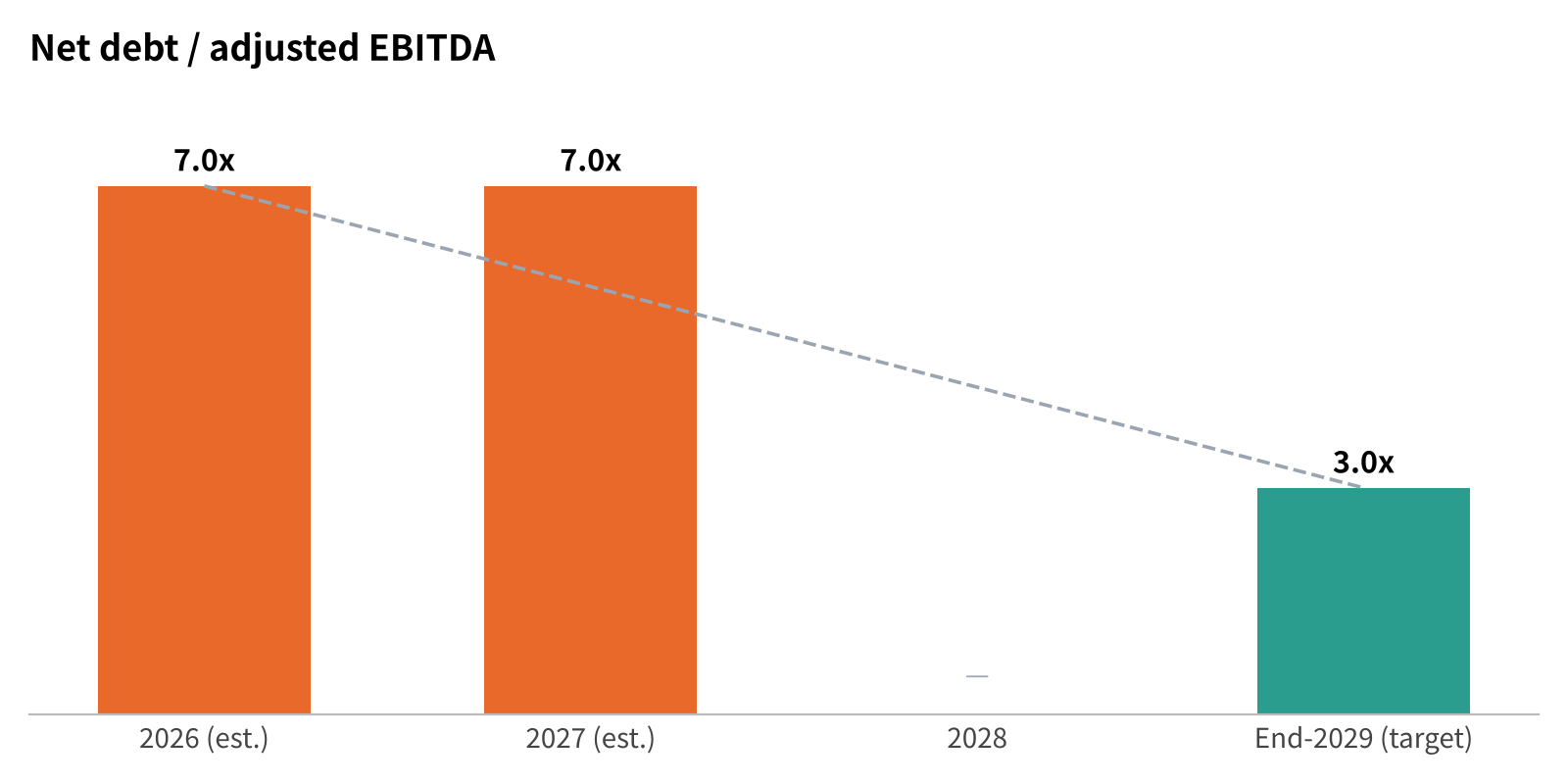
In its Oct. 6 downgrade, Fitch cited "materially higher leverage" and "significant execution and integration risks," as well as structural pressure on linear revenue, streaming competition and hit-driven content. "Fitch's base case does not include equity-funded debt reduction or asset sales," it wrote. Ellison and Kreiz did not say whether assets would be sold or how many jobs will go. The company says most savings will come from non-labor items, but a Los Angeles County-commissioned study estimates nearly 4,500 local film and TV jobs could be affected over three years. "The best I can say to our detractors is, give us time and we'll prove it," Ellison said.
$1.5 billion more for U.S. production, with a federal tax credit targeted for December
"Paramount's domestic production level is about 5%," Ellison said, and jobs are "being shipped overseas." He has been meeting senators of both parties to get a federal film rebate passed by Dec. 11. Citing state incentives of 43% in New Jersey and 38% in Georgia, he said that "even if you got the federal rebate, California would not be as competitive." Paramount signed a 10-year lease last year at 1888 Studios, a new soundstage complex in New Jersey. If a federal credit passes, some of the location and post-production money Hollywood studios spend abroad could move home, changing the terms for Korean production-service and visual-effects companies that have been winning that work.
An export outlet for TVING, Hollywood titles for Coupang Play… Skydance on both sides of Korea's streaming race
Skydance now deals with both sides of Korea's streaming competition: it gives one an export outlet and supplies the other with Hollywood titles.
The link to TVING is HBO Max. On Jan. 2, HBO Max opened a TVING branded hub in 17 Asia-Pacific markets under a multi-year deal WBD and CJ ENM signed on Oct. 16, 2025. The deal covers hundreds of hours of CJ ENM and TVING drama and entertainment, plus co-investment in and co-production of Korean drama (WBD). MBC's "Judge Lee Han-young" (판사 이한영) and a JTBC drama reached Asian viewers through the hub (CJ Newsroom).
Coupang Play (쿠팡플레이) is on the receiving end. Since March 2025 it has held exclusive Korean rights to HBO and HBO Max originals (The Korea Times), and since Oct. 29 that year it has sold Paramount+ titles as an add-on (Sports Kyunghyang). With the merger, Korean supply of both HBO and Paramount+ now runs through Coupang Play.
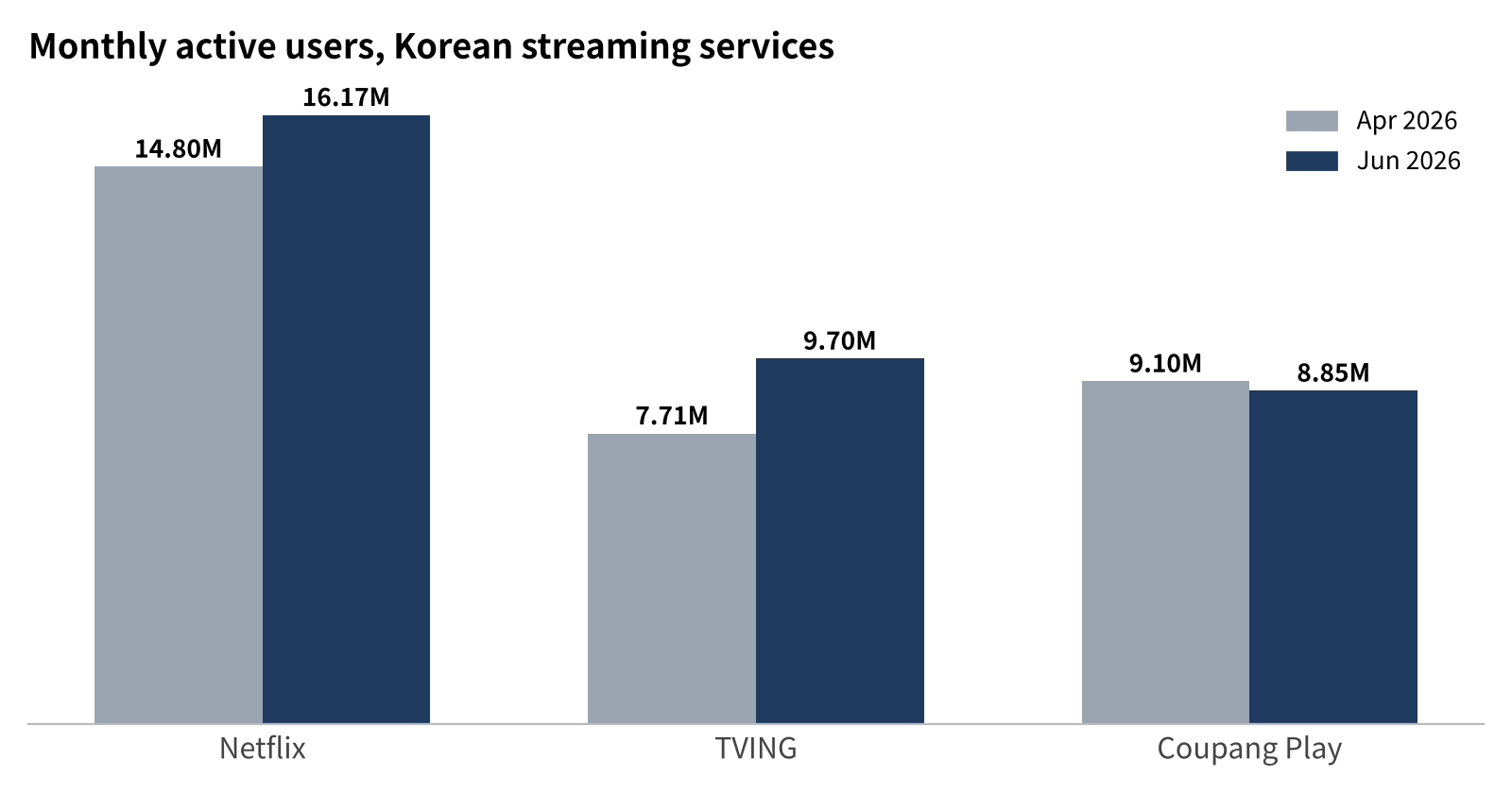
Skydance's programming shows up in the two services' user race. Coupang Play reached 9.1 million monthly active users in April and credited new HBO series such as the third season of "Euphoria" (Aju Business Daily). TVING, helped by KBO baseball, reached 9.7 million in June and moved back ahead of Coupang Play (8.85 million) (MTN).
Once the apps merge, the TVING hub's terms must be reset
The variables are the change in management and the merging of services. Zaslav and JB Perrette announced the CJ ENM deal for WBD. Zaslav has not joined the new company; Perrette stays as co-chair and chief business officer of Skydance DTC. Once HBO Max and Paramount+ become one service, the terms on which the TVING hub sits inside the combined app across 17 markets will have to be renegotiated.
For CJ ENM it is the second time around. CJ ENM partnered with Paramount in 2021, sending "Yonder" (욘더), "Ransom" (몸값) and "Unlucky Day" (운수 오진 날) out on Paramount+, but closed TVING's Paramount+ section on June 18, 2024 (Dealsite). WBD, the partner it chose next, has now merged with that same Paramount.
Warner Bros.' experience shows what to look for in overseas window deals. It gained subscribers in 2021 by releasing new films in theaters and on HBO Max the same day, and paid for it by losing directors. Which window comes first shaped its relationship with creators. The same applies when Korean broadcasters place drama in overseas outlets like the TVING hub: the order of first release, whether domestic and overseas release are simultaneous, and who holds the IP are the core of the contract.
JTBC's ₩20.6 billion default and Skydance's $80 billion in net debt… rights bought with debt, and where the repayment comes from
The way Skydance bought Warner Bros. is familiar to Korean media companies: buy big rights with debt first, then pay the debt down with what the rights earn. This year Korea produced a case where that model broke: JTBC. The difference between the two companies lies less in the size of the debt than in where the money to repay it comes from.
In 2019 JTBC became the first non-terrestrial Korean broadcaster to secure Olympic rights for 2026–2032 and World Cup rights for 2026–2030, an investment reported at about ₩700 billion ($521 million). That cost had to be recovered through domestic advertising and resale to the terrestrial networks. On June 12, JTBC failed to repay ₩20.6 billion ($15.3 million) of securitized borrowings, and NICE Investors Service cut its long-term rating the same day from BBB/Negative to CCC. On June 14, JoongAng Holdings, Contentree JoongAng, Megabox JoongAng and JoongAng P&I filed for rehabilitation at the Seoul Bankruptcy Court, followed by JTBC on June 15. Group borrowings total about ₩2.8 trillion ($2.08 billion), and JTBC's consolidated debt ratio was 2,443.6% at the end of March. On June 30 the court opened rehabilitation for the four affiliates and placed JTBC in its Autonomous Restructuring Support (ARS) program, which lets a company negotiate with creditors first.
The recovery failed because of the size of the market. Terrestrial TV ad revenue fell 51.1% from ₩1.8976 trillion in 2014 to ₩927.3 billion in 2023, and dropped further to ₩835.7 billion in 2024. Rights fees rise in dollars, while the domestic ad market that has to pay for them halved in ten years. "The government needs to boldly, even radically, lift advertising and programming regulations for content-producing broadcasters to survive," a broadcasting official told Digital Daily.
Skydance carries heavy debt too. Net debt is about $80 billion, and Fitch cut it to BB, a speculative grade, on the day of closing. But its repayment is not tied to one country's ad market. The company points to nearly $70 billion in annual revenue, more than 200 million streaming subscribers worldwide and $47 billion of equity from Larry Ellison and Middle Eastern sovereign funds, plus plans to cut more than $6 billion a year in costs within three years and lift free cash flow to $10 billion by 2030. Both are rated speculative, but Skydance repays from subscribers around the world and from theatrical, TV and streaming revenue. JTBC had to rely on a single, shrinking domestic ad market.
In Korea, the merger of TVING and Wavve (웨이브) has been floated as a way to close that gap in scale. On June 10, 2025, the Fair Trade Commission (공정거래위원회) conditionally approved the combination, under which CJ ENM and TVING executives sit on Wavve's board. But without the consent of KT Studio Genie (KT스튜디오지니), which holds 13.54% of TVING, the merger has not been completed. TVING reported a ₩6 billion operating profit in the second quarter, its first quarterly profit since launch, and said on Aug. 6 it would step up merger talks in the second half. While Korean companies work on getting bigger, JTBC's dramas reach overseas viewers through HBO Max's TVING hub. To widen the market in which they recover rights costs, Korean broadcasters will for now have to go through the outlets of global companies such as Skydance.
Megabox in rehabilitation, admissions at 104.9 million… the '30 films a year' pledge sets supply for Korean cinemas
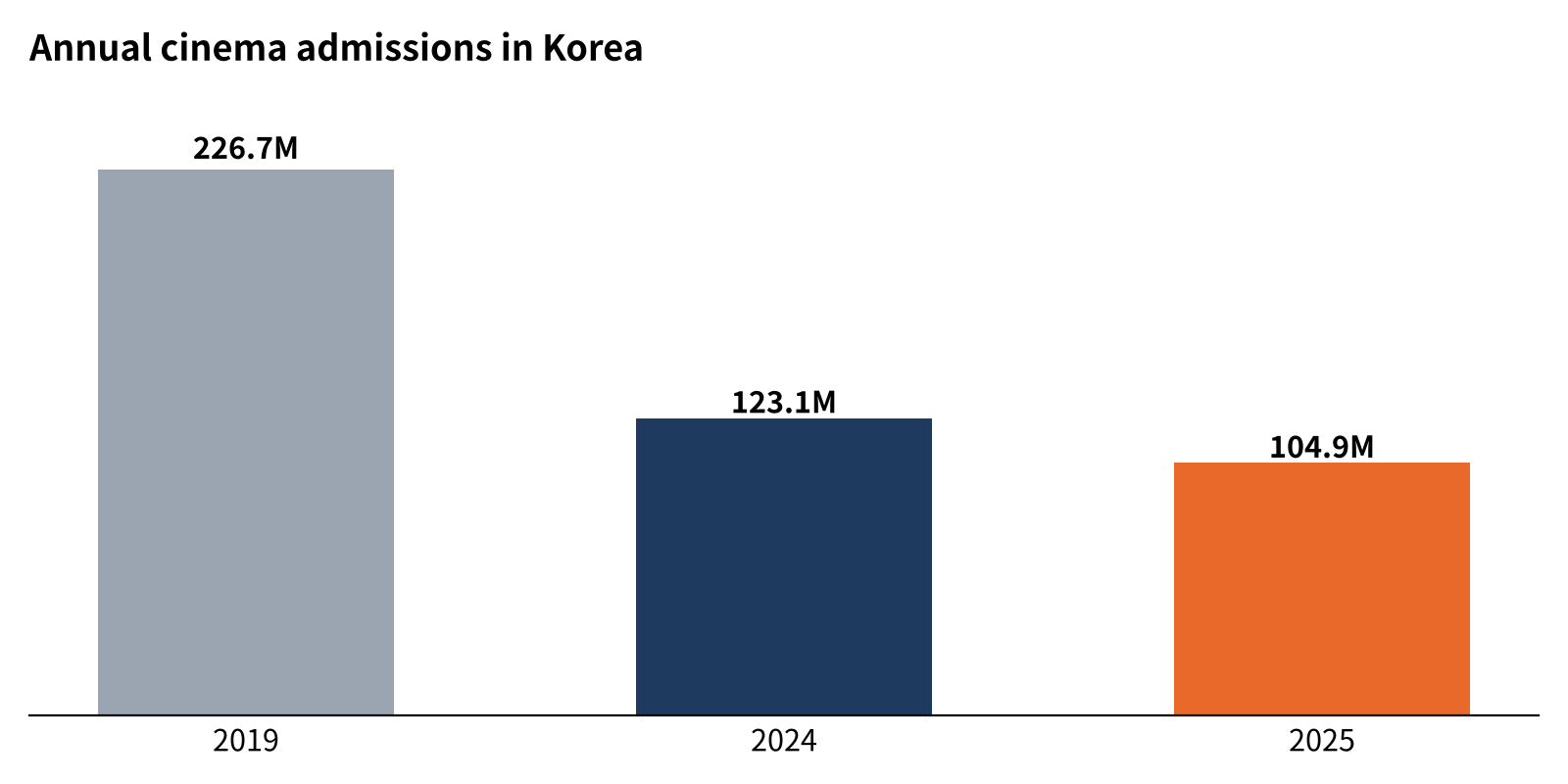
Korean cinema admissions fell 14.8% in 2025 to 104,922,364 (through Dec. 28), with no film reaching 10 million viewers. Megabox JoongAng's rehabilitation filing froze payments owed to distributors up to June 14 as rehabilitation claims. On July 8, a coalition of film groups warned that independent and art-house distributors would be hit directly and called for protections for settlement payments. The Lotte Cinema–Megabox merger agreed in May 2025 has made no progress in over a year.
"F1 The Movie," distributed by Warner Bros. Korea, drew 5.21 million admissions in Korea, and Paramount's "Mission: Impossible – The Final Reckoning" had 2025's biggest opening day with 423,945. The promise of at least 30 releases a year and the theatrical-window terms Ellison gave U.S. theater chains are American settlement conditions, but the volume of new Hollywood films reaching Korean screens, and how long they stay, follow them. If the two studios' release dates are coordinated by genre and audience as Kreiz described, fewer tentpoles will open on the same weekend, which will also affect Korean exhibitors' peak-season programming.
Conclusion… the app, layoffs and deleveraging are America's homework; Korea is left with a market of fewer outlets
Skydance has three open variables.
The first is the launch timetable for the combined app. Ellison has said only that Paramount+ and HBO Max will run separately for now, with bundles on sale, and be combined in the long term (Deadline).
The second is the scale of layoffs. The company plans to cut $6 billion in costs over three years, and a study commissioned by Los Angeles County estimates nearly 4,500 local film and TV jobs could be affected.
The third is the pace of deleveraging. The company plans to keep spending $30 billion to $40 billion a year on content while bringing leverage down from about 7x to 3x. Fitch called the execution and integration risks "significant" (Deadline). What happens to the cable networks, and whether a federal production credit passes in December, are also undecided.
The bigger problem for Korea is that there are fewer outlets to buy its content. With Paramount and Warner Bros. now one company, Korean broadcasters and producers have one fewer major Hollywood buyer, and the reach of a single company's decisions has grown on both the selling and buying sides. On the selling side, the question is where and on what terms the TVING hub in HBO Max's 17 Asia-Pacific markets will sit in the combined app. On the buying side, the term and renewal conditions of Coupang Play's HBO exclusivity have not been disclosed. Korean companies now negotiate with the same counterparty whether they are selling or buying.
Cinemas face the same problem. Skydance has promised at least 30 theatrical releases a year, but Megabox, Korea's No. 3 multiplex chain, is in rehabilitation, and its merger with Lotte Cinema collapsed when the memorandum of understanding expired on June 30 (The Korea Financial Times). More Hollywood supply means little if Korean cinemas are too weak to take it. On the production side, the federal tax credit is the variable: if it passes and some location and post-production budgets return to the U.S., Korean companies that have built up production-service and visual-effects work could lose business.
JTBC and Skydance leave the same question: after buying rights with debt, what repays the debt? Skydance points to 200 million subscribers worldwide and theatrical, TV and streaming revenue. JTBC relied on a domestic ad market that halved in ten years and ended up in rehabilitation. With the TVING–Wavve merger stalled for lack of KT Studio Genie's consent, the overseas reach of Korean content has come to depend more on global companies' branded hubs. When Korean broadcasters sign with overseas outlets, how well they hold on to the order of first release, IP ownership and co-production stakes becomes the practical means of recovering value.
Warner Bros., No. 1 at the U.S. box office from 2007 to 2013, now has its third owner in eight years.
At his first town hall, Ellison said the two companies "are not coming together to manage decline. We are coming together to build for growth... Very simply, we are here to win." While Skydance bets on scale, the task for Korean media is to protect its bargaining power as the number of outlets shrinks.