Snap has again pinned its next phase of growth on SPECS, the $2,195 augmented reality glasses launching September 16. Co-founder and chief executive Evan Spiegel restated that commitment alongside second-quarter results, and what underwrites it is less the revenue growth rate than the cash. Revenue rose 19% to $1,598.99 million from $1,344.93 million a year earlier, while adjusted EBITDA climbed from $41.27 million to $249.62 million and free cash flow from $23.79 million to $120.54 million over the same period. A cost base lowered by April’s layoffs and the shift to an AI-enabled operating model met recovering spend from larger North American advertisers and growth in subscription-led direct revenue.

In the earnings release Spiegel said the quarter reflects progress in strengthening the core business and building a more durable financial foundation. The company grew revenue 19%, expanded margins and generated positive free cash flow while improving advertising performance and rapidly growing its direct revenue business. He added that Snap remains focused on serving its 971 million monthly active users, delivering measurable value for advertisers, and investing with discipline to increase free cash flow per share over time.

Snap co-founder and CEO Evan Spiegel unveiling SPECS during the AWE 2026 keynote “Making Computing More Human” on June 16, 2026. / Screen capture from Snap’s YouTube video “Introducing SPECS at AWE”
Q2 financial results
US dollars, three months ended June 30, 2026, versus the prior year
For the first six months, revenue reached $3,127.78 million, up 15%, and the net loss narrowed to $252.91 million from $402.16 million. Adjusted EBITDA rose 223% to $482.95 million and free cash flow rose 194% to $406.55 million. Shares outstanding held at 1,682 million, unchanged from a year earlier — which lines up with the free cash flow per share goal Spiegel set out.
Adjusted EBITDA is a non-GAAP measure. The company said restructuring charges of $128.5 million, included in the consolidated statement of operations for both the three and six months ended June 30, 2026, were excluded from it. The accounting cost of April’s layoffs does not sit inside that figure.
Users, guidance and market reaction
After posting its first user decline in years at the end of 2025, Snap grew its audience over the first half of 2026. Daily active users reached 493 million for the quarter ending in June, above the 488 million analysts expected. Spiegel said the US audience also grew quarter-over-quarter, led by people aged 35 and older.
Other revenue, the line Snap is using to reduce its reliance on advertising, grew 85% to $316 million. It covers the Snapchat+ consumer subscription and an upgraded Memories plan that charges users to store some images and videos. New chief financial officer Doug Hott said in prepared remarks that the layoff savings — previously put at more than $500 million off the annualised cost base — are expected to be more fully reflected in the third quarter and beyond.
Earlier this year Snap warned that the war in the Middle East would weigh on advertising, a warning that hurt the stock after the May report. Monday’s shareholder letter made no mention of the conflict.
$2,195 glasses, launch event September 16
In the shareholder letter Spiegel called SPECS the company’s largest long-term opportunity, describing it as a new kind of computer built into see-through glasses, designed for a future in which AI does more work on people’s behalf and users spend less time operating screens. Because the glasses do not require a Snapchat account, he sees them reaching an audience beyond the existing app. Snap’s own corporate description now lists Specs Inc., a wholly owned subsidiary dedicated to making computing more human, alongside Snapchat as its operating businesses.
Snap unveiled its first consumer-oriented AR glasses in June, opening pre-orders at $2,195 with a $200 refundable deposit. Shipments are expected this autumn in the United States, the United Kingdom and France, with the launch event set for September 16. The device has been described as a hybrid of AI glasses and VR headsets, offering navigation, an AI assistant, content streaming and the ability to overlay interactive lessons onto real surfaces.

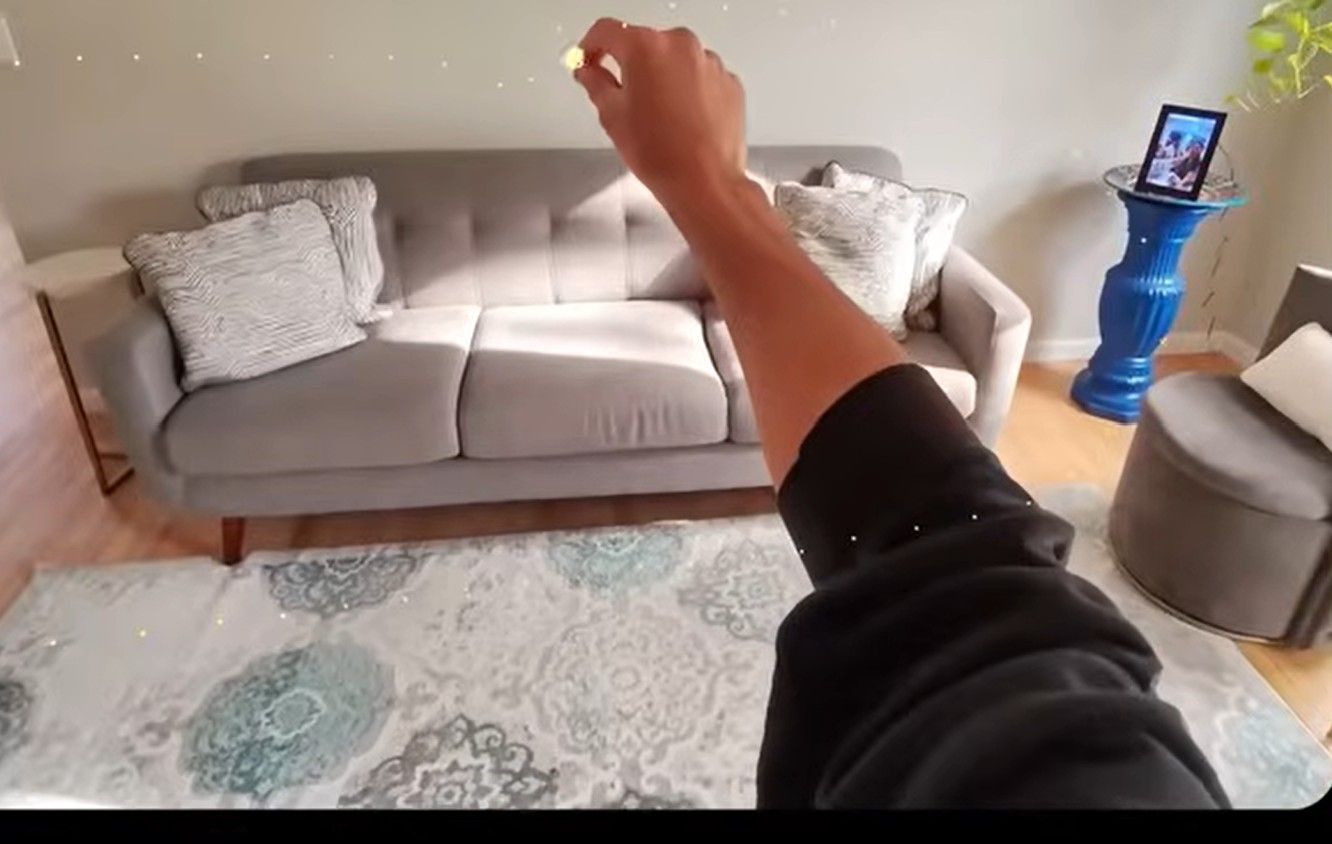
A SPECS demonstration: a drawing lesson and its controls overlaid on a physical sketchbook and the space around it. / Screen capture from Snap’s YouTube video “Introducing SPECS at AWE”
The hardware specifications were disclosed at the AWE 2026 unveiling in June. SPECS uses Snap’s own liquid crystal on silicon (LCoS) display with a 51-degree field of view and 16 million colours, giving a display area 30% larger than the fifth generation. Two Qualcomm Snapdragon processors — one for computer vision, one for running Lenses — let the glasses operate standalone with no external compute unit. Electrochromic lenses shift from clear to tinted in about 10 seconds for outdoor use, and motion-to-photon latency is 7 milliseconds. Built from Swiss TR90 polymer and offered in two sizes at 132 and 136 grams, they are roughly 40% lighter than the fifth-generation model. Battery life runs to about four hours of mixed use, or around 20 hours including the charging case.
Asked how pre-orders were tracking, Spiegel said prospective buyers want to try the product first. At $2,195 this is a high-consideration purchase; developers and those familiar with the platform understand the technical leap this generation represents, but the broader public will need hands-on time. The September 16 event, he said, is the starting point of that consumer-oriented journey.
Investor scepticism and the first-mover claim
Not everyone on the call was convinced. Some investors questioned whether SPECS can break through in a crowded field where competitors such as Meta have far greater resources, and pressed Spiegel on whether there are limits to how much he might invest in the product.
Spiegel replied that the long-term opportunity to develop the next computing platform is enormous, noting that Snapchat itself launched into an already crowded social media industry and still found success. What makes this opportunity distinctive, he said, is that Snap is a first mover. He also said technology like SPECS is unlikely to be widely adopted until the end of the decade, and that the company is approaching the investment with a lot of discipline. While Meta and Alphabet’s Google pour tens of billions into AI models and data centres, Snap has put the same money into a single device.
Snap has been here before. It launched Spectacles, camera-equipped sunglasses that recorded short videos, in 2016; sales disappointed, and in 2017 the company booked losses tied to excess orders. Updated versions followed, along with AR glasses in 2021. The glasses business was moved into a wholly owned subsidiary in January.
Teen regulation and litigation
Snap warned of a challenging regulatory and legal environment at home and abroad. After Australia became the first country to ban a range of apps including Snapchat for under-16s in December, several others proposed similar restrictions, and last month France became the first European Union member to ban social media for young teenagers.
In the United States, Snap’s most valuable market, broad litigation continues alleging that leading social media companies knowingly hooked and harmed minors. Thousands of individuals and US school districts are suing Snap and its rivals. Snap has settled claims in three closely watched cases this year but still faces several other trials scheduled in 2026.
Hott told investors the landscape could materially affect the business and financial results. Spiegel echoed the point, saying the company is closely monitoring the regulatory environment — including age assurance, privacy and online safety requirements — which may affect the product experience or user growth and engagement over time.
The “AI does it for you” premise meets a demand for disclosure
SPECS rests on the premise that AI handles more of the work on the user’s behalf. Lenses generate and lay content over physical space in real time, which makes it harder than on a phone screen to tell where generative AI ends and the world begins. Over the same period, surveys across content categories have found large majorities asking to be told when generative AI was involved.

Consumer research on disclosure of generative AI use across music, film, TV and video games. / Sources: National Research Group; Ipsos Digital/Deezer; HUB Entertainment Research
In games, National Research Group surveyed 1,000 US consumers aged 18-44 who play on PC or console at least weekly in March 2026. Full disclosure of where AI was used — details on AI-generated characters, dialogue and art — was an acceptable level of transparency for 49%. A general statement that AI tools were used satisfied 31%, disclosure of major AI features only satisfied 17%, and just 3% said no disclosure was necessary.
In music, Ipsos surveyed 6,791 global music streaming users for Deezer between October 6 and 10, 2025. Asked whether they would like to know if a streaming service is recommending 100% AI-generated music, 73% said yes, 22% said no and 5% were unsure. In the same research, 80% wanted fully AI-generated music clearly labelled, and 97% of the 9,000 participants could not distinguish AI-generated from human-made music. Deezer remains the only major streaming platform that systematically labels fully AI-generated content.
In film and television, HUB Entertainment Research surveyed 2,500 US consumers aged 16-74 in November 2025 and published in January 2026. Asked whether viewers should be informed when companies use AI in making a TV show or movie, 72% said companies should always disclose it, 21% said only if AI was used in a major way, and 7% said disclosure was not necessary.
Where the duty to disclose lands differs by medium. In music, large numbers of AI tracks have been uploaded to streaming services and accumulated plays without users’ knowledge, so much of the labelling responsibility falls to the platforms. Film, TV and game studios have to track where AI entered the creative process and decide how and where to disclose it. For eyewear that lays AI-generated elements over physical space, no established form for that disclosure exists yet.
What to watch next
September 16 is the point at which SPECS either crosses from a developer product into a consumer one or does not. Since Spiegel has acknowledged that pre-order customers want to try the glasses first, sales will turn on how much physical demonstration Snap can put in front of buyers. Meta already has eyewear retail distribution through its Ray-Ban partnership; Snap will be working largely through its own channels.
This quarter’s cash flow changes the funding terms for that bet. Free cash flow of $120.54 million for the quarter and $406.55 million for the half year is enough to carry hardware investment for a stretch without outside money. Setting free cash flow per share as the target while holding shares outstanding flat year-over-year reads as an answer to the investment-ceiling question raised on the call: it will be managed against a cash flow metric.
At the same time, the 505% jump in adjusted EBITDA excludes $128.5 million in restructuring charges. Together with the company’s own statement that layoff savings land more fully from the third quarter, Q3 becomes the checkpoint for whether the improvement came from excluding one-off costs or from a genuinely lower cost structure.
Spiegel’s end-of-decade adoption estimate doubles as guidance on how long this investment runs. Early shipment volumes will not offset slower ad growth, and SPECS contributes nothing to the top line yet. Regulation acts directly on the timetable: if the precedents set by Australia and France spread, Snapchat’s teen base shrinks and the weight of new audience SPECS has to open up grows accordingly. That the stock sits more than 37% below where it started the year despite the beat suggests the market is still pricing SPECS as an option rather than as earnings.
What this means for Korean players
The gap between 9% advertising growth and 85% growth in direct revenue reads across directly to Korean platforms and broadcasters. Snap lowered its ad dependence through a fairly simple combination: a consumer subscription and paid storage. For Korean operators that already hold both the user data and the storage demand, that is a proven path.
It is also worth noting which metric Snap put at the front of this release — not revenue, but free cash flow and free cash flow per share. Communicating on cash generation rather than growth rate is a usable narrative structure for Korean content and platform companies that have to explain long-horizon investment while still running losses. The precondition, when leading with a non-GAAP measure such as adjusted EBITDA, is disclosing what has been excluded from it.
Disclosure of generative AI use belongs in the same preparation column. Ninety-seven percent in games, 93% in film and TV and 73% in music point to labelling as a response to user demand rather than to regulation. Building a record of where AI entered production first is what makes any eventual disclosure requirement cheap to meet.
Teen usage restrictions are a signposted trend. With France following Australia, age assurance is closer to a design requirement than a compliance response. Building age assurance, privacy and online safety requirements into the product from the start costs less than retrofitting them.
The structure that houses long-horizon hardware investment in a separate entity able to take minority investment is worth study by Korean entertainment technology companies weighing how to fund new businesses. On content, Spiegel’s end-of-decade horizon is the preparation window: short-form spatial formats suited to eyewear cannot begin after the devices sell. The detail that US growth was led by the over-35s belongs in the same frame — the assumption that these are teen platforms is loosening, and targeting built on it needs revisiting.
Sources
1. "Snap Inc. Announces Second Quarter 2026 Financial Results" (Exhibit 99.1), Snap Inc., August 3, 2026 — revenue, operating loss, net loss, adjusted EBITDA, operating cash flow, free cash flow, loss per share, shares outstanding, six-month figures, the $128.5 million restructuring exclusion, Spiegel quotation, description of Specs Inc.
https://s25.q4cdn.com/442043304/files/doc_financials/2026/q2/Q2-26-Earnings-Release_Final.pdf
2. Caitlin Huston, "Snap CEO Sees New Wearable Glasses as ‘Largest Long-Term Opportunity’", The Hollywood Reporter, August 3, 2026 — user figures, Spiegel earnings-call remarks, SPECS specifications and price, Spectacles history, guidance, Hott on regulation
3. Alexandra S. Levine (Bloomberg), "Snap bets its future on AR glasses in crowded AI race", Los Angeles Times, August 4, 2026 — results versus consensus, advertising and other revenue detail, share price move, rebound after the late-2025 user decline and over-35 growth, investor scepticism, end-of-decade adoption estimate, Australia and France restrictions and US litigation, Hott on when layoff savings land
4. "Snap Projects Strong Sales Growth Ahead of AR Glasses Debut", Bloomberg, August 3, 2026 — the originating wire version of the above
5. "Snap’s stock jumps on earnings beat and strong sales forecast", CNBC, August 3, 2026 — rationale for the $50 million increase to infrastructure guidance, $200 refundable deposit
https://www.cnbc.com/2026/08/03/snap-q2-earnings-report-2026.html
6. "Snap establishes Specs subsidiary for its AR glasses", CNBC, January 28, 2026 — rationale for Specs Inc., potential for minority investment
https://www.cnbc.com/2026/01/28/snap-establishes-specs-subsidiary-for-its-ar-glasses.html
7. "Introducing SPECS at AWE", Snap official YouTube channel, June 2026 — Spiegel’s AWE 2026 keynote “Making Computing More Human” and SPECS demonstration footage (source of both photographs above)
https://www.youtube.com/watch?v=dE1_z5nyA0c
8. "Snap Reveals Next-gen Specs AR Glasses, Priced at $2,200", Road to VR, June 16, 2026 — LCoS display, 51-degree field of view, dual Snapdragon processors, electrochromic lenses, weight and battery figures
https://roadtovr.com/snap-specs-2026-ar-glasses-release-date-price/
9. National Research Group, "Gamers Are Warming to AI, Just as Long as It’s Not in the Driver’s Seat", June 2026 — fielded March 2026 among 1,000 US consumers aged 18-44 who play video games on PC or console at least weekly
10. Ipsos Digital/Deezer, "Music & AI", fielded October 6-10, 2025 — 6,791 global music streaming users, from 9,000 total participants across eight countries
11. HUB Entertainment Research, "AI & Audiences", January 2026 — fielded November 2025 among 2,500 US consumers aged 16-74
* Adjusted EBITDA and free cash flow are non-GAAP measures; definitions and the reconciliation to GAAP appear on page 8 of Snap’s earnings release.