
IN BRIEF Amazon is considering bundling its Amazon Leo satellite broadband service with Prime, eero routers, Fire TV and Ring. In a Bango survey fielded in late September, U.S. adults said a music subscription (23%), a food-delivery membership (20%) and a shopping membership (19%) would do most to make a streaming bundle more valuable. As video-only bundles settle into a contest over discounts, the ingredients are widening to connectivity, commerce and everyday services. In Korea, Coupang WOW, Naver Plus and Baemin Club already carry streaming services inside them.
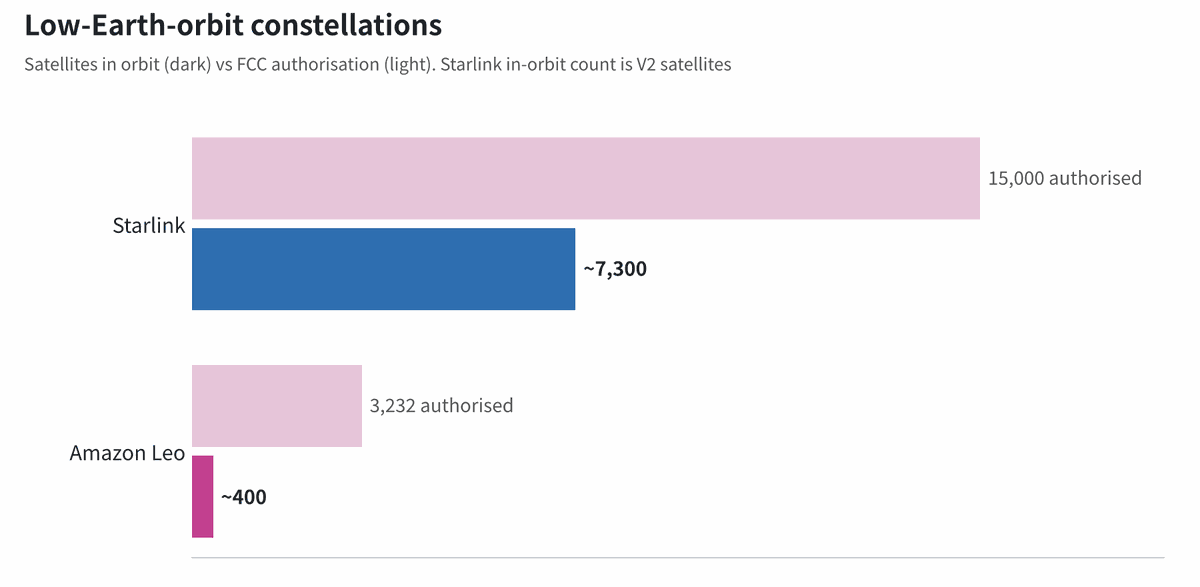
Amazon is considering selling its Amazon Leo satellite broadband service in combination with Prime membership, eero Wi-Fi equipment, Fire TV and Ring doorbells. Chris Weber, the unit’s vice president of business, laid out the idea this month in an interview with Ars Technica. Amazon has nearly 400 satellites in orbit and is aiming to switch on initial service before the end of the year.
When American consumers were asked what should go into a streaming bundle, their answers also pointed away from video. Bango, a subscription-payments technology company, surveyed 2,500 U.S. adults between September 24 and 30. A music streaming subscription topped the list of services that would make a streaming bundle more valuable, at 23%. Food-delivery memberships offering free delivery or discounts came second at 20%, shopping memberships with free shipping third at 19%, and gaming subscriptions fourth at 15%. Andrew Wallenstein, chief insights officer at Luminate, paired the findings with Amazon’s Leo plans in a recent newsletter, arguing that the next frontier in bundling may have little to do with adding another streaming service.
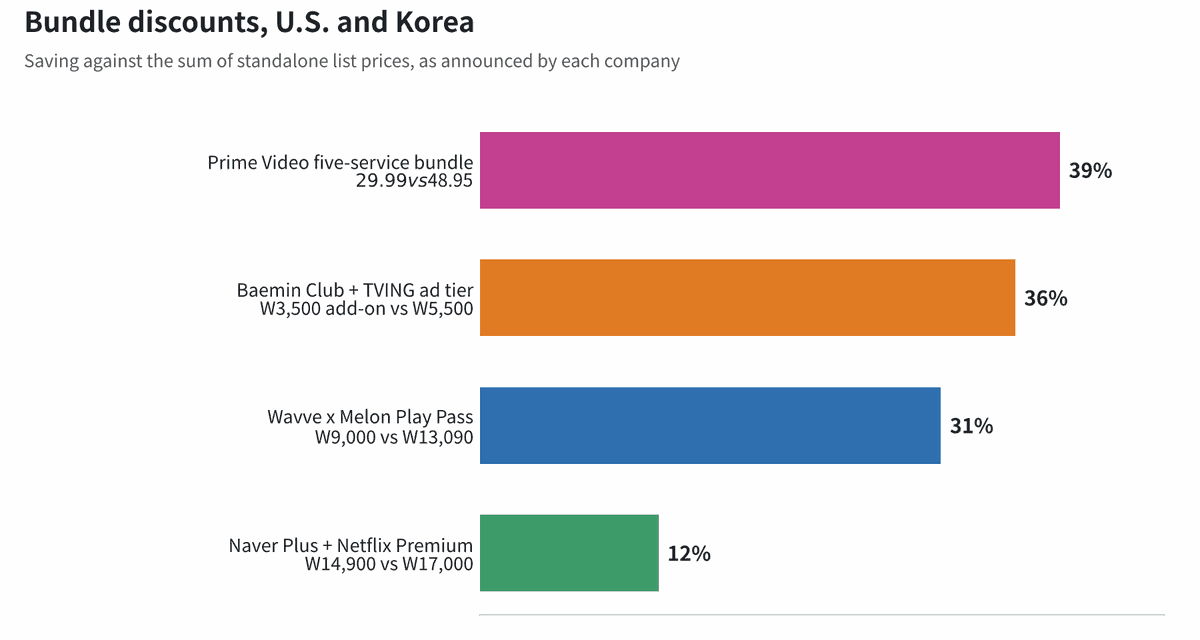
Bundles built only from video have already turned into a discount race. On September 15, Prime Video launched its first five-service bundle, combining AMC+, BritBox, MGM+, PBS Masterpiece and Starz for $29.99 a month (about 39,800 won), 39% below the combined standalone prices. Wallenstein’s point was that differentiation gets harder when every bundle is assembled from variations of the same basic ingredients.
The commercial purpose of a bundle has not changed: it is there to stop people cancelling. In the Bango survey, 61% of respondents said they would be more likely to keep a streaming subscription if they could get it cheaper through a bundle, and 21% of Gen Z respondents had switched from buying a subscription on its own to getting it through a bundle in the past year. Amazon wants to chase the same goal with assets that sit outside video — commerce, devices and now satellite connectivity. In Korea, Coupang, Naver and Baemin (배달의민족) built that structure first, putting streaming services inside shopping and food-delivery memberships.
Nearly 400 Leo satellites in orbit… ‘lots of assets within Amazon’ to pair with them
“There are lots of assets within Amazon that we can pair with Leo to bring new value to consumers,” Weber told Ars Technica, as quoted by Broadband Breakfast on October 9. The candidates he named were Prime, eero routers, Fire TV and Ring. GeekWire reported that consumer-side synergies could also involve Prime Video, the Zoox robotaxi unit and Amazon’s delivery services. Leo sits in the same Devices and Services division as Kindle, Echo, Fire TV, eero and Ring, so most of the bundle partners report into the same organisation.
How soon any of this reaches customers depends on satellites. Amazon has built its 1,000th spacecraft and says it is weeks away from resuming launches, with at least three planned this year, starting on a United Launch Alliance Vulcan and followed by an Arianespace flight. The Federal Communications Commission has authorised 3,232 satellites, with a full-deployment deadline of July 2029; in June the agency waived an interim requirement to have 1,616 in service by July 30 after Amazon cited difficulty securing launches. Leo will offer three terminal tiers: Nano at up to 100 Mbps, Pro at up to 400 Mbps and Ultra at up to 1 Gbps. BGR reported that consumer beta service is expected in late 2026 or early 2027 in the U.S., Canada, the U.K., France and Germany.
The incumbent is SpaceX’s Starlink, which New Street Research estimates has about 4 million U.S. subscribers. Starlink’s global base has reached 13.6 million, and its average revenue per user held at $66 a month (about 87,700 won) in the second quarter. It operates roughly 7,300 V2 satellites against an authorisation for 15,000. Behind on both satellites and subscribers, Amazon is putting its retail membership and device ecosystem at the front of its pitch.
Prime Video’s five-service bundle costs $29.99… but saves about $10 over its existing three-pack
Any Amazon customer can buy the five-service bundle; a Prime membership is not required. Bought separately, the five services cost $48.95 a month, AFTVnews calculated. Amazon already sells AMC+, MGM+ and Starz together for $21.99, however, and adding BritBox and PBS Masterpiece individually to that brings the total to $39.97 — so the new bundle’s real saving for many customers is about $10 a month.
“Our subscriptions and bundles business continues to see incredible growth because we stay focused on delivering unmatched selection, value and convenience.” — Ryan Pirozzi, head of Prime Video Channels, U.S., Amazon announcement, September 15
Prime Video Channels plays each partner service inside the Prime Video app and consolidates billing in one place. According to figures cited by TheWrap, the number of U.S. consumers who transacted with a specialty subscription streaming service rose 55%, from 41 million in the second quarter of 2024 to 63.6 million in the second quarter of 2026. Comcast also sells a five-service package through its StreamSaver perk, but only to Xfinity TV and Internet customers.
Music 23%, delivery 20%, shopping 19%… no add-on wins a majority
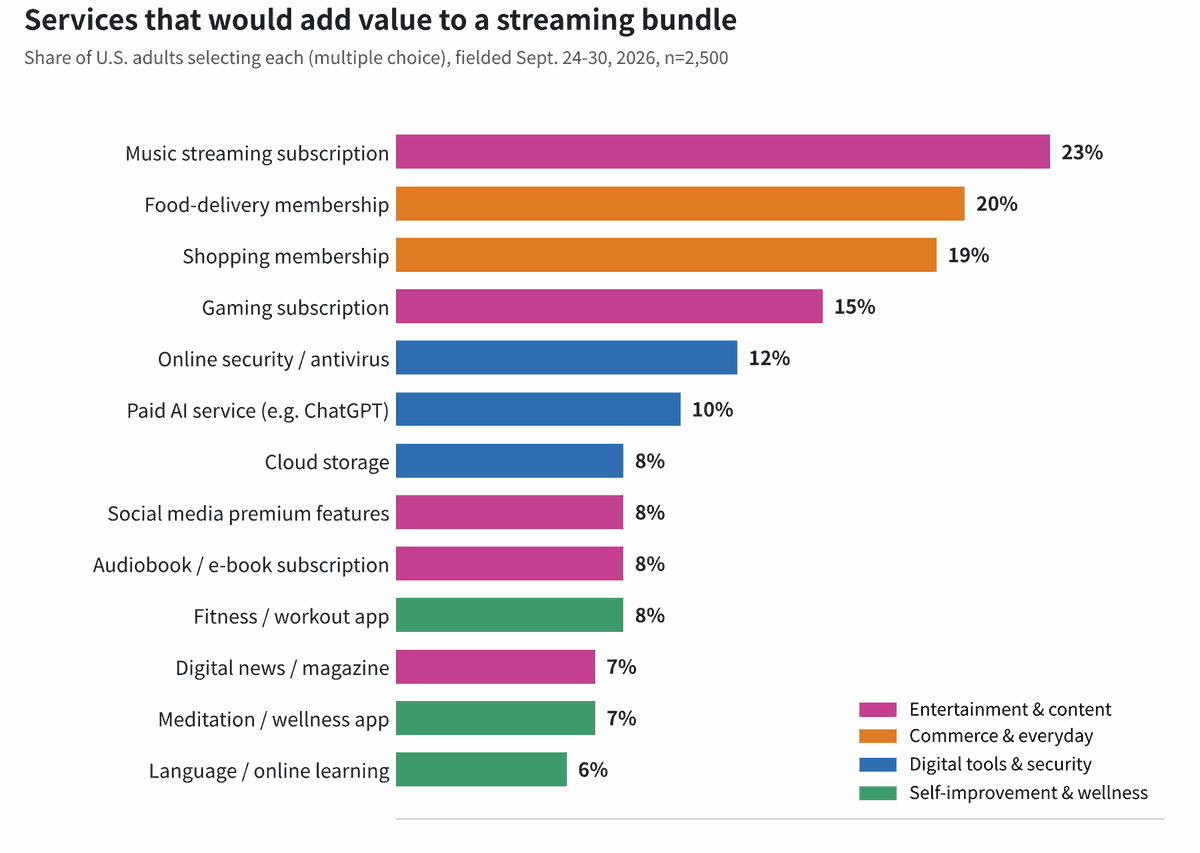
None of the 13 options was chosen by a majority; the top answer, music, drew 23%. Wallenstein read that less as a weakness than as room to build different combinations for different audiences, and the generational splits support the reading. Millennials were the most likely to want music, at 26%. Baby boomers led on shopping memberships at 24%, five points above the total, and on online security at 18%. Gen Z stood out on gaming at 23%, eight points above the overall 15%. Food delivery drew an identical 21% from Gen Z, millennials and Gen X.
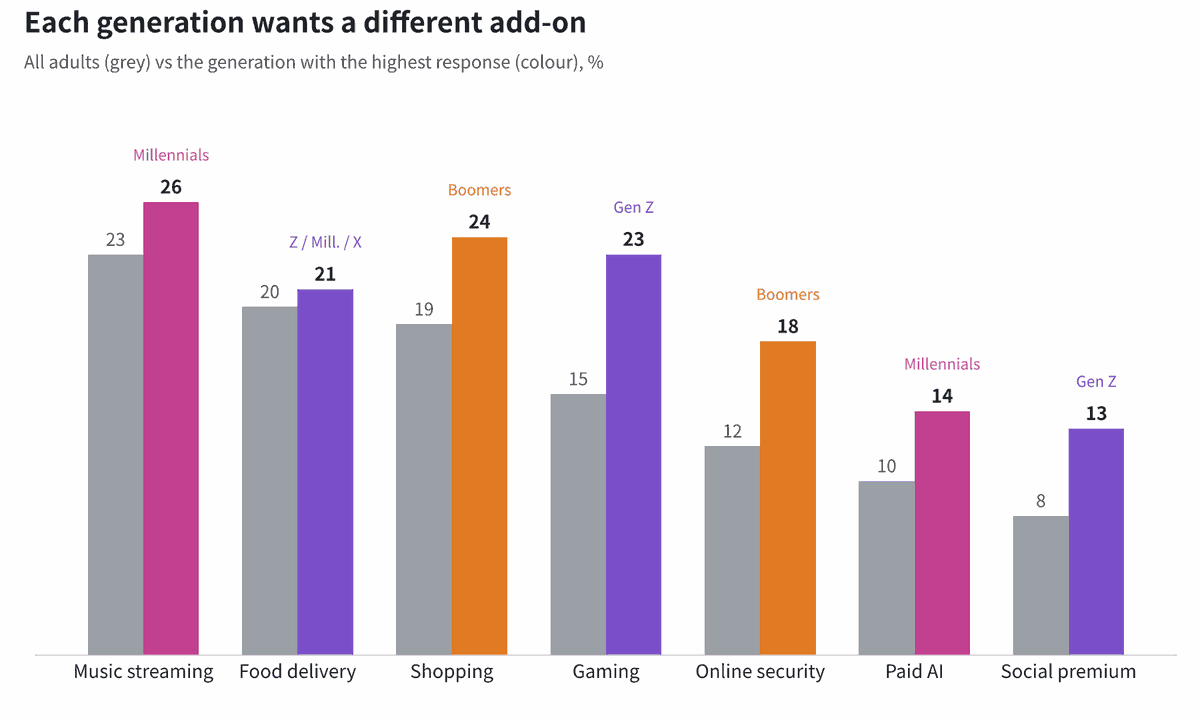
A paid AI service such as ChatGPT appealed to 10% of respondents (14% of millennials), ahead of cloud storage at 8%. On short-form video, 40% said they would use a streaming service more often if it offered clips of shows they follow, and 53% of Gen Z said they prefer clips to full episodes, The Desk reported on October 13. Full episodes still mattered to 65% when deciding whether to keep a subscription, against 64% for an exclusive film and TV library and 50% for live sports. “People still value the shows they follow,” said Bango chief executive Paul Larbey.
Bango itself sells the plumbing for this kind of bundling: its Digital Vending Machine lets telecom operators, banks and other resellers package third-party subscriptions, with Verizon among its clients. Its subscription revenue rose 13% to $12.3 million (about 16.3 billion won) in the first half of 2026.
Coupang WOW: 7,890 won for streaming plus free delivery… in Korea, lifestyle memberships already carry streaming
The second- and third-ranked add-ons in Bango’s survey — delivery and shopping memberships — are the very products that carry streaming in Korea. Coupang’s WOW membership (쿠팡 와우) costs 7,890 won (about $5.94) a month and bundles free Rocket shipping, free Coupang Eats delivery and Coupang Play. The last figure Coupang disclosed was 14 million WOW members at the end of 2023. Coupang Play (쿠팡플레이) recorded 10,067,459 monthly active users in August, according to IGAWorks’ Mobile Index, making it the first Korean streaming service to pass 10 million. Coupang took Amazon’s template of video layered on a shipping membership and extended it to restaurant delivery.
Naver (네이버) added Netflix’s ad-supported Standard plan to its 4,900-won Naver Plus membership on November 26, 2024. On July 1 this year it cut the upgrade fees for members, from 8,000 to 6,500 won for Netflix Standard and from 11,500 to 10,000 won for Premium. A Naver Plus member now pays 14,900 won a month for Netflix Premium, against 17,000 won direct, with shopping rewards on top — a price cut at a time when streaming prices are generally rising.
Baemin, Korea’s largest food-delivery app, began offering TVING’s ad-supported Standard plan as a 3,500-won add-on to its Baemin Club membership on June 2, 2025; TVING’s standalone ad tier cost 5,500 won at launch. TVING (티빙) is also sold through SSG.com’s Sseuk7 Club and the plans of all three Korean mobile carriers, MTN reported.
Wavve pairs with Melon, TVING with Baemin… Korean streaming services pick music and delivery
The partners Korean streaming services have chosen line up with Bango’s top two categories. Wavve (웨이브), whose shareholders include the three terrestrial broadcasters KBS, MBC and SBS, launched the Wavve x Melon Play Pass with Kakao Entertainment’s Melon (멜론) music service on April 30. It combines Wavve’s ad-supported Standard tier (5,500 won) with Melon’s mobile streaming plan (7,590 won) for 9,000 won on web and One Store, 31% below the 13,090-won combined price, and the two companies have said an add-on product for existing Melon subscribers will follow. TVING, part of CJ ENM, said cumulative new sign-ups through its Baemin Club tie-up and its Wavve double pass more than tripled over the two months after their launch week, with Baemin users watching originals and live sports alongside their delivery and grocery orders.
Music bundling has also been tested by Korean competition regulators. The Korea Fair Trade Commission (공정거래위원회) objected that Google sold only YouTube Premium, which bundles video with YouTube Music, and a music-only plan, with no video-only option. Under a consent decision finalised on November 27, 2025, Google agreed to launch YouTube Premium Lite without music at 8,500 won on Android and web and 10,900 won on iOS, and to freeze the 14,900-won Premium price for a year. The Korean Lite plan includes background play and offline downloads, which Lite plans abroad do not, and Google agreed to put 30 billion won into a fund for the local music industry. The regulator’s objection was to the absence of a standalone choice, not to bundling as such.
As bundles multiply, the more important question for broadcaster-backed streaming services is who holds the subscriber account and the bill, rather than the size of the discount. Prime Video Channels streams its partners inside the Prime Video app and rolls their charges into one line. Korean carriers’ TVING plans work differently: subscribers register an existing TVING ID with their phone plan, so TVING keeps the account data. Korean broadcast content now reaches bundles through carrier plans, commerce and delivery memberships and tie-ups between streaming services, yet only a handful of those bundles — Wavve x Melon among them — were designed by a broadcaster-affiliated service. With terrestrial advertising revenue in decline, the more subscription sales run through other companies’ memberships, the more broadcasters’ leverage over discount terms and subscriber data becomes a negotiating issue they must manage.
Starlink costs 87,000 won a month in Korea… where the connectivity bundle belongs to the carriers
The connectivity-plus-content bundle Amazon is building around Leo already belongs to Korea’s three mobile carriers. Starlink launched in Korea on December 4, 2025, with a residential plan at 87,000 won (about $65.50) a month and a Residential Lite plan at 64,000 won, sold through SK Telink and KT SAT; the antenna and router kit costs a further 550,000 won. In an April report, the Korea Information Society Development Institute (KISDI, 정보통신정책연구원) found that Starlink’s effective price in Korea is 1.25 times the OECD average and that, given dense terrestrial networks and cheap fixed and mobile tariffs, its near-term impact would be limited to niches such as islands and shipping, Newsis reported.
Carrier subscription platforms already sell music, video and everyday services together. SK Telecom’s T Universe (T우주) added Melon last December and lets Melon bundle buyers add TVING’s ad tier for 4,000 won. LG Uplus’s Udok (유독) platform sells a YouTube Premium package for 13,900 won a month. What Amazon wants to do by layering Prime Video and devices on top of satellite broadband, Korean carriers already do by layering IPTV and subscription bundles on top of fixed and mobile lines.
Leo’s commercial launch will be the first test… connectivity, commerce and content on one bill
Amazon is expected to reveal Leo’s consumer pricing and bundle terms when beta service opens, between late this year and early next. It has not yet published satellite broadband prices. If Leo is tied to Prime, Amazon will manage a retail membership, devices, streaming and a broadband connection under one account and one bill. In a market where Starlink collects $66 per subscriber per month, the first question is whether bundle discounts let Amazon undercut on price.
Korean pricing will keep moving. YouTube’s Premium price freeze runs for one year from Lite’s launch, and Netflix’s North American increase in March has fuelled expectations of a Korean rise; Naver, by contrast, has just cut what its members pay for Netflix. With no add-on winning a majority in Bango’s survey, the shape of each bundle is likely to follow the assets each company already owns — shipping and delivery for Coupang, shopping rewards for Naver, the phone line for the carriers, a music partnership for Wavve. As Wallenstein put it, the most compelling streaming bundle of the future may not look much like a streaming bundle at all.
Note: Currency conversions use 1,328.1 won per dollar, the Seoul foreign-exchange market’s daytime close on October 20, 2026.
Note: Text in quotation marks is reported or published speech; unquoted attributions summarise reporting. Second-hand quotes are marked as such.
Note: Bango surveyed 2,500 U.S. adults on Sept. 24-30, 2026 (multiple answers allowed). Generational figures show the highest result above the total, including ties.