
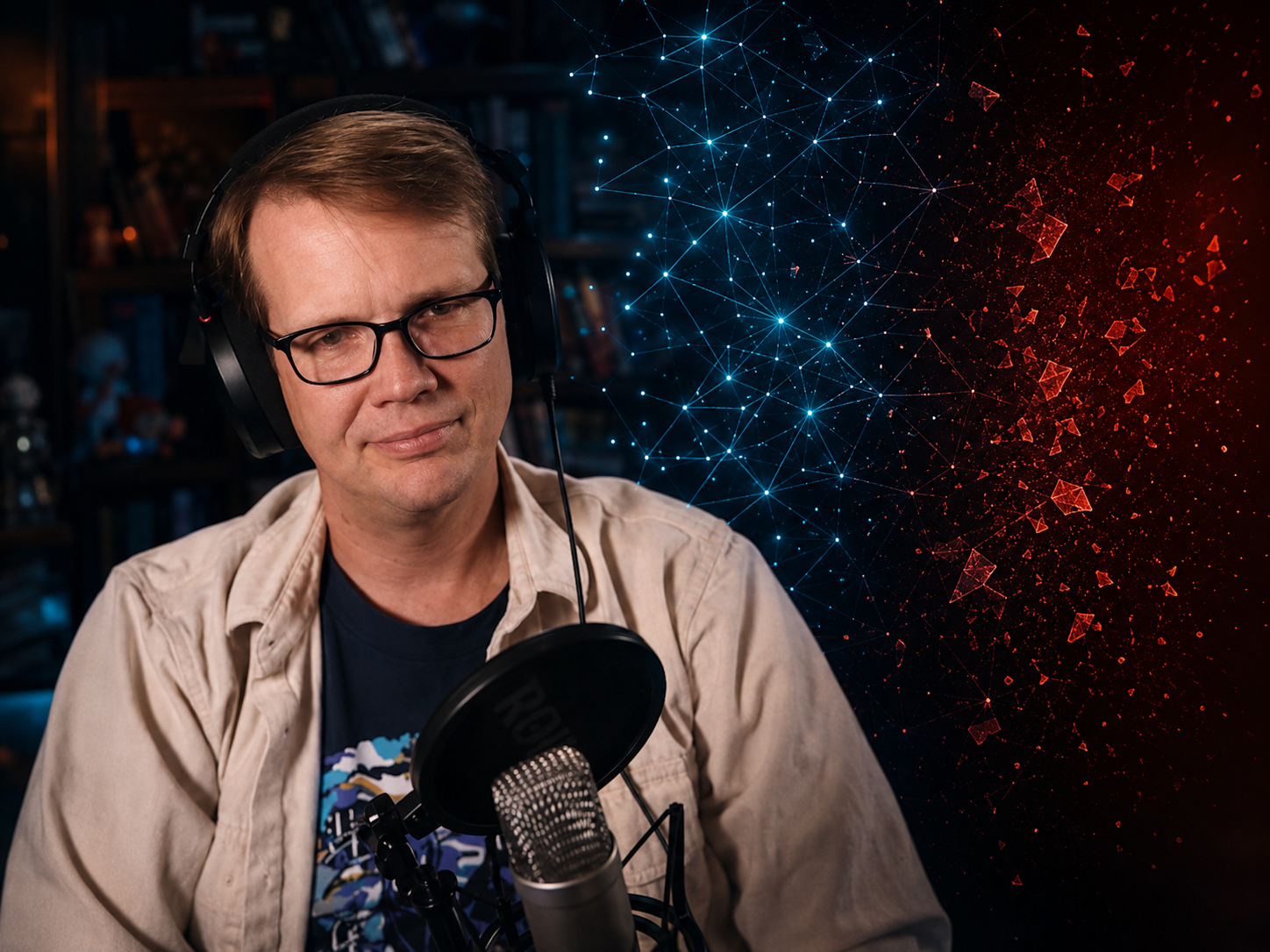
Hank Green pauses his channels after admitting ChatGPT research — 72% of creators use AI, while 37% of U.S. teens say AI content makes them cringe
Science and education YouTuber Hank Green has stopped producing videos on his personal channel. In early August he posted an apology to the fan community r/nerdfighters on Reddit and said he would cut back his use of large language models.
The trigger was a single sentence in a video. On a channel run by Complexly, the educational studio he co-founded, Green used the phrase “I appreciate the pushback,” and viewers flagged it as wording that turns up routinely in chatbot replies. Forbes reported on Aug. 4 that the phrase is common in responses from ChatGPT, Gemini and Claude.
Deleted X post concedes ChatGPT was used for script research; 3.2 million-subscriber channel goes on hold
Green acknowledged in a since-deleted post on X that he had used ChatGPT for research on the script. He said the phrase itself was not written by a chatbot but was an off-the-cuff reply to a guest in the episode, and that he had made the video under heavy pressure. TechCrunch on Aug. 1 and Fortune on Aug. 4 carried the explanation.
In the Reddit post, Green wrote that he was mortified at having let people down and said he would change how he makes things. Fortune reported that he described his relationship with LLMs as unhealthy for him and bad for the world. Green has 3.2 million subscribers and is one of the central figures in U.S. online education video, having created Vlogbrothers with his brother, novelist John Green, and built SciShow and Crash Course.
The pullback was immediate. Green said he would post fewer videos on Hankschannel and might pause it entirely, and that SMUSH and 4×3, the daily word games he produces, would stop (as reported by Business Insider, cited secondhand).
The new rules: no LLM in scripts, images or music
Green’s published rules run along three lines. No part of a script will be written, edited or outlined by an LLM, and no images or music used in a video will be model-generated. TheWrap reported on Aug. 25 that the rules came within days of the initial backlash.
What drew the anger was the workflow, not the artifact. The voice and the point of view in the finished video were still his; the change sat upstream, in research. Inc. argued in August that a “human-written” claim carries little weight once the research, the outline, the source list or the first draft has passed through a model.
72% of creators use AI; 5% use it to generate visuals, 4% for strategy
AI use among creators is already majority behavior. In The State of Creators 2026, published in August by CreatorIQ and Influencers.club from a survey of 5,095 creators across 100 regions conducted May 29 to June 29, 72% of respondents said they had used AI tools.
The uses cluster in brainstorming, writing and editing. Four percent apply AI to strategy or positioning, and 1% use it to automate content workflows. The margin of error is plus or minus 1.4 percentage points.
Alex Rawitz, director of research and insights at CreatorIQ, told TheWrap that only 5% of creators use AI to generate visuals or images, while more than half use it for brainstorming, writing and editing. The same survey found that most creators do not feel pressure to adopt AI in order to stay competitive.

How creators apply AI, by share of respondents. Source: CreatorIQ and Influencers.club, The State of Creators 2026 (n=5,095)
The picture shifts with the sample. Adobe’s 2026 Creators’ Toolkit Report, released June 16 and based on a survey of more than 16,000 creators across eight countries including South Korea (한국), found that 87% of those using creative AI said it had accelerated the growth of their business or audience, and 75% described it as integrated into or essential to their work. Those figures come from people already using or trialing the tools.
37% of U.S. teens say AI content makes them cringe; branded-campaign comments have changed too
The audience signal points the other way. Data from the research firm YPulse shows 37% of Americans aged 13 to 17 cringe at AI-generated music and video, and more than half worry about AI spreading misinformation and deepfakes. WIRED cited the data on July 24.
Music data runs in the same direction. Luminate’s report Generative AI in Entertainment 2026 found consumer attitudes toward AI in music net negative, and its author, Audrey Schomer, told NPR on May 2 that people are more likely to feel uncomfortable than comfortable. Euronews reported on Aug. 20 that roughly 40% of music released worldwide in July involved AI.
For branded content, that reaction reaches the performance metrics. Dayna Carney, founder of the social-first agency Dayna’s House, told TheWrap that comment sections under creator campaigns are normally a source of audience insight, but that once AI is involved the comments fill up with arguments over what is and is not AI (cited from TheWrap, Aug. 25). If what advertisers are buying from creators is authenticity, a comment section that turns into a dispute changes how the campaign can be evaluated at all.
YouTube terminated 16 channels with 35 million subscribers in January; in July it added an ‘off-putting content’ category
Platforms are already at the enforcement stage. In July 2025 YouTube renamed the “repetitious content” clause in its monetization policy to “inauthentic content,” making mass-produced and repetitive video ineligible for revenue.
TechTimes reported on July 15 that the January 2026 enforcement wave permanently terminated 16 channels with a combined 35 million subscribers and 4.7 billion lifetime views.
The policy was tightened again in July. According to TechCrunch on July 20, YouTube spelled out three types of video that cannot be monetized under the inauthentic-content heading and added a category for content that is unsatisfying or off-putting to watch.
YouTube CEO Neal Mohan named reducing AI slop and identifying deepfakes as platform priorities for 2026 in his January annual letter (cited secondhand via Fortune).
Monetization eligibility and disclosure operate separately. YouTube requires creators to toggle the altered-or-synthetic-content disclosure at upload when a video makes a real person appear to say something they did not, or depicts a realistic scene that never happened, and says repeated failure to disclose can lead to removal or loss of Partner Program access. Audio cleanup and automatic translation do not require disclosure. The European Union’s AI Act has required AI content labeling on platforms operating in the bloc since Aug. 2.
Tolerance varies by platform: infinite scroll on Reels, deliberate viewing on YouTube
Tolerance tracks how each platform is consumed. Adam Bumas, head of research at the creator-led news organization Garbage Media, told TheWrap that Instagram and Reels lean harder on infinite scroll, so users decide less about what they see and AI-generated Reels spread more easily. TikTok, by contrast, is built on candid day-in-the-life video, which makes AI-looking clips easy to call out.
Genre and audience split the same way. Green’s work is used in classrooms, and his audience read AI use as a breach of trust; the audience for a visual-effects creator such as Brandon B, with more than 16 million subscribers, is far more comfortable with AI tools. CreatorIQ data also shows AI-generated creator accounts drawing lower engagement on Instagram than on other short-form platforms.
Trading trust for efficiency: ‘a true creative is not scalable’
Green increased his AI use in order to make more content. Samir Chaudry of The Colin and Samir Show told TheWrap that what separates creator companies from the studios of the past is that they are rooted in talent: as revenue, ad surfaces and content formats grow, the creator still wants to watch everything and stay in the edit, and that is precisely what pushes the company to look for efficiencies (cited from TheWrap, Aug. 25).
Colin Rosenblum and Chaudry responded by recording their newsroom’s AI policy discussion for The Publish Press — disagreements included — and posting it to YouTube. Both defended using AI for research and outlining; the Gen Z members of the team pushed back on environmental cost, displacement of entry-level jobs and low trust in the technology. Chaudry noted that Mark Zuckerberg was an aspirational figure when he finished college, while Gen Z experiences the technology as something imposed on them.
Dave Jorgenson, who left The Washington Post to co-found Local News International Media, set a policy of no AI in the company’s videos, hired a researcher and has graphics made by hand. He told TheWrap that the episode finally opened a conversation the industry had been circling for a year or two.

Grading disclosure: 1 for a search engine, 10 for fully generated
In practice, producing anything with no AI at all is close to impossible. Google search returns AI summaries; TikTok and YouTube use AI for automatic dubbing and captions. TheWrap disclosed that the article itself relied on an AI service to transcribe interviews.
Jorgenson’s proposed answer is a scale. A 1 would mean the creator used a search engine for research; a 10 would mean a fully AI-generated video, with disclosure obligations attached to each level. Platforms have started down a similar road: TheWrap reported that Facebook has introduced badges distinguishing real users from AI ones, and that Spotify has begun labeling AI artists and removing their work from algorithmic and editorial recommendations. Bumas said he does not think AI can be built into production at zero reputational cost.
What this means for Korean companies
In Korea, the legal duty and the disclosure the market expects are out of alignment. The Framework Act on the Development of Artificial Intelligence and Establishment of Trust (AI 기본법, the AI Framework Act) and its enforcement decree took effect on Jan. 22, 2026, imposing a labeling duty on generative AI output. The duty falls on AI businesses; under the current guideline reading, users who apply AI as a tool sit outside it. A creator or production house that ran script research through a chatbot has no statutory labeling obligation — and, as Green’s case shows, that is exactly where the audience objects.
The labeling method splits by content type. Ordinary generated output can be marked either visibly, through captions, logos or watermarks, or in machine-readable form through metadata or a digital watermark; deepfake output may only carry a visible mark the user can plainly see. Violations can draw a corrective order and a fine of up to 30 million won (about US$21,000), though the government is running a grace period of at least a year, which makes actual penalties unlikely before 2027.
Three things are worth preparing. The first is a disclosure threshold: separate uses that do not change the point of view of the output — research, transcription, captioning, translation — from uses that produce the output itself, such as script, image or voice generation, and put an internal rule in writing that discloses only the latter. That is a stronger position than explaining after the fact. The second is contracts. If what advertisers are buying is the audience response visible in the comments, an AI-use disclosure clause and a defined scope of permitted use belong in the agreement. The third is platform monetization: YouTube reviews inauthentic content at the channel level rather than the video level, so a company running a high-volume format on one channel puts its other channels’ monetization at risk alongside it.
What this means for Korean broadcasters
Broadcasters sit differently from creators. They commission outside production, they are the counterparty on performer contracts, and they hold the archive. What matters first is not how much AI they use themselves but how AI enters through deliverables and contracts.
At the commissioning stage, the fastest practical step is a disclosure clause in the production agreement plus an itemized statement of AI use in the deliverable. Requiring producers to declare whether and how generative AI was used in scripts, treatments, research materials, graphics and music removes the need for the broadcaster to audit a finished program after delivery.
On the performer side, voice and face synthesis are the pressure points. Using a voice actor’s or performer’s voice and likeness for training or synthesis without settling consent and compensation at the contract stage invites neighboring-rights disputes. The archive works the same way: before supplying library footage for external model training or feeding it into an in-house AI service, broadcasters need to check whether existing agreements with on-screen talent, performers and production companies cover that use.
Where to draw the disclosure line also has to be decided in practice. Following YouTube’s carve-out for audio cleanup and automatic translation, uses that do not change what the viewer takes to be fact — subtitling, dubbing, picture restoration — can sit outside labeling, while uses that could be mistaken for record, such as dramatized reconstruction or synthesized people, carry an on-screen mark. That line answers both broadcast review and the AI Framework Act. There is an ad-sales consequence as well: advertiser response to labeled content is not yet settled, so it is worth mapping in advance which programs in the schedule will carry a label.
Sources
· TheWrap, “Inside the Creator AI Reckoning: Backlash, Heated Debates and So Much Slop,” Kayla Cobb, Aug. 25, 2026
· TechCrunch, “YouTuber Hank Green says his AI usage is ‘not healthy’,” Aug. 1, 2026
· Fortune, “YouTube star Hank Green apologizes for ChatGPT overuse…,” Aug. 4, 2026
· Forbes, “The Anti-AI Backlash Against Hank Green, Explained,” Dani Di Placido, Aug. 4, 2026 (updated Aug. 9)
· Inc., “YouTuber Hank Green’s ChatGPT Backlash,” Ashley Couto, August 2026
· CreatorIQ and Influencers.club, The State of Creators 2026, press release and whitepaper (fielded May 29–June 29, 2026; n=5,095; margin of error ±1.4 points)
· TheWrap, “A 67% Majority of Creators Earn Less Than $10,000 per Year, Study Finds,” August 2026
· Tubefilter, analysis of CreatorIQ State of Creators brand-deal and AI findings, Aug. 16, 2026
· Adobe, 2026 Creators’ Toolkit Report press release, June 16, 2026 (16,000+ creators across eight countries)
· YPulse, “A third of teens think AI is cringe,” July 27, 2026; original reporting, WIRED, July 24, 2026
· NPR, “AI music is flooding streaming platforms. But listeners like it less and less,” May 2, 2026 (citing Luminate, Generative AI in Entertainment 2026)
· Euronews, report on the share of globally released music using AI in July 2026, Aug. 20, 2026
· TechCrunch, “YouTube clarifies policies around AI slop and upsetting videos,” July 20, 2026
· TechTimes, reporting on YouTube inauthentic-content enforcement and channel terminations, July 15, 2026
· Kukmin Ilbo (국민일보), “World’s first AI Framework Act takes effect — watermarking of AI output made mandatory,” Jan. 21, 2026
· Beonhwa Law Office (법률사무소 번화), “Mandatory labeling of AI output: scope, methods and applicable law,” June 17, 2026
· Korea Policy Briefing (대한민국 정책브리핑) and the Ministry of Science and ICT (과학기술정보통신부), materials on the entry into force of the AI Framework Act and its enforcement decree, January 2026
Attribution note | Quotation marks indicate wording as reported by the named outlet; unquoted sentences summarize reporting. Statements first published elsewhere and relayed by TheWrap or another outlet are marked as cited secondhand.
Currency | Won figures are converted at 1,400 won to the U.S. dollar.