When Cooking Became Entertainment: The Future of K-Food Content
by
2026년 2월 13일

How the Paramount–WBD Merger, CTV Ad Surge, and FAST Expansion Are Rewriting the Rules for K-Content
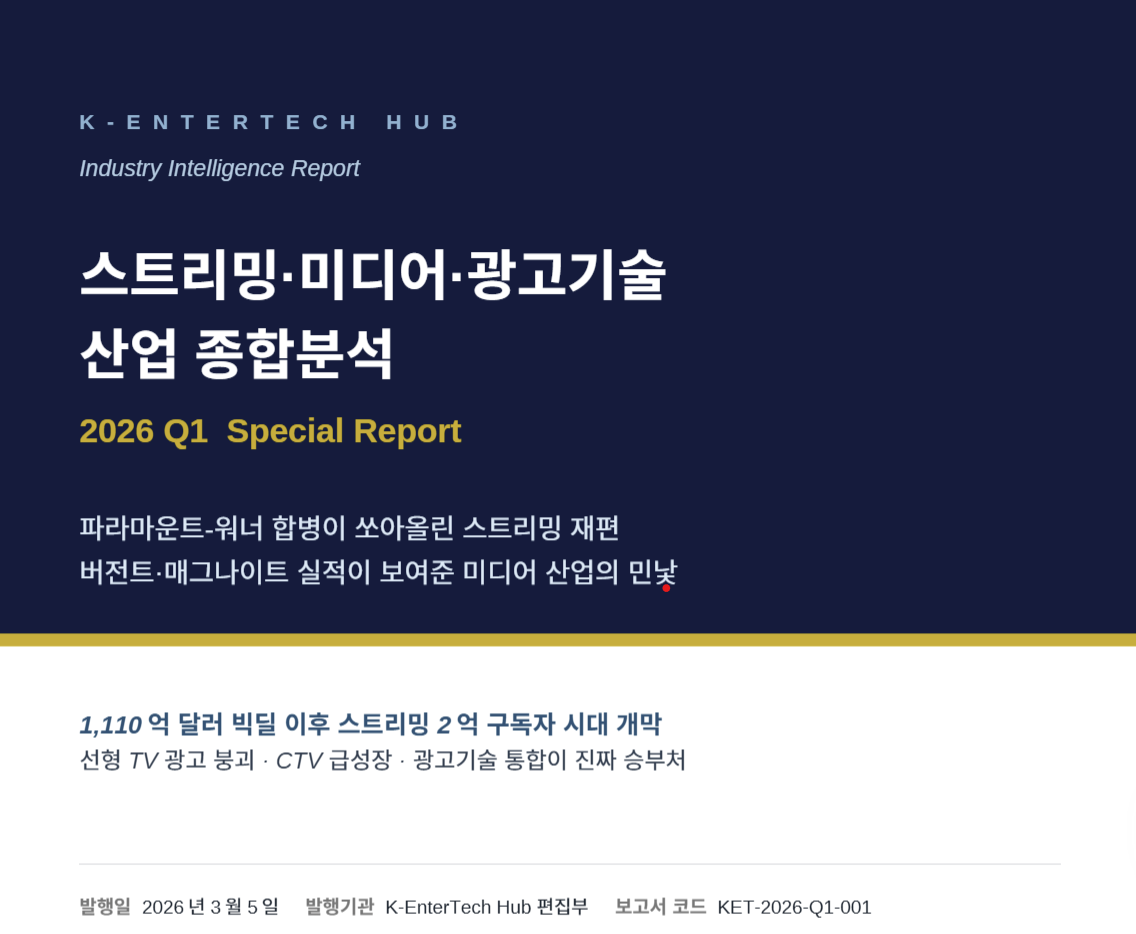
K-content's window of opportunity in the global streaming market is narrowing — not because Korean content has lost its appeal, but because the game itself has fundamentally changed. The K-EnterTechHub Streaming & Media Industry Comprehensive Analysis: 2026 Q1 delivers a pointed message to the Korean content industry: producing great content is no longer enough. The era of being a passive IP supplier is over.
 Jung Han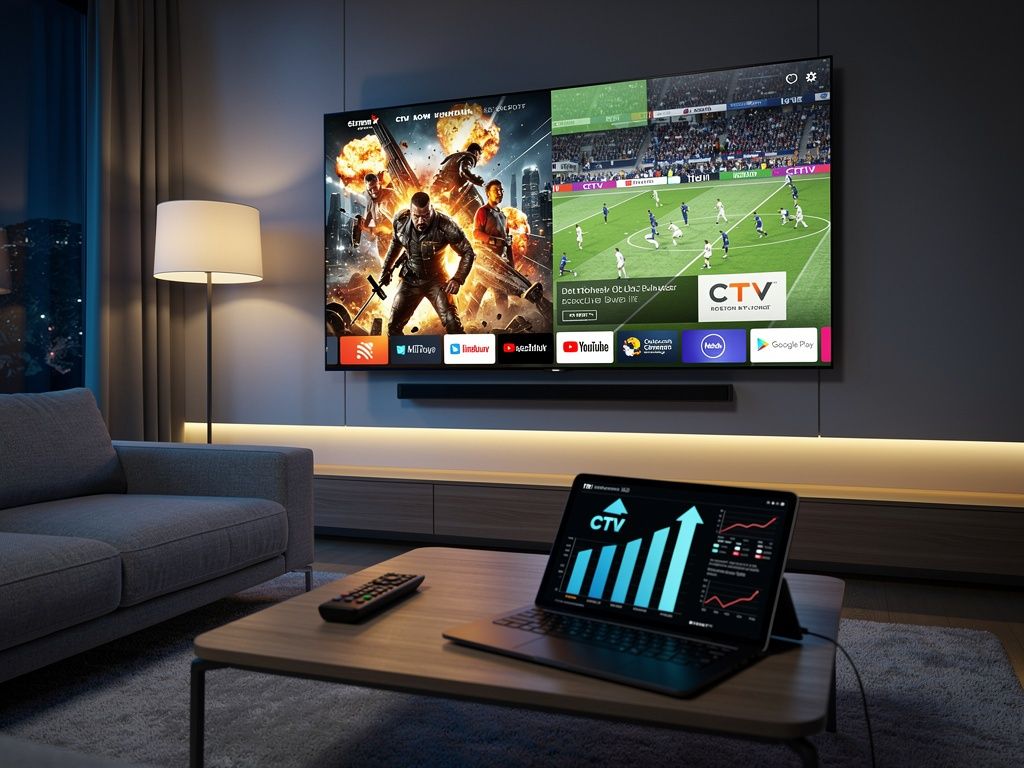
What survives the next wave of global streaming consolidation is the intelligent content packager — the operator that wraps K-content IP in AI localization, FAST/CTV channel architecture, ad monetization models, and data intelligence to deliver a turnkey, revenue-ready bundle to global platforms.
The report synthesizes four converging forces — the Paramount–WBD merger, $79 billion in combined debt, the restructuring of sports rights led by the NFL, and the CTV/FAST advertising pivot evidenced by Viant and Magnite earnings — to diagnose a structural shift that K-content operators can no longer afford to observe from the sidelines.
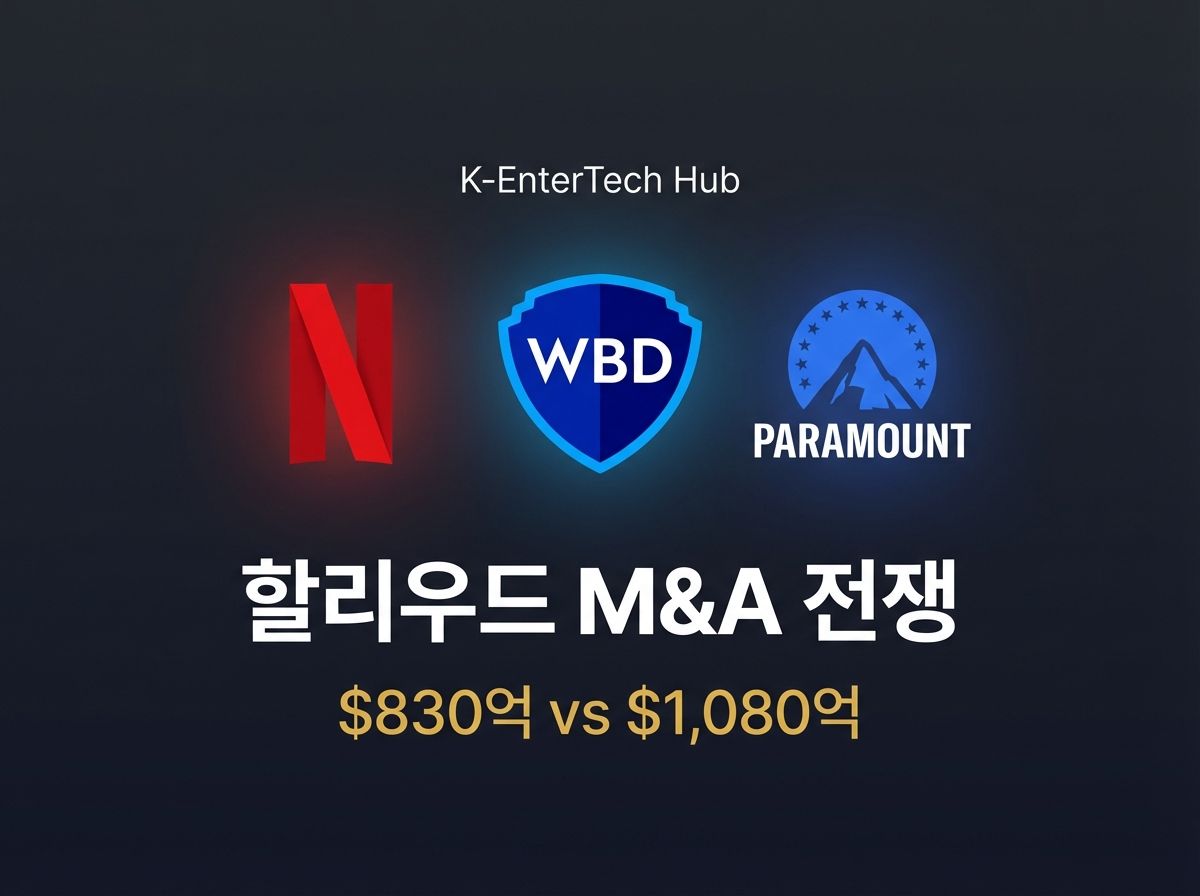
The proposed merger of Paramount and Warner Bros. Discovery would create a streaming entity carrying approximately $79 billion in net debt — a staggering financial burden that simultaneously buys the combined entity something no competitor can easily replicate: a single platform housing CBS, HBO, Warner, and Discovery IP alongside the most aggressive live sports portfolio in American television, spanning the NFL, UFC, MLB, NHL, and NCAA March Madness.
K-EnterTech Hub identifies three pivots that will determine whether this merger succeeds or collapses under its own leverage:
The stakes of this consolidation extend well beyond Hollywood. The report frames the Paramount–WBD bet as a signal of what "minimum viable scale" looks like in the post-consolidation streaming era — and the implications for smaller market players are sobering.
While mega-mergers grab the headlines, independent adtech firms are quietly proving the structural case for streaming's ad-driven future. Magnite's Q4 2025 results showed CTV revenue (ex-TAC) growing 32% year-over-year, accounting for 48% of total revenue — while its DV+ display segment grew just 4%.
CEO Michael Barrett was unambiguous: advertiser budgets are migrating structurally to CTV, and that migration is irreversible.
Viant's parallel trajectory reinforces the same conclusion. Together, these two independent adtech bellwethers are providing the industry with something more valuable than a forecast — they are providing a real-time ledger of where money is actually moving.
The report's interpretation for Korean operators is direct: "Any content or platform business that lacks a CTV- and FAST-centered entertech strategy will lose its growth momentum." This is not a trend to watch. It is a structural reordering already underway.
The core argument of the report is a redefinition of competitive identity. K-EnterTech Hub introduces the concept of the Entertainment tech Content Packager: an operator that layers technology, data, and monetization architecture on top of K-content IP to deliver a globally deployable, platform-ready bundle — not just a file.
The anatomy of this packager model includes:
The report's framing is pointed: global integrated platforms increasingly prefer partners who deliver Production Intelligence over suppliers who simply deliver volume. The distinction between being a valued partner and a commodity vendor — a "third-party file provider" — will be decided by whether Korean operators can offer channel- and slot-level solutions that combine entertainment, adtech, and data.
The report highlights two leading indicators that the packager model is not theoretical — it is already operational within the Korean ecosystem.
NEW ID has built a model that simultaneously supplies K-content-based FAST channels to major global CTV and FAST platforms — LG Channels, Samsung TV Plus, Roku, and Vizio — while managing channel launch, operations, localization, and ad revenue sharing as an integrated offering. NEW ID is not functioning as an IP broker; it is functioning as an entertainment tech content packager in practice.
The government-and-industry K-FAST Project, meanwhile, is distributing over 20 K-channels across global FAST networks, with the strategic objective of establishing K-Drama, K-Variety, and K-Lifestyle as anchor categories within the FAST ecosystem.
The report's assessment: "FAST is both the revenue regeneration engine for a subscription-fatigued streaming environment and the frontline testbed for AI advertising technology — and K-content has already established itself as a meaningful category within this ecosystem."
K-EnterTechHub identifies AI production and distribution technology — alongside what it terms Digital Studio Transformation — as the second structural pillar of the content packager strategy.
AI-powered accessibility tools (recommendation engines, search optimization, automated subtitling, voice synthesis, and AI dubbing) are emerging as decisive variables in lowering the barrier to international market entry. AI-based automated localization, in particular, compresses the operational cost of running FAST channels while enabling simultaneous multilingual scheduling and synchronized global launches of the same IP.
Digital Studio Transformation represents a departure from Korea's traditional production paradigm — where creative decisions are driven primarily by the intuition and experience of PDs and writers — toward a data-informed architecture in which metrics such as audience drop-off points, episode completion rates, ad response rates, and A/B test results for thumbnails and titles are integrated from the development stage. The goal is to engineer K-content to be structurally preferred by FAST and CTV recommendation algorithms.
The report outlines a Korean FAST format blueprint built around:
The report's conclusion is unsparing. The data from Viant and Magnite confirms that the shift from linear TV to streaming, and from display to CTV advertising, has already passed the point of reversibility. The Paramount–WBD merger is an attempt to achieve the minimum scale required to survive this transition. Netflix and YouTube will continue to dominate, but the second-tier streaming and advertising market is heading toward a comprehensive realignment by 2026 to 2027.
For Korea's content industry, the report closes with a defining challenge:
"Over the next five years, K-content's competitive value will not be measured by which platform a title was sold to — but by what entertech package it came with, and how far down the data and advertising architecture was designed. Operators who fail to build entertech content packager capabilities now will have no alternative but to remain permanent third-party suppliers to the global integrated platforms."
K-EnterTech Hub positions the Streaming & Media Industry Comprehensive Analysis: 2026 Q1 as an immediately actionable reference for Korean producers and platforms working through K-FAST strategy, AI localization, digital studio transformation, and entertech packager positioning.
K-EnterTech Hub is a Korean media and entertainment technology platform connecting K-content with cutting-edge technologies through industry analysis, global partnerships, and conference operations.




![[보고서]전통 언론사의 크리에이터 전략 대전환](https://cdn.media.bluedot.so/bluedot.kentertechhub/2026/02/0nwc9z_202602100212.png)