
Key takeaway
Fox-owned free streamer Tubi is financing the first long-form series from 12 TikTok creators, 10 shows in all. In Luminate's October report, 57% of U.S. 18-24-year-olds said they discover films and TV through short-form video, ahead of browsing inside streaming apps (55%). With discovery and viewing now happening in different places, an ad-supported free service is testing a production model designed to convert short-form reach into long-form viewing.
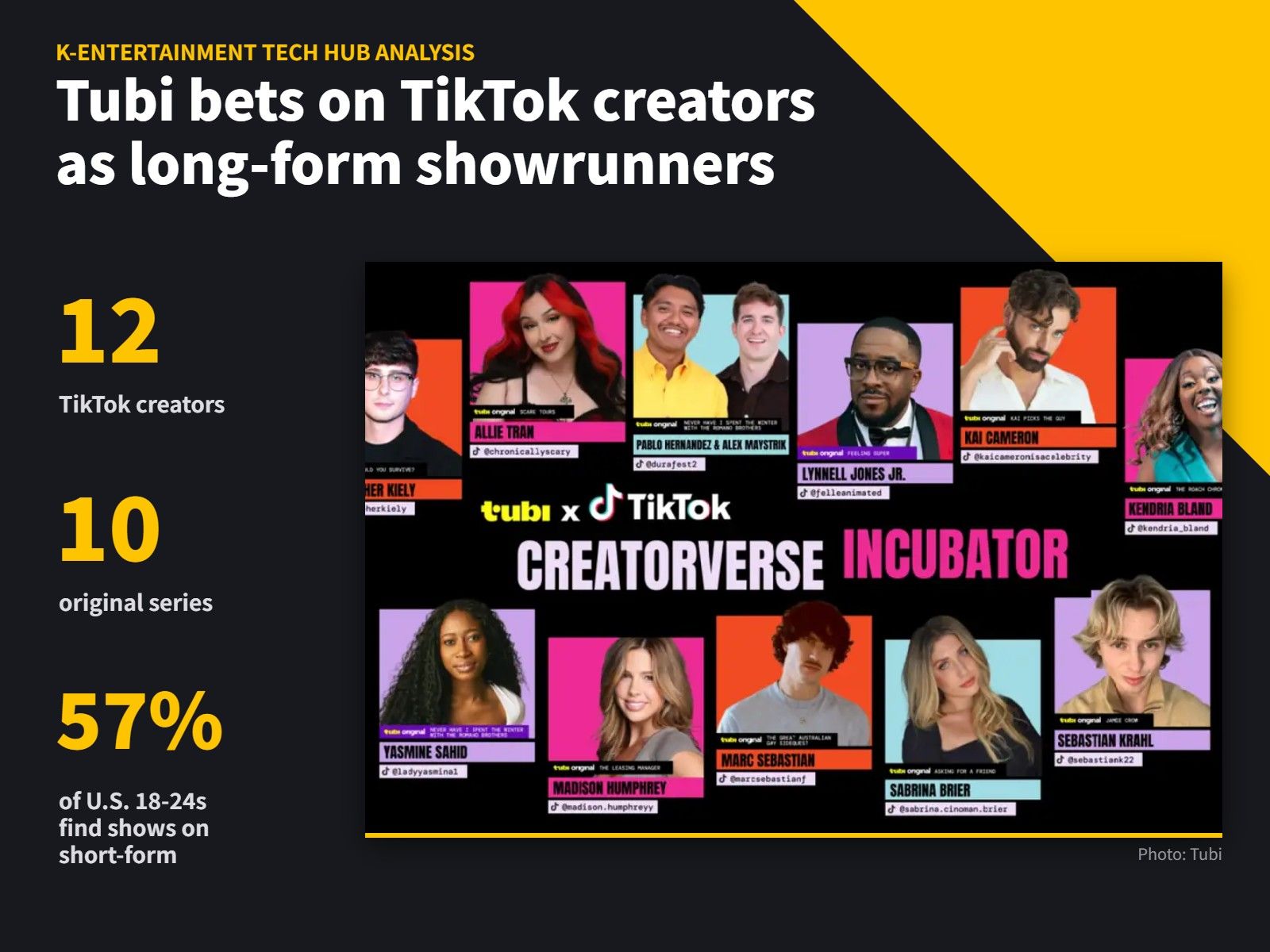
Tubi, Fox Corporation's free ad-supported streaming TV (FAST) service, will fund 10 original long-form series from 12 TikTok creators. The slate is the first class of the Creatorverse Incubator, first reported by Variety on Oct. 27. The shows will stream exclusively on Tubi and span animation, horror, reality and young adult (YA).
Tubi's rationale is a shift in how audiences find what to watch. In its October special report, "Social Media & Entertainment Discovery," Luminate Intelligence found that 57% of Americans aged 18-24 discover new films and TV series through short-form video, edging out browsing within streaming services (55%). The 18-24 cohort is the only age group in which short-form ranks as the No. 1 discovery channel.
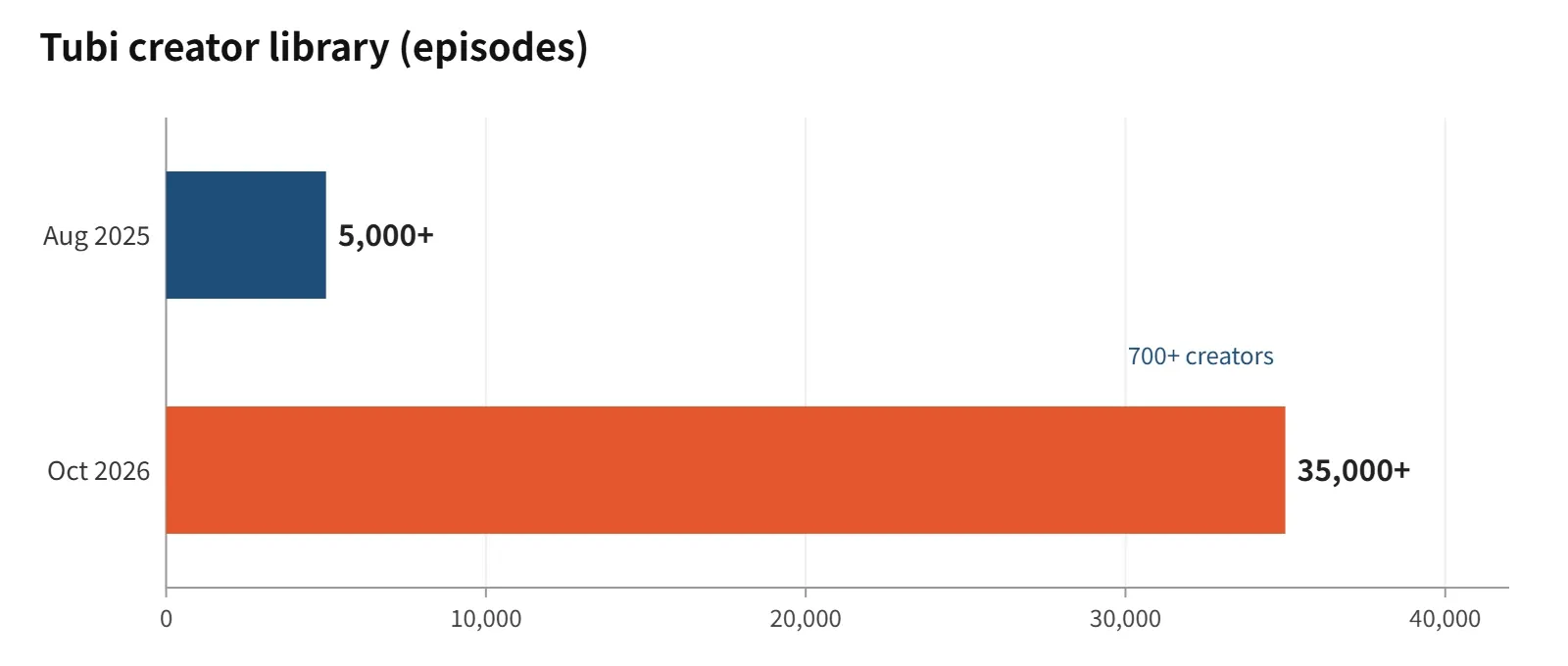
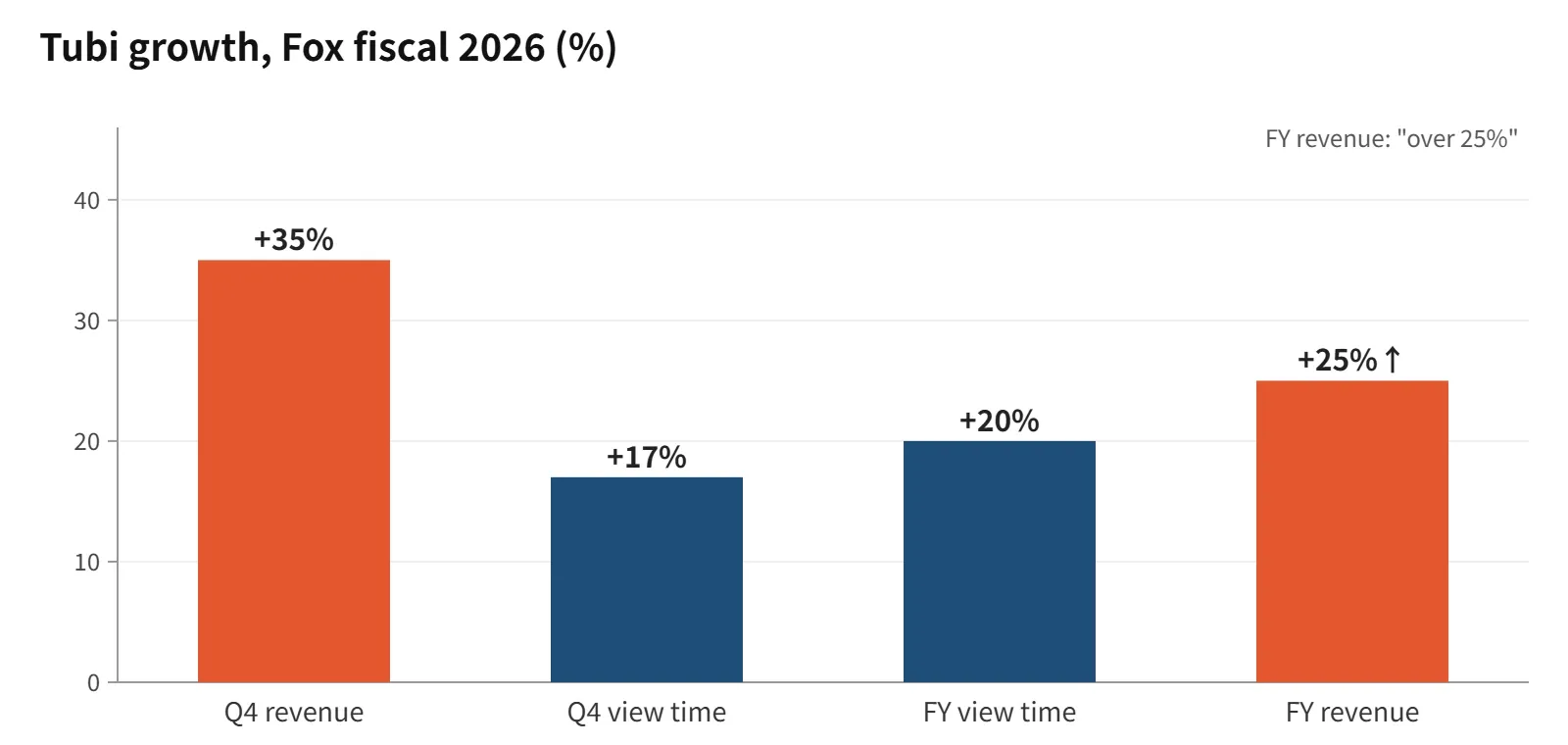
Tubi's numbers have grown over the same stretch. In the fiscal fourth quarter of Fox's FY2026 (July 2025-June 2026), reported in August, Tubi revenue rose 35% and total view time 17%, with 110 million monthly active users. Since launching Tubi for Creators in June 2025, the service has signed up more than 700 creators and over 35,000 episodes. In June, Fox also agreed to acquire Roku for $22 billion, a deal that would bring a TV operating system and free-channel distribution under the same roof.
Some things have not changed. Across all U.S. viewers, only 33% find films via short-form video, behind word of mouth (49%), TV advertising (44%) and genre browsing on streaming services (43%), and the share falls to 25% or less among those 55 and older. Tubi and TikTok have turned that generational split into a division of labor: TikTok picks the creators and uses its TikTok Spotlight marketing tool to steer fan engagement toward the Tubi series, while Tubi supplies the production budget and the exclusive window.
12 Creators, 10 Series: Three Animated, Three Reality
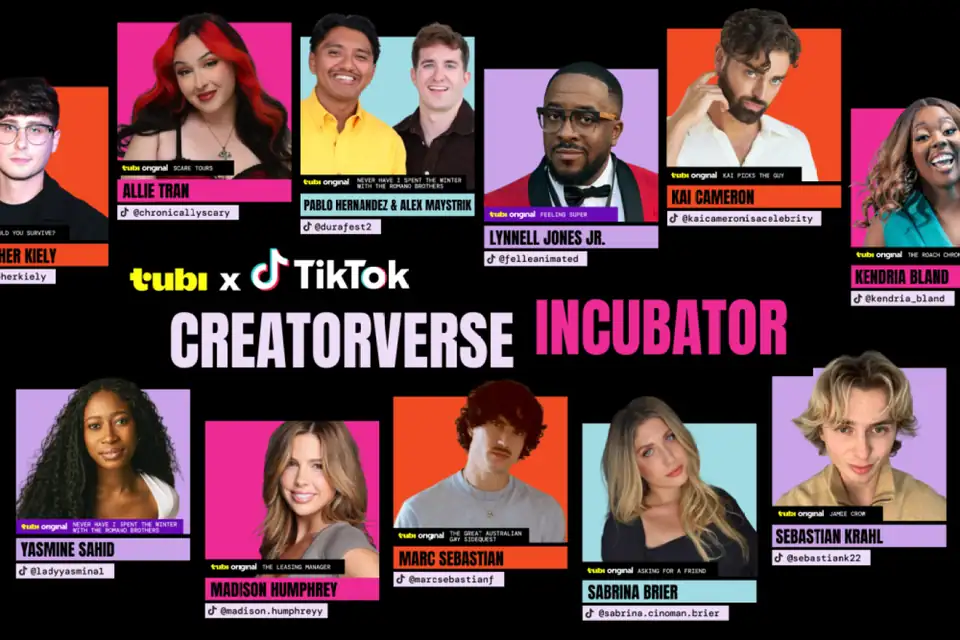
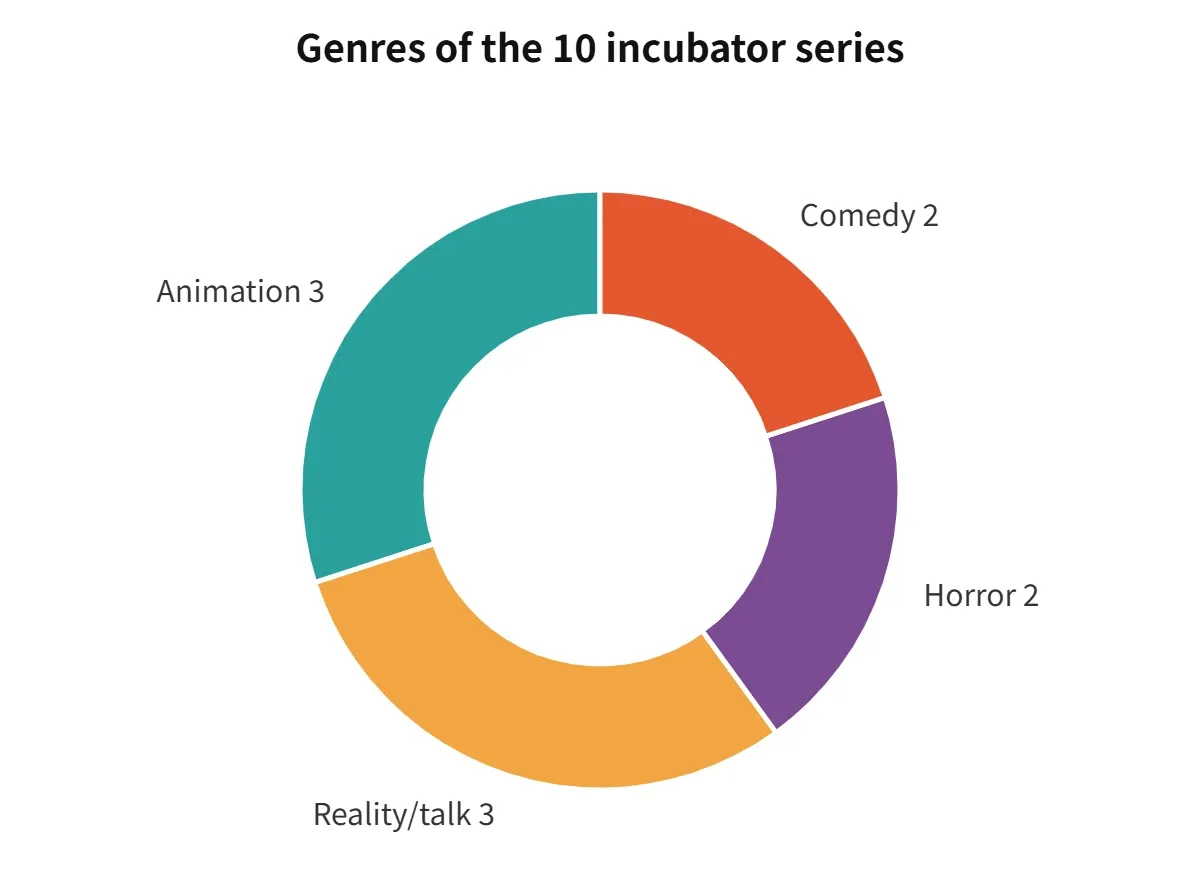
The slate breaks down into two horror titles, three animated series, three reality/talk shows and two comedies. In the dating show "Kai Picks the Guy," three men who believe they are there to date a female contestant are instead vetted by host Kai Cameron through one-on-one "dates."
"A Great Australian Gay Sidequest" follows Marc Sebastian as he tours Australia's quirkiest tourist spots.
The duo of Pablo Hernandez and Alex Maystrik joins Yasmine Sahid on the comedy "Never Have I Spent the Winter with the Romano Brothers," which is why 12 creators share 10 series. Budgets and premiere dates were not disclosed.
| Series | Creator | Genre |
|---|---|---|
| Would You Survive? | Christopher Kiely | Horror |
| Scare Tours | Allie Tran | Horror |
| Feeling Super | Lynnell Jones Jr. | Animation |
| The Roach Chronicles | Kendria Bland | Animation |
| Jamie Crow | Sebastian Krahl | Adult animation |
| Kai Picks the Guy | Kai Cameron | Dating reality |
| A Great Australian Gay Sidequest | Marc Sebastian | Travel reality |
| Asking for a Friend | Sabrina Brier | Celebrity talk |
| The Leasing Manager | Starring Madison Humphrey | Workplace comedy |
| Never Have I Spent the Winter with the Romano Brothers | Yasmine Sahid; Pablo Hernandez & Alex Maystrik | Comedy |
First-class series of the Tubi x TikTok Creatorverse Incubator. Sources: The Desk, Variety
"The creators we're working with have built a following, a point of view and a body of work that people come back for," Kudzi Chikumbu, Tubi's vice president of creator partnerships, told Variety. "The Incubator is where we come in as their partner, giving them the creative freedom to grow what they've started."
Chikumbu said Tubi is supporting the creators "as they create their first TV shows, making ambitious work they may not otherwise be able to make." Dawn Yang, TikTok's global head of entertainment and micro-series, said, "Their communities on TikTok show just how much people connect with creator-led storytelling, and this partnership gives them another way to share their work with new audiences."
Seven Months From Announcement: A Creator Push Led by a TikTok Veteran
Tubi and TikTok first announced the incubator on March 19, saying the inaugural class would be unveiled "this summer." The program is run by Rich Bloom, executive vice president of business development and head of creator programs, who joined in April 2025, together with Chikumbu.
Chikumbu spent eight years at TikTok and its predecessor Musical.ly, where he served as global head of creator marketing, before joining Tubi in August 2025.
When he arrived, Tubi's creator catalog, including MrBeast and Alan's Universe, numbered just over 5,000 titles.
Fourteen months later, it has passed 35,000, a sevenfold increase. Tubi built a dedicated Creatorverse hub inside its app and in June began distributing creator programming on Amazon Fire TV. Its overall library holds 375,000 movies and TV episodes, plus nearly 400 originals. The incubator layers directly funded originals on top of a creator library built through licensing.
U.S. Creator Ad Spend to Hit $43.9 Billion This Year, Growing 4x Faster Than Media Overall
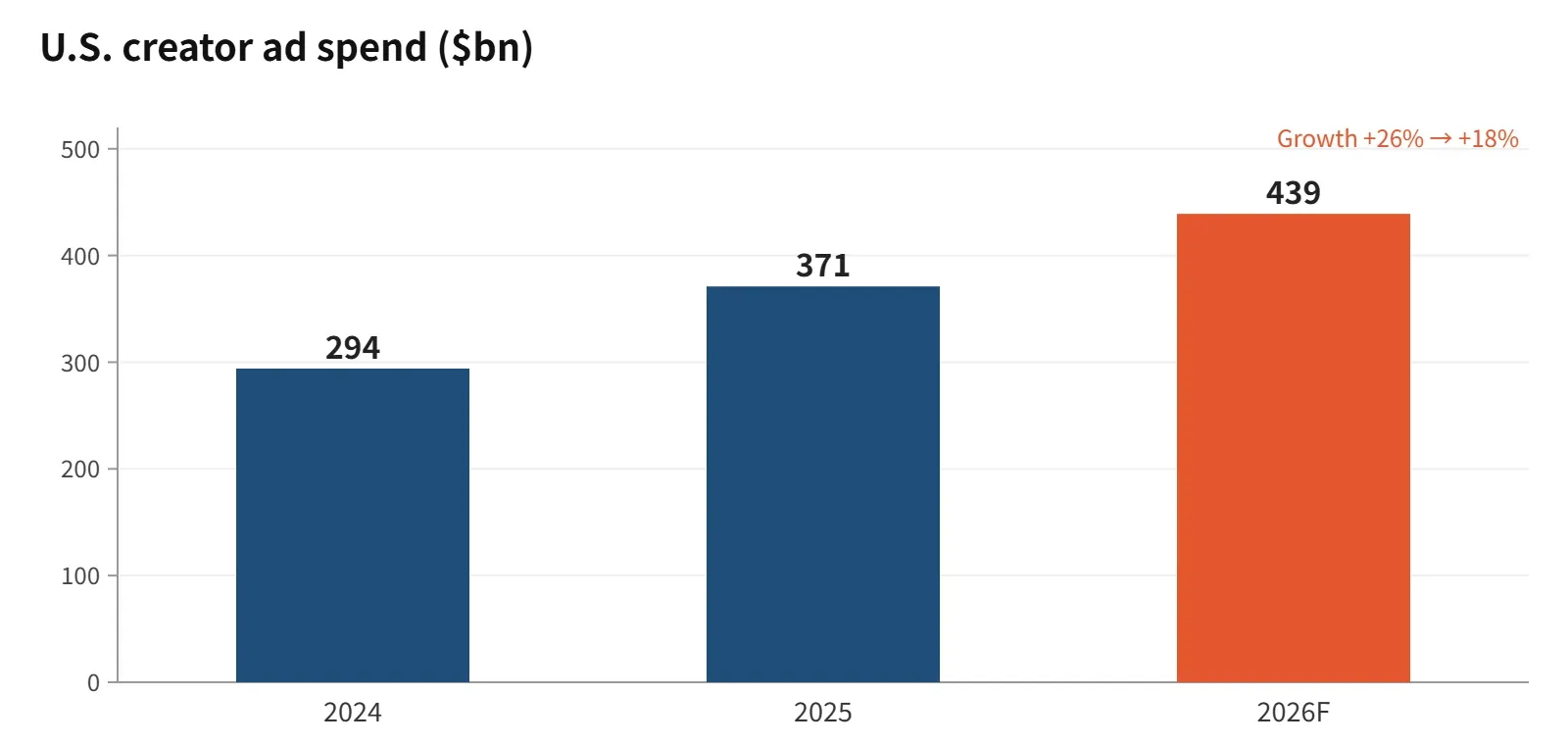
Creator content keeps taking a bigger slice of the pie. U.S. advertisers spent $37.1 billion on creator content in 2025, up 26%. The Interactive Advertising Bureau (IAB) projects that figure will rise another 18% to $43.9 billion this year, four times the growth rate of the overall media industry. Much of the increase goes to paid amplification on social media of content commissioned directly from creators, a line item the IAB expects to grow 48% to $13.2 billion this year. The IAB now classifies creator advertising as a "core media channel."
Goldman Sachs projects the creator economy will grow from about $250 billion in 2023 to $480 billion by 2027, driven by brand marketing and ad-revenue sharing on short-form platforms. Only about 4% of creators are "professionals" earning more than $100,000 a year. Tubi's incubator funds long-form projects for a small subset of that group who already have a fan base.
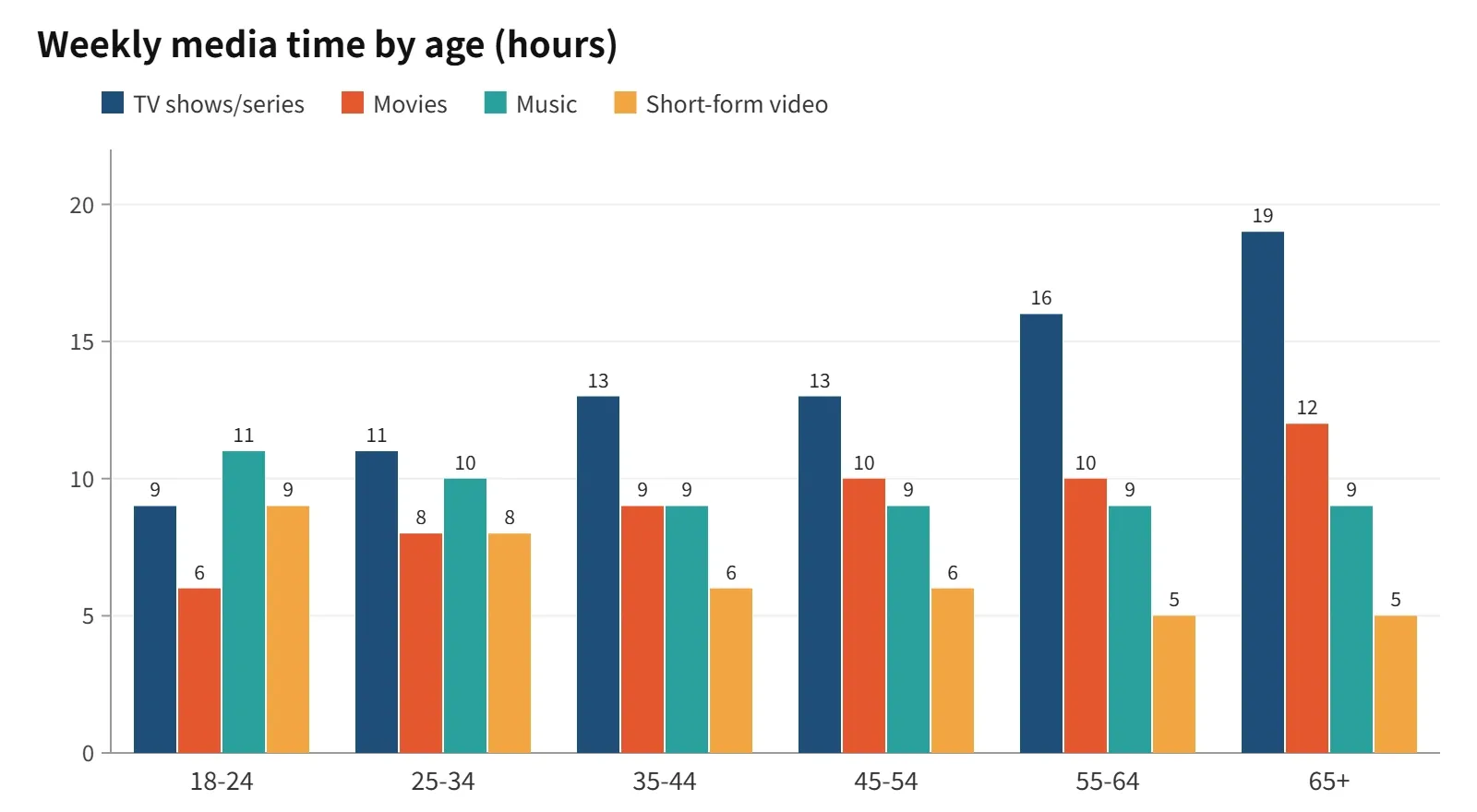
Short-Form Takes 26% of 18-24s' Weekly Media Time, vs. 12% for 55+
Short-form has become the default format for younger audiences. According to Luminate's Entertainment 365 consumer survey, Wave 17 (May 5-26, 2026, n=2,000), and Music 360 for Q1-Q2 2026 (n=8,105), 18-24-year-olds spend nine hours a week on TV shows and series, six on movies, 11 on music and nine on short-form video. Those 65 and older spend 19 hours on TV and five on short-form. Across those four activities, short-form accounts for 26% of weekly media time for 18-24s and 12% for those 55 and older.
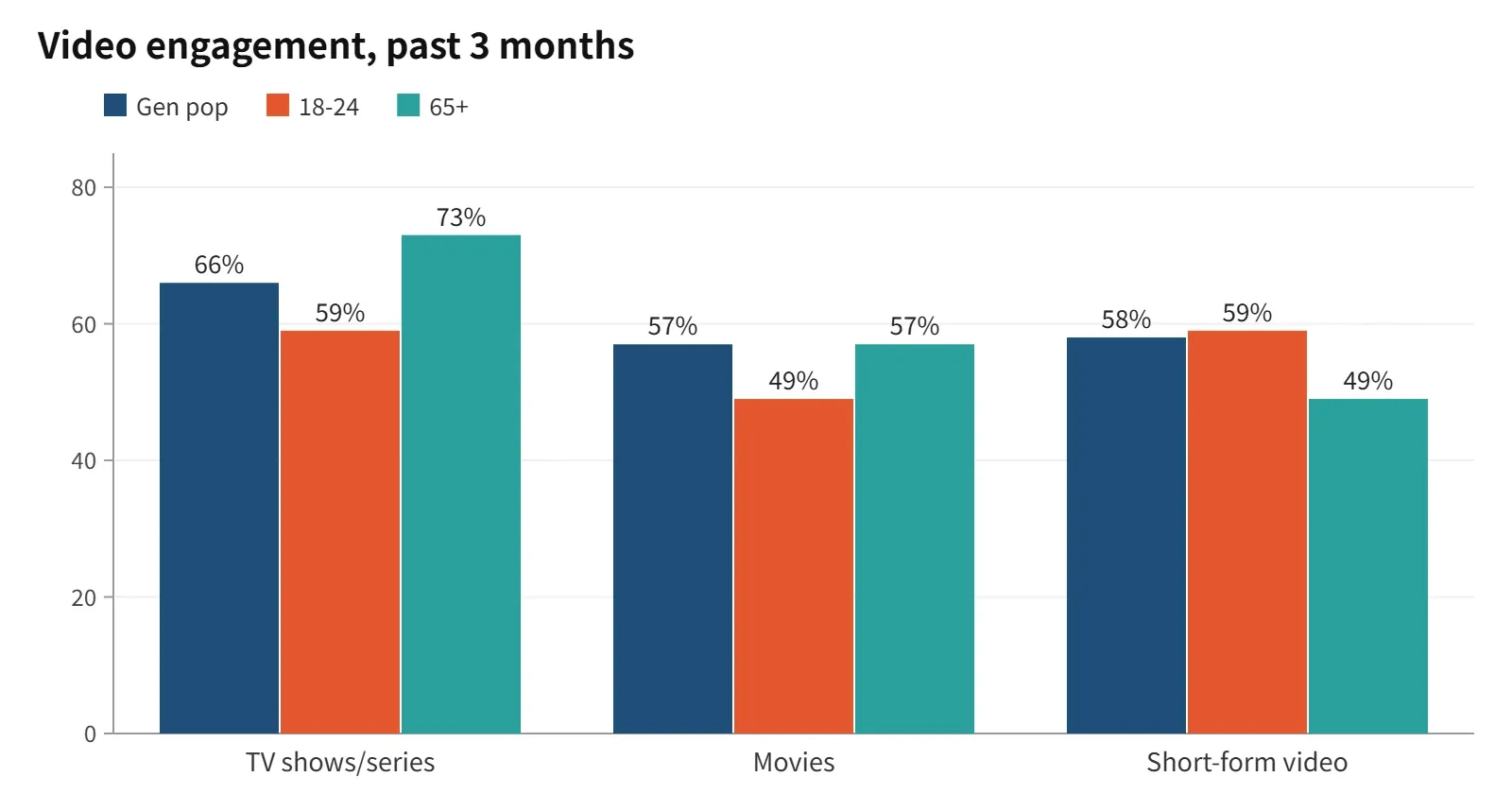
Short-form is also where younger viewers first encounter content. Luminate found that 59% of 18-24s watched short-form video in the past three months, more than watched a movie (49%). Among those 65 and older, the order is TV series (73%), movies (57%) and short-form (49%).
Thirty-eight percent of 18-24s described themselves as "die-hard" short-form fans, on par with TV series (36%), compared with 14% of those 65 and older. "Long-form premium content will continue to have an audience, but it will likely share equal weight with short-form," the report said.
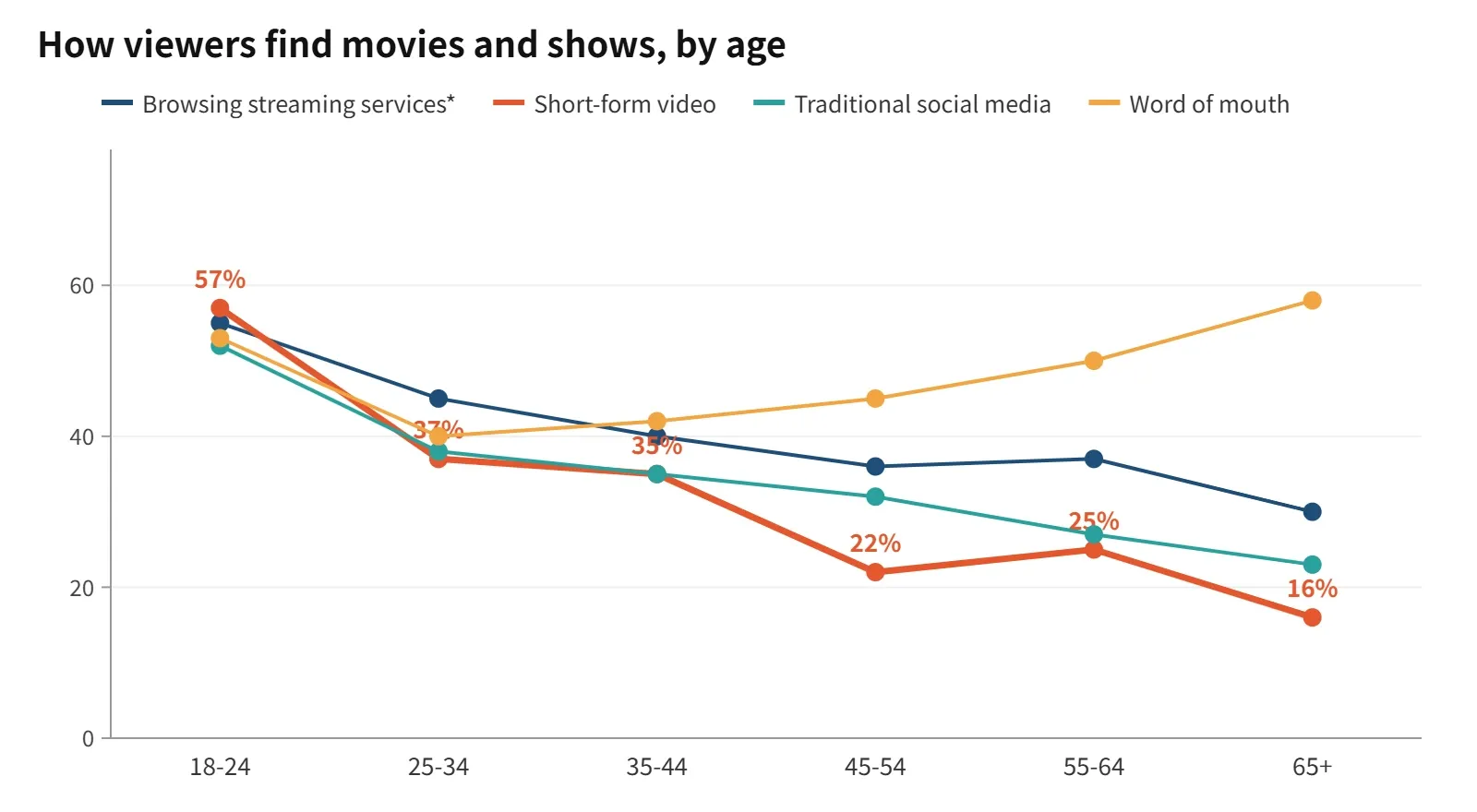
Short-Form Discovery Ranks First at 57%, Topping Streaming Browsing Only Among 18-24s
Broken out by age, 18-24s discover films and TV via short-form video (57%), streaming-service browsing (55%, averaging recommendations, genre and popular-title browsing), word of mouth (53%) and traditional social media (52%). More than half of this cohort uses both short-form and social media for discovery. The short-form figure drops to 37% for 25-34s, 22% for 45-54s and 16% for those 65 and older. Word of mouth moves the other way, rising with age to 58% among those 65 and older.
The two environments surface content in fundamentally different ways. Streaming services present titles in rows of tiles, or carousels, while short-form users encounter clips cut from films and series, or fan-made videos, while swiping through an algorithmic feed.
Even across all viewers, roughly a third find titles via short-form video (33% for films, 30% for TV) and social media (35% and 32%). The report called the gap with in-app streaming browsing "slim."
42% of Frequent Moviegoers Find Films on Short-Form, 9 Points Above Average
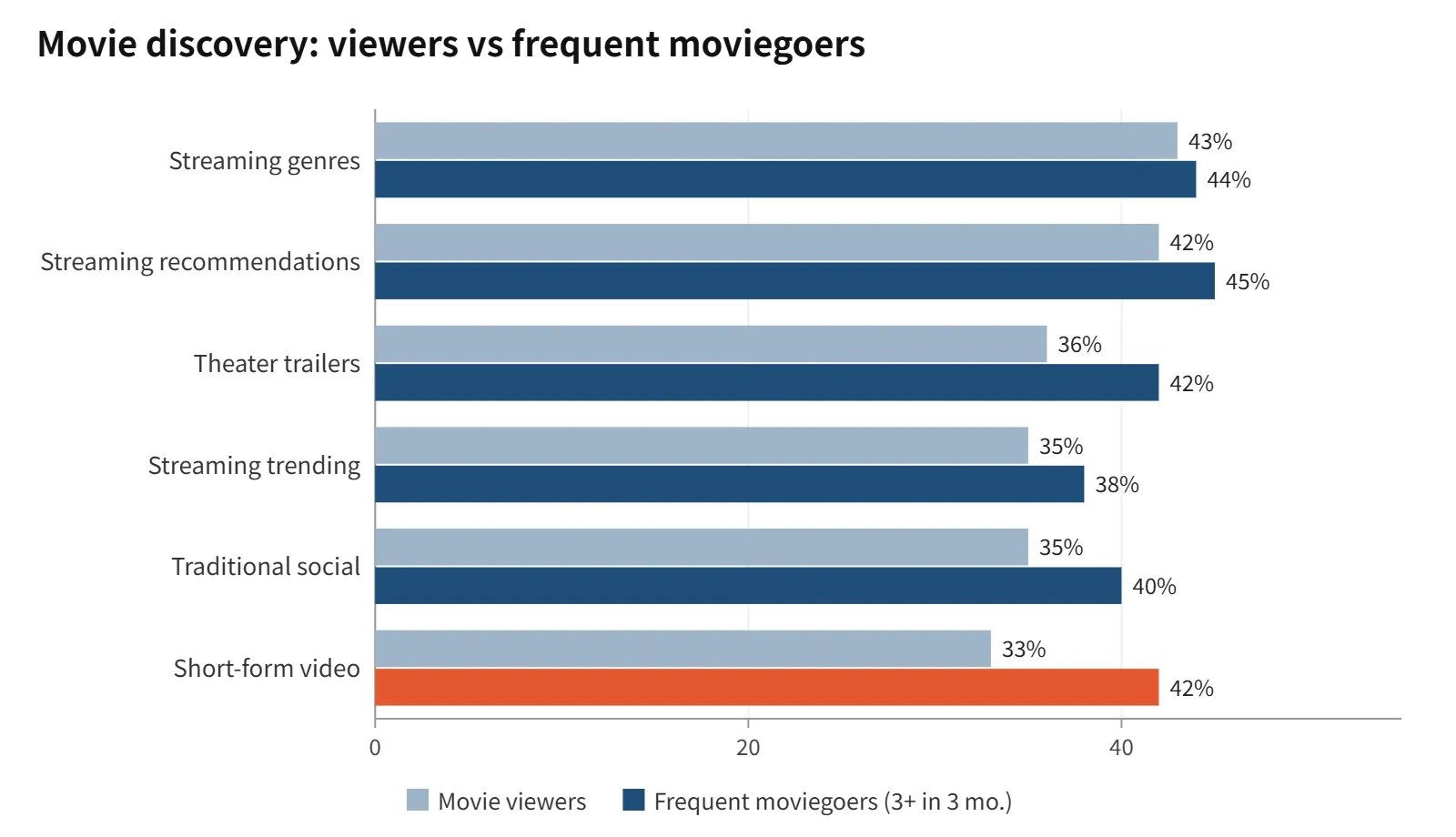
The more audiences spend, the more likely they are to discover new titles through short-form. Among "frequent moviegoers," those who saw three or more films in theaters in the past three months, 42% find films via short-form video. That is nine percentage points above all film viewers (33%) and nearly level with streaming genre browsing (44%); for other channels, the gap is one to six points. Among frequent moviegoers aged 18-24, 67% find films through social media and 62% through short-form. Those aged 25-44 leaned even more on short-form, while among 45-54s traditional social media (35%) beat short-form (22%).
Music Discovery Follows Suit: 60% of Concertgoers Find New Music on Short-Form
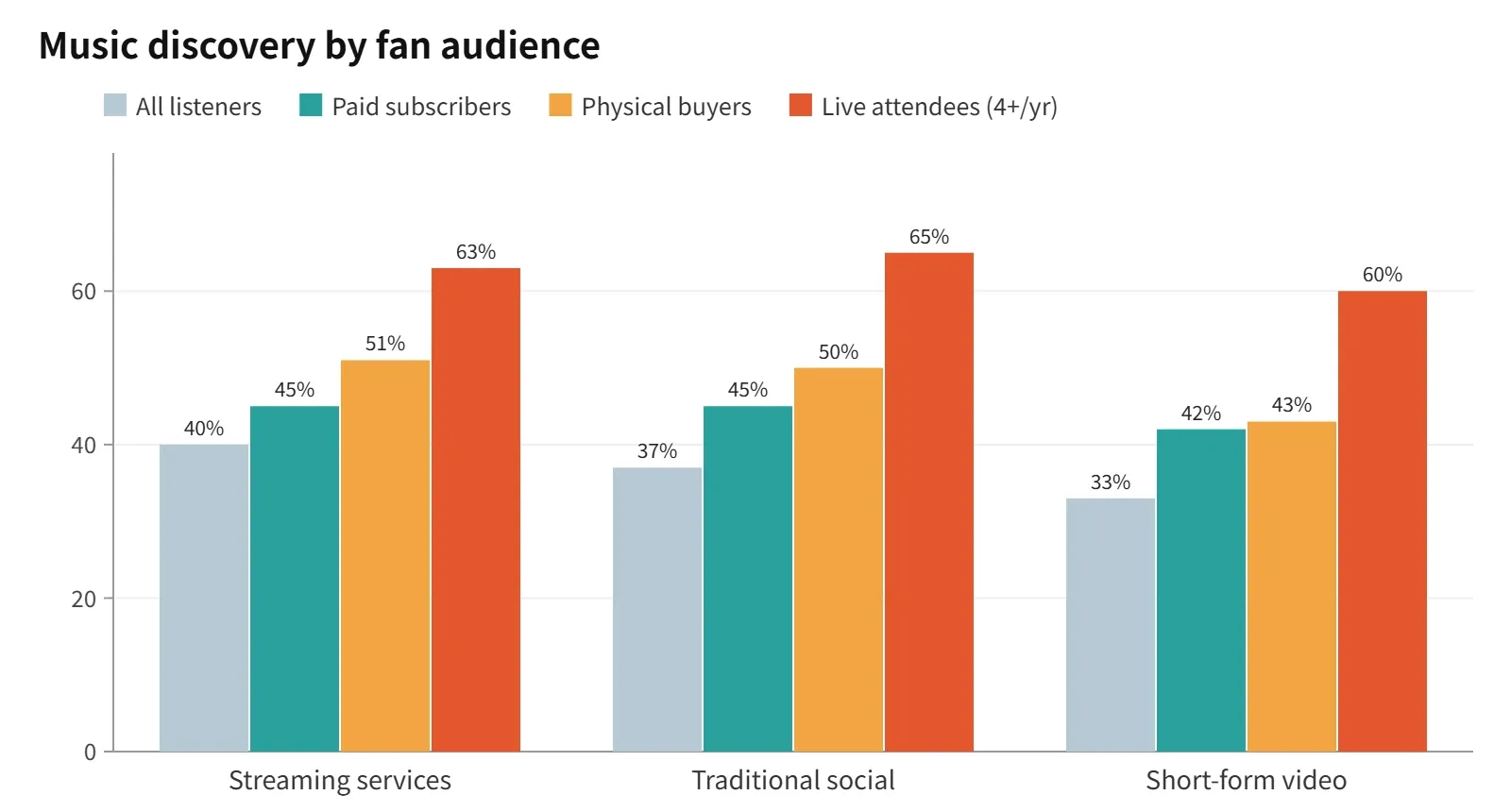
Short-form is already a primary consumption channel for music too. Fifty-eight percent of 18-24 music listeners watch short music clips on apps like TikTok, versus 19% of those 65 and older. Across all U.S. listeners, discovery channels are tightly bunched: streaming 40%, radio 39%, friends and family 38%, traditional social media 37% and short-form 33%. Among 18-24s, short-form (53%) is closing in on streaming (55%).
Fans who spend more are more likely to discover through social platforms. Among those attending four or more concerts a year, 65% found new music on social media and 60% on short-form video, 28 and 27 points above the listener average, respectively. Social media even topped streaming (63%) for this group.
Discovery carries over into consumption elsewhere. Fifty-eight percent of listeners who discovered music on social media went on to seek out other songs by that artist, rising to 69% among users engaging in four or more music activities on social. Thirty-nine percent of 18-24 social users search for newly discovered music again on streaming services such as Spotify.
Tubi's logic in handing long-form projects to creators rests on this same dynamic. If interest sparked on short-form carries over to longer viewing on other platforms, a first long-form series from a creator with an existing fan base becomes an original with lower discovery costs. In the paid extended edition of its report, Luminate said "most consumers who discovered films or TV on social media went on to watch the full title."
Seven Streamers Add Vertical Feeds; Tubi's "Scenes" Led the Way in November 2024
Streaming services have brought short-form discovery into their own apps. According to Luminate, most major U.S. streamers added TikTok-style vertical video feeds to their mobile apps over the past year. The mechanics are the same: swipe through clips, then jump straight to the full title, add it to a watchlist or share it via messaging. In August, Disney partnered with TikTok to let creators post videos featuring Marvel, Pixar and Star Wars characters on both TikTok and Verts, the vertical feed inside Disney+.
| Service | Feed name | Launch | Content |
|---|---|---|---|
| Tubi | Scenes | Nov. 2024 | Film and TV clips |
| Disney+ | Verts | Mar. 2026 | Library scenes; creator content under review |
| Netflix | Clips | Apr. 2026 | Series, film and specials clips; podcasts and live to follow |
| Paramount+ | (Unnamed) | Apr. 2026 | Sports highlights, CBS News, UFC; creator and short-drama content under review |
| Prime Video | Clips | May 2026 | NBA highlights, film and TV clips |
| HBO Max | HBO Max Shorts | Jul. 2026 | Trailers, clips, bonus content |
| Peacock | Vertical Feed | Aug. 2026 | Library clips; short-drama hub "Your Bravoverse" |
Vertical video feeds in U.S. streaming services' mobile apps. Source: Luminate Intelligence (September 2026)
Tubi was the first to launch a vertical feed. While other services pull short-form clips into their apps to aid discovery, the incubator runs in the opposite direction, bringing in creators who have already built audiences on short-form to make long-form shows.
Tubi Q4 Revenue Up 35%; U.S. TV Viewing Share Hits Record 2.3%
Fox's FY2026 revenue rose 5% to $17.13 billion. Fiscal fourth-quarter advertising revenue jumped 78% on World Cup coverage and Tubi's growth. Fox CEO Lachlan Murdoch said Tubi's World Cup-related revenue was meaningful but small relative to Tubi's overall revenue growth. According to Fox's registration statement, Tubi's annual revenue grew more than 25%, and annual total view time rose 20% to about 13.2 billion hours.
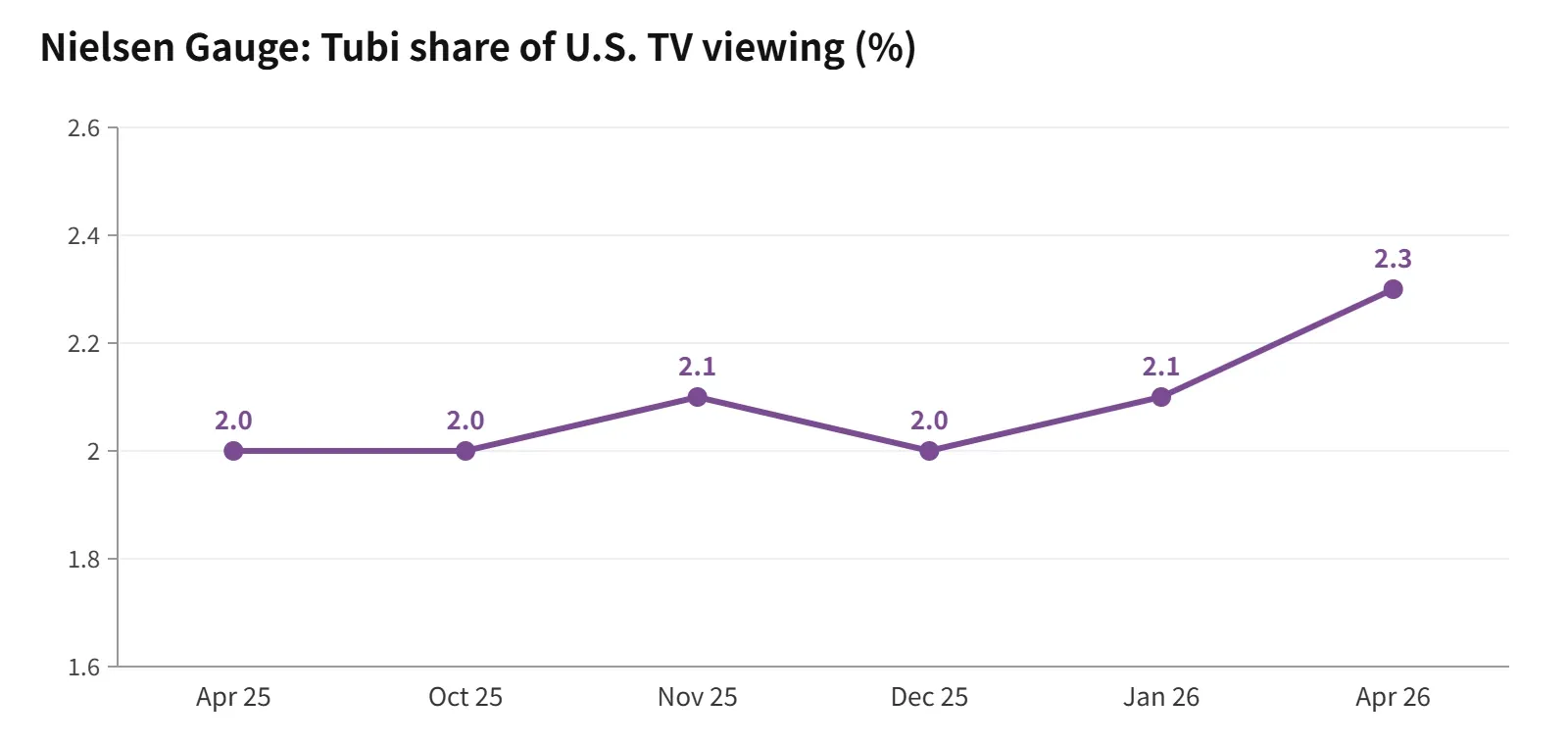
In Nielsen's The Gauge, Tubi's share of total U.S. TV viewing rose from 2.0-2.1% in October-December 2025 to a record 2.3% in April 2026. In Nielsen's Ad-Supported Gauge, which tracks ad-supported viewing only, Tubi accounted for 6.2% of ad-supported streaming in Q4 2025. Fox bought Tubi in 2020 for $440 million.
In The Stream 2026, a survey Tubi conducted with The Harris Poll, 67% of respondents said content from digital creators feels more original than traditional TV and film. Seventy-six percent want more programming from independent and smaller creators, and 78% of Gen Z respondents prefer originals over remakes and franchises. Tubi released the survey the same week it announced the incubator.
Netflix Licenses, YouTube Pays for Exclusivity: The Battle for Creators
This year, the fight for creators has moved to the TV screen.
Netflix has been acquiring video podcasts from Spotify and iHeartMedia, along with work by YouTubers. On Aug. 19, Bloomberg reported that YouTube offered some top creators millions of dollars, production funding and a share of brand-campaign revenue in exchange for not simultaneously releasing on Netflix, and warned that creators who sign with Netflix could be left out of marketing events and other opportunities. YouTube has paid out more than $50 billion to creators in recent years.
Tubi has played in this market as well. In October 2025, it brought in titles from Audiochuck, the company run by "Crime Junkie" podcast creator Ashley Flowers, in a multiyear deal the industry estimates at about $150 million.
The incubator takes a different approach. Rather than buying creators who already make long-form videos on YouTube, Tubi is giving creators who built audiences with short videos on TikTok their first TV series. It is a different talent pipeline from the long-form YouTubers who received exclusivity offers from YouTube.
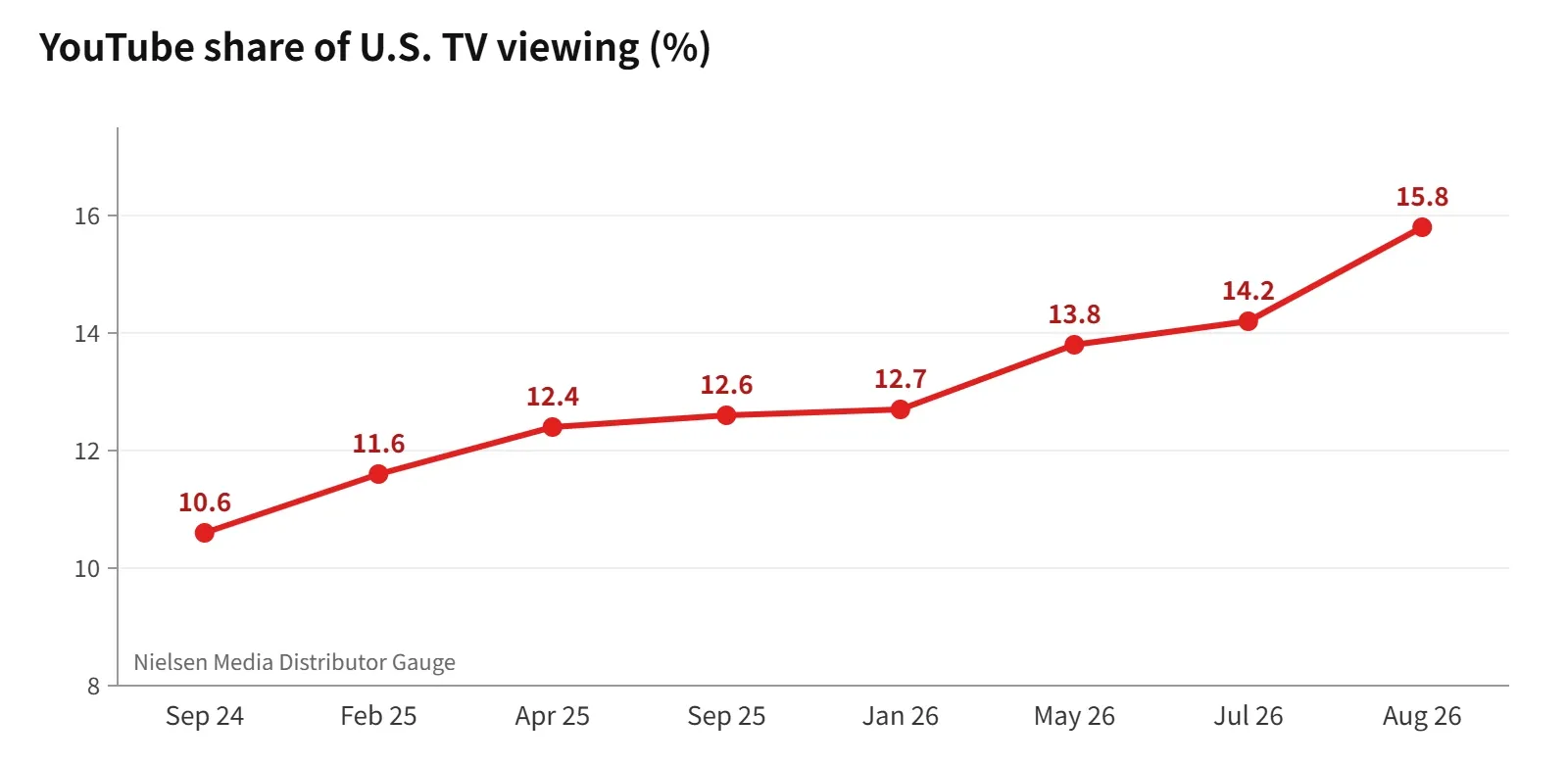
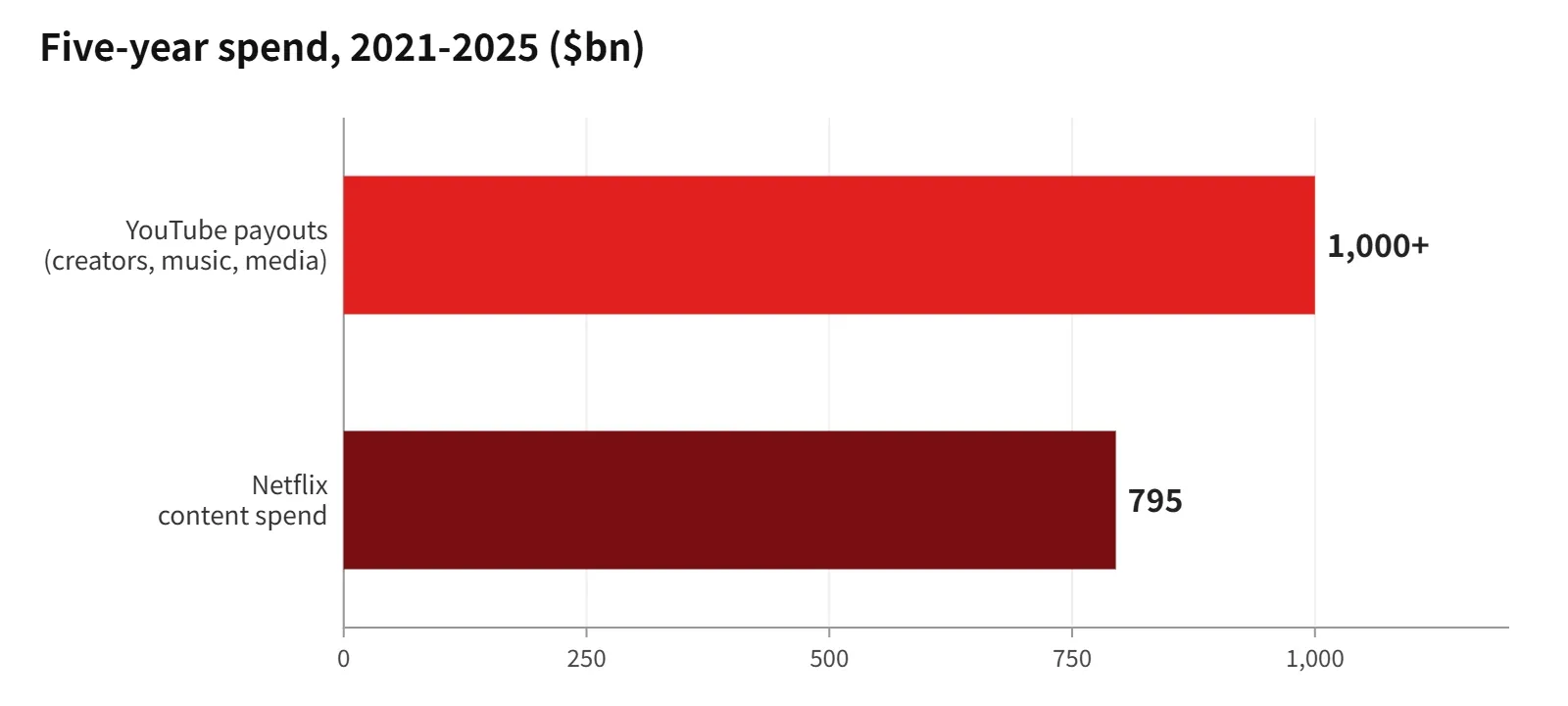
YouTube content already dominates the TV screen. YouTube's share of U.S. TV viewing hit a record 15.8% in August, more than double third-ranked Netflix (7.7%). That is up 5.2 points in two years from 10.6% in September 2024, and YouTube viewing among adults 50 and older rose 9% in August. From 2021 to 2025, YouTube paid more than $100 billion to creators, music labels and media companies, while Netflix's content spending over the same period totaled $79.5 billion.
MoffettNathanson estimated YouTube's 2025 revenue at about $62 billion, surpassing Disney's media businesses ($60.9 billion). In September 2025, YouTube said the number of channels earning more than $100,000 a year from TV screens had grown 45% year over year.
| Platform | Approach | Scale | Examples |
|---|---|---|---|
| YouTube | Revenue sharing, exclusivity payments | $100B+ paid out, 2021-2025 | Offers conditioned on skipping Netflix simulcasts (Aug.) |
| Netflix | Licensing, exclusive releases | $79.5B content spend over 5 years | Spotify and iHeart video podcasts |
| Tubi | Licensing → production funding | 700 creators, 35,000 episodes | 10 TikTok incubator series; Audiochuck (est. $150M) |
| TikTok | Short-form revenue sharing, micro-series | PineDrama app (Jan.) | HOORAE partnership; long-form with Tubi |
| Samsung TV Plus | FAST channel programming | 100M monthly users | Creator channels incl. Smosh |
How platforms are securing creators. Sources: Company reports, Bloomberg, Variety, The Desk
TikTok Takes One-Minute Dramas, Tubi Takes Long-Form: Entertainment Expansion After the U.S. JV
TikTok's U.S. business, long clouded by its Chinese parent, was transferred to the TikTok USDS Joint Venture on Jan. 22. U.S. and global investors hold 80.1% and ByteDance 19.9%, with Oracle, Silver Lake and MGX each holding 15%.
That same month, TikTok launched PineDrama, a vertical drama app with episodes of about a minute, in the U.S. and Brazil, and in June it signed a microseries partnership with Issa Rae's HOORAE. "Micro-series" even appears in Dawn Yang's title. TikTok is growing one-minute vertical dramas in-house and leaving long-form to Tubi.
The $22 Billion Roku Deal: Production, Free Channels and Ads Under One Company
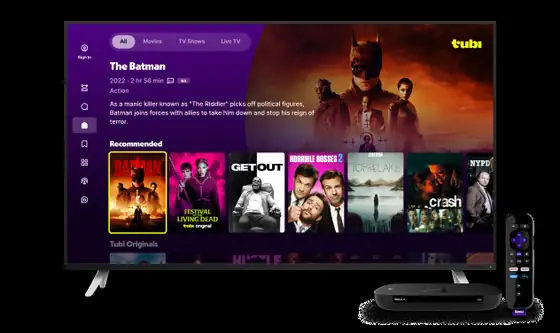
On June 15, Fox agreed to acquire Roku for $160 per share ($96 in cash plus 0.9693 Fox Class A shares). Roku has direct relationships with 100 million streaming households worldwide and operates the free channel platform The Roku Channel. Fox said the combined company would become the No. 3 U.S. TV platform by viewing share and generate $400 million in annual cost savings. Fox shares fell 15% on the morning of the announcement. The deal is expected to close in the first half of 2027, pending shareholder and regulatory approval. Once completed, Tubi, which makes creator originals, and the Roku home screen, which distributes free channels, will sit inside the same company.
Showbox Co-Produces Short Dramas With ReelShort as Global Market Reaches $16 Billion
Korean producers are also leaning into vertical video. On June 15, Showbox, distributor of the hit film "Exhuma," signed a co-production deal with ReelShort, a short-drama platform with 70 million monthly users. The partners will start with ReelShort-owned IP and expand into Showbox originals, and the titles will stream exclusively on ReelShort worldwide for six months. Showbox entered short drama in December 2025 with two titles, including "Bridal Shower: The Missing Bride," and has also signed distribution deals with DramaBox and Vigloo. The short-form K-drama "In The Name Of Beauty" has surpassed 300 million views on TikTok.
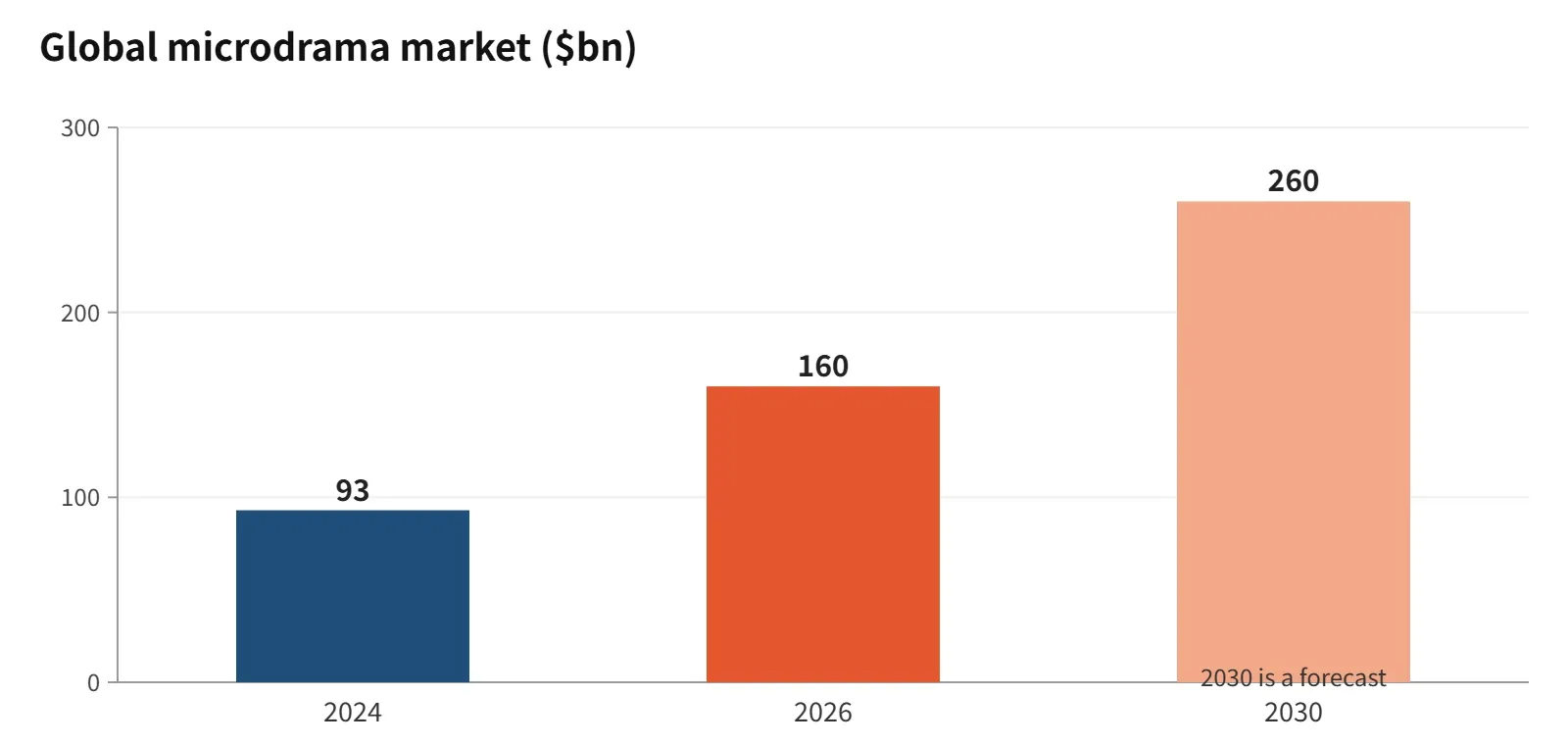
Media Partners Asia (MPA) expects global short-drama revenue to grow from $9.3 billion in 2024 to $16 billion in 2026 and reach $26 billion by 2030. Deloitte forecasts in-app payment revenue will rise from $3.8 billion in 2025 to $7.8 billion in 2026. Kakao Ventures estimated Korea's domestic market at about 650 billion won ($486 million) in 2024.
Samsung TV Plus Tops 100 Million Monthly Users as Creator Channels Move to FAST
Korean-run FAST services are also deepening ties with YouTube creators. Samsung Electronics' Samsung TV Plus passed 100 million monthly active users in January. Speaking at Samsung's Tech Forum at CES 2026, Smosh CEO Alessandra Catanese said that since launching FAST channels, Smosh is "seen less as a YouTuber and more as a premium comedy brand and media studio." In January, Samsung TV Plus also became the first FAST platform in Korea to carry a 24-hour terrestrial news channel. A Korean company already owns the pathway that takes YouTube-grown creator brands onto a TV maker's free channels.
Korea's 34,806 Solo Creators Earned 2.47 Trillion Won; Top 1% Took 18%
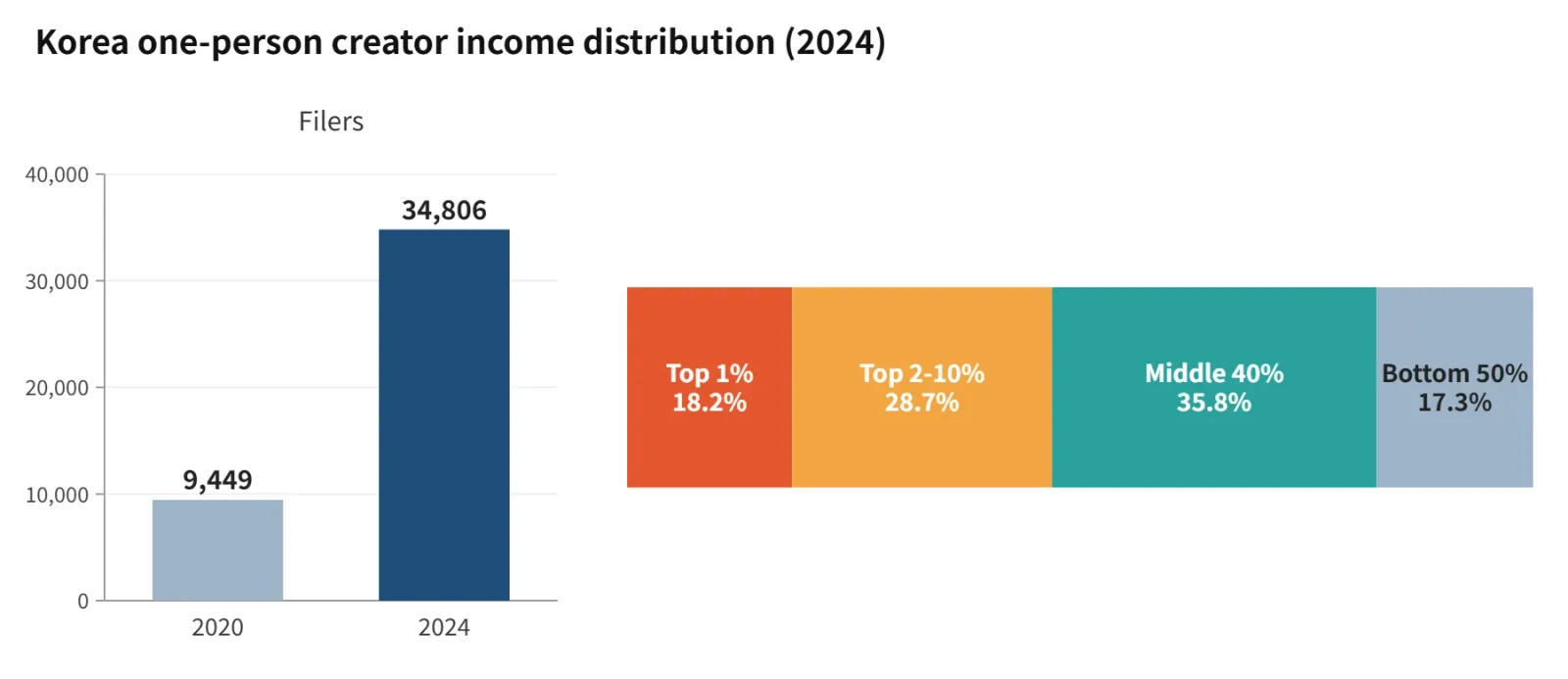
According to data the National Tax Service (NTS) submitted to Rep. Park Sung-hoon of the People Power Party, 34,806 solo media creators reported income for 2024, totaling 2.4714 trillion won ($1.848 billion). That is 3.7 times the 2020 count (9,449), and average income per creator rose 25.6%, from 56.51 million won to about 71 million won ($53,100). The top 1% (348 creators) averaged 1.29339 billion won each, or 450.1 billion won combined, capturing 18.2% of the total. The top 10% (3,480) took 46.9%, while the bottom 50% (17,404) took 17.3%. Corporations in the solo-media sector numbered 2,024, with 1.1134 trillion won ($832 million) in revenue, based on 2025 corporate tax filings.
This top-heavy distribution mirrors the global market Goldman Sachs describes, where about 4% of creators are professionals. The several thousand top Korean creators earning hundreds of millions of won a year are exactly the "creators who already have fans" the Tubi-TikTok model is looking for. If Korean broadcasters and studios co-develop long-form projects with them, the core of any deal will be not just revenue sharing but how IP ownership and exclusivity windows are divided. Tubi funded production and took an exclusive window; Showbox gave ReelShort six months of exclusivity.
Tubi Executive to Keynote in Seoul Nov. 5: Turning Short-Form Discovery Into Long-Form Viewing
Tubi's creator strategy will be presented in Seoul next week. The 2026 International OTT Forum, hosted by Korea's Broadcasting, Media and Communications Commission and organized by the Korea Broadcast Advertising Corporation (KOBACO), takes place Nov. 5 at the Four Seasons Hotel Seoul in Gwanghwamun. Tubi Vice President David Salmon will deliver a keynote on fandom- and taste-based curation and creator collaboration. Other speakers include Cho Eun-jin, director of the YouTube web variety show "Pinggyego"; Park Hyun-yong, producer of tvN's "Earth Arcade"; Kim Jin-man, head of production at MBC; and Kerensa Sammanidis, head of BBC iPlayer.
What This Means for Korean Companies: Link Clips to Full Episodes, Co-Develop With Creators
Luminate's research quantifies a reality for Korean broadcasters and media companies: short-form is the first gateway to reaching young U.S. viewers. Fifty-seven percent of 18-24s find titles via short-form, and the share is higher still among frequent moviegoers and concertgoers. Korean broadcasters already post clips and web variety shows on YouTube, but what U.S. streamers have attached to their vertical feeds is a button that takes viewers straight from the clip to the full episode. Discovery turns into viewing only when the path from clip to full-length title on a specific service is designed in.
Broadcasters should decide where a clip leads before they post it. Seven U.S. streaming services have attached a "watch full episode" button to their vertical feeds, and Luminate says most consumers who discover a title on social media go on to watch it in full. For overseas viewers, that destination can be a Korean manufacturer's FAST service such as Samsung TV Plus or LG Channels, or Tubi and The Roku Channel. A short clip earns a broadcaster revenue only when it turns into long-form viewing that carries ads.
Studios should prepare deals that bring creators in as co-developers rather than as on-screen talent. The Tubi-TikTok model splits the work: the short-form platform scouts and promotes creators, while the long-form service funds production and holds the exclusive window. Just as Showbox (쇼박스) gave ReelShort six months of exclusivity before production, Korean broadcasters and studios can take long-form shows co-developed with Korean creators to U.S. free platforms. IP ownership, exclusivity periods and rights to later seasons should be written into the contract alongside revenue splits.
Creators and multichannel networks need a track record of moving short-form followers into long-form viewing, because that record is their leverage. With the top 10% of Korea's solo creators (3,480 people) taking 46.9% of all income, the ones who will get overseas long-form offers are those who already have fan bases. Tubi's 12 picks were creators with "a body of work that people come back for" on TikTok. Short clips with English and Spanish subtitles or dubbing are the way into the feeds of U.S. 18-to-24-year-olds.
TV makers and platforms can move from programming channels to funding production. Fox makes originals through Tubi and, with Roku, will tie them to a TV operating system and home screen. Samsung TV Plus (100 million monthly users) and LG Channels already pair an operating system with free channels. A Tubi-style model of funding creator originals in exchange for an exclusive window is one that Korean manufacturers are well placed to test. Tubi does not define a "monthly active user," which makes comparisons with other services difficult; Korean companies signing with overseas free platforms should settle what viewing data they will receive first.
What Seoul Should Do: Remove the Short-Form/Long-Form Divide and Turn K-FAST Into Co-Development
Government support has worked on the distribution side. The Ministry of Science and ICT (과학기술정보통신부) used 8 billion won (about $5.98 million) from a 2025 supplementary budget to build 20 AI-dubbed K-FAST channels carried on Samsung TV Plus and LG Channels in 22 countries, which reached about 100 million cumulative viewers by the end of April 2026, five months after launch. This year it is adding four channels, including vertical drama, K-beauty and K-dance, at 230 million won (about $172,000) per channel; the vertical drama channel uses a "dual view" layout to fit 9:16 video on TV screens. Membership of the Global K-FAST Alliance has grown from 22 companies at launch to 82.
Creator support rules, however, cut against the Tubi model. The ministry's 2025 creator content production program excluded short-form videos under one minute and barred broadcasters and IPTV operators. This year the Korea Communications and Media Commission (방송미디어통신위원회) has set aside 8.5 billion won (about $6.35 million) for the creator media industry, with up to 60 million won per project. Consortia that pair creators discovered on short-form with broadcasters' or studios' long-form production struggle to qualify under these divisions.
The first fix is a co-development track that links short-form discovery to long-form production, letting creators, broadcasters and studios apply as one consortium. K-FAST could also expand beyond building channels and dubbing into incubator-style projects that co-develop Korean creator originals with overseas FAST platforms, with domestic short-form platforms, FAST operators and studios splitting the roles that TikTok and Tubi play.
Contract and data standards are also needed. Standard contract guidance covering exclusivity periods, IP ownership and the scope of viewing data from overseas platforms would strengthen individual creators and smaller studios at the table. Creator industry statistics should go beyond National Tax Service income data to surveys that combine overseas revenue and viewing data by platform. With programs split across the science ministry, the commission and the Ministry of Culture, Sports and Tourism (문화체육관광부), a single cross-ministry channel for helping short-form creators reach overseas long-form markets is worth considering.
Budgets and Dates Undisclosed: Will Short-Form Fans Become Long-Form Viewers?
Tubi has not disclosed budgets or release timing for the incubator series. Once the first shows premiere, the key metric will be whether TikTok followers watch episodes on Tubi all the way through. Because short-form discovery in Luminate's survey is concentrated among 18-24s and stays at 25% or less among those 55 and older, the audience for creator series is likely to skew young as well.
When the Roku acquisition closes in the first half of 2027, Fox will run creator-original production (Tubi), free-channel distribution (The Roku Channel), a TV operating system and ad sales within a single company. While Netflix locks in creators through licensing and YouTube through exclusivity payments, Fox has chosen to develop creators proven on short-form into long-form producers. The performance of Tubi's first class will be the first real test of how much short-form discovery power can be converted into ad-supported long-form viewing.