
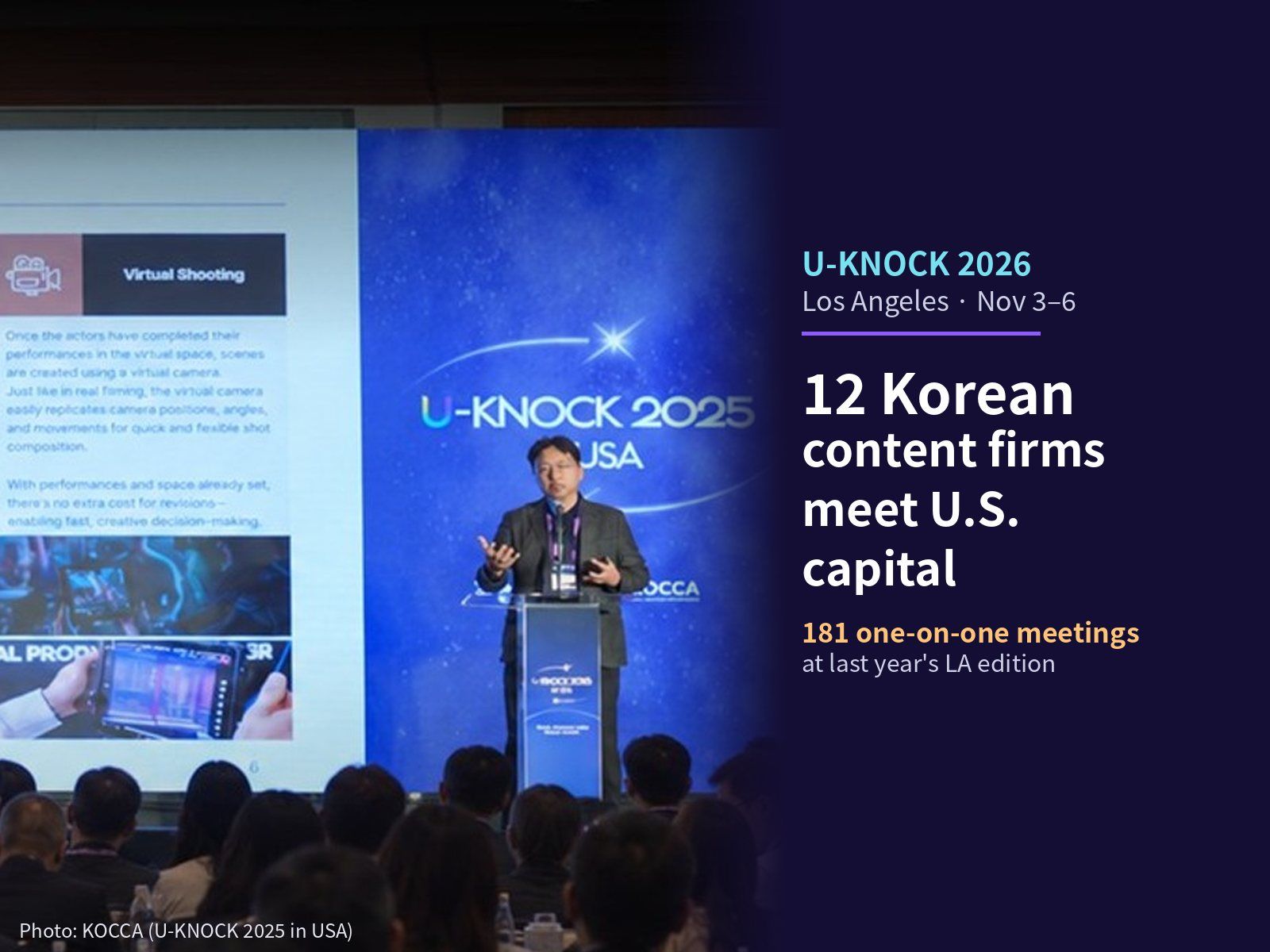
In brief U-KNOCK 2026 in USA, run by Korea's culture ministry and KOCCA in Los Angeles Nov. 3-6, is built around capital rather than sales. Much of the Nov. 5 forum lineup comes from investment banks, private equity and banks, and 12 Korean companies meet North American investors one-on-one on Nov. 6. With the value of U.S. content rights rising, Korean companies need contracts that bring in capital while keeping their IP.

South Korea's Ministry of Culture, Sports and Tourism (문화체육관광부) and the Korea Creative Content Agency (한국콘텐츠진흥원, KOCCA) will run U-KNOCK 2026 in USA in Los Angeles from Nov. 3 to Nov. 6. The main venue is The Biltmore Los Angeles. It is the program's third year in the United States.
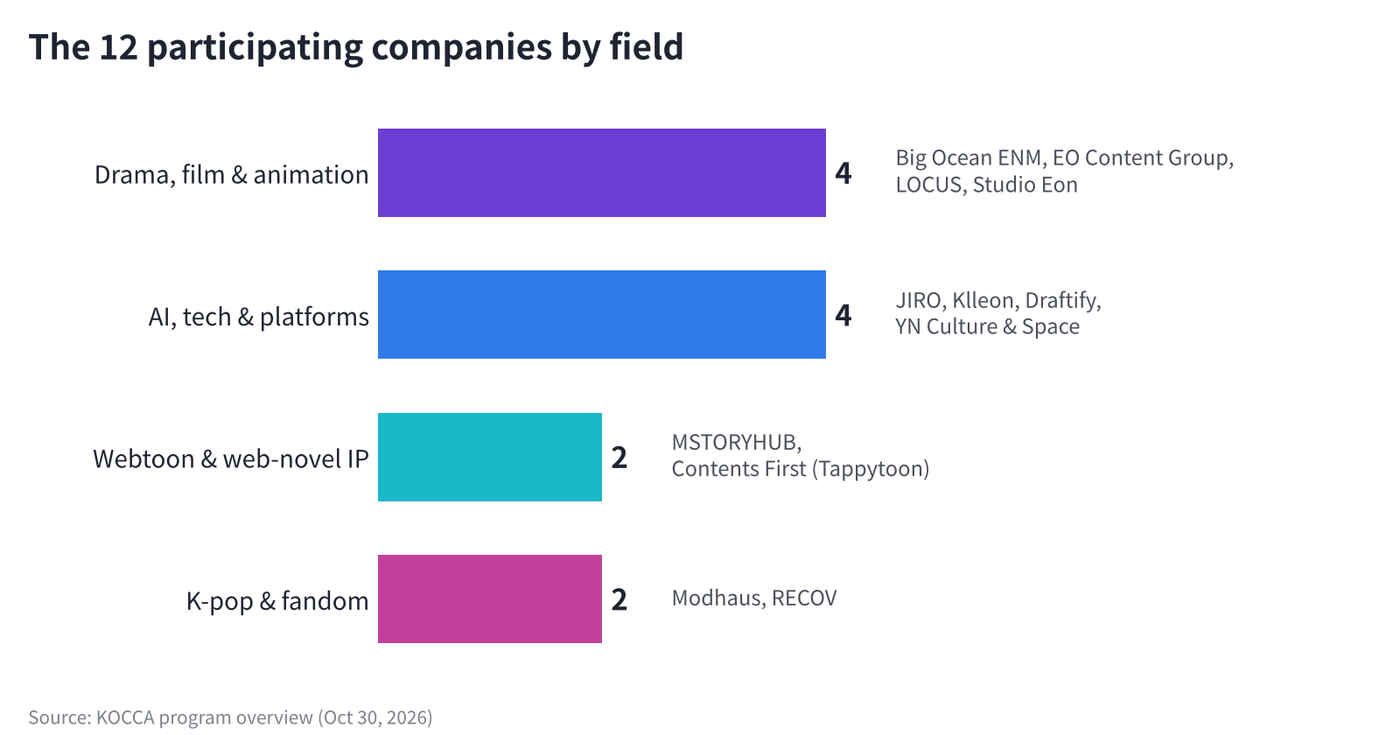
Much of the Nov. 5 forum lineup comes from finance: New York merchant bank The Raine Group, IP-focused private equity firm Shamrock Capital, media private equity firm Atwater Capital and J.P. Morgan's global corporate bank. Producers Amblin Entertainment, Anonymous Content and 21 Laps Entertainment are also on the bill. The theme is "What Makes Content Last." On Nov. 6, 12 Korean drama, animation, webtoon, K-pop and AI companies hold 30-minute meetings with North American investors and studios.
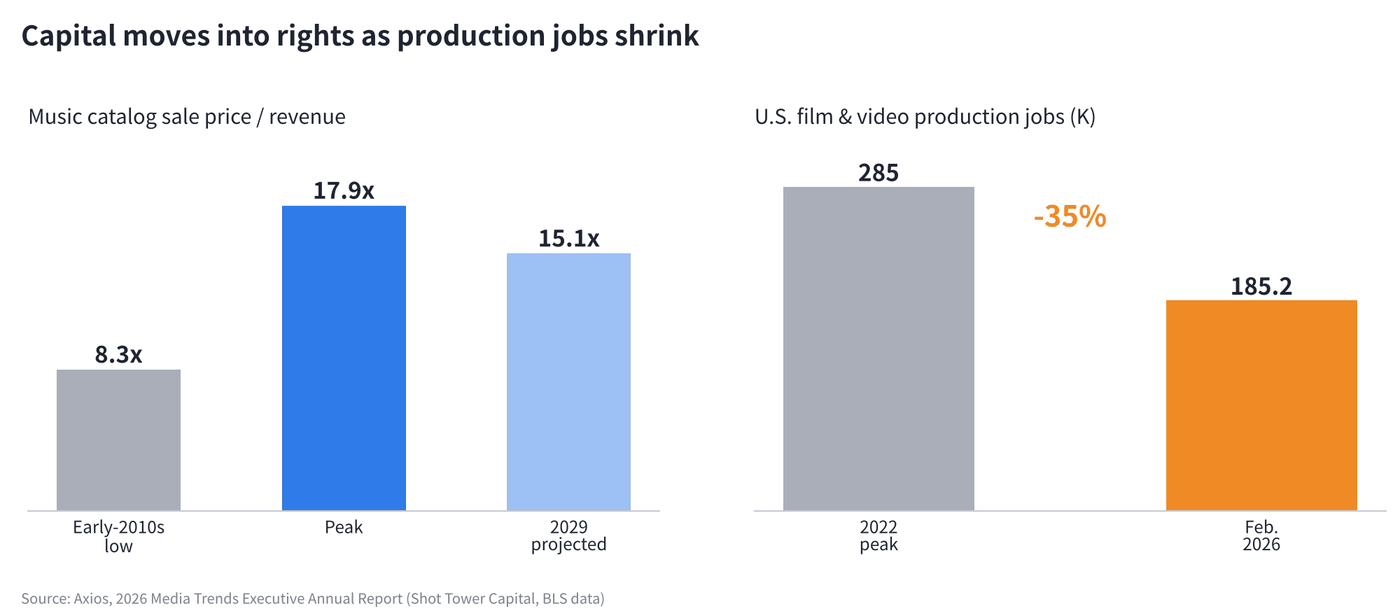
The lineup lines up with what U.S. market data shows. Axios's 2026 Media Trends Executive Annual Report, released Oct. 20, puts music catalog sale prices at up to 17.9 times revenue, up from 8.3 times, with private equity, pension funds and asset managers moving into content rights. The same report counts 185,200 U.S. film and video production jobs in February, about 35% below the 2022 peak of 285,000. U.S. networks produced nearly 5,000 fewer TV episodes in 2024 than in 2022.
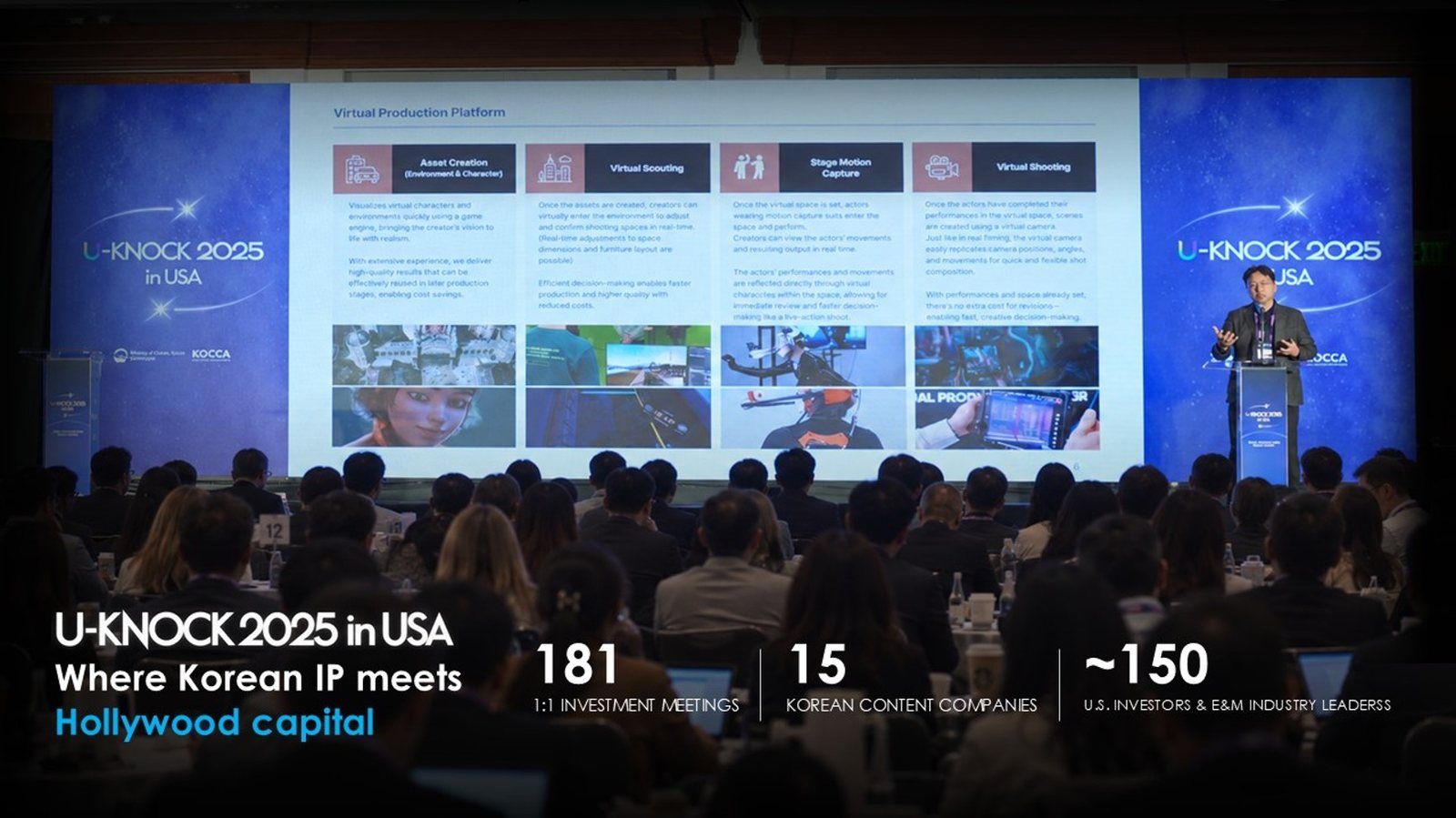
KOCCA started U-KNOCK in 2024 as an overseas investment program. At the first event in Anaheim in June 2024, 10 companies held 97 meetings worth about 16.8 billion won ($12.6 million), Aju Business Daily reported. At the Loews Hollywood Hotel last November, 15 companies took 181 one-on-one investment meetings. The first two years built up meeting counts; this year, deal structure itself is on the forum agenda.
A Korean-American roundtable on Nov. 3; visits to UTA, completion guarantor FFI and Hanmi Bank on Nov. 4
The week opens on the evening of Nov. 3 with PRE U-KNOCK, a roundtable with KALH, a group of Korean-American leaders in Hollywood, covering production and finance, source IP, music and fandom, and AI and platforms. The main program runs Nov. 4-6. On Nov. 4, participating companies and Korean investors visit talent agency UTA and completion guarantor Film Finances International (FFI), while financial institutions visit Hanmi Bank and FFI. The Korea Credit Guarantee Fund (신용보증기금), Korea Technology Finance Corp. (기술보증기금), SJ Investment Partners and Union Investment Partners travel with the delegation.
A completion guarantee assures financiers that a film will be finished on its promised budget and schedule, and U.S. independent films are often required to have one before they can draw bank loans or outside investment. Sending Korea's state guarantors and VCs to see that operation connects with a structure in which guarantees and loans are layered onto Korean producers' overseas projects.
| Date (PT) | Program | Details |
|---|---|---|
| Nov. 3, 6-8 p.m. | PRE U-KNOCK: Korean E&M roundtable | With KALH; production & finance, source IP, music & fandom, AI & platforms |
| Nov. 4 | U.S. industry and finance meetups | Companies and Korean investors visit UTA and FFI; financial institutions visit Hanmi Bank and FFI |
| Nov. 5, afternoon | International Content Investment Forum | Keynotes, fireside chats, panels, IR pitches by five companies; reception to 8 p.m. |
| Nov. 6, 10 a.m.-5 p.m. | One-on-one investment & business meetings | 30-minute meetings built on each company's business, IP and project needs |
Source: KOCCA program overview, Oct. 30, 2026. The forum runs in English with Korean-English simultaneous interpretation.
Music catalogs at 17.9 times revenue; Raine's Fred Davis gives the first keynote
The first keynote speaker is Fred Davis, a Raine Group partner since 2014 and a former EMI Records executive vice president, who will talk about how the decentralization of the music industry draws capital. The IFPI figures cited in the Axios report put 2025 global music revenue at a record $31.7 billion, 70% of it from streaming. Music rights returned about 13% a year over five years, and at least four major catalog deals have closed this year. Streaming has given catalogs predictable long-term cash flow, the report says, which brought private equity and pension money into the rights market.
YLAB CEO Kang Choul-gu (강철구), formerly CEO of Studio Dragon, gives the second keynote on growing IP value by extending webtoon originals into screen content and merchandise. The IP assetization panel includes Jason Sklar of Shamrock Capital, which began in 1978 as the Disney family's investment company and managed about $7.4 billion as of June. Vania Schlogel, founder of Atwater Capital - set up in 2017 and an investor in Plan B, 88rising and music library Epidemic Sound - sits down with Variety co-editor-in-chief Cynthia Littleton in the Content x AI session.
Hollywood production jobs down 35%; Amblin, J.P. Morgan and Anonymous Content on 'IP assetization'
Axios counts U.S. film and video production employment at its lowest since 2020 and 25% below pre-pandemic levels. Studios are cutting scripted spending and shifting investment to live sports. Congress is weighing a bipartisan 20% federal production credit for U.S.-made film and TV, and 38 states already run incentives. U.S. film and TV exports total $16.4 billion a year.
On the IP assetization panel, Sklar is joined by Jeff Small, CEO of Steven Spielberg's Amblin; David Shaheen, head of media and communications at J.P. Morgan's global corporate bank; and Steve Shikiya, COO of Anonymous Content. The subject is how to structure rights from greenlight through terminal value after release. CJ ENM America CEO Park Hyon-bae (박현배) and LINE FRIENDS America VP Jay Ahn (안재석), head of IPX in the U.S., then present on keeping IP and running it as a pipeline.
PG films took a third of U.S. ticket sales in 2024, the highest share since 1995, and animation about 25%, according to Axios. The 2026 domestic box office reached $8.1 billion through Oct. 19. In the meetings, LOCUS, developing the 3D family fantasy feature Kkokdu, and sci-fi music animation studio Studio Eon are looking for North American distributors and co-producers.
57% of Americans aged 18-24 find movies and TV on short-form video; Meta Comedy and Moneygraphy take the stage
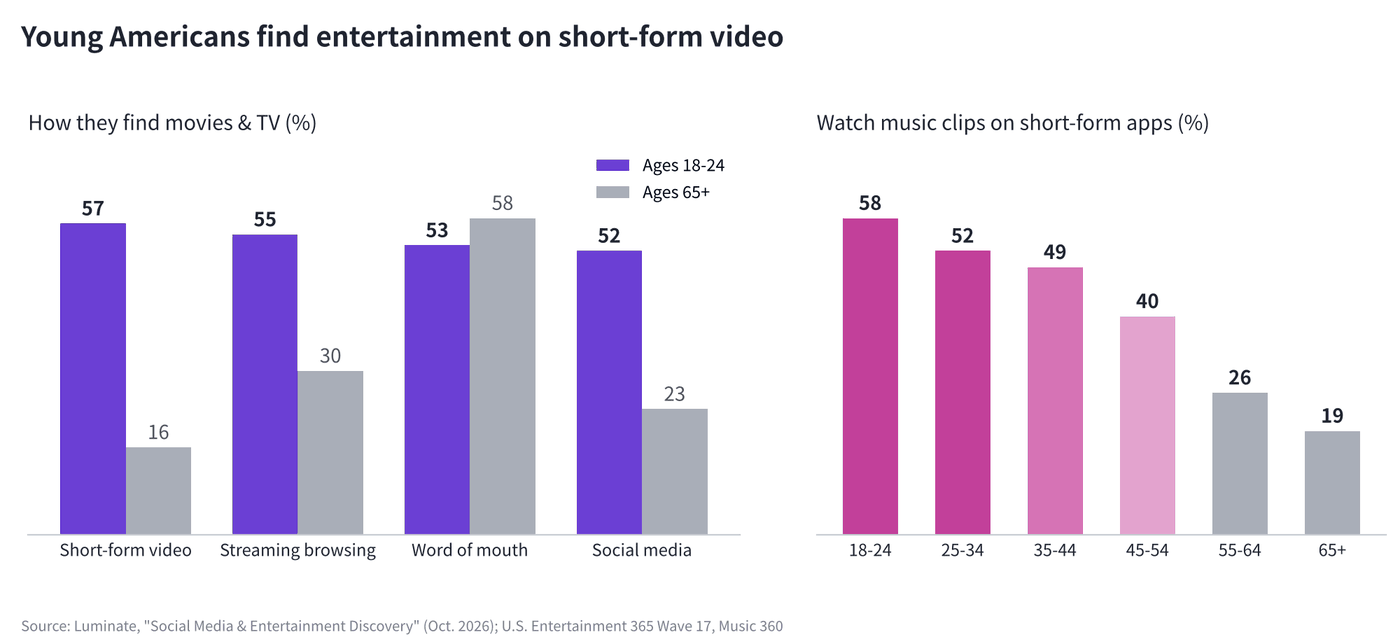
Luminate's October report, Social Media & Entertainment Discovery, finds 57% of Americans aged 18-24 discover new movies and TV on short-form video, ahead of browsing inside streaming services (55%). It is the only age group for which short-form is the top discovery source; among those 65 and over the figure is 16%. Across all U.S. viewers, about a third discover film and TV on social and short-form platforms. Short-form takes 26% of weekly media time for 18-to-24-year-olds, more than double the 12% for those 55 and over. The surveys covered 2,000 Americans aged 13 and over (May 5-26) and 8,105 music listeners (first half).
U.S. streamers have added vertical feeds to their apps. Per Luminate, Disney+ Verts (March), Netflix Clips (April), Prime Video Clips (May), HBO Max Shorts (July) and Peacock's vertical feed (August) arrived this year in turn. In August Disney teamed with TikTok so creators can use Marvel, Pixar and Star Wars characters in videos on TikTok and Disney+ Verts. Axios cites a Goldman Sachs estimate of a $250 billion global creator economy.
The forum's Korean unscripted session covers this market. Speakers are Meta Comedy CEO Chung Young-joon (정영준), whose label built YouTube hits Psick University and Short Box, and producers Jeong Hyun-jung and Bae Chae-min of Moneygraphy, the media brand of fintech Toss, whose channel passed 500,000 subscribers and 150 million views in January. Both companies grew on YouTube, outside the broadcasters.
Live revenue at $149 billion and fandom as a KPI; AEG Presents and bemyfriends in discussion
Live entertainment revenue has nearly doubled since 2021 to $149 billion, and PwC projects $174 billion by 2030, the Axios report says; top-tour tickets average $127. With streamers turning into franchise hubs, fandom has become the new KPI, the report notes. Disney gets 38% of revenue from experiences such as theme parks.
In Luminate's data, 58% of U.S. music listeners aged 18-24 watch music content on short-form apps (19% for 65+) and 53% discover new music there. Among social and short-form users, 39% of 18-to-24-year-olds go on to look up those songs on streaming services.
In the fandom and technology session, bemyfriends CEO Seo Woo-seok (서우석), a former HYBE CPO and CTO and Weverse Company CEO, presents on turning fandom into an asset. Bryan Oh, EVP at 21 Laps, the company behind Stranger Things, and Kelly Stelbasky, SVP of global touring at AEG Presents, then debate why Hollywood is putting K-pop at the top of the bill. Oh is a producer of the 2027 film K-Pop: The Debut. Among participants, Modhaus (tripleS, ARTMS, idntt) and overseas K-pop tour operator RECOV are seeking partners in this field.
AI content deals outnumber lawsuits 299 to 107; production experiments from Utopai, JIRO and Klleon
Axios counts at least 299 content deals between media and AI companies against 107 copyright lawsuits. News leads on licensing, music and publishing remain more litigation-heavy, and gaming deals are emerging. Compensation is shifting from AI training licenses to usage-based payment. In Korea, 32.1% of content businesses used generative AI in the fourth quarter of 2025.
In the Content x AI session, Katarina Scierko, VP of strategy and operations at AI film and TV studio Utopai Studios (founded 2022), and chief product officer Hans Ku, a former Tubi SVP, explain AI production from script to screen. Among participants, JIRO brings Dropshot AI, a platform combining more than 50 generative AI models, and SEORIA, a fully AI-generated K-pop idol that debuted in August; Klleon brings real-time conversational digital humans. The closing special session features Rotten Tomatoes co-founder Patrick Lee, CEO of VENN, and Daniel Suh, general partner at Gold House Ventures.
| Session | Speakers | Related U.S. market data |
|---|---|---|
| Keynotes | Fred Davis (Raine), Kang Choul-gu (YLAB) | Music catalogs 8.3x to 17.9x revenue; music rights ~13% a year over five years |
| A-1 Content x AI | Vania Schlogel (Atwater); Katarina Scierko, Hans Ku (Utopai) | 299 AI-media content deals vs. 107 lawsuits |
| A-2 K-unscripted | Chung Young-joon (Meta Comedy); Jeong Hyun-jung, Bae Chae-min (Moneygraphy) | 57% of 18-24s find film/TV on short-form; $250B creator economy |
| A-3 Fandom & tech | Seo Woo-seok (bemyfriends), Bryan Oh (21 Laps), Kelly Stelbasky (AEG) | $149B live revenue; 58% of 18-24s watch music content on short-form |
| B-1 IP assetization | Jason Sklar (Shamrock), Jeff Small (Amblin), David Shaheen (J.P. Morgan), Steve Shikiya (Anonymous) | 185,200 production jobs (-35% from 2022 peak); ~5,000 fewer TV episodes vs. 2022 |
| B-2 IP pipeline | Park Hyon-bae (CJ ENM America), Jay Ahn (LINE FRIENDS America) | 38% of Disney revenue from experiences; fandom as streaming KPI |
| Special session | Patrick Lee (VENN), Daniel Suh (Gold House Ventures) | — |
Sources: KOCCA forum program; Axios 2026 Media Trends Executive Annual Report; Luminate, Social Media & Entertainment Discovery. Market data are the reports' figures, not the organizer's stated reasons for the lineup.
Twelve companies; The Remarried Empress reaches the table two days after its Disney+ debut
The 12 companies in the Nov. 6 meetings were chosen after pre-screening and a two-way demand survey. MSTORYHUB has a release lined up with the meetings: its webtoon IP The Remarried Empress premieres as a Disney+ original series on Nov. 4, two days before. The 10-episode series stars Shin Min-a, Ju Ji-hoon, Lee Jong-suk and Lee Se-young, and the original webtoon had about 2.97 billion global views as of July. MSTORYHUB is also producing an animated version, so it can carry interest from the live-action launch straight into animation and licensing talks.
JIRO and Draftify won the grand prize and top excellence award at the 2026 KNOCK IR Day at COEX on Aug. 28. Draftify launched PlaySquad, where viewer donations steer the game, in the U.S. in October; the company says its Minecraft-based mode averages about $310 per stream session, roughly 21 times a standard hourly game-stream donation on Korea's CHZZK. Contents First runs Tappytoon, which serves webtoons and web novels in English, French and German in more than 200 countries and territories; its Character Chat service, launched in June, is growing two to three times a month, the company says.
In drama, Big Ocean ENM, maker of SBS's Flex X Cop, is seeking co-development and co-financing partners for the near-future procedural Another Heaven (8 x 50 minutes). Flex X Cop's first season hit an 11.0% nationwide rating and its second-season finale 11.8%, and both seasons ranked No. 1 among Korean dramas on Disney+. EO Content Group (Love Scout, Dear Hongrang) brings the espionage action series TEAM-K (12 x 60 minutes); LOCUS (Red Shoes, Yumi's Cells: The Movie) the feature Kkokdu, drawn from Korean funeral-bier traditions; and Studio Eon the Unreal Engine series Armed Idols: Kill Stage (13 x 20 minutes). Virtual production company YN Culture & Space owns the completed AI virtual-artist series NOWHERE (5 x 12 minutes). Modhaus, YN Culture & Space, Klleon, Contents First and Studio Eon also pitch at the Nov. 5 forum.
| Company | Lead project | Stage | U.S. partnership sought |
|---|---|---|---|
| MSTORYHUB | The Remarried Empress (webtoon IP) | Disney+ series Nov. 4; animation in production | Investment, IP licensing |
| Big Ocean ENM | Another Heaven / Flex X Cop 1-2 | Development / completed | Co-production, co-development, co-financing |
| EO Content Group | TEAM-K | In development | Creative development, investment, distribution |
| LOCUS | Kkokdu (3D animated feature) | Development | Company and project investment, N. American distribution |
| Studio Eon* | Armed Idols: Kill Stage | Pre-production | Investment, co-production, streaming distribution, licensing |
| Contents First* | To You Who Stole My Wish / Character Chat | Development / live | Project financing, adaptation and derivative rights |
| Modhaus* | COSMO / tripleS, ARTMS, idntt | Live | Investment, publishing, co-production |
| YN Culture & Space* | NOWHERE (AI virtual artist) | Completed | Investment, co-production, marketing |
| Klleon* | Real-time digital human | Live | Interactive IP, localization |
| RECOV | K-pop tour operations / D2C commerce | Operating / pre-launch | Investment, U.S. co-promotion, venue and merch deals |
| JIRO | SEORIA / Dropshot AI | Live | Strategic investment, enterprise deals, IP licensing |
| Draftify | PlaySquad | Live (U.S. launch in Oct.) | Strategic investment, game-IP integration, platform deals |
*Also pitching at the Nov. 5 forum. Sources: KOCCA release and program overview; U-KNOCK 2026 brochure
Korean content exports reach $14.9 billion; music up 32.4%, film up 19.9%
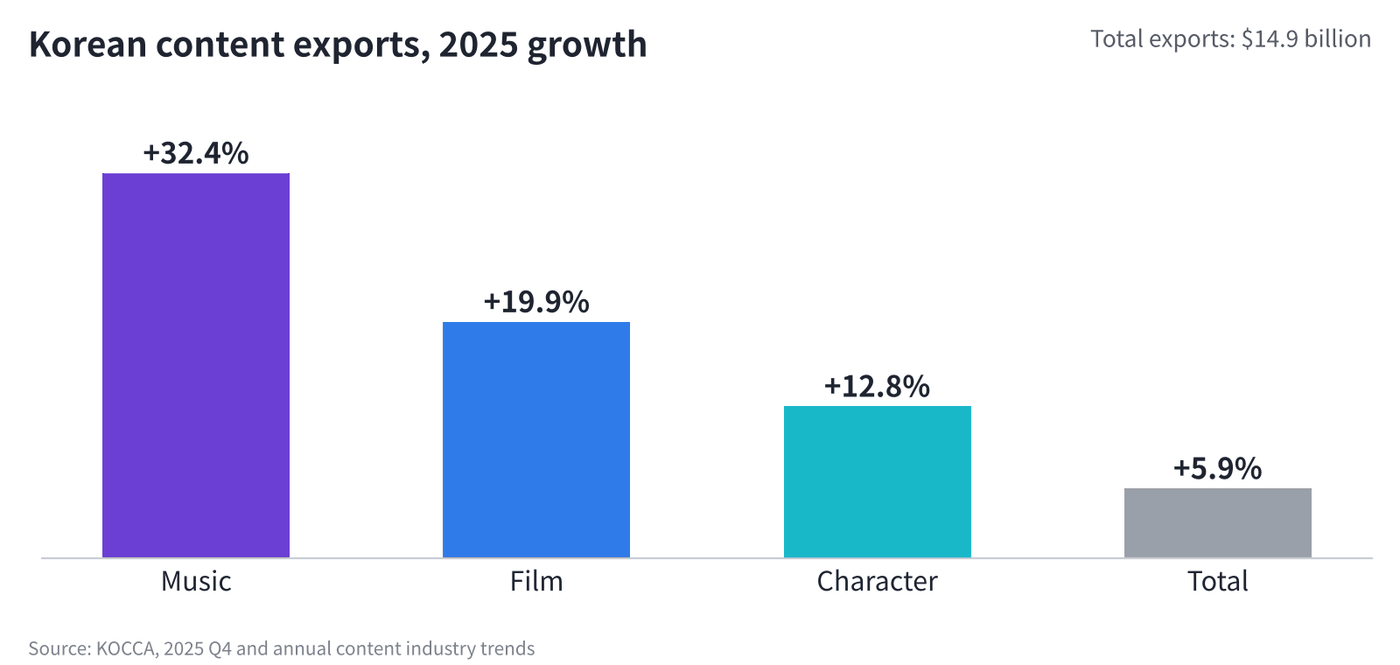
Korea's content exports rose 5.9% last year to $14.9 billion, according to KOCCA's 2025 annual industry trends report. Music (+32.4%), film (+19.9%) and characters (+12.8%) led the increase, while advertising, broadcasting and video, and publishing revenue fell. That K-pop and fandom firms plus AI, tech and platform companies make up half of this year's 12 tracks the same trend.
From selling titles to structuring rights: the task for Korean broadcasters as their revenue falls
After last year's event, KOCCA's head of content finance support told Asia Business Daily that investment talks usually take more than six months, so tangible results would come the following year. 2025 participant MOFAC Studio later raised about 6 billion won ($4.5 million) from Altos Ventures, the paper reported. In the same coverage, a participating CEO said some streaming services and distributors make global exclusive streaming a condition, naming exclusive IP demands and revenue splits as the heaviest burden.
This year's forum takes that burden on directly. With the price of rights assets rising and production jobs shrinking in the U.S., the first thing banks and private equity check when they look at Korean IP is who holds the rights and for how long. If Korean producers' deals with overseas platforms have mostly traded rights for covered production costs, negotiations with financial capital turn on how IP equity, territorial and term-limited rights and secondary business rights are divided and retained - and that feeds directly into company value. That is the question CJ ENM America's pipeline session and the Shamrock-Amblin-J.P. Morgan panel are built around.
The task for Korea's broadcasters and producers follows from that. Last year's export growth came from music, film and characters, while broadcasting and video revenue fell. Delivering titles slot by slot makes it hard to share in a market where rights are gaining value. Structuring international co-productions so that IP equity and secondary rights stay in Korea, and learning production-finance structures that combine completion guarantees, bank loans and public guarantees, could become broadcasters' and producers' next competitive edge. The Remarried Empress, with a source-IP company extending rights into animation and licensing right after a screen adaptation, shows the direction.
The shift of young Americans' discovery to short-form video is an opening for Korean companies. Comedy producers that grew outside broadcasting, like Meta Comedy and Moneygraphy, and K-pop fandoms where music spreads through short clips are territory U.S. streamers are only now chasing by bolting vertical feeds onto their apps. To turn that into investment, though, companies need to explain views and subscribers as revenue and cash flow. Financiers look for predictable income over buzz.
Policy support should also shift weight from meeting counts to follow-through. If deals take more than six months, what decides results is a mechanism that carries legal and accounting advice and guarantees through due diligence and contracting after the event. Whether the guarantee agencies' visits to U.S. lenders lead to guarantees for Korean producers' overseas projects is something to check after the event.
Outlook: a third year that could turn Korean IP into an investable asset
"Marking its third year, U-KNOCK serves as a practical, high-impact deal-making bridge connecting Korea's creative content and innovative tech enterprises directly with mainstream institutional capital and leading partners at the core of global entertainment," a KOCCA official said. "Rather than settling for one-off success, we will continue to provide comprehensive, end-to-end support to ensure K-content transforms into enduring assets backed by global financial capital." Meeting requests are taken at uknockglobal.com.
Given typical negotiation timelines, the results of this year's meetings should begin to surface as investment and co-production deals from the first half of 2027. That Hollywood finance is now probing the rights structure of Korean IP is itself a sign that K-content is being valued not only as product to sell but as an asset to invest in. If this year's talks become contracts that keep rights on the Korean side, U-KNOCK's third edition could be remembered as the point where Korean creators began partnering with global capital on equal terms, an outcome worth watching closely.