
57% of U.S. 18-24s find shows through short-form video, ahead of browsing a streaming service (55%); seven services now run vertical feeds on mobile
IN ONE LINE Seven major U.S. streamers run TikTok-style vertical feeds in their phone apps. Luminate finds 57% of 18-24s discover titles via short-form video, ahead of streaming-app browsing (55%). The feeds pull social discovery in-house and now carry microdramas and creator video. App habit is the next test.
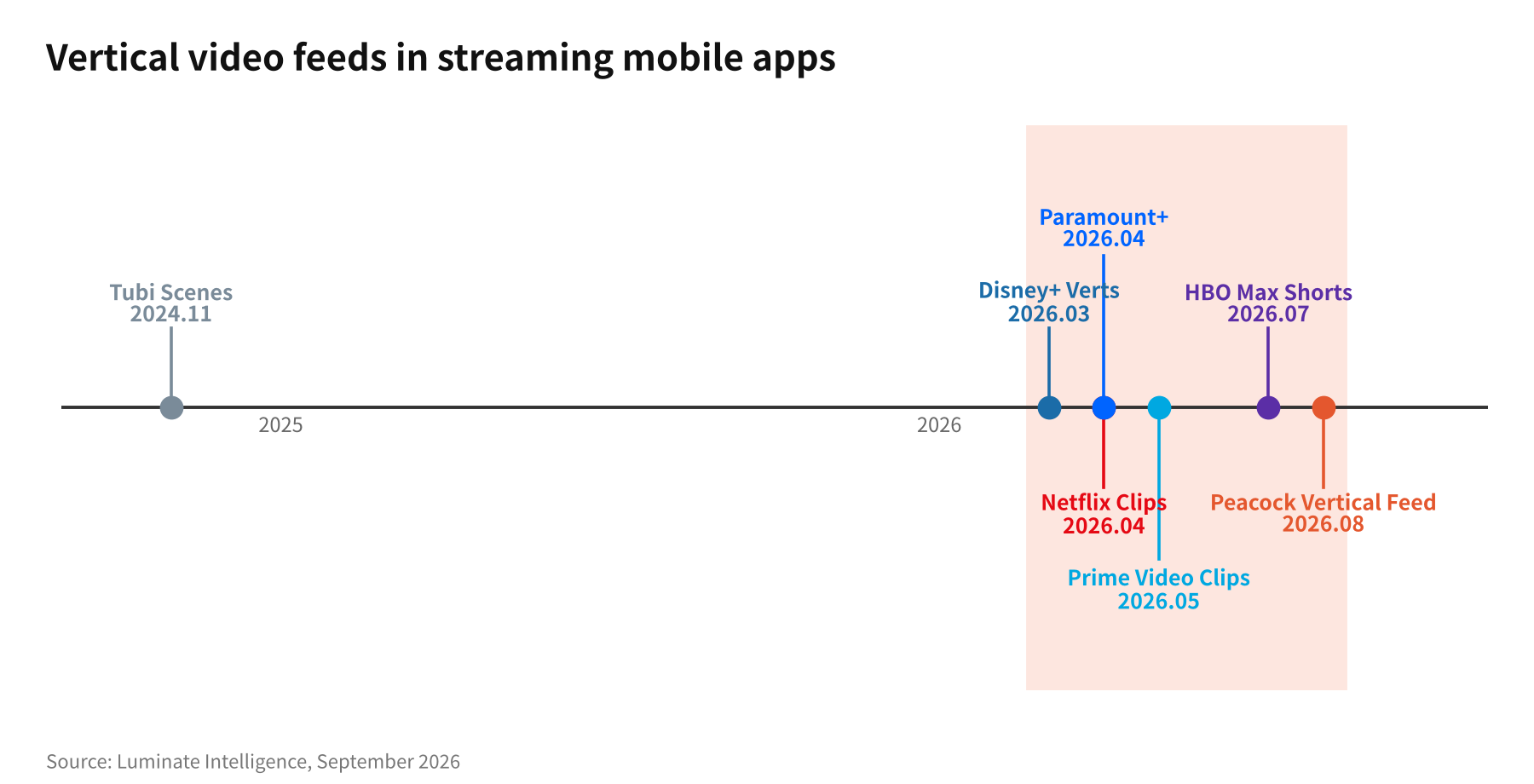
Nearly every major U.S. streaming service now has a vertical video feed in its phone app. Disney+ opened Verts in March and Netflix launched Clips in April. Paramount+, Amazon Prime Video, HBO Max and Peacock followed by August. Counting Tubi, which introduced Scenes in November 2024, the tally is seven.
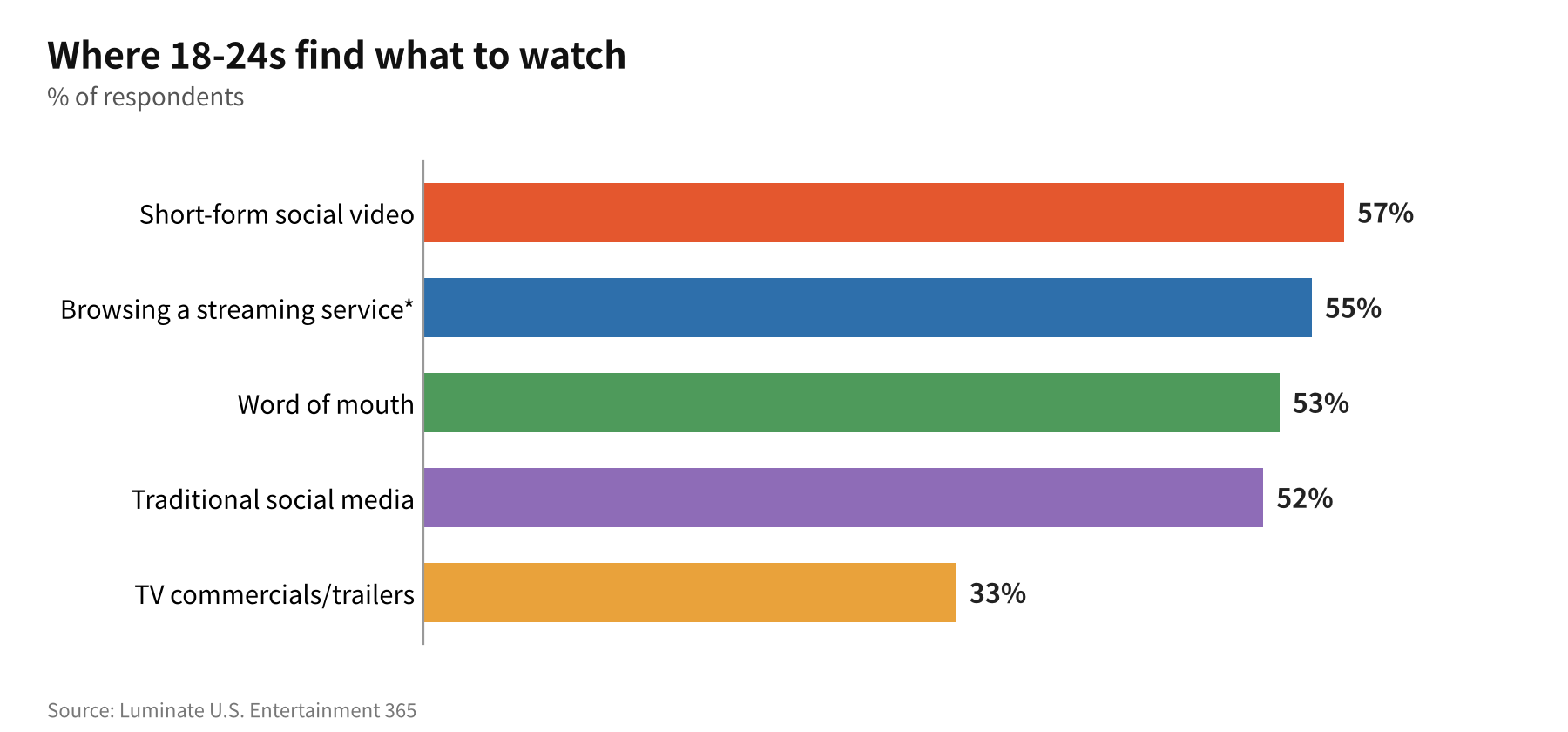
Discovery is the reason the companies give. In its October report Social Media & Entertainment Discovery, the entertainment data firm Luminate found that 57% of U.S. viewers aged 18 to 24 use short-form video to find new movies and TV shows, slightly more than the 55% who find them by browsing a streaming service.
The two paths work differently. A streaming app lays out rows of curated tiles and asks the viewer to choose. A social app serves an algorithmic stream of clips — a scene, a behind-the-scenes interview, a creator's take — and the viewer leaves the platform to find the original. The new feeds are an attempt to rebuild that second path inside the streamer's own app.
Luminate argues the more important word is "mobile," not "vertical." Social platforms redesigned themselves for phones as usage moved off the desktop; streaming apps on phones largely remained shrunken versions of the TV interface. With the feeds in place, the services are now filling them with new material. Peacock opened Your Bravoverse, a personalized feed of Bravo moments, on Oct. 13, and Disney has agreed to carry TikTok creators' videos inside Verts.
Short-form discovery: 57% at 18-24, 16% at 65+
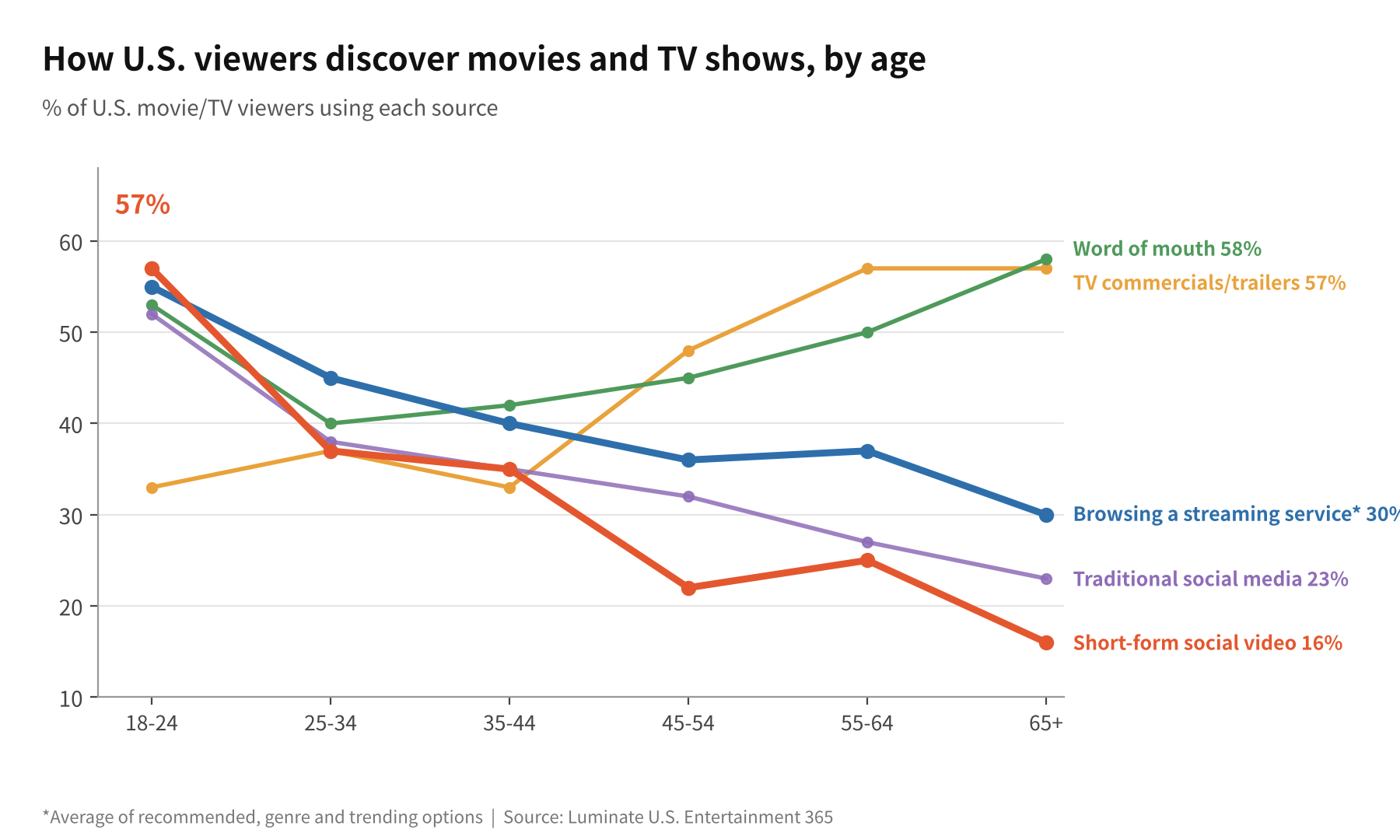
In Luminate's U.S. Entertainment 365 survey, the share of viewers who discover titles through short-form social video falls steadily with age: 57% among 18-24s, 37% among 25-34s, 35% among 35-44s, 22% among 45-54s, 25% among 55-64s and 16% among those 65 and older. Browsing a streaming service drops as well, from 55% to 30%.
Older viewers lean on television and on other people. TV commercials and trailers are cited by 57% of both 55-64s and those 65-plus, and word of mouth by 58% of the oldest group, the highest figure in the survey. Among 18-24s, TV ads and trailers come last at 33%. Younger viewers are choosing what to watch in places TV advertising does not reach.
The youngest group also uses more sources at once: four of the five top 50% — short-form video (57%), streaming browsing (55%), word of mouth (53%) and traditional social media (52%). The streamers' target is the slice of that discovery currently happening in short-form feeds.
There is evidence the clips convert. A 2026 YouGov survey in Britain found that 77% of viewers who came across TV or film clips on social media went on to watch the full program.
Tubi went first in 2024; six followed between March and August 2026
Fox's free, ad-supported Tubi was first, launching Scenes in November 2024. The subscription services arrived in a cluster this spring. Disney+ added Verts in March, and Netflix rebuilt its mobile app on April 30 in nine markets including the U.S., Canada, the U.K. and India, dropping its New & Hot tab and promoting Search and Clips to the bottom navigation bar.
Paramount+ added a feed of sports highlights, CBS News segments, UFC clips and trailers in April. Prime Video's Clips arrived in May with NBA highlights and movie and series clips; HBO Max Shorts followed in July with trailers, clips and bonus material. Peacock launched its vertical feed of library clips in August.
| Service | Feed | Launch | Content |
|---|---|---|---|
| Peacock | Vertical Feed | Aug. 2026 | Library clips; Your Bravoverse hub with original scripted and unscripted microdramas |
| HBO Max | HBO Max Shorts | July 2026 | Trailers, clips and bonus content from the HBO Max library |
| Amazon Prime Video | Clips | May 2026 | NBA highlights, movie and show clips |
| Netflix | Clips | April 2026 | Series, film and specials clips; podcasts, live and genre collections planned |
| Paramount+ | (unnamed) | April 2026 | Sports highlights, CBS News, UFC clips, trailers; may add creator content or microdramas |
| Disney+ | Verts | March 2026 | Scenes from the Disney+ library; may add fandom-driven creator content |
| Tubi | Scenes | Nov. 2024 | Movie and show clips |
Vertical video feeds in U.S. streaming mobile apps. Source: Luminate Intelligence, September 2026
Netflix has framed its feed narrowly. According to eMarketer, the company has said Clips is a discovery tool, not a product meant to rival vertical-video platforms. Even so, Luminate notes Netflix plans to add podcasts, live programming and genre-based collections, while Paramount+ and Disney+ have left the door open to creator content and microdramas.
YouTube takes 15.8% of U.S. TV time, double Netflix
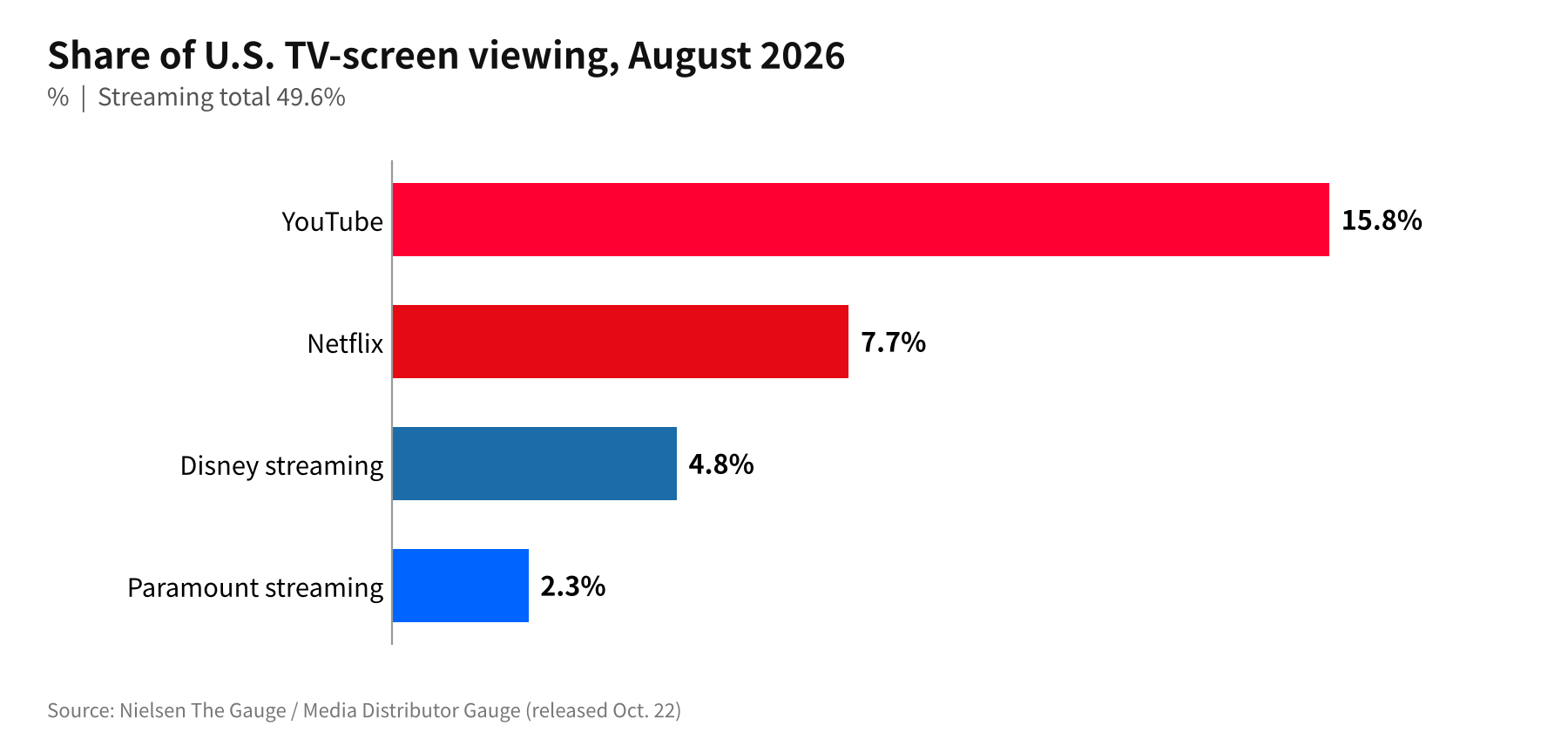
The contest is not confined to phones. In Nielsen's August Gauge, released Oct. 22, YouTube took a record 15.8% of all viewing on U.S. television screens. Total TV usage fell 4.4% and streaming usage 3.2% as the World Cup ended and schools reopened, yet YouTube viewing rose 6%. Netflix was second at 7.7%.
YouTube said last year that the TV had overtaken mobile as the primary device for watching YouTube in the U.S. Instagram launched a TV app on Amazon Fire TV in December 2025 and brought it to Google TV in February; TikTok pulled its TV apps in 2025, though Luminate points to reports that it is again working on a CTV app.
Media multitasking compounds the pressure: viewers often scroll social feeds on a second screen while the TV is on. Social platforms now compete for all video time, user-generated or premium, which is why the streamers are fixing their phone apps first.
Peacock builds a Bravo feed; Disney brings in TikTok creators
What fills the feeds is widening beyond verticalized clips. On June 22 Peacock announced its vertical feed alongside original unscripted Bravo microdramas such as Campus Confidential: Miami and Salon Confessionals, episodes of a minute or two shot for phones. The Hollywood Reporter reported that Peacock has also begun licensing select titles from the microdrama app ReelShort.
Your Bravoverse, launched Oct. 13, sits on the Peacock mobile homepage and serves Bravo moments that adapt in real time to how each fan engages, with an AI avatar of host Andy Cohen as guide. NBCUniversal says it combines AI with its own editorial staff, pitches it to advertisers as a new canvas for reaching Bravo fans, and plans to extend it to living-room devices.
Disney went outside. On Aug. 5, Disney and TikTok announced a deal giving creators licensed access to assets from hundreds of Pixar, Marvel, Star Wars and FX films and series. Videos from creators who opt in run on TikTok and in Verts, with Disney choosing what appears on Disney+; the program starts as a U.S. pilot. The deal gives "creators a bigger stage to share what they've made, and audiences more to discover on Disney+ every day," Asad Ayaz, Disney's chief marketing and brand officer, said in the announcement reported by CBS News. It follows the collapse in March of Disney's arrangement to license characters to OpenAI's Sora, which OpenAI shut down.
The microdrama business itself is growing. Deloitte forecasts global in-app revenue for short-drama apps rising from $3.8 billion in 2025 to $7.8 billion in 2026. Luminate expects Disney+ and Paramount+ to launch original microdramas as well.
Netflix Clips reached Korea in July; TVING has had a Shorts tab since 2024
Korean viewers are seeing the same screens. At its June 10 Asia-Pacific product showcase, Netflix said the new mobile experience, Clips included, would roll out in South Korea (한국) and Japan in July, drawing personalized clips from series, films and live programming, with mood- and genre-themed collections due later this year.
Among Korean services, TVING (티빙) moved first, opening a Shorts tab on Dec. 5, 2024 with roughly one-minute vertical clips of tvN and Mnet dramas, variety shows and KBO baseball highlights, and a button that jumps straight to the full episode. From June 22 this year it ran a 12-week "Comedy Short League" in which comedians competed with 192 short videos.
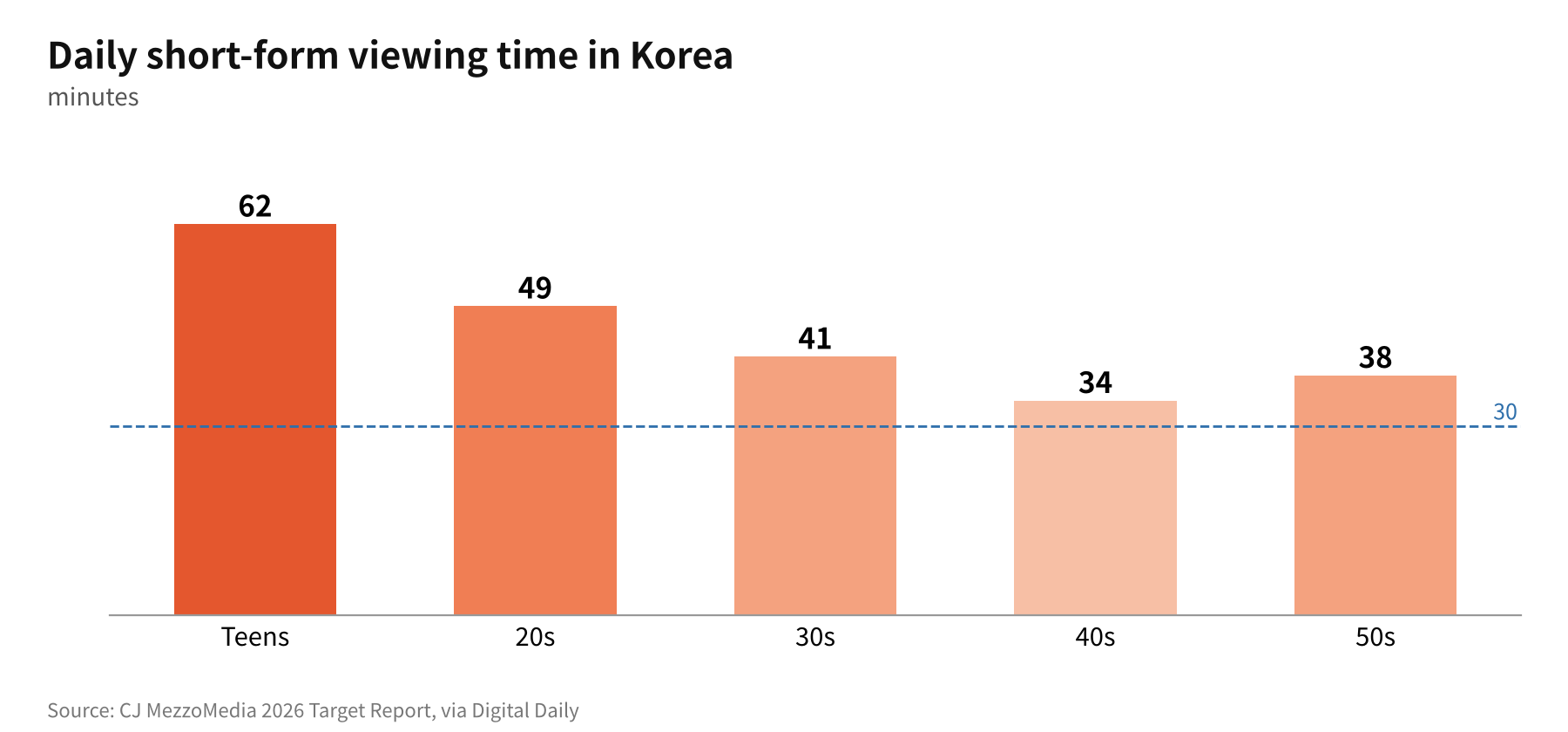
Short-form viewing time in Korea is substantial. CJ MezzoMedia's (CJ메조미디어) 2026 Target Report puts average daily short-form viewing at 62 minutes for teens, 49 for people in their 20s, 41 for their 30s, 34 for their 40s and 38 for their 50s. The figures measure time spent rather than discovery, so they are not directly comparable with Luminate's.
MBC takes its microdrama to DramaBox; what the U.S. model means for Korean broadcasters
Korean broadcasters are making vertical content too. MBC released the microdrama 착한 아내는 끝났다 (roughly, “The Good Wife Is Done”) on June 30 through the global app DramaBox, its second short-form drama after a September 2025 title spun out of its horror-story talk show 심야괴담회. MBC is also preparing at least two mid-form dramas of 10 to 30 minutes an episode for release this half. Kakao Ventures (카카오벤처스) estimated Korea's short-drama market at about 650 billion won ($486 million) in 2024.
In the U.S. examples, whoever owns the app owns the feed. Peacock stocks its feed with its own Bravo archive and commissioned microdramas; Disney opens its IP to creators but routes the output back into Verts. Either way, the discovery, viewing data and ad inventory the clips generate accrue to the feed operator. MBC's microdrama, by contrast, is consumed inside a third-party app, and much of Korean broadcasters' clip output circulates on YouTube channels.
As Netflix and TVING turn scenes from Korean broadcast dramas and variety shows into vertical clips, the discovery traffic those programs generate will build up inside the streamers' apps. That puts two contract terms on the table when broadcasters license shows: the right to cut vertical clips, and access to clip-viewing and full-episode conversion data. Broadcasters sitting on decades of variety and drama archives have the raw material to try a Peacock-style feed in their own apps or on Wavve (웨이브). Disney's TikTok deal points to another option: bringing unlicensed fan edits of broadcast footage inside a licensing framework.
Outlook: ad products still pending; habit is the harder problem
Monetization is early. eMarketer notes that none of the services has confirmed ad inventory inside these feeds; Peacock's pitch of Your Bravoverse to advertisers is the first clear signal. MIDiA Research argues the feeds can become a layer for short-form ads, branded entertainment and creator-led formats.
Luminate sees a bigger challenge in getting audiences into streaming services' mobile apps at all, and then building habits around regular use. Young viewers already discover titles in TikTok, Instagram and YouTube Shorts; a streamer's feed only works once someone opens the app. Luminate's conclusion is that the feeds are about establishing a competitive presence on mobile and owning behaviors consumers already practice on social media, so those viewers can be steered into long-form content and IP.
The feeds are also heading for the TV. Disney has signaled Verts may come to connected TVs, and NBCUniversal plans to bring Your Bravoverse to living-room devices — at the same moment Instagram is putting Reels on TV apps. Nielsen applies a one-time methodology adjustment to the Gauge starting with September data, resetting the YouTube-versus-streamers comparison. The real test of the feeds will come when services disclose how often a clip leads to a full play.