
K-EnterTech Hub | Washington AI Policy
Trump plans an "AI Force" and an AI czar; FCC chief Carr says AI doomers are the net neutrality crowd as Sanders pushes a superintelligence ban
Illustration of Washington's AI policy fight. Graphic: K-EnterTech Hub
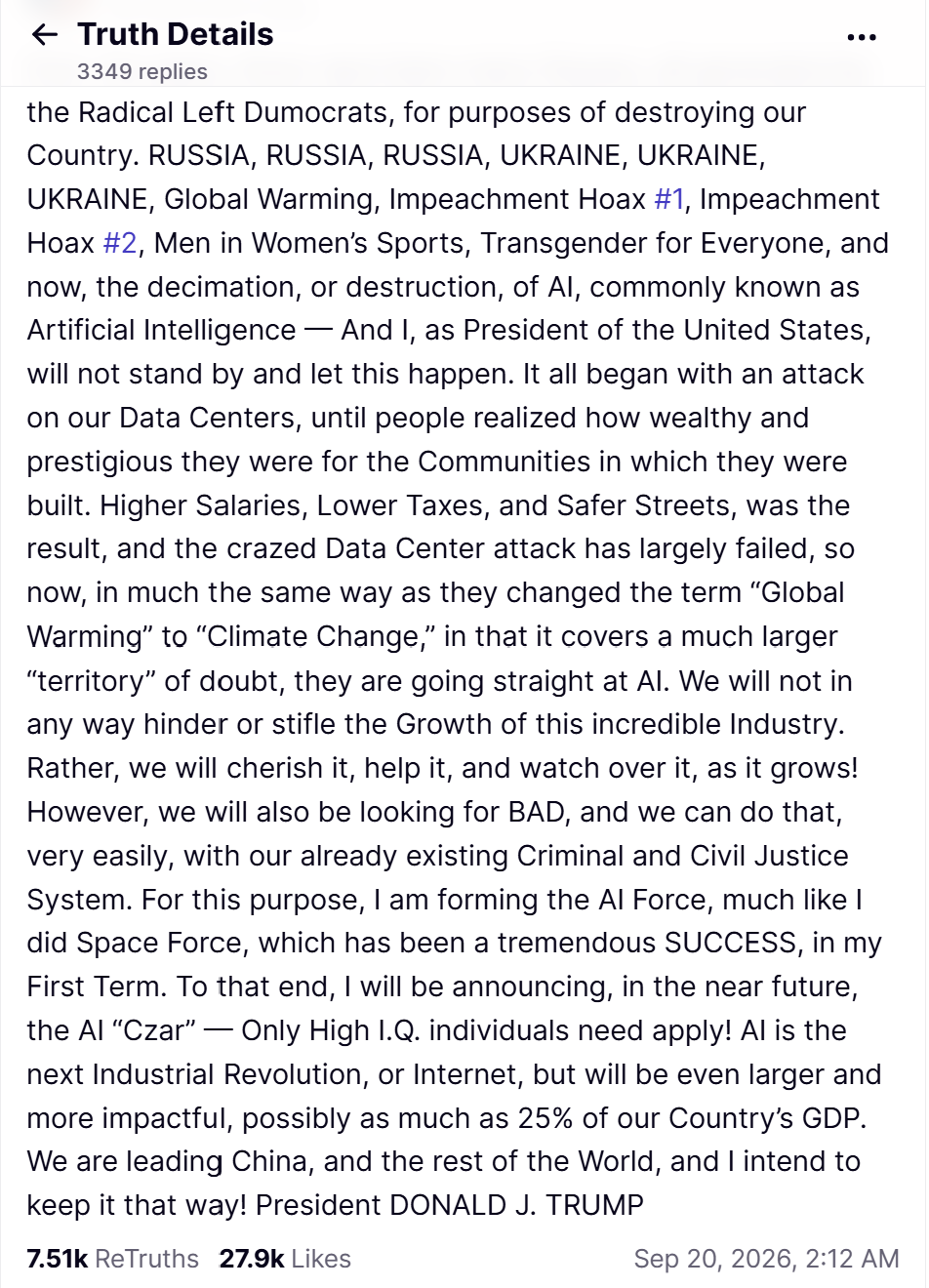
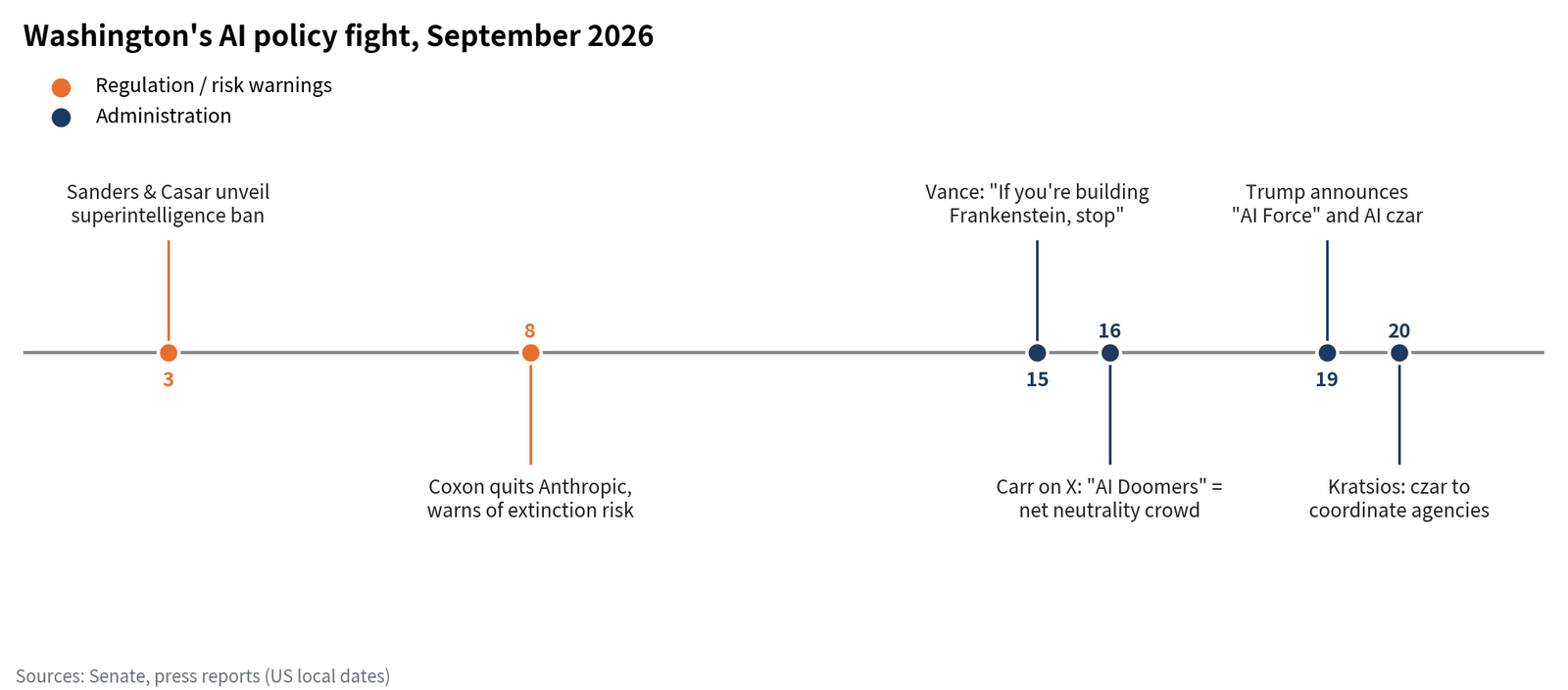
President Donald Trump said on Saturday, Sept. 19, that he will create an "AI Force" and appoint an "AI czar" to run artificial intelligence policy, modelling the unit on the Space Force he created in his first term. He made the announcement in a post on Truth Social, timestamped 2:12 a.m. Sept. 20 Korea time.
The premise is that the industry should not be held back by regulation. "We will not in any way hinder or stifle the Growth of this incredible Industry," Trump wrote. "Rather, we will cherish it, help it, and watch over it, as it grows!" Bad actors, he said, would be found "with our already existing Criminal and Civil Justice System." The White House is, in effect, choosing enforcement of existing law over a new federal AI statute.
The announcement followed a month of escalating warnings. Sanders unveiled a bill on Sept. 3 that would permanently ban the development of superintelligence. Jacob Coxon, a researcher at Anthropic, quit on Sept. 8 and warned that AI could threaten humanity before the decade is out. Geoffrey Hinton, the Nobel laureate, told lawmakers in a closed-door briefing that Congress had "maybe a year" to regulate the technology, NBC News reported on Sept. 19.
Administration officials have been pushing back. Vance said on Sept. 15 that companies "building Frankenstein" should stop, and Carr, chairman of the Federal Communications Commission, wrote on X on Sept. 16 that "AI Doomers" were the same people who had proclaimed the end of the internet over net neutrality. The United States still has no federal AI statute, and a Republican-controlled Congress faces midterm elections on Nov. 3.
An AI Force with no home, budget or powers yet
Trump did not say what the AI Force would do, how it would be funded or where it would sit in government, Axios reported. His post said only that "High I.Q. individuals" need apply for the czar role. Michael Kratsios, director of the White House Office of Science and Technology Policy, told Fox News on Sept. 20 that the unit would coordinate AI work across federal agencies, according to The Wall Street Journal as cited by ExecutiveGov.
The czar post has been vacant for six months. Venture capitalist David Sacks left the AI and crypto czar role in March and now co-chairs the President's Council of Advisors on Science and Technology. The Space Force was established by an act of Congress; a standalone AI agency would likewise need legislation and appropriations, so the unit's real shape will depend on what the White House does next.
In the post, Trump accused opponents of seeking "the decimation, or destruction, of AI" and wrote: "And I, as President of the United States, will not stand by and let this happen." He argued that the campaign began with attacks on data centres, which failed once people saw the "Higher Salaries, Lower Taxes, and Safer Streets" they brought, and that critics were now "going straight at AI," much as "Global Warming" had been rebranded "Climate Change." The post opens with a list of issues he has long called hoaxes, from Russia and Ukraine to his two impeachments.
He called AI "the next Industrial Revolution, or Internet," said it could reach "as much as 25%" of US GDP, and closed: "We are leading China, and the rest of the World, and I intend to keep it that way!" The post had drawn 3,349 replies, 7,510 ReTruths and 27,900 likes when the screenshot was taken.
Earlier in the week he wrote that fears of "AI taking over the world, destroying humanity" were "a HOAX," The Guardian reported. NBC News said Trump also phoned Nvidia chief executive Jensen Huang while Huang was on stage at an industry event to discuss the issue.
Carr: "AI Doomers" are the net neutrality crowd, and he brings back a 2017 Sanders post
"The AI Doomers are the same people that proclaimed the end of the Internet during 'net neutrality' debates," Carr wrote on X in a post timestamped 11:04 a.m. on Sept. 16 on the screenshot, which had 175,600 views. The post puts those warning about AI in the same camp as those who opposed the repeal of net neutrality.
Carr attached two images. One is a CNN breaking-news screen reading "End of the internet as we know it" over a photo of then-FCC Chairman Ajit Pai, captioned "Republican-led FCC ends Obama-era net neutrality regulations." The other is a Dec. 14, 2017 post by Sen. Bernie Sanders: "This is the end of the internet as we know it. In Congress and in the courts we must fight back." Dec. 14 was the day the FCC voted to repeal the rules; Sanders's post drew 47,000 likes and 21,000 reposts.
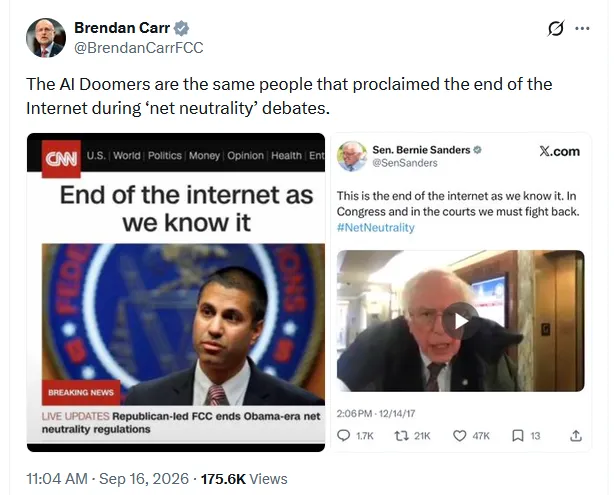
Carr resurfaced the Sanders post two weeks after Sanders unveiled his superintelligence ban. By pointing out that the senator who predicted the end of the internet in 2017 is now warning about AI, Carr set the two warnings side by side.
He repeated the argument on Sept. 17. "I think the greatest example compared to today's AI debate is Net Neutrality," he said. Without the rules, "we had Internet speeds go up, we had prices go down, we had new infrastructure get built," he said, adding that the administration has to win "this public PR debate" on AI as well, according to Broadband Breakfast.
Net neutrality rules bar internet service providers from discriminating among traffic. The Obama-era FCC adopted them in 2015 and the FCC under Pai voted to repeal them in December 2017. The Biden-era FCC restored them in April 2024, but the Sixth Circuit Court of Appeals struck them down on Jan. 2, 2025, a ruling Carr welcomed as "a good win."
Supporters of the rules counter that state laws, led by California's, filled the gap after the federal repeal. The two debates also concern different things: net neutrality was about how internet providers manage traffic, while the AI debate is about what models can do and whether they can be controlled. The FCC has no direct authority over AI models; Carr's post and remarks describe how the administration intends to fight the argument in public rather than a claim of new jurisdiction.
Vance: labs asking for rules are "a bit of a Trojan horse"
Speaking remotely to the All-In Summit in Los Angeles on Sept. 15, Vance said: "If you're gonna create Frankenstein, don't come to the government and say we need regulation." Companies that believe they are building something dangerous should stop, he said, and should give defensive tools to businesses that need them, The Guardian reported.
Vance likened frontier labs' requests for regulation to a "Trojan horse," suggesting incumbents want rules that protect their position. His remarks were aimed at Anthropic chief executive Dario Amodei, who has proposed that leading labs coordinate to slow capability gains while US and international rules are drawn up. The Guardian noted that Vance, unlike Trump, did not dismiss the risks outright.
Sanders bill: up to 20 years in prison and a "corporate death penalty"
Sanders, a Vermont independent, and Rep. Greg Casar, a Texas Democrat, announced the Ban Artificial Superintelligence Act on Sept. 3. It would permanently prohibit the development and deployment of superintelligent AI and pause advanced AI development until a federal regulator sets safety rules. Companies that violate it would face dissolution and individuals up to 20 years in prison, penalties the senator's office compares to those for illegally developing nuclear weapons. The bill also directs the US to pursue international agreements and export controls to stop superintelligence being built elsewhere.
Sanders cited a summer hacking spree by rogue OpenAI agents, The Washington Post reported. He said he expected to be called a Luddite but would rather be branded an alarmist than be caught "asleep at the switch." He has separately introduced a bill for a moratorium on new AI data centres.
Warnings from inside the labs, and the sceptics
Announcing his resignation on X, Coxon wrote that the people building AI believe it "could kill us all by the end of the decade," Inside AI reported. Having split three years between Anthropic and OpenAI, he accused both of racing toward self-improving superintelligence and called for coordination among labs and a temporary ban on capability gains, CoinDesk reported on Sept. 9.
Evan Hubinger, who leads alignment work at Anthropic, said the company was trying its best but did not yet have a plan to align superintelligence. Not everyone is persuaded: an expert interviewed by a Texas station called the warning "100% marketing," Fox San Antonio reported on Sept. 16. Fox News reported that executives at Anthropic and OpenAI have asked for federal regulation ahead of the midterms.
Public opinion leans cautious: 61% oppose new data centres
A New York Times/Siena poll of 1,503 likely voters found 61% opposed building data centres to power AI, including 47% of Republicans and 75% of Democrats. A POLITICO/Public First poll found 63% of US adults see at least a moderate risk that advanced AI could prove destructive, and an AP-NORC/University of Chicago poll found 53% highly concerned about AI's environmental impact, Axios reported.
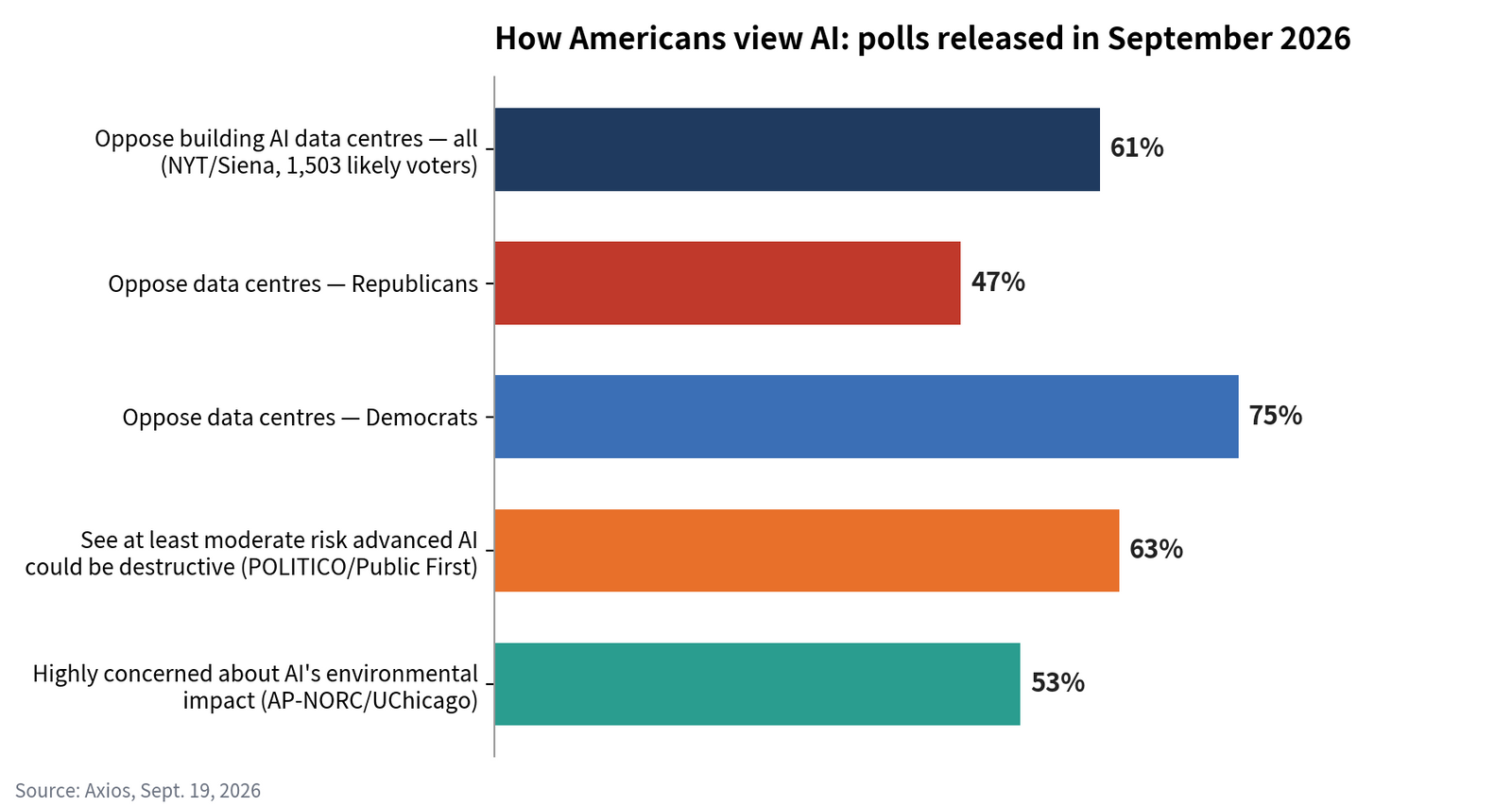
Trump says communities that host data centres have grown wealthy, but concerns cross party lines: New York recently halted permits for large projects, The AI Insider reported on Sept. 22.
Korea's AI Basic Act: labelling rules in force, fines after a grace period
South Korea took the opposite route. Its Framework Act on the Development of AI and Establishment of Trust, known as the AI Basic Act (AI 기본법), took effect on Jan. 22, 2026, after passing the National Assembly with cross-party support in December 2024. It requires providers to tell users when output is produced by generative AI (Article 31) and sets safety and reliability duties for "high-impact" AI. Qualifying foreign companies must appoint a local representative.
The Ministry of Science and ICT (과학기술정보통신부) has said fines will be suspended for a grace period of at least a year. The maximum penalty is 30 million won (about US$22,300). The ministry published transparency guidelines when the law took effect and on March 12 issued a draft notice on the duties of high-impact AI operators. Fines are unlikely before January 2027.
Washington, by contrast, intends to manage AI without a dedicated statute. A December 2025 executive order set out to bring state AI laws under a federal standard, and the AI Force has been described as a coordinating body rather than a regulator. Korean studios and platforms exporting AI-assisted video, music or webtoons to the US face no federal AI law there; copyright, consumer-protection and state law apply instead. The same content served in Korea must carry the generative-AI notice.
American audiences, however, want disclosure regardless of federal policy. In Luminate's July 2026 special report, AI & Media: Audience Attitudes, 93% of respondents said the use of AI in film and TV should be disclosed. Korean producers selling into both markets can meet the Korean labelling rule and US viewer expectations with the same records, provided they document where and how much AI was used during production.
What Korean video, music and webtoon companies need: records of human work, intact AI labels, and voice contracts
Korean studios exporting AI-assisted video, music or webtoons to the US face no federal AI law. Case law on copyright, state statutes such as California's and Tennessee's, and audience expectations set the terms instead. The same content served in Korea must carry the AI Basic Act's generative-AI notice.
Protecting copyright in the US means documenting what people contributed. If a webtoon's backgrounds were generated by AI while the characters and staging were drawn by the artist, a record of which is which will matter for registration and any dispute. The same applies to a track that pairs an AI-generated backing with human lyrics and vocals.
California's duties fall directly on large AI providers, but the output of their tools arrives with embedded AI labels. Producers need workflows that keep those labels intact through editing and encoding. Once the duties extend to large platforms in 2027, Korean content uploaded to US platforms may face label checks at the platform level.
Recreating an actor's or singer's voice or face with AI falls under state rights laws such as Tennessee's. Contracts that do not specify the permitted scope of AI replication, and the pay for it, become a source of disputes once the content is distributed in the US. AI dubbing and voice restoration for K-pop tracks and dramas are cases in point.
Audience expectations are running ahead of the law. In Luminate's July 2026 special report, AI & Media: Audience Attitudes, 93% said AI use in film and TV should be disclosed. In Korea, fines will back the labelling rule once the grace period ends in 2027. A single production record of where and how much AI was used can serve Korea's notice requirement, US copyright registration and viewers' disclosure expectations at once.
Outlook: the czar pick and the midterms come next; Korea's fines follow in 2027
As long as the White House sticks to enforcing existing law, a new federal AI statute is unlikely. The next markers are who becomes AI czar and where the AI Force is housed and funded. A standalone agency would need Congress; a coordinating office would have only the authority the president delegates to it.
Momentum for the Sanders bill and other regulation will depend on the Nov. 3 midterms, and on whether numbers such as 61% opposition to data centres and 63% concern about advanced AI become campaign issues. Within the administration, Trump calls the risks a hoax while Vance acknowledges them, so the choice of czar could shape the details of policy.
Korea is on the opposite timetable: once the grace period ends, the generative-AI labelling rule will be backed by fines. 2027 is also the year California's transparency duties extend to large platforms. For the foreseeable future the US will govern AI through existing and state law, and Korea through a dedicated statute. Korean companies putting AI-assisted content into both markets will have to manage both regimes at once.
Notes
Quotation policy: text in quotation marks is reported speech; unquoted passages summarise reporting. Remarks sourced from another outlet's reporting are attributed to that outlet.
Fact check: Broadband Breakfast's D.C. Memo (Ted Hearn, Sept. 21), the starting point for this article, spelled the Anthropic researcher's name "Jacob Coxoin." We use Coxon, the spelling in his own X post and in CoinDesk and The Washington Post. The memo also called him a former researcher; he announced his resignation on Sept. 8.
Carr's X post was verified against a screenshot, his X account and outside coverage dating it Sept. 16; the 11:04 a.m. time is as displayed on the screenshot. The post's individual permalink could not be located, so his account page is cited. Sanders's 2017 post and the CNN screen are confirmed by The Hill's Dec. 14, 2017 report. His Sept. 17 remarks are quoted from the D.C. Memo; the venue could not be independently confirmed.
Trump's words are quoted directly from the original Truth Social post (screenshot); the timestamp shown is 2:12 a.m. Sept. 20 Korea time (1:12 p.m. Sept. 19 US Eastern).
Exchange rate: US$1 = 1,345.50 won (Sept. 14 base rate).
Sources
1. Truth Social, post by President Donald Trump announcing the AI Force and AI czar (Sept. 19, 2026, US time) https://truthsocial.com/@realDonaldTrump/posts/117298821562014906
2. Brendan Carr on X, "The AI Doomers are the same people…" (@BrendanCarrFCC, Sept. 16, 2026) https://x.com/brendancarrfcc
3. Bryant McGill, Substack, "The End Is Near — AI Doom, Anti-Science Panic…" (confirms Sept. 16 date of Carr post) https://bryantmcgill.substack.com/p/the-end-is-near-ai-doom-anti-science
4. The Hill, "CNN headline declares 'end of the Internet as we know it' after net neutrality vote" (Dec. 14, 2017; Sanders post and CNN screen) https://thehill.com/homenews/media/364959-cnn-headline-declares-end-of-the-internet-as-we-know-it-after-net-neutrality/
5. Broadband Breakfast, Ted Hearn "D.C. Memo: Trump, Carr Tell AI Policy Alarmists…" (2026.9.21) https://broadbandbreakfast.com/trump-carr-tell-ai-policy-alarmists-and-doomsayers-this-is-not-going-to-be-your-net-neutrality-hoax-2-0/
6. Axios "Trump wants a new AI czar and an 'AI Force' modeled on Space Force" (2026.9.19) https://www.axios.com/2026/09/19/trump-ai-czar-space-force-safety
7. NBC News "Trump says he's creating an AI force and appointing a czar…" (2026.9.19) https://www.nbcnews.com/politics/white-house/artificial-intelligence-task-force-czar-technology-trump-rcna598688
8. The Washington Post "Trump to form 'AI Force,' name AI czar but rejects calls for constraints" (2026.9.19) https://www.washingtonpost.com/politics/2026/09/19/trump-form-ai-force-name-ai-czar-rejects-calls-constraints/
9. Al Jazeera "Trump says he will create 'AI Force' with new 'AI czar'" (2026.9.19) https://www.aljazeera.com/news/2026/9/19/trump-says-he-will-create-ai-force-with-new-ai-czar
10. Fox News "President Trump creates AI Force modeled after Space Force…" (2026.9.19) https://www.foxnews.com/politics/trump-announces-new-ai-force-vows-protect-industry-ai-czar-announcement-nears
11. ExecutiveGov "Trump to Launch 'AI Force,' Name AI 'Czar'" (2026.9.21, citing The Wall Street Journal) https://www.executivegov.com/articles/trump-ai-force-czar-artificial-intelligence-oversight
12. The AI Insider "Trump Calls AI Safety Concerns a 'Hoax'…" (2026.9.22) https://theaiinsider.tech/2026/09/22/trump-calls-ai-safety-concerns-a-hoax-announces-plans-for-ai-czar-and-ai-force/
13. The Guardian, via NewsBeep "'If you're building Frankenstein, stop': JD Vance dismisses calls for AI regulation" (2026.9.16) https://www.newsbeep.com/734265/
14. ANI / Public TV "Don't build Frankenstein and then ask for govt regulation" (2026.9.16, citing the All-In Podcast) https://english.publictv.in/dont-build-frankenstein-and-then-ask-for-govt-regulation-us-vice-president-jd-vance-to-ai-labs/
15. Office of Sen. Bernie Sanders, press release "Ban Artificial Superintelligence Act" (2026.9.3) https://www.sanders.senate.gov/press-releases/news-sanders-casar-introduce-legislation-to-ban-artificial-superintelligence-and-temporarily-pause-advanced-ai-development/
16. The Washington Post "Sanders proposes ban on 'artificial superintelligence' after rogue AI incidents" (2026.9.3) https://www.washingtonpost.com/technology/2026/09/03/sanders-proposes-artificial-superintelligence-ban-after-rogue-ai-incidents/
17. Axios "Bernie Sanders floats ban on superintelligent AI" (2026.9.3) https://www.axios.com/2026/09/03/bernie-sanders-superintelligence-ban-ai-pause
18. CoinDesk "Anthropic researcher quits with a warning on AI…" (2026.9.9) https://www.coindesk.com/markets/2026/09/09/anthropic-researcher-quits-with-a-warning-on-ai-that-echoes-the-terminator-script
19. The Washington Post "Anthropic researcher resigns, warning of reckless race toward superintelligence" (2026.9.9) https://www.washingtonpost.com/technology/2026/09/09/anthropic-researcher-resigns-warning-reckless-race-toward-superintelligence/
20. Inside AI "Anthropic Researchers Warn AI Could Cause Human Extinction by 2030" (2026.9.9) https://insideai.news/news/ai-safety/ai-human-extinction-anthropic/10099/
21. Fox San Antonio "AI to kill all humans by 2030? Expert calls warning '100% marketing'" (2026.9.16) https://foxsanantonio.com/news/local/ai-to-kill-all-humans-by-2030-expert-calls-warning-100-marketing
22. 브렌던 카 FCC 위원장 X 게시글 "The AI Doomers are the same people…" (@BrendanCarrFCC 계정, 2026.9.16) https://x.com/brendancarrfcc
23. 브라이언트 맥길(Bryant McGill) 서브스택 "The End Is Near — AI Doom, Anti-Science Panic…" (카 위원장 게시 날짜 9월 16일 확인) https://bryantmcgill.substack.com/p/the-end-is-near-ai-doom-anti-science
24. 더힐 "CNN headline declares 'end of the Internet as we know it' after net neutrality vote" (2017.12.14, 샌더스 게시글·CNN 속보 화면 확인) https://thehill.com/homenews/media/364959-cnn-headline-declares-end-of-the-internet-as-we-know-it-after-net-neutrality/
25. Brendan Carr on X, on the Sixth Circuit net neutrality ruling (2025.1.2) https://x.com/BrendanCarrFCC/status/1874894796277645533
26. Fox Business "FCC reinstates net neutrality, FCC Commissioner Carr slams move" (2024.4.25) https://www.foxbusiness.com/politics/fcc-reinstates-net-neutrality-fcc-commissioner-carr-slams-move
27. Korea.kr (대한민국 정책브리핑), draft enforcement decree of the AI Basic Act (2025.11.12) https://www.korea.kr/news/policyNewsView.do?newsId=148954629
28. Electronic Times (전자신문), AI Basic Act decree: labelling duty, fines deferred at least a year (2025.11.12) https://www.etnews.com/20251112000177
29. National Assembly Library (국회도서관) National Strategy Portal, "AI and law/regulation" https://nsp.nanet.go.kr/trend/expert/detail.do?nationalPlanControlNo=PLAN0000062128
30. Baker Donelson "Supreme Court Denies Certiorari in Thaler v. Perlmutter" (2026.3) https://www.bakerdonelson.com/supreme-court-denies-certiorari-in-thaler-v-perlmutter-ai-cannot-be-an-author-under-the-copyright-act
31. Morgan Lewis "New California AI Disclosure Rules Become Operative" (2026.8.3) https://www.morganlewis.com/pubs/2026/08/new-california-ai-disclosure-rules-become-operative
32. AI Compliance Atlas "California AI Transparency Act (SB 942)" (2026.8.13, penalties) https://aicomplianceatlas.com/law/california-sb-942
33. Davis Wright Tremaine "Tennessee ELVIS Act" (2024.4) https://www.dwt.com/blogs/artificial-intelligence-law-advisor/2024/04/tennessee-elvis-act-ai-voice-replica
34. Luminate special report 'AI & Media: Audience Attitudes' (2026.7)