

MediaGPT · K-EnterTech Hub
AI content deals reach 299, 2.8 times the lawsuits, as the contract market outruns the courts
Google tests payment by answer contribution; Microsoft builds a content marketplace
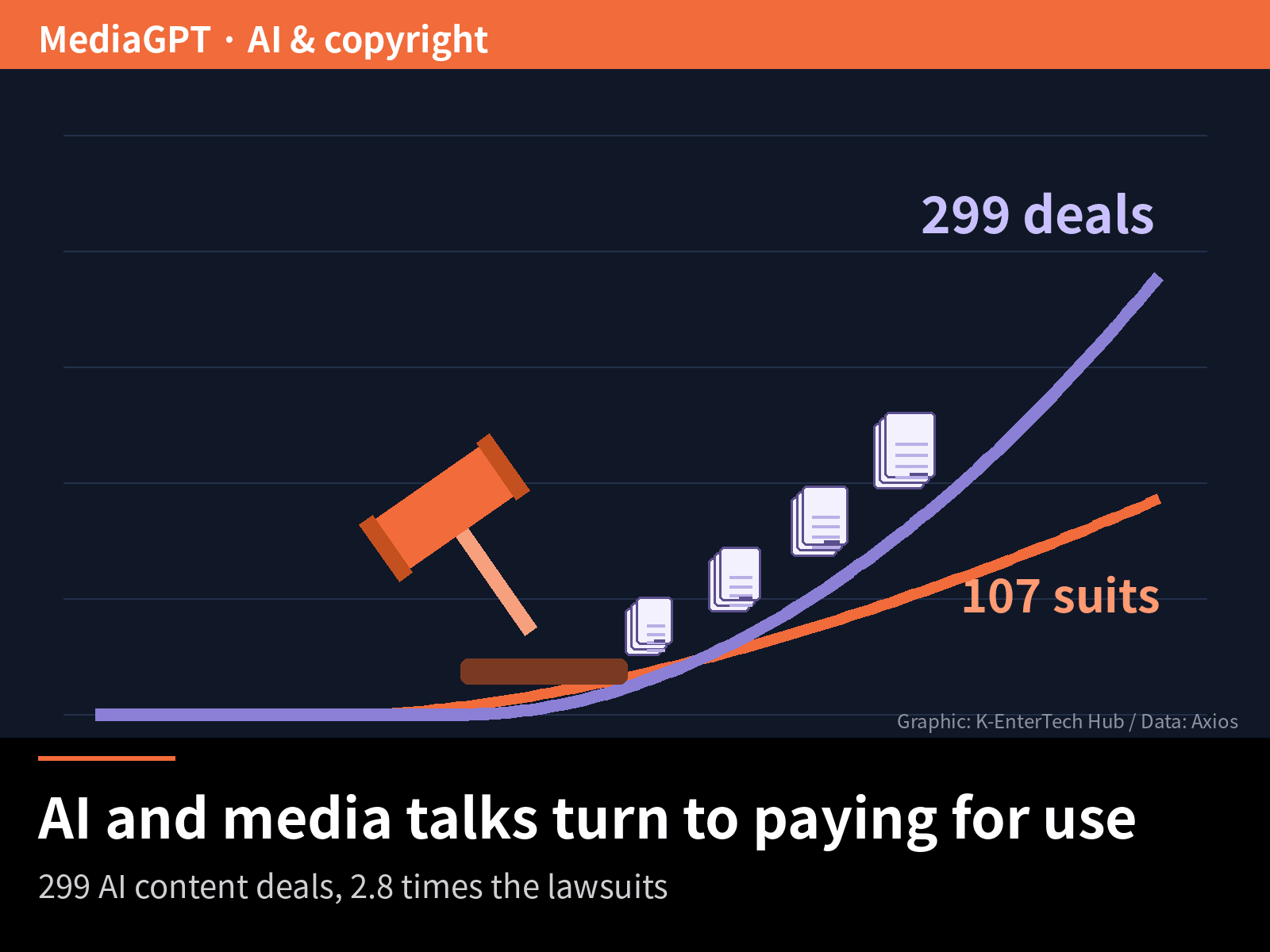
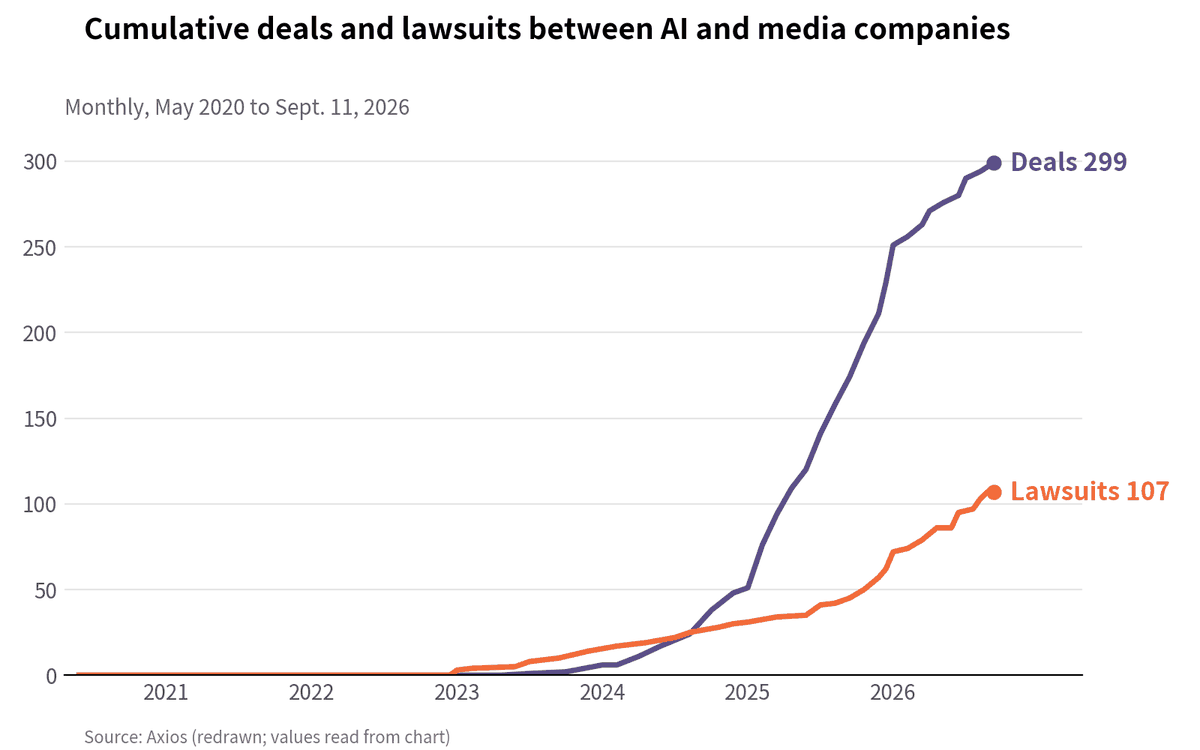
Copyright disputes between artificial intelligence companies and the media industry are producing a new market outside the courtroom. AI companies have signed at least 299 deals with media companies since 2023, about 2.8 times the 107 lawsuits filed over the same period, according to an Axios analysis published Sept. 19. While courts weigh whether AI use of content is lawful, companies are negotiating the scope of use and the terms of payment first.
More deals do not mean the copyright fight is over. Only some cases have produced major decisions, and others could take years to move through district and appeals courts, Axios noted. Media companies have an incentive to lock in revenue before rulings arrive; AI companies want access to content and a lower risk of further litigation.
The deal count says nothing on its own about transaction value, what rights holders actually earn or how content may be used. A single partnership with one outlet and a single contract covering a major label's entire catalog do not carry the same economic weight.
News signs outlet by outlet; music and books negotiate in bulk
News is where the deal market has moved furthest, according to Axios. The growth has come not only from large developers such as Anthropic but also from smaller players such as ProRata. The rise in news deals cannot be read as large AI companies collectively agreeing to a payment system.
Music and book publishing have seen more lawsuits over the past two years, and their ratio of deals to suits is lower than in news. Axios pointed to industry structure: major labels and publishing houses represent thousands of artists and authors, while news copyrights are largely spread across individual outlets. Industries that pool rights for negotiation and those dominated by outlet-level contracts accumulate deals in different ways.
Gaming has fewer AI deals than news, music or entertainment, but partnerships to co-develop production technology are emerging. Electronic Arts and Stability AI said they will jointly develop AI models, tools and workflows for game creators, including support for surface-texture creation and 3D pre-visualization. Technology partnerships of this kind are distinct from contracts that sell existing content for AI training.
Warner Music and Suno settle and partner in one agreement
Warner Music Group announced a partnership with AI music generator Suno on Nov. 25, 2025, and said the companies' existing litigation would be settled. The resolution of the dispute and the start of a new business relationship came in a single agreement.
The announcement set out plans to launch new licensed models in 2026 and replace the existing ones. It also introduced an opt-in system under which artists and songwriters decide whether their names, likenesses, voices and compositions can be used in new AI music. The talks covered not just payment for past use but how creators' assets will be used going forward.
A settlement between two companies is not a court ruling on the legality of AI training in general. Usage terms set by commercial agreements and the scope of rights set by courts are separate matters. As deals multiply, what matters is less whether a contract exists than what material is used, for what purpose, and how much creators are paid and how.
From training data to content used in answers
Deal-making is widening from data used to train models to content that AI systems retrieve at the moment they generate answers. Under retrieval arrangements, payment attaches to articles and other material that AI tools search and cite as the basis for a response. That makes verifying which content was actually used, and settling payment for it, more important than a one-time sale of an article archive.
Google is running an "AI contribution pilot" with some publishers, testing payment when content makes a meaningful contribution to answers in Gemini, AI Overviews and AI Mode, Digiday reported. Google described it as an early experiment in how to reward high-quality content.
The pilot is not a per-access or per-query fee. Digiday reported that payment is based on the value content provides rather than on simple usage counts, and that participants see monthly earnings in Search Console without a full explanation of how they are calculated. A commitment to pay and a rights holder's ability to verify the payout are separate questions.
Microsoft introduced its Publisher Content Marketplace (PCM) in February. Publishers set terms of use, AI developers find and license content to ground their answers, and usage reporting shows the value of that use.
Microsoft said it designed the marketplace with the Associated Press, Condé Nast, Hearst and Vox Media, among others, and after testing it in Copilot began onboarding demand-side partners including Yahoo. What the company announced was an expansion of a pilot, not a fully operating market. A usage-reporting feature does not mean every participant is earning satisfactory revenue.
Measurement and settlement matter more than price
Companies such as Snowflake and TollBit are building tools to help publishers price content for retrieval, Axios reported. TollBit's co-founders noted that programs performing legitimate services, such as AI agents making reservations, can be blocked by anti-scraping controls. Opening everything or blocking everything does not distinguish between different purposes of use.
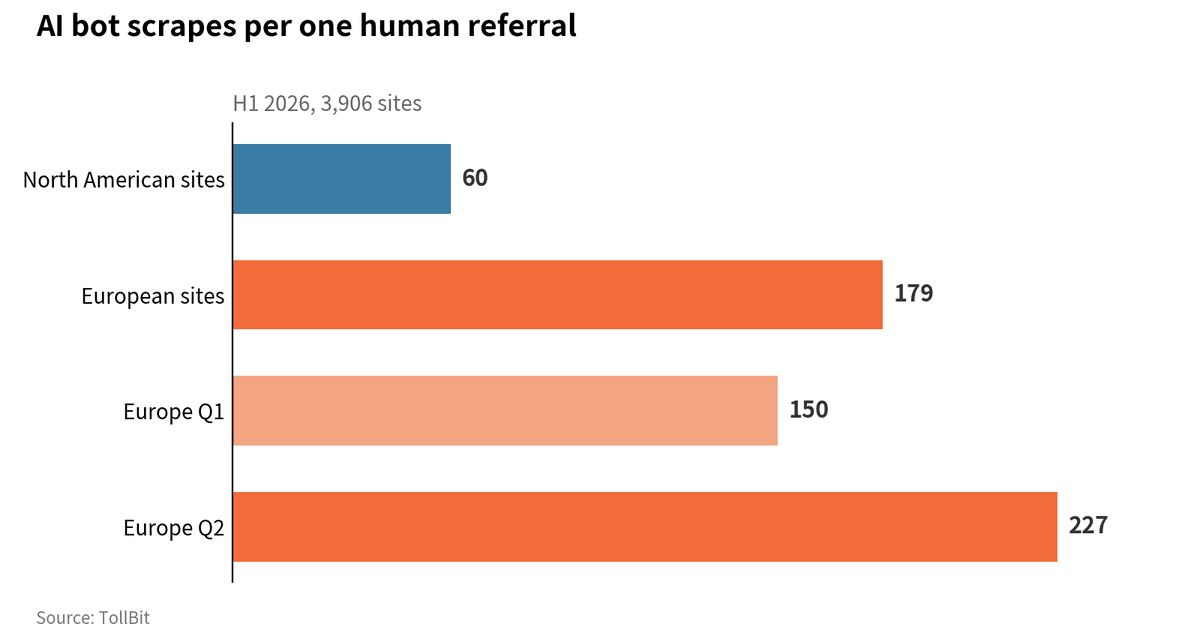
TollBit's analysis of 3,906 sites in the first half of 2026 found that European sites logged 179 AI-bot scrapes for every human visit referred by an AI app, against about 60 to 1 in North America. The European ratio widened from 150 to 1 in the first quarter to 227 to 1 in the second. With scraping rising and referrals flat, usage records of this kind are what publishers can bring to the table.
The practical work for news organizations lies in contract terms. Contracts need to separate collection of content, model training, retrieval during answer generation and retransmission of original text, and to define what counts as a single use. Parties also need to agree on scope and verifiable records for cases such as storing an article for repeated use or passing it to another AI provider.
Korean broadcasters' suits against Naver and OpenAI under way
In Korea, questions of rights and payment have already reached the courts. KBS, MBC and SBS sued Naver (네이버) in January 2025 over the use of news for AI training; the case reached its seventh hearing on Sept. 8. On Feb. 23, 2026, the three broadcasters sued OpenAI seeking an end to copyright infringement and damages. The Korean Broadcasters Association (한국방송협회) said the broadcasters allege their news was used without permission to train ChatGPT. Those are the grounds of the suit; no infringement has been established.
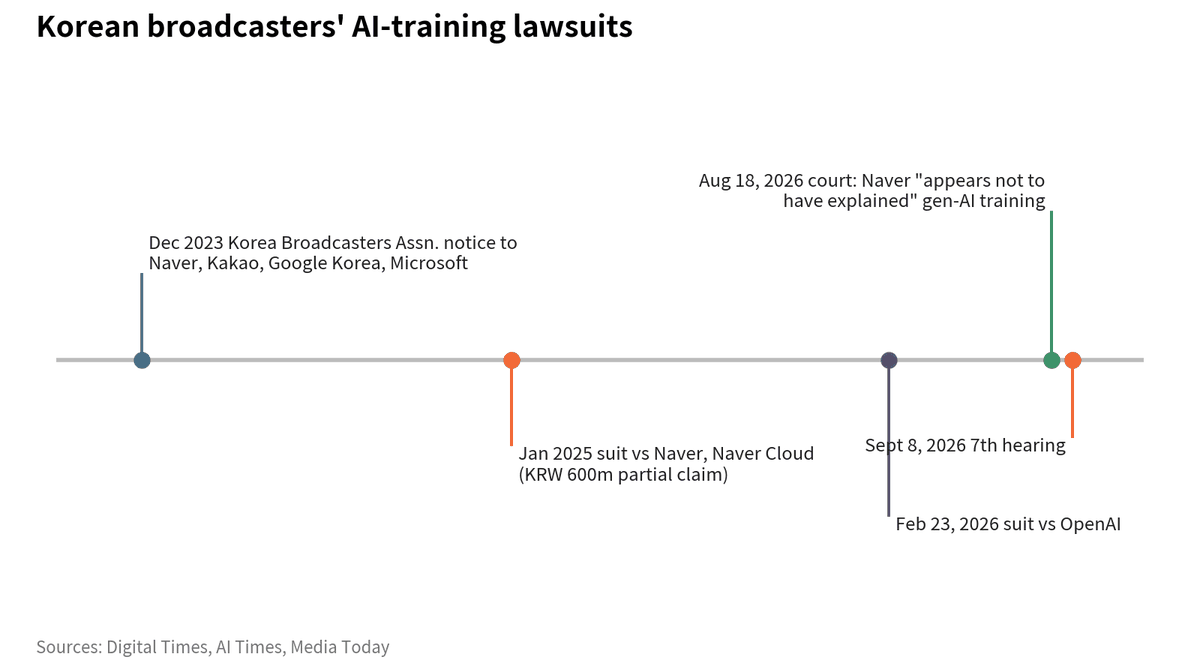
The broadcasters' AI-training suit against Naver reached its seventh hearing in September. Sources: Digital Times, AI Times, Media Today
Korean news organizations do not have to choose between litigation and licensing. Contesting liability for past use and designing terms for future use can proceed together. Training fees, payment for retrieval in answers, attribution and links to original articles, and the scope of usage data provided can each be treated as separate negotiating items.
Conclusion: verifiable usage records over deal counts
The number of signed contracts alone is a poor measure of the AI content market. News organizations and creators need to be able to see where and how much their content was used, and to be paid on that basis. With deals growing ahead of court rulings, what media companies need to secure is not a larger deal count but verifiable usage records and sustainable settlement terms.
Sources
1. Kerry Flynn and Sara Fischer, "Media AI deals dramatically outpace lawsuits," Axios, Sept. 19, 2026 — https://www.axios.com/media-trends-membership/2026/09/19/media-ai-deals-dramatically-outpace-lawsuits
2. Electronic Arts, "EA and Stability AI partner to empower artists, designers, and developers," October 2025 — https://www.ea.com/news/ea-partners-with-stability-ai
3. Warner Music Group, "Warner Music Group and Suno forge groundbreaking partnership," Nov. 25, 2025 — https://investors.wmg.com/news-events/news-releases/news-details/2025/WARNER-MUSIC-GROUP-AND-SUNO-FORGE-GROUNDBREAKING-PARTNERSHIP/default.aspx
4. Jessica Davies and Sara Guaglione, "Google rolls out pay-per-value AI licensing program to publishers," Digiday, Sept. 14, 2026 — https://digiday.com/media/google-rolls-out-pay-value-ai-licensing-program-to-publishers/
5. Microsoft Advertising, "Building toward a sustainable content economy for the agentic web," February 2026 — https://about.ads.microsoft.com/en/blog/post/february-2026/building-toward-a-sustainable-content-economy-for-the-agentic-web
6. Resultsense (summary of TollBit report), Aug. 14, 2026 — https://www.resultsense.com/news/2026-08-14-tollbit-european-publisher-scraping/
7. Digital Times (디지털타임스), Jan. 14, 2025 — https://www.dt.co.kr/article/11639426
8. Media Today (미디어오늘), Aug. 18, 2026 — https://www.mediatoday.co.kr/news/articleView.html?idxno=336548
9. AI Times (AI타임스), Feb. 23, 2026 — https://www.aitimes.com/news/articleView.html?idxno=207120
Note: The first chart redraws Axios' curves from visual readings; only the end values (299 deals, 107 lawsuits) are Axios figures.