

FUS TV Measurement Reform Puts Trading Trust at the Center
CIMM proposes common currency requirements as fragmented certification and methodology changes complicate advertising contracts
US television advertising is reopening a question that sits between audience measurement and commercial negotiation: when is an audience number reliable enough to determine a price? The Coalition for Innovative Media Measurement is seeking to form a Strong Foundations Implementation Task Force to strengthen existing accreditation and establish provider-neutral currency requirements.
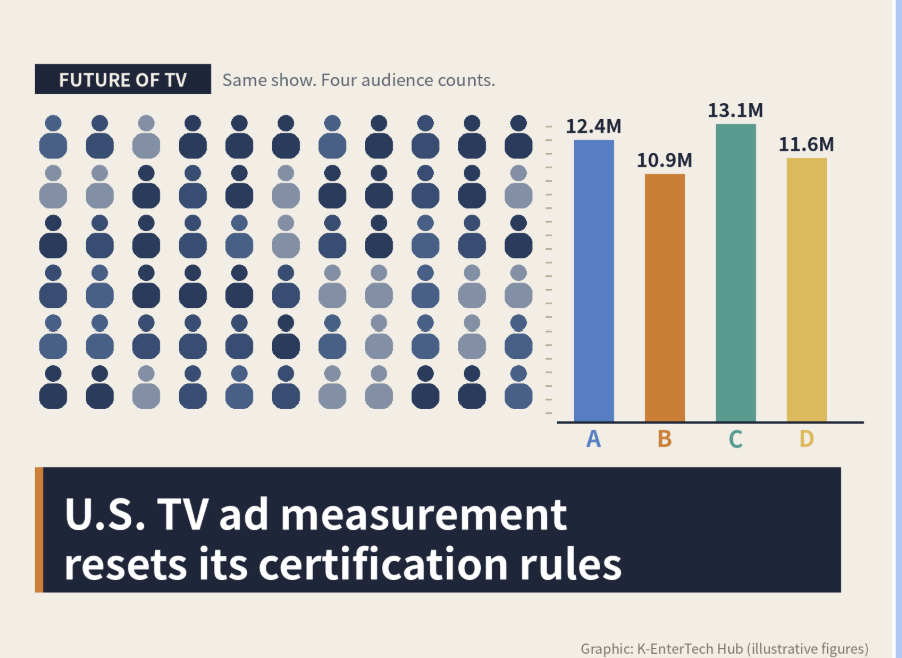
A currency is the measurement metric buyers and sellers agree to use when pricing inventory and setting audience guarantees. As multiple providers compete, a lack of shared verification can turn differences in methodology into differences in how the same viewing is valued.
According to Digiday, CIMM managing director Jon Watts outlined the initiative at the September summit. The US already has the Media Rating Council’s service accreditation process and the US Joint Industry Committee’s currency certification program. The difficulty is that their coverage and provider participation do not align. VideoAmp and Nielsen One withdrew from the MRC accreditation process, while Nielsen has twice declined to submit for JIC certification.
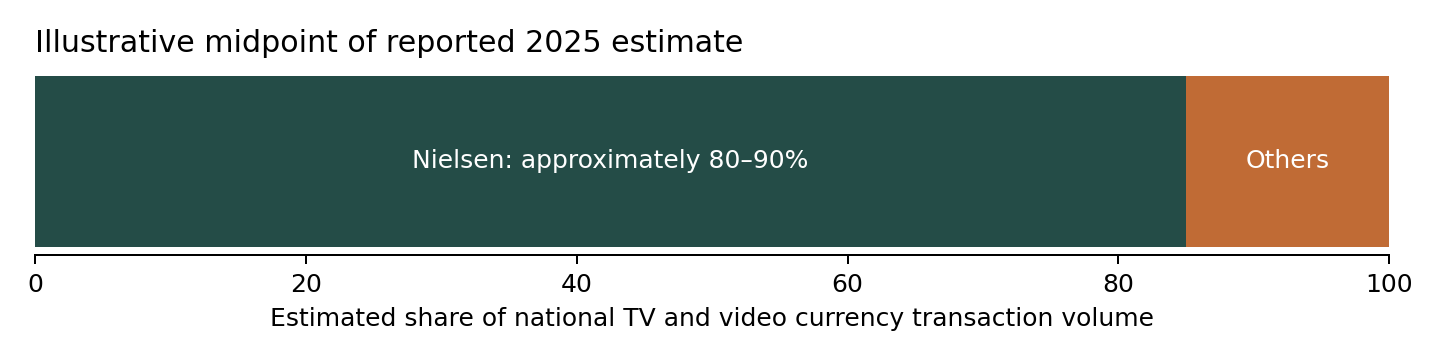
Nielsen nevertheless remains deeply embedded in advertising transactions. MediaPost cited a 2025 estimate from The Current placing Nielsen’s share of national TV and video currency transaction volume at roughly 80–90%. That is an estimate from an earlier period, not a confirmed 2026 market share. Its continuing role illustrates the distance between certification participation and commercial adoption.
Methodology changes have added another source of uncertainty. Nielsen implemented seven enhancements at the end of August, including changes to co-viewing and household demographic assignment. Buyers questioned whether they had enough time and data to separate the effects. Common requirements therefore need to address both measurement quality and the process for comparing numbers before and after a change.
MRC Accreditation and JIC Certification Answer Different Questions
MediaPost reported that VideoAmp and Nielsen One were removed from the MRC’s in-process accreditation list in July. The reported status descriptions referred to an intention not to continue the audit and withdrawal of the service, respectively. A withdrawal by Nielsen One should not be presented as a loss of accreditation across every Nielsen product. Accreditation must be checked at the level of the particular service and its scope.
The JIC certified Comscore and VideoAmp in 2024 and has now recertified Comscore, iSpot and VideoAmp as national currencies for 2026–2028. Its evaluation covered 39 data questions, 672 tests across transaction types and estimation methods, and 150 million telecast observations across more than 680 networks. The assessment addressed transactability across total households, advanced audiences and personified demographics. It does not constitute an interchangeable substitute for every MRC audit.
JIC members include sellers such as Paramount Skydance, Fox, NBCUniversal, Warner Bros. Discovery and TelevisaUnivision, alongside agencies including Dentsu, WPP, Omnicom Media Group and Publicis Media. Their joint participation moves the question of trading confidence beyond separate negotiations between each measurement provider and its customers.
Source: MediaPost, Digiday and The Measure. The proposed task force is not an established replacement accreditation body.
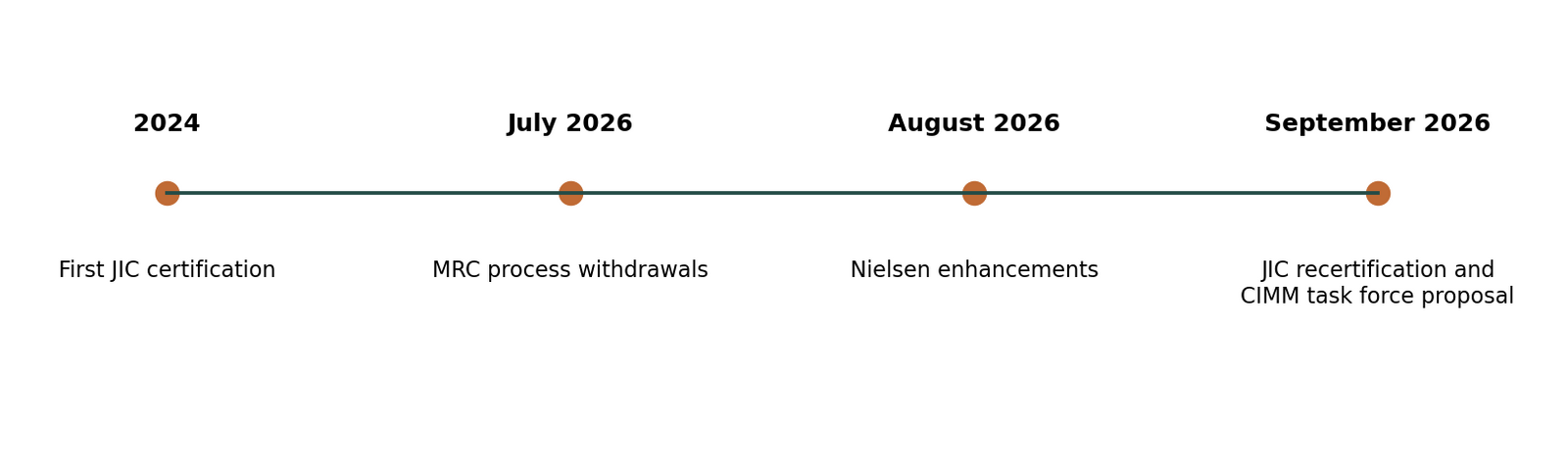
Key developments in US TV currency verification. Sources: StreamTV Insider, MediaPost, PPC Land and Digiday.
Alternative Currencies Are Advancing Alongside Nielsen
Disney’s Jamie Power described Nielsen as a baseline at the summit, according to Digiday. The description helps explain why adding an alternative provider does not immediately displace the incumbent. Demonstrating measurement capability and persuading advertisers to shift budgets and contracts are separate challenges.
Some transactions already use other currencies. Versant-owned CNBC uses Cogent, while Initiative uses VideoAmp for audience buying for many clients, Digiday reported. Initiative chief investment officer Tim Hill also expected to keep using Nielsen. The emerging market is consequently a mix of providers selected for different customers and transaction purposes, rather than an immediate wholesale replacement.
Data sources also explain why providers produce different numbers. VideoAmp combines smart-TV automatic content recognition, pay-TV set-top-box data and identity graphs. iSpot uses ACR and advertising-content fingerprinting. Comscore draws on set-top boxes, ACR and census panels. Differences in the observed devices and households, and in the conversion of device activity into individual viewing, can change the result.
Sources: MediaPost and the supplied source article. This table does not describe the accreditation status of every service offered by each company.
Publicis Media research executive Helen Katz argued that the next stage of measurement maturity depends on connecting and harmonizing datasets, according to Digiday. For buyers and sellers, the practical requirement is a way to understand differences among measures and compare them on defined terms.
Methodology Changes Need a Commercial Transition Process
After moving from panel-focused measurement to a Big Data + Panel currency, Nielsen revised household universe estimates and other elements in 2026. PPC Land reported that the seven enhancements included co-viewing, lag-adjusted DASH household estimates, demographic assignment, unified weighting, Hispanic estimation, ACR tuning calibration and household grouping for one data supplier. The report also described advance impact data for clients and MRC oversight of timing and content. Nielsen stated that improving accuracy did not guarantee higher ratings for every customer.
Source: PPC Land. These are the seven changes described in the supplied reporting.
The buying-side concern was the ability to evaluate the transition. Omnicom Media Group video currency head Mariel Estrada said buyers lacked sufficient time and data, according to Digiday. When several adjustments arrive together, it becomes harder to determine whether audience counts changed because viewing behavior changed or because the model did. That distinction also affects target reach and campaign-efficiency assessments.
Sellers face the same uncertainty in revenue terms. TelevisaUnivision’s Dan Riess described swings in the Nielsen baseline following methodology adjustments. Audience guarantees can trigger further negotiations, including makegood inventory, when delivery falls short. Advance notice, impact data and a period of parallel comparison are therefore commercial safeguards as well as technical practices.
The Task Force Will Be Judged by Adoption of Common Requirements
The Measure reported that the proposed task force would coordinate and strengthen verification across organizations including MRC, JIC and IAB. Digiday described participant recruitment as an early-stage effort. Watts’ 12–18 month window was a commitment to dissolve the group if meaningful progress failed to emerge; it was not a formal deadline for completing certification or achieving industry-wide implementation.
CIMM has also pursued national measurement comparisons, local TV currency guidance and work on children’s media measurement. The new initiative extends the discussion from evaluating individual solutions to agreeing on verification requirements. Relevant outcomes would include disclosure of service-specific scope, comparable change-impact analysis and actual adoption of the requirements by trading partners.
Korea Must Distinguish Advertising Measurement from Regulatory Share
Korea starts from a different position. A February 2025 KCA publication, in an article by Sungkyunkwan University visiting professor Yu Geon-sik, described TNMS as having stopped ratings research in 2024. That source listed Nielsen Korea’s live-broadcast panels as 550 households in Seoul, 1,345 in the metropolitan area and 3,134 nationwide. These are figures from the publication’s reference period, not independently verified current panel sizes.
Multiple providers did not previously yield identical ratings. Media Today reported MBC’s audience rating for a 2022 presidential debate as 5.0% under Nielsen and 3.9% under TNMS. Adding another provider alone does not eliminate differences. Buyers and sellers need to understand sampling, viewing coverage and person-level assignment.
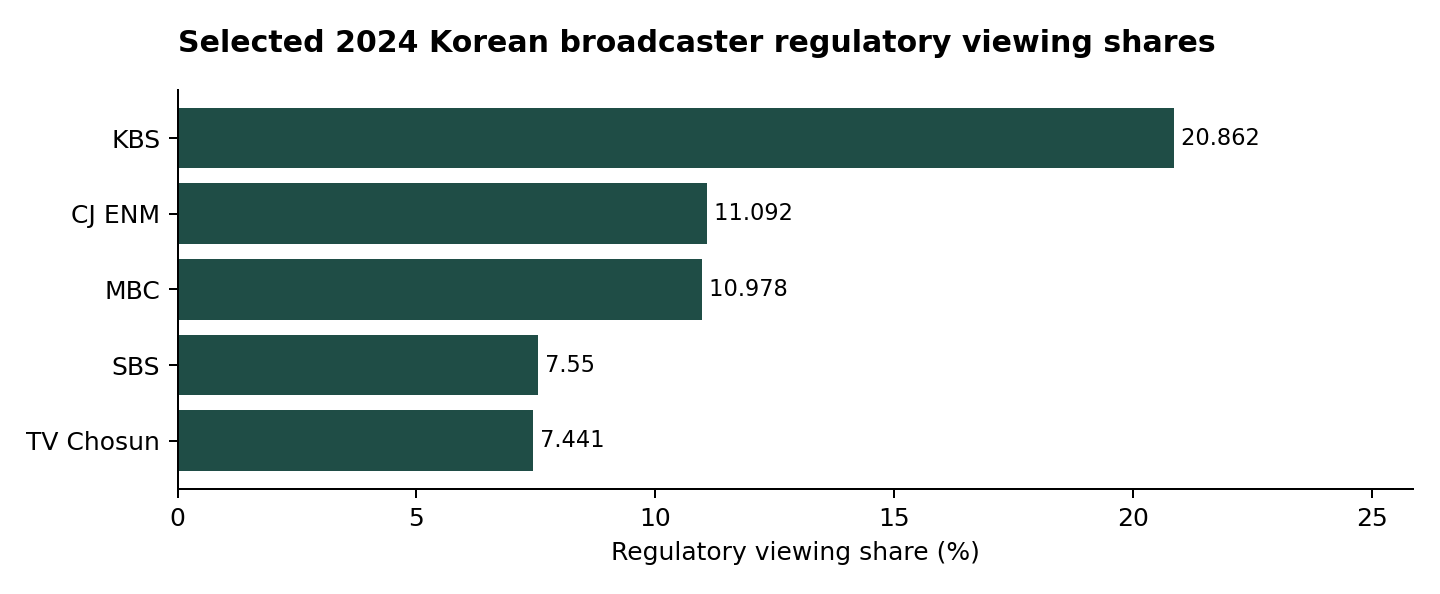
The supplied article, citing Digital Daily, lists 2024 broadcaster viewing shares as KBS 20.862%, CJ ENM 11.092%, MBC 10.978%, SBS 7.55% and TV Chosun 7.441%. These regulatory measures include affiliated entities and newspaper-subscription conversion. They serve ownership-control purposes under broadcasting law and should not be confused with advertising ratings or currencies. A review of how new media enter regulatory calculations is a separate exercise from changing ad trading metrics.
.
Shrinking Broadcast Ad Revenue Raises the Stakes for Integrated Measurement
The Journalists Association of Korea reported a survey by the Korea Communications and Media Commission and KOBACO showing that total domestic advertising expenditure rose 3.5% to KRW 17.1263 trillion in 2024. Online advertising accounted for KRW 10.1011 trillion, or 59% of the total. Broadcast advertising fell 5% to KRW 3.2191 trillion. The KRW 1.2317 trillion terrestrial figure covered television, radio and DMB together, not television alone. The survey’s KRW 2.7744 trillion broadcast figure for 2025 was an estimate and should not be presented as final expenditure.
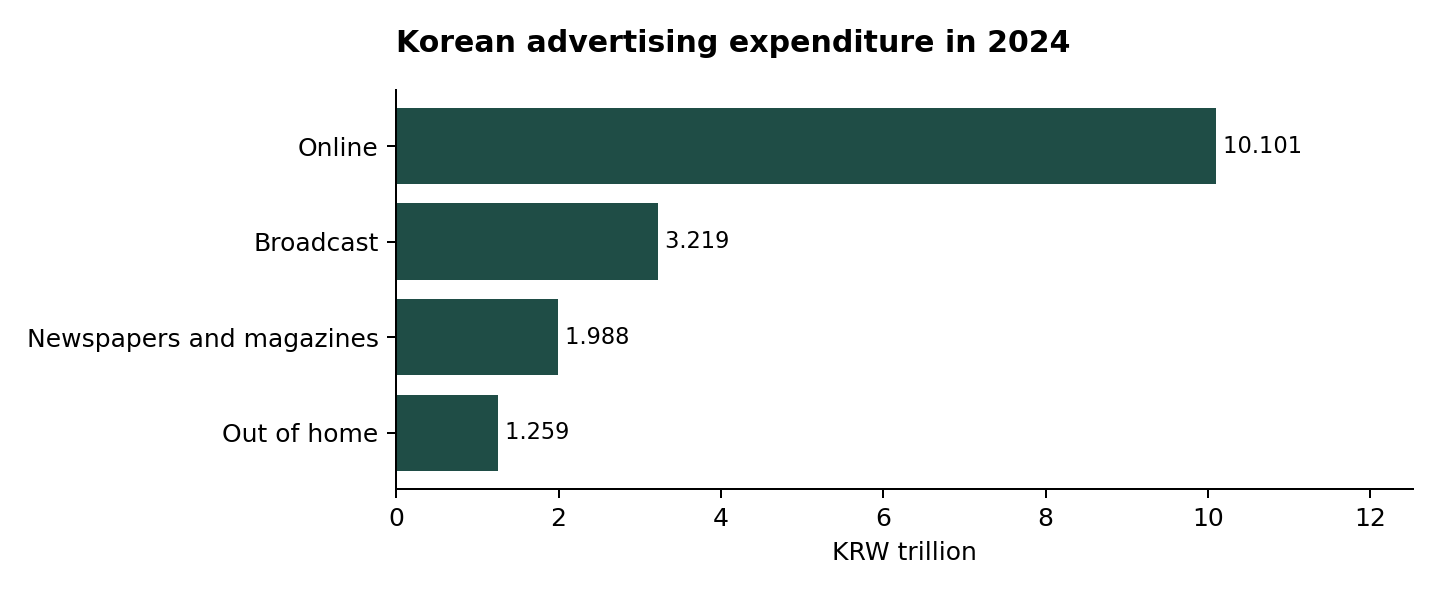
Live-broadcast household ratings do not by themselves capture streaming replay and mobile viewing as a unified audience. Online metrics also vary by platform, limiting straightforward comparisons. Connecting broadcast and OTT audiences requires aligned viewing definitions, deduplication and verified methods for translating device records into person-level reach.
Korea has relevant data inputs, including smart-TV and IPTV viewing records. Samsung Ads and LG Ad Solutions operate advertising businesses built around smart-TV data. The existence of data does not automatically establish a shared domestic currency. Access, user consent, representativeness, unobserved viewing and deduplication need to be addressed together.
The US experience suggests that more data and common verification must be developed together. A Korean alternative metric would require broadcasters, program providers, agencies, KOBACO and data companies to agree on what must be verified for a transaction. Defining what is measured and how results can be compared comes before selecting an additional vendor.
The Next Upfront Offers a Test of Comparability
Counting 12–18 months from the September summit places CIMM’s progress-review window around September 2027 to March 2028. The intervening 2027 upfront negotiations offer an opportunity to observe whether common requirements reach contracts. There is insufficient basis to describe those negotiations as the first annual contracts after Nielsen’s methodology changes.
Nielsen’s participation matters, but so does clarity about the responsibilities of existing verification bodies. Participation alone should not stand in for evidence of measurement quality. The useful questions concern each service’s audited scope, explanation of change impacts and acceptance by counterparties. A multi-currency market earns trust by explaining differences and incorporating them into agreements.
Korean broadcasters face a comparable commercial question. Regulatory viewing-share reform and advertising measurement should be treated as separate workstreams while the industry decides how to recognize reach across broadcast and streaming. Falling ad revenue cannot be explained by measurement alone. Still, converting the audience that content attracts into a defensible trading value requires a clear account of what the number covers and how it has been validated.