
MediaGPT | ENTERTAINMENT TECH ANALYSIS
InterPositive puts production footage at the center of postproduction AI while Artists Equity tests a larger share of success for filmmakers and crews
As artificial intelligence moves into film production, the business question is becoming harder to avoid: who gets the value it creates? Ben Affleck is approaching that question from both sides of the production ledger. He has used tools developed by his AI company, InterPositive, in postproduction on Animals, while his studio, Artists Equity, pursues compensation tied to a film’s performance and a new independent-film funding model that puts creative talent alongside investors.
The two initiatives address different parts of the same business. One seeks to give filmmakers more control over the tools applied to their footage. The other seeks to reconnect compensation with the commercial outcome of their work. Together, they suggest that Hollywood’s AI transition will depend as much on contracts and incentives as on model capabilities.
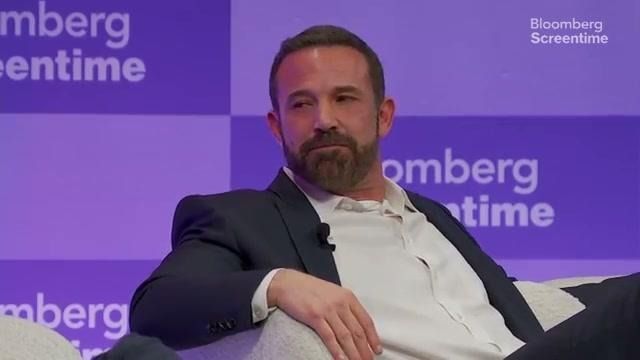
Affleck laid out the approach at Bloomberg’s Screentime event in Los Angeles. For Korean producers and broadcasters, the implications extend beyond whether to adopt a new tool. The negotiations concern access to production data, permission to train models, the use of project-specific outputs and the terms on which creative teams participate in success.
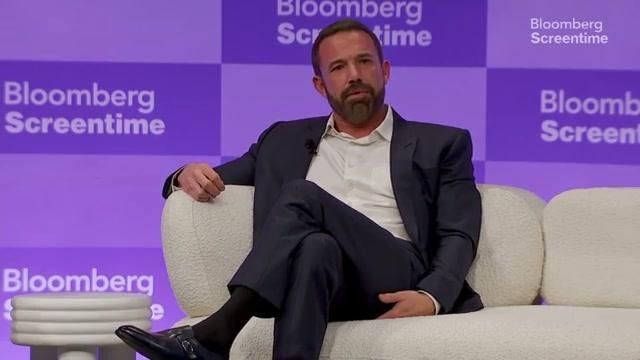
Interview overview Source: supplied Bloomberg Live interview summary
A production problem shaped the technology
Affleck’s interest in technology predates the current AI boom. In the interview, he described an early attempt to build a PC-based nonlinear editing business and the online ambitions of LivePlanet, the company he formed with Matt Damon and Sean Bailey in 2000. Both exposed the gap between a promising idea and the infrastructure needed to make it work.
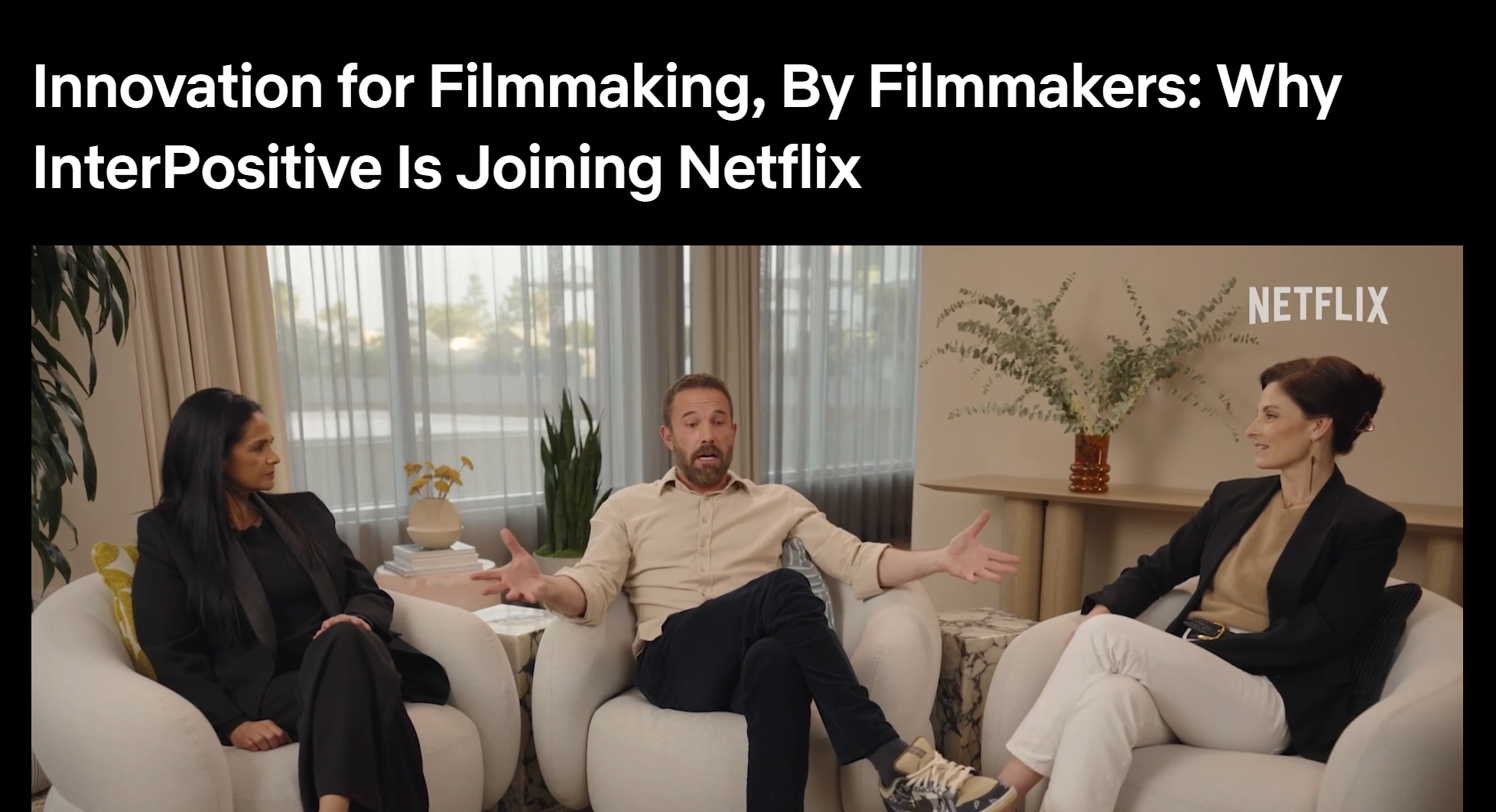
His first encounter with emerging image-generation technology produced alarm about the future of filmmaking. A closer look brought a different conclusion: researchers could build impressive models without fully understanding the practical requirements of a film set or a postproduction pipeline. InterPositive was his attempt to close that gap.
He said the company spent about eight months filming its own training material in a controlled environment. Rather than simply collecting finished work by other filmmakers, it sought footage designed around the visual and technical problems of production. Affleck described further training open models to better handle cinematic tasks.
The distinction matters, but it should not be overstated. A proprietary dataset makes the source of that additional training material easier to establish. It does not, by itself, resolve every question about the underlying model’s training history, licenses or downstream rights. Nor does Affleck’s description of a final cinematic layer establish that the system updates only one literal neural-network layer.
The footage becomes part of the workflow
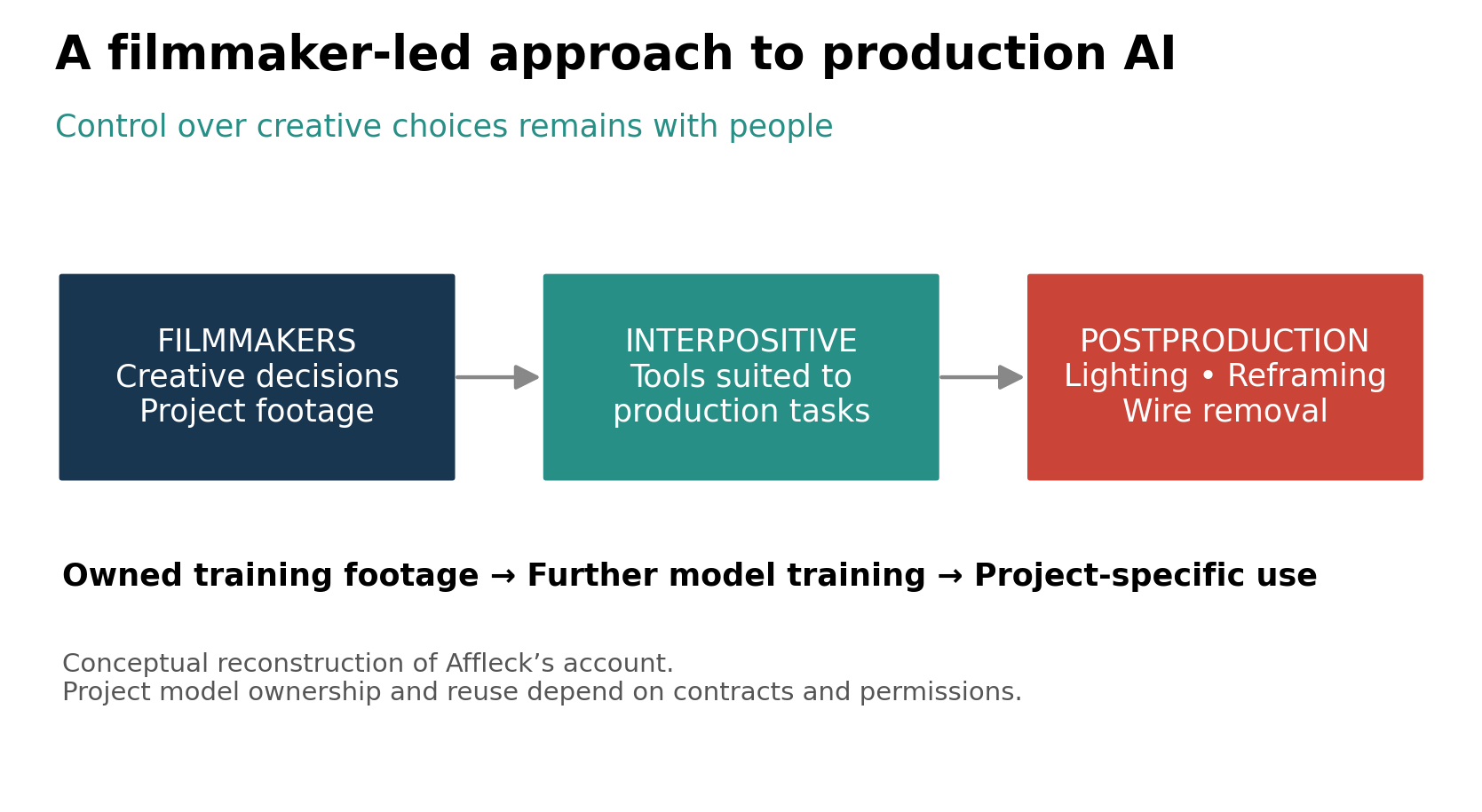
InterPositive’s proposition is to build tools around footage a production has already shot. A filmmaker can use project material to develop a model suited to that project, then apply it to postproduction tasks such as adjusting lighting, reframing an image, removing stunt wires or addressing a missing shot. The commercial appeal lies in maintaining the visual logic of a production while giving filmmakers more options to complete it.
That is a narrower and more practical proposition than generating a finished feature from a text prompt. Affleck argued that audience interest in a film still depends on human creative decisions. His position is that AI can extend those decisions and reduce friction in carrying them out.
Project-specific training also raises contract questions. The right to possess dailies is not necessarily the right to use them for training. Permission may depend on performer agreements, underlying intellectual property, music licenses and the arrangements among producers, financiers and distributors. Statements about creative control should not be treated as proof that an individual director legally owns the resulting model.
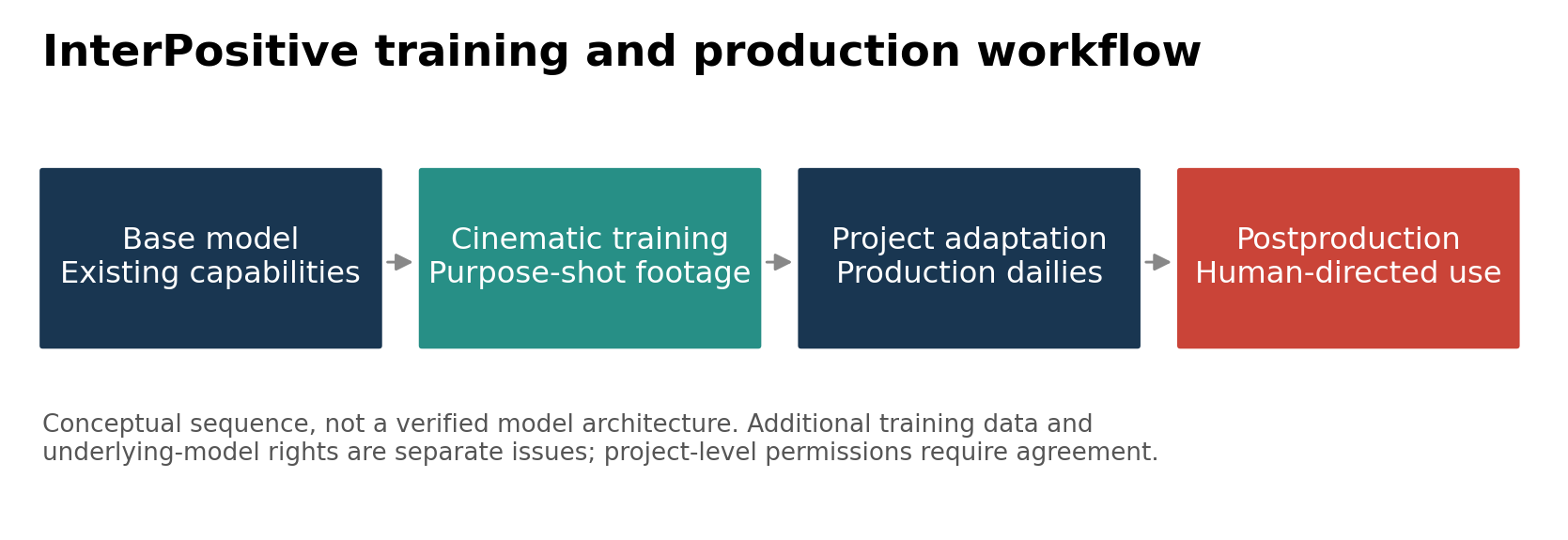
Training and production sequence reconstructed from the interview. Source: supplied interview materials and Netflix announcement.
Netflix brings the tools inside its production network
Netflix announced its acquisition of InterPositive in March, with Affleck joining as a senior adviser. The companies did not disclose the financial terms. Bloomberg reporting put the potential value at as much as $600 million, including performance-linked conditions; that reported ceiling should not be described as a confirmed upfront payment.
The acquisition places a filmmaker-led technology operation within one of the world’s largest commissioning platforms. Its significance is not simply ownership of another AI system. Netflix is buying a way to bring tools into production relationships where directors, performers and crews need confidence about how their material will be used.
Affleck rejected the suggestion that the deal merely provided reputational cover for Netflix’s use of AI. He argued that a company dependent on filmmakers cannot afford to alienate them. His account that the tools have not reduced staffing remains a participant’s observation, rather than an independently established finding about employment across the industry.
InterPositive acquisition overview Source: Netflix announcement and supplied Bloomberg reporting
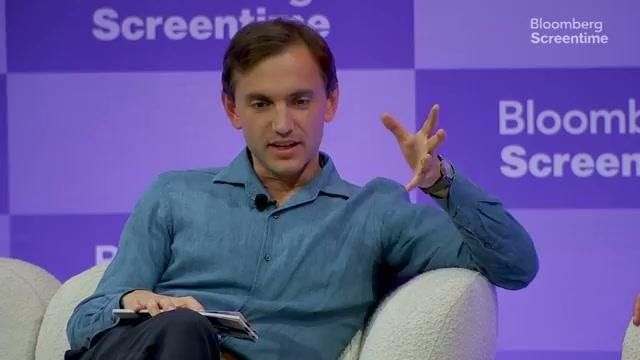
Bloomberg moderator Lucas Shaw. Photo: supplied Bloomberg Screentime video capture.
Animals puts the approach into practice
Animals arrives on Netflix and in select theaters on October 9. Affleck co-wrote, directed and stars in the thriller, which follows a Los Angeles mayoral candidate and his wife as they try to raise a ransom after their son is kidnapped.
Kerry Washington, Gillian Anderson, Steven Yeun, Adriana Paz and Luis Gerardo Méndez are among the cast. The project brings together Artists Equity, Makeready and Fifth Season.
At Screentime, Affleck said he used AI on the film, chiefly in postproduction, but declined to identify the individual shots or tasks. He framed that decision as preserving the audience’s immersion in the story. The disclosure confirms that the technology has entered a completed production; it does not establish a quantified saving in time, budget or labor.
The story’s central concerns are marriage and the distance between public morality and private choices. Affleck also described interruptions during development and location work. That context matters to his argument: the technology is being tested on a character-driven thriller, rather than presented only as a showcase of synthetic imagery.
The Rip connects performance with crew compensation
Artists Equity’s compensation experiment became visible with The Rip, the Netflix thriller starring Affleck and Damon that launched in January. The production negotiated a bonus arrangement covering roughly 1,200 cast and crew members, tied to the film’s performance over its first 90 days. Detailed thresholds and individual payments were not publicly disclosed.
The arrangement adds a route to upside participation for workers whose connection to a film’s commercial outcome often ends with their production pay. It should not be confused with replacing guild minimums or contractual residuals. Project bonuses, collectively bargained streaming payments and an investor-style profit share are distinct mechanisms.
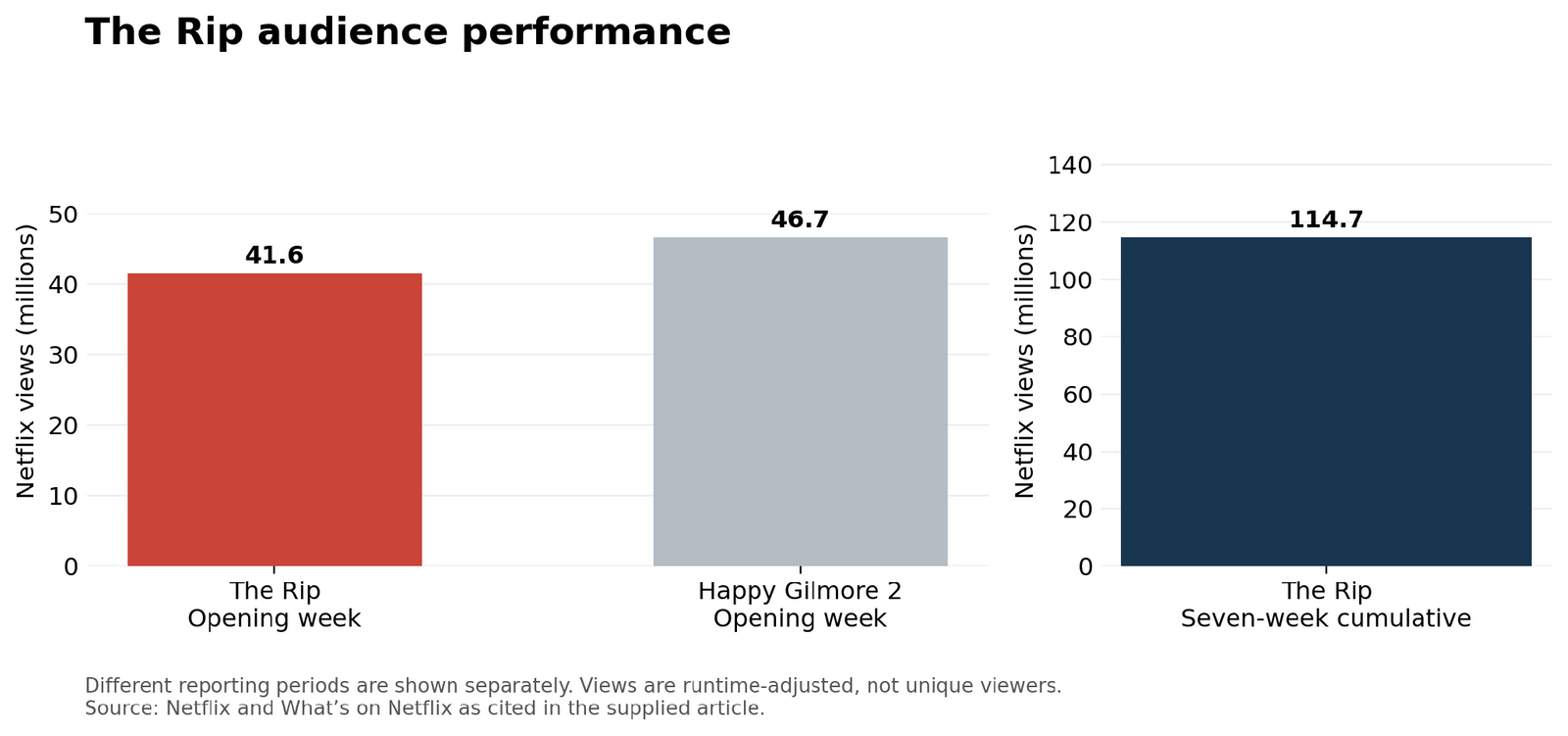
The Rip opened strongly, with the supplied reporting recording 41.6 million views in its first Netflix reporting week. That result establishes audience scale, not the value of bonuses ultimately paid. A view is also Netflix’s runtime-adjusted measure, rather than a count of unique people. Affleck said Animals had been contracted before this compensation arrangement and did not use the same model.
Affleck’s incentive argument is that people make different decisions when they share in the outcome. Lower upfront exposure and meaningful upside can encourage greater attention to budgets, production choices and promotion. But the structure works only if participants can understand the performance measure and trust the settlement process.
A savings forecast is not a demonstrated result
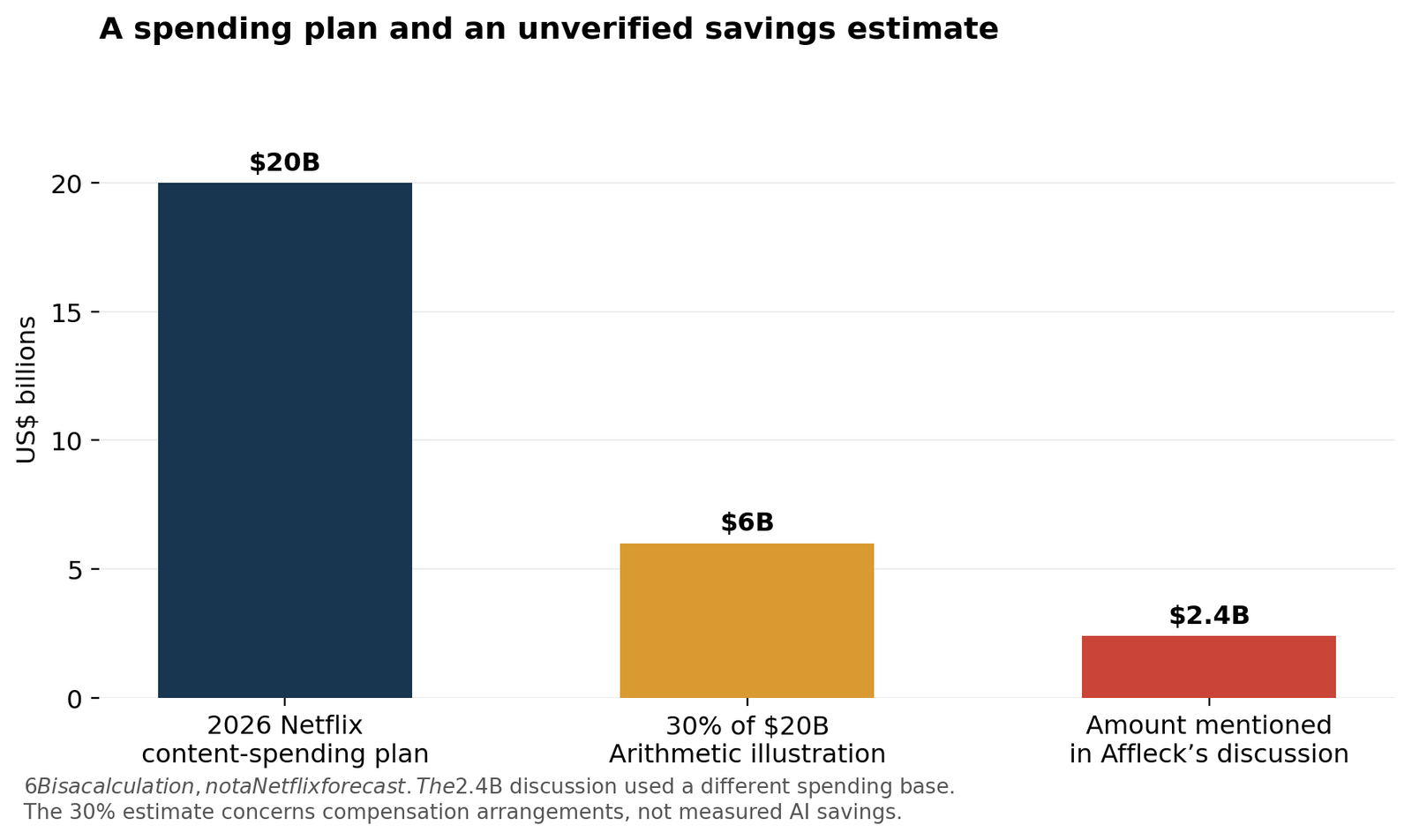
Affleck suggested that broader adoption of a revised compensation model could reduce streaming content spending by about 30 percent. He did not publish a methodology. The estimate concerns financing and compensation arrangements; it is not evidence that his AI tools cut production costs by 30 percent.
The distinction is especially important when applying that percentage to Netflix’s reported $20 billion content-spending plan for 2026. Multiplying the two produces $6 billion, but that is an arithmetic illustration, not a forecast endorsed by Netflix. Reducing upfront payments lowers initial exposure; a successful film can subsequently generate substantial bonus or profit-participation payments.
The final economics depend on definitions: what counts as revenue, which costs are recouped first, when a project reaches break-even and how marketing expenses are allocated. Without those terms, a headline savings percentage says little about the balance of risk between workers and financiers.
An independent film fund changes the risk allocation
Affleck also outlined an independent theatrical-film fund in which above-the-line participants—including actors, directors, writers and producers—would receive guild-minimum upfront pay and participate in returns alongside financial investors. He described a dollar-for-dollar arrangement intended to place their deferred economic interests on a comparable footing. The fund’s size, backers and full contractual terms were not disclosed.
That is a more consequential shift than adding a bonus to an otherwise conventional contract. Creative participants give up part of the certainty of a larger upfront fee in exchange for an interest in the outcome. The potential reward increases, but so does exposure to a film that fails to earn back its costs.
Such a structure may also create incentives to promote a theatrical release and subsequent premium and subscription video windows. It does not mean every worker is being turned into an investor, or that everyone receives an identical share. Eligibility, contribution values, recoupment priority and loss treatment remain essential details.
Compensation structures compared Source: supplied Bloomberg interview and
Creative autonomy remains part of the bargain
Affleck also revisited publicity surrounding Damon’s remarks on The Joe Rogan Experience about streaming films repeating plot information for distracted viewers. He disputed the interpretation that Netflix had imposed those requirements on their own work and said Animals received no such creative notes.
His experience is relevant to the relationship he is defending, but it cannot stand in for every filmmaker’s dealings with the platform. The wider business question is how a platform can scale new tools while retaining the trust and discretion of the people making its films.
Korean producers face a rights and revenue negotiation
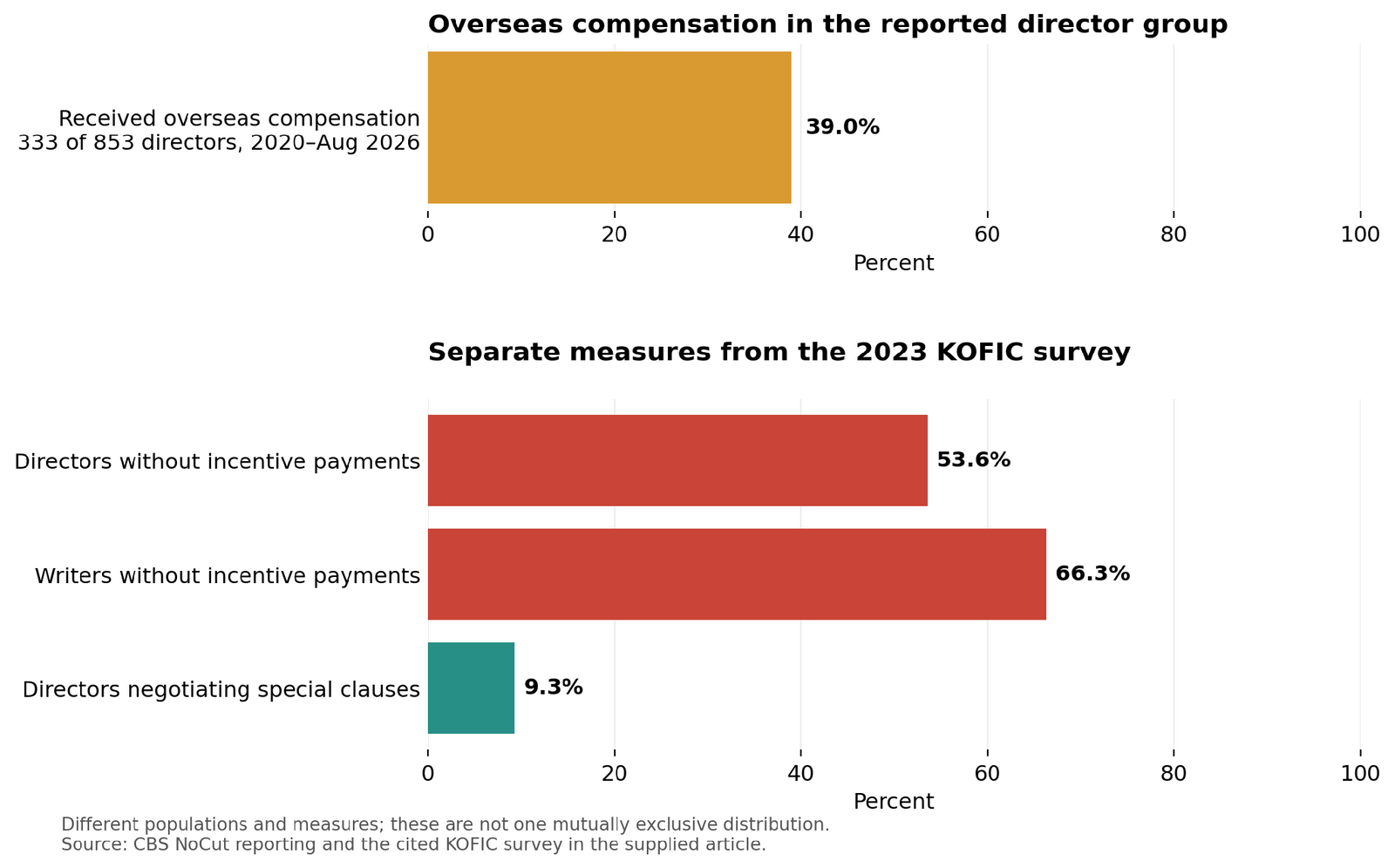
The Korean industry has its own version of the gap between production pay and downstream success. Reporting supplied with the source article cited 333 recipients of overseas compensation among a group of 853 film directors, and a 2023 Korean Film Council survey in which 53.6 percent of directors and 66.3 percent of writers had received no incentive payments. These figures describe the reported groups and survey measures; they are not a count of creators denied all royalties or a Netflix-only dataset.
Korean projects use varied financing and rights arrangements. An upfront buyout may provide certainty and cover production risk while limiting participation in later success. Affleck’s deals offer a negotiating example, not a contractual entitlement that automatically transfers to Korean productions.
Broadcasters and production companies also hold extensive archives. Those holdings could become a starting point for project-specific AI, provided the relevant training permissions exist. Archive ownership alone is insufficient: performer consent, music, underlying works, co-production terms and outsourced production agreements can all limit permitted uses.
The practical next step is to negotiate the terms together. Producers need to establish who may train on the footage, who can use or transfer the resulting model, what happens to data after a project ends and how any economic benefit is shared. On compensation, the corresponding questions concern performance-data access, auditable calculations, payment timing and dispute resolution.
Affleck’s experiment is therefore best judged through implementation. Animals will show a filmmaker using the tools in a finished feature, but viewing rankings cannot isolate their contribution. The more revealing evidence will be production-level cost and time comparisons, the actual settlement of The Rip’s bonuses and the disclosed terms of the independent-film fund. AI may improve a production’s economics; contracts determine who participates in the gain.
Korean creator compensation indicators
How the interview develops
The discussion moves from Affleck’s technology ventures and production-data strategy to Animals, creative autonomy and compensation. The AI and InterPositive portion occupies approximately ten minutes, while the performance-pay and fund discussion takes about seven. The supplied timestamps contain a small overlap and short gaps; they are an editorial guide, not a continuous segmentation of the full video.
Affleck also raised concerns about children’s learning and responsible AI use. His comment about an increase in college A grades was an interview claim, not a verified education statistic. In the closing exchange he named filmmakers he would like to work with, including Martin Scorsese and Christopher Nolan, and Denzel Washington as an actor he would like to direct.
Video times preserved from the supplied interview summary. Some intervals overlap or contain gaps.
The next production contract
The test for this model is practical: permission to train on production material, control over project outputs, access to performance data and a settlement process people can trust. Better tools can improve the economics of a film. The next contract determines whether those improvements also benefit the creative team.