
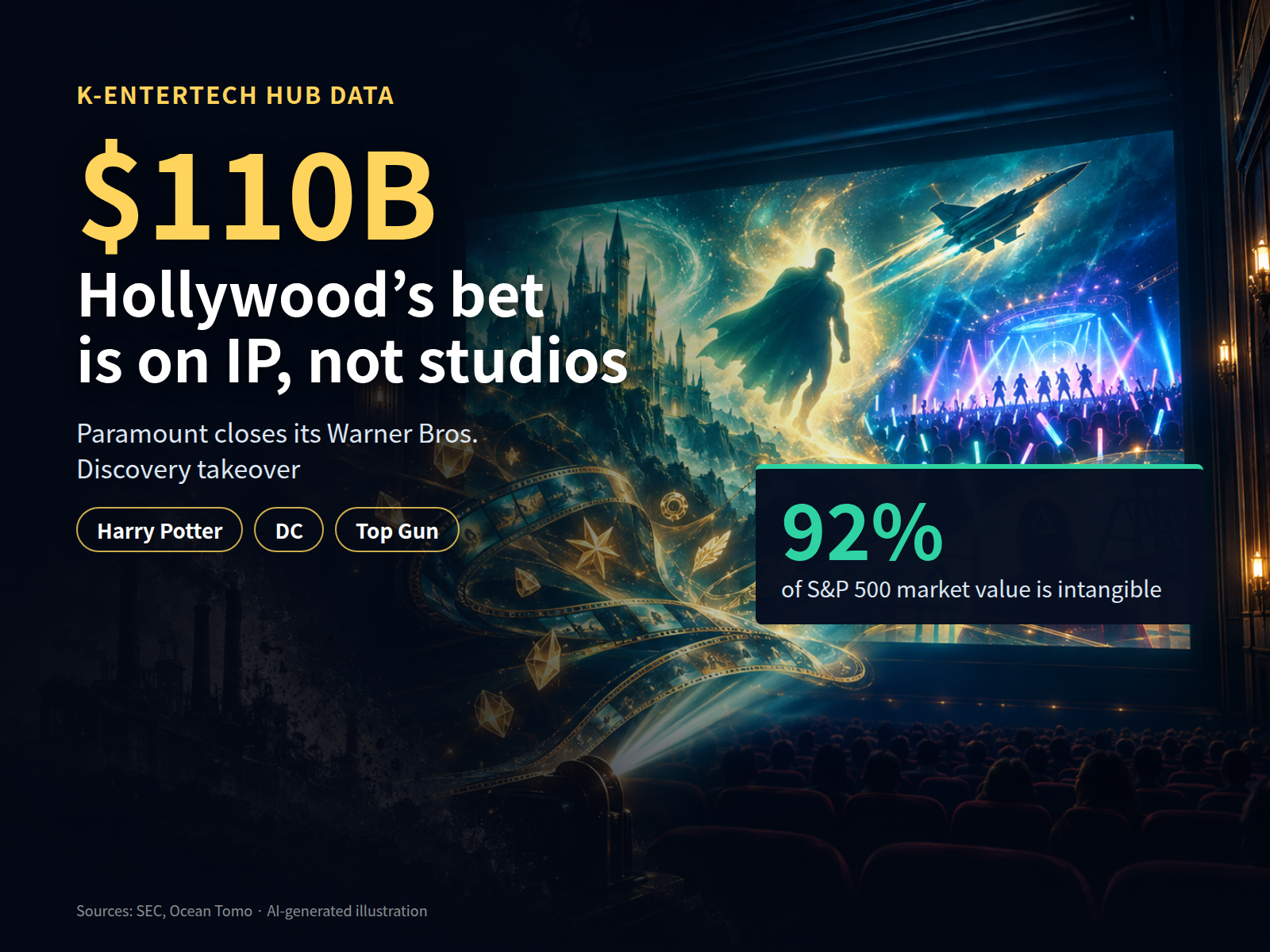
K-ENTERTECH HUB | DATA
Intangibles make up 92% of S&P 500 value. Paramount paid $110 billion for franchises; Korea is putting ₩200 billion into keeping the rights to its own stories
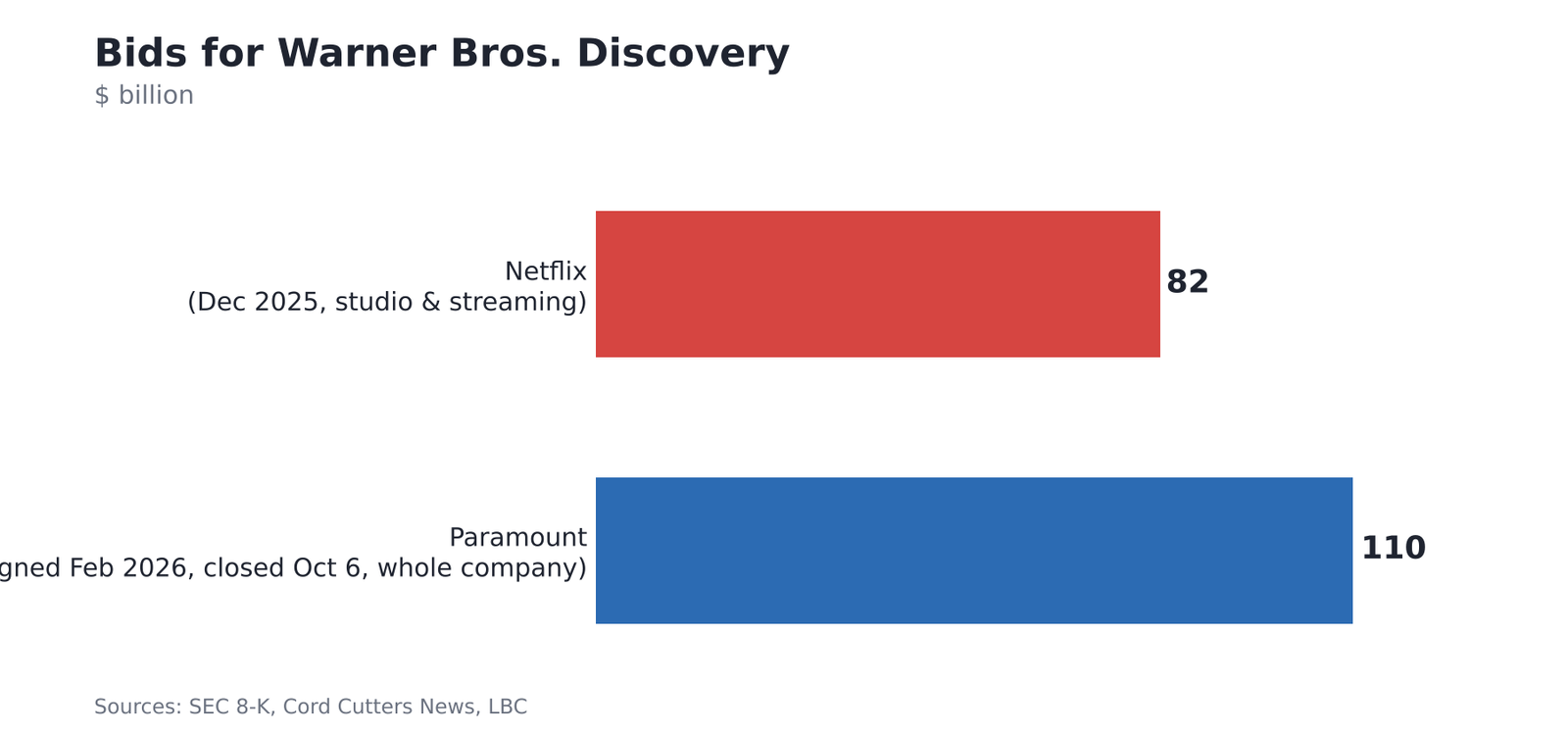
Paramount closed its acquisition of Warner Bros. Discovery on Oct. 6 in a deal valued at about $110 billion including debt, bringing WBD's Harry Potter and DC together with Paramount's Top Gun. What Paramount borrowed heavily to buy was not studio lots or transmission gear. It was franchise rights that can be sold again for decades across theaters, streaming, games and merchandise.
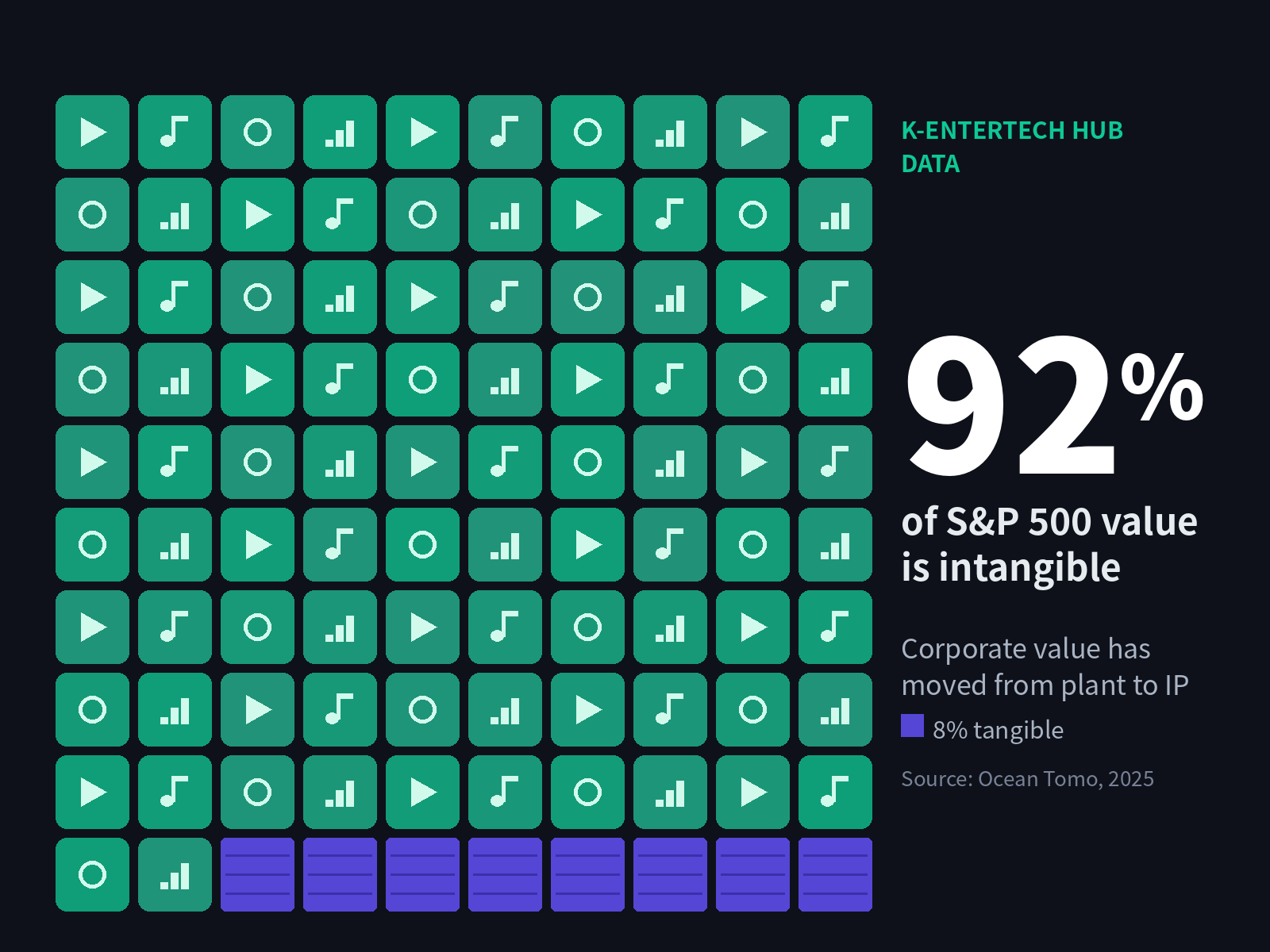
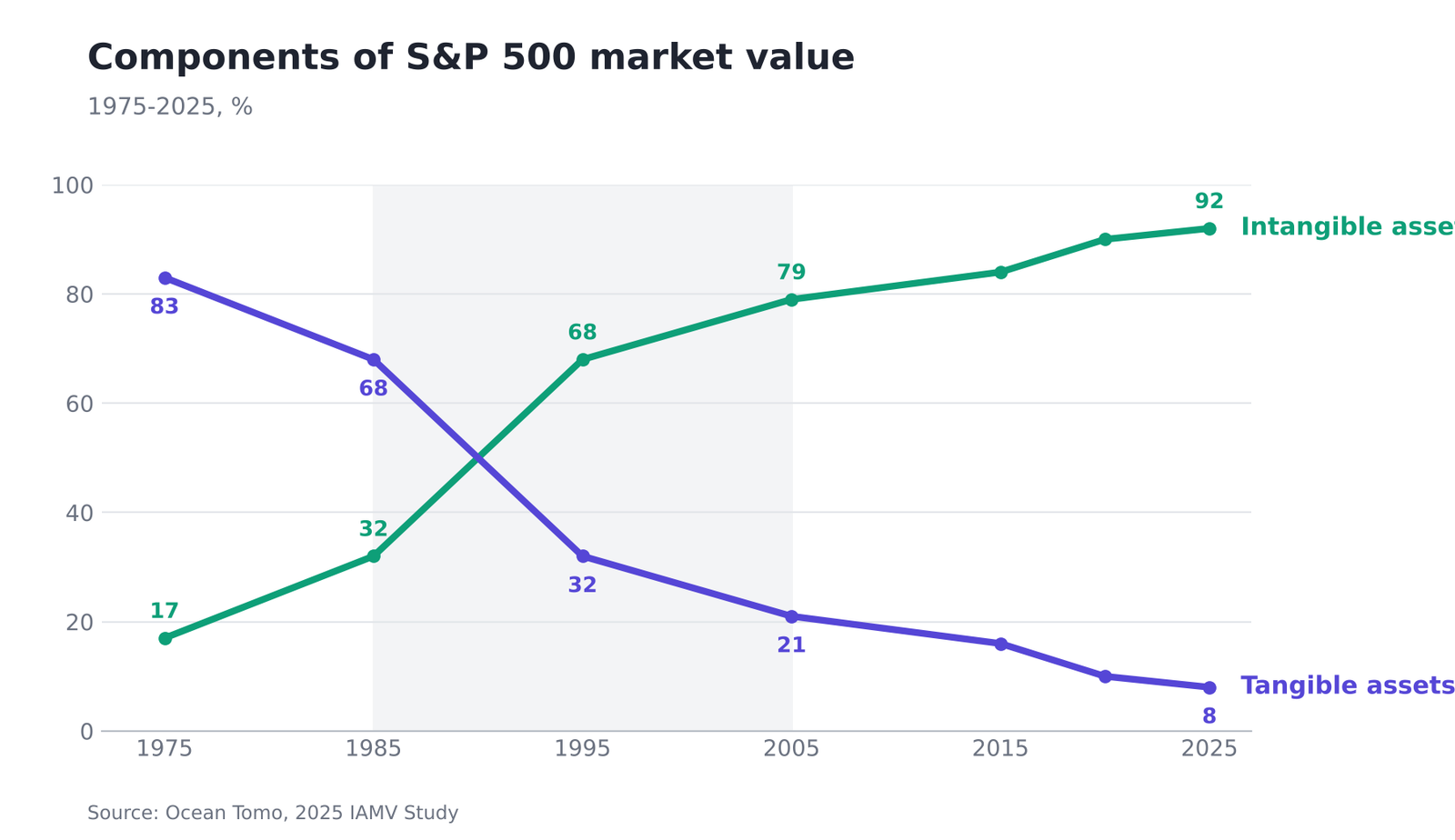
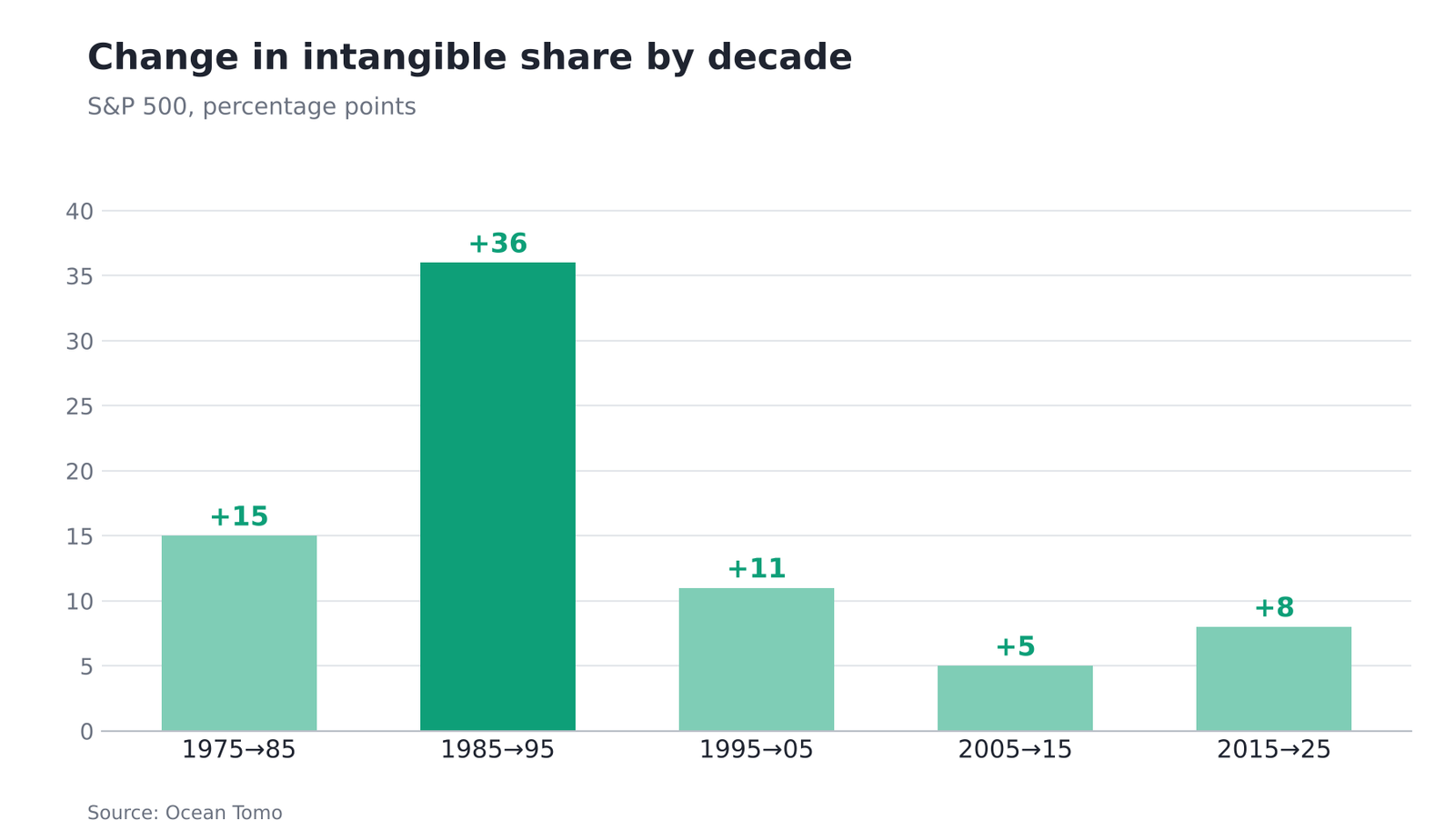
The numbers explain why Hollywood is betting so much on IP. Intangible assets accounted for 92% of the market value of S&P 500 companies, according to the 2025 Intangible Asset Market Value (IAMV) study released on Feb. 12 by IP advisory firm Ocean Tomo. Factories, equipment and inventory now make up 8%. In 1975 the split was 83% tangible and 17% intangible.
Media executives read the figure as a case for owning IP. Axios media correspondent Sara Fischer ran Ocean Tomo's data under the headline "Golden era for original IP." Seen from Korea, the same chart raises a different question.
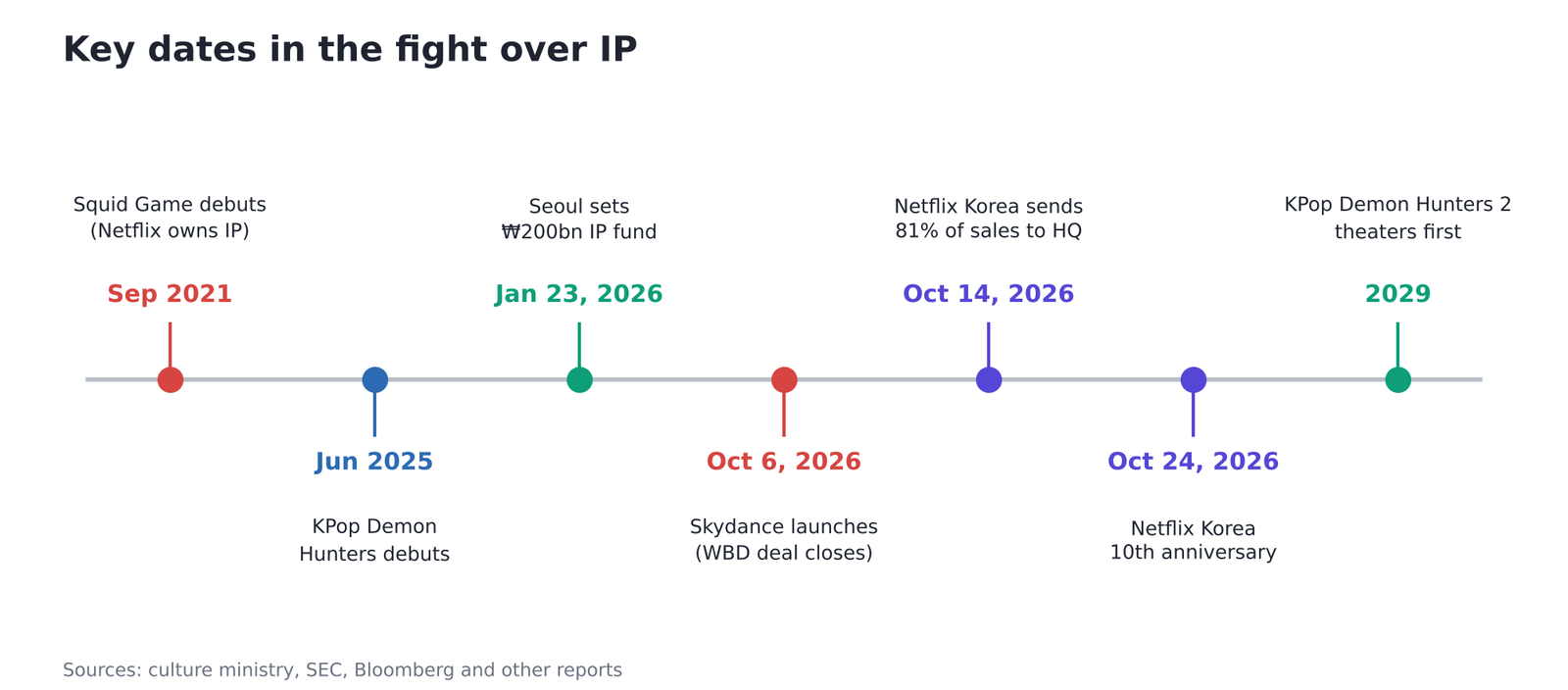
Netflix marked a decade in Korea at an event in Seoul on Oct. 24, and members worldwide watched more than 12 billion hours of Korean content in the past year. Yet Korean producers earn margins of 3% to 10% of production costs on Netflix originals, and Netflix's Korean unit sent 81% of last year's local revenue to its US parent. Even for global hits made in Korea or built on Korean material, such as "Squid Game" and "KPop Demon Hunters," much of the right to sequels, games and merchandise sits with foreign companies. That is why the government is setting aside a ₩200 billion fund this year to help producers keep original IP.
An 'economic inversion' in half a century, and no retreat when rates rose
Ocean Tomo calculates intangible asset market value as market capitalization minus net tangible assets. It does not count patents and trademarks line by line. Brands, software, data and customer networks priced into market value are included, along with investors' growth expectations.
Measured that way, the make-up of US corporate value flipped between 1985 and 2005. The intangible share rose from 32% in 1985 to 68% in 1995 and 79% in 2005, a 47-point gain in 20 years; 36 points of it came in 1985-95 alone. Ocean Tomo calls the shift an "economic inversion." The share reached 84% in 2015 and 90% in 2020.
The 2020-25 figures carry an interest-rate test. The Federal Reserve ran its most aggressive tightening cycle in four decades, yet the intangible share held near 90%. Because higher rates usually hit valuations built on future growth first, the result runs against expectations. Ocean Tomo said it will address why in a forthcoming paper.
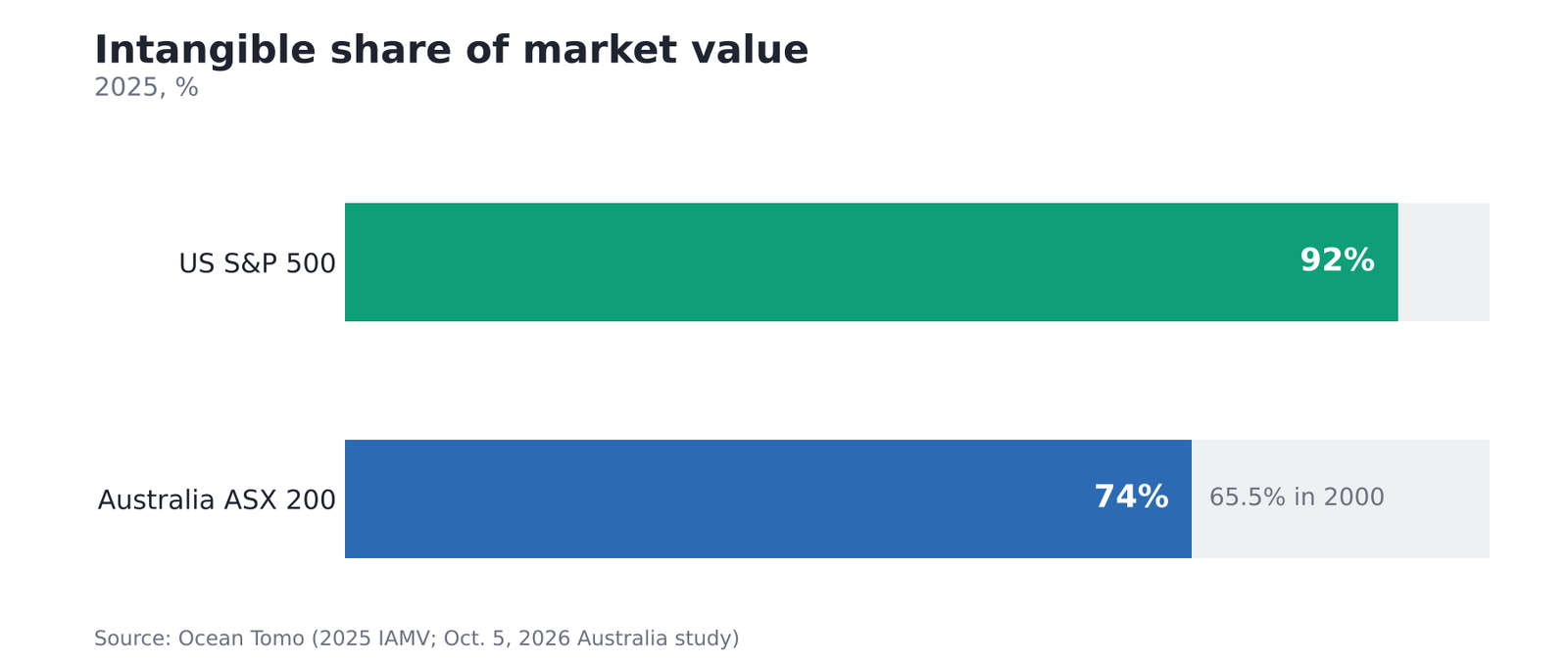
The pattern is not only American. Ocean Tomo has tracked equity indexes in Europe, China, Japan and South Korea since 2005. Its Oct. 5 analysis put the intangible share of Australia's ASX 200 at 74% in 2025, up from 65.5% in 2000. 2025 figures for Korean indexes have not yet appeared in its public summaries.
Money moves from factories to software and brands: 3.5% versus 0.98%
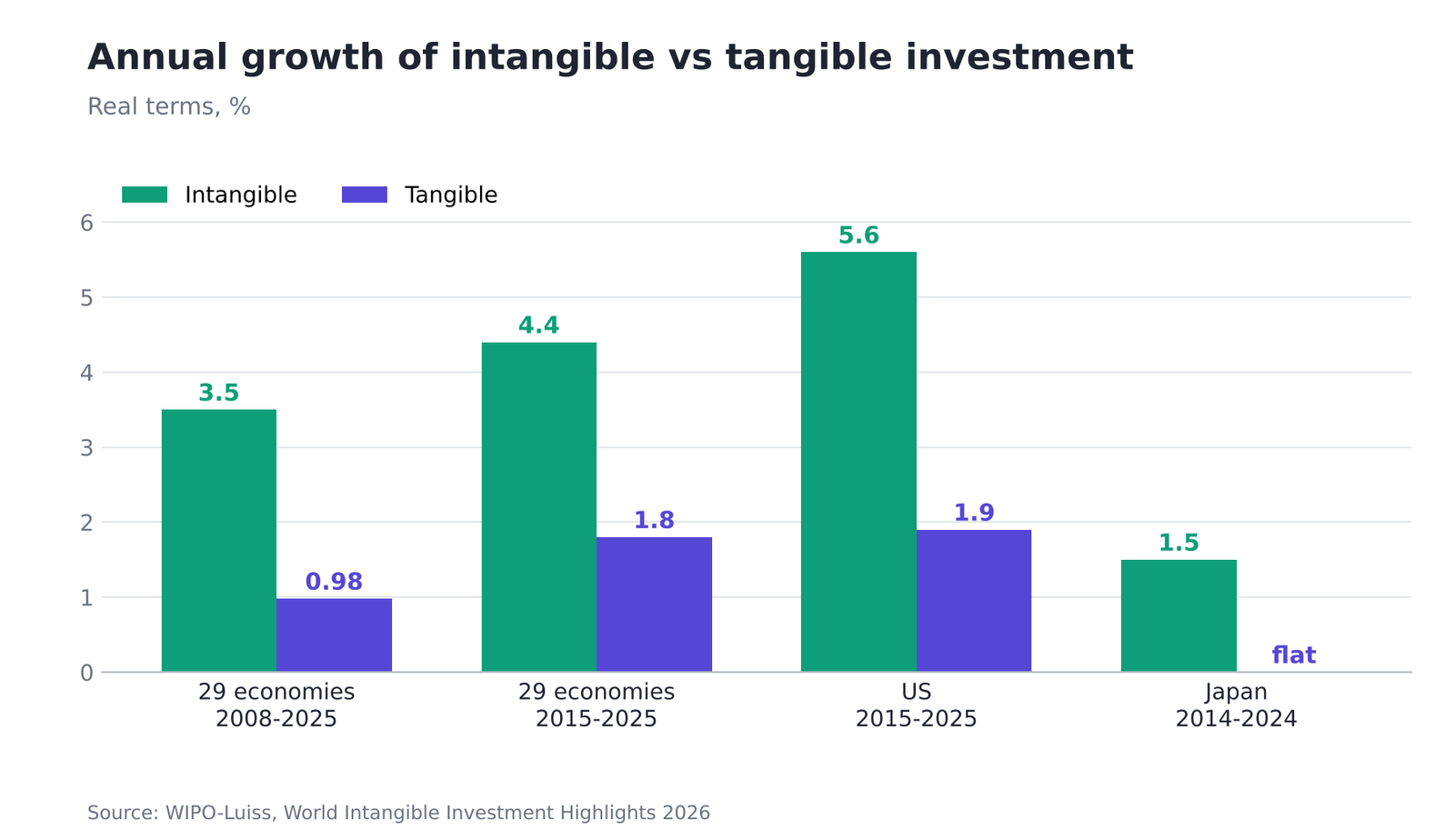
The intangible share grew because companies changed where they spend. Global intangible investment rose 3.5% a year in real terms between 2008 and 2025, 3.6 times the 0.98% pace for tangible investment, according to the World Intangible Investment Highlights 2026 published in July by the World Intellectual Property Organization (WIPO) and Italy's Luiss Business School. Intangible investment passed $10 trillion for the first time last year. The Axios line that intangible investment has grown three times faster since 2008 comes from this series.
This year's edition covers 29 economies, adding Canada and the Philippines. Between 2015 and 2025, intangible investment rose 4.4% a year against 1.8% for tangible, and grew faster in 22 of the 29 economies. In the US the figures were 5.6% and 1.9%.
The report singles out Japan as the most striking case. Until 2019 its tangible and intangible investment grew at similar rates, with tangible slightly ahead. Since then tangible investment has fallen below its 2015 level while intangible investment kept rising, by 1.5% a year over 2014-24. WIPO calls it a structural shift, not a cyclical one. Software and data, along with brands, have grown fastest; the 2024 edition found both grew three times faster than R&D in 2011-21. Media, built on content, fan data and brands, sits at the center of the trend.
Hollywood borrowed to buy franchises: Skydance launches with $87 billion of debt
After closing the deal, Paramount renamed itself Skydance. Its SEC filing shows two film studios, two global streaming services, and CBS, HBO and CNN under one roof. WBD shareholders received $31.0167 a share in cash, and approvals came from nearly 70 jurisdictions, Cord Cutters News reported.
The deal did not start as Paramount's. Netflix agreed last December to buy WBD's studio and streaming business for about $82 billion. Paramount then bid for the whole company, cable networks included, and won in February.
Much of the price is debt. Skydance carries about $87 billion of total debt and has committed to $6 billion of cost savings within three years, Bloomberg reported. In return it holds Harry Potter, Batman, The Lord of the Rings and Star Trek. It has promised more than 30 theatrical releases a year and a theatrical window of at least 45 days. "This combined company will be spending more on content and on storytelling than any other company in the world," co-CEO David Ellison told Bloomberg. The rights holder sets the windows and their length, then raises what a single piece of IP earns within them.
Rights holders' leverage showed in another negotiation this month. Microsoft's Xbox countered Netflix's $500 million offer for seven years of screen-adaptation rights to its game IP with a demand for $800 million, ZDNet Korea reported on Oct. 27, citing GamesIndustry.biz and other outlets. Talks collapsed after the Netflix executive leading them left the company earlier this month, and Xbox has shifted to smaller title-by-title deals.
The third point on the Axios slide is that publishers and retailers benefit from first-party relationships. Subscriber and membership data gathered without a platform in the middle also counts in market value as an intangible asset. Skydance's subscriber base across two streaming services falls into that category.
Korean stories, other people's contracts: 'KPop Demon Hunters' and 'Squid Game'
"KPop Demon Hunters," built on idol groups, shamanism and grim reapers, became the most-watched film in Netflix history, with 325.1 million views in its first 90 days and 63 straight weeks in the global Top 10. Sony Pictures Animation produced it, and Netflix acquired it during the pandemic, Fortune reported. Press accounts say Netflix covered the roughly $100 million production cost while Sony took a fixed fee plus music and publishing revenue.
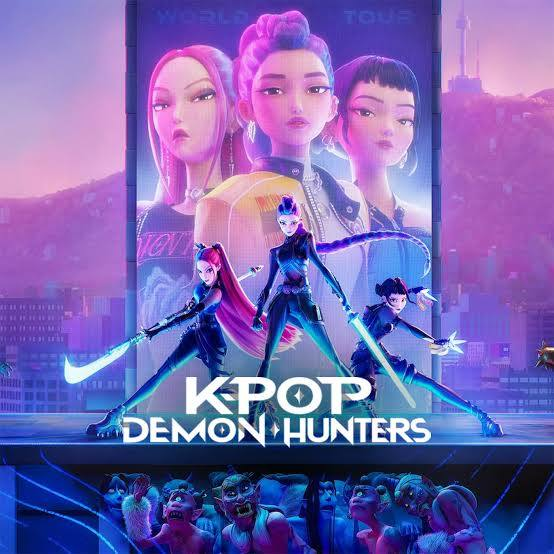
Netflix paid Sony a success bonus of about $15 million, The Hollywood Reporter reported, as cited in Korean media. Netflix keeps adding windows for the IP. A sing-along version released in theaters two months after the streaming debut took in about $19 million over two days. Co-CEO Ted Sarandos said at a Bloomberg event that the 2029 sequel will get a broad theatrical release before streaming, PinkNews reported, and this month the characters arrived in the children's game Toca Boca World. The story came from Korea, but the parties to the contracts that split sequel, game and box-office revenue are American and Japanese. Even Sony, which made the hit, handed much of the rights to the distributor.
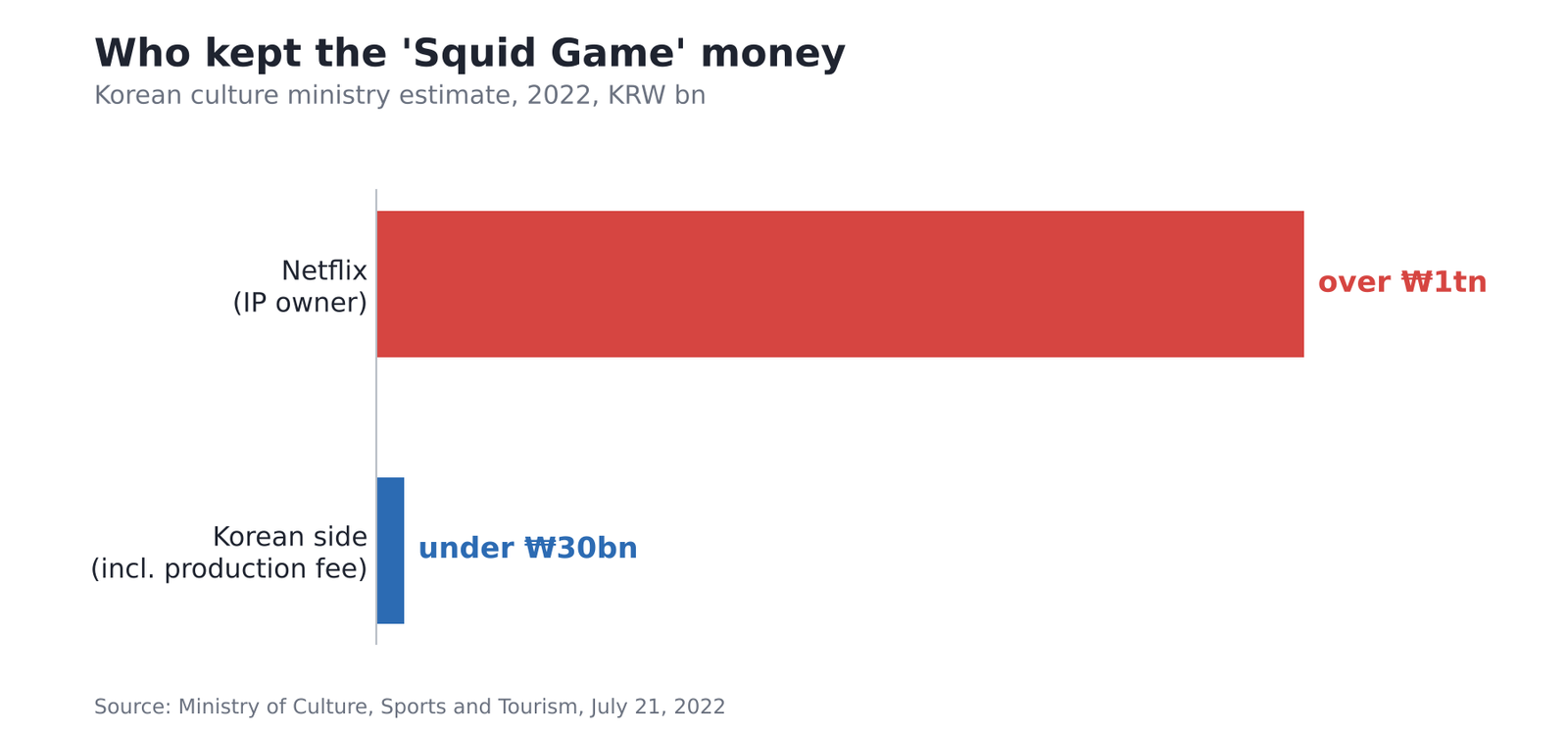
If "KPop Demon Hunters" shows the contract structure, "Squid Game" puts a price on it. Its three seasons have drawn 600.36 million views, and Netflix owns the IP. In July 2022 then culture minister Park Bo-gyoon (박보균) said Netflix had earned more than ₩1 trillion ($748 million) from the show while the Korean side, lacking the IP, received under ₩30 billion ($22.4 million) including production fees, Newsis reported. Both are government estimates.
Netflix's decade in Korea: 81% of revenue to headquarters, 3-10% margins for producers
Figures released for Netflix's Korean anniversary show the scale. Since 2016 Netflix has made more than 200 Korean titles with over 80 local producers, and between April 2025 and March 2026 Korean content drew more than 12 billion viewing hours, second only to US productions, Green Economy (녹색경제신문) reported.
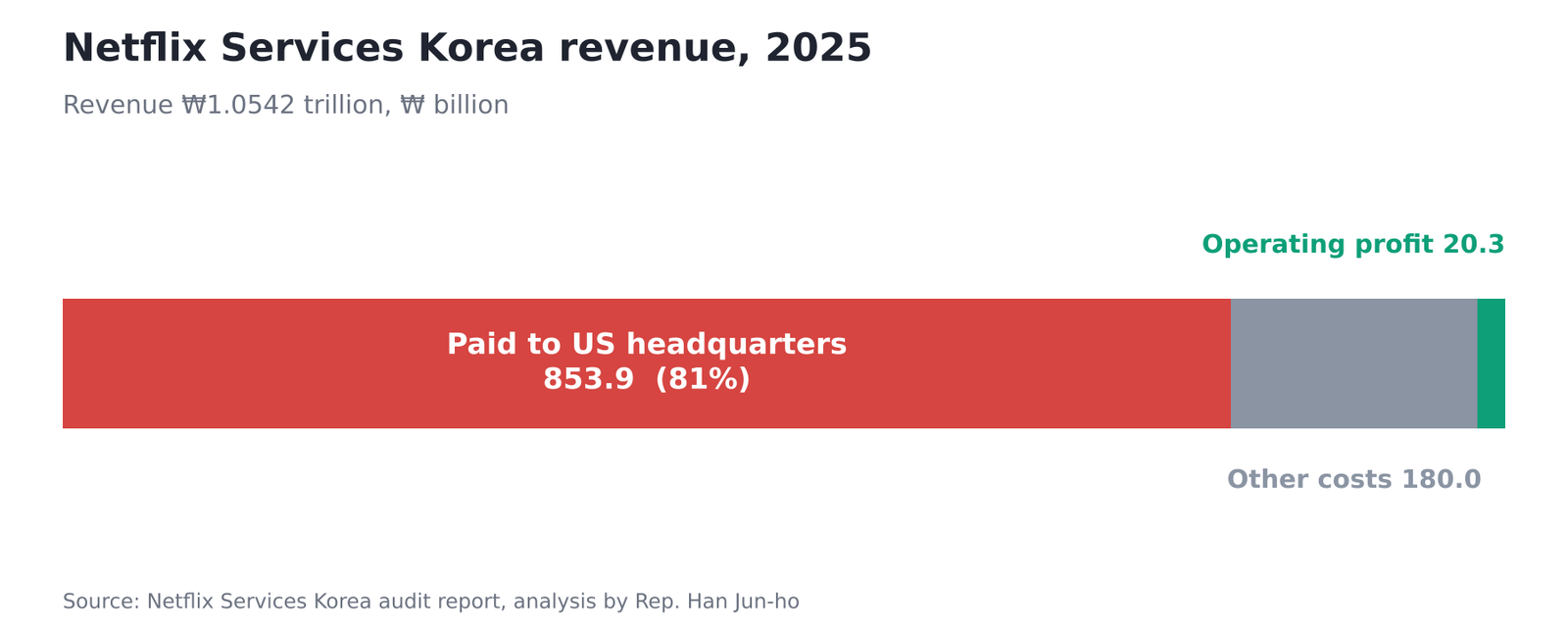
The money trail appeared 10 days earlier. An audit-report analysis by lawmaker Han Jun-ho (한준호) showed Netflix Services Korea's revenue rose 66.9% from 2021 to ₩1.0542 trillion ($788 million) last year. Of that, 81%, or ₩853.9 billion, went to the US parent as subscription membership purchase fees, leaving operating profit of ₩20.3 billion and a 1.9% margin. Money Today (머니투데이) noted that the payment is not pure profit, since it covers global content and operating costs. The same analysis found Korean producers earn margins of 3% to 10% of production costs on Netflix originals.
Producers accept the terms because they remove risk. A Netflix original guarantees the budget and a margin of around 10%, while the traditional route of a broadcast run followed by domestic streaming and overseas sales recovers only 70-80% of costs, Segye Ilbo (세계일보) reported on Oct. 28. The number of original Korean dramas across broadcasters and streaming services fell from 136 in 2022 to 110 last year. A copyright bill introduced in September by lawmaker Lim Oh-kyung (임오경) would let creators who have assigned their rights claim additional pay when a work succeeds.
Some Korean companies have held on to rights and widened their windows. The Kakao Page web novel "Solo Leveling" has drawn 14.3 billion views worldwide and expanded into webtoon, games and anime; the anime became the first Korean work to win Anime of the Year at the 2025 Crunchyroll Anime Awards, among nine categories. Netflix's live-action series is being produced by rights holder Kakao Entertainment (카카오엔터테인먼트) with Sanai Pictures, Hankyung reported. Studio Dragon (스튜디오드래곤) widened its buyers to SBS, MBC, Disney+ and Netflix in the second quarter, raising episodes aired from 41 to 77 and content sales 37.3% to ₩126.9 billion, MTN reported. Keeping original rights, or splitting sales across buyers, lets licensing income grow with every new medium and window.

A ₩200 billion IP fund, and why broadcasters' value rests on rights, not transmitters
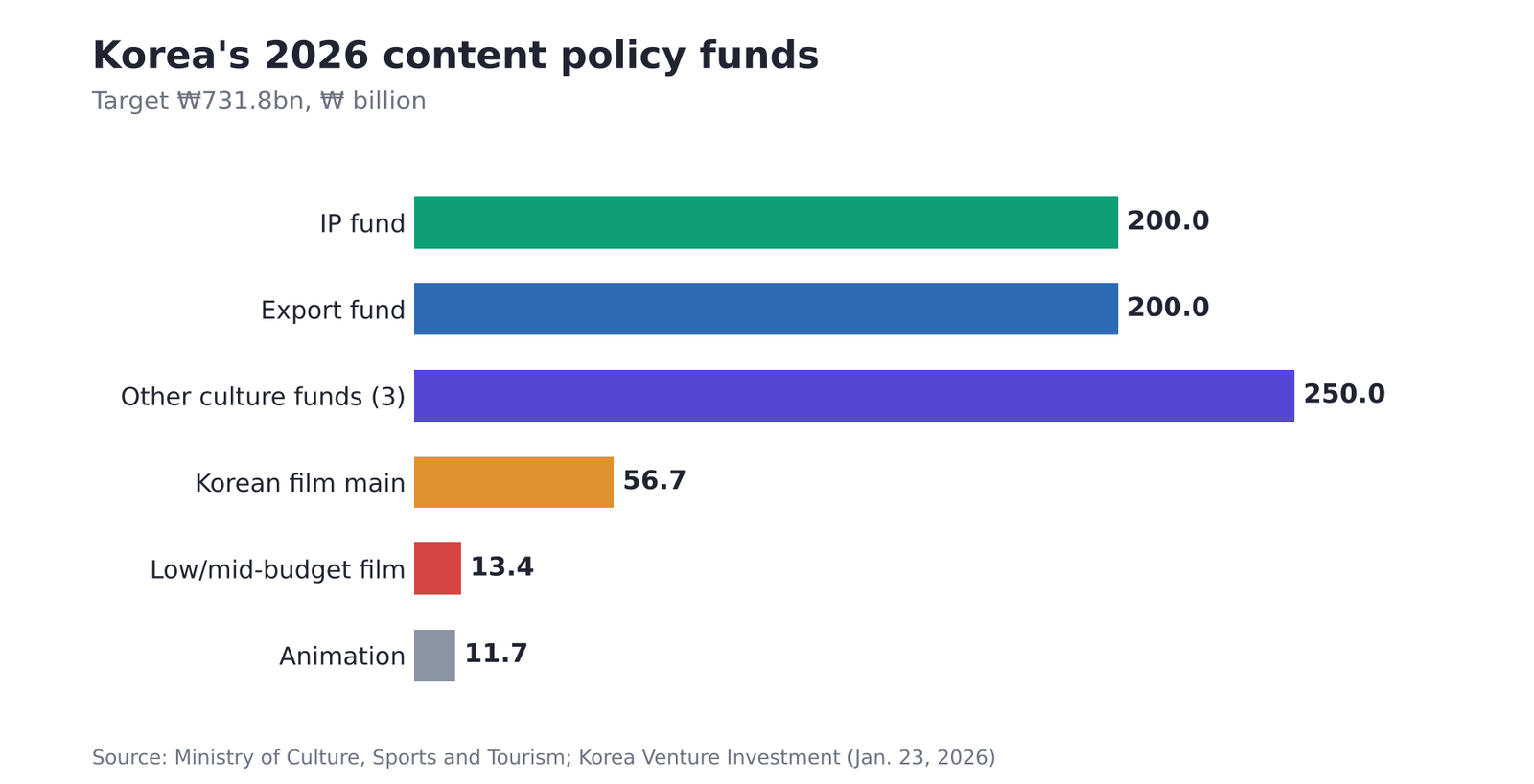
The government wants to change where the money goes. On Jan. 23 the culture ministry and Korea Venture Investment Corp. (한국벤처투자) set a target of ₩731.8 billion ($547 million) for this year's content policy funds, a record and 22% more than last year. The ministry's commitment to the culture account rose from ₩300 billion to ₩390 billion, seeding ₩650 billion of sub-funds.
The largest is a ₩200 billion ($150 million) IP fund aimed at helping producers secure original rights, split into two ₩100 billion vehicles, Asia Business Daily (아시아경제) reported. A ₩200 billion export fund and an ₩11.7 billion animation fund come with it, and Korea Growth Investment Corp. (한국성장금융) runs a separate ₩55 billion fund for content IP and M&A.
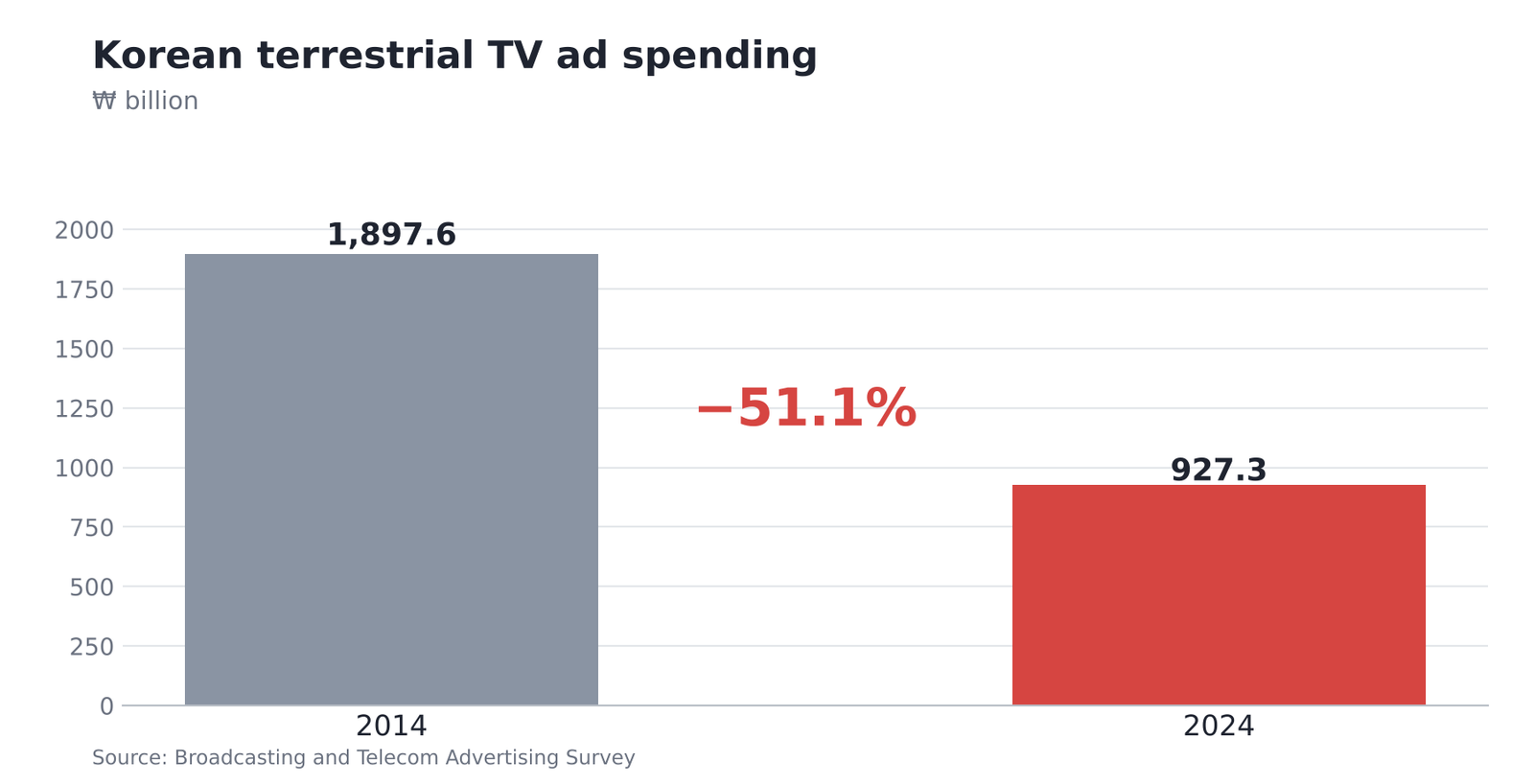
For broadcasters the problem is more urgent. Terrestrial TV advertising fell 51.1%, from ₩1.8976 trillion ($1.42 billion) in 2014 to ₩927.3 billion ($693 million) in 2024, according to the government's annual advertising survey. As ad sales shrank, so did the cash from transmitters and studios. Measured Ocean Tomo's way, what the market values in a broadcaster is the stock of rights it can sell again: archives, formats and characters.
When Korean broadcasters and producers supplied shows to global streaming services, handing over overseas and ancillary rights was a way to recover costs quickly. The "KPop Demon Hunters" and "Squid Game" cases show what those deals gave up: sequels, games, merchandise and licensing. Who holds the right to resell a show on free ad-supported streaming TV (FAST) channels, through foreign remakes or on stage will decide broadcasters' next revenue lines.
The first-party point applies too. A broadcaster that receives viewer data only through portals and platforms cannot easily carry that data as an asset. One with its own streaming service and membership base can use it for ad sales and for planning IP businesses.
What to negotiate is not the production fee but the length and scope of rights
The 92% figure is not a constant. Ocean Tomo has noted that AI is creating new intangible assets, such as training data and proprietary models, while speeding the obsolescence of existing ones. Because intangible value includes growth expectations, it moves with rates and earnings outlooks. Whether the share holds near 90%, as it has since 2020, depends on what the follow-up analysis finds.
Nor is Netflix's Korean spending guaranteed. Segye Ilbo noted that Korea featured less prominently than India and Japan in Netflix's third-quarter shareholder letter. If spending shifts to cheaper markets, producers that take only a margin, with no rights, will have even less leverage.
Hollywood's next step is integration. Skydance will run the Paramount and Warner Bros. franchises in a single motion picture group, and Netflix and Sony will open the "KPop Demon Hunters" sequel in theaters first in 2029. Both bet less on new titles than on how many times existing IP can be reused across theaters, streaming, games and products. As AI lowers production costs, what becomes scarce is not the ability to make things but the right to own proven stories and characters.
In Korea, this year's ₩200 billion IP fund goes toward securing original IP. Its success will be measured less by the number of deals than by how much sequel and ancillary rights Korean producers keep in contracts with global platforms. Yoon Song-yi (윤송이), an adjunct professor at Hanyang University, told Segye Ilbo that producers should keep the IP and sell platforms only time- and territory-limited broadcast rights.
1975, 83% of US corporate value sat in factories and equipment; half a century later, stories, characters and data have taken that place. Over Netflix's decade in Korea, the country proved it can make stories the world wants. What remains is writing contracts that bring revenue home each time those stories are sold again. In a market where nine-tenths of corporate value is intangible, what content companies need to negotiate is the length and scope of their rights, not the production fee.