
STREAMING · LIBRARY ANALYSIS
Seven years after its finale, the sitcom reaches No. 1 on Nielsen’s US streaming chart as HBO Max pairs a new spinoff with a 279 episode library
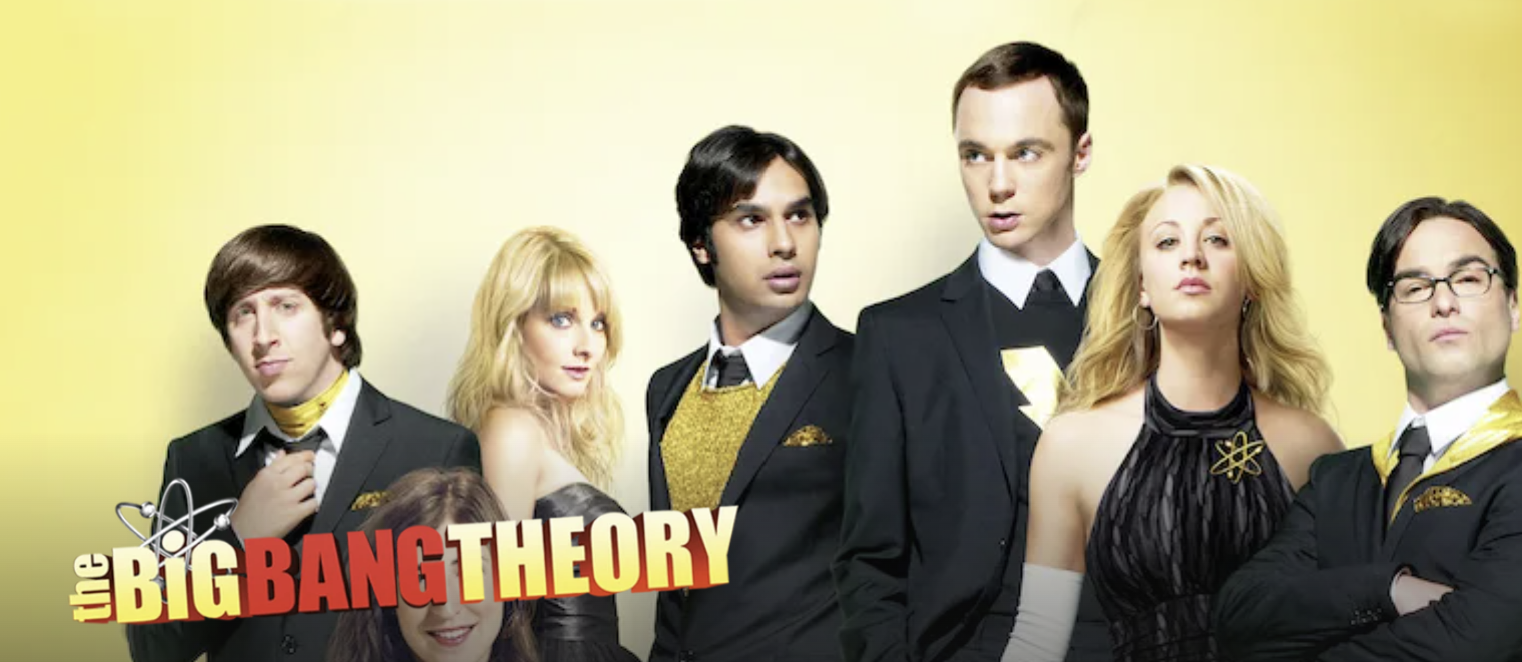
Seven years after its finale, The Big Bang Theory reached the top of Nielsen’s US streaming chart. The sitcom logged 1.14 billion viewing minutes in the week of July 27–Aug 2, 2026, its first overall weekly No. 1. It was also the third consecutive week above 1 billion minutes. The result puts a familiar studio question back in focus: how can one new series help audiences rediscover hundreds of existing episodes?
The timing coincided with HBO Max’s July 23 debut of Stuart Fails to Save the Universe. The spinoff follows comic book store owner Stuart Bloom as he tries to repair a multiverse catastrophe, bringing back Kevin Sussman, Lauren Lapkus, Brian Posehn and John Ross Bowie in their original roles. Stuart had not reached Nielsen’s top 10 through that measurement week, when only two episodes were available. Comparing its accumulated minutes with the original’s 279 episodes therefore requires care.
A Sept. 3 report in TheWrap, republished by Parrot Analytics, identified the spinoff as a catalyst for renewed interest in the original. The mechanism resembles the “Netflix effect,” but HBO Max could connect the new title and library within its own service. Both HBO Max and producer Warner Bros. Television belong to Warner Bros. Discovery. Parrot estimates that the franchise contributed more than $900 million, or about 1.23 trillion won, in global subscriber revenue and more than 3 million signups to HBO Max during 2020–2025. Those are modeled historical franchise contributions, not revenue disclosed by WBD for an individual title or an estimate of the 2026 spinoff’s incremental return.
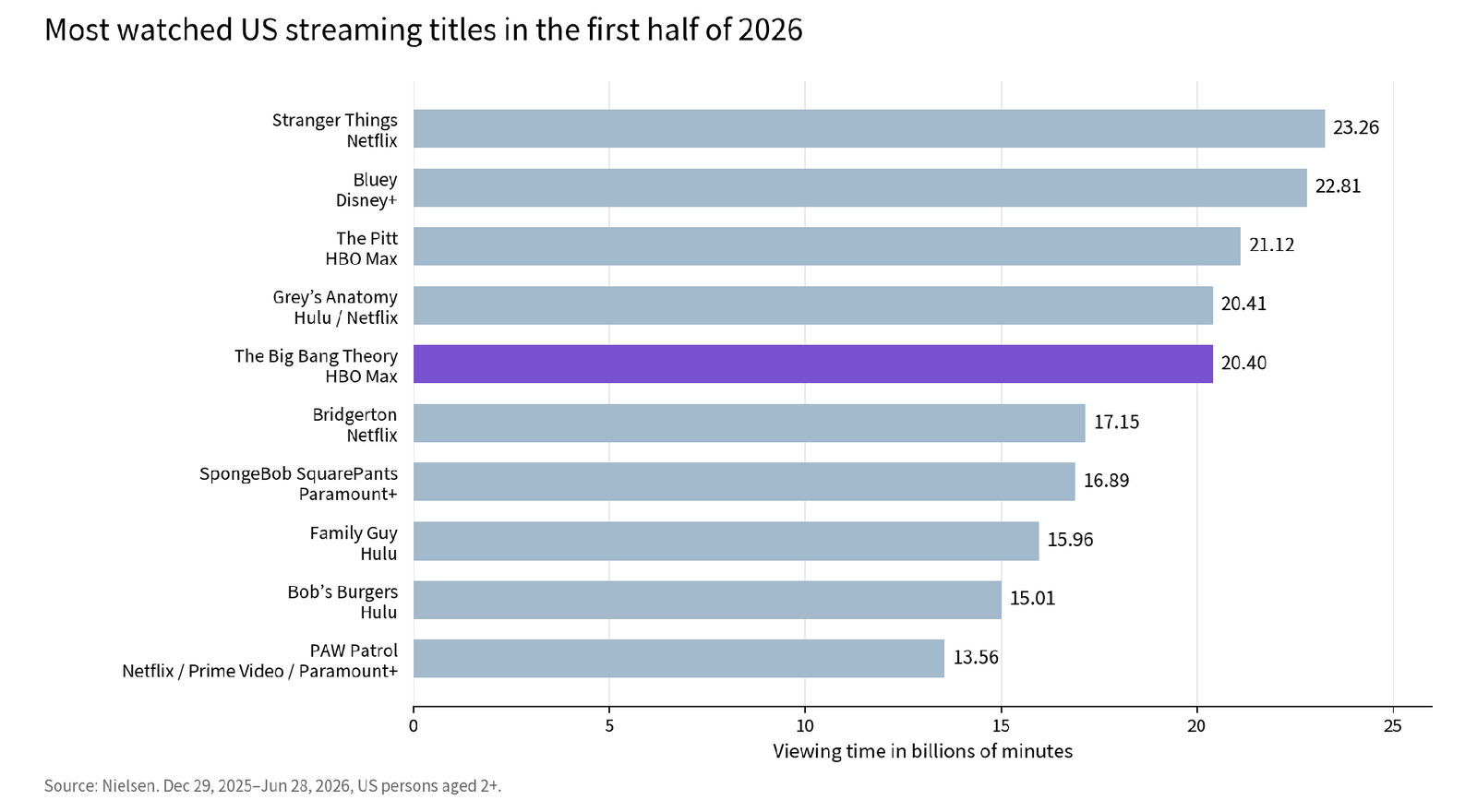
The simultaneous rise does not establish the path taken by individual viewers. Summer scheduling, promotion, recommendations and habitual rewatching could also affect the result. The original was already fifth in Nielsen’s first half ranking, with 20.4 billion minutes before Stuart launched. This was an additional surge for an established library performer, rather than evidence that a dormant title had suddenly acquired an audience.

Demand for the original rises to roughly 47 times average
Parrot’s Demand360 expresses interest as a multiple of the average television title in a market. It combines viewing and engagement signals, including search and social activity, and is distinct from Nielsen viewing minutes or a measured viewer count. The published US chart shows The Big Bang Theory falling to roughly 27 times average in spring 2026, recovering to about 44 times in June and reaching about 47 times shortly after the spinoff arrived. The upward trend had begun before the premiere.
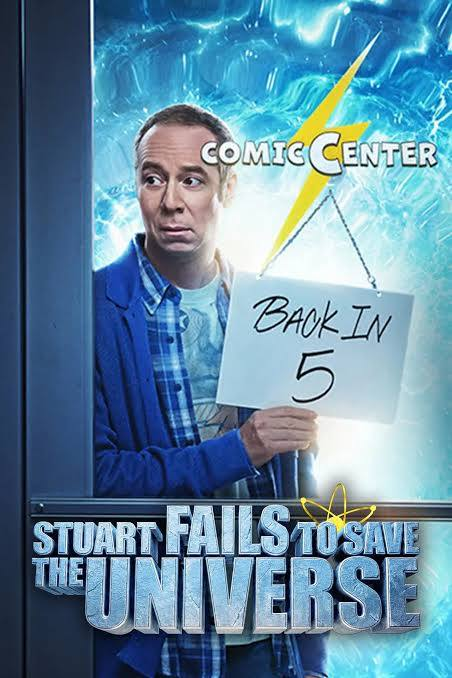
Stuart rose from periods of single digit demand multiples before launch to roughly 37 times average around its debut, then settled near 28–31 times by late August.
Young Sheldon fell from the 30s in late 2024 to about 12 times by the end of the chart, while Georgie & Mandy’s First Marriage finished in the low 20s. The franchise did not move uniformly. The clearest launch period changes were visible in the new spinoff and the original, without proving how much one caused the other.
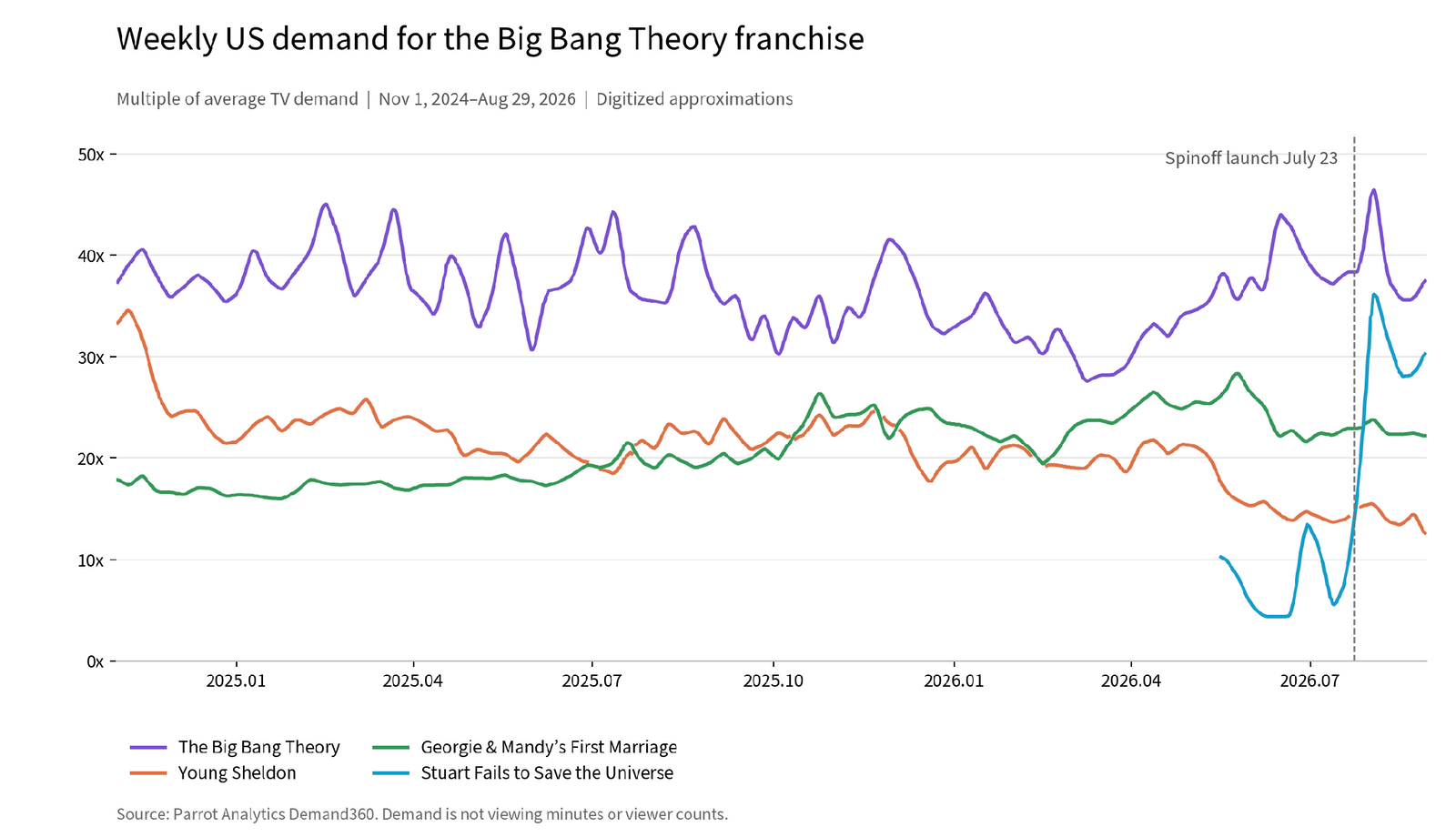
US weekly demand, Nov 1, 2024–Aug 29, 2026. Approximate values digitized from the published chart, not Parrot’s underlying dataset. Source: Parrot Analytics Demand360
A strong library baseline before the spinoff arrived
The Big Bang Theory ranked fifth in Nielsen’s first half 2026 list with 20.40 billion minutes. It followed Stranger Things at 23.26 billion, Bluey at 22.81 billion, The Pitt at 21.12 billion and Grey’s Anatomy at 20.41 billion. The reporting interval ran from Dec 29, 2025 through Jun 28, 2026. A gap of just 10 million minutes separated fourth and fifth place, underscoring how strong the sitcom was before the summer launch.

Only three of the top 10 — ‘Stranger Things,’ ‘The Pitt’ and ‘Bridgerton’ — are streaming-service originals. The rest are broadcast series or licensed titles, many with deep episode counts built up over years on network or cable TV: ‘Grey’s Anatomy,’ ‘Family Guy,’ ‘Bob’s Burgers’ and ‘SpongeBob SquarePants’ sit alongside ‘The Big Bang Theory.’ Once a long-running library title catches, its minutes stack up quickly.
Each spinoff attracts a different demographic response
Parrot’s global, all time audience estimates based on social interactions suggest distinct generational profiles. The original’s largest group is Zennials, defined in the chart as ages 27–33, at 31.1%, with a gender split of 51.3% male and 48.7% female. Gen X and older, ages 44+, account for 47.9% of Young Sheldon and 58.3% of Georgie & Mandy. Their female shares are 55.7% and 58.5%, respectively. These estimates are not a direct census of each platform’s viewers.
For Stuart, Gen Z ages 17–26 accounts for 30.0% and Zennials for 40.0%, a combined 70.0%. Gen X and older represent 10.0%, while the male share is 55.0%. That suggests the multiverse comedy is drawing a different response from the family sitcom branches of the franchise. The original is spread more evenly across the four generations, at roughly 20–31% each. The distribution cannot by itself show how many people moved from a spinoff to the parent series.
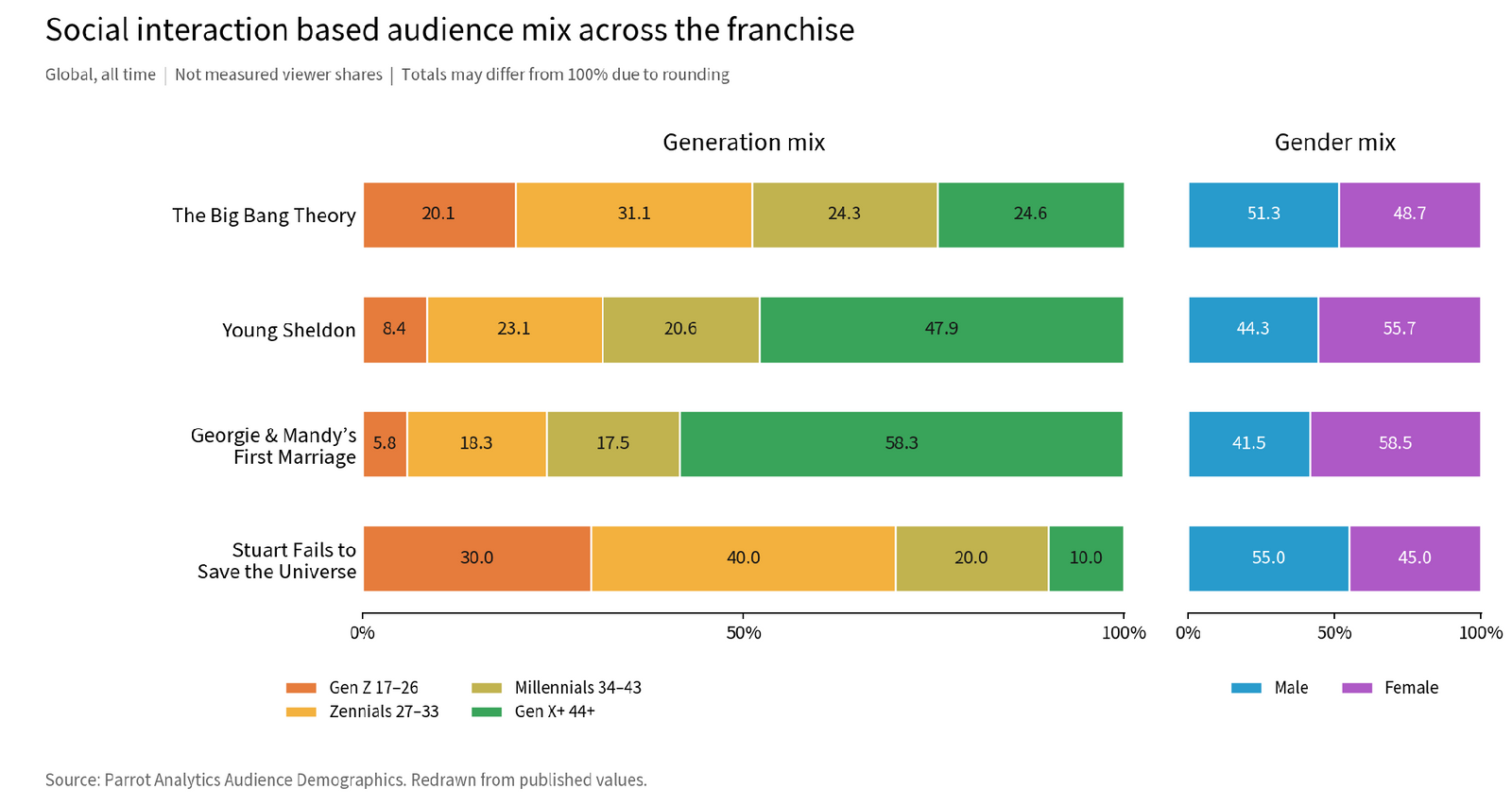
Global, all time audience estimates based on social interactions. Values transcribed from the published chart; rounded shares may not total 100%. Source: Parrot Analytics
The Big Bang Theory universe at a glance. Sources: Parrot Analytics, Nielsen, Warner Bros. Discovery, Deadline, Variety
Rights and release windows shape the value of the library
HBO Max announced exclusive US streaming rights to The Big Bang Theory in September 2019, ahead of the service’s launch. Contemporary reporting put the rights arrangement at about $600 million, or 821 billion won.
TBS’s cable window was also extended through 2028. Streaming and cable terms should be distinguished, and the reported price should not be treated as a current 2026 valuation. The strategic point is that 12 seasons and 279 episodes were positioned as an audience asset from the service’s beginning.

Young Sheldon illustrates another distribution route. After reaching Netflix in the US in November 2023, it led Nielsen’s weekly chart with about 1.3 billion minutes in the final week of December. External licensing and an in-house spinoff can both expand attention. Yet the platform’s subscription and engagement benefits are different from the producer’s licence payments. A rights holder must compare the fee, incremental audience value and opportunity cost of exclusivity rather than assume one arrangement is always superior.
HBO Max described Stuart as its second-biggest original comedy launch globally and renewed it on Aug. 14. It did not disclose an exact audience count or the full basis of that ranking. HBO programming executive Amy Gravitt emphasized the response from existing fans and newcomers. Warner Bros. Television Group chair Channing Dungey credited Chuck Lorre, Zak Penn and Bill Prady with a new interpretation that retained the original franchise’s appeal.

The proposed Paramount takeover remains unfinished
Paramount Skydance’s roughly $110 billion, or 150.5 trillion won, proposed WBD acquisition could eventually change the ownership of these windows. Despite a settlement with 12 state attorneys general, US District Judge Araceli Martínez-Olguín held off on approval on Sept. 24. A Sept. 25 statement from Sen. Cory Booker’s office said the court had directed the parties to answer his concerns by noon on Sept. 28. As of Sept. 27 in Korea, the acquisition should not be described as completed.
If completed, the transaction would bring CBS, Warner Bros. Television and HBO Max into one corporate group, creating more scope to coordinate broadcast follow-ups, streaming spinoffs and the original library. Common ownership would not automatically merge existing contracts or territorial rights. Licence terms, local availability and regulatory conditions would still determine what could be aligned.

Korean IP owners need a franchise view of licensing
Korea offers a useful comparison in Resident Playbook, the Hospital Playlist spinoff. The 12 episode tvN series aired April 12–May 18, 2025, with planning by Shin Won-ho and Lee Woo-jung and production by Eggiscoming.
It entered Netflix’s official global non-English TV top 10 in its debut week of April 7–13. Separately, an April 16 allkpop report citing FlixPatrol reported No. 1 positions in South Korea, Indonesia, Malaysia, Thailand and Vietnam and top 10 placements in 44 countries. Those country rankings should not be conflated with Netflix’s official global weekly chart.
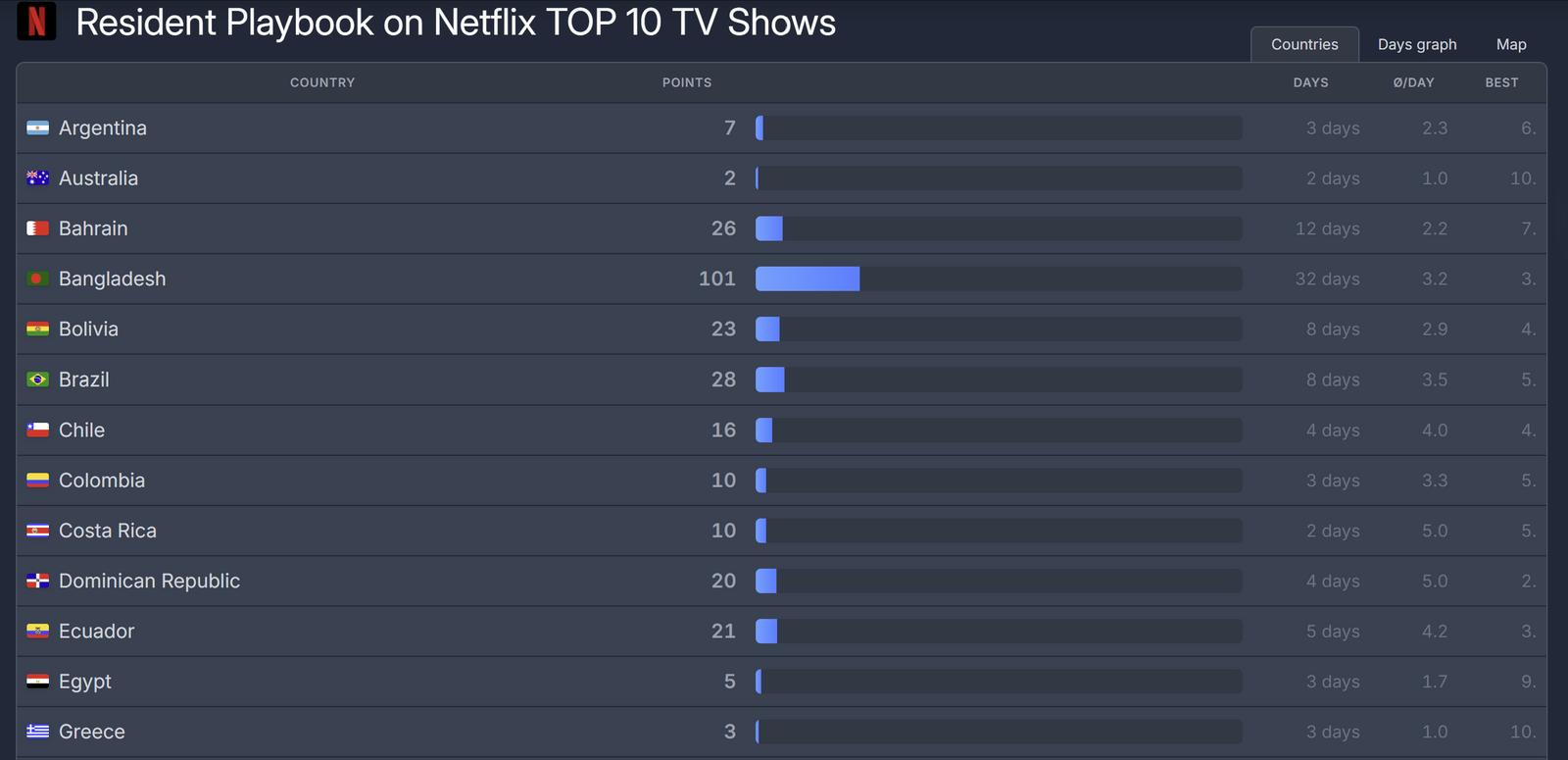
Multiple Korean access points for the spinoff and original, including Netflix and TVING, differ from HBO Max’s exclusive US streaming home for The Big Bang Theory. Any renewed library interest need not accrue to just one service. Platform-level incremental viewing has not been disclosed, however, so the allocation of any lift cannot be quantified. Reporting of CJ ENM’s second quarter 2026 results put TVING revenue at 140.7 billion won, about $103 million, and operating profit at 6 billion won, about $4.4 million, its first quarterly profit. Those company-wide figures do not establish the contribution of an individual drama or spinoff.
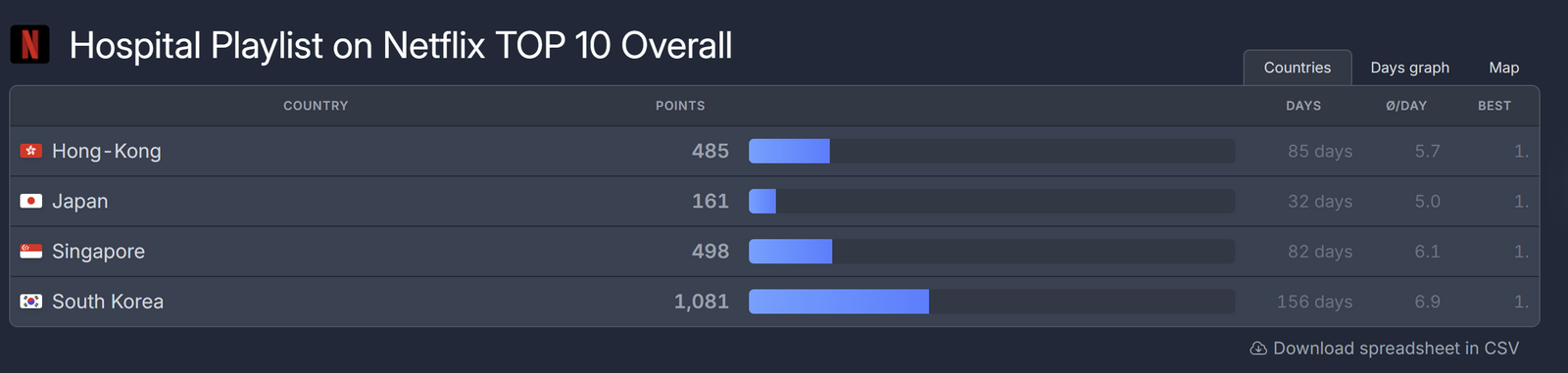
For Korean broadcasters and producers, the practical task is to review the original’s licence expiry, territorial exclusivity, the follow-up’s release window, cross-promotion rights and access to viewing data together. A new show’s launch is more useful to the library when the contract permits renewed promotion and timely availability. External licence income must also be weighed against the value of retaining users on an affiliated service. Franchise planning widens those choices rather than prescribing universal exclusivity.
The next test comes after the season ends
With Stuart’s first season ending Sept. 24, the next question is how the original performs without a weekly supply of new episodes. By late August, Parrot’s published chart put Stuart near 28–31 times average and The Big Bang Theory near 35–38 times, below their peaks. September and October Nielsen results will help show whether weekly viewing stays near 1 billion minutes and above its prior trend. User-level transitions and subscription retention would provide stronger evidence of business impact.
The Big Bang Theory demonstrates that a hit’s commercial life can continue well beyond its final episode. A spinoff can create an occasion to rediscover hundreds of library episodes as well as generate its own audience. More viewing, however, is not equivalent to more profit. Production and rights costs, licence income and subscriber retention all belong in the calculation. For Korean IP owners, the opportunity is to negotiate new-series plans and library rights together, supported by enough data to evaluate the result.
Sources
· Parrot Analytics, “Why The Big Bang Theory is suddenly dominating streaming again,” Sep 3, 2026 Source
· TheWrap (Loree Seitz), “Inside ‘The Big Bang Theory’s Explosive Streaming Moment,” Sep 3, 2026 Source
· The Hollywood Reporter (Rick Porter), “Streaming Ratings: ‘The Big Bang Theory’ Claims First Ever Overall No. 1,” Aug 28, 2026 Source
· CinemaBlend, Big Bang Theory viewership record, Aug 30, 2026 Source
· Nielsen, first-half 2026 streaming rankings, Aug 4, 2026 Source
· Warner Bros. Discovery press release, ‘Stuart Fails to Save the Universe’ Season 2 renewal, Aug 14, 2026 Source
· Wikipedia, Stuart Fails to Save the Universe Source
· Multichannel News / Next TV, HBO Max Nabs Big Bang Theory, Sep 17, 2019 Source
· Deadline, HBO Max lands Big Bang Theory rights; TBS extends to 2028, Sept. 2019 Source
· What’s on Netflix, ‘Young Sheldon’ to Netflix U.S. (Nov. 2023) Source
· The Hollywood Reporter, streaming ratings Dec. 25–31, 2023 Source
· Al Jazeera, Paramount settles with states and WGA, Sep 21, 2026 Source
· Sen. Cory Booker, statement on court review of the Paramount settlement, Sep 25, 2026 Source
· Wikipedia, Resident Playbook Source
· allkpop, ‘Resident Playbook’ global rankings, April 2025 Source
· EToday, CJ ENM second quarter results and TVING first quarterly profit, Aug 6, 2026 Source
Notes: Won equivalents use an editorial conversion of 1,368.4 won per dollar for consistency; this is not presented as a verified market closing rate. Demand curves are approximate readings of a published image. Demographic shares are based on social interactions. Viewing minutes, demand, audience estimates and subscriber revenue attribution are distinct measures.