

DATA
A surge in low-quality sites and the race for AI visibility expose a gap in media economics; ad requests rose 354% this year as Big Tech turns to paid content markets
Low-quality content churned out by generative AI is turning into a new cost for the advertising market. Operators can produce an article page for less than $2.25 and pack it with ad slots, and the scramble to appear in AI answers — generative engine optimization, or GEO — is adding fuel. The task for advertisers and publishers is less about how much content exists than about verifying where it travels and where ad money lands.
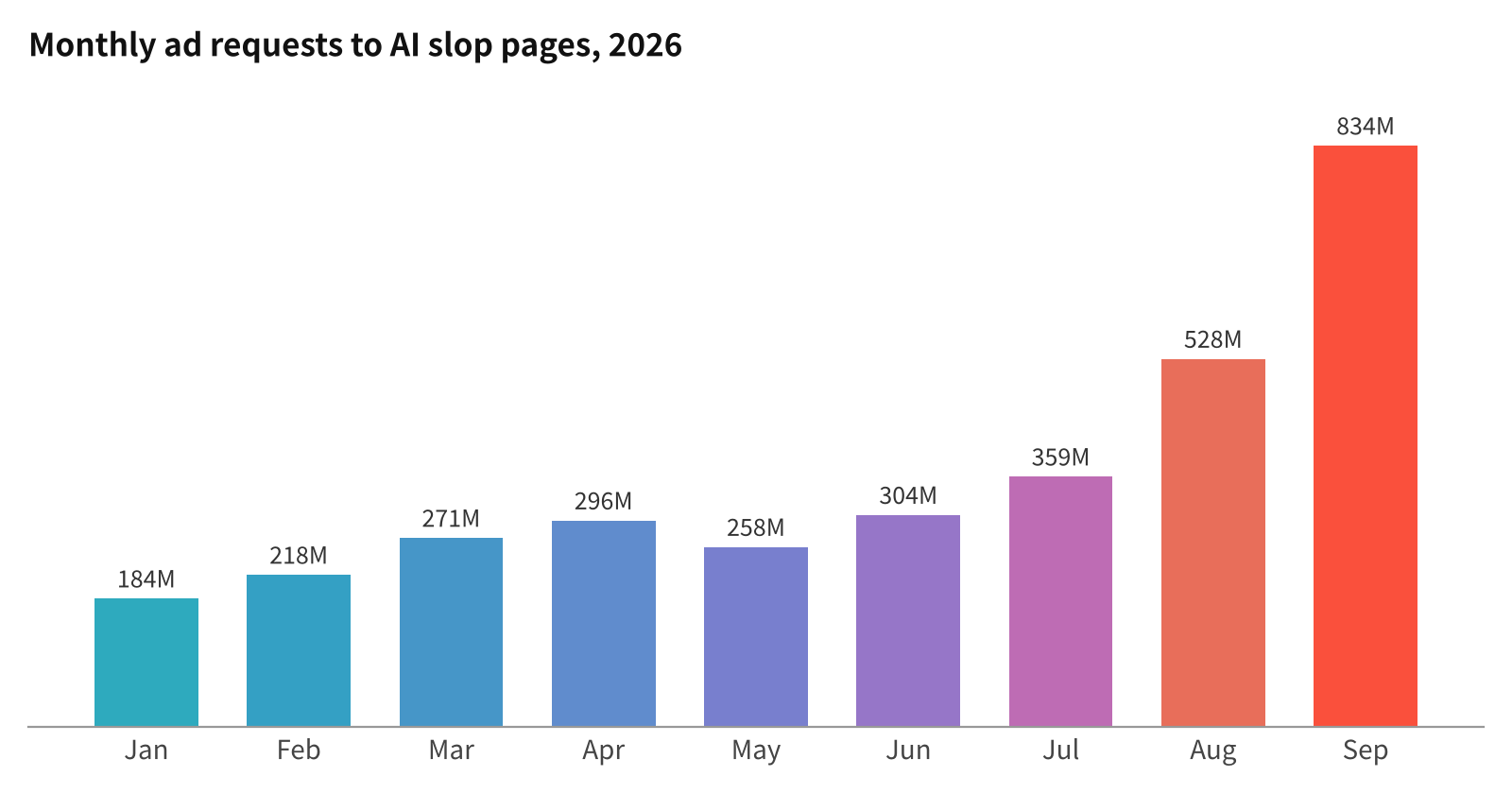
Sites filled with low-quality AI material grew more than fivefold in the second quarter from a year earlier and their traffic quadrupled, according to ad-verification firm DoubleVerify. Monthly ad requests to those pages rose 4.5-fold, from 184 million in January to 834 million in September, topping 3.2 billion for the nine months, Axios reported on Oct. 17.
Big Tech is building markets that pay for verified content. Microsoft is expanding a Publisher Content Marketplace that compensates publishers when AI answers cite their material, and Amazon is weighing one of its own. Google and OpenAI have released AI checkout standards with Shopify and Stripe. Those efforts cover paid content and transactions; free pages built to harvest ad revenue remain outside them.
Ad requests climb from 184 million to 834 million, with 42% landing in August and September
An ad request is a call from a page to an ad server or exchange asking for an ad. It does not mean an ad was shown or seen, and it cannot be converted directly into ad spend or operator revenue. The 3.2 billion requests measure the volume of trading opportunities slop pages created.
Requests rose gradually to 359 million in July, then surged to 528 million in August and 834 million in September; those two months account for 42% of the nine-month total. Dan Slivjanovski, DoubleVerify's chief marketing officer, told Axios the late-year spike tracks historical ad-fraud patterns as operators position for holiday spending.
A 200-site network, 50 slides a page, eight banners a slide
DoubleVerify identified a made-for-advertising network of more than 200 sites. Pages ran upward of 50 slides, each carrying as many as eight banners that refreshed every few seconds. The figure describes networks DoubleVerify found; it is not a count of AI-generated sites worldwide or a measure of losses to any advertiser.
The AutoBait network, first exposed in an Axios exclusive in March, was also more than 200 sites strong. Its operators generated pages from templated prompts for under $2.25 each. Instructions left in the sites' JavaScript told the model to lead with the most shocking detail and charge every paragraph with fear or anger, and the group bought lapsed domains to inherit existing traffic and search history. "AI is supercharging so many types of attacks," Gilit Saporta, DoubleVerify's senior director of fraud and quality analysis, told Axios at the time, adding that fraudsters are always early adopters.
An $11 fake brand reaches ChatGPT in three weeks as visibility shifts from rankings to answers
GEO means shaping content so that brands and information are found and cited by AI search and chatbots. Supplying accurate source material and structured data is part of it, so GEO is not spam by definition. The risk lies in a race for visibility alone, which rewards cheap, repetitive pages — the content farms that once chased search clicks now chase a place among the sources AI consults.
Deana Burke, a marketer turned writer of the Boys Club newsletter, showed how that works. She spent $11.25 on a cheap domain, a three-page site of mostly AI-written copy and a single Substack post for Morrowen, a natural deodorant brand that does not exist. Three weeks later ChatGPT, with browsing on, was recommending Morrowen to users asking about deodorant for sensitive skin, at times ahead of clinically tested brands, Inc. reported on Aug. 8. Claude and Gemini never surfaced it.
In an earlier test, Burke put buying questions to the three models nearly 9,000 times and found the same products recurring across them, a shelf led by Native, named first 99 of 180 times. Morrowen landed on a dusty back shelf. "But I was still in the store, remarkably!" Burke wrote. She argues the stakes exceed classic SEO manipulation: a chatbot's pick carries more authority than a list of links, and an AI agent can turn that pick into a purchase.
"There is a problem with stuff that's created just for bots," Joe Marchese, an investor and author of the forthcoming book Human Dot AI, told Axios, questioning how a trillion-dollar industry can be fooled by an $11 website. Frequency and favorability also diverge: Kantar's snapshot of AI-generated airline recommendations found the carrier mentioned most often was described less favorably than a rival with fewer mentions. Chief executive Paul Zwillenberg said the firm advises clients to put quality and relevance ahead of volume.
Medium chief executive Tony Stubblebine told Axios that roughly half of the 25 Medium stories most often surfaced in Google's AI search summaries had already been excluded from Medium's own recommendation algorithm. DoubleVerify's data, however, count ad requests; how often slop pages are adopted in AI answers, or how much they sway purchase recommendations, has not been measured.
Key AI slop metrics. Data: DoubleVerify via Axios (Oct. 17, March 4); Inc. (Aug. 8)
UCP and ACP standardize checkout; verifying content is a separate job
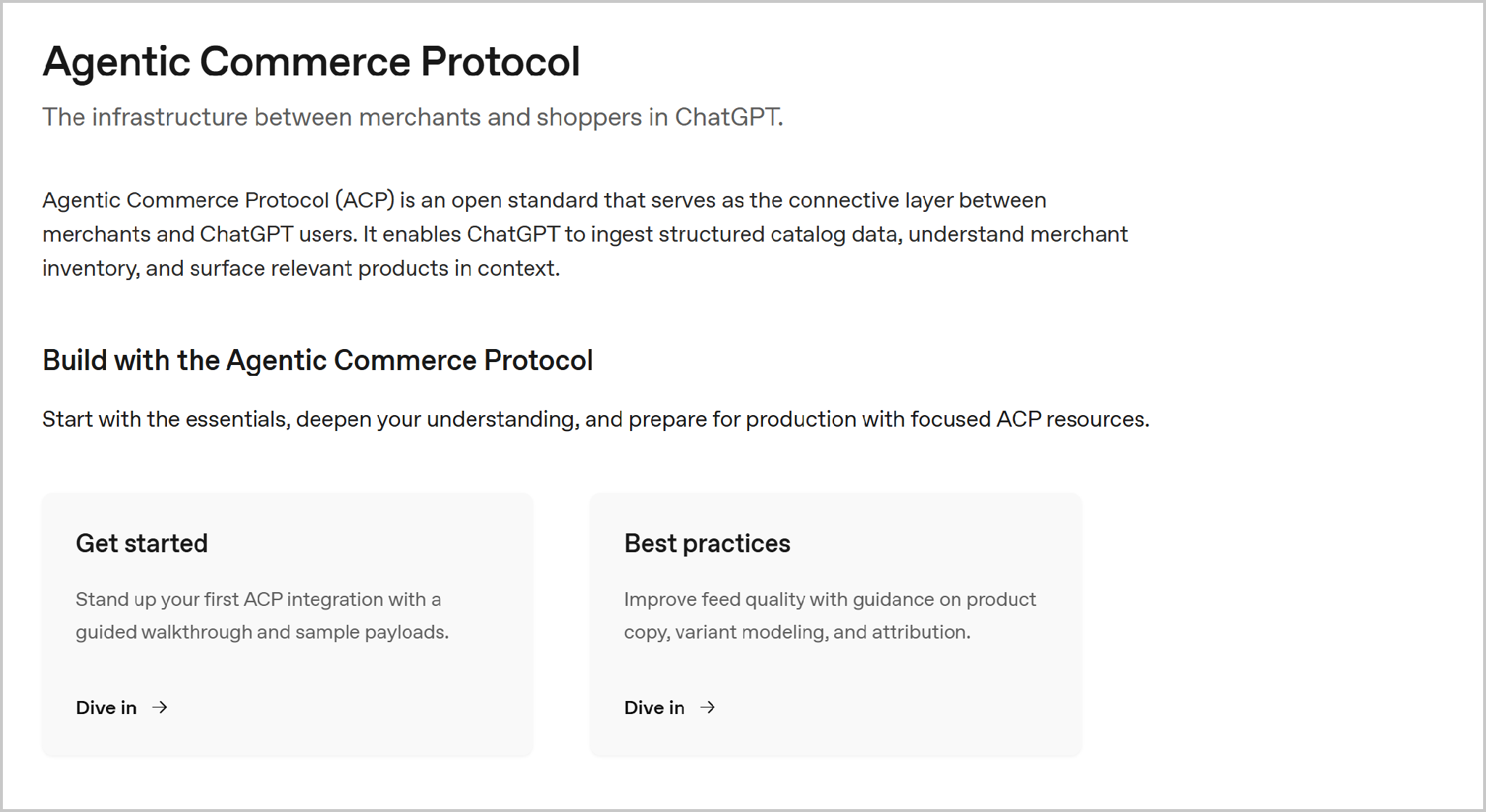
The Universal Commerce Protocol, developed by Shopify with Google, is an open standard connecting merchants to AI agents, with Target, Wayfair and Etsy among its backers. OpenAI and Stripe released the Agentic Commerce Protocol on Sept. 29, 2025, launching Instant Checkout inside ChatGPT. Stripe's shared payment tokens are limited to a single merchant and cart total, letting ChatGPT initiate payment without handling card details.
Microsoft backed UCP on April 21 and said it would plug Shopify's Global Catalog into Copilot Checkout, opening more than half a million merchants to Copilot users. Both standards tie product data and payment to verified merchants. Axios noted that such partnerships may guard much of the transactional web, but content made to sway language models is growing fast outside it. The existence of these standards is no evidence that slop is being blocked.
From upfront fees to per-citation pay: Microsoft's PCM, with Amazon weighing a rival
Microsoft's Publisher Content Marketplace compensates providers of information that is hard to get free online — map data, product catalogs, news, health information — when AI platforms cite it, with Copilot as the first buyer. "We expect this to be a very high-volume marketplace in the future," Tim Frank, Microsoft's corporate vice president for AI monetization, told Axios in April. The company will charge a low technology fee and take no cut of transactions.
Most retrieval-augmented generation deals between publishers and AI platforms today are paid upfront; a marketplace pays each time content is cited. Citing The Information, TechCrunch reported on Feb. 10 that Amazon had briefed publishing executives on a content marketplace and circulated slides mentioning one before an AWS publisher conference. An Amazon spokesperson did not deny the report, telling TechCrunch the company had "nothing specific to share on this subject at this time."
OpenAI has signed licensing deals with the Associated Press, Vox Media, News Corp and The Atlantic, among others, but those agreements have not stemmed copyright litigation, and publishers blame Google's AI summaries for falling referral traffic. The Information reported that publishers see a marketplace as a more sustainable business, one that scales with AI usage.
AI platforms' commerce and content standards and marketplaces. Sources: Axios, TechCrunch, Stripe, Shopify
Advertisers check placements, publishers show their sources
A February report from Korean video-analysis firm Pyler (파일러) found that 19.3% of corporate ad budgets on video platforms ran alongside AI slop and other low-quality or sensitive videos, Digital Insight (디지털인사이트) reported on Feb. 4. Pyler estimated that placement next to harmful content can cut brand trust by as much as 60%. Buying on low prices and abundant impressions alone sends part of a budget to such inventory.
For advertisers, that means auditing where ads actually ran: delivery by outlet and sales path, ad density per page, originality of content and whether an editor is accountable — and checking that money removed from dubious outlets reaches verified ones.
For publishers, showing whose reporting and data underpin a story carries more weight. Bylines, update times, links to source material and correction histories make provenance traceable for readers and AI services alike, and become the basis for trade in markets that pay per citation.
Korea: news-training dispute sits with regulators; broadcast archives fit the marketplace categories
DoubleVerify's figures are global and offer no basis for estimating Korean losses or growth in Korea's slop sites. In Korea, payment for content has surfaced first as a dispute. The Korea Newspaper Association (한국신문협회) asked the Korea Fair Trade Commission (공정거래위원회) in April 2025 to act against Naver (네이버) for training AI on news without permission, withholding training-data details and using news in its generative search. The commission opened a market-dominance case that May, the Journalists Association of Korea (한국기자협회) reported.
The categories Microsoft prices — maps, products, news, health — overlap with what Korean broadcasters hold: news video archives, programming and talent data, and local reporting. With no per-citation benchmark in Korea, prices set in overseas marketplaces are likely to anchor Korean negotiations. In ad sales, the same verification data support broadcasters: once ad requests to low-quality pages are quantified, the brand-safety gap between broadcast inventory and made-for-advertising sites can be expressed in price.
Outlook: holiday fraud season and the missing metric
The fourth quarter draws the year's heaviest ad spending. If the holiday pattern Slivjanovski describes repeats, ad requests to slop pages could climb past September's level, lifting demand for verification.
UCP and ACP now cover checkout, while Microsoft's PCM and Amazon's plan cover paid content. There is no accepted measure of how much slop reaches AI answers; Medium's disclosure is one of the few data points. Once such a measure exists, verification firms are likely to extend their scope from ad placements to AI answers, and content marketplaces to price against it.
The more content AI supplies, the more it costs to establish trust. The spread of slop leaves the media industry with a design question: which content advertising budgets and licensing fees should flow to.