AI Recommendation Replaces Discovery, and Ad Money Moves to Small Creators

As discovery moves from chronological feeds to AI recommendation and conversational interfaces, content is priced on relevance rather than reach: 45.5% of U.S. influencer marketing spend goes to accounts under 20,000 followers, and the web is now logging one AI bot visit for every 31 human visits.

AI Recommendation Replaces Discovery, and Ad Money Moves to Small Creators

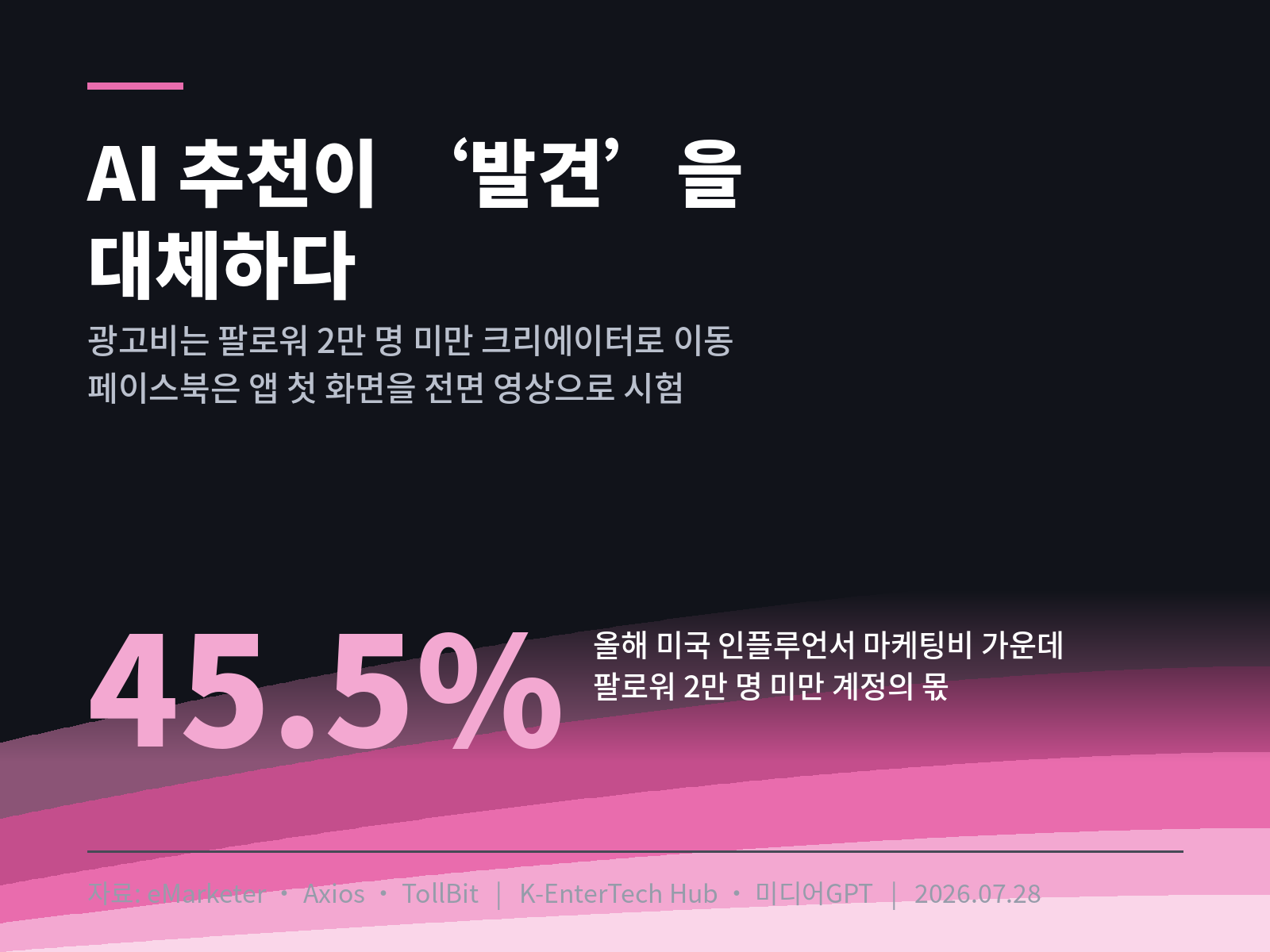
45.5% of U.S. influencer marketing spend now goes to accounts under 20,000 followers, and Facebook is testing a video-first home screen

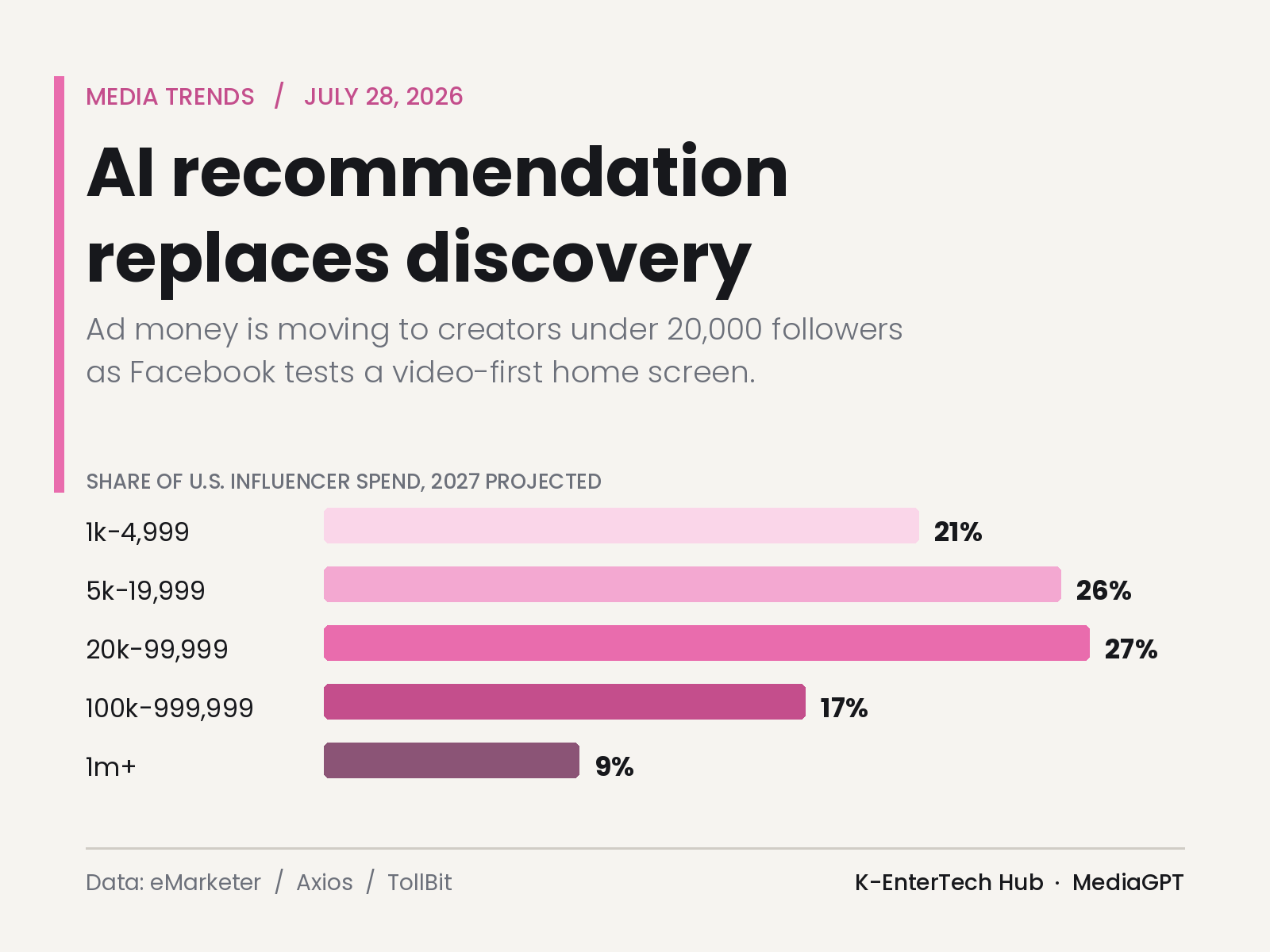
Some 45.5% of U.S. influencer marketing spend this year goes to accounts with fewer than 20,000 followers, while the share held by accounts above one million falls to 9% by 2027, according to eMarketer.

AI 추천이 ‘발견’을 대체하자, 광고비가 소형 크리에이터로 이동했다
인터넷 콘텐츠 발견 경로가 시간순 피드에서 AI 추천과 대화형 인터페이스로 넘어가면서 콘텐츠 가격 기준이 도달 범위에서 관련성으로 바뀜. 미국 인플루언서 마케팅비의 45.5%가 팔로워 2만 명 미만 계정으로 향하고, 웹은 인간 방문 31회당 AI 봇 1회를 기록 중

The shift follows a change in how content is priced — on relevance rather than reach. Recommendation systems and conversational interfaces have taken over the discovery work users once did by curating a follow list and scrolling it in order, giving platforms every reason to surface content that matches an individual's intent over content built for the broadest possible appeal. Axios described the state of play on July 28 as the internet's low-effort era.

Meta Turns the Home Screen Over to Video

Meta announced on July 24, in a newsroom post titled "Connecting Real People on Facebook," that it is testing an app that opens straight into a full-screen vertical video stream. The Classic Feed, the app's front door for more than two decades, moves to a second tab.

Tom Alison, Head of Facebook, wrote that people are signaling they want more immersive, video-forward experiences, and that video is where conversations, communities and commerce are taking place.

The test starts later this year in international markets with heavy video consumption, with a U.S. rollout under review for 2027. Users in the test can revert to the feed-first layout, and the Classic Feed remains available as a tab. Reels, across Facebook and Instagram, sits at a $50 billion annual run rate and now generates more advertising revenue than YouTube.

Ad Money Moves Below 20,000 Followers

eMarketer projects that by 2027 the 1,000–4,999, 5,000–19,999 and 20,000–99,999 follower tiers will each take between 22% and 27% of U.S. influencer marketing spend, while accounts above one million hold 9%.

Share of U.S. influencer marketing spend by follower count, 2021-2027 (2026-2027 projected). Data: eMarketer; Chart: Danielle Alberti/Axios

In 2021 the two tiers below 20,000 followers together took less than 20% of the money, while the two tiers above 100,000 held roughly half. By 2027 the ratio inverts, with the sub-20,000 tiers approaching half the total.

Bloomberg reported on July 24 that Anna Fenstermacher, who has 33,000 TikTok followers, earned $140,000 last year from home decor and fashion content. Abi Platock, a 25-year-old who was working a corporate marketing job in New York, signed her first four-figure brand deal at 8,000 followers. A creator tier is assembling incomes comparable to mid-level salaries out of brand deals, affiliate commerce and TikTok Shop commissions.

Rate data points the same way. In Influencer Marketing Hub's 2026 benchmark report, cost-band selections clustered in the nano tier at 29.54% and the micro tier at 22.36%, against 4.35% for macro creators.

Universal Appeal Loses Its Premium

Shira Lazar, founder of What's Trending and a 2026 TIME100 Creators honoree, said creators no longer have to manufacture universal relatability or appeal to the broadest possible group, and that being specific can now work as an advantage. Almost anyone, she said, regardless of age, background or expertise, can find a community and an audience.

Production practice is following. Vitus "V" Spehar, founder of the social-first news brand Under the Desk News, which has 3.8 million followers, said on TikTok that creators no longer need visible headphones or microphones to signal legitimacy. Sound-blocking in-ear buds and hidden mini-mics, they said, read as more authentic than broadcast-style gear.

One AI Bot Visit for Every 31 Humans

As discovery moves into conversational interfaces, the reader has changed too. TollBit's State of the Bots report found that publisher sites on its network logged one AI bot visit for every 31 human visits in the fourth quarter of 2025, narrowed from 200 to 1 in the first quarter. Human visits fell about 5% from the third quarter.

The composition shifted as well. Training crawls dropped roughly 15% between the second and fourth quarters of 2025, while RAG bots pulling live information rose about 33% and AI search indexers about 59%. Click-through from AI applications back to publishers fell from 0.8% in the second quarter of 2025 to 0.27% in the fourth.

TollBit found business and professional content draws more scrapes per human query than any other category, attributing it to users routing information-retrieval tasks through AI tools. Scrape-to-visit ratios ran 71 to 1 for national news and 76 to 1 for local news, against 218 to 1 in sports, 491 to 1 in health and wellness and 2,235 to 1 in deals and shopping — separating subjects where people still open the source from subjects where the answer ends the session.

Users Ask for the Dials

As machines fill more of the feed, demand for control and transparency has grown. Threads runs a "Dear Algo" feature that lets users write requests to the recommendation system directly, and TikTok offers "Manage Topics" controls for adjusting what surfaces.

What This Means for Korean Players

For Korean broadcasters and content companies this lands first as a distribution design problem. With recommendation systems replacing the discovery function once carried by channel brands and schedules, reach depends on how an individual clip reads as a signal. Because Meta begins its test in video-heavy international markets, Korean users may meet the interface before American ones do.

In K-content distribution, clips organized around filming locations, food, fashion or production process function as separate distribution units rather than the full narrative of a drama. That makes clip-level metadata and secondary-use rights clearance items to settle during production.

Brand and municipal spending needs the same adjustment. Concentrating a budget on one large influencer is already losing efficiency in the U.S. market. In categories with sharply defined interest — regional tourism, K-beauty, K-food — running a portfolio of many small creators converts better.

AI crawlers reaching content ahead of human readers bears directly on Korean media revenue models. The clicks that traffic-based advertising assumed are not coming back, which moves licensing terms, per-access pricing and scrape measurement tooling up the schedule. If citation without visitation becomes the steady state, the link between brand recognition and revenue breaks.

Sources

· Sara Fischer & Kerry Flynn, "Internet enters its low effort era," Axios, July 28, 2026 (original article)  https://www.axios.com/media-trends-membership/2026/07/28/internet-video-social-media-personalization

· Tom Alison, "Connecting Real People on Facebook," Meta Newsroom, July 24, 2026  https://about.fb.com/news/2026/07/connecting-real-people-on-facebook/

· "Facebook Is Testing if People Want to Swap Their Feed for 'Immersive Video'," The Hollywood Reporter, July 24, 2026  https://tech.yahoo.com/social-media/articles/facebook-testing-people-want-swap-134813382.html

· "Facebook Tests New Video Feed Experience for Mobile App," Barrett Media, July 24, 2026 (Reels $50B run rate)  https://barrettmedia.com/2026/07/24/facebook-tests-new-video-feed-experience/

· "Meta drops Facebook Feed to second tab in full-screen video test," PPC Land, July 24, 2026  https://ppc.land/meta-drops-facebook-feed-to-second-tab-in-full-screen-video-test/

· eMarketer, "Micro- and Nano-Influencers Will Claim Almost Half of Influencer Marketing Budgets in 2026," Feb. 1, 2026 (chart data)  https://www.emarketer.com/chart/c/361073/micro-nano-influencers-will-claim-almost-half-of-influencer-marketing-budgets-2026-361073

· "How TikTok Creators Earn Midlevel Salaries With Small Audiences, Brand Deals," Bloomberg, July 24, 2026  https://www.bloomberg.com/news/articles/2026-07-24/how-tiktok-creators-earn-midlevel-salaries-with-small-audiences-brand-deals

· Influencer Marketing Hub, "Influencer Marketing Benchmark Report 2026"  https://influencermarketinghub.com/influencer-marketing-benchmark-report/

· TollBit, "State of the Bots" quarterly report  https://tollbit.com/state-of-the-bots/

· "Bots are taking over the internet and AI users are to blame," The Register, Feb. 4, 2026 (bot-to-human ratio, RAG and indexer growth)  https://www.theregister.com/2026/02/04/ai_bot_traffic_web_browsers/

· "AI Bot Traffic's Effect on Publishers: The Indirect Costs Adding Up," A Media Operator, April 2026 (scrape-to-visit ratios by category)  https://www.amediaoperator.com/analysis/ai-bots-crawlers-web-hosting-costs-indirect/

· Under the Desk News (@underthedesknews), TikTok  https://www.tiktok.com/@underthedesknews

· TIME100 Creators 2026 — Shira Lazar  https://time.com/collection/time100-creators/2026/shira-lazar/