
Summary Samseog Ko of Dongguk University argues in a ZDNet Korea column that K-Culture, K-Brand and K-Tech should grow together with partner countries. He has since pitched co-production in Malaysia, Singapore, Japan and Central Asia; Seoul now targets $110 billion in K-culture exports by 2030.

Samseog Ko (고삼석), a distinguished professor at Dongguk University, wants Korea to stop measuring the Korean Wave by how much content it sells abroad. In a February 23 column for ZDNet Korea titled "Why Co-evolution? From Content Exports to Building an Ecosystem," he proposed a "co-evolution" strategy in which K-Culture, K-Brand and K-Tech grow by connecting with one another and with other countries.
Co-evolution, in his telling, is not a model where Korea alone gets ahead. It is one "in which Korea grows and develops together with other countries that love K-Culture and its brands," he wrote, pursuing social value and inclusion alongside economic growth.
Government figures released after the column point the same way. The Ministry of Culture, Sports and Tourism (문화체육관광부) said on June 2 that content exports hit a record $14.9 billion in 2025. Foreign arrivals reached a record 18.94 million and tourism exports a record $27.2 billion. The ministry has broadened its definition of K-culture to include tourism, food, beauty and fashion, and raised its 2030 export target from $35 billion to $110 billion.
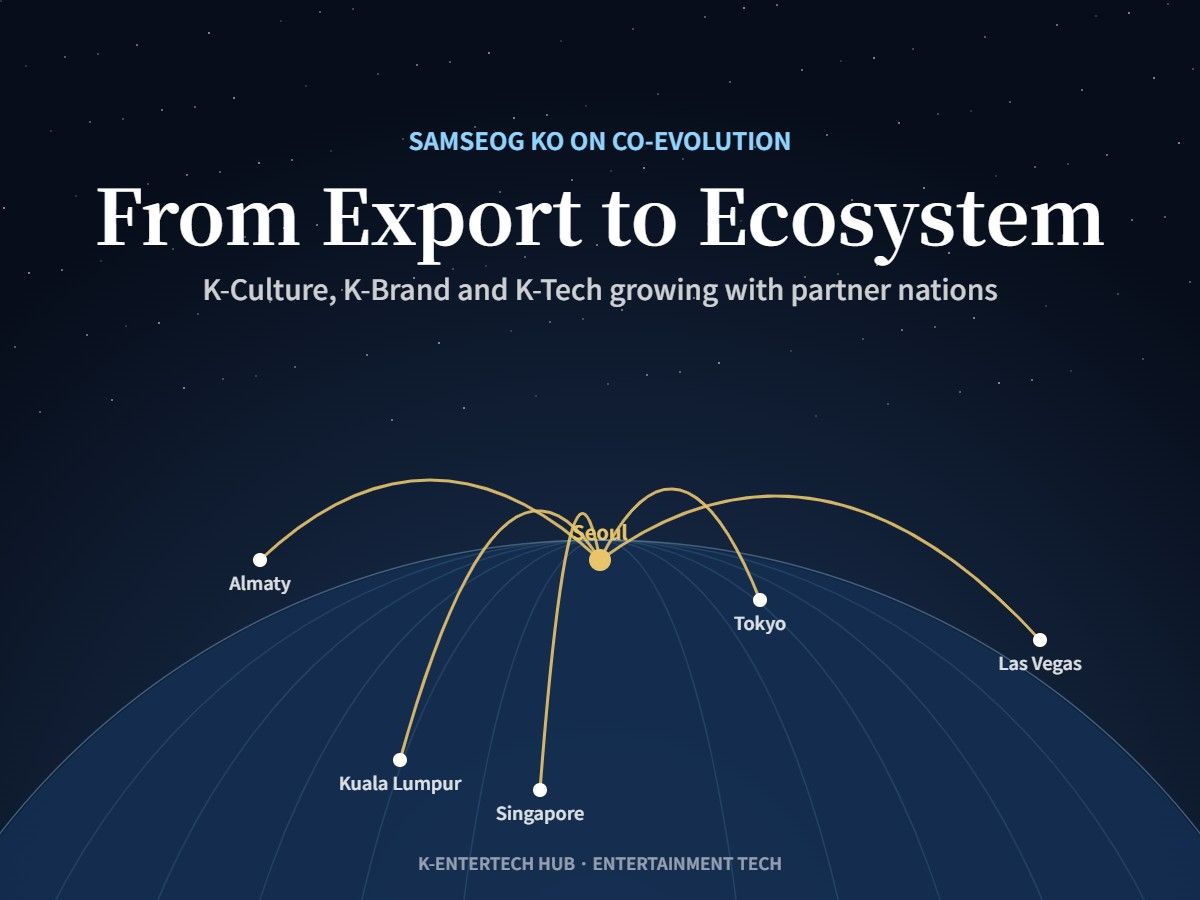
Ko has since taken the idea abroad. He proposed a Korea-Malaysia-U.S. triangle in Kuala Lumpur, a Korea-Singapore Entertainment Tech alliance to a delegation from Singapore's Infocomm Media Development Authority (IMDA), and a standing open-innovation track with Japan. In September he called for joint IP development with Central Asia.
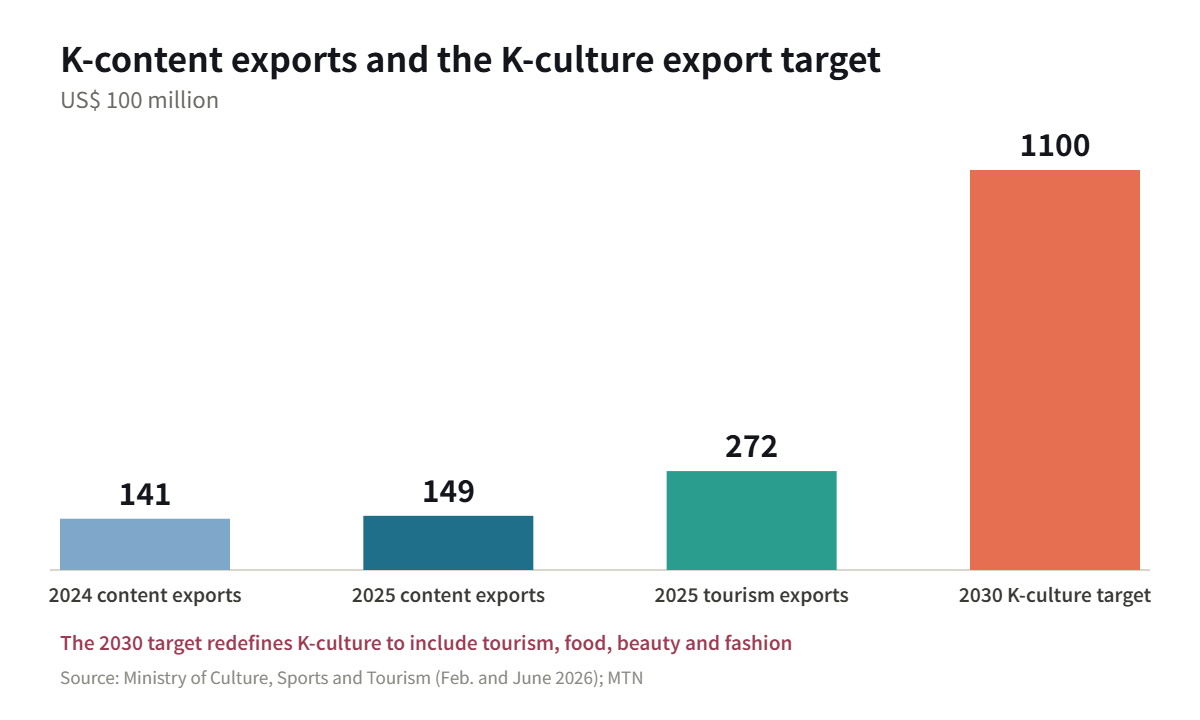
K-culture as a "lifestyle public good": content exports $14.9 billion, tourism $27.2 billion
The first pillar is widening K-culture from a cultural product into what Ko calls a "lifestyle public good." Fans abroad, he argues, no longer stop at watching and listening; they want Korean food, fashion and travel as part of daily life. K-culture therefore "must shift from a closed cultural industry to an open platform," he wrote, built so that creators from other countries can make work together and young people, minorities and emerging economies can take part.
The government's redefinition of K-culture runs in the same direction. Culture Minister Choi Hwi-young (최휘영) raised the 2030 K-culture market target from 300 trillion won to 400 trillion won at a press conference marking the government's first year, folding in inbound tourism, food, beauty and fashion, MTN reported on June 8. Tourism exports of $27.2 billion in 2025 were 1.8 times content exports.
K-Brand as fair consumption, K-Tech as digital inclusion — and a warning about "cultural inequality"
The second pillar is K-Brand. Ko argues that the growth of Korean food, beauty and fashion brands has to come with social responsibility: greener production, labor protections and benefits for local communities. He singles out K-food as a medium for exchange. "Food has the power to ease political and religious conflict and connect people," he wrote, calling for strategies that respect dietary diversity when working with countries of different faiths and cultures.
On the third pillar, K-Tech, he warns that if the gains from generative AI concentrate in a few companies or countries, global "cultural inequality" will deepen. Public platforms, open technology and creator support should let young people, regions and small creators reach world markets. He ties this to the Lee Jae-myung government's "global AI basic society" vision. At the APEC summit in Gyeongju in November 2025, the 21 member economies adopted the APEC AI Initiative, the forum's first joint vision on AI.
| When | Where / occasion | Proposal |
|---|---|---|
| Jan. 26–28 | Kuala Lumpur, meeting with Malaysia's deputy trade minister | Korean and Malaysian firms jointly entering the U.S. market; parliamentary roundtables on content and AI policy |
| Feb. 23 | ZDNet Korea column | Co-evolution of K-Culture, K-Brand and K-Tech; co-production, shared platforms and shared fandoms with emerging regions |
| Apr. 21 | Seoul, Singapore IMDA "Korea Learning Trip 2026" | Korea-Singapore Entertainment Tech alliance linking Southeast Asia and the U.S. |
| June 12 | Nozawa Onsen, Japan, ASTEEDA Executive Salon 2026 | Korea-Japan Entertainment Tech open-innovation track matching large companies and startups |
| Sept. 14 | ZDNet Korea column | Joint IP development with Central Asia that shares creative rights |
Samseog Ko's co-evolution proposals in 2026. Sources: ZDNet Korea, K-EnterTech Hub
Malaysia, Singapore, Japan: the proposals that followed the column
The fourth pillar replaces a competition-driven national model with cooperation. Joint production, talent development, shared platforms and shared fandoms with Southeast Asia, the Middle East and Africa, Ko writes, would turn K-culture from one-way diffusion into mutual growth and move past the old charge of "cultural imperialism."
His work abroad has followed that outline. In January in Kuala Lumpur he met Sim Tze Tzin, Malaysia's deputy minister of investment, trade and industry, and proposed that companies from both countries go after the U.S. market together; the two sides agreed to set up academic channels and parliamentary policy roundtables, ZDNet Korea reported on January 28. On April 21, at a workshop for an IMDA delegation, he put forward a Korea-Singapore Entertainment Tech alliance.
On June 12, at the ASTEEDA Executive Salon 2026 in Nozawa Onsen, Nagano, he turned to Japan. Korea is strong in pop, drama and games and Japan in animation, characters and games, he said, but neither has a strong global distribution platform. "We need a Korea-Japan Entertainment Tech open-innovation track, backed by both governments, where large companies and startups are matched on a standing basis," he said, ZDNet Korea reported on June 14. Lotte Holdings President Genichi Tamatsuka and ESTsoft CEO Jung Sang-won (정상원) joined the session, which K-EnterTech Hub CEO Jung Han moderated.
For co-evolution with mature content markets, the column points to Netflix's animated film "KPop Demon Hunters." Produced by Sony Pictures Animation, it reached 266 million views as of September 3, 2025, becoming Netflix's most-watched title across films and series, Kyunghyang Shinmun reported. It pairs Korean culture with American production money and a global platform.
Seoul as a "global Entertainment Tech hub" — and bringing foreign companies in
The last pillar is cities and regions. Seoul, Ko writes, should become a "global Entertainment Tech hub" where culture, technology, startups and civic participation meet. In a column six days earlier, he noted that global streaming services and digital platforms are mostly owned by U.S. and Chinese companies, so data and revenue flow abroad.
He also wants ties with regional cultural cities such as Gyeonggi, Incheon and Gwangju to drive balanced development. "More than Korean companies going abroad, we should draw foreign companies to come directly into Korea and its regions," he wrote — treating co-evolution as two-way investment rather than one-way export.
Co-production and shared platforms next; for broadcasters, the question is who owns the IP
The debate is moving into policy. Ko was appointed on August 27 as an adviser on culture, broadcasting and ICT to National Assembly Speaker Cho Jeong-sik (조정식), and sits on a subcommittee of the Presidential Council on National AI Strategy. With the K-culture export target at $110 billion, how to design projects that link content with tourism and consumer goods is now a policy question.
For Korean broadcasters, the issue is production and rights. The co-production and shared platforms Ko describes mean planning with partner countries from the start and splitting the results. Moving from selling overseas licenses to co-producing requires settling first who owns the IP and how revenue is shared. In his September column on Central Asia, he made genuinely sharing creative authority and IP a condition for cooperation.
AI dubbing and localization are tools for this as well. PERSO.ai, the AI dubbing platform of ESTsoft, which joined the Japan session, has 460,000 cumulative users, 90% of them outside Korea, and supports more than 75 languages. Pairing technology that moves Korean content into many languages quickly with partner countries' IP is one concrete form the K-Tech pillar could take.
Ko ends the column this way: "Moving beyond content exports to building a vibrant ecosystem, and beyond competition to co-evolution, will be the forward-looking strategy through which Korea grows together with the world."