
NEW BOOK
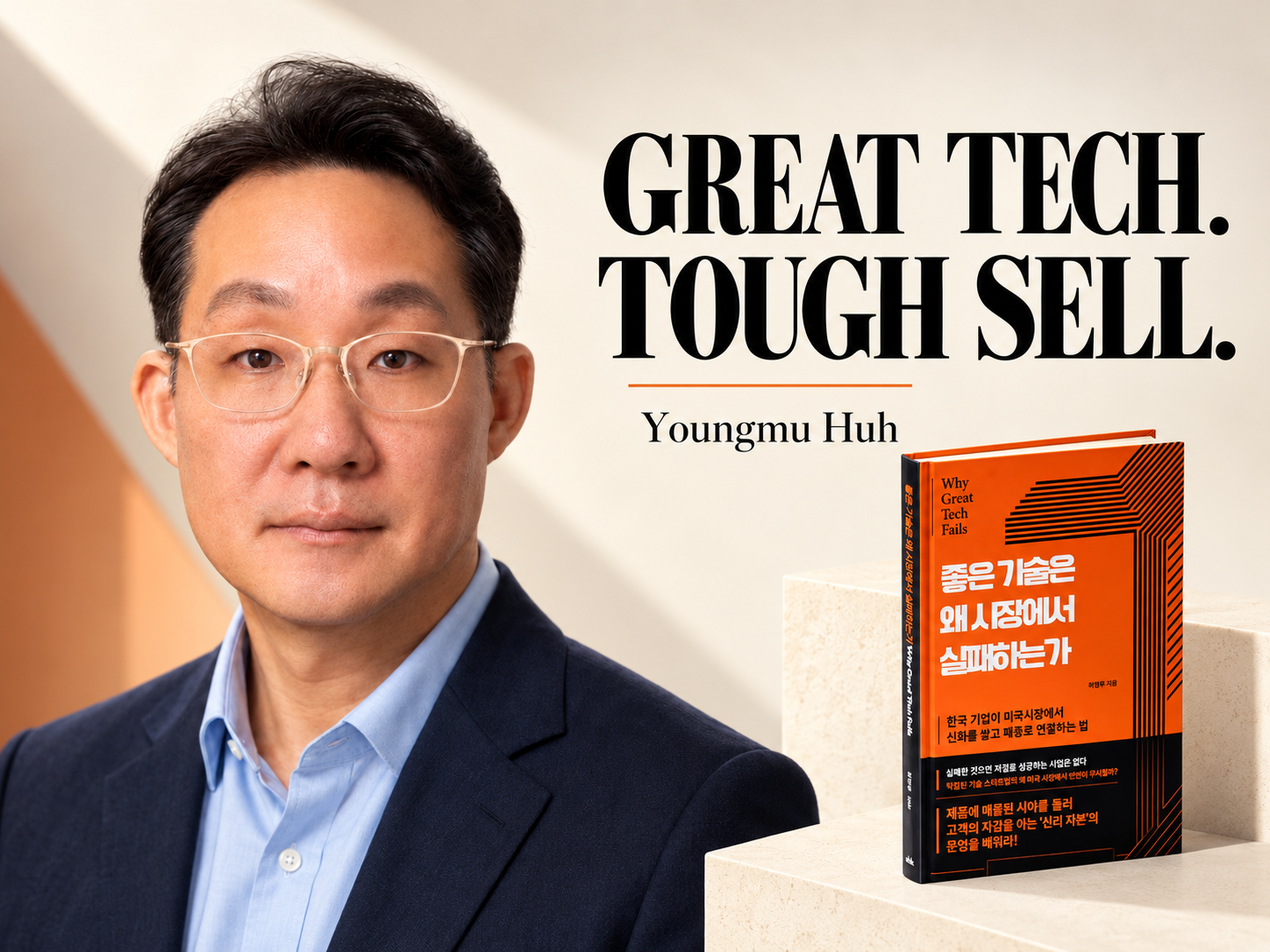
Youngmu Huh (허영무) of YM&Company publishes “Why Great Tech Fails,” 17 chapters of field cases from 22 years in Korea, Japan and the U.S.
Youngmu Huh (허영무), founder and chief executive of YM&Company, has published “Why Great Tech Fails” (좋은 기술은 왜 시장에서 실패하는가). The subtitle translates as “How Korean companies build trust in the U.S. market and turn it into revenue.” The Korean-language book came out on Aug. 10, runs to 230 pages and is priced at 22,000 won.
The book asks why Korean companies with strong technology fail to win customers abroad. Huh does not blame the technology or the execution. “The problem lay less in the technology itself than in the way the technology met the market,” he writes. The core of the failure, he adds, “was closer to a flaw in structure than a shortcoming in people.”
Korean companies took 206 of the 347 Innovation Awards at CES 2026 in January, leading the count for a third straight year. The book covers the step after the award: meeting local customers and turning interest into contracts and revenue.
Huh spent 22 years on business in Korea, Japan and the U.S. at LG Electronics (LG전자), Samsung SDS (삼성SDS) and SK Magic (SK매직). He now works from Georgia, helping robotics, automation, manufacturing and energy companies enter the U.S. market.
Buyers ask who is accountable before they ask how well it works
“If we adopt this and something goes wrong, who is responsible?” is how the book renders the U.S. buyer’s private question. A customer taking on a new technology weighs performance alongside accountability if the project fails, added operating burden and conflict with existing systems. Every new specification a manufacturer adds is one more risk the buyer has to clear. That is why the more advanced product is often the easier one to turn down.
Huh’s remedy is “translation”: restating a technology’s strengths in terms of the customer’s problem, economics and operating environment. In practice it means turning a proposal that lists functions into one a buyer can evaluate. Technology that never makes it into the customer’s language he calls “innovation that stays inside the product manual.”
Trust, he writes, is “business infrastructure, not a relationship.” Local customers and partners look at who will support the product, who answers when something breaks and whether the supplier will be around for the long run. He treats going global as entry into a local ecosystem of customers, partners, distributors, talent and institutions. Expansion without those ties, he says, does not last.
Three parts, 17 chapters: market grammar in the U.S., Japan and Dubai; bidding; joint ventures
Part 1, “Understand the law of the global jungle,” gives the U.S., Japan and Dubai a chapter each. Chapter 1 is subtitled “Drop the Korean way of doing business completely,” Chapter 2 “The quiet but certain rules of silence,” and Chapter 3 “The law of relationships in which 10% of the population governs 90%.” Chapter 4 works through a global luxury hotel project, and Chapter 5 asks why Ultra Stretch, an extra-wide signage display from LG Electronics, came back.
Part 2, “Carry weapons that open markets,” covers solution selling, solving the customer’s spatial problem, bidding, culture and price negotiation. Chapter 8 is subtitled “Escaping the prison of the spec.” Chapter 10 uses McDonald’s and Starbucks in Japan to argue that customers buy on psychological comfort first.
Part 3, “No one survives alone,” deals with the structure of conflict inside joint ventures, the move from a single channel to a multi-network, and the role of local partners. Chapter 14 is titled “The less familiar the product, the more the partner matters.” The final chapter, the 17th, is “Why do we keep repeating failure?” Each chapter is built from cases Huh encountered in the field.
Dubai Mall OLED, 5,000 7-Eleven stores in Japan: the author

Huh has an unusual career: he has worked in all three of Korea, Japan and the U.S., for 22 years in total. Over that time he generated more than $150 million in cumulative revenue for the companies and institutions he worked with.
At LG Electronics he ran the Dubai Mall OLED project, which earned a Guinness World Record, and store infrastructure for 5,000 7-Eleven outlets in Japan. At Samsung SDS he built a $10 million pipeline around an Atlanta logistics hub. At SK Magic he set up the U.S. corporation and headed sales.
After leaving corporate life he founded YM&Company in Johns Creek, Georgia. The firm goes into the field on a client’s behalf to generate revenue. Georgia Tech, the Georgia Department of Economic Development and the Metro Atlanta Chamber form its local network.
Huh is also founding chair of the Atlanta chapter of the International Network of Korean Entrepreneurs (INKE, 세계한인벤처네트워크). The book’s preface, “From agent to architect,” refers to his move from applying headquarters strategy in the field to designing deals himself.
 K-EnterTech Hub
Georgia booked a record $35.2 billion; in October Huh takes 10 Korean companies to Atlanta
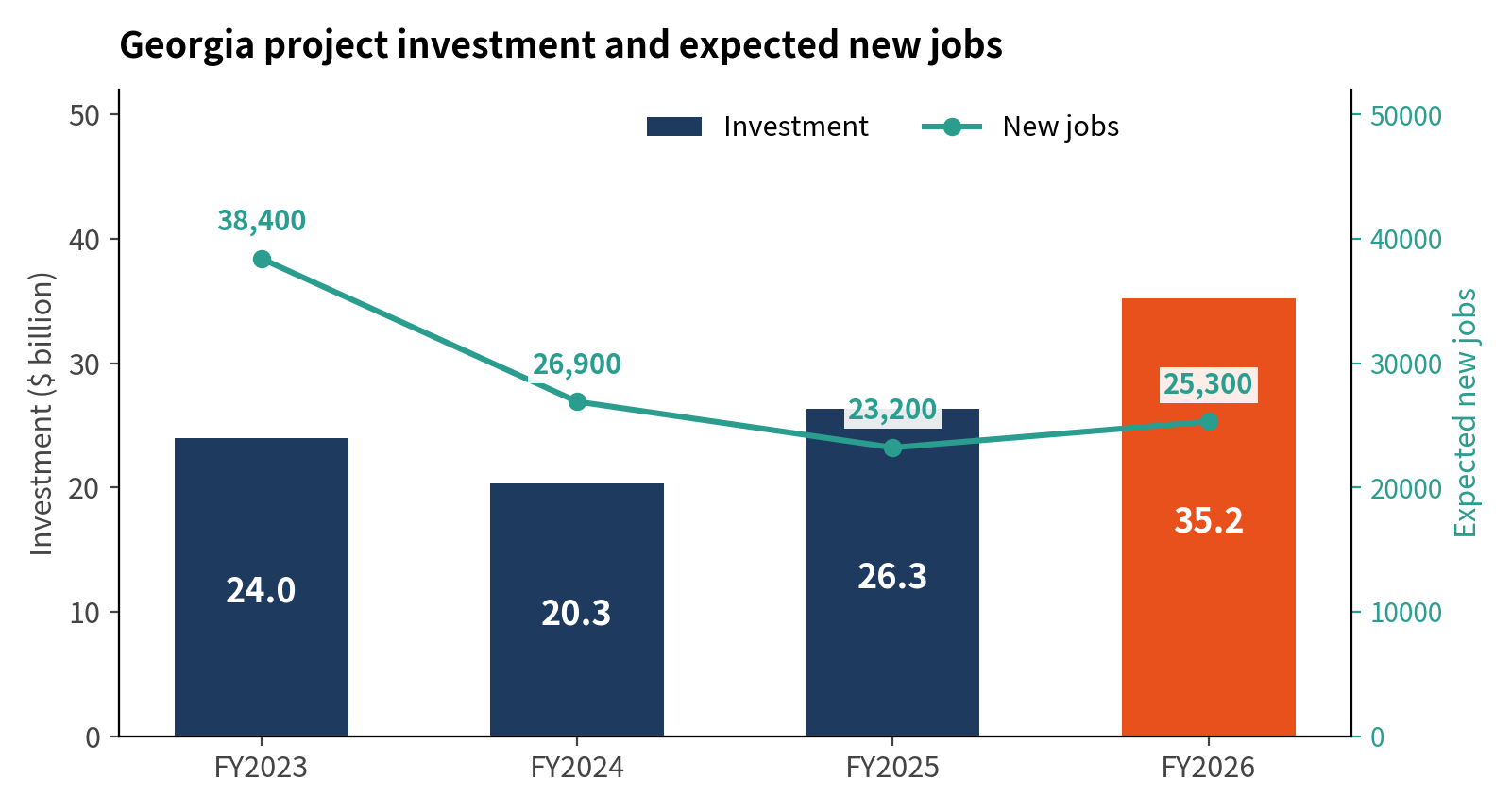
Georgia recorded $35.2 billion in project investment in fiscal 2026, 34% above the previous year and a record for the second year running. Manufacturing accounts for 67% of the 25,300 expected new jobs. The governor’s office listed Korea first among the top international sources of jobs. Korean companies supported by the state have announced more than $24 billion in investment over the past decade.
Huh’s YM&Company and K-EnterTech Hub will run the K-Georgia Innovation Mission 2026 in Atlanta from Oct. 13 to 16 for 10 Korean companies. Huh opens with a briefing on Georgia and the U.S. Southeast. On Oct. 14-15 the group staffs a Korean Desk inside the Venture Atlanta Conference, meeting investors and corporate procurement staff. On the afternoon of Oct. 15 it holds its own event, K-Startup Georgia, at Curiosity Lab in Peachtree Corners, and Oct. 16 is given to one-to-one meetings and site visits. The fee is $3,500 per company and applications close on Sept. 30.
“Georgia is a place where you can extend customers and supply chains on top of a Korea-U.S. industrial base that already exists,” Huh said.
“Failure is a learning cost, not a blemish”: a book to read before CES 2027
“Rather than a glossy success story, I wanted to share a painful realisation and a few small insights: the problem is in how technology meets the market,” Huh said in a statement on the book’s publication. In the epilogue he writes that “the scars earned in the field become a sturdier asset than success at a desk.”
CES 2027 opens in January. Award winners that move into adoption talks with U.S. buyers will be asked about cost, accountability and operating burden. The book offers a three-step order for answering. Restate the technology’s strengths in the buyer’s terms of cost and operations. Establish locally who supports the product and answers for it. Enter the local ecosystem through partners and institutions.
The book is written for executives of technology companies preparing for the U.S., start-ups struggling to land overseas customers, overseas-business managers at small and mid-sized companies, and B2B sales practitioners.
Book details
Title 좋은 기술은 왜 시장에서 실패하는가 (Why Great Tech Fails)
Author Youngmu Huh (허영무), Founder & CEO, YM&Company
Published Aug. 10, 2026 · 230 pages · 22,000 won · ISBN 9791194050940 · in Korean
Where to buy
Kyobo Book Centre (교보문고) https://product.kyobobook.co.kr/detail/S000220806683
Yes24 (예스24) https://www.yes24.com/product/goods/195029546
Talks and interviews YM&Company, ym@ymandco.com
Sources
· Youngmu Huh, book promotion kit and publication statement; Yes24 product page (listing, table of contents, publisher’s review); YM&Company website https://ymandco.com/
· Korea Policy Briefing (Ministry of SMEs and Startups), Jan. 7, 2026; Korea.net citing KOTRA, Dec. 1, 2025
· Office of the Governor of Georgia, Sept. 3, 2026 https://gov.georgia.gov/press-releases/2026-09-03/gov-kemp-announces-another-record-breaking-year-economic-development ; The Atlanta Journal-Constitution, guest column, May 13, 2025
· K-EnterTech Hub, Aug. 24, 2026 https://www.kentertechhub.com/koria/
Quotations are translated from Korean by K-EnterTech Hub. K-EnterTech Hub is a co-host of the K-Georgia Innovation Mission.