
STREAMING INDUSTRY ANALYSIS
Live events and integrated channels change the economics of streaming
After a decade in Korea the next negotiations reach advertising data and intellectual property
Ted Sarandos is putting the economic value of viewing at the center of Netflix’s next phase. Live events, integrated channels and theatrical releases bring new opportunities, and tougher questions about advertising rights, audience data and IP for Korean broadcasters.
Netflix is looking beyond the rate at which viewing hours grow to the business each hour can generate. Live events can attract subscribers and advertisers. Broadcaster channels can give members more reasons to return. Wider theatrical releases can extend selected films beyond the service. After ten years in South Korea, where Netflix’s local service company has passed KRW 1 trillion in annual revenue, that strategy raises a question for broadcasters: how much of the audience relationship and advertising business should accompany the programs they sell?
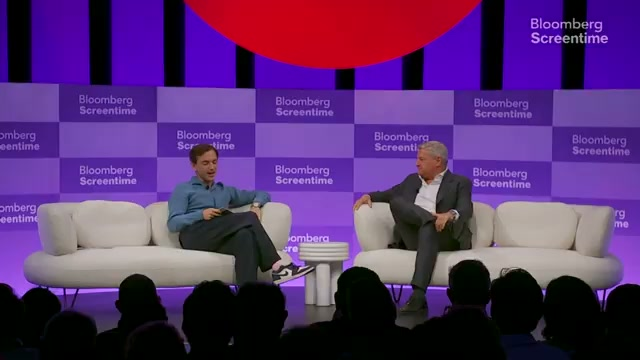
Ted Sarandos acknowledged the growth challenge in an Oct 1, 2026 conversation with Lucas Shaw at Bloomberg Screentime in Los Angeles. Netflix, he said, was not growing as quickly as he wanted. His remarks, covered by Bloomberg and The Hollywood Reporter, also challenged the idea that every hour watched has the same economic value. An hour of Judge Judy in the middle of the day does not produce the same revenue as an hour of NFL football, he argued. The distinction matters as Netflix expands its mix of subscriptions, advertising and programming.
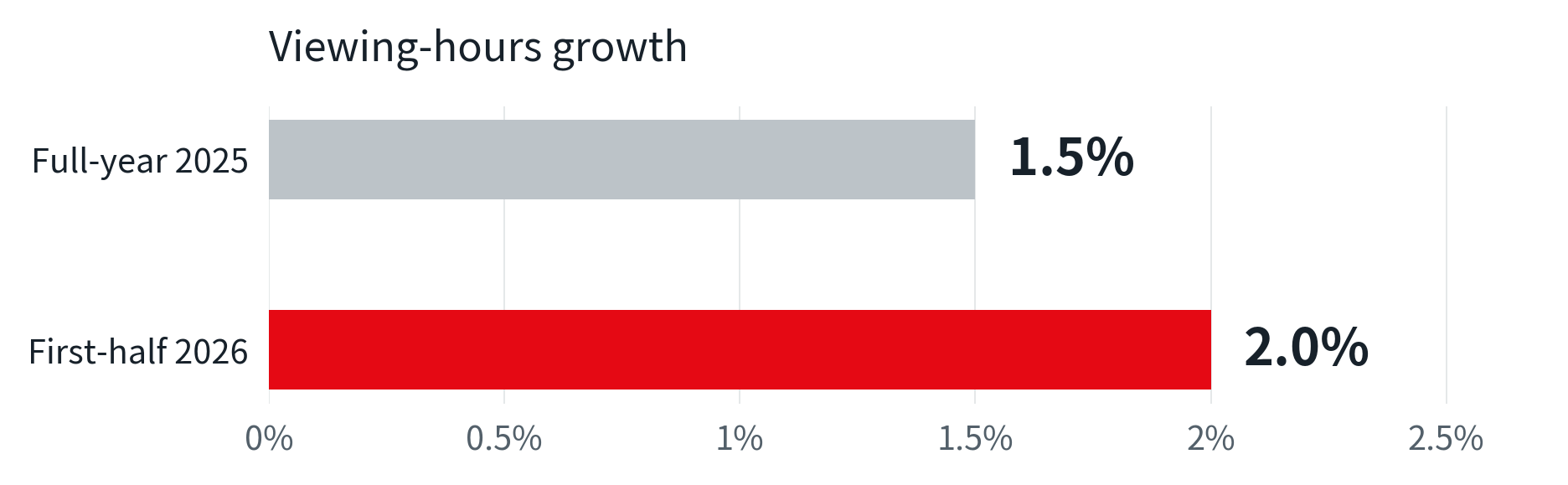
The second-quarter 2026 shareholder letter helps explain that position. Viewing exceeded 97 billion hours in the first half, up 2% from a year earlier, compared with 1.5% growth for full-year 2025. Second-quarter revenue increased 13.4%. Those figures cover different reporting periods and cannot simply be divided to calculate revenue per viewing hour. They nevertheless show why viewing growth alone cannot explain a business also shaped by pricing, subscription tiers, advertising and currency movements. Netflix stopped reporting quarterly subscriber totals in 2025. Sarandos said the economics of a member had become harder to express as one number as plans proliferated across markets. From 2027, the company will also reduce its twice-yearly viewing report to an annual publication.
A usable revenue-per-hour measure would require revenue and viewing for the same period and service scope. It would also need a method for allocating subscription revenue across titles and distinguishing ad-free from advertising-supported plans. The published totals do not show precisely how much more profitable an NFL hour is than an hour of drama. Understanding the strategy and verifying its financial results are therefore separate tasks. The distinction becomes more important, rather than less, as Netflix’s programming mix broadens.
Investors have been asking about Netflix’s growth path since its withdrawal from the Warner Bros. Discovery transaction in February. In his assessment of the Screentime discussion, nScreenMedia chief analyst Colin Dixon questioned whether the company had a clear script for accelerating growth again. Sarandos’s answer was to keep most of the roughly $20 billion annual content budget, equivalent to about KRW 27 trillion, directed toward professionally produced films, series and games while expanding programming with different revenue characteristics. Live events and the integration of France’s TF1 provide two examples of how that expansion could work.
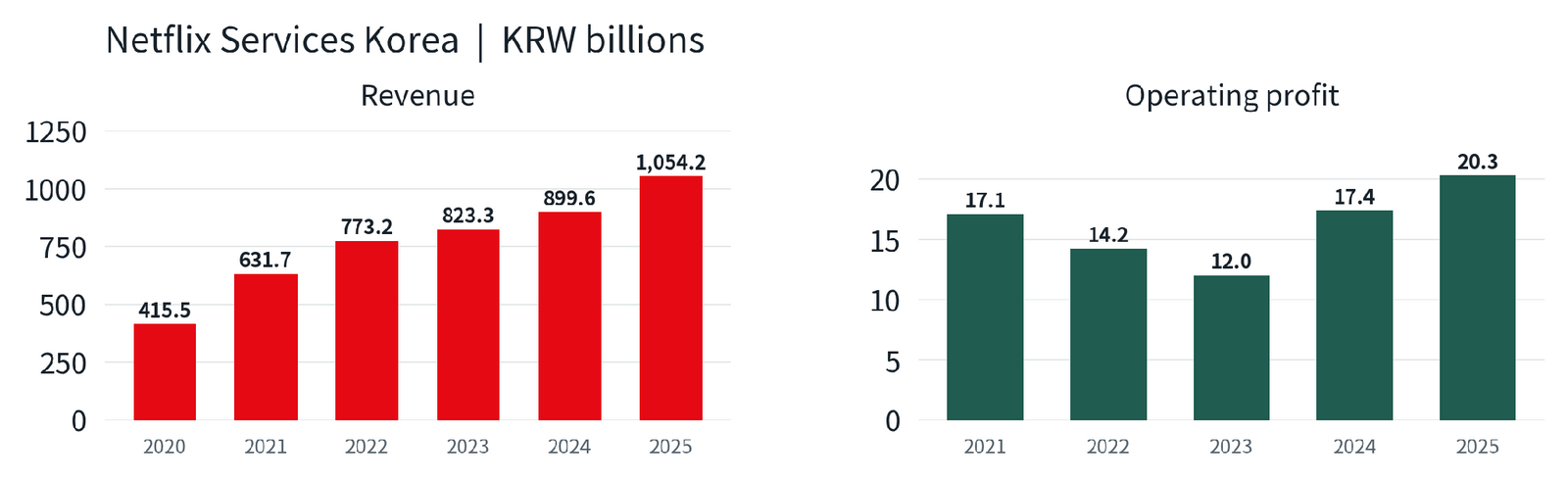
The implications are particularly significant in Korea. Netflix entered the market on Jan 7, 2016, and is marking its tenth anniversary. Netflix Services Korea generated KRW 1.0542 trillion in revenue in 2025, passing KRW 1 trillion for the first time. In a May 2026 survey of Korean streaming apps, Netflix accounted for 57.7% of usage time. KBS and MBC, meanwhile, reported 2025 operating losses of KRW 99.6 billion and KRW 27.6 billion respectively. If a TF1-style channel integration were introduced in Korea, transactions could expand from individual programs to the rights surrounding channels, viewing data and advertising.
Live events connect acquisition retention and advertising
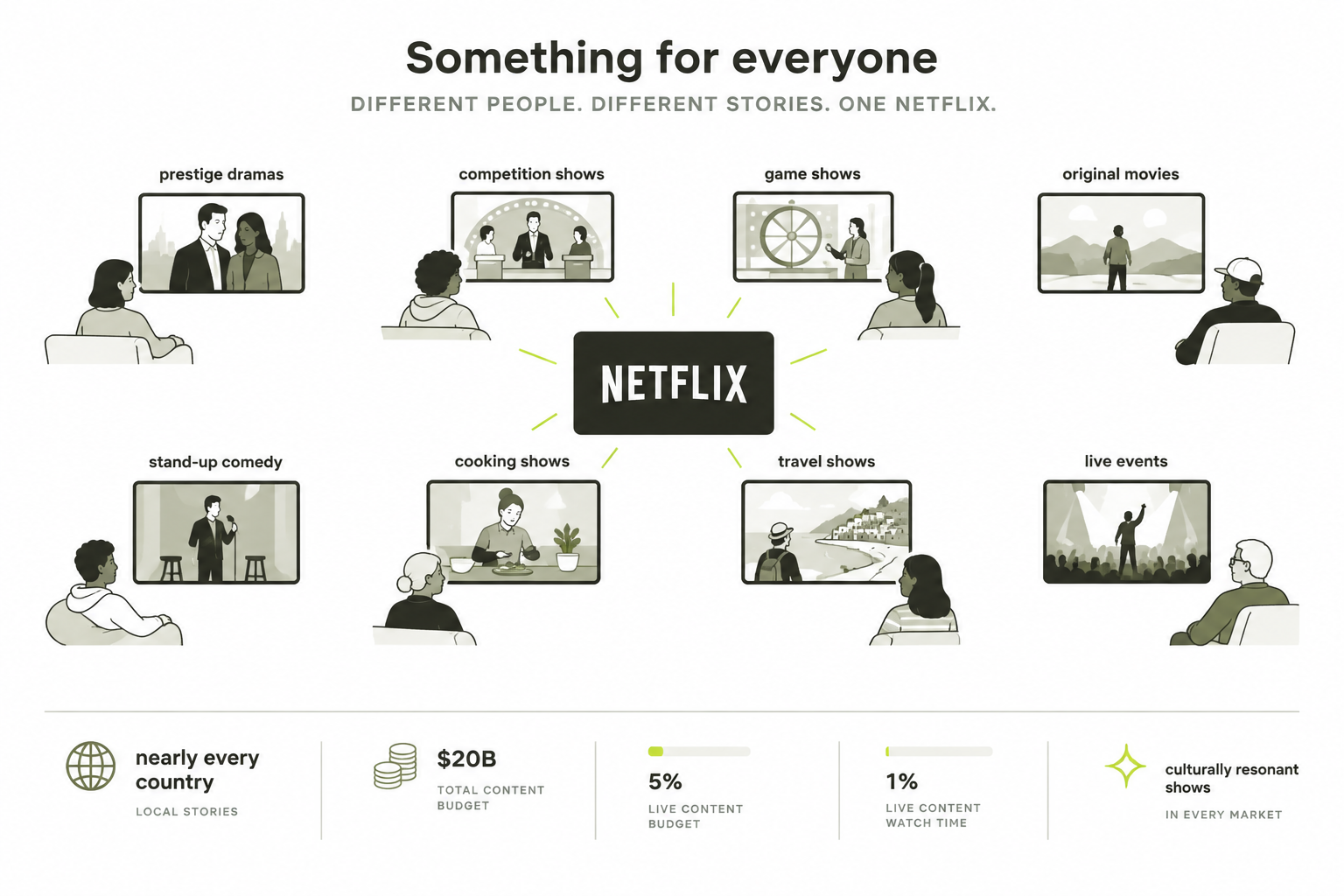
Sarandos identified live programming as one reason viewing hours can understate the role of content spending. Netflix allocates approximately 5% of its content budget to live events, while those events account for about 1% of total viewing. Applied to a $20 billion budget, the spending share implies roughly $1 billion, or KRW 1.35 trillion. Live content performs other functions, he said, including subscriber acquisition, retention and advertising. He also pointed to the 2% increase in viewing during a period when major global sports events, including the World Cup, competed for audience attention.
The 5% and 1% figures have different denominators. Dividing them does not show a return on investment or establish that live programming is one-fifth as efficient as another genre. A meaningful assessment requires rights fees, production and delivery costs, the duration of subscriptions acquired through an event, ad prices and inventory sell-through. The commercial challenge is to convert attention on the day of an event into a sustained relationship with subscribers and advertisers.
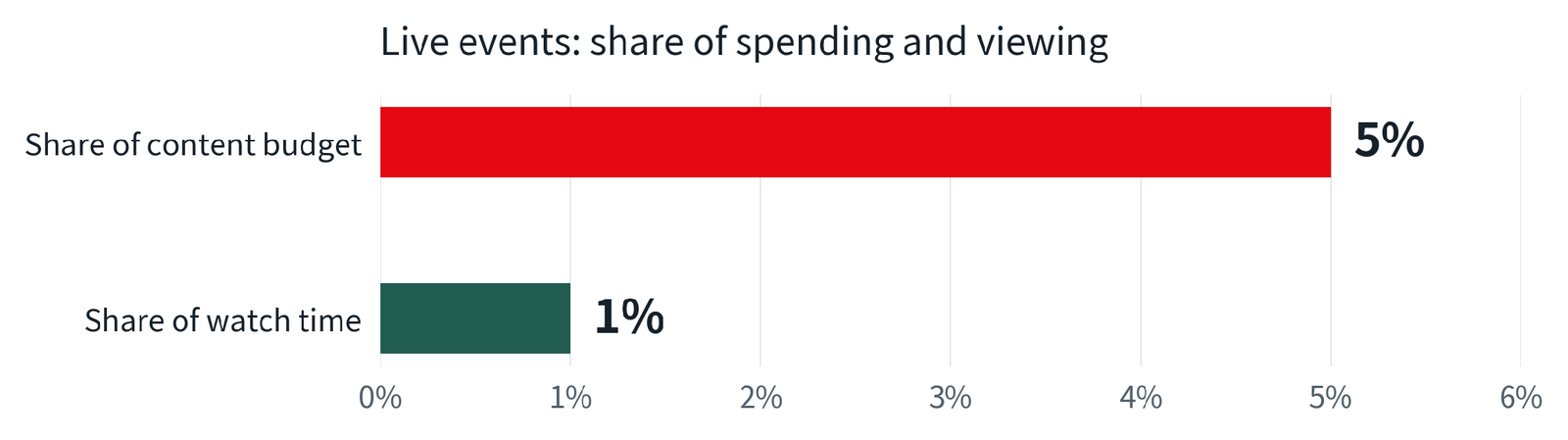
Live programming’s share of Netflix content spending and total viewing. The percentages use different denominators. Source: Sarandos’s Screentime remarks. Source
Advertising provides an important part of the rationale. Netflix’s 2026 advertising revenue outlook was approximately $3 billion, or KRW 4.05 trillion, roughly double the previous year. Its shareholder letter also identified MLB programming and an NFL opening-week game in the third-quarter slate. When Shaw raised a comparison suggesting Netflix earned more revenue per view than YouTube, referring to advertising CPMs, Sarandos said Netflix’s programming monetized more effectively. That claim describes the company’s position; it does not provide a complete, like-for-like profitability comparison between the two services.
Advertising adds another dimension to content valuation. An hour’s revenue can vary with the country, subscription tier, audience characteristics, advertiser demand and proportion of available spots sold. A premium live ad price does not by itself prove that the associated rights fee is economical. Netflix’s annual advertising outlook indicates the direction of the business, but it is not an event-level profit statement. Suppliers negotiating with the service need to distinguish claims about monetization potential from evidence of realized returns.
Local programming supports double digit regional growth
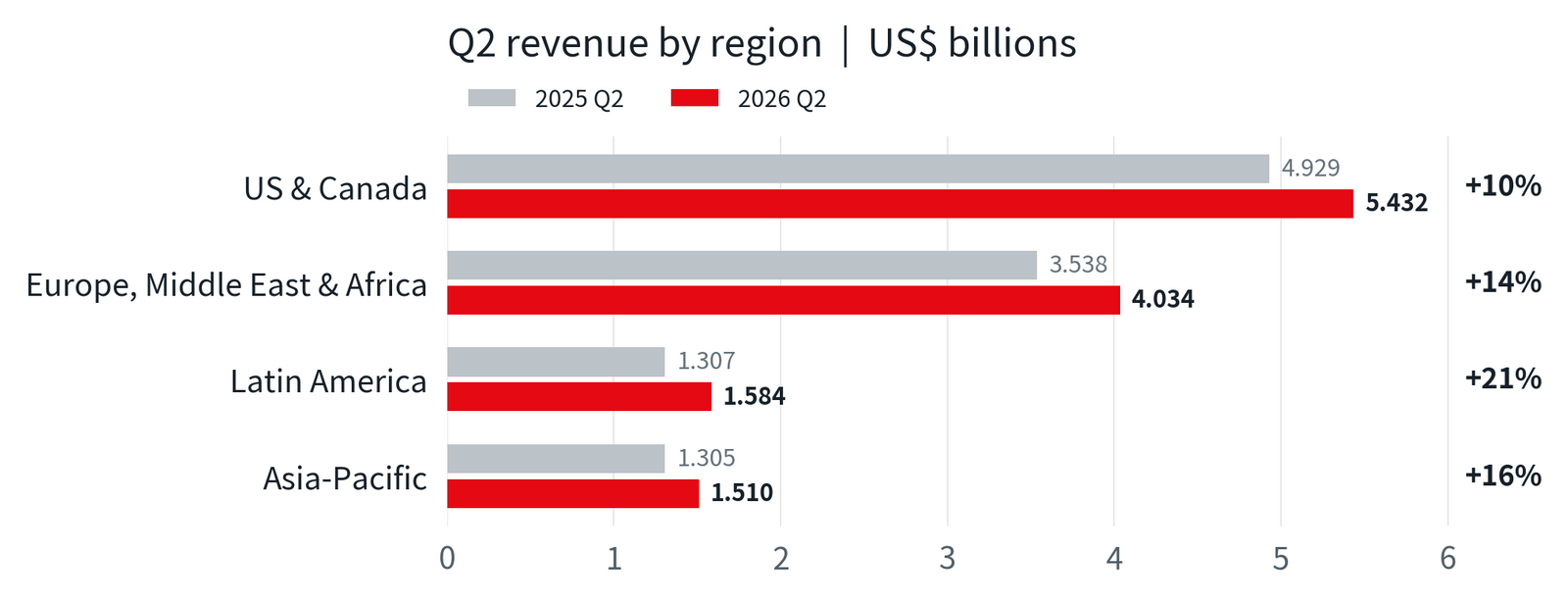
Second-quarter revenue reached $12.56 billion, or approximately KRW 16.956 trillion, up 13.4%. Revenue was $5.432 billion in the United States and Canada, up 10%; $4.034 billion in Europe, the Middle East and Africa, up 14%; $1.584 billion in Latin America, up 21%; and $1.510 billion in Asia-Pacific, up 16%. Those were the double-digit gains across every region that Sarandos emphasized. Non-English content accounted for more than one-third of first-half viewing. As Netflix experiments with new ways to monetize attention, programming that connects with local audiences remains the foundation of the wider business.
India was Sarandos’s example of that foundation at work. The country did not have an advertising tier, he noted, yet strong programming was driving growth. He cited Operation Safed Sagar, about Indian Air Force operations during the 1999 Kargil conflict; the romance Musafir Cafe; and the reality competition Lock Upp. The second season of Lock Upp launched on Netflix on Jun 27, 2026. Sarandos described a schedule that expanded from weekly episodes to five days a week and then seven, creating conversation that encouraged viewers to try other shows. Esquire India’s coverage of trending titles placed Musafir Cafe and Lock Upp at the top of Netflix’s Indian rankings. ContentAsia’s account of the 2026 slate identified 30 Indian originals, comprising 19 series and 11 films, with Operation Safed Sagar at the front of the lineup.
A broader slate creates more reasons to subscribe
Asked about criticism that shows aimed at particular audiences could end up appealing to nobody, Sarandos rejected the idea that Netflix should make a single program for everyone. The objective is to give people with different tastes something they want to watch.
He traced an expansion from the prestige-drama strategy associated with House of Cards in 2013 into competition formats, game shows, cooking and travel programs, original films, stand-up comedy and live events. He described the United States as accounting for roughly half of revenue and viewing, with local production taking place in almost every country. A broader slate can therefore bring more viewers to individual programs while creating different reasons to return throughout the week.
TF1 brings the broadcast channel inside Netflix
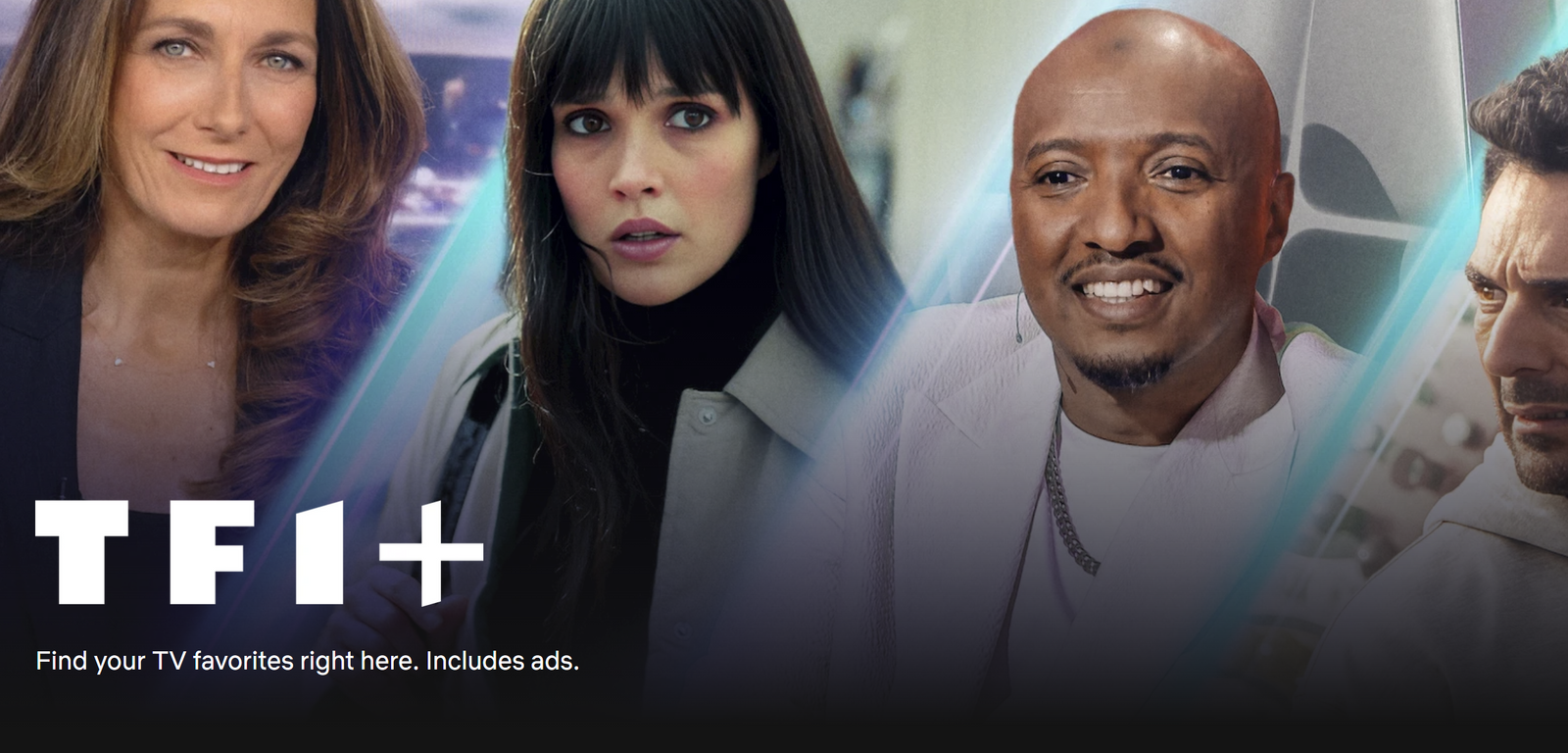
France already provides a working example of broadcaster integration. The TF1 service on Netflix launched on Jun 19, 2026, allowing French Netflix members to watch TF1 live channels and TF1+ catch-up programming within their existing subscription. Rugby and football, entertainment shows including Star Academy and Koh-Lanta, news and drama appear within Netflix’s viewing interface, including Continue Watching, My List and Top 10. Sarandos said French subscribers wanted more French programming, more quickly than Netflix could produce it on its own. The TF1 arrangement was meeting that demand and growing rapidly, in his assessment.
Sarandos called TF1 the most difficult version of the model to implement because live channels and catch-up programs had to be integrated into Netflix’s interface and recommendation system. That experience could make other forms of distribution, including paid add-ons, easier to introduce. Asked whether Disney+ might eventually be sold through Netflix, he said such models could develop over time. He also put Netflix’s share of the broader entertainment business at 6% to 7%, describing additional distribution as an opportunity the company had barely explored. The distinctions remain essential: TF1 is included in the existing subscription, while Disney+ was a hypothetical example in a question. Neither a Disney+ resale agreement nor a Korean paid-channel product was announced.
Channel integration also brings costs and operating requirements for Netflix. Online retransmission rights for sport, music and imported programs must be cleared. Territorial blackouts and catch-up periods need to be managed. Partners must decide whether to carry the advertising already embedded in the live signal or replace it with newly sold spots. The existence of the TF1 arrangement does not establish that these terms can be copied unchanged in another jurisdiction. Broadcasters hold different rights packages and operate under different distribution commitments.
YouTube offers a comparison. In July, NBCUniversal agreed to bundle ad-supported Peacock Premium with YouTube Premium from 2027, with Peacock first offered as an add-on through YouTube Primetime Channels, as described in Axios’s coverage of the agreement. Sarandos said he had not reviewed the terms, but viewed the sale of the Peacock app through YouTube as comparable to other channel distribution arrangements. Asked whether HBO would have become a Netflix add-on had the Warner transaction succeeded, he said that would have been a sensible option rather than an absolute requirement. Netflix, in his view, should become more flexible about the ways people can watch through the service over time.
Sources: SBS disclosure, TF1 announcement and Sarandos interview. Paid add-ons remain a potential model. SBS · TF1
Creators receive funding for a larger production scale
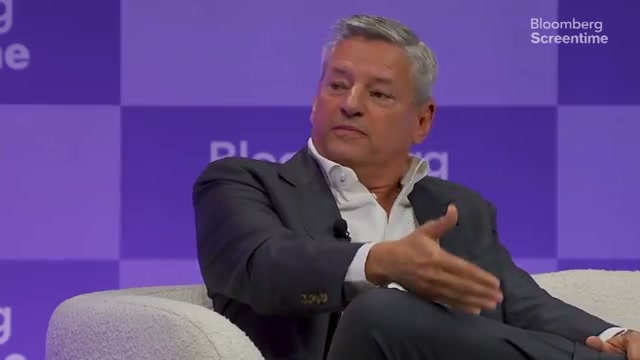
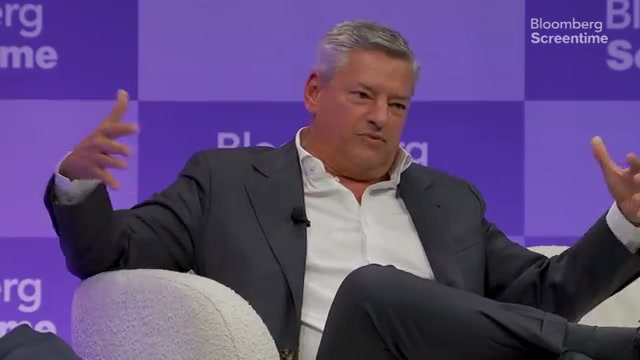
Netflix co-CEO Ted Sarandos at Bloomberg Screentime. Image: frame from the interview. Source
Shaw also returned to Sarandos’s earlier comparison between time spent with Netflix and YouTube. Sarandos disputed the suggestion that he had called YouTube a place to waste time, then said he should not have made the remark. Netflix has been signing creators such as Mark Rober, but Sarandos drew a distinction between that activity and running a user-generated-content platform. The company is financing creators whose work is already close to professional production and giving them the money and infrastructure to make larger projects. The recruitment strategy broadens Netflix’s source of talent while preserving its role in selecting and commissioning programs.
The distribution question becomes more complicated when creators release work on Netflix and YouTube on the same day. Asked about YouTube’s concerns, Sarandos said companies pursue such arrangements when they see benefits, much as studios weigh release windows and broadcasters decide whether to license programs. The challenge is to build one business without undermining another. Sometimes both can grow, he argued, and sometimes a creator must choose a partner. He compared children’s programming now found on YouTube with the Nickelodeon shows his children had watched, including Blue’s Clues, suggesting that changes in distribution do not necessarily mean the underlying audience demand is new.
Organic growth returns to the center after Warner
Netflix agreed in December 2025 to buy Warner Bros.’ studio and HBO Max assets, then withdrew on Feb 26, 2026 after Paramount raised its offer to approximately $111 billion, equivalent to about KRW 149.85 trillion. Netflix received a $2.8 billion termination payment, or approximately KRW 3.78 trillion. In the account carried by Semafor, Sarandos and co-CEO Greg Peters framed the assets as desirable at the right price rather than essential at any price. The withdrawal returned attention to Netflix’s ability to expand through its existing operation.
Sarandos said he did not regret pursuing the transaction. At Netflix’s scale, its final price represented the limit at which management believed the assets could create shareholder value; paying more would have pushed the economics in the wrong direction. He described the opportunity as unusually clean because the desired assets could be assessed without taking on unwanted businesses and damaging value elsewhere. He acknowledged that the attempt had unsettled the company’s investment narrative. Management could accept that disruption when convinced a transaction served long-term returns, he said, but should not put the business itself at risk. Future growth would be primarily organic, and Netflix was not looking for another acquisition simply to replace Warner.

Asked about the competitive threat from combining Paramount and Warner Bros. Discovery, Sarandos declined to assume that adding two companies would automatically produce a stronger competitor. On paper it was one plus one, he said; the outcome could be two, one and a half or three. Shaw also mentioned Sarandos’s public lunch with HBO content chief Casey Bloys. Sarandos praised Bloys as a talented executive who would be well positioned wherever he worked, without announcing a hiring agreement or new arrangement.
Games remain part of Netflix’s plans. Asked whether members would still be playing games on the service in five years, Sarandos said he expected they would. Mobile gaming had been a gateway to cloud gaming, he explained, with a phone acting as the controller for play on a television. He sees opportunities for TV games in a post-console environment and values gaming as an extension of intellectual property and brands. GameSpot’s coverage also noted the company’s retreat from some AAA development efforts and studio closures. Those changes indicate a reassessment of the investment model, rather than an announced exit from the category.
Gaming time is not included in Netflix’s film and series viewing report. Games could therefore support retention or consumption of a franchise without their contribution appearing in video hours. Reducing AAA development or closing a studio should be distinguished from ending the whole business. The more relevant question is which costs Netflix is removing and which experiences it is preserving as it shifts attention from mobile games toward play on the television through the cloud.

The theatrical window becomes a title by title decision
The release plan for La Bola Negra illustrates Netflix’s greater flexibility. The Spanish-language film from directing duo Los Javis, a joint winner of the Cannes directing prize, is scheduled to open in theaters on Oct 16, 2026 and arrive on Netflix on Dec 2, 2026. The 47-day interval was reported as Netflix’s longest exclusive theatrical window, exceeding the 30 days given to Noah Baumbach’s Marriage Story in 2019. Netflix also plans to begin reporting box office results with the release. The end of an exclusive window does not mean a film must leave theaters when it becomes available on Netflix.
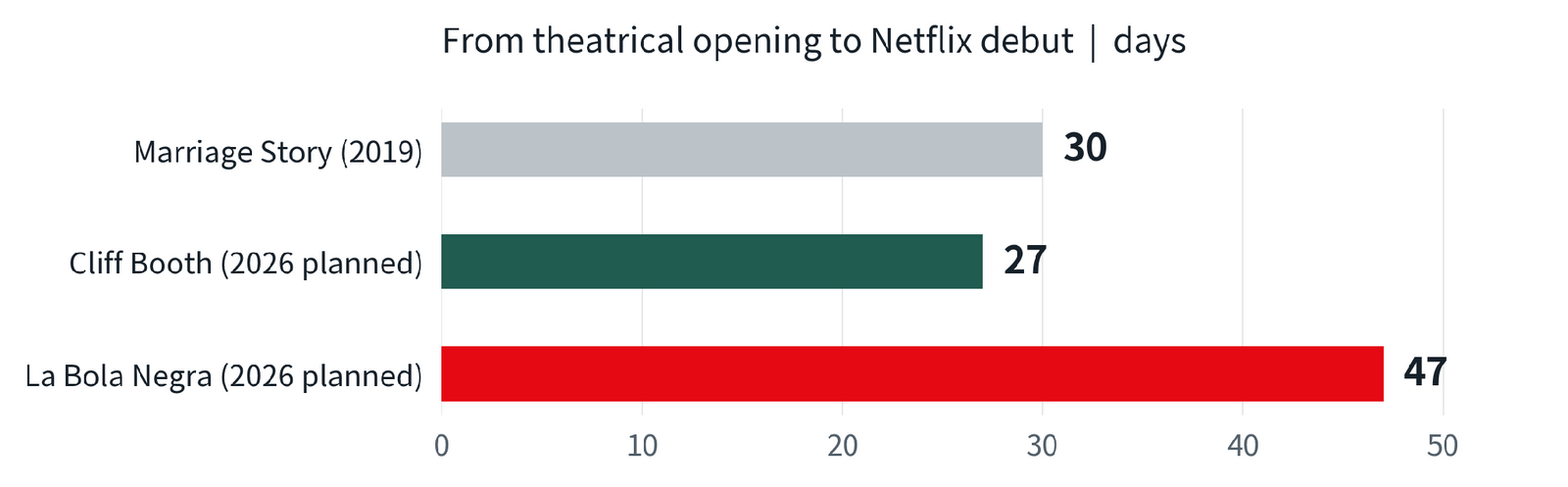
Sarandos’s reasoning rests on the difference between theatrical and streaming audiences. The most committed viewers may see a film in a cinema, while those who had intended to watch it remain available when it reaches Netflix.
He said Netflix originals dominate the service’s annual film rankings, with repeat-viewed family movies the main category in which licensed theatrical films can outperform them. Netflix put more than 30 films into theaters last year, choosing the length of the run, the marketing commitment and the cities separately for each title. The company therefore treats theatrical distribution as a set of individual commercial choices rather than one fixed rule for every film.
Art-house titles such as La Bola Negra and last year’s Train Dreams can remain in theaters longer with relatively little damage to their value on Netflix, in Sarandos’s account. Family films sit at the other end of the calculation because repeated viewing is especially valuable to the service. Greta Gerwig’s The Chronicles of Narnia: The Magician’s Nephew is planned for a major release in February 2027, followed by the animated Charlie vs. the Chocolate Factory in November 2027. David Fincher’s The Further Mis-Adventures of Cliff Booth is scheduled for a Nov 26, 2026 IMAX opening, with two weeks of IMAX exclusivity before its Dec 23, 2026 Netflix debut, as described by TheWrap and SlashFilm. Peter Berg’s World War II film Mosquito Bowl is also expected to receive a short theatrical window.
Korean-inspired IP is part of the larger theatrical ambition. Sarandos said audiences could expect a very wide release for the sequel to KPop Demon Hunters. A 2029 target for the sequel has been reported by Vogue Korea and other outlets. His test was not simply whether ticket sales added substantially to a film’s income statement. If a release created even a small risk to performance on Netflix, he argued, the theatrical opportunity had to be large enough to justify it. Narnia and KPop Demon Hunters were his examples of properties with that kind of potential global scale.
Theatrical windows also affect marketing and relationships with filmmakers. Festival and awards exposure for an art-house title serves a different purpose from repeat family viewing. Ticket revenue must be weighed against marketing expense and any weakening of an exclusive streaming debut, then assessed alongside post-release viewing and retention. A longer window is not evidence that a theater-first approach is superior for every title. Netflix’s flexibility makes the selection criteria and results more important than the existence of a theatrical run alone.
Talent agreements change while individual projects continue
Changes involving the Duffer brothers, Shawn Levy, Noah Baumbach and David Fincher show how Netflix’s relationships with major creators are evolving. Sarandos described them as separate agreements designed for different purposes and reaching different stages. After the first decade of Stranger Things, Matt and Ross Duffer wanted to make major theatrical films. Sarandos said he encouraged them to pursue that ambition at 40 rather than regret not doing it at 60. Levy’s Star Wars commitments created a practical reason to align his overall agreement with Disney, because competing commitments can lead to conflicts over a filmmaker’s time. Sarandos said Netflix had worked with Fincher since 2011 and that Fincher had not made a film outside Netflix since 2014. The end of the current deal should not be equated with a decision to abandon the relationship. Their work on Mindhunter, House of Cards and Love, Death & Robots also formed part of a collaboration that could continue through individual projects.
Sources: Variety on the Duffers, Variety on Levy, TheWrap on Baumbach and SlashFilm on Fincher.
The end of an exclusive or overall agreement is different from the end of project collaboration. An overall deal organizes a production relationship for a period; a first-look arrangement gives a studio the opportunity to consider new projects before other buyers. Start dates, existing development commitments and project rights vary. Netflix’s challenge is not to renew every major creator at any cost. It is to align budgets, release ambitions and rights so that the next project still has a reason to remain on the service.
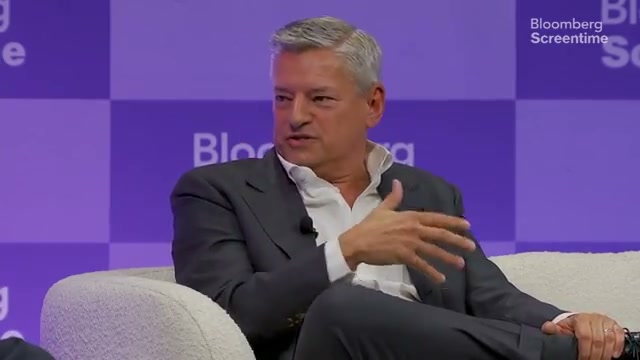
Sarandos responds to questions about changes in major creator agreements. Image: frame from the Bloomberg Screentime interview. Source
Free streaming faces a content funding constraint
Sarandos ruled out launching a free version of Netflix for now, while acknowledging that the company continues to examine business models. He recognized that advertising-funded services such as Tubi and Pluto TV are taking viewing time. His concern was whether a free service could become large enough to compensate for the subscription revenue it might displace. Deciding how much content to assign to free and paid products would leave a narrow commercial path. He also questioned whether a purely advertising-supported service could finance the ambitious programs that drive Netflix’s production strategy. The answer was therefore not that free viewing lacks demand, but that the economics must support the company’s preferred scale of programming.
A free product can reach people unwilling to pay, but existing members moving to it could reduce subscription income. How much that happens depends on the titles assigned to the free service and how long paying members retain an exclusive window. What the interview establishes is that Netflix is examining models while declining to launch one immediately. It does not establish the pricing structure, launch markets or programming lineup of a new free Netflix service.
Production incentives reshape the competition for spending
Sarandos supported a federal US production tax credit, arguing that state incentives alone leave American locations at a disadvantage against countries such as the United Kingdom. Public companies have obligations to shareholders and respond to differences in production costs. A federal layer on top of state credits could change those calculations. He claimed that a dollar of incentive support could generate six to nine dollars of economic activity; that claim should not be treated as a government tax-recovery ratio or an established return on an individual project. A bill introduced on Sep 24, 2026 by lawmakers including Senators Tim Scott and Adam Schiff proposed a 20% credit based on eligible US labor, with conditional additions taking the maximum to 30%, alongside state incentives. It included minimum-spending and US principal-photography requirements. Introduction is not enactment. President Trump’s call for legislation and Sarandos’s support provide political backing without guaranteeing passage.
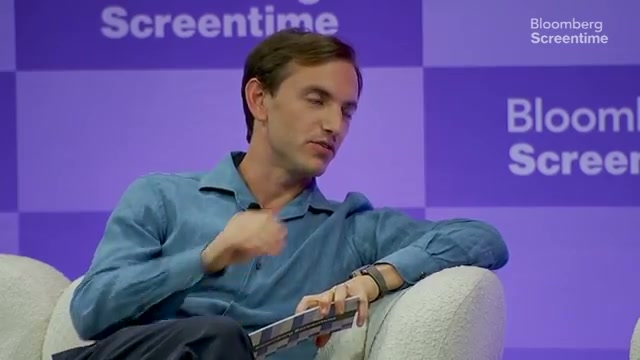
Lucas Shaw asks about production conditions and federal incentives. Image: frame from the Bloomberg Screentime interview. Source
Sarandos declined to predict the legislative outcome. The post-election lame-duck session and possible changes in congressional control could affect which measures advance and who receives credit for them, he said. He described Trump as someone interested in entertainment and job creation. California, by contrast, had become complacent about its concentration of talent, allowed infrastructure to age and made filming in Los Angeles difficult. Even so, Sarandos said three recent Los Angeles productions, including Animals and Fincher’s Cliff Booth, represented more than $400 million, or KRW 540 billion, in spending. He also said Netflix had filmed in all 50 states in recent years and pointed to its New Jersey production investment. Incentives, infrastructure and skilled workers jointly determine whether a location remains competitive.

A decade in Korea expands the market and production base
Netflix began operating in South Korea on Jan 7, 2016, as part of its expansion into more than 130 countries. A retrospective of its Korean growth put first-year domestic users at approximately 60,000 to 70,000. Its production presence expanded through Bong Joon-ho’s Okja in 2017, Yoo Byung-jae: Black Comedy in 2018 and its first Korean original series, Kingdom, in 2019. Netflix’s tenth-anniversary account said more than 210 Korean titles had entered the global Top 10 since that measurement began in June 2021. Squid Game spent 32 consecutive weeks in the ranking, including nine at number one. Its international breakthrough in 2021 helped establish Korea as a central production market for the service.
Investment grew alongside that audience. In April 2023, Netflix committed $2.5 billion to Korean content over four years, described at the time as roughly KRW 3.3 trillion and equivalent to KRW 3.375 trillion at this article’s illustrative exchange rate. The final year of that commitment is 2026. At the Jan 21, 2026 Next on Netflix 2026 event, Korean content vice president Kang Dong-han said investment was not being cut and projects for 2027 and 2028 were already confirmed. He also described Korean-language content as the most watched after English-language programming. The end of an announced investment period should not be confused with a withdrawal from Korea. What matters next is the scale, duration and contractual composition of the following investment program.
Netflix Services Korea’s revenue rose from KRW 415.5 billion in 2020 to KRW 631.7 billion in 2021, KRW 773.2 billion in 2022, KRW 823.3 billion in 2023 and KRW 899.6 billion in 2024. In 2025 it reached KRW 1.0542 trillion, about $780.9 million, up 17.2% year on year and approximately 2.5 times the 2020 level. Operating profit was KRW 20.3 billion, or about $15 million, giving an operating margin of roughly 1.9%. Of KRW 892.9 billion in cost of sales, KRW 853.9 billion was described as payments to the US parent for subscription membership purchases. Corporate tax was KRW 6.6 billion. These accounts describe the local service company. They do not capture the entire overseas value generated by Korean programming, and local revenue should not be treated as a direct measure of Korean production investment.
Netflix takes a larger share of app time than users
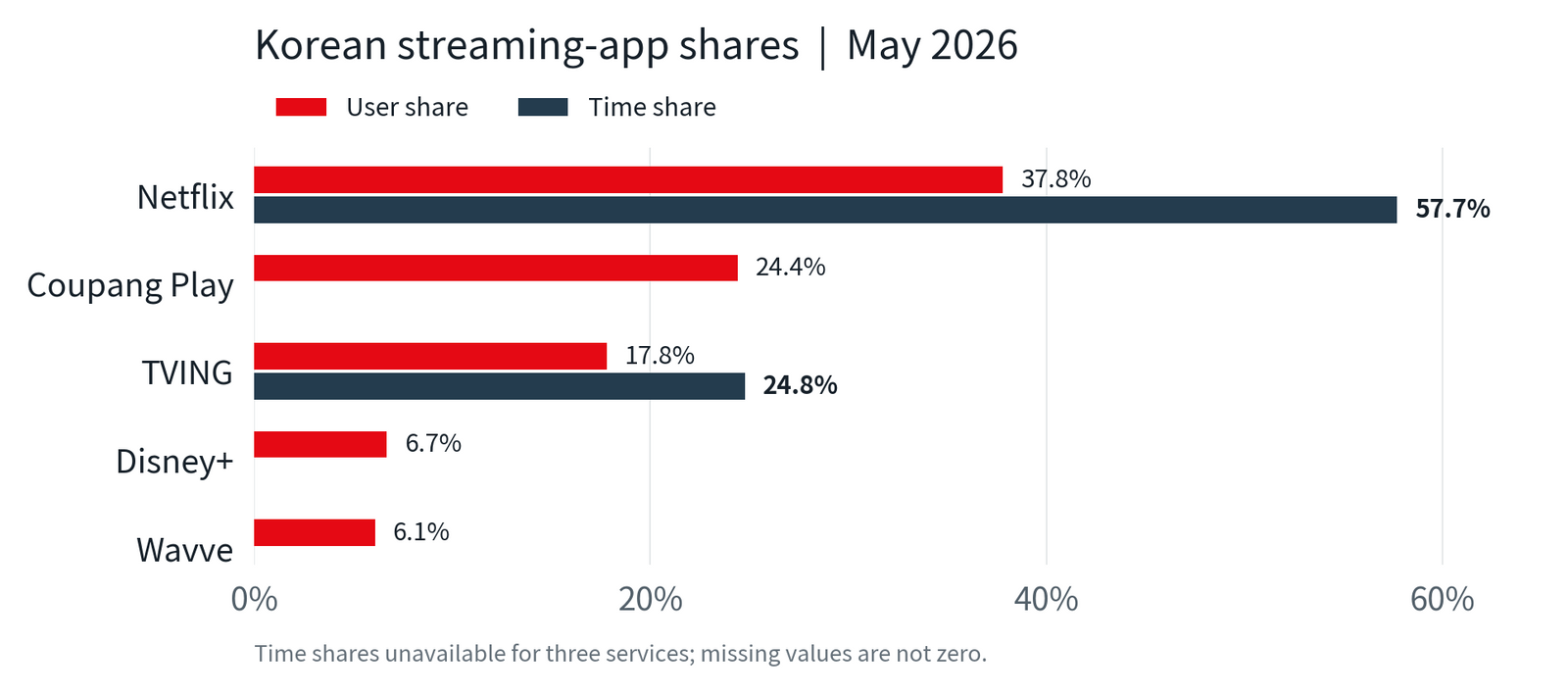
Wiseapp Retail’s May 2026 streaming-app survey reported 22.09 million Korean users. Netflix accounted for 37.8% of the survey’s user share and 57.7% of usage time. Coupang Play’s user share was 24.4%, followed by TVING at 17.8%, Disney+ at 6.7% and Wavve at 6.1%. TVING accounted for 24.8% of usage time. The three largest services together represented 80% of the reported user shares. Those figures point to a concentration of time on Netflix within the measured apps. They do not establish that Netflix commands 57.7% of all Korean video viewing across television sets, browsers and every other screen. App usage, subscriber totals and paid-revenue shares measure different things.
Within the same survey, Netflix’s share of time exceeded its share of users by 19.9 percentage points; TVING’s difference was 7.0 points. Those gaps provide a starting point for examining the depth of use. They are affected by people using more than one app and by sample and device coverage, however, and cannot alone establish individual average viewing time or customer lifetime value. Distribution negotiations require data that distinguishes general market totals from the audience actually covered by a contract.
TVING’s second-quarter results show that domestic services can also improve profitability through programming and advertising. Revenue increased 41% to KRW 140.7 billion, approximately $104.2 million, and operating profit reached KRW 6 billion, about $4.4 million. Monthly users stood at 9.7 million and advertising revenue increased 52%.
At its Aug 6, 2026 results briefing, TVING said substantive discussions about merging with Wavve would take place in the second half. Execution had remained unresolved for more than a year after the Korea Fair Trade Commission’s conditional approval in June 2025. One profitable quarter and completion of a merger are separate milestones. Sustainable earnings depend on keeping subscribers and growing advertising while carrying sports and other programming-rights costs.
Broadcasters face declining advertising and cost pressure
The broadcasting and communications advertising survey released on Jan 8, 2026 by the broadcasting regulator and Korea Broadcast Advertising Corporation shows the direction of market change. Estimated 2025 broadcast advertising was KRW 2.7744 trillion, approximately $2.055 billion, down 13.8% year on year. Online advertising increased 6.1% to KRW 10.7204 trillion, about $7.942 billion, accounting for 62.1% of the total. The survey and related coverage also found that 65% of advertisers planning to buy OTT advertising in 2026 preferred Netflix. That was a preference response among advertisers with such plans, not Netflix’s share of actual advertising expenditure or a percentage of all advertisers.
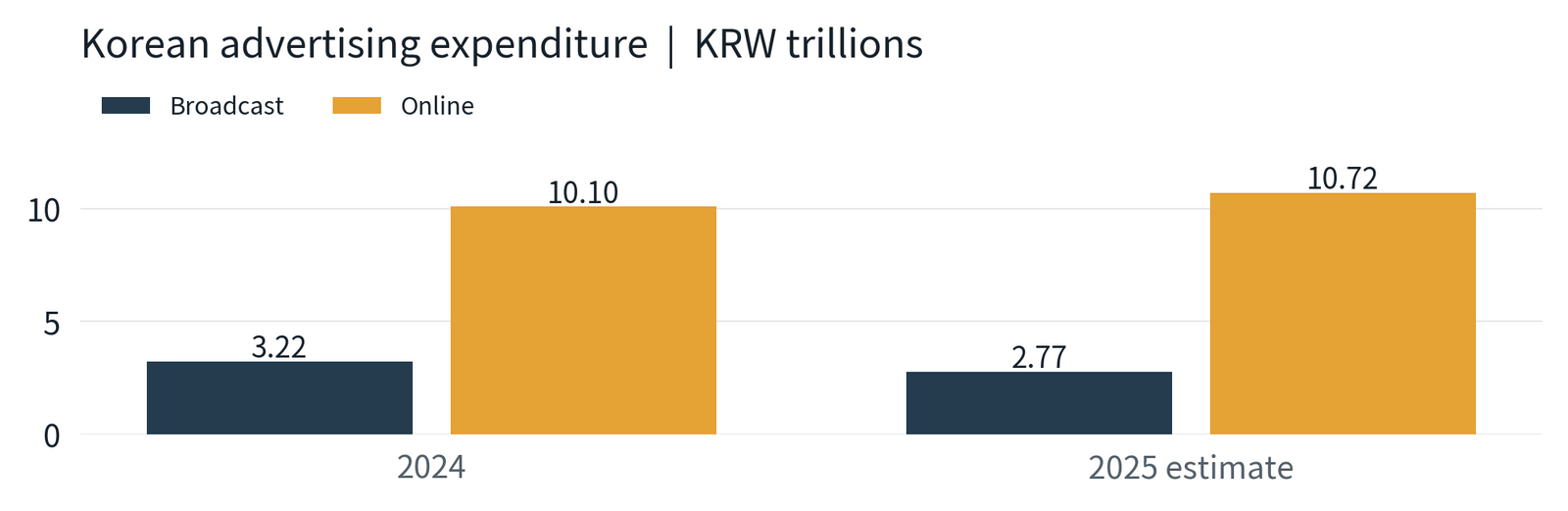
Korean broadcast and online advertising expenditure. The 2025 values were estimates at the time of the survey. Source: broadcasting regulator and Korea Broadcast Advertising Corporation. Source
In reported 2025 broadcaster results, KBS posted an operating loss of KRW 99.6 billion, approximately $73.8 million, and MBC lost KRW 27.6 billion, about $20.4 million. SBS returned to profit after reducing operating expenses by KRW 130.8 billion against a KRW 91.7 billion decline in revenue. Media Today’s compilation put SBS revenue at KRW 676.7 billion and operating profit at KRW 13.2 billion. MBC advertising revenue fell from KRW 265 billion to KRW 243.5 billion. On Jun 12, 2026, JTBC failed to repay approximately KRW 20.6 billion, or $15.3 million, in securitized borrowing at maturity. NICE Investors Service lowered its long-term rating from BBB to CCC. JTBC’s 2025 operating loss was KRW 28.7 billion. The companies have different businesses and accounting scopes, and their losses cannot be attributed to Netflix alone. The results do, however, illustrate the strain of weakening advertising and high content costs on broadcasters’ cash generation.
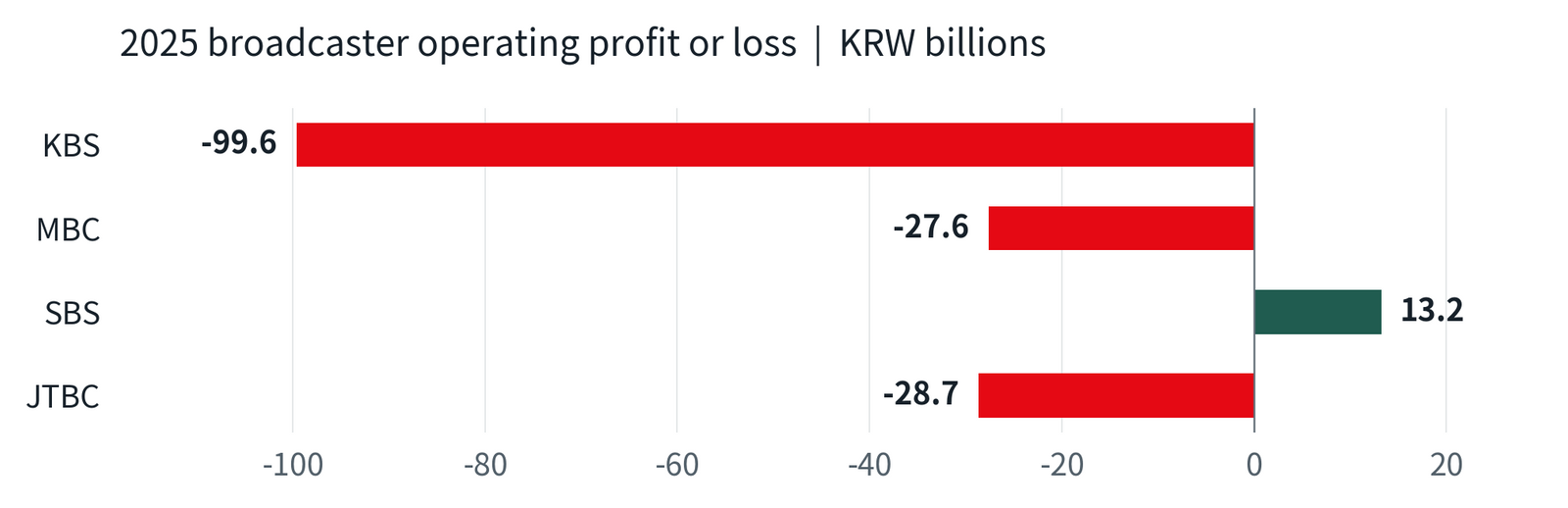
Operating profit or loss at major Korean broadcasters in 2025. Sources: Journalists Association of Korea and Media Today; JTBC figure from MTN. Company scopes differ. Source
Rising production costs sharpen the debate over IP
Higher budgets constrain the choices available to broadcasters and producers. Examples compiled by Sisa Journal put the cost per episode of Kingdom at KRW 2 billion, approximately $1.48 million; Sweet Home at KRW 3 billion, about $2.22 million; and Narco-Saints at roughly KRW 5.83 billion, about $4.32 million.
The comparison range for a conventional terrestrial miniseries was KRW 500 million to KRW 1.5 billion per episode. Those productions differ in year, genre and scale, so the examples should not be read as a controlled inflation index. They nevertheless show the financing demands of major projects. The central debate is over arrangements in which a global platform funds production risk in return for extensive IP and exploitation rights, while the producer receives production fees and a limited set of ancillary rights.
The issue resurfaced at Netflix’s Korean anniversary briefing. Media specialist Cho Young-shin warned that unchecked platform dominance could undermine sustainable growth in Korea’s media industry. Kang Dong-han responded that contract terms vary and licensing arrangements in which broadcasters retain rights are much more common than full IP purchases. His description of such arrangements as a hundred times more common was a rhetorical claim about variety, not a published count of contracts. The Netflix Original label therefore does not prove that every program has the same ownership or revenue-sharing structure. The move of Monthly Boyfriend, starring Jisoo and Seo In-guk, to Netflix as an original, after earlier reports of an MBC slot, illustrates how financing and distribution choices can change broadcast plans.
IP ownership and commercial returns are not interchangeable. A producer may retain some rights but have limited upside if sequel approvals, territories, long exclusivity periods or merchandising permissions are tightly restricted. Conversely, a platform-funded arrangement can give a producer dependable production income and performance compensation while shifting much of the financing risk to the buyer. The scope and duration of the rights, and the payments linked to performance, matter more than the name attached to the agreement.
Korean negotiations extend to channels data and advertising rights
Sarandos did not discuss Korea directly in the interview, and Netflix has not announced a Korean equivalent of its TF1 arrangement. His emphasis on live programming, integrated channels and flexible release windows nevertheless overlaps with businesses Korean broadcasters already operate. The useful question is not whether his remarks constitute a confirmed Korean rollout. It is which assets broadcasters could contribute to a future arrangement and which rights they would need to retain when evaluating it.
Scheduled live programming is one such asset. News, sport and live entertainment gather people at a specific time and give them reasons to return, overlapping with the acquisition, retention and advertising functions Netflix seeks from live events. An everyday television channel does not, however, command the same pricing power as a globally important sports event. A Korean broadcaster would need evidence of additional viewers, more frequent use, paid conversion or retention to justify a higher distribution fee. TF1’s integration of live channels and catch-up programming offers an actual case against which to assess those possibilities.
The SBS agreement disclosed in late 2024 covers a six-year program-distribution partnership beginning in 2025. Its unit of trade differs from the channel integration used with TF1. Once a channel is consumed inside Netflix’s account, recommendation and payment environment, commercial value depends on more than the content fee. The agreement must determine who sells advertising, what viewing data is shared, and how exposure overlaps with existing broadcast campaigns. A survey showing advertiser preference for Netflix does not establish that broadcaster advertising will migrate by the same percentage. Selling rights and revenue allocation have to be assessed in the actual agreement.
A data clause needs more detail than a promise to supply a report. It should specify the frequency and definitions of title-, episode-, territory- and tier-level viewing, audience reach, ad impressions and sell-through, along with notice when those definitions change. Aggregated reporting can protect personal information while still allowing the parties to assess contractual performance. Advertising provisions should distinguish broadcast inventory from platform-inserted spots and address the selling party, revenue split, unsold inventory, repeated exposure and conflicts between advertiser categories.
Release windows are another negotiable asset. La Bola Negra’s 47 days reflect a choice about the film’s genre and audience, rather than a new standard for every Netflix title. Korean broadcasters can distinguish the broadcast premiere, the Netflix release, simultaneous overseas availability and the catch-up period on their own services. A longer first window may protect an owned platform’s subscription appeal but weaken international conversation or reduce the licensing fee. Rather than impose one interval across the slate, the supplier can compare advertising, subscription and overseas distribution income title by title.
IP and financing require similar precision. A producer unable to fund a series costing billions of won per episode cannot easily carry all the risk while retaining every right. Separating co-investment, budget overruns, sequel approvals, remake and format rights, live performance, merchandising and performance-related payments makes it possible to assess funding security alongside long-term returns. As the TVING–Wavve merger remains under discussion and terrestrial content is supplied to multiple platforms, the strength of each company’s own distribution outlet also affects its negotiating position. Industry discussion of standard rights definitions and consistent performance reporting could help individual companies compare the value of different agreements.
The calculation must also include any reduction in the appeal of a broadcaster’s own OTT subscription. A large minimum guarantee can be less attractive over time if it is accompanied by a decline in owned audiences and advertising. A partnership can create value when new international viewing and additional ad sales exceed displaced business. Withdrawal of catch-up programs at the end of the agreement, access to historical performance records and the freedom to place later seasons elsewhere should be addressed at the start, rather than left for the renewal negotiation.
Production incentives form part of those cost calculations. Korea’s expanded framework introduced in 2024 increased base credits to 5% for large companies, 10% for medium-sized companies and 15% for small companies, with qualifying additions taking the respective maxima to 15%, 20% and 30%. Spending at least 80% of filming costs domestically was one requirement alongside additional conditions involving personnel, post-production and IP. If the proposed US federal credit is enacted, combining it with state support could change effective production costs. But a US labor-based credit and a Korean production-cost credit cover different expenses and conditions. Comparing their headline maximum percentages does not establish which location is cheaper. A project-level assessment must include eligible costs, timing of payments, currency, labor and post-production capacity.
Analytical framework based on disclosed partnerships and business models; these are not undisclosed contract terms.

The next results must show the quality of growth
Netflix’s third-quarter revenue forecast was $12.86 billion, approximately KRW 17.361 trillion, up 11.7% year on year. Full-year guidance was $51 billion to $51.4 billion, equivalent to about KRW 68.85 trillion to KRW 69.39 trillion. Those remain forecasts.
The gap between viewing growth and revenue growth cannot be assumed to persist automatically. The next assessment needs to establish how much pricing and advertising contributed, and whether operating profit and cash flow also improved after live rights and production costs. Sarandos emphasized the economic value of viewing; he did not announce a new, formally reported revenue-per-hour metric.
The remaining calendar offers several tests. La Bola Negra’s planned Oct 16, 2026 theatrical opening and Cliff Booth’s Nov 26, 2026 IMAX launch will provide opportunities to compare cinema results with performance after the films reach Netflix. The federal production-credit bill could be affected by congressional scheduling and negotiations after the Nov 3, 2026 midterm elections, but its passage or timing is not settled. In 2027, Narnia’s large-scale release, any expansion of TF1-type partnerships into additional markets, and the move to annual viewing reports will be important developments. As Netflix adds businesses with different economics, the information available to evaluate each contribution becomes more consequential.
In Korea, the investment program after 2023–2026 will intersect with decisions about domestic streaming consolidation. Netflix’s first decade expanded the international distribution of Korean programming. Future agreements could place greater weight on control over channels, ad inventory and audience data. Broadcasters need to assess what they receive in return for live schedules and IP: the sales booked when an agreement is signed, as well as the customer relationships, rights and revenue capacity that remain after it ends. As Netflix seeks to raise the value of every hour watched, Korean broadcasters will need to reflect the long-term value of every hour they supply in the terms they negotiate.
Dollar and won equivalents use a fixed illustrative exchange rate of KRW 1,350 per US dollar and are rounded. The 2025 advertising figures were survey estimates. Korean OTT shares refer to the May 2026 app survey and its measurement scope.
Information is current to Oct 4, 2026. Quotations and interview paraphrases refer to the Bloomberg Screentime conversation and the linked coverage. Discussion of Korean negotiating terms and business economics is analysis based on disclosed facts. Future release, service and legislative schedules may change.