
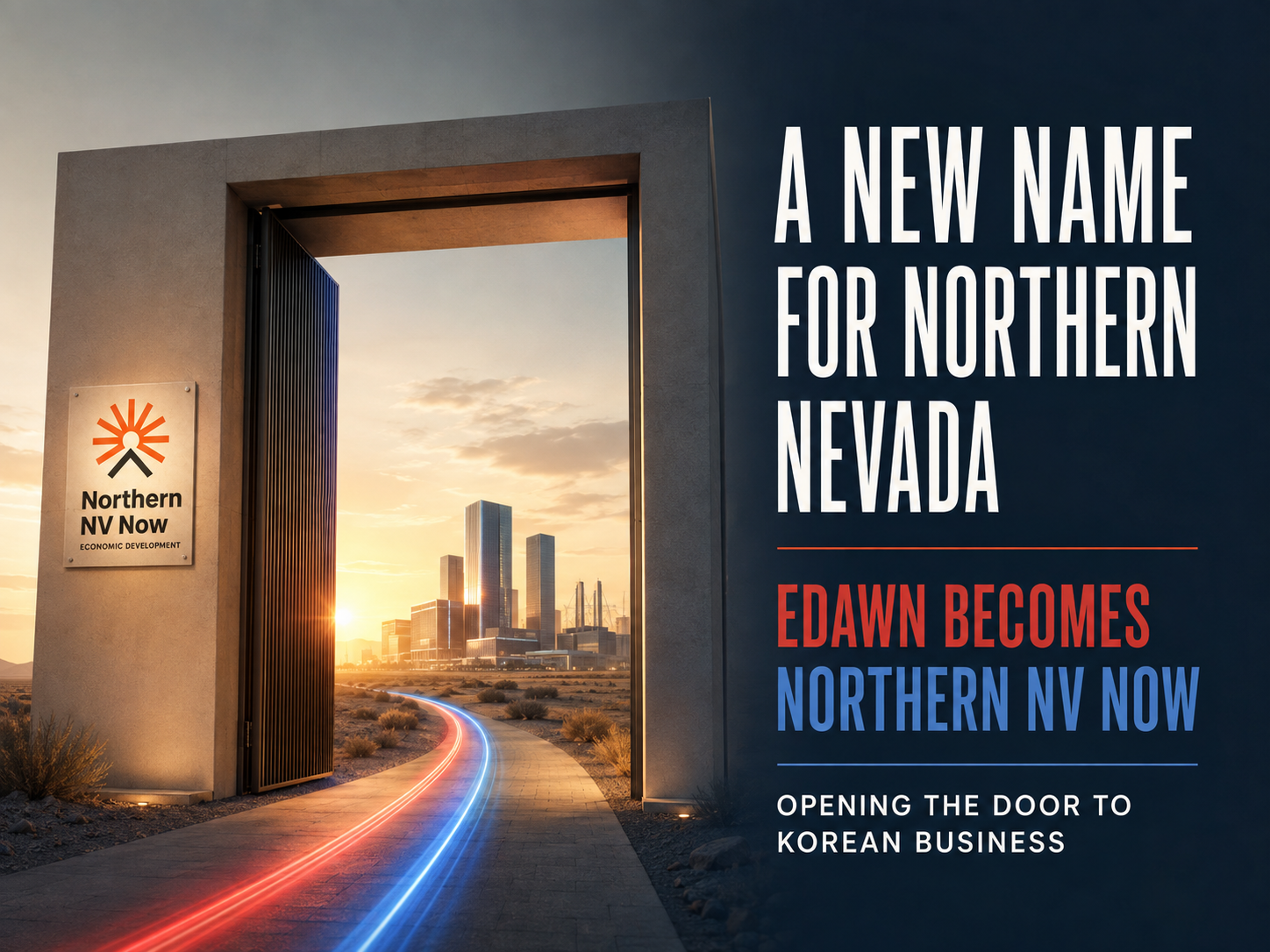
Nevada Is Recruiting Korean Companies — and Its Northern Development Agency Just Changed Its Name After 43 Years

EDAWN has rebranded as Northern NV Now, highlighting northern Nevada’s shift toward AI, advanced manufacturing and data centers while expanding partnerships with Korean technology and content companies.

Nevada Is Recruiting Korean Companies — and Its Northern Development Agency Just Changed Its Name After 43 Years

EDAWN becomes Northern NV Now as the Reno region shifts toward AI data centers — from a February memorandum and the K-Nevada Bridge program to electric school bus pilots and the opening Sphere leaves for K-content tech
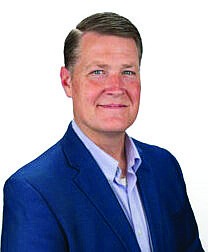
Taylor Adams, president and CEO of Northern NV Now. Photo: Northern NV Now / NNBW

The Economic Development Authority of Western Nevada has changed the name it presents to the outside world for the first time since it was created in 1983. It is now Northern NV Now. The legal entity keeps its original name for corporate and legal filings, and the staff, funding structure and mandate stay in place. What changed is how the organization introduces itself outside the region. Taylor Adams, its president and CEO, framed the move not as a change of direction but as a clearer way of describing what the organization has become. Korea sits on the list of markets that description is aimed at.

네바다가 한국 기업을 부른다… 45년 만에 간판 바꾼 EDAWN, ‘노던 NV 나우’로
북부 네바다 경제개발기구 EDAWN이 43년 만에 ‘노던 NV 나우(Northern NV Now)’로 대외 명칭 변경. 카지노·물류에서 첨단제조로, 다시 AI 연산 수요를 좇는 데이터센터로 옮겨간 지역 경제를 외부 시장에 설명하기 위한 개편으로, 세금 감면(abatement)을 앞세운 유치 공식은 그대로 유지. 노던 NV나우는 지난 2월 한국의 더웨이컴퍼니·K엔터테크허브와 공식 MOU를 맺었고, 9월 28일 리노에서 열리는 한국 스타트업 프로그램 ‘K-네바다 게이트웨이 2026’에 현지 협력 기관으로 참여.

The industrial mix around Reno and Sparks has shifted twice in little more than a decade — from casinos and distribution to advanced manufacturing, and then toward data centers chasing AI compute demand. The competitive set moved with it, from neighboring Northern California to aggressive incentive states such as Arizona, Utah and Texas, and following battery, semiconductor and AI supply chains widened the pool of target companies to headquarters in Korea and Japan. As those conversations multiplied, so did the time spent explaining what an EDAWN is and where Western Nevada actually sits. The rebrand is essentially an attempt to close that gap — and for Korean companies it means one more clearly marked entry point into the American West — one the organization opened with a Korean partnership signed back in February.

Neither an “Authority” nor “Western Nevada”

Adams identified three problems with the old brand: the acronym itself communicated nothing to outsiders; the word “authority” suggested a government agency; and “Western Nevada” failed to identify the territory the organization actually serves.

The third was the most practical. The area commonly described as Western Nevada runs roughly 600 miles north to south and technically includes Las Vegas in its entirety. An organization working out of Reno describing itself that way leaves out-of-market companies unsure where it is. EDAWN is a 501(c)6 nonprofit founded in 1983, funded primarily by private investors and corporate partners with support from local municipalities and the state — so being mistaken for a public agency meant restarting the explanation of its funding and role in every conversation.

Adams pointed to the Reno-Sparks Convention and Visitors Authority, which markets itself outside the region as Visit Reno Tahoe, as a local precedent for a place name outperforming an acronym.

The rebrand took close to a year. It involved stakeholder interviews with municipalities, Washoe County, GOED and out-of-market clients. The Abbi Agency led research, strategy and creative. Agency president and founder Abbi Whitaker described the result as a marker of where the region is heading, emphasizing immediacy and direction.

The new mark sets a dark teal mountain form inside a burst of orange rays. The rising sun keeps a thread back to the old acronym, and the peak points to the Sierra-flanked terrain of the Reno region. The palette retains the previous blue and teal while adding an orange drawn from the sunrise. The detail worth noting sits under the name: the words ECONOMIC DEVELOPMENT. Having stripped "authority" out of the name to kill the government-agency assumption, the organization spells out what it actually does inside the mark itself.

The Northern NV Now mark unveiled on July 23, with ECONOMIC DEVELOPMENT set beneath the name. Image: KTVN 2News Nevada broadcast

The name was revealed on July 23 at Reno Public Market, with the website and social channels switching over the following day. Board Chair Stephen Ascuaga said the region’s growth warranted a brand to match. Adams acknowledged the new name will take time to settle locally.

Taylor Adams unveils the new brand at the July 23 press conference at Reno Public Market. Image: KTVN 2News Nevada broadcast

Speed was the word the organization pressed at the press conference: northern Nevada is not the place it was 40 years ago, and neither is the organization; the new name tells people where it works and how fast it moves. The brand is meant to convey moving quickly and with purpose, the way the companies locating and growing in the region do. The organization also framed the change as one made from a position of strength — advanced manufacturing, clean energy and technology companies continue to choose the region, and Positron, founded in Reno, recently crossed a billion-dollar valuation.

Figure 1. From EDAWN to Northern NV Now — 43 years of turning points

From Hewlett-Packard’s 1982 rejection to Tesla in 2014

The organization was born out of a failed recruitment. In 1982 Hewlett-Packard walked away from a plant in the Reno area, concluding the region was too dominated by gaming culture and lacked serious local government backing. Mortgage rates were near 16 percent, unemployment topped 10 percent, and Atlantic City’s new casinos were pulling away gaming business. EDAWN was created the following year.

The strategy that shaped the modern region came after the financial crisis. Mike Kazmierski, who took over in 2011, has said the area had no real brand at that point; unemployment was in double digits and job creation had nearly stalled. EDAWN’s answer was advanced manufacturing — a sector the region had barely touched, but where its infrastructure, labor and cost position could compete with California.

The pitch was straightforward: operating costs in Reno roughly 40 percent below Northern California, and a company up and running in about a year versus five across the state line. More than 40 manufacturers had already relocated on that basis before Tesla began looking for a Gigafactory site in 2014. That deal came with a 10-year abatement that has since expired, and Google, Apple, Panasonic and data center operator Switch followed.

Kazmierski described incentives as “icing on the cake,” his point being that a region still needs the cake. Abatements, in his telling, were the cost of getting to the table rather than the reason companies chose Reno.

What Reno puts on the table: taxes, power and lithium

Nevada’s pitch to companies starts with tax. There is no corporate income tax and no personal income tax, and no franchise, inventory, capital gains or estate tax either. In their place sit a Commerce Tax of 0.051 to 0.331 percent by industry on gross revenue above $4 million, a Modified Business Tax of 1.17 percent on quarterly payroll above $50,000, and an annual business license fee of $200 to $500 depending on headcount. The Tax Foundation ranks Nevada’s business tax climate seventh in the country.

Abatements are not a data-center-only instrument. The standard program under NRS 360.750 lets new or expanding companies that meet two of three tests — capital investment, job creation and wages — cut the sales and use tax rate on equipment purchases to as low as 2 percent for up to two years and take a 50 percent Modified Business Tax abatement for up to four years. For a new urban-area company that means 50 full-time jobs within eight quarters and $5 million in capital investment for manufacturing, with lower thresholds in rural jurisdictions. Separate programs cover aviation, real property recycling, $1 billion and $3.5 billion investments, and a discounted electricity rate rider.

Connectivity is the argument Reno makes against Silicon Valley. Fiber latency between Reno and the Bay Area runs about four to six milliseconds, and local operators describe crossing one mountain range as buying room on land, power and cost. More than 300 clear days a year also underpin a high share of solar and geothermal generation.

On batteries the case is sharper still. Silver Peak produces roughly 6,000 tonnes of lithium a year, with the Thacker Pass and Rhyolite Ridge projects behind it; together they could position the state to supply as much as a quarter of global lithium demand. Extraction, cell manufacturing and recycling inside one state is the “Lithium Loop” the state markets as its signature industrial brand.

Location and labor round it out. The region sits close to western markets and Pacific ports, has an international airport at Reno-Tahoe, and operates as a right-to-work state. Median household income around Reno is roughly $93,000, keeping wages and living costs below California. Research infrastructure at UNR and DRI and an FAA drone test site with 1,000 square miles of airspace provide the validation base.

Table 1. What Nevada offers

Category

Details

Taxes

No corporate, personal income, franchise, inventory, capital gains or estate tax; Commerce Tax (0.051-0.331% on gross revenue above $4M) and Modified Business Tax (1.17% on quarterly payroll above $50K); business tax climate ranked 7th nationally (Tax Foundation)

Standard abatements

NRS 360.750 — sales/use rate on equipment to 2% (up to 2 years), 50% Modified Business Tax abatement (up to 4 years), personal property abatement; separate data center, aviation and large-investment programs

Power and connectivity

Reno-Silicon Valley fiber latency of 4-6 ms, available land and power; 300+ clear days a year supporting solar and geothermal

Battery value chain

Silver Peak producing ~6,000 tonnes of lithium a year, Thacker Pass and Rhyolite Ridge in development; extraction to manufacturing to recycling in the "Lithium Loop"

Industrial base

Tesla Gigafactory, Panasonic, Google, Apple, Switch at the Tahoe-Reno Industrial Center; Storey County employment up 81% from 2017 to 2022

Location and labor

Access to western markets and Pacific ports, Reno-Tahoe International Airport, right-to-work state, median household income around $93,000

Validation and research

UNR and DRI research infrastructure, FAA drone test site with 1,000 sq mi of airspace, NCAR applied research

Support channels

GOED for incentives and trade, Northern NV Now for sites, workforce and partners; Battle Born Venture state investment program

Sources: GOED, Tax Foundation, Nevada Business, NNDA

A data center corridor, and the abatement program behind it

More than 40 data centers are now operating or planned across the Reno-Sparks region. The center of gravity is Storey County, home to the Tahoe-Reno Industrial Center, one of the largest industrial parks in the world. Employment in the county grew 81 percent between 2017 and 2022, approaching 20,000 jobs. In May 2026, a $4.6 billion, two-million-square-foot facility broke ground along USA Parkway, and Amazon is building a campus at Switch’s Citadel site.

Adams said data centers are not something the organization actively recruits, putting them at roughly 10 to 15 percent of last year’s closed deals. The organization’s FY25-29 strategic plan, written in his first year as CEO in 2023, nonetheless lists data centers as a target industry and sets a $500 million annual capital investment goal. That plan is now being updated to account for artificial intelligence, which barely registered when it was drafted.

Abatements remain part of the strategy. Adams argues that Nevada’s structure defers a portion of tax revenue that does not yet exist rather than forgiving an existing liability, and that the tool is necessary to compete with Arizona, Utah and Texas.

The framework sits in NRS 360.754, 361.0683 and 374.356. A qualifying data center receives up to a 75 percent abatement on personal property tax and a reduction of the local sales and use tax rate to 2 percent, over either 10 or 20 years.

Table 2. Nevada data center abatement requirements (GOED, FY2026)

Category

10-year abatement

20-year abatement

Jobs

10 full-time Nevada residents within 5 years

50 full-time Nevada residents within 5 years

Wages

100% of statewide average wage ($31.57/hr, FY26)

100% of statewide average wage

Capital investment

$25 million cumulative within 5 years

$100 million cumulative within 5 years

Tax treatment

75% personal property abatement; sales/use rate to 2%

75% personal property abatement; sales/use rate to 2%

Other conditions

Nevada registration; employer pays 65%+ of insurance premiums; 50%+ Nevada-resident construction workforce

Same

Source: GOED, “Data Center 2026” and “Nevada Incentive Programs FY2026”

The scale is as follows. Since the program began in 2015, Nevada has approved an estimated $457 million in data center abatements. Applicants projected roughly 300 permanent jobs, $1 billion in new tax revenue and $6.6 billion in economic activity. A 2023 analysis counting facilities with and without abatements put data center employment in Nevada at 4,550 and state and local tax payments at $290 million.

Figure 2. The Nevada data center abatement program at a glance

Predictability is what the program is valued for. Nevada’s abatements apply automatically once statutory criteria are met, so a company weighing an investment can price the tax treatment into its plan in advance. Adams points to that as the basis on which the state competes with more aggressive incentive jurisdictions.

A production incentive in progress — and an opening for K-content tech

Nevada is working on a content production incentive too; it currently sits at the legislative stage. A package offering up to $120 million a year in transferable tax credits over 15 years, tied to a Summerlin Studios campus, narrowly missed clearing the Senate as AB 238 in the 2025 regular session and returned as AB 5 in the November special session. Howard Hughes is the developer, with Sony Pictures Entertainment and Warner Bros. Discovery attached to a $1.5 billion project. Fiscal recovery was the point of contention in review, and the film tax credit currently stands at $10 million a year. With major studios and the developer still attached, another attempt remains on the table.

Whatever happens with that legislation, it is not the only door into Nevada for content companies. For firms selling technology rather than filming in the state, the openings sit on assets already running — above all the live, exhibition and convention infrastructure of Las Vegas.

Sphere is the clearest case. The 366-foot venue seats 20,000 inside a wraparound 16K LED screen, with a Holoplot-based immersive audio system that delivers different sound to every seat and 4D systems for haptics, breeze and scent. Sphere Studios built its own Big Sky camera, a 316-megapixel HDR sensor capturing 16K from a single camera. Producing and running content at that resolution requires suppliers across capture, rendering, media serving and audio. On the opening day of CES 2026, Lenovo staged its annual Tech World event at Sphere as an official technology partner of Sphere Studios, with its workstations and infrastructure platforms embedded in the studio’s production workflow — the venue functioning as a technology showcase as much as a concert hall.

Northern Nevada has its own contact points. UNR’s VARI Core carries VR/AR and high-performance computing facilities, and the density of data centers across Reno-Sparks means the compute behind generative-AI content production can be sourced locally. What the region offers content companies is compute and validation infrastructure rather than a production rebate.

The September cohort is aimed at exactly that. Hudson AI works on media-specific voice AI and agentic localization and is partnered with Sinclair on K-content channels; Hellowworks brings vertical short-form drama on a per-episode paywall for the North American market. Millennialworks attaches AI characters and virtual production to theme parks and mixed-use venues, and Pixelscope offers crewless AI capture and broadcast for live sport — products that line up with a city that keeps adding professional franchises and new stadiums and runs large-scale events year-round.

The memorandum GOED signed with MBC sits on the same track. It defines Nevada as a destination for K-content production, K-pop concerts and festivals; with the production credit at a $10 million cap, results are likelier to appear first in live events and in the technology supplied to those stages.

Nevada’s diversification has run through advanced manufacturing and compute infrastructure. On the content side, the working assets are Las Vegas’s live, exhibition and event infrastructure and the technology that plugs into it. For Korean content-tech companies, that means a route exists now — selling into the stages already operating — without waiting for production legislation.

EDAWN signed with Korea in February

Nevada has been turning toward Korea. In the second half of last year a trade delegation led by the Governor’s Office of Economic Development (GOED) visited Korea, meeting the National Assembly, MBC and the Incheon Free Economic Zone among others to discuss collaboration. Then, six months before it changed its name, on February 5, 2026, EDAWN signed a memorandum of understanding with The Way Company (led by Michelle Minkyung Kim) and K-EnterTech Hub (led by Jung Han), two firms that support Korean companies entering the U.S. market. The signing took place at EDAWN’s annual State of the Economy event at the Peppermill Resort in Reno. Before an audience of more than 1,500 executives, investors and officials, Taylor Adams named both companies from the stage and made the intent to work with Korea public.

The signing at the Peppermill Resort in Reno on February 5, with The Way Company, K-EnterTech Hub, EDAWN and Nevada economic delegates. Photo: K-EnterTech Hub

Adams described that announcement as a deliberate message: the breadth of Korea’s venture ecosystem, its standing as the third-largest exhibitor nation at CES, and government-scale AI R&D investment are why Nevada treats Korea as a technology partner rather than simply an FDI target. Heather Wessling Grosz, EDAWN’s executive vice president, who ran the process on the ground, noted that the state office of economic development has been running missions to Korea for more than a decade, and that the volume of Korean companies looking at the U.S. market has risen sharply.

The Korean delegation spent February 3 to 6 in Reno, meeting Tesla, NV Energy, Renown Health, Dragonfly Energy, the Southern Nevada Water Authority and EDAWN in succession. Wessling Grosz accompanied the full itinerary and arranged the meetings, and at the 1,500-person economic luncheon the delegation was seated at the Tesla table. A Gigafactory tour showed the Semi production line, the 4680 cell plant and an LFP battery plant all under construction at once. The 5.4-million-square-foot site employs about 8,000 people and is in the middle of a $3.5 billion expansion; counting the Panasonic joint venture, total employment at the Tahoe-Reno Industrial Center reaches 22,000.

The meetings surfaced concrete openings for Korean technology. NV Energy walked through Greenlink, the 525-kilovolt transmission project tying the state together, and Sierra Solar, its first company-owned solar plant, pairing 400 megawatts of generation with 400 megawatts of storage. The Way Company’s Michelle Kim used the session to introduce a Korean firm that has worked with KEPCO for more than eight years on AI-based infrastructure inspection and predictive maintenance — AI cameras on power assets for real-time monitoring, with efficiency gains of up to 40 times over manual methods and extreme-environment testing completed in Saudi Arabia — and noted that pilot costs would be covered entirely by Korean government funds or the company itself. Tesla executives, for their part, shared plans for a Center of Excellence and offered to support future events.

Local demand explains why EDAWN opened the door. Twenty-five data centers are operating or under construction inside the industrial center alone, and new power requests filed with NV Energy total roughly 20 gigawatts — more than double current peak load. The regional development pipeline runs to $26 billion, manufacturing jobs have doubled over the past decade, and population growth of 1.5 to 2 percent a year runs three to four times the national average. Construction investment is expected to grow 23 percent in 2026, with the axis shifting from housing to digital infrastructure, in Adams’s reading. He says business leads have gone from 34 eighteen months ago to more than 130, and that over 175 site visits a year puts the organization in the top 1 percent of U.S. economic development agencies — the result, in his telling, of redefining it over three years as a marketing service platform rather than a bureaucracy.

Where demand outruns local supply is where Korean companies fit. Nevada’s battery value chain does not yet include the large Asian players — LG, Samsung, TSMC — and the region continues to run a skills gap in healthcare, technology, advanced manufacturing and education. Wessling Grosz argues there is nothing California can do that Nevada cannot from an FDI standpoint, with less competition, lower cost and the same access, citing Positron, a Reno-founded company that crossed a billion-dollar valuation, and Reno Startup Week registrations of 1,400, up 40 percent year over year.

Batteries and semiconductors are where the fit is sharpest. The Tesla Gigafactory is building a 4680 cell plant and an LFP battery plant side by side, with Panasonic producing cells; Dragonfly Energy adds lithium iron phosphate and dry-electrode technology, and Redwood Materials handles recycling and second-life use. Add Silver Peak’s lithium production and the Thacker Pass and Rhyolite Ridge projects and the chain runs from raw material through cells to recycling inside one state — a structure that materials, equipment, battery diagnostics and safety software, and inspection automation from Korean suppliers can plug into directly.

Semiconductors and AI infrastructure have more blank space still. The large Asian players — LG, Samsung, TSMC — have not entered Nevada’s battery and semiconductor chain. Meanwhile 25 data centers are running inside the Tahoe-Reno Industrial Center alone and new power requests at NV Energy total 20 gigawatts. Power management and cooling, distribution-asset inspection, server and equipment testing, edge compute — the whole support layer around data center operations remains open demand. That is why K-Nevada Gateway lists semiconductors and AI alongside energy and batteries among its target sectors.

The memorandum has four pillars. EDAWN operates a dedicated incentive track for Korean companies with one-stop support on visas, site selection and tax treatment. The parties jointly run a year-round program of webinars, local proof-of-concept matching, investment events and links to global trade shows. They match the $26 billion development pipeline with Korean deep-tech capability to drive direct investment. And they connect Korean companies to UNR, DRI and NCAR for joint R&D and technology validation.

Execution runs under the name K-Nevada Bridge Program, in four stages.

Table 3. K-Nevada Bridge Program roadmap

Stage

Timing

Activity

1. Understanding the market

From March, ongoing

Monthly "Why Nevada" webinars — EDAWN incentives and tax guidance, UNR and DRI researchers, anchor company presentations from Tesla, Panasonic and Dragonfly

2. Technology validation

Year-round

365-day PoC matching led by The Way Company — 1:1 introductions to Tesla, NV Energy, Renown Health and others, on a fast track aimed at launching pilots within 90 days

3. Investment and networking

Sept 28 - Oct 2

K-Nevada Gateway and Korea Night 2026, a Korea-only pitch slot inside Reno Startup Week, and a "Next K-Wave" conference

4. Global expansion

January 2027

CES 2027 debut built on the validation track record accumulated in Nevada

Source: EDAWN, The Way Company and K-EnterTech Hub memorandum materials

Roles are divided as well. The Way Company handles local demand discovery and pilot negotiation; K-EnterTech Hub covers roadmap design, branding and pitch training. Mediontech and GenAxis source and mentor in bio and healthcare, and Pacemakers runs acceleration and follow-on investment. The supply pool is wide: The Way Company draws on roughly 18,000 member companies of the Korea Venture Business Association, sorting candidates against the priorities of Nevada end users and matching timelines.

That GOED mission ran through Japan as well as Korea, meeting large corporations, early-stage companies and investment partners across battery supply chains, semiconductors, AI and advanced manufacturing; many, the agency says, expressed interest in entering the U.S. market through Nevada. Alongside the National Assembly, MBC and the Incheon zone and its university network, the Korean leg included LG Science Park, the Innopolis Foundation, PEN Ventures, BSR Korea and K-EnterTech Hub, with Executive Director Tom Burns visiting the Incheon zone, MBC and LG Science Park in person.

One outcome of that mission was a memorandum with MBC. GOED described the agreement as positioning Nevada as a destination for K-content production, K-pop concerts, festivals and other cultural events, citing the state’s film incentives, tourism-driven entertainment ecosystem and growing media infrastructure. As the previous section set out, results from that agreement are likelier to land first in live events and in the technology supplied to those stages.

GOED also runs a separate international trade division handling both inbound investment and Nevada exports. In October 2025 it named unpaid honorary Special Envoys to widen investment and trade partnerships in Europe, Africa and the Middle East, and at the SelectUSA Investment Summit in May the agency fielded a team including Burns and Northern Regional Director Alex Bacchus alongside the state’s regional development authorities. For a Korean company, that means entry points exist at both the state and the regional level.

K-Nevada Gateway 2026 lands in Reno this September

The K-Nevada Gateway 2026 program page. Source: knevada.com

The place where the rebranded organization actually receives Korean companies is set for September. K-Nevada Gateway 2026, hosted by K-EnterTech Hub and The Way Company, runs in Reno from Monday September 28 to Thursday October 1.

The University of Nevada, Reno’s Ozmen Center for Entrepreneurship (directed by Dr. Mehmet Tosun) and its Center for Global Engagement are the core partners, with Northern NV Now (EDAWN), GOED and the Nevada Center for Applied Research (NCAR) as local collaborators.

The program compresses pitching, investor meetings, networking and site visits into four days. On day two, participating teams pitch in six-minute sector slots before Northern NV Now, GOED, NCAR, StartUpNV and local venture investors. Day three is built around 30-minute one-on-one meetings with StartUpNV, FundNV, AngelNV and Mission Law Firm, among others.

Table 4. K-Nevada Gateway 2026 at a glance

Item

Details

Dates / venue

Mon Sept 28 – Thu Oct 1, 2026, Reno, Nevada (UNR Ozmen Center and other sites)

Organizers

K-EnterTech Hub × The Way Company; core partners UNR Ozmen Center and CGE; local collaborators Northern NV Now (EDAWN), GOED, NCAR, Nevada Autonomous, DRI, StartUpNV, KSEA Nevada Chapter

Scale / fee

About 10 Korean and Asian teams (6 confirmed as of July, 2 in discussion); $7,500 per team, covering the full program, three nights’ lodging, meals and follow-up support (airfare excluded)

Target sectors

Energy/Battery · Semiconductor/AI · Medical/HealthTech · AI/Content/Media · Drone/Mobility · AgTech/CleanTech

Core components

K-Startup Showcase, 1:1 VC and partner meetings, Korea Night 2026, site visits by track, official affiliation with Reno Startup Week (Sept 29–Oct 2)

Follow-through

K-Nevada Bridge — three months of PoC and pilot matching, R&D collaboration, CES 2027 linkage

Sources: K-Nevada Gateway 2026 program guide and official site (knevada.com)

The cohort splits between batteries, AI and media, and robotics. Six companies had confirmed as of July, with two more in discussion.

Table 5. K-Nevada Gateway 2026 participating companies (as of July 2026)

Company

Sector

What it does

Batterfly

Energy / battery AI

AI battery diagnostics and safety SaaS (BBTAN) — early fire detection for electric transit and school bus fleets

Acryl

AI platform / AX

Jonathan integrated AI platform and Nadia healthcare AI for enterprise and public-sector AI transformation (participation in discussion)

IROVA

Autonomous service robots

HelloCaddy autonomous golf caddy robot — in use at 35 Korean courses, expanding to the U.S. and Australia

Pixelscope

AI sports media

Crewless AI sports capture and broadcast production

Millennialworks

AI experiential content

AI characters and virtual production for theme parks and mixed-use venues

Hudson AI

AI dubbing / localization

Media-specific voice AI and agentic localization; partnership with Sinclair on K-content channels

Hellowworks

Microdrama

Vertical short-form drama production and distribution on a per-episode paywall model

Studio MetaK

Generative AI content

AI film and short-form drama studio (participation in discussion)

Source: K-Nevada Gateway 2026 program guide

Korea Night 2026 takes place on the evening of day three under the theme “Business Meetup K-Night: Next K-Wave & EnterTech.” The invitation list spans New York and Los Angeles Korean-American networks, the consulate general, the Korean-American Scientists and Engineers Association, officials from Korea’s SME ministry, science and ICT ministry, KOCCA and KOTRA, alongside GOED, Northern NV Now, the mayor of Reno and Washoe County representatives. A K-pop and K-culture opening leads into themed tables covering energy and batteries, AI and media, and mobility and robotics. The program also includes welcome remarks by a Korean municipal delegation and economic cooperation meetings between that delegation and Northern NV Now, GOED, the city of Reno and Washoe County.

The final day splits into site-visit tracks. The energy and battery track covers Tesla’s Gigafactory and Panasonic Energy at TRIC plus Dragonfly Energy, which works on lithium iron phosphate cells and battery management R&D.

The medical track visits Renown Health, Nevada’s largest health system, the NCAR biosciences incubator and the UNR School of Medicine. The drone and mobility track goes to Nevada Autonomous, an FAA UAS test site with 1,000 square miles of airspace and beyond-visual-line-of-sight authorization, and to the Desert Research Institute. The AI, data and content track visits Switch’s Citadel campus, UNR’s VARI Core for VR/AR and high-performance computing, and the downtown Innevation Center.

Of the nine destinations, Tesla, Panasonic and Switch are all EDAWN-era recruitment wins, and the Switch Citadel campus sits at the center of the data center cluster described above. No corporate or personal income tax, a lithium loop running from extraction through cell manufacturing to recycling, an FAA test site, and the research infrastructure at UNR and DRI are the regional strengths the program puts forward. Three months of POC and pilot matching plus a CES 2027 linkage follow the program itself.

Korean pilot work in Reno is already underway

Some companies did not wait for September. Sungwon Park, CEO of Batterfly — one of the participating companies — was in Reno from July 21 to 24 for pilot discussions with local institutions and end users, accompanied by Matthew Kihwan Cho, co-CEO of the startup accelerator Pacemakers.

Based in Asan, South Chungcheong province, Batterfly was spun off from LG CNS and uses AI on real-world EV driving data to manage battery safety, service life and residual value. Its core capability is early detection of fire risk in electric bus batteries from telematics-collected driving and charging data. The product line runs across BBTAN, a diagnostics and monitoring platform; DEAL4EV, for digital battery certification and used-EV transactions; and Volt Harvest, which links second-life use and recycling of retired cells.

The four days alternated between universities and end users: UNR’s Center for Global Engagement on the 21st, the Ozmen Center on the morning of the 22nd, Washoe County School District (WCSD) transportation that afternoon, the Regional Transportation Commission with operator Keolis on the morning of the 23rd, the Nevada Clean Energy Fund that afternoon, and GOED on the final day.

Matthew Kihwan Cho, co-CEO of Pacemakers, and Sungwon Park, CEO of Batterfly, at the Washoe County School District bus depot during their Reno visit. Vehicle-to-grid equipment is installed alongside the chargers. Photo: K-EnterTech Hub

Who they met explains what the trip was for. The school district transportation office and RTC/Keolis are organizations that actually run electric buses. These were not conversations about tax treatment but sessions with the end users the product would be deployed against, and the proposals were specific: a fire early-warning and state-of-health pilot covering the 26 Proterra electric buses among RTC’s 75-vehicle fleet; attaching monitoring to the two electric school buses WCSD is piloting; and building battery safety and data requirements into the statewide electric school bus conversion program the Nevada Clean Energy Fund is running.

It echoes the former EDAWN chief’s point about incentives being icing rather than cake. For battery safety software, a region that combines lithium extraction and cell manufacturing with fleet operators on the ground and a fund holding the conversion budget is a stronger draw than any abatement.

Batterfly’s July 24 meeting at the Governor’s Office of Economic Development. Photo: K-EnterTech Hub

At GOED the discussion got more specific about what a pilot would look like. Batterfly explained that with cell manufacturers unwilling to open their data, it has been collecting it through fleet operators and transport and rental car businesses instead.

Its device plugs into a vehicle’s OBD port and captures driving and charging history along with battery condition; a new version was due in August. In October the company plans to launch a domestic model aimed at repair shops and used-car dealers, diagnosing battery condition to price the vehicle. It has agreements with more than 300 large repair shops in Korea and plans to expand to over 200 service sites next year. The U.S. participants read the model as Kelley Blue Book with battery health added.

What the Nevada side offered in return was the local battery industry. The first introduction floated was Redwood Materials, the battery recycler, on the grounds that its work putting cells past their automotive life into solar and grid storage — including power for data centers — makes it an accessible partner for proof-of-concept work. An introduction to the Nevada battery association was logged as a follow-up. With RTC, the discussion covered inventory management for vehicles and parts as well as charging infrastructure, and produced a proposal to rebuild Nevada’s electric bus charging setup together with a Korean charging operator already active in more than ten U.S. states.

School buses were the clearest opening the visit produced. STN Expo, which draws school transportation operators from across the country, is held in Reno annually, and Batterfly had attended just before. Because electric school bus purchases draw federal and state grant funding, routing those channels through the local battery association was also discussed.

Batterfly is weighing setting up a Reno entity, on the view that EV demand is concentrated in the western states, and the Nevada side offered support on site selection and incentive consultations — pointing to a local mix that runs from Tesla and Panasonic down to smaller battery companies such as Dragonfly Energy.

What July identified carries into September. On the final day of the main program, Batterfly joins the energy and battery track through Tesla’s Gigafactory, Panasonic and Dragonfly Energy, revisiting the same value chain from the manufacturing side.

What this means for Korean industry players

First, the division of labor between counterparties. Northern NV Now is not a government agency; it is a nonprofit funded mainly by private investors. GOED administers tax incentives and organizes overseas trade missions, while regional organizations handle sites, workforce, partner introductions and landing support. Abatement applications go to GOED; local landing and partnerships go to the regional body. Putting both in the same program, as K-Nevada Gateway does, is a way to see that split in one pass, and February’s memorandum established a dedicated incentive track and one-stop support desk for Korean companies on the regional side.

Second, calibrate expectations about incentives. The former head of an organization with four decades of recruitment experience described incentives as icing rather than cake. Tax treatment operates at the end of a shortlist; the decision itself turns on power, permitting speed, workforce and cost structure. That is a useful contrast with the Korean practice of leading with the size of the incentive package.

Third, pick the right entry route for content companies. The production credit runs at a $10 million annual cap, but Sphere and the convention and live infrastructure around it operate at scale and buy technology across capture, rendering, audio and localization. Selling into stages that are already running beats waiting for production recruitment, and UNR’s VARI Core and local data center compute are worth considering as a validation base.

Fourth, note how the incentive is designed. Nevada’s abatements apply automatically once criteria are met, with no discretionary review in between, which lets a company fix the tax treatment into its investment case up front — a feature that works in practice when competing for projects, and a design worth studying as Korea’s own AI data center competition accelerates.

Fifth, split the roles by state. Jurisdictions with functioning production credits, such as Georgia or New Jersey, serve as production bases; Nevada works better as a distribution, showcase and technology-validation stage. K-Nevada Gateway’s decision to attach its AI/content/media track to UNR’s VARI Core and the Switch data center points the same way. For content-tech firms, Georgia or New Jersey serve as production bases while Nevada works as a supply, validation and showcase stage.

Sixth, speed. The K-Nevada Bridge Program is designed to get pilots started within 90 days. Given that Reno sells itself on permitting and start-up speed, the item to check before contract terms is how long it takes to begin a pilot.

Seventh, sequence the entry. What July demonstrated in Reno is a three-step path: open pilot discussions with end users first, attach pitching and investor meetings at the main event, then carry it into a standing channel with local universities and institutions. That is where outcomes diverge from a one-off trade show appearance. Public-sector end users such as school districts and transit authorities are particularly worth engaging early, since a successful pilot can flow straight into procurement — which makes their budget cycles and contracting rules worth learning up front.

Eighth, timing. Organizations that have just launched a new brand are typically most active in the first year or two in building visible partnership cases, and GOED’s trade mission signals that attention is already pointed at Korea. For Korean companies or municipal programs considering the Reno region, that window is open now, and the September program is one route through it. Capacity is set at 10 teams, with applications closing in August.

How to apply

K-Nevada Gateway 2026 — applications open

Sept 28 – Oct 1, 2026 · Reno, Nevada · 10 teams · $7,500 per team (full four-day program, lodging and meals; airfare excluded) · applications close in August 2026

Sectors: Energy/Battery · Semiconductor/AI · Medical/HealthTech · AI/Content/Media · Drone/Mobility · AgTech/CleanTech

Apply or inquire: application form at knevada.com, or info@knevada.com (individual follow-up after review)

The program is open to companies evaluating entry into Nevada, those seeking local POC or pilot partners, and those looking for R&D collaboration with universities and research institutions. Site visits and one-on-one investor meetings are assigned by track according to the sector selected on the application.

Sources

· Rob Sabo, “EDAWN rebranding to Northern NV Now,” Northern Nevada Business Weekly, July 29, 2026 — https://www.nnbw.com/news/2026/jul/29/edawn-rebranding-to-northern-nv-now/

· Piper Heath, “Northern Nevada’s economic development agency rebrands; abatement-driven strategy to stay,” The Nevada Independent, July 23, 2026 — https://thenevadaindependent.com/article/northern-nevadas-economic-development-agency-rebrands-as-data-center-scrutiny-grows

· “EDAWN Becomes Northern NV Now” (press release), Northern NV Now / PR Newswire, July 23, 2026 — https://northernnvnow.com/edawn-becomes-northern-nv-now/

· “EDAWN rebranding to Northern NV Now,” KOLO 8 News Now, July 23, 2026 — https://www.kolotv.com/2026/07/23/edawn-rebranding-northern-nv-now/

· “EDAWN rebrands itself after 40+ years, becomes Northern NV Now,” KTVN 2News Nevada, July 23, 2026 — https://www.2news.com/news/local/edawn-rebrands-itself-after-40-years-becomes-northern-nv-now/article_428b58f0-519f-4424-b33b-a4564293edb5.html (video: https://www.youtube.com/watch?v=jZNRtSHal1s)

· Evan Haddad, “Expanding International Collaboration: Nevada’s Mission to Japan and South Korea,” GOED, Dec. 15, 2025 — https://goed.nv.gov/expanding-international-collaboration-nevadas-mission-to-japan-and-south-korea/

· GOED, “International Trade” program page — https://goed.nv.gov/programs/international-trade/

· GOED, “Philippe Ziade and George Alwan Special Appointed Envoys for the State of Nevada,” Oct. 2, 2025 — https://goed.nv.gov/newsroom/philippe-ziade-and-george-alwan-special-appointed-envoys-for-the-state-of-nevada

· K-Nevada Gateway 2026 official site — https://knevada.com/

· “The Way Company and K-EnterTech Hub sign a memorandum with Nevada’s northern economic development authority,” K-EnterTech Hub, Feb. 15, 2026 — https://www.kentertechhub.com/deoweikeompeoni/

· K-Nevada Gateway 2026 program guide and participating company profiles (K-EnterTech Hub, July 10, 2026)

· K-EnterTech Hub — https://www.kentertechhub.com/

· Record of Batterfly’s Reno visit and GOED meeting (July 21-24, 2026)

· “Nevadans get few details into data centers receiving tax breaks — and it might be illegal,” The Nevada Independent, March 2026 — https://thenevadaindependent.com/article/nevadans-get-few-details-into-data-centers-receiving-tax-breaks-and-it-might-be-illegal

· “Have data center tax breaks helped Nevada’s economy? Here’s what we found,” The Nevada Independent, March 2026 — https://thenevadaindependent.com/article/have-data-center-tax-breaks-helped-nevadas-economy-heres-what-we-found

· “Voters are fired up over data centers. Do Nevada candidates care?,” The Nevada Independent, May 2026 — https://thenevadaindependent.com/article/voters-are-fired-up-over-data-centers-do-nevada-candidates-care

· GOED, “Doing Business in Nevada” — https://goed.nv.gov/doing-business-nevada

· GOED, “Data Center 2026” — https://goed.nv.gov/wp-content/uploads/2025/08/Data-Center-2026.pdf

· “Sustainable Intelligent Growth: Economic Development in Nevada,” Nevada Business, March 2026 — https://nevadabusiness.com/2026/03/economic-development-in-nevada/

· “Doing Business in Nevada in 2026” — https://remotepeople.com/countries/us-states/nevada/doing-business-in-nevada/

· GOED, “Nevada Incentive Programs FY2026 (Updated Jan 2026)” — https://goed.nv.gov/wp-content/uploads/2026/01/Nevada-Incentive-Programs_FY-2026-Updated-Jan26.pdf

· “Entertainment Like Never Before: How Lenovo Helps Sphere Deliver Thrilling Immersive Experiences,” CSRwire, 2026 — https://csrwire.com/press-release/entertainment-never-how-lenovo-helps-sphere-deliver-thrilling-immersive-experiences/

· “Las Vegas’ Sphere: World’s Largest High-Res LED Screen for Live Action and VFX,” VFX Voice — https://vfxvoice.com/las-vegas-sphere-worlds-largest-high-res-led-screen-for-live-action-and-vfx/

· “Nevada Senate rejects film tax credit expansion, killing marquee bill of special session,” The Nevada Independent, Nov. 19, 2025 — https://thenevadaindependent.com/article/nevada-senate-rejects-film-tax-credit-expansion-killing-bill

· “Lawmakers debate proposed film studio bill,” Nevada Current, Nov. 14, 2025 — https://nevadacurrent.com/2025/11/14/lawmakers-debate-proposed-film-studio-bill-for-every-dollar-wed-lose-77-cents/

· “Gov. Lombardo, construction companies break ground on 2 million sq. ft. data center in Storey Co.,” KOLO, May 20, 2026 — https://www.kolotv.com/2026/05/20/gov-lombardo-construction-companies-break-ground-2-million-sq-ft-data-center-storey-co/

· “Who Controls the West: Nevada’s New Data Center Boom,” Sierra Nevada Ally, May 17, 2026 — https://sierranevadaally.org/2026/05/17/data-centers-nevadas-new-boom/

· “FOX5 Investigates: Nevada data center boom strains energy, water, and land resources,” FOX5 Vegas, July 6, 2026 — https://www.fox5vegas.com/2026/07/07/fox5-investigates-nevada-data-center-boom-strains-energy-water-land-resources/

· “Q&A with Storey County Manager Austin Osborne,” NNBW, June 30, 2026 — https://www.nnbw.com/news/2026/jun/30/qa-with-storey-county-manager-austin-osborne/

· NNDA, “Storey County” regional data — https://nnda.org/the-nnda-region/storey-county

· “EDAWN hosts 2026 State of the Economy in Northern Nevada,” 2News, February 2026 — https://www.2news.com/news/edawn-hosts-2026-state-of-the-economy-in-northern-nevada/article_aa7a20de-cad0-419c-b9c3-334be74c68c7.html

Junghoon Han | CEO, K-EnterTech Hub · Adjunct Professor, Dongguk University Graduate School of Digital Media