

The New York Times Company has entered exclusive negotiations to acquire Letterboxd, the social network where film fans log, rate and review movies. The price under discussion is about $330 million, the Times reported on Thursday. No deal has been signed, and the talks could still collapse.
That price is about 22 times Letterboxd's projected 2026 earnings before interest, taxes, depreciation and amortization of roughly $15 million. In 2023 the Canadian holding company Tiny bought a 60% stake at a valuation of $50 million to $60 million, so the business has gained more than fivefold in three years.
Membership drove the jump. Letterboxd ended the second quarter with 30.7 million members, up 43% from a year earlier, and was closing in on 35 million by October, according to TheWrap. Founded in 2011 by two New Zealand designers, the site earns money from advertising and its paid Pro and Patron tiers.
For the Times, the deal extends a yearslong push to sell products beyond news. The company is targeting 15 million subscribers by the end of 2027 and reported 13.76 million in its third-quarter results on Wednesday.
Free logging, a $18.99 Pro tier and a membership half under 35
Joining Letterboxd is free. Members log films in a diary with a date, star rating, review and tags, keep a watchlist of films to see and build lists to share. Following other members brings their logs and reviews into a feed. Member ratings feed an official list of the Top 250 Narrative Features, and each January the site publishes a Year in Review of viewing data. It does not stream films, but in December 2025 it opened a Video Store that rents individual titles.
Money comes from three places: ads, paid tiers and rentals. On the App Store, Pro costs $18.99 a year and adds annual and all-time stats, filters by the streaming services a member subscribes to, list cloning and no third-party ads. Patron, at $48.99 a year, adds custom posters and backdrops, extra stats, a listing in the Patrons directory and early access to features. Free members see ads, and Video Store rentals run $3.99 to $19.99 a title.
| Product | Price (U.S. App Store) | What it includes |
|---|---|---|
| Free | Free | Diary, ratings, reviews, lists, watchlist, follows; ads shown |
| Pro | $18.99 a year | Annual and all-time stats, streaming-service filters, list cloning, no third-party ads |
| Patron | $48.99 a year | Pro plus custom posters and backdrops, extra stats, Patrons directory, early access |
| Video Store | $3.99-$19.99 per title | Launched Dec. 2025; rentals of unreleased and indie films |
That membership is what bidders were pricing. Half of Letterboxd's active users are under 35, and more than half of that group is 16 to 24, Variety reported. "We know what people like and what they really like," said Gemma Gracewood, Letterboxd's editor in chief. Pre- and post-release audience reaction, young viewers' interest in classics and indie films and member-made lists all sit in one place. The company itself is small, with more than 40 employees across New Zealand, the United States, Canada and Britain.
Views on its worth differ. Puck's July analysis offered Facebook's purchase of Instagram, a hobbyist photo community turned advertising giant, as an acquirer's bull case. In the same piece a marketing consultant warned that advertising would quickly destroy Letterboxd's appeal. The Times's plan to pledge independence while wiring in its ad tech is a choice between those two views.
30,000 logs for one film: how the Letterboxd page works
A Letterboxd film page is where member activity collects. As of Saturday, the page for Jordan Firstman's 2026 film "Club Kid" showed about 32,000 members who had logged it as watched, 23,600 member lists that included it and 16,800 likes. A bar chart shows how members rated it; the average was 4.4 out of 5.
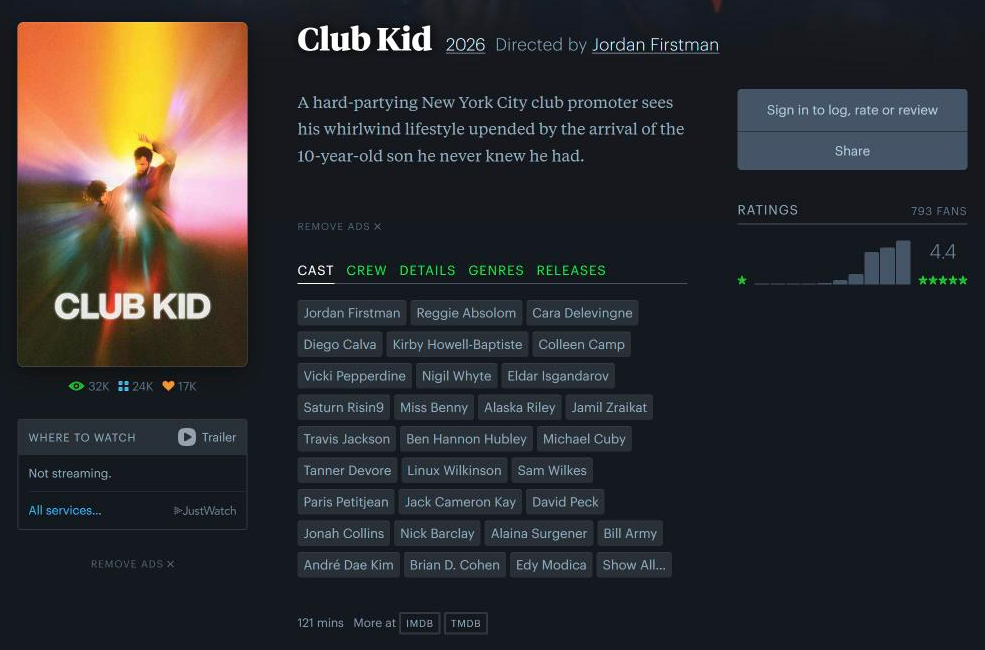
On the left, a where-to-watch panel powered by JustWatch sits next to a trailer button. "Club Kid" is not yet on a streaming service, so the panel reads "Not streaming." Audience reaction piles up before a film reaches streaming. Members keep diaries of what they watch, build and share lists, and take on challenges such as "Horror x 52," which has them work through horror subgenres over a year.
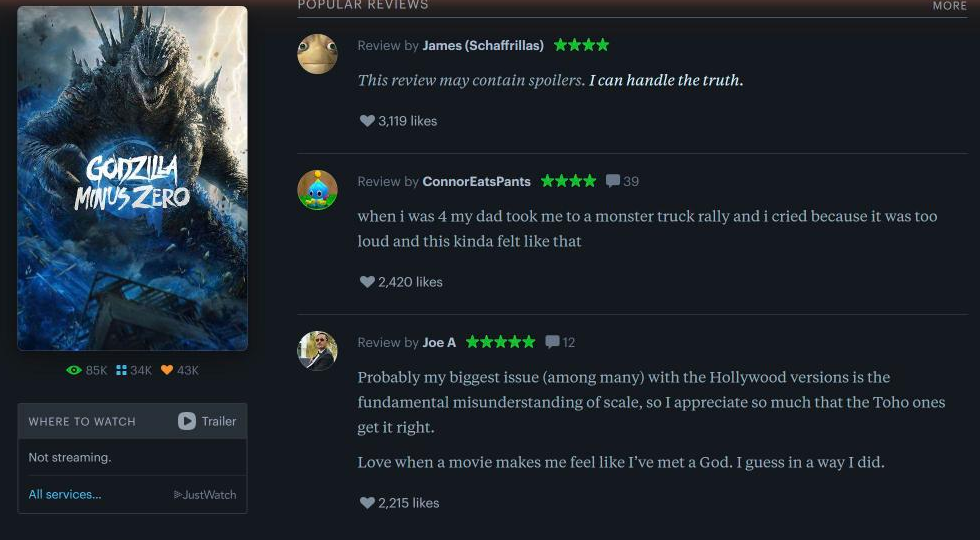
Reviews accumulate the same way. The page for "Godzilla Minus Zero," the latest Godzilla film from Japan's Toho, showed about 85,000 watches, 33,700 lists and 43,400 likes as of Saturday. The top three entries in its Popular Reviews section had drawn between 2,215 and 3,119 likes each, and one had 39 comments. Star ratings, short takes and reaction counts appear together, so member reviews steer other members' viewing choices. This film, too, is listed as "Not streaming."
Letterboxd also layers editorial on top of member activity. Its in-house Letterboxd Journal posted the November edition of "Unreleased Gems" for the Video Store on Nov. 5, gathering recent discoveries yet to find distribution and overlooked films that most members had been unable to see. On Nov. 4 it listed 20 buddy comedies to mark the release of Martin McDonagh's "Wild Horse Nine," and on Nov. 3, 20 films that blend horror and noir. Member logs, editorial curation and rentals connect on one site, much as the Times links recommendations to purchases at Wirecutter.
A24 outbid as price climbs; founders to stay, site to run standalone
LionTree ran the sale. In July the bank floated a $250 million valuation and Netflix, Sony Pictures and Paramount took early meetings, Variety reported, citing Puck. By September A24 and the Times had joined the race at more than $300 million, and an investor group led by Madison Wells chief executive Gigi Pritzker followed.
A24 promised the founders independence and an unchanged business model but was edged out as the price rose. One rival bidder warned that other buyers might push parts of the service behind a paywall. A studio or streamer owner would raise at least the perception of a conflict of interest, Variety noted on Sept. 24, since users might wonder whether it favored its own titles. Rotten Tomatoes spent years inside NBCUniversal amid questions about its independence before moving to Versant Media, which spun off from NBCU this year. In July a Letterboxd spokesperson said, "Any decision about Letterboxd's future would involve the founders."
Under the terms discussed, co-founders Matthew Buchanan and Karl von Randow would stay in charge and report to a Times executive. Letterboxd would keep operating as a standalone site while the Times plugs its advertising technology into Letterboxd's systems. The Times declined to comment; Mr. Buchanan did not respond to a request for comment.
Third-quarter revenue up 9.7%; digital net adds rebound to 420,000
A day before the talks were reported, the company posted third-quarter results. Revenue rose 9.7% to $768.5 million. Subscription revenue grew 10.7% to $547.5 million, including $421.3 million from digital-only subscriptions, up 14.6%. Advertising revenue rose 7.8% to $142.6 million; digital advertising climbed 12.0% to $109.9 million on marketer demand and more ad supply. Affiliate, licensing and other revenue rose 6.2% to $78.4 million.
Margins widened. Operating profit rose 16.4% to $121.9 million, and adjusted operating profit reached $149.6 million, a 19.5% margin. Net income rose 19.2% to $97.4 million. "Subscriber growth was powered by strong engagement and retention across our portfolio," said Meredith Kopit Levien, the chief executive.
The company ended the quarter with 13.76 million subscribers: 13.22 million digital-only and 540,000 print. It added about 420,000 net digital-only subscribers, up from 280,000 in the second quarter, when additions missed estimates of about 295,000 and raised concerns about a slowdown. Digital-only average revenue per user rose 1.4% to $9.93. The company is about 1.24 million subscribers short of its 2027 goal.
The results also show the capacity for a deal. Free cash flow for the first nine months was $435.8 million, more than the Letterboxd price, and the company bought back $79.1 million of stock in the third quarter alone. For the fourth quarter it guided to 12% to 15% growth in digital-only subscription revenue and high-single to low-double-digit growth in digital advertising. It booked $3.8 million in generative A.I. litigation costs in the quarter.
From Wirecutter to The Athletic, and now ad inventory as well
The Times bought the product-review site Wirecutter for more than $30 million in 2016 and paid $550 million in cash for The Athletic in 2022, the same year it added Wordle to its games bundle. A Letterboxd deal would be its largest since The Athletic.
Letterboxd does not disclose its paying members, but both companies pair subscriptions with advertising, a fit the Times cites. Having credited more ad supply for its digital ad growth, the Times would gain a community of nearly 35 million film fans to sell through its own ad tech. Letterboxd's EBITDA is projected to top $20 million in 2027. Last year it opened a Video Store that rents indie films, including previously unreleased titles, without a streaming subscription. Puck noted in July that the company had been slow to monetize its audience.
Korea's Watcha (왓챠), born the same year, sold in court for about $3 million
Watcha (왓챠), also founded in 2011, began as the film-rating service now called Watcha Pedia (왓챠피디아) and has amassed more than 700 million content ratings. It launched a streaming service in 2016 and began paying for licensed content. Revenue peaked at 73.4 billion won ($54 million) in 2022, but by the end of 2024 the company had an accumulated deficit of 267 billion won and negative equity of 87.5 billion won. Monthly active users fell from 1.3 million in 2022 to the 300,000 range this year.
Watcha entered court receivership at the Seoul Bankruptcy Court (서울회생법원) in August 2025. CJ ENM and the recommendation platform Kinolights (키노라이츠) filed letters of intent in a public sale in March, but neither placed a final bid in April. A private sale followed, and Kinolights moved to acquire the company for 4.25 billion won, about $3.1 million, just above the court-assessed liquidation value of 4.22 billion won. Watcha was once valued at more than 300 billion won.
| Letterboxd | Watcha (왓챠) | |
|---|---|---|
| Founded | 2011, New Zealand | 2011, South Korea |
| Origin | Film diary and review community | Film-rating service (now Watcha Pedia) |
| Licensing costs | None (rentals only) | Streaming service since 2016 |
| Audience | ~35 million members (Oct 2026) | 300,000-range MAU (2026) |
| Deal value | ~$330 million | 4.25 billion won (~$3.1 million) |
| Deal type | Exclusive talks with the Times | Court-supervised sale to Kinolights |
71% of Times revenue from subscriptions; Korean newspapers get 60% from ads
Subscriptions made up 71% of the Times's third-quarter revenue and advertising 19%. Korea's newspaper industry runs the other way: the Korea Press Foundation (한국언론진흥재단) estimates that subscriptions accounted for about 40% of industry revenue in 2024 and advertising about 60%. Broadcasting is losing ad money faster. Figures from the Korea Communications and Media Commission (방송미디어통신위원회) show broadcast ad revenue fell 12.3% in 2025 to 2.01 trillion won ($1.48 billion). From 2021 to 2025, mobile advertising grew 7.5% a year on average while broadcast advertising shrank 10.6% a year.
None of the companies the Times has bought are news outlets. Product reviews, sports, a word game and now a film community are all services people return to daily. Ms. Kopit Levien credited engagement and retention for subscriber growth. When 60% of Korean newspaper revenue comes from ads, subscription products that keep users inside a publisher's own service remain a small share of the business.
Letterboxd does not stream films. Its inventory is what members write, and without large licensing bills, member growth flows into ad and subscription revenue. Watcha held more than 700 million ratings but tied them to a streaming business that carried content costs, and it sold at liquidation value. A separate sale of Watcha Pedia was floated but drew little support. Analysts said CJ ENM's interest in Watcha was partly about moving its rating data and recommendation engine into TVING (티빙).
Korean broadcasters' streaming strategy has centered on scale. TVING and Wavve (웨이브) signed a merger memorandum in 2023 and won conditional approval from the Korea Fair Trade Commission (공정거래위원회), but the deal has stalled for three years without the consent of TVING shareholder KT Studio Genie (KT스튜디오지니). The Times can cover the Letterboxd price from nine months of free cash flow, then leave the acquired business to run on its own while it earns through ad tech and the bundle.
The deal leaves Korean broadcasters, streaming services and publishers with three questions. Can the viewer ratings, comments and fan-community data they hold run as a product separate from content licensing? Can they sell the ad inventory that product creates through their own ad tech? Can they build a subscription that bundles games, cooking, sports and communities under one account rather than a single news or drama product? The Times has widened its bundle in that direction since its digital paywall launched in 2011, and Letterboxd is the next piece.
No signed deal yet; the 2027 subscriber goal is the yardstick
The talks are exclusive but may not reach a signed agreement. If they do, the Times gains a film-fan audience nearing 35 million, new ad inventory, and a business projected to earn more than $20 million in EBITDA in 2027. Whether members' paywall fears come true will depend on how long the standalone promise holds.
Watcha now has to find a path under Kinolights. Experts quoted by Digital Daily said its ability to secure content after the takeover will decide whether it survives. Two film-taste services born in 2011 are changing hands at about $330 million and about $3 million.