
![[Samseog Ko's Insight]Seoul's Moment: Becoming the World's Global Entertainment tech Hub](https://cdn.media.bluedot.so/bluedot.kentertechhub/2026/02/icu6an_202602170621.png)
By Samseog Ko
Distinguished Professor, College of Advanced Convergence, Dongguk University; Member, Presidential National AI Strategy Committee
The rules of 21st-century urban competition are being rewritten. Where finance, manufacturing, and logistics once determined a city's global standing, a new cultural economy — one powered by artificial intelligence, content platforms, and fandom — is now taking center stage. We are living in the age of the "experience economy," and it is reshaping the destiny of cities worldwide.
In this seismic shift, Seoul stands at a crossroads. It can remain a respectable tourist destination and content-production base, or it can seize an unprecedented opportunity: to become the world's leading EnterTech hub(Entertainment tech Hub) — a city where entertainment and technology converge to generate and command global cultural power.
A New Geography of Cultural Power
What makes this moment so distinctive is that the redistribution of global cultural influence looks nothing like the old model of cultural imperialism.
In the 20th century, great powers projected their cultures outward on the back of political, military, and economic might. Hollywood and multinational brands served as instruments of an American-led cultural order. But the rise of digital platforms, the platform economy, and fandom-driven culture has fundamentally altered the equation. Cultural power is migrating — from nation-states to platforms, from corporations to fan communities, from centralized studios to decentralized tech collectives.
This structural transformation does more than explain the meteoric rise of K-Culture (Hallyu). It offers a strategic blueprint for how a metropolis like Seoul should position itself for the decades ahead.
Seoul's Unique Convergence
Seoul already sits at the epicenter of a remarkable convergence. K-pop, K-drama, gaming, and webtoons have secured a formidable global footprint, cultivating passionate fanbases across Southeast Asia, the Middle East, and Europe. Simultaneously, Seoul is one of the world's most advanced IT cities, anchored by 5G infrastructure, AI capabilities, mobile-first consumer behavior, and a vibrant startup ecosystem.
This dual strength — content and technology thriving in a single metropolitan space — is globally rare. New York commands finance. Los Angeles dominates film. Tokyo excels in animation. But no city has built an integrated Entertainment tech ecosystem — a living laboratory where content and digital technology fuse — quite the way Seoul has.
Yet an honest assessment demands candor. Seoul's cultural economy remains in its early stages of maturity. Global OTT platforms and digital infrastructure are overwhelmingly controlled by American and Chinese corporations. Data and revenue continue to flow offshore. A sustainable ecosystem for creators and young talent has yet to be fully realized. Seoul's strengths exist, but they are dramatically underutilized.
Five Pillars of an Entertainment tech Strategy
Solving these challenges requires more than piecemeal cultural subsidies or industry-promotion programs. Seoul needs a new urban development paradigm — one that systematically integrates content with AI, XR, data analytics, and fandom economics. Crucially, this Entertainment hub strategy must be inseparable from the construction of a digitally inclusive society.
Digital transformation is an engine of innovation and growth, but it also breeds new forms of inequality — not just in Korea, but worldwide. As digital platforms and AI assume central roles in the economy and culture, creators, small businesses, and vulnerable populations face growing risks of exclusion. Seoul's future strategy must therefore be designed to achieve growth and inclusion simultaneously, through the fusion of K-Culture and AI.
1. Open the AI-Powered Creative Ecosystem to Everyone
The "AI for All" initiative championed by the current government should find its proving ground in Seoul. Generative AI is already lowering the barriers to content creation.
Through public AI creative platforms and educational programs, Seoul can empower youth, women, persons with disabilities, and seniors to participate actively in digital content production. Several cities in the United Kingdom and Europe are already pursuing public AI education and creative studios that simultaneously bridge the digital divide and stimulate the creator economy. Seoul can build on and surpass these models to become a true "AI Creative City."
2. Strengthen the Inclusivity of the Fandom Economy
The engine of K-Culture is not passive consumption — it is participation and co-creation. Global fans engage through cover dances, fan art, remakes, and micro-investments, contributing actively to the content production cycle.
Seoul should institutionally support this participatory culture and invest in digital platforms that connect global fans with local creators, fostering a new cultural ecosystem. This strategy simultaneously counters the platform monopoly of global Big Tech and invites global citizens to become stakeholders in Seoul's cultural economy.

3. Transform Urban Spaces into Digital Cultural Platforms
Iconic Seoul districts — Gwanghwamun, the Han River corridor, Seongsu, Hongdae, Gangnam — can be reimagined as "urban digital performance venues," integrating XR experiences, media art installations, and virtual concerts into the fabric of the city.
Singapore, Las Vegas, Dubai, and London are already reconceiving urban space around digital experience, generating high-value returns in tourism and cultural industries. Seoul possesses both the technological infrastructure and the content capacity to lead this transformation.
4. Deepen Global Cooperation and Digital Solidarity
ASEAN nations, the Middle East, and the broader Islamic world are witnessing surging demand for K-Content, with governments in these regions aggressively nurturing their own digital content industries.
Through joint investment and production, co-developed platforms, and shared infrastructure, Seoul can position itself as the nexus of a global cultural network. Unlike the one-way cultural diffusion of the past, this is a strategy of co-evolution — building a new cultural order rooted in collaboration and mutual growth.
5. Create Youth-Centered Entertainment tech Jobs
Content, AI, XR, gaming, metaverse, and data industries offer both high value-added output and significant employment creation. If Seoul succeeds as a global EnterTech hub, it will generate quality jobs across a wide spectrum — for creators, developers, designers, and planners alike. This addresses two of Korea's most pressing challenges simultaneously: youth unemployment and urban competitiveness.
Beyond Industry Policy: A Civilizational Shift
The strategies outlined above have implications that extend well beyond economic performance. They can serve as the foundation for a new model of democracy and civic participation. Digital technology and culture enable a society in which citizens are not merely consumers but producers and creators. This represents not old-fashioned "cultural imperialism" but a new cultural power structure built on networks, cooperation, and shared ownership.
If Seoul leads this model, it opens the door to a new form of city-level public diplomacy and the cultivation of a truly global civic network.
Ultimately, the "Global Entertainment tech Hub Seoul" strategy is not an industrial policy. It is a strategy for civilizational transition — a new model of urban development that integrates culture, technology, and inclusion. The digitally inclusive society we aspire to is not simply about welfare or redistribution. It is about building a social architecture in which everyone can participate in economic and cultural activity and share in the fruits of growth.
If Seoul moves in this direction, K-Culture will cease to be a cultural phenomenon belonging to one particular country. It will become a platform for global cooperation and co-evolution.
A Pivotal Moment
The upcoming June local elections represent a critical inflection point for Seoul's future. Alongside essential bread-and-butter issues — housing, transportation, welfare, public safety — candidates must articulate a new urban vision and strategy that weaves together culture, technology, youth empowerment, and global engagement.
If Seoul makes the leap to become a global Entertainment tech hub, it will create not just a more competitive city but a new growth model for the Republic of Korea as a whole. And at the heart of that model will stand a new form of cultural power — one built on digital inclusion, participation, and connection.
About the Author
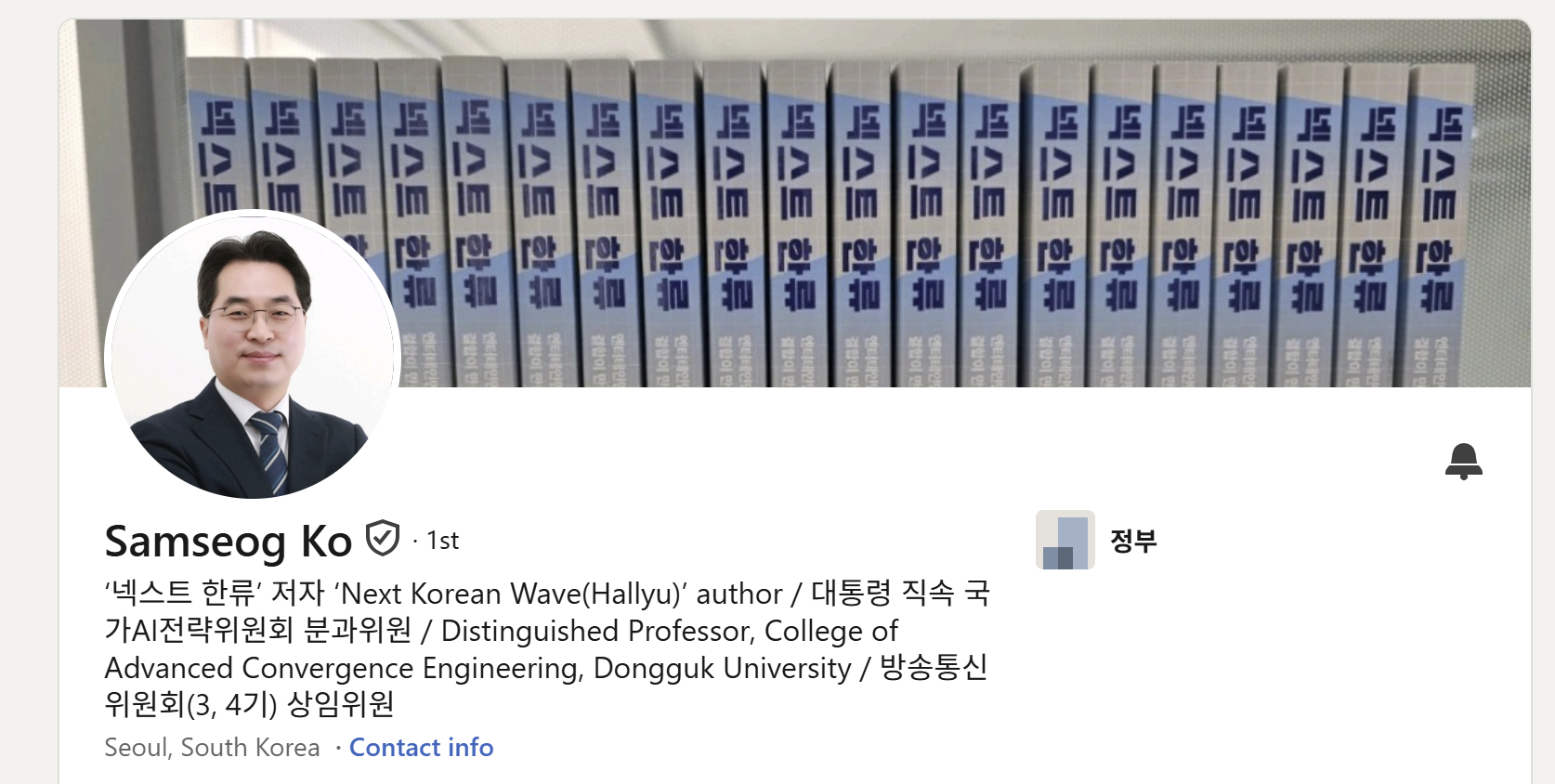
Samseog Ko is Distinguished Professor at the College of Advanced Convergence, Dongguk University, and a member of the Presidential National AI Strategy Committee. A leading policy expert on media, ICT, and digital transformation, he served as Standing Commissioner of the Korea Communications Commission (KCC) for five years and five months — the longest tenure of any political appointee in the commission's history — where he was instrumental in shaping Korea's broadcasting and telecommunications policies.
He previously served as Innovation Officer at the Presidential Office (Cheong Wa Dae). Prof. Ko earned his Ph.D. in Journalism from Chung-Ang University and is the author of several influential books, including 5G Hyper-Connected Society: A Completely New Future, whose Chinese-language edition reached No. 1 on Dangdang.com's new release rankings in industrial technology.
He has been a prominent voice advocating for the convergence of entertainment and technology, proposing the Korea-US "EnterTech Alliance" at CES 2026 and championing trilateral co-evolution models linking Korea with ASEAN and Middle Eastern partners. His work centers on building a digitally inclusive society in which advanced technology and cultural creativity serve as engines of shared prosperity.