
Luminate: 59% of 18-24s watched short-form in the past three months vs 49% for movies; among 65+ the order flips, led by TV series at 73%. Short-form is also their top discovery route, as seven U.S. streaming services add vertical feeds and Netflix brings its feed to Korea
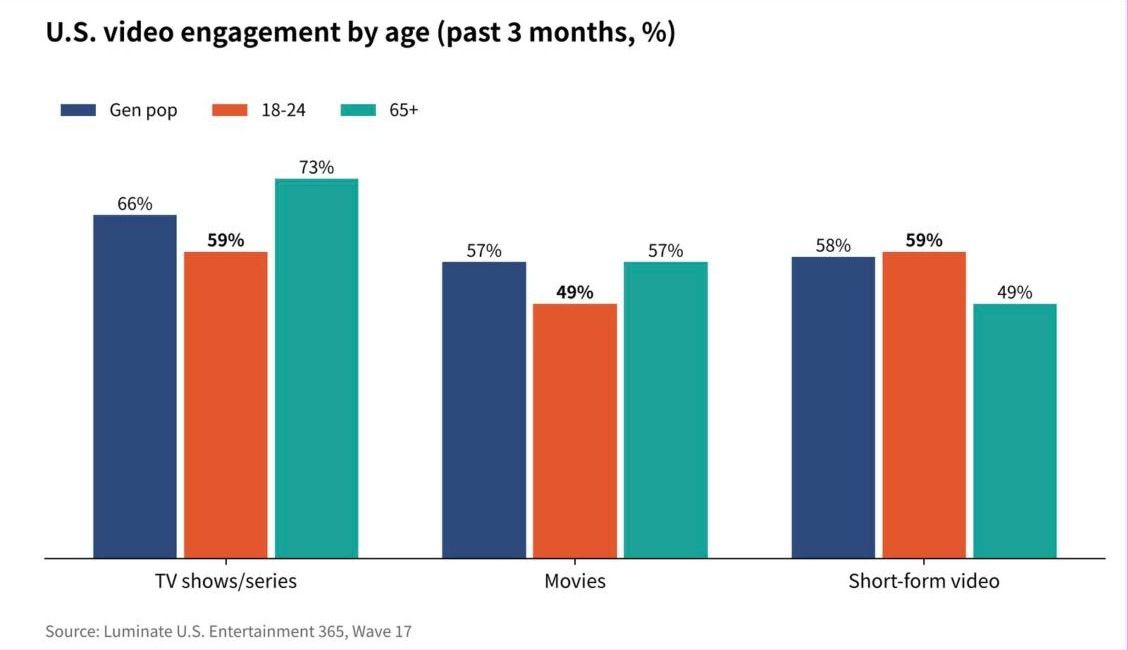
Nearly six in 10 Americans aged 18 to 24, or 59%, watched short-form video in the past three months. Only 49% watched a movie. The figures come from Wave 17 of Luminate's U.S. Entertainment 365 consumer survey, broken out by age.
Viewers 65 and older rank the three activities in the opposite order: TV series 73%, movies 57%, short-form 49%. Across the general population, TV series lead at 66%, with short-form (58%) and movies (57%) a single point apart.
For 18-24s, TV series sit at 59%, level with short-form. Luminate's reading is that long-form premium content still has an audience, but among young viewers it is likely to share equal prominence with short-form rather than lead it.
Streaming services are embracing short-form in response, pulling it into their own apps. Since Tubi opened a vertical feed in November 2024, seven major U.S. services, Peacock the latest in August 2026, have added TikTok-style feeds to their phone apps. In June, Netflix said its vertical feed would roll out in its Korean and Japanese mobile apps from July.
Short-form 59%, movies 49% for 18-24s… TV series 73% for 65+
Luminate's Entertainment 365 is a quarterly survey of how Americans spend time across music, film, TV, gaming and short-form video. Wave 17 polled 2,000 people between May 5 and 26, 2026, asking whether they had done each activity in the past three months. TV viewing covers both linear TV and services such as Netflix, Hulu and Prime Video; movie viewing covers theatres, TV and streaming; short-form covers TikTok, Instagram Reels and YouTube Shorts.
The age gap is wider in long-form than in short-form. Young adults' short-form rate (59%) is close to the population average (58%). Their TV-series rate is 14 points below the 65+ group, and their movie rate 8 points below. Luminate itself says the shortfall in TV and movie viewing is the more striking finding.
Britain shows the same ordering. A YouGov survey from October 2025 found 85% of 16-24s watch short-form weekly, ahead of TV series (65%) and films (45%), eMarketer reported; 69% watch it daily, against 18% of those 55 and over. In a 2026 analysis, YouGov described short clips as a step in the viewing journey that sends people on to full programmes. YouGov measures weekly use, so its numbers are not directly comparable with Luminate's three-month window.
Short-form leads title discovery at 57%… ahead of in-app browsing at 55%
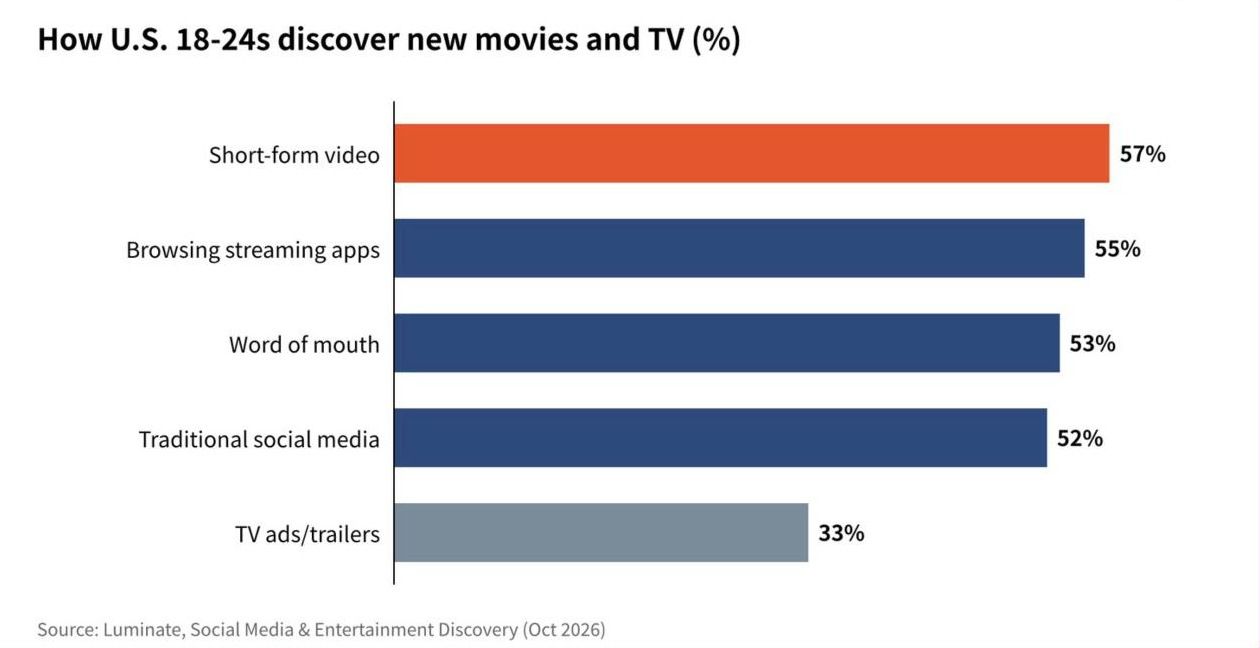
In its October special report, Social Media & Entertainment Discovery, Luminate found 57% of 18-24s use short-form video to find new films and series, edging out browsing inside streaming apps (55%), word of mouth (53%) and traditional social media (52%). TV ads and trailers trail at 33%.
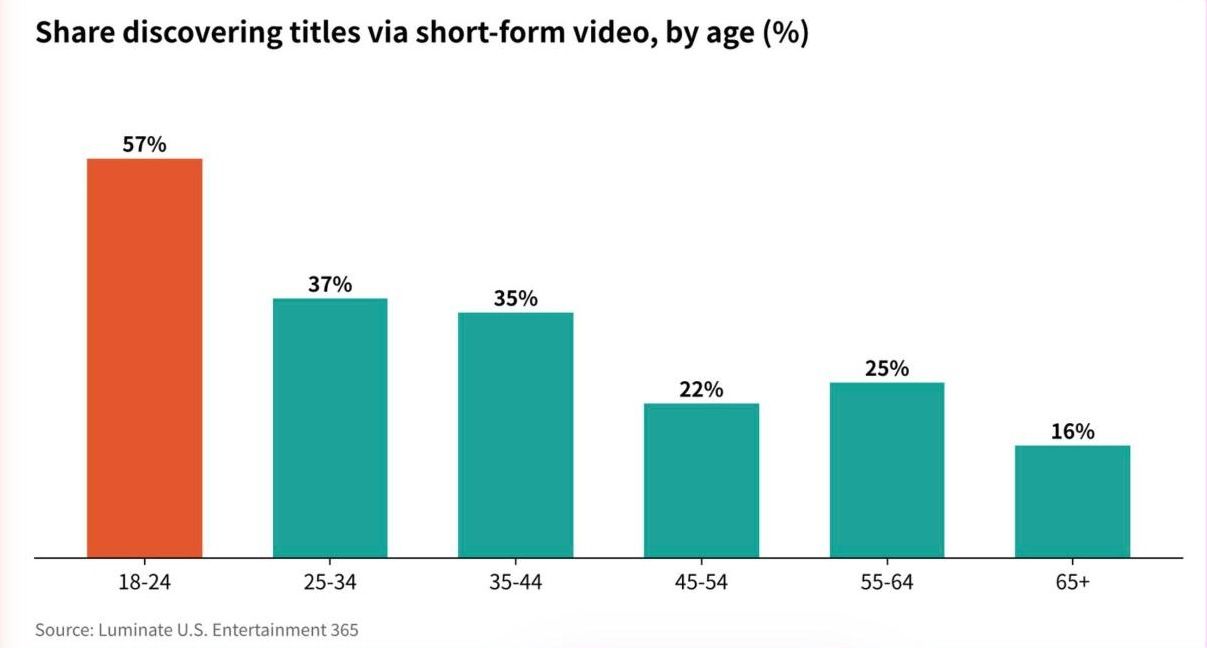
18-24s are the only age group for whom short-form is the leading discovery route. The share drops to 37% at 25-34, 35% at 35-44, 22% at 45-54, 25% at 55-64 and 16% at 65+. Among 55-64s and over-65s, 57% cite TV ads and trailers, and 58% of over-65s cite word of mouth.
In an October 29 post, Luminate media analyst Audrey Schomer said discovery has been the main rationale for streaming services rebuilding their mobile apps around vertical feeds. As short-form takes over social feeds, she wrote, social platforms now compete for all video time, whether the content is user-made or premium, and are hosting more microdramas, video podcasts and creator-led series that can stand in for long-form.
K-EnterTech Hub examines how short-form, vertical feeds and recommendation algorithms compete for title discovery in its report The Discovery Economy: Global Media & Entertainment Tech Trends 2027.
Life stage, not age… Sony says viewers move to premium content once they share a home
Not everyone reads the market by birth year. On Luminate's In the Lab podcast, Tania Missad, Sony Pictures Entertainment's EVP of insights, strategy and analytics, argued that life stage predicts video habits better than age. As summarised by Luminate chief media analyst Andrew Wallenstein on April 9, teens and singles lean on social video for identity and peer connection, while people who partner up or raise children shift toward premium content that is watched together.
Sony drew the conclusion from a nationally representative survey of more than 4,500 Americans, behavioural analytics and more than 250 ethnographic interviews. Short-form, mostly watched alone on personal devices, struggles to replace the shared emotional role of long-form, the research found. It also describes a social TV feedback loop: titles with shareable music, fashion or emotional moments spread on social platforms and send viewers back to the original.
On that view, young adults' low long-form rates may reflect a passing life stage rather than a fixed generational taste. Whether today's short-form habit survives the move into shared households has not yet been tested with long-run data.
Seven U.S. streaming services run vertical feeds… YouTube takes 15.8% of TV time
| Service | Vertical feed | Launch |
|---|---|---|
| Tubi | Scenes | Nov 2024 |
| Disney+ | Verts | Mar 2026 |
| Netflix | Clips | Apr 2026 (U.S. and others) |
| Paramount+ | Vertical feed | Apr 2026 |
| Prime Video | Clips | May 2026 |
| HBO Max | Shorts | Jul 2026 |
| Peacock | Vertical Feed | Aug 2026 |
| Netflix Korea/Japan | Clips (클립 영상) | Jul 2026 (announced) |
| TVING (티빙) | Shorts tab | 2024 |
Vertical-feed launches at major U.S. streaming services, with Korean services added below. Sources: Luminate, Electronic Times (전자신문), Digital Daily (디지털데일리)
The feeds began as clipped scenes from existing titles and are widening into new formats. In August Disney struck a TikTok partnership letting creators use Marvel, Pixar and Star Wars characters on TikTok and in Disney+ Verts. Peacock has opened a microdrama hub, Your Bravoverse, in its mobile app, and Disney+ and Paramount+ are expected to launch original microdramas, according to Luminate.
YouTube, the largest home of short-form and creator video, has pushed into the living room. In Nielsen's August Gauge it took a record 15.8% of U.S. TV-screen viewing, more than twice Netflix's 7.7%. Tubefilter reported that YouTube viewing among people 50 and older rose 9% in the same edition. On the TV set, short-form is no longer only a young person's phone habit.
Korea: 58.6% use short-form… broadcast variety clips are the most-watched type
Short-form is spreading fast in Korea too. In the Korea Creative Content Agency's 2025 Content Usage Survey (한국콘텐츠진흥원 2025 콘텐츠 이용행태 조사), based on face-to-face interviews with 6,554 people aged 10 and over and released in December 2025, 58.6% said they use short-form video. YouTube Shorts dominates at 93.4%, followed by Instagram Reels (30.9%), TikTok (21.1%) and Naver Clip (6.7%). Respondents watch because clips are short (76.0%), to see only the fun parts (51.4%) and because of recommendation algorithms (47.0%). The most-preferred short-form content is edited variety clips (62.1%) and drama clips (38.1%), both cut from TV programmes.
The 2025 Broadcasting Media Usage Survey by the Korea Communications and Media Commission (방송미디어통신위원회) and KAIT, covering 8,320 people aged 13 and over, found short-form was the most common type of content watched on streaming services, at 78.9%, ahead of streaming originals (68.6%), pay-TV productions (42.0%) and terrestrial broadcaster productions (30.3%).
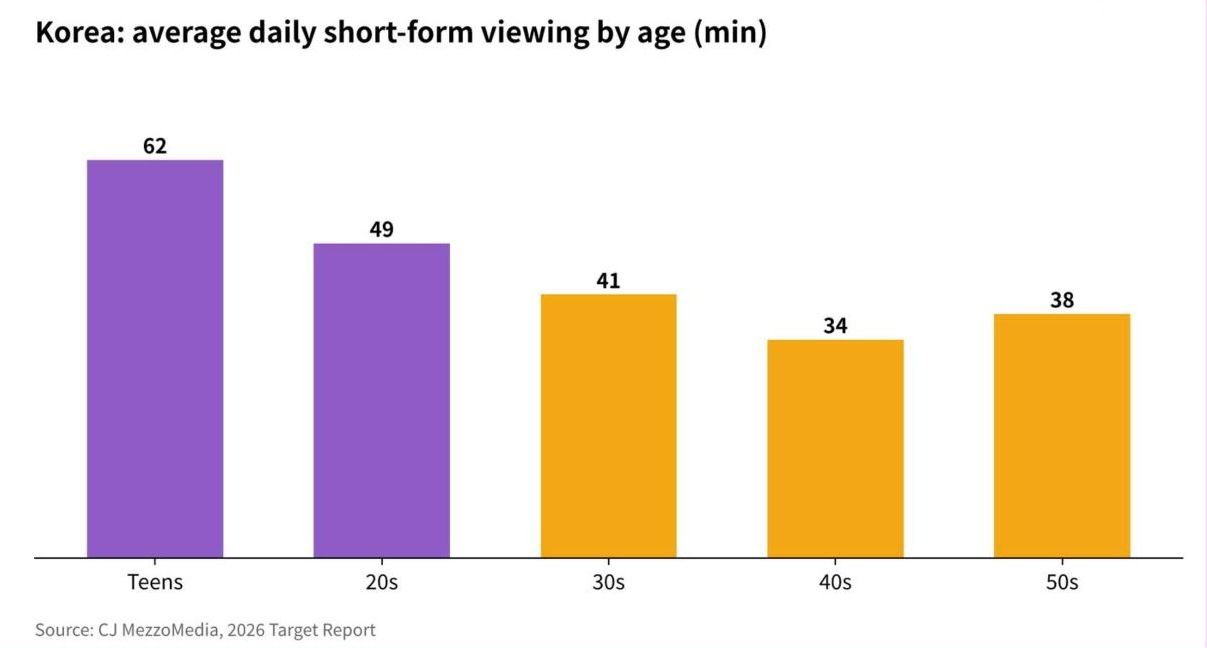
Time spent follows age too. CJ MezzoMedia's 2026 Target Report puts average daily short-form viewing at 62 minutes for teens, 49 for people in their 20s, 41 for 30s, 34 for 40s and 38 for 50s, above 30 minutes in every group. People in their 50s watching more than those in their 40s echoes the rise in YouTube viewing among Americans over 50 in Nielsen's data.
Netflix Clips arrives in Korea… TVING's comedy league, MBC's short-form dramas
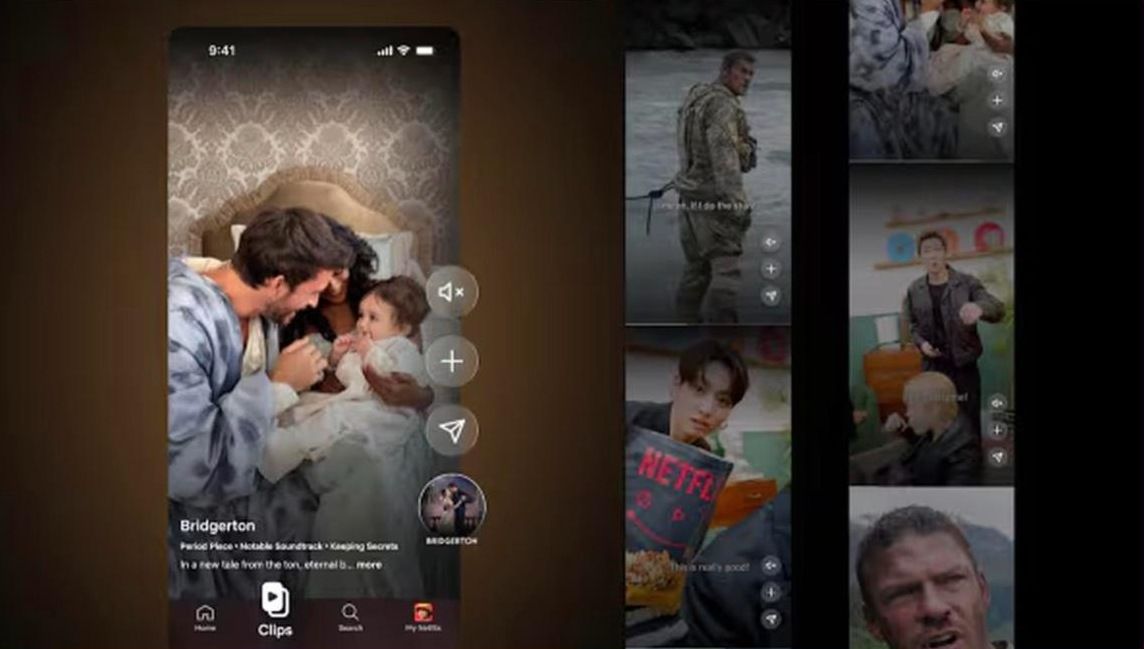
At a June 10 showcase for Asia-Pacific media, Netflix said its redesigned mobile app, built around the Clips vertical feed, would launch in Korea and Japan in July. Clips serves personalised scenes from across the catalogue, including series, films and live events, with save, share and title-page buttons. Mobile product designer Kim Ho said vertical feeds now account for a large part of how people discover entertainment.
Korean streaming services have leaned into participation. TVING added a Shorts tab in 2024 carrying vertical clips of tvN and Mnet dramas and variety shows plus KBO baseball highlights, with a jump to the full episode. Its Comedy Short League (코미디 숏리그), which began on June 22, has comedians post 192 short videos over 12 weeks, ranked by views, likes and votes. Wavve (웨이브) is discussing 10-minute short-form productions with partners, and Coupang Play (쿠팡플레이) pushes SNL Korea clips out through Instagram and YouTube.
Broadcasters are treating short-form as a production format. On June 30 MBC released the short-form drama The Good Wife Is Over (착한 아내는 끝났다) on the global platform DramaBox, its second after a September 2025 title spun out of its horror-talk show Midnight Horror Story (심야괴담회). MBC is also preparing at least two mid-form dramas of 10 to 30 minutes an episode for the second half, MTN reported. Google Korea said on October 30 that views of short-form dramas on YouTube in Korea rose more than 130% and watch time more than 100% in the year to June 2026.
Nine in ten Korean short-form users are on YouTube Shorts, and what they watch most there is edited broadcast variety and drama. Broadcaster clips already serve as the raw material of discovery, but the feed, the recommendation data and much of the ad revenue stay with YouTube. Netflix and TVING placing vertical feeds inside their own apps is an attempt to move that discovery step onto their platforms. Terrestrial broadcasters are still distributing short-form dramas through outside platforms; the open tasks are securing clip-editing and redistribution rights at the casting and music-licensing stage, and building a path from the clip to wherever the full programme can be watched.
Nielsen's September-October Gauge due this year… the contest shifts to discovery
Luminate's numbers do not show long-form shrinking. TV series remain the most common video activity for the population as a whole (66%) and reach 73% among over-65s. What has changed is that, among 18-24s, short-form has drawn level with TV series at 59% and become the first place they look for something new to watch.
If Sony is right, today's young viewers may watch more long-form as their lives change. Which service they choose at that point is likely to favour whoever controls discovery now, the same calculation that led seven U.S. streaming services to add vertical feeds within 18 months.
Three sets of numbers come next. Nielsen plans to publish its September and October Gauge together later this year after a one-time methodology adjustment, giving a first look at YouTube's share during football season. In Korea, mobile usage after the Netflix Clips rollout, and whether TVING's league and MBC's short- and mid-form dramas lead to full-episode viewing and IP sales, will show how far broadcasters' short-form bets are paying off.
Join K-EnterTech Hub at CES 2027: entertainment tech tours now recruiting

K-EnterTech Hub and smartcms are recruiting companies for the CES 2027 Entertainment Tech Insight Tour (Jan. 6-9, 2027, Las Vegas), built only for entertainment, content and media businesses. The tour centres on the C Space campus, where advertising, content and entertainment companies gather, and on Digital Hollywood at ARIA on Jan. 5, the day before the show opens, so participants can see on site what comes next for the short-form, vertical-feed and discovery race covered in this article. Every package includes our CES 2027 entertainment tech session analysis.
Half-day tour · Full-day tour · Three networking meetings · Conference talk on Jan. 7 · Talk + exhibit. Conference talk applications close Nov. 30; tours and networking close Dec. 11. Start with the free CES 2027 session preview.