

Third-quarter revenue of $893 million and adjusted EBITDA of $213 million, with political advertising at a quarterly record $136 million and core advertising down 4%. The 39% national ownership cap is gone, and ATSC 3.0 datacasting is the next bet.
Sinclair posted third-quarter revenue of $893 million and adjusted EBITDA of $213 million. Midterm political advertising of $136 million drove the gain while core advertising fell 4%.

Sinclair reported third-quarter results on Nov. 4. Revenue was $893 million, up 16% from a year earlier. Adjusted EBITDA was $213 million, up 113%. Net income attributable to the company was $43 million. A year ago the company booked a $1 million loss.
The gain came from one line. Political advertising revenue reached $136 million. The same quarter a year ago brought in $6 million. Core advertising fell 4% to $301 million over the same period. Distribution revenue, which carries retransmission fees, rose 1% to $426 million.
Political money arrives every other year and disappears in between. Chief Financial Officer Narinder Sahai called 2027 “a tougher comp year” on the earnings call. Political revenue goes away, and there is no Olympics or World Cup. Unresolved labor talks hang over the Major League Baseball season.
Most of the presentation went to revenue that does not come from spot advertising. The strategic review Sinclair opened last year ended with a decision not to separate the Ventures portfolio on its own. The company put its weight behind buying stations instead. Chief Executive Chris Ripley set out three buckets of spectrum revenue: ATSC 3.0 video delivery, datacasting and leasing.
| Item | Q3 2026 | Change |
|---|---|---|
| Total revenue | $893 million | +16% |
| Distribution (retrans and other) | $426 million | +1% |
| Core advertising | $301 million | -4% |
| Political advertising | $136 million | from $6 million |
| Adjusted EBITDA | $213 million | +113% |
| Net income attributable to Sinclair | $43 million | from a $1 million loss |
| Total debt / cash | $4,035 million / $659 million | liquidity about $1.4 billion |
Source: Sinclair third-quarter 2026 earnings release. Compiled by K-EnterTech Hub
Political advertising hit a quarterly record of $136 million as core advertising fell 4%
Sinclair is the second-largest broadcast group in the United States. Its annual report counts 185 stations and 641 channels across 86 markets, with signals reaching about 40% of U.S. households. It owns Fox, NBC, CBS and ABC affiliates, Tennis Channel and multicast networks such as Comet and CHARGE!. Local Media produced 88% of the quarter's revenue.
Revenue rose $120 million in the quarter, and political advertising rose $130 million. Everything else was flat or down. Sinclair said political revenue ran 55% ahead of the third quarter of the 2022 midterm cycle, helped by a dense map of battleground races and by the political climate itself.
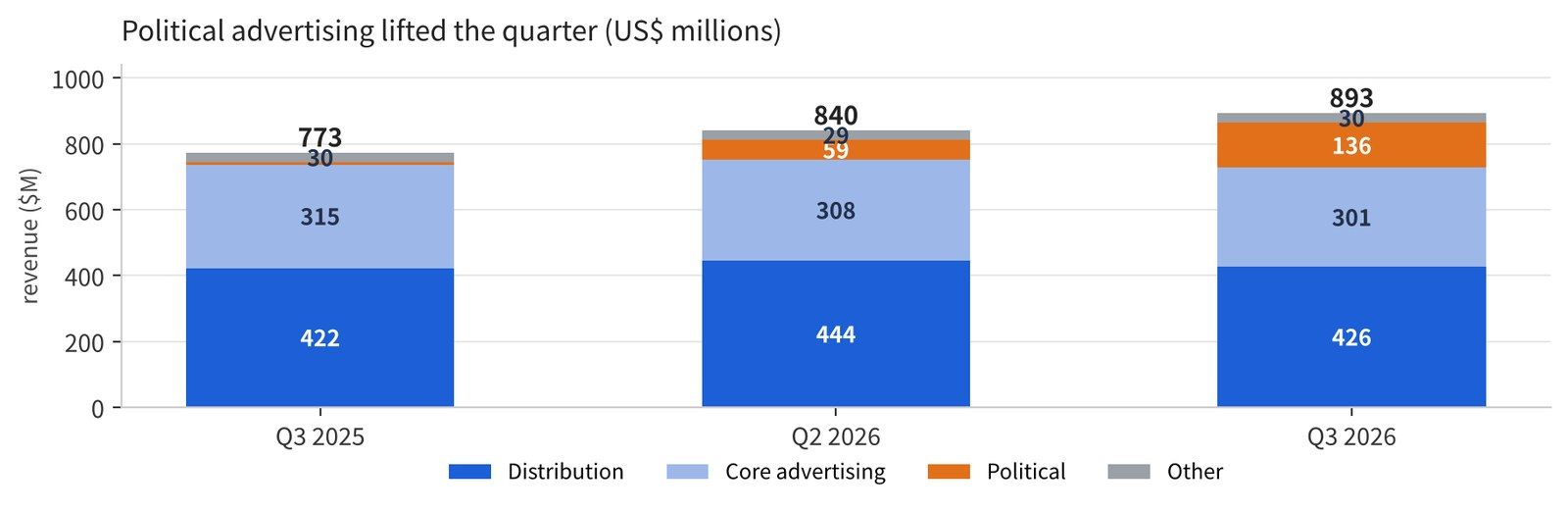
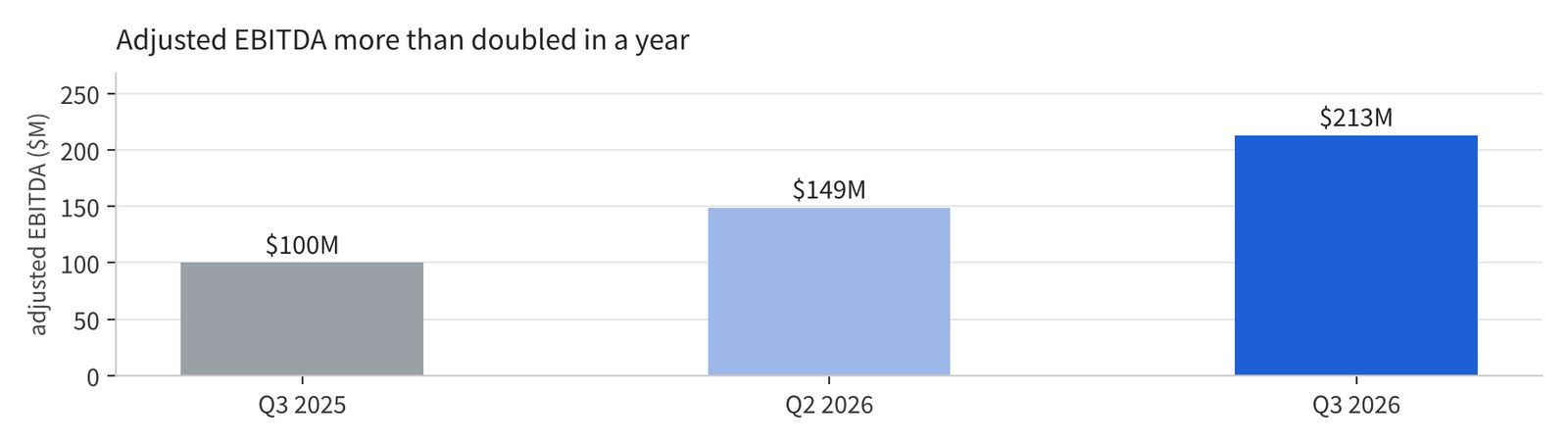
Profit moved further than revenue. Political spots carry no incremental production cost and sit in inventory the stations already own, so most of the money falls through. Adjusted EBITDA went from $100 million a year ago to $213 million. For the first nine months, adjusted EBITDA rose 55% to $488 million and the net loss narrowed to $13 million from $221 million.
Distribution revenue of $426 million was up 1% year over year and down 4% from the second quarter. Ripley said pay-TV churn has improved into the mid single digits, crediting the skinny bundles sold by Charter and DirecTV.
The release also logged programming results. Sinclair reached affiliation agreements with ABC and CBS in recent weeks. It cited record audiences for the 2026 FIFA World Cup, the NFL and college football. Those, it argued, keep broadcast at the centre of appointment viewing.
Local Media was the only segment to add profit as Tennis and Ventures stayed flat
The segment table makes the source of the gain plain. Local Media revenue rose to $789 million from $667 million, and segment adjusted EBITDA more than doubled to $205 million from $92 million. Political advertising inside Local Media alone was $135 million.
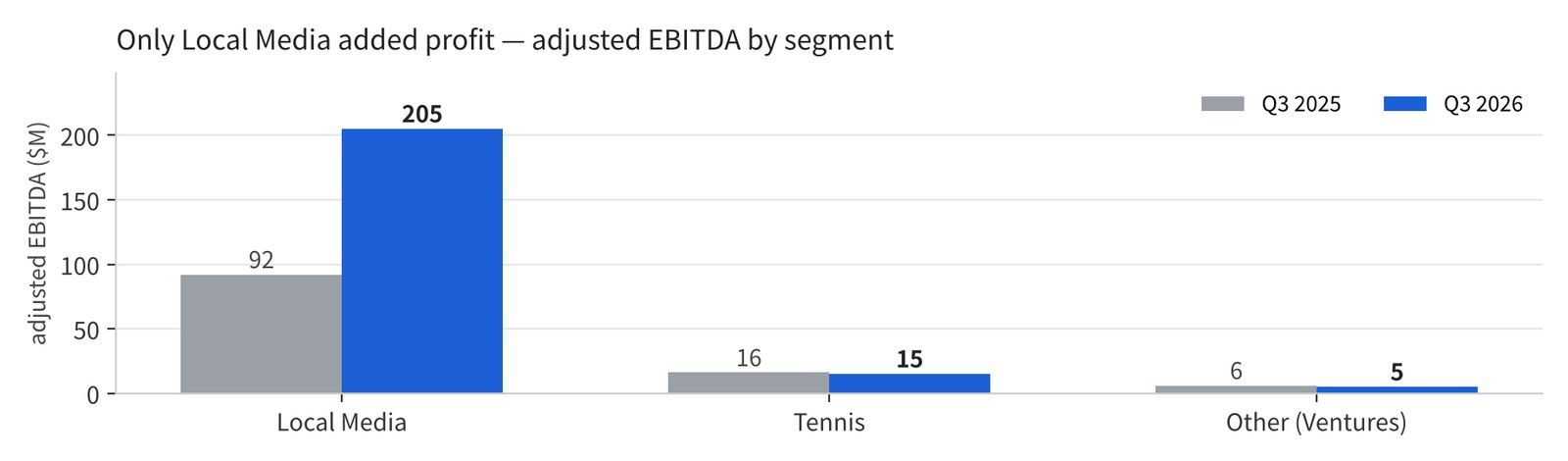
The other two segments stood still. Tennis revenue rose to $71 million but adjusted EBITDA slipped to $15 million from $16 million, which Sahai attributed to programming, production and direct-to-consumer spending. The Other segment, which holds Digital Remedy and non-media investments, posted $46 million of revenue and $5 million of adjusted EBITDA, both slightly lower.

| Segment | Revenue (Q3 2025 → Q3 2026) | Adjusted EBITDA |
|---|---|---|
| Local Media | $667m → $789m | $92m → $205m |
| Tennis | $67m → $71m | $16m → $15m |
| Other (Ventures) | $48m → $46m | $6m → $5m |
| Consolidated | $773m → $893m | $100m → $213m |
Source: Sinclair third-quarter 2026 earnings release. Consolidated figures include corporate costs and eliminations. Compiled by K-EnterTech Hub
Full-year adjusted EBITDA guidance raised to $835 million, and 2027 has no election
Sinclair lifted the outlook it gave in August. Full-year adjusted EBITDA guidance moved to $825 million to $835 million from $730 million to $760 million, and total revenue to $3.53 billion to $3.60 billion. Political revenue of about $455 million would be a company record, ahead of the $405 million booked in the 2024 presidential year.
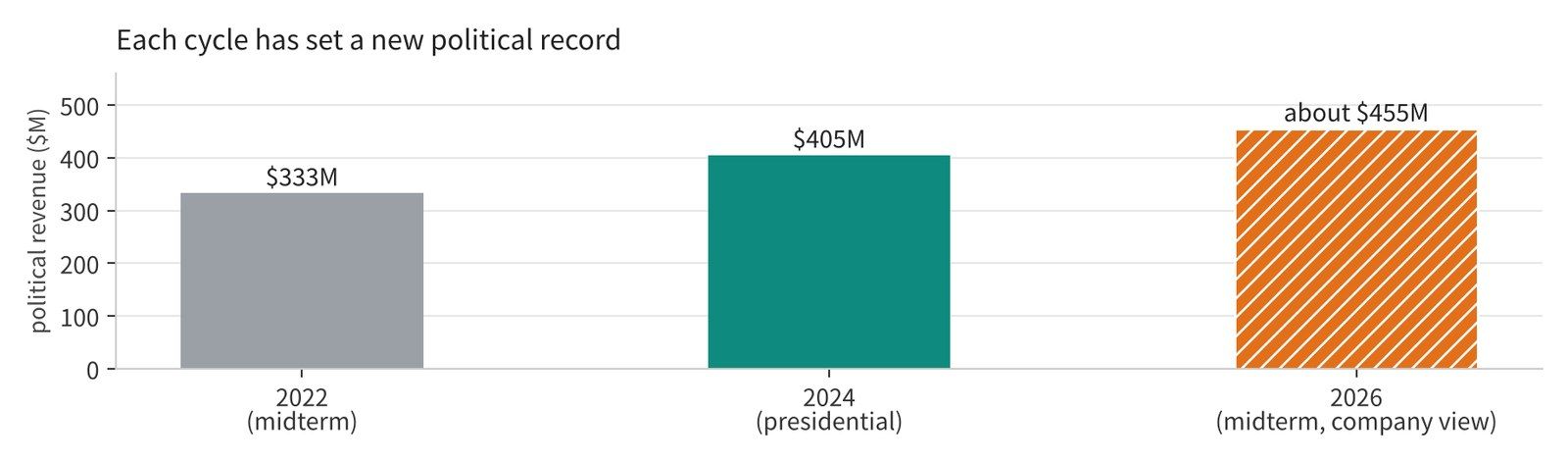
In the release Ripley noted that the new range is “higher than our 2024 Adjusted EBITDA of $816 million excluding the Diamond-related management fees”. Measured election year against election year, the baseline has moved up. The company did not give 2027 guidance and said it would do so with fourth-quarter results in late February.
| Item | August guidance | November guidance |
|---|---|---|
| Total revenue | $3.40bn – $3.54bn | $3.53bn – $3.60bn |
| Adjusted EBITDA | $730m – $760m | $825m – $835m |
| Distribution revenue | $1.72bn – $1.79bn | $1.735bn – $1.775bn |
| Core advertising | $1.22bn – $1.28bn | $1.22bn – $1.25bn |
| Political advertising | at least $375m | about $455m |
| Capital expenditures | $75m – $80m | $75m – $80m |
Source: full-year guidance in Sinclair’s third-quarter 2026 earnings release. Compiled by K-EnterTech Hub
The 39% national ownership cap is gone: “as good as it’s ever been”
The reason deal talk moved to the front of the call is regulatory. On Aug. 6 the Federal Communications Commission scrapped the national ownership cap that barred a single company from reaching more than 39% of U.S. television households. Chairman Brendan Carr and Commissioner Olivia Trusty voted for it and Commissioner Anna Gomez against, 2-1. Case-by-case review of transactions replaces the cap.
Ripley said the “regulatory environment right now is as good as it’s ever been”. He said Sinclair has bought three in-market station groups over the past 12 months and has more in the pipeline across several counterparties, and that the company is “ready and willing and able to jump on larger deals.”
He named one obstacle: the antitrust suit brought by state attorneys general and DirecTV against the Nexstar-Tegna merger, and the injunction that came with it, which he said is keeping others from moving. Sinclair has its own history here. Its attempt to merge with E.W. Scripps collapsed late last year when Scripps declined to take part.
Ventures will not be separated on its own: “it would also reduce strategic flexibility”
The strategic review Sinclair opened last year produced its answer this quarter. The company will not separate Ventures, which holds investments outside the core station business, through a spin-off or split-off. Ripley said that “certainly on paper, separating out ventures would create value, but it would also reduce strategic flexibility”, and that a spin-merge with another company “is still a priority.”
Sahai said Ventures will keep monetizing minority positions and redeploy the proceeds into Tennis Channel, Digital Remedy and return-seeking investments. Of the $659 million of cash at the end of September, $489 million sits at Ventures, which he described as optionality for a large broadcast transaction.
The balance sheet was tidied in the quarter as well. Sinclair retired $25 million of the B7 term loan at a discount and terminated what was left of the B3 loan. It paid a quarterly cash dividend of $0.25 a share in September. The First Out First Lien leverage ratio stood at 1.7 times and total leverage at 5.1 times, against covenants of 3.5 and 7.0 times. Undrawn revolver capacity was $724 million.

Three spectrum buckets: video delivery, datacasting and leasing
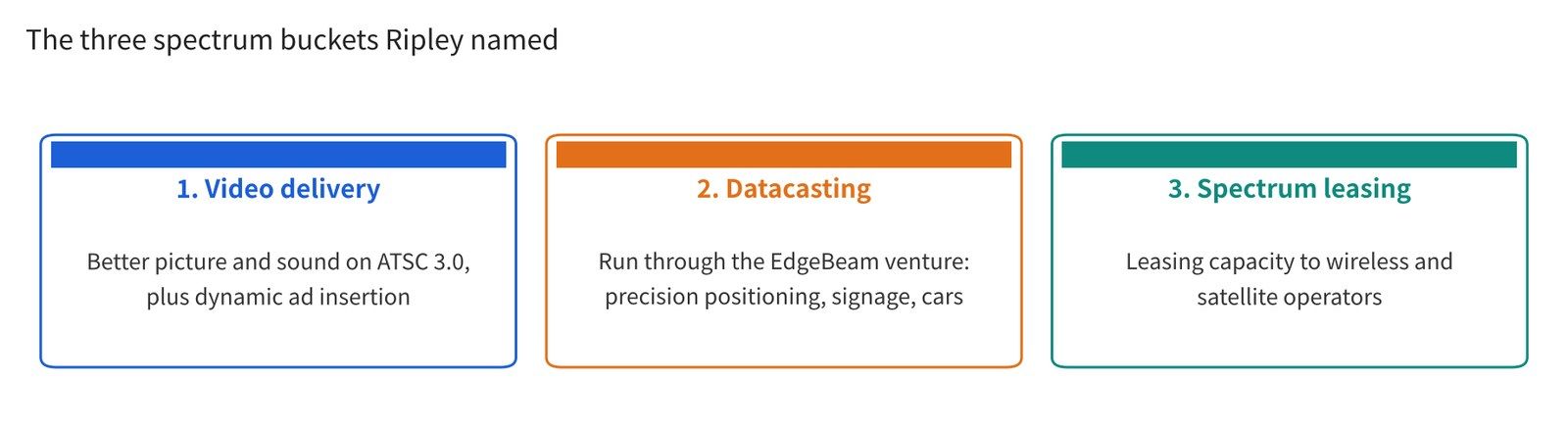
Ripley split the spectrum opportunity three ways. The first is video: ATSC 3.0 improves picture and sound and supports features such as dynamic ad insertion. The second is datacasting. The third is leasing capacity to wireless and satellite operators. Completing the transition, he said, frees up spectrum and therefore helps the datacasting case.
The timetable still sits with the regulator. The FCC opened a further rulemaking in October 2025 that would drop the simulcast obligation, and in January Sinclair, Nexstar, Gray Media and Scripps asked for a hard date to end 1.0 broadcasting. The National Association of Broadcasters has proposed February 2028 for the top 55 markets and February 2030 for the rest, a schedule Sinclair supports. Not everyone agrees. Weigel Broadcasting opposed a premature mandate, estimating that only 6% of U.S. television sets carry an ATSC 3.0 tuner.
EdgeBeam has its first paying customer, and its positioning partner is Korea’s MBC
Datacasting runs through EdgeBeam Wireless, the venture that Scripps, Gray, Nexstar and Sinclair formed in 2025 to sell data rather than video over ATSC 3.0 facilities. On the call Ripley said EdgeBeam is making progress in enhanced positioning, digital signage and automotive, but that it is early and takes time to ramp.
EdgeBeam chief executive Conrad Clemson told TV Technology in January that the contract with its first customer, Digital Mapping Group, is the point where the company is “crossing the chasm of pre-revenue to revenue”. The service carries real-time kinematic satellite-positioning corrections over ATSC 3.0 and resells them to utilities and governments.
A Korean broadcaster sits inside that product. In the same interview Clemson said EdgeBeam’s technology partner in the United States for the positioning capability is Munhwa Broadcasting Corporation (문화방송, MBC) of Korea, a relationship that goes back to BitPath, EdgeBeam’s predecessor, and that Sinclair made the introduction. Korean terrestrial broadcasters are supplying ATSC 3.0 know-how into an American datacasting business.
K82's business model landed at NAB Show New York in October: the guide as a storefront
Sinclair’s technical message this year came out of the NAB Show in Las Vegas in April. With its ONE Media Technologies unit the company demonstrated “Broadcast Once. Deliver Everywhere” at the ATSC booth: a single ATSC 3.0 transmission reaching television sets, tablets and mobile devices.

The technology it pushed hardest at the show was the Broadcast Positioning System, which uses timing from terrestrial transmitters to back up satellite navigation. Harvey Arnold, senior vice president of engineering, spoke in three sessions on single-frequency network deployment and on supplying timing to data centers, and received NAB’s 2026 Television Engineering Achievement Award. Ripley said at the time that the company looked forward to showing the continued evolution of ATSC 3.0 and the positioning system.
The working version of turning spectrum into revenue arrived in October. Del Parks, Sinclair's president of technology, set out K82's distribution and monetization plan on Oct. 22 at NAB Show New York at the Javits Center. The design links the channel to the broadcast programme guide, the broadcast app, ad-impression measurement and screen-recognition shopping: a viewer finds Korean content in the guide, watches it in the app, and moves on to advertising and purchases. K-EnterTech Hub reported the session on Oct. 24.
K82 is a 24-hour Korean culture channel named for Korea's country code, carrying K-pop, drama, variety, food, beauty and lifestyle. It takes one of the ATSC 3.0 multicast slots, with KBS, Arirang TV, YTN and EBS filling blocks of hours and a daily one-hour strip, K-Relay TV, produced by K-EnterTech Hub. A Washington, D.C., pilot comes first, with an extension to free ad-supported channels on Samsung (삼성) and LG smart televisions in 2027. The author is chief executive of K-EnterTech Hub, which takes part in the project.
Reach is why Sinclair treats K82 as a way to widen ATSC 3.0. The company says its stations take 3.3% of U.S. television advertising exposure, more than Netflix and Amazon combined. ATSC 3.0 service reached 75% of households inside its licensed areas as of the first quarter of 2024. In September it began a joint NextGen TV campaign with Nexstar in 13 markets, including Washington, D.C., and Baltimore.
The technical message came earlier, at the NAB Show in Las Vegas in April. 2026. K-Channel 82 would run one of the ATSC 3.0 multicast channels as a 24-hour Korean culture service, with KBS, Arirang TV, YTN and EBS filling blocks of hours and a daily one-hour strip, K-Relay TV, produced by K-EnterTech Hub. Washington, D.C., Baltimore and Las Vegas were the markets under consideration, with six months of piloting before an extension to free ad-supported channels on Samsung (삼성) and LG smart televisions in 2027. The author is chief executive of K-EnterTech Hub, which takes part in the project.
Political money holds up the local ad market, and $8.6 billion of it leaves in 2027
This is not a Sinclair-only problem. BIA Advisory Services puts the 2026 U.S. local advertising market at $186.1 billion, of which $9.7 billion is political. That is $1.3 billion more than BIA forecast in April, and $1.2 billion of the increase went to over-the-air television and streaming video.
Next year is the problem. BIA sees the 2027 local market at $186.5 billion, essentially flat, with political falling $8.6 billion to about $1.1 billion. Roughly $9 billion of non-political growth — real estate up 9.8%, leisure 5.9%, automotive 5.1% — is expected to fill the hole. For station groups that means replacing political dollars with ordinary advertisers.

Chief Operating Officer Rob Weisbord described 2027 as a largely fallow year and said Sinclair has plans to grow revenue beyond spot advertising. That is the context for the time the call spent on spectrum. Retransmission revenue carries a shrinking subscriber base, and core advertising fell again this quarter.
Korea’s UHD network is unfinished nine years in, and regional MBC ad revenue has halved
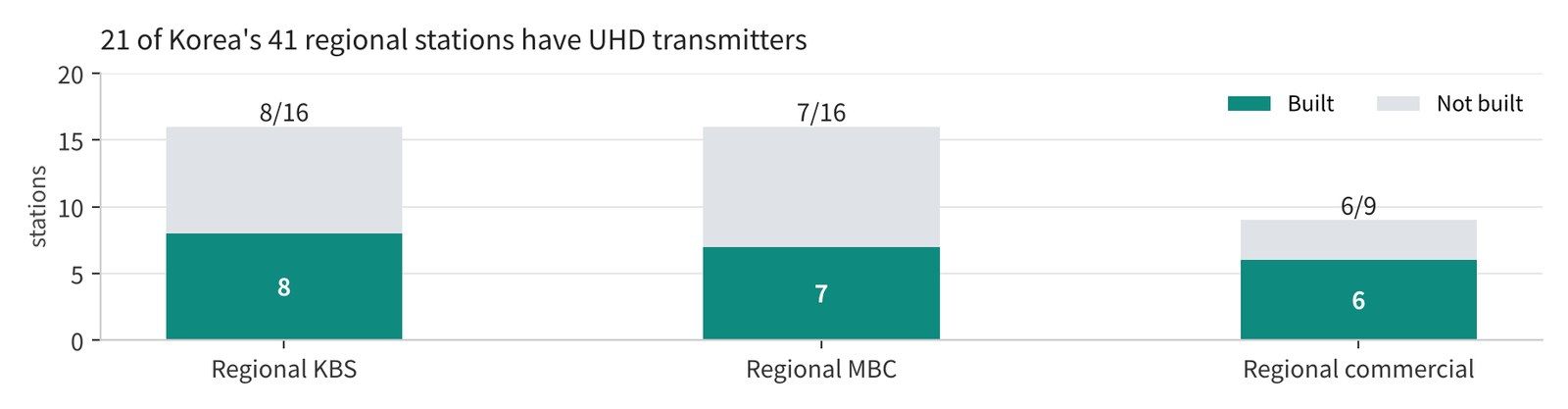
While American broadcasters argue over a transition date and what to sell on the new transmitter, Korea (한국) — the first country to put ATSC 3.0 on air — is still building the network. Data submitted by the Korea Media and Communications Commission (방송미디어통신위원회) to lawmaker Kim Jang-kyum (김장겸) shows that as of October, 21 of the 41 regional KBS, MBC and commercial stations had UHD transmission facilities. Average population coverage per broadcaster was 68.3% in October 2024, and area coverage 22.5%.
The government had planned to extend the UHD network to city and county level by 2021, pushed that to 2023 as regional broadcasters’ finances deteriorated, and has not met the target since. The commission will only convene a study group on next-generation terrestrial policy in December, covering the national build-out schedule, the timing of an HD shutdown and UHD programming quotas. Broadcasters must replace HD equipment that has been in service for 15 to 20 years, and are holding off on the investment until the direction is settled. The UHD investment plans 31 broadcasters filed in 2015 came to 960.4 billion won (about $707 million).
Reception is thin as well. In the 2025 broadcast media usage survey, 20.3% of households owned a UHD set and 11% received terrestrial signals directly. Where the American argument turns on a 6% tuner base, the Korean one turns on how few households take the signal off the air at all, so the benefit of a transition has to travel through pay-TV retransmission.
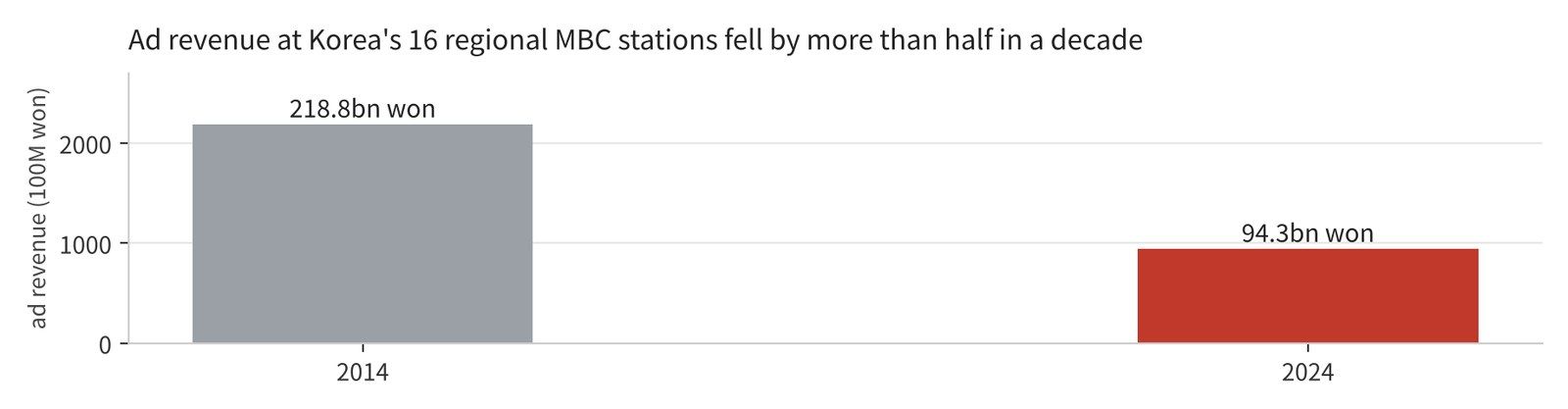
Funding is the more urgent half. In a joint statement in January, the advertising directors of the 16 regional MBC stations said advertising income had fallen to about 30% of its level a decade ago. On the official industry survey, combined advertising revenue at the regional MBC stations went from 218.8 billion won in 2014 to 94.3 billion won in 2024 — roughly $161 million to $69 million. They asked for negative-list advertising regulation and for virtual, product-placement and mid-roll advertising to be opened up.
In the United States retransmission fees hold the floor under declining advertising, and in election years political money lifts profit above it. Sinclair’s $426 million of distribution revenue this quarter was larger than its $301 million of core advertising. Korea’s regional terrestrial stations have no second revenue line of comparable size. That is why the criticism at home is that the policy conversation has stayed on coverage maps and picture quality while the same standard is being sold as a data business abroad.
| Item | United States | Korea |
|---|---|---|
| Transition timetable | Before the FCC; industry asks for 2028 and 2030 | No national date; study group convenes in December |
| Reception base | About 6% of TV sets have an ATSC 3.0 tuner | 20.3% own a UHD set, 11% receive over the air |
| Spectrum revenue | EdgeBeam datacasting has its first revenue | Data business models still under discussion |
| Regional station funding | Retrans and political offset ad decline | Ad-dependent; regional MBC ad revenue more than halved |
| Ownership rules | 39% national cap repealed in August | Ownership and cross-ownership limits retained |
Sources: FCC and Sinclair filings, Korea Media and Communications Commission data, Korean broadcasting industry survey, BIA. Compiled by K-EnterTech Hub
Conclusion and outlook
Sinclair’s third quarter is an election-year quarter. In 2027 the $455 million of political revenue goes away. There is no Olympics and no World Cup. The company offered three answers. Buy more stations in a market without an ownership cap. Reset what it pays networks against what those networks earn from streaming. Make money from ATSC 3.0 spectrum that does not come from advertising.
The first two will be visible inside 2027. The Fox renewal comes up in December. Most major pay-TV carriage deals fall due next year. Whenever the Nexstar-Tegna litigation clears is also when larger combinations can move. The third will take longer. EdgeBeam has only just taken its first paying customer. The transition date is the FCC’s to set.
Two questions sit in front of Korean terrestrial broadcasters. The first is the timetable. If December’s study group does not fix a date for the HD shutdown, replacement investment in ageing transmission equipment stays frozen. The second is what gets sold after the switch. The United States has begun selling positioning corrections, signage and automotive delivery on the same standard. A Korean broadcaster supplies part of that technology. No equivalent business has been built at home.
Note: quotation marks mark statements confirmed in public filings, calls and reporting; text without them is summary. Won figures are converted at 1,358.73 won to the dollar, the European Central Bank cross rate of Nov. 6, 2026. The author is chief executive of K-EnterTech Hub, which takes part in the K-Channel 82 project described above.