When Cooking Became Entertainment: The Future of K-Food Content
by
2026년 2월 13일

They Fell, Too. Now Only Korea Remains.
Canal+ Shuts Down Showmax: The Last Warning for Korea's K-AI EnterTech Moment
$309 million. 11 years. 44 countries. Why it failed — and what Korea must learn.
Another challenger has fallen in the global streaming wars. Showmax, which launched a direct assault on Netflix across 44 African countries, has finally surrendered. MultiChoice and NBCUniversal poured a combined $309 million into the platform — yet trading losses worsened 88% and revenue actually declined. The global streaming giants survived. Showmax did not.
Of the handful of local streaming platforms that once dared to compete independently against Netflix and its rivals, Korea now stands nearly alone. But the question is: for how long?
 Jung Han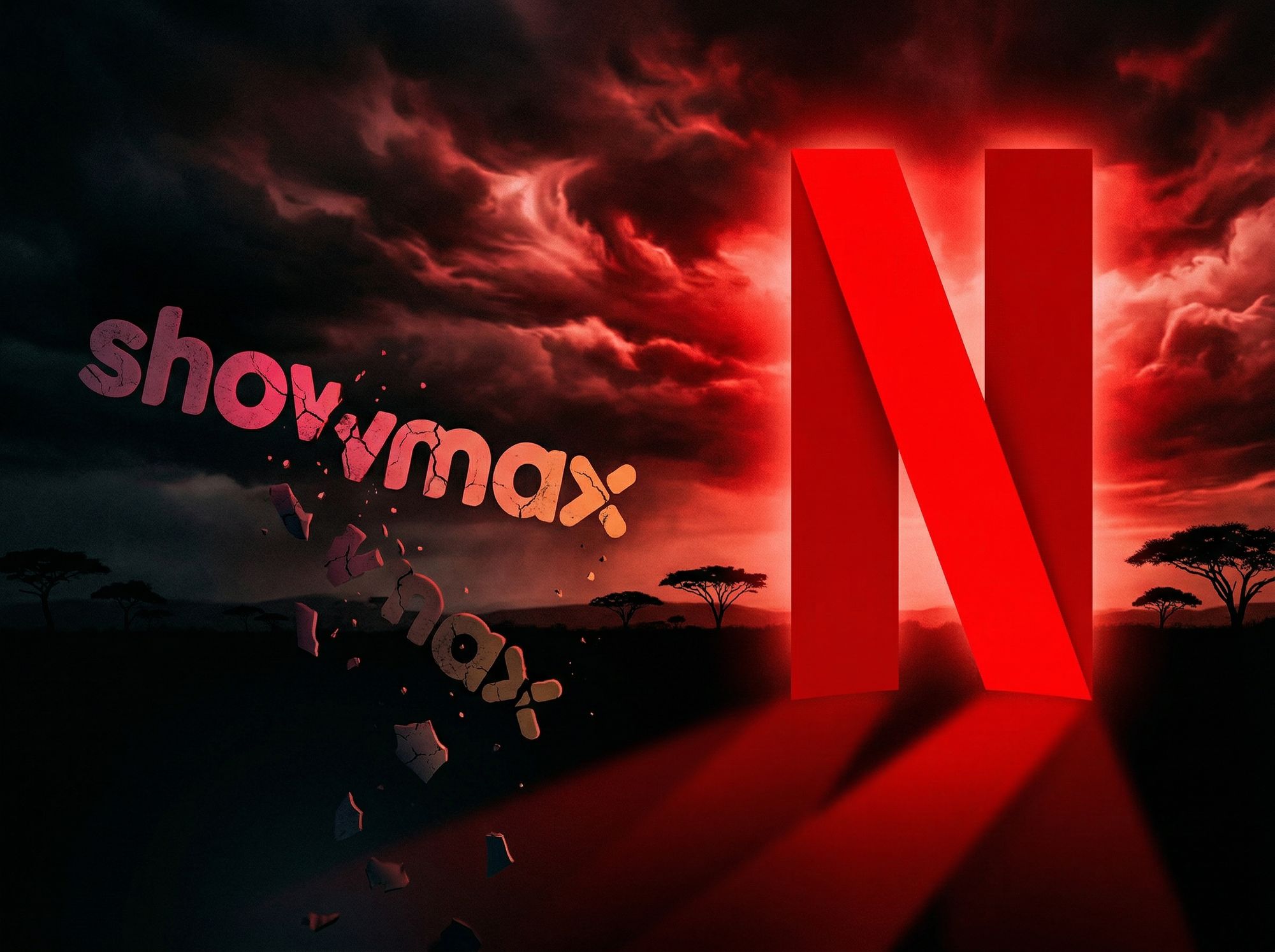
■ Showmax at a Glance — Sources: Variety, TechCentral, Weetracker
▪ Total investment $309M (MultiChoice + NBCUniversal combined equity funding)
▪ Service period & territory August 2015 – 2026 / 44 African countries (11 years of operation)
▪ Final subscriber count ~3.9 million (2025) (vs. Netflix Africa ~9 million)
▪ FY2025 trading loss ZAR 4.9 billion (~$308 million) (88% worse YoY from ZAR 2.6B — MultiChoice official filing)
▪ Subscriber paradox +44% YoY subscriber growth — yet revenue fell (Content & platform cost surge wiped out gains)
▪ Target vs. reality Target: $1B revenue & 16M subscribers (within 5 years) (Actual: less than 30% of target at shutdown)
▪ NBCUniversal stake 30% joint venture (Under Comcast)
▪ Canal+ savings target $479M/year (group-wide) (Showmax cuts directly contributed — Canal+ CEO statement)
Showmax launched in South Africa in August 2015. As Netflix, Apple TV, Amazon Prime Video, and Disney+ moved into African markets and began eroding MultiChoice's satellite pay-TV subscriber base, MultiChoice responded by building its own streaming challenger.
In February 2024, MultiChoice raised the stakes dramatically. It partnered with NBCUniversal (a Comcast company) and Sky to fully relaunch the platform as Showmax 2.0 — rebuilt on Peacock's streaming technology. The relaunched service positioned three offerings as its competitive edge: African local originals, Hollywood titles, and English Premier League mobile streaming rights. Then-executive Yolisa Phahle publicly set an audacious target: $1 billion in annual revenue and 16 million subscribers within five years.
The results were devastating. In FY2024 (year ending March 2024), Showmax posted a trading loss of ZAR 2.6 billion (~$164 million). By FY2025, that figure had surged to ZAR 4.9 billion (~$308 million) — an 88% deterioration. Subscribers grew 44%, but revenue actually fell. MultiChoice's group trading profit collapsed 49%. When Canal+ completed its full acquisition of MultiChoice in September 2025, the conclusion was already written.
"Financially, commercially, the thing is not flying."
— David Mignot, CEO of MultiChoice — TechCentral interview, February 2026
Showmax's collapse was not a simple strategy error. Six structural forces, operating simultaneously, made survival almost impossible — regardless of effort.
① Infrastructure: Africa Wasn't Ready for Streaming
Showmax's greatest enemy wasn't Netflix. It was the infrastructure gap. Approximately 21% of sub-Saharan Africa's population still lacks reliable internet access. (Source: GSMA Mobile Economy Sub-Saharan Africa, 2022) Hundreds of millions of households cannot sustain the 3Mbps minimum required for streaming. Mobile data costs remain prohibitively high relative to household income across key markets. Showmax introduced a mobile-only plan at roughly R69/month and supported low-bandwidth streaming, but these measures could not overcome a structural barrier of this scale.
② The Revenue Trap: More Subscribers, Less Money
FY2025 delivered a paradox that exposed Showmax's broken economics: subscriber count rose 44% year-over-year, yet revenue declined. Low-cost mobile plans (averaging ~$3/month) drove subscriber growth while content costs and Peacock platform operating fees scaled upward as fixed costs. The virtuous cycle — subscribers grow, revenue grows, profits follow — never activated. Showmax itself described the dynamic as a 'step-change in content costs and platform costs.' Running a high-cost platform in a low-ARPU market is a structural contradiction. (Sources: Weetracker; MultiChoice annual results)
③ The Content Dilemma: Caught Between Local and Global
Showmax pursued two strategies simultaneously — heavy investment in African local originals AND licensing Hollywood titles and EPL rights. Focusing on local meant losing to Netflix's global library. Chasing global content meant costs spiraled. Attempting both meant excelling at neither. More fundamentally: African local content generated zero export revenue. Unlike Korean content, which now drives Netflix's global subscriber growth, African originals had no recoupment mechanism outside the continent. The economic flywheel that makes K-content viable simply did not exist for Showmax.
④ Macroeconomic Shocks: Currency Collapse and Consumer Squeeze
The February 2024 relaunch coincided almost exactly with a sharp depreciation of Africa's major currencies. The South African rand (ZAR), Nigerian naira (NGN), and Egyptian pound (EGP) all fell sharply against the US dollar, decimating real subscription revenue. MultiChoice's official filings cited 'a severely stretched consumer environment,' foreign exchange volatility, intensifying competition from global streaming services, and rampant piracy as the primary headwinds. DStv, MultiChoice's legacy satellite TV service, lost 2.8 million subscribers over two years. (Source: Weetracker, January 2026)
⑤ The Platform Cost Trap: Peacock Technology as a Burden
The centerpiece of Showmax 2.0 was its new streaming infrastructure — built on NBCUniversal's Peacock platform. Designed for developed markets with high ARPU, the technology imposed fixed operating costs that African revenue could not support. Showmax was burning cash to maintain global-standard infrastructure before it could reach the critical subscriber mass needed to sustain it. This technology-market mismatch — deploying premium infrastructure into a low-income, high-piracy environment — directly accelerated the financial collapse. Showmax acknowledged 'increased platform costs' as a formal explanation for the widening losses.
⑥ No Strategic Patience: Canal+'s Priorities Changed Everything
Under MultiChoice's independent management, Showmax could be framed as a long-term strategic investment. Canal+'s acquisition in September 2025 changed the calculus entirely. Canal+'s strategic priorities in Africa are scale and cost reduction in pay-TV — not streaming competition. Showmax was an unplanned burden on Canal+'s balance sheet, not a strategic asset. CEO Maxime Saada stated explicitly in a January 2026 investor call that Showmax budget cuts directly contributed to the group's €479 million annual savings target. When ownership changes, so does patience.
"Showmax was not a commercial success — it's quite obvious."
— Maxime Saada, CEO of Canal+ — Investor conference call, January 2026
The opportunity Showmax was chasing was real. SVOD subscribers in sub-Saharan Africa were projected to grow from 5 million in 2021 to 15 million by 2026 — a threefold increase. (Source: Dataxis, 2022) Africa's total TV market is forecast to expand from $87.8 billion in 2025 to $223.2 billion by 2034. (Source: Market Data Forecast, 2025)
The competitive reality is less welcoming. Netflix operates across all 60 African countries, leading the market with approximately 9 million subscribers. Amazon Prime Video reaches virtually all of Africa through bundle arrangements. Disney+ covers only 13 countries, including Egypt, South Africa, and Morocco. Max (formerly HBO Max) has no African presence at all. Canal+ holds over 7 million pay-TV subscribers across 25 Francophone African countries. (Source: Vitrina AI, March 2026)
With Showmax gone, the African streaming market is likely to consolidate further around Netflix. Canal+ has pivoted from competing with Netflix to distributing it — bundling Netflix subscriptions into its pay-TV packages to retain existing subscribers rather than lose them entirely.
Rather than continuing to compete with Netflix directly, Canal+ chose partnership. In June 2025, Canal+ and Netflix announced an agreement covering 24 Francophone African countries, making Canal+ the first traditional African pay-TV operator to bundle Netflix into its offering. Variety reported that Canal+ is expected to extend this model across all of Africa. (Source: Variety, March 2026)
The strategic logic is clear: abandon the attempt to become a global-scale streaming service, and instead monetize Netflix's reach to prevent pay-TV subscriber churn. If you can't beat the streaming giant, sell its subscriptions. Canal+'s full strategic update is expected on March 11, when it will report its first consolidated annual results following the MultiChoice acquisition.
Under the terms of the acquisition agreement, Canal+ is prohibited from layoffs for three years. Showmax staff will be redeployed within MultiChoice rather than dismissed. Showmax's original programming catalog — including Spinners, Wyfie, Reyka, Shaka iLembe, Koek, Adulting, Catch Me a Killer, Khaki Fever, Youngins, and Dam — will be rebranded and folded into MultiChoice's existing channel portfolio: Africa Magic, M-Net, kykNET, and Mzansi Magic on DStv.
"Showmax was the only platform willing to back bold and authentic stories. These were projects that no competing platform or broadcaster would ever have commissioned. If 2026 is the Year of the Horse, this horse is being sent to the factory to be turned into glue and cheap pies."
— Award-winning South African filmmaker and producer — Variety interview, March 2026
This closure follows Amazon MGM Studios' January 2024 decision to halt all African local original commissioning and terminate over 12 development deals with production companies. Africa's creative ecosystem has now absorbed two major structural blows in two years.
Showmax is not an isolated failure. HOOQ, a joint venture of Singtel and Sony in Southeast Asia, was liquidated in 2020. OSN+ in the MENA region, AltBalaji in India, and multiple telco-backed streaming services across Latin America have all collapsed in the face of Netflix, Disney+, and Prime Video.
The pattern is consistent: local markets alone cannot generate the subscriber scale needed to sustain the content investment and technology costs required to compete — before cash runs out.
Netflix's global dominance is now near-total. As of early 2026, Netflix has approximately 301.6 million global subscribers — including 96.1 million across Europe, Middle East, and Africa — and annualized revenue approaching $44 billion. (Source: Netflix investor filings, Q3 2025) The number of local streaming platforms attempting independent survival against this machine can now be counted on one hand. Korea is among them.
The Korean market deserves a clear-eyed look at the data.
■ Korea OTT Market — Sources: FSS DART filings; IGAWorks MobileIndex
▪ Netflix Korea revenue (2024) KRW 899.7B / Operating profit KRW 17.4B (+9.3% YoY — Netflix Services Korea filing)
▪ Tving revenue (2024) KRW 435.5B / Operating loss KRW 71B (+33.4% YoY growth — CJ ENM filing)
▪ Wavve revenue (2024) KRW 331.3B / Operating loss KRW 27.7B (Loss significantly narrowed from KRW 79.1B prior year)
▪ Tving + Wavve cumulative deficit Over KRW 1 trillion (since launch) (Source: Newspim, December 2025)
▪ Korea OTT MAU ranking (November 2025 — MobileIndex)
— Netflix 14.44 million (No. 1)
— Coupang Play 8.19 million (No. 2)
— Tving 7.79 million (No. 3)
— Wavve 4.08 million (No. 4)
— Tving + Wavve combined 11.87 million 82% of Netflix's audience
▪ Merger status Conditionally approved by KFTC (June 2025) — shareholder consent delayed (KT shareholder meeting (March 2026) seen as next decision point — Edaily, Dec 2025)
Netflix Korea's revenue approaches KRW 900 billion — roughly double Tving's and nearly triple Wavve's. Both Korean platforms remain loss-making. The structural parallel with Showmax is uncomfortable.
The merger timeline tells its own story. Korea's Fair Trade Commission conditionally approved the Tving-Wavve combination in June 2025, subject to a price freeze through end-2026. Since then, ContentWave (Wavve's operator) installed a CJ ENM executive as its new CEO, and SK Square injected KRW 75 billion in convertible bonds — tangible signs of operational integration. But KT, Tving's second-largest shareholder at 13.54%, has withheld a definitive position, citing concerns about dilution of its IPTV business. The formal merger remains unsigned. (Sources: CJ ENM Q3 2025 earnings call; ZDNet Korea; Edaily) Meanwhile, SBS — once a pillar of Wavve's content library — has departed to partner directly with Netflix, a signal that the strategic realignment is already underway, with or without the merger.
Korea does, however, hold one card Showmax never had. Squid Game. The Glory. Black and White Chef. When You Star in the Universe. K-content has become a genuine global export phenomenon — compelling Netflix to keep investing heavily in Korean originals. Netflix's cumulative investment in Korean content exceeded KRW 2.5 trillion between 2016 and 2024. (Source: Netflix Korea announcement, 2024) This 'export-grade content competitiveness' is Korea's singular competitive advantage. Showmax never achieved anything like it. But export power does not sustain itself without deliberate strategy.
Lesson 1. The Merger Window Is Closing
Showmax shut down just two years after its major relaunch. Tving and Wavve have been in merger discussions since December 2023 — already more than two years. The Korean industry shares a consensus that the platforms face mutual destruction without consolidation, yet commercial interests keep delaying the decision. Showmax's lesson is direct: in a persistent loss-making structure, the longer scale is deferred, the more likely it becomes that an acquiring party — or a board — eventually reaches for the cost-cutting knife. The time lost negotiating the merger is itself a risk.
Lesson 2. Low-Price Subscriber Growth Is Not Monetization
Showmax's FY2025 paradox — 44% subscriber growth, declining revenue — is the clearest warning in this case. Filling subscriber numbers with low-cost plans did not offset rising content and platform costs. Korean platforms face an analogous dynamic: acquiring subscribers through sports rights (KBO, EPL) and ad-supported tiers is a legitimate tactic, but it must be paired with a credible ARPU (average revenue per user) expansion strategy. Subscriber count is a means, not an end.
Lesson 3. Platform Technology Costs Can Strangle the Business Model
Peacock's technology made Showmax more sophisticated — and more expensive — without making it more viable. For Korean platforms building global-standard streaming infrastructure in pursuit of international expansion, this lesson applies directly. Technology costs can asphyxiate a business before it reaches the critical subscriber mass needed to sustain them. Merger-driven scale is the most realistic mechanism for distributing infrastructure costs across a large enough base.
Lesson 4. Local Content Alone Cannot Beat Global Platforms — But Korea May Be the Exception
Showmax's African originals were critically admired locally. They generated zero global revenue. Korean content is structurally different. Squid Game became the most-watched series in Netflix history. K-content has become a meaningful driver of Netflix's global subscriber acquisition. This 'exportable content competitiveness' is Korea's only genuine differentiator against global platforms. Showmax had nothing equivalent. That said, this advantage will not persist without deliberate investment: Korean platforms must pursue strategies to secure content IP ownership on their own platforms first, or risk the competitive gains flowing exclusively to Netflix and global rivals.
Lesson 5. Fight or Partner? Canal+'s Choice Is Becoming Korea's Choice
Canal+ abandoned Showmax and chose to distribute Netflix instead. In Korea, SBS has already left Wavve to partner directly with Netflix. The strategic fork in the road — 'build an independent platform capable of competing with global streaming services' versus 'operate as a content IP business that coexists and co-distributes with global platforms' — is Korea's defining OTT industry question for 2026. Canal+'s decision demonstrates that one of those paths is commercially executable. The other requires a level of scale, capital, and speed that the Korean market has not yet assembled.
Showmax is over in Africa. But the failure's implications extend far beyond the continent. It is now clear that platforms lacking technology, capital, EnterTech IP, and global scale simultaneously cannot survive independently in a streaming war where AI has become another front.
And yet: Korea is one of the few credible candidates for a K-AI EnterTech hub — a country with globally proven content IP that could plausibly integrate generative AI, personalization, metadata intelligence, and production automation into a coherent competitive stack.
The decisive question is whether Korea deploys that IP and AI capability as a feature upgrade for global platforms like Netflix — essentially becoming a high-quality supplier — or whether it integrates those assets into a Korean EnterTech value chain spanning platform, data, advertising, and commerce.
"Showmax's collapse proves that good content and good intentions are not enough for a local platform to survive the AI-accelerated streaming era. Without architectural design that combines EnterTech IP with AI infrastructure, data, and a viable business model, the outcome is inevitable: not a direct competitor, but a distributor and subcontractor for the global streaming services — exactly the path Canal+ was forced to take."
This is the last window.Whether Korea becomes the next Showmax — or emerges as one of the rare Entertainment tech hubs with genuine negotiating leverage inside the global streaming order — will be decided by how deliberately and urgently Korea designs its K-AI Entertainment tech strategy: K-content IP at the center, with AI recommendation, production, advertising, and commerce integrated as a single compounding system.
They fell. Now, K-AI Entertainment tech Korea remains.
[Sources ]
① Variety — "Canal+ Axes MultiChoice Streamer Showmax" | Thinus Ferreira, Georg Szalai | variety.com | Mar 4, 2026
② The Hollywood Reporter — "Showmax End: Canal+ MultiChoice Africa Streaming Service" | hollywoodreporter.com | Mar 4, 2026
[ Additional Data Sources ]
③ TechCentral — "Showmax Can't Continue in Its Current Form" | techcentral.co.za | Feb 2026
④ Weetracker — "Canal+ Declares Showmax Failure, Cuts Investment" | weetracker.com | Jan 2026
⑤ Vitrina AI — "Top OTT Platforms in Africa 2026" | vitrina.ai | Mar 2026
⑥ Dataxis — "African SVOD Platforms Will Compete for 15 Million Subscribers" | dataxis.com | 2022/2025
⑦ Korea Financial Supervisory Service (FSS) DART — Netflix Services Korea, Tving, Wavve annual reports | dart.fss.or.kr | FY2024
⑧ IGAWorks MobileIndex — Korea OTT MAU data | November 2025
⑨ CJ ENM Q3 2025 earnings call (Nov 6, 2025) / ZDNet Korea · Edaily · Newspim · MoneyToday — Tving-Wavve merger updates | 2025
⑩ Netflix Korea — KRW 2.5 trillion cumulative content investment announcement | 2024
Analysis & Compilation: K-EnterTech Hub (March 5, 2026)





![[보고서]전통 언론사의 크리에이터 전략 대전환](https://cdn.media.bluedot.so/bluedot.kentertechhub/2026/02/0nwc9z_202602100212.png)