
Long-form video and podcast deals put repeat viewing at the center of competition and challenge Korean broadcasters to rethink production and rights
Global streaming services are changing how they source programming. Netflix and Disney are bringing YouTube-grown creators and video podcasts onto their services, while Instagram is testing horizontal videos lasting up to 90 minutes. The shift points to a growing premium on hosts and formats that give audiences a reason to return between major releases.
Instagram began testing Features with selected U.S. creators on Oct. 26 and launched its Apple TV app the same day. Netflix hired former Apple Podcasts executive Steve Wilson to oversee podcasts that week. Together with deals at Disney, Tubi and Amazon, these moves suggest a wider effort to connect established creator audiences with streaming services.
The target is YouTube. In Nielsen’s August Media Distributor Gauge, released Oct. 22, YouTube accounted for 15.8% of all U.S. television viewing, its highest share on record. Disney followed at 9.3% across its broadcast, cable and streaming properties, and Netflix at 7.7%.
What platforms are acquiring extends beyond a video library. They are seeking recurring viewing habits, communities that attract sponsors and rights that can be exploited across screens. Korean broadcasters face a related decision: whether their digital channels will remain promotional outlets or become businesses with distinct programs and audience relationships.
Living room viewing strengthens the case for creator deals
Total U.S. TV usage fell 4.4% in August from July as the World Cup ended and schools reopened. YouTube viewing rose 6% over the same period, lifting its share 1.6 points from 14.2% in July. Nielsen said back-to-school weighed on viewing among 6- to 17-year-olds, while YouTube viewing among adults 50 and older rose 9%.
Streaming’s overall share rose 0.6 points to 49.6%. Streaming usage itself fell 3.2%, but total TV fell faster. Cable took 18.9% and broadcast 17.5%, TheWrap reported.
YouTube’s growth shows that creator programming is competing for time on television screens as well as phones. Viewing share must nevertheless be read alongside actual usage. Streaming gained share even as its viewing declined because total television usage fell faster. The two measures answer different questions.
Nielsen will apply a one-time methodology adjustment to The Gauge, the Media Distributor Gauge and the Ad Supported Gauge starting with the September period, to align them with its TV currency data. September and October will be published together later this year, making August, released Oct. 22, the latest Gauge available and the last under the current method.
Broadcast and streaming compete on the same screen
In Nielsen’s Gauge this year, YouTube’s share held or rose in every month reported: 12.7% in January and February, 13.4% in April, 13.8% in May and June, 14.2% in July and 15.8% in August. The March report was delayed amid a methodology dispute. Netflix went from 9.0% in January to 7.8% in April, 8.0% in May, 7.9% in June and 7.7% in August. The gap between the two widened from 3.7 points in January to 8.1 points in August.
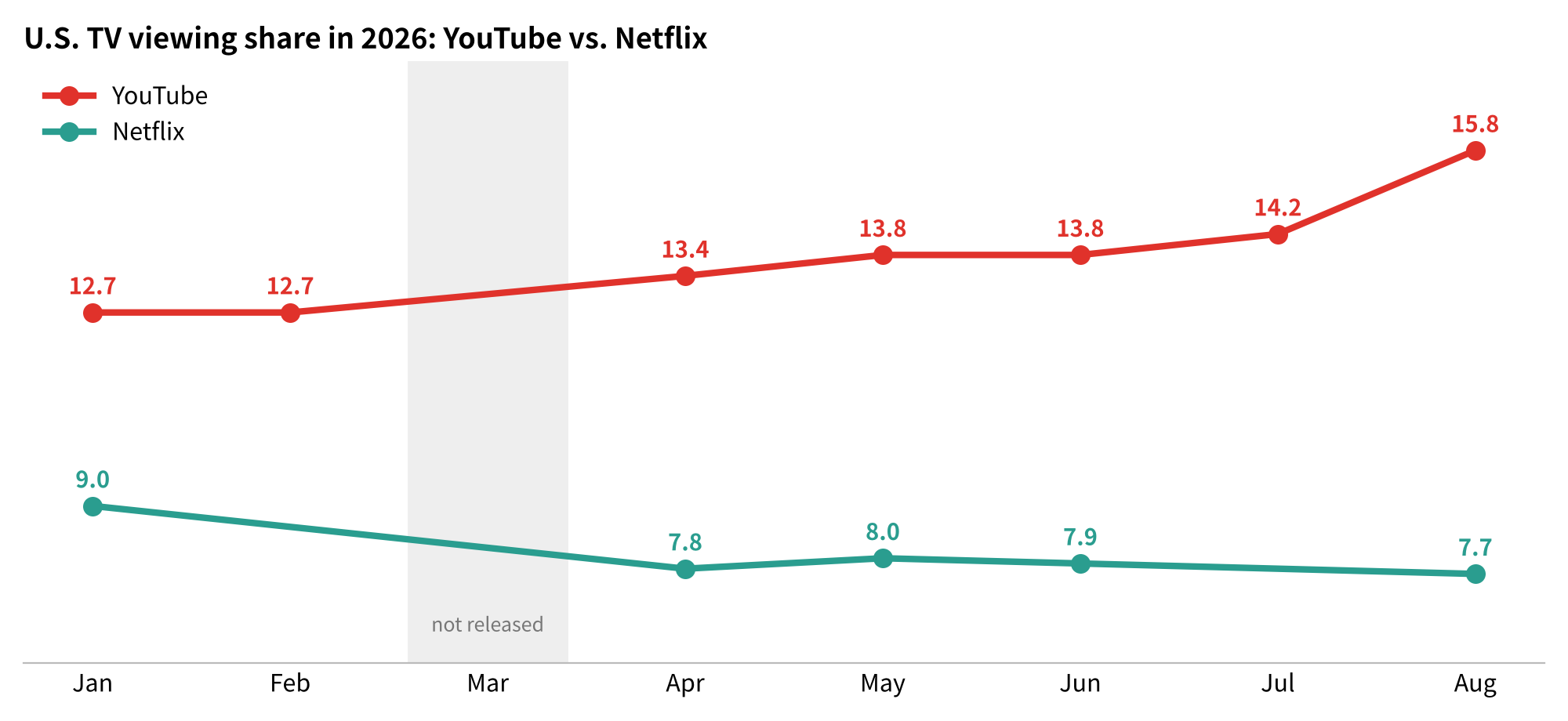
YouTube’s share of U.S. TV viewing rose from 12.7% in January to 15.8% in August; Netflix’s fell from 9.0% to 7.7%. March was not released. Source: Nielsen
In August’s distributor ranking, Disney rose 0.4 points to 9.3% to return to No. 2. Netflix was third at 7.7%, with NBCU+Versant 0.03 points behind in fourth. Paramount rose 0.3 points to 6.8% and FOX took 5.6%, down from 7.4% in June and 7.8% in July when it carried the World Cup. Among streaming platforms, Disney’s streaming properties had 4.8%, Paramount streaming (Paramount+ and Pluto TV) 2.3% and Peacock 1.6%, down 1.0 point after Telemundo’s World Cup coverage and Love Island USA ended in July.
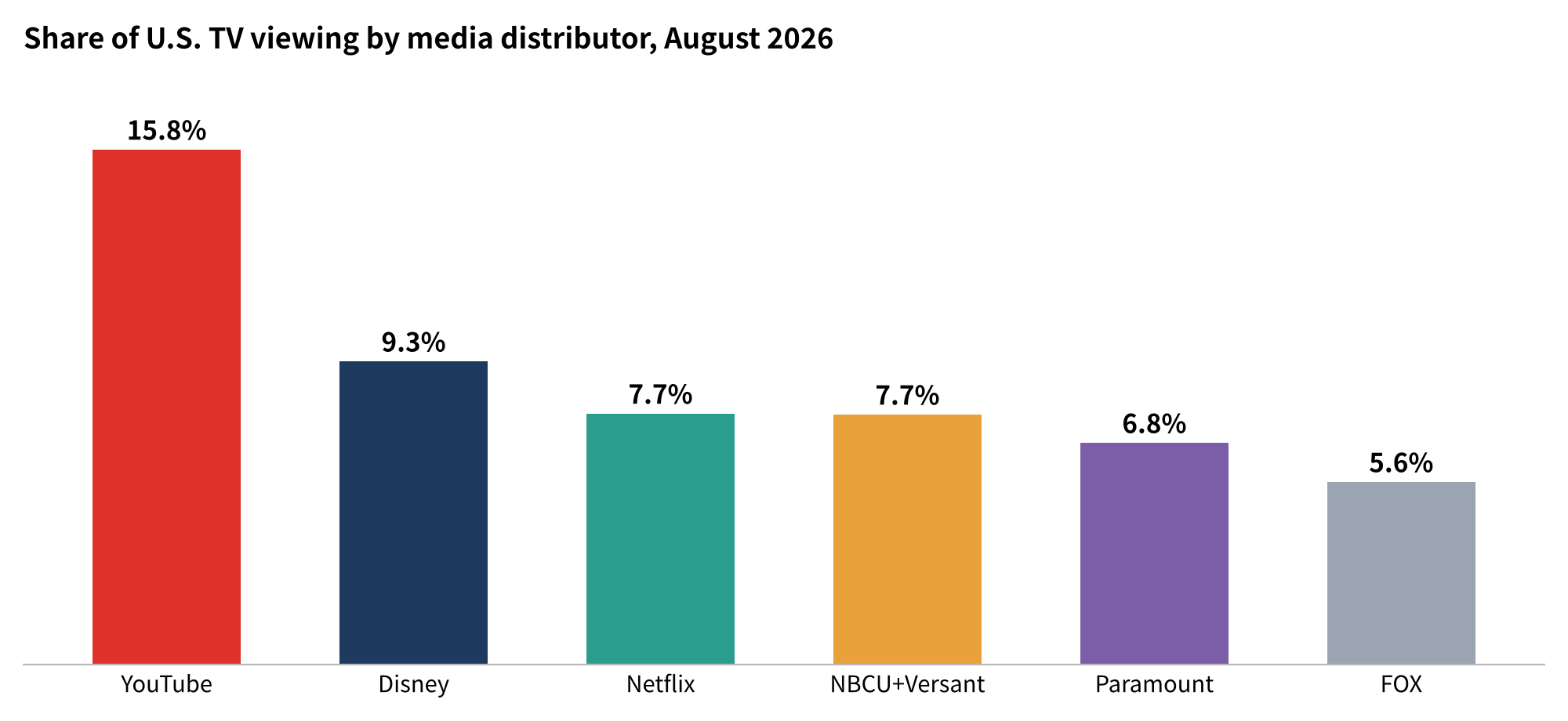
August media distributor ranking. NBCU+Versant trails Netflix by 0.03 points. Source: Nielsen
By category, streaming took 48.6% in May, 48.5% in June, 49.0% in July and 49.6% in August. Broadcast rose to 19.8% in June on the World Cup and NBA Finals, then fell 2.0 points to 17.5% in August as broadcast usage dropped 14% and sports’ share of broadcast viewing fell from 30% in July to under 9%. Cable hit a record low of 18.7% in July, down from 20.4% in May, before edging up to 18.9% in August.
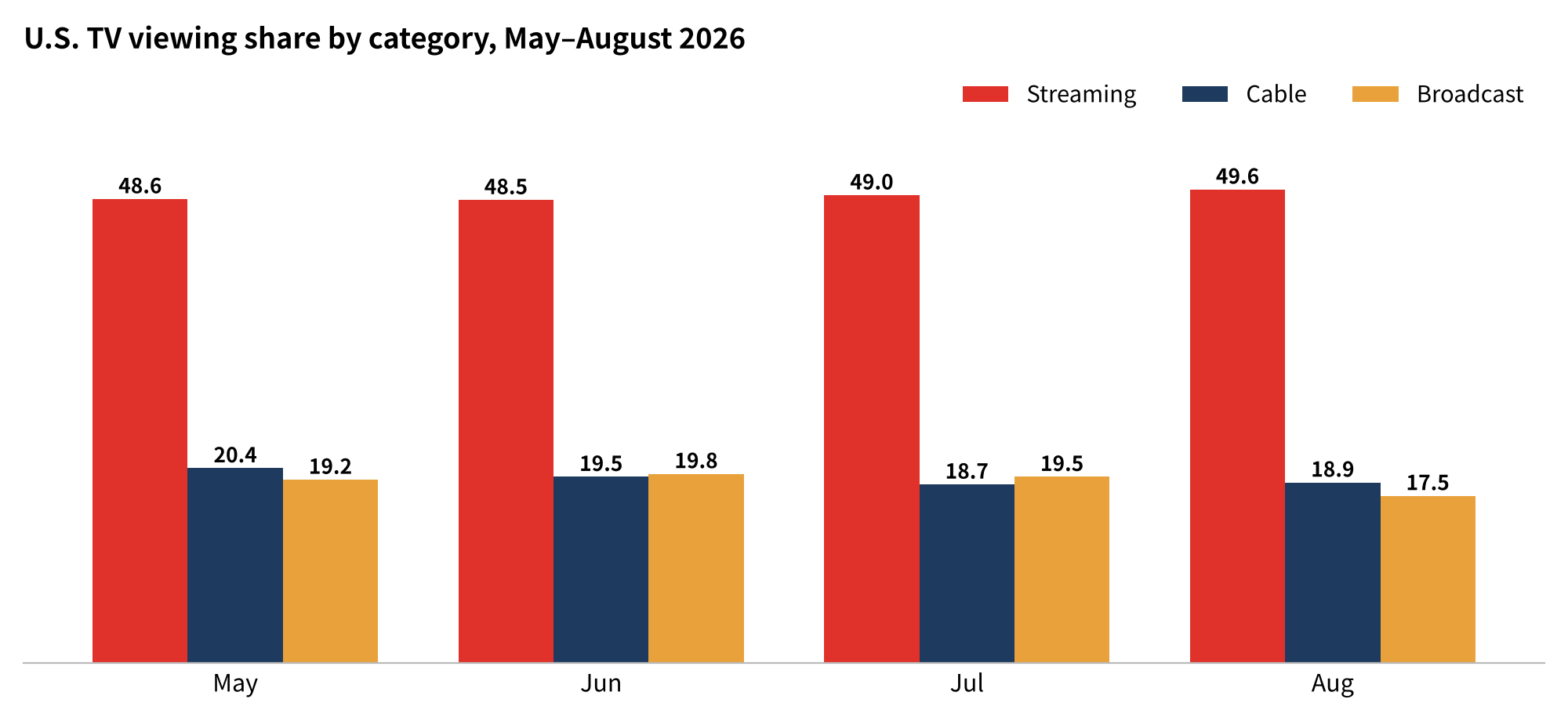
Streaming took 49.6% of U.S. TV time in August; broadcast fell to 17.5% after the World Cup. Source: Nielsen
Netflix has disputed Nielsen’s method. Co-CEO Greg Peters said on the first-quarter call in April that “Nielsen Gauge is not the currency for the video marketplace.”
Instagram tests long form before settling its payout model
Features is built for long horizontal video such as podcasts, comedy and episodic shows. Instagram head Adam Mosseri and product vice president Tessa Lyons announced it in a video on Oct. 26. The format was tested first in Brazil. Instagram plans to expand the U.S. test to tens of thousands of creators, and Features videos will be recommended on the Explore page and elsewhere, The Hollywood Reporter reported Oct. 26. Early creators include podcast host and Skims co-founder Emma Grede, beauty and fashion creator Monet McMichael, Preston Rakovsky, who interviews New Yorkers about love and relationships, and football creator Donald De La Haye.
Instagram is also testing Clips as Reels, which links up to eight short videos, and Series, which gives episodic Reels a home on a creator’s profile. It is developing a feature that turns a phone into a TV remote. The idea is for a Reels teaser to lead viewers into the full Feature. “You see a clip of a podcast that you love, you can just click and continue watching,” Lyons told The Hollywood Reporter.
Instagram for TV began as a test on Amazon Fire TV in the U.S. in December 2025, then reached Samsung and Google TV before Apple TV. Features launches on mobile, but the TV app is the goal. “The best viewing experience for longform horizontal content is on a big, horizontal screen,” Lyons said, adding that she expects much of the deep consumption to happen there over time.
Mosseri said in the announcement that he had opposed long-form video on Instagram for years, out of concern that longer sessions reduce shares and messages. He said the growing habit of friends watching Reels together on living-room TVs changed his view.
There is no ad-revenue share yet. YouTube’s Partner Program pays creators 55% of ad revenue. Instagram told Variety it is directly funding some creators making longer videos during the test, and a Meta spokesperson told TechCrunch it is too early to share a long-term monetization model. On the Colin and Samir Show, Mosseri said Instagram’s performance-based payouts lose money, and that breaking even would be fine but losses could not be justified.
Lyons said Instagram is working on “a few different deals” with early Features creators. Unlike Netflix’s podcast deals, there is no exclusivity, The Hollywood Reporter said. Existing ad deals carry over into the videos, and Instagram will help creators without placements find brand partners. “There’s a big opportunity for us to help creators who don’t yet have that infrastructure,” Lyons said.
Series, the episodic format, responds to the rise of microdramas and creators’ demand for episodic video. Instagram began reaching out to microdrama studios in Southeast Asia in June to test it, then widened the test to individual creators. It plans to test Series in more countries in the coming months and bring it to the U.S. by the end of this year or early next year, and is testing how it will appear on TV. A separate test puts live video into the Reels tab and shows it to non-followers, starting in Indonesia and Brazil with a U.S. launch planned for next year.
TikTok began testing hour-long uploads in 2024 and still allows them, but unlike Instagram it no longer offers a TV app.
Pooja Tripathi, host of the Instagram talk show Brooklyn Coffee Shop, called Instagram the one platform where you can do everything at an event in September marking the show’s 100th episode. She asked for TV-style features such as cast and production credits to set shows apart from everyday posts.
Video podcasts offer a way to encourage regular visits
Wilson spent nearly 15 years at Apple, from 2006 to 2020, as one of the earliest members of the Apple Podcasts team, then served as chief strategy officer at Daylight Media, formerly QCODE, until 2026. He will start as a consultant handling podcast acquisitions. The hire came just over a week after Peter Rice replaced Bela Bajaria as chief content officer, and Barrett Media noted it was the first hire under Rice. Netflix had already signed deals with Spotify, iHeartMedia and Barstool Sports that brought shows such as The Breakfast Club to the service.
Disney announced a video podcast deal with iHeartMedia on Aug. 10 covering six iHeartPodcasts titles, each streaming new episodes weekly. The Jonas Brothers’ Hey Jonas! debuted on Disney+ and Hulu on Aug. 14, timed to the premiere of Camp Rock 3, with episodes from D23 that weekend. Pod Meets World, hosted by Boy Meets World stars Danielle Fishel, Will Friedle and Rider Strong and past 55 million audio downloads, followed on Disney+ on Aug. 24.
Desperately Devoted, a Desperate Housewives rewatch hosted by Teri Hatcher, her on-screen daughter Andrea Bowen and her real-life daughter Emerson Tenney, arrives on Hulu in video for the first time on Nov. 2. Scrubs stars Zach Braff and Donald Faison’s Fake Doctors, Real Friends comes to Hulu later this year, with StraightioLab and Thanks Dad with Ego Nwodim in the fall. The deal is distribution, not acquisition: iHeart keeps ownership of the shows.

Disney+, Hulu and iHeartMedia announced a six-title video podcast deal on Aug. 10. Source: Disney+
Disney organizes podcasts in three groups: licensed titles such as Handsome, rewatch podcasts such as That Was Us, and companion podcasts for its own series, including Paradise, American Idol and Dancing with the Stars. Disney+ has a “Podcasts” collection and Hulu a “Podcasts” hub. Lauren Tempest, Disney’s head of content planning and partnerships for DTC, said in the announcement that podcasts have become one of the fastest-growing ways for audiences to connect with the stories and talent they love. Las Culturistas, cited by Axios, streams on Disney+ and Hulu from Nov. 18.
Tubi, Fox’s free streaming service, announced a non-exclusive distribution and monetization deal with SiriusXM on June 2 that brings video podcasts from the SiriusXM Podcast Network to its 100 million monthly active users. The initial slate is six shows: Conan O’Brien Needs a Friend, Rotten Mango, The School of Greatness, What Now? with Trevor Noah, Moral of the Story and The Deep 3 Podcast, with more to come. Ad sales are shared between Tubi and SiriusXM Media, the company’s advertising arm, and the shows remain on YouTube and other platforms.
SiriusXM is applying its audio playbook to video. “In podcasting, audio has long thrived through broad distribution across platforms,” Andrew Moss, SiriusXM’s senior vice president of content strategy and development, said in the announcement, adding that the company is extending its creators’ reach across phones, computers and connected TVs. The SiriusXM Podcast Network has more of the top 20 U.S. podcasts than any other network, according to Edison Research, and reaches one in two U.S. podcast listeners each month.
Tubi is the second-largest free ad-supported streaming service by reach among U.S. adults 18 and older, with more than 300,000 movies and TV episodes and over 1 billion hours watched each month. More than 95% of its viewing is on demand, which Tubi pitches to advertisers as premium inventory. “Tubi is a platform built to help creators grow their fanbases and revenue,” said Rich Bloom, general manager of creator programs and executive vice president of business development. Amazon, meanwhile, has brought creator podcasts including Jason and Travis Kelce’s New Heights to Prime Video.
Hours of podcasts watched on YouTube through TV screens rose 75%, from 400 million a month in October 2024 to 700 million in October 2025.
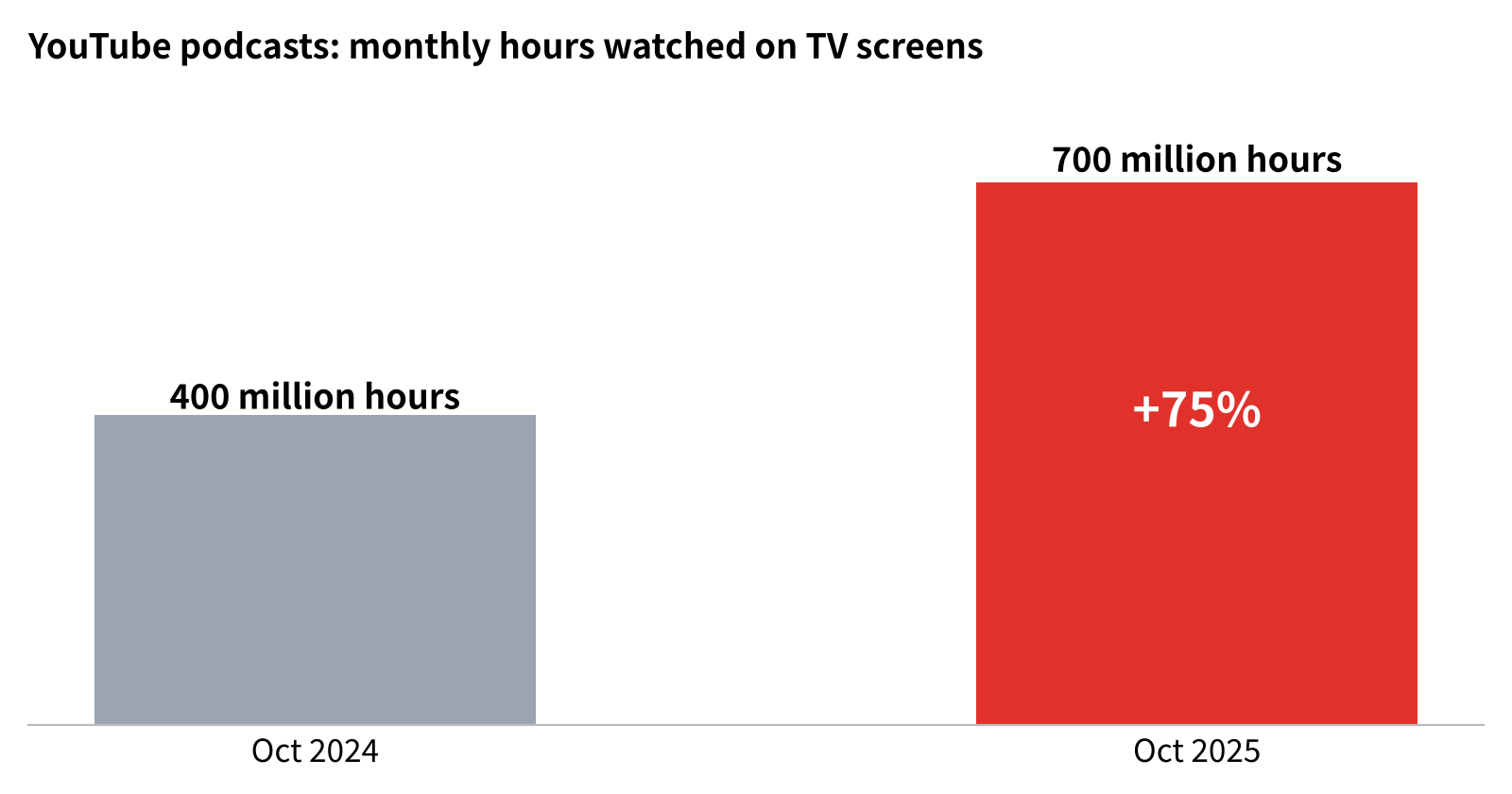
Podcast viewing on TV screens via YouTube rose 75% in a year. Source: YouTube
| Company | Partner | Deal | Timing |
|---|---|---|---|
| Netflix | Spotify, iHeartMedia, Barstool Sports | Video podcast distribution | 2025–2026 |
| Netflix | Mark Rober | Original competition series SCHOOLED! | Early 2027 |
| Disney | iHeartMedia | Video podcast distribution (iHeart keeps ownership) | From Aug. 2026 |
| Disney | Dude Perfect | Company-wide creative partnership | Oct. 15, 2026 |
| Tubi | SiriusXM | Non-exclusive distribution, shared ad sales (six shows to start) | June 2, 2026 |
| Amazon | Kelce brothers’ New Heights, others | Podcasts on Prime Video | — |
| U.S. and Brazil creators (U.S. test to reach tens of thousands) | 90-minute Features test, non-exclusive individual deals | Oct. 26, 2026 |
Source: company announcements; Axios, Variety and The Hollywood Reporter
Audience growth does not guarantee profitable talent deals
iHeartMedia CEO Bob Pittman said at Axios’ Media Trends Live in New York on Oct. 20 that video podcasts are bringing new audiences to audio rather than replacing listening. “It expanded the pie,” he said, adding that video also commands higher ad rates.
Pittman also warned that some podcast talent deals are paying more than they can earn back. iHeart signed with Netflix last fall and now has more than 15 shows there; the Disney deal adds another video outlet.
Creator partnerships expand into original production
Disney signed a company-wide creative partnership with Dude Perfect on Oct. 15. The YouTube sports-and-comedy group will make content tied to Super Bowl LXI on Feb. 14, 2027, carried by ABC and ESPN, the 50th anniversary of Star Wars and Marvel Studios’ Avengers: Doomsday. Disney will distribute part of Dude Perfect’s short-form library across Disney+, ESPN and Disney social channels. In August, Disney ordered 20 episodes from Dhar Mann Studios.
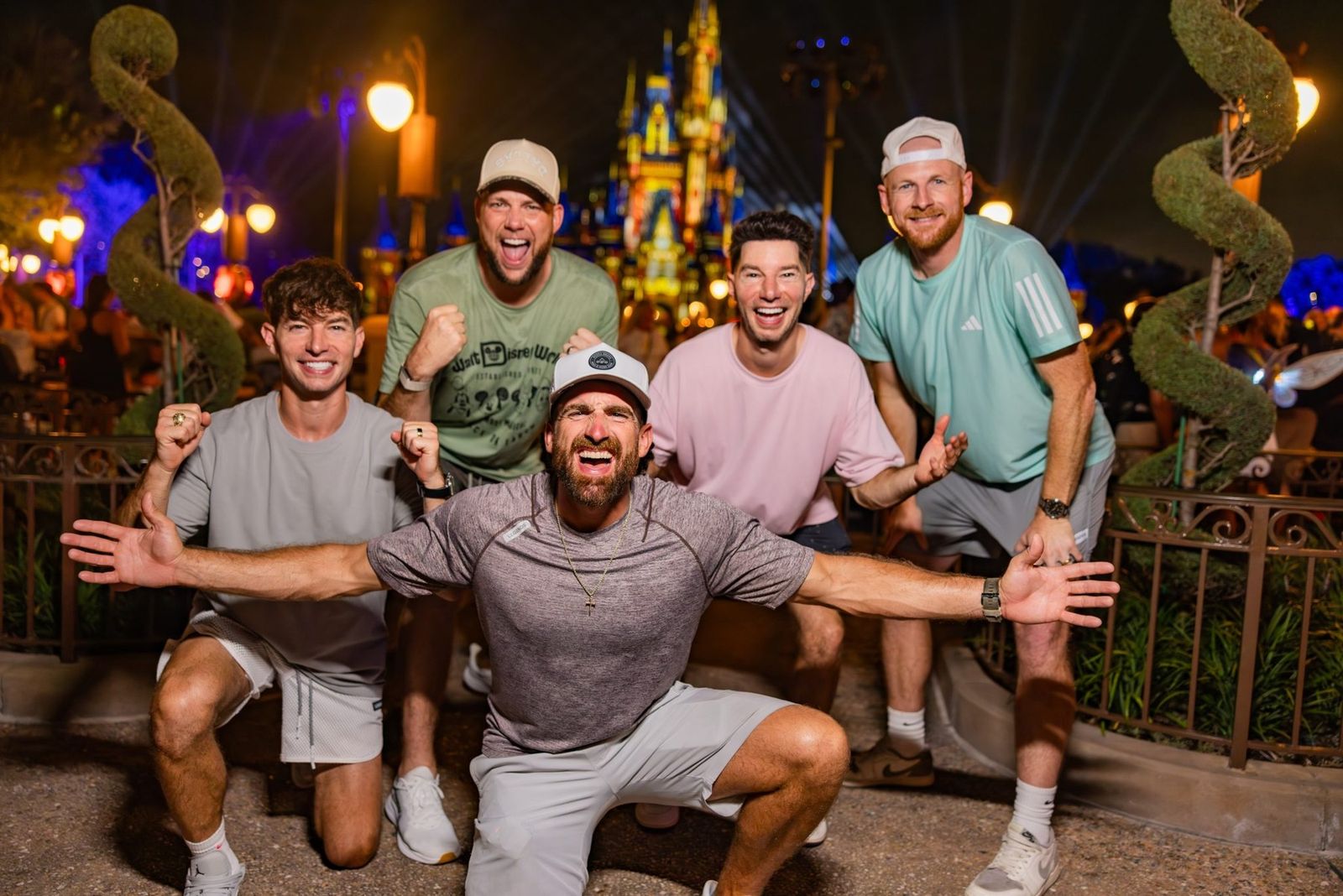
Dude Perfect in front of Cinderella Castle at Walt Disney World. Disney signed a company-wide creative partnership with the group on Oct. 15. Photo: Disney
Dude Perfect has more than 130 million followers and over 22 billion lifetime views, with businesses spanning original content, live touring, the Almost Athletes podcast and consumer products. Its Avengers content will also run in its series Overtime. Last year the group and Disney attempted a world record by visiting all 12 Disney parks worldwide in under 75 hours; the video drew more than 13 million views, the channel’s No. 2 upload in its first 24 hours, and a linked fundraiser raised more than $1.2 million for Make-A-Wish. Disney is a place where “great storytellers come to create,” Asad Ayaz, Disney’s chief marketing and brand officer, said in the announcement. Co-founder Garrett Hilbert said the group grew up as Disney fans and learned from Disney to “go big and dream.”
Netflix is developing SCHOOLED!, a science competition series hosted by former NASA engineer and YouTube star Mark Rober, in which student teams compete in a gamified school. Jimmy Kimmel’s Kimmelot co-produces. Rober said at Bloomberg’s ScreenTime that it will premiere in early 2027.
YouTube exclusivity offers put a price on distribution flexibility
Bloomberg reported on Aug. 19 that YouTube is offering some top channels millions of dollars to upload exclusively to its site for a set period. Creators who release videos on Netflix at the same time would be less likely to be featured in YouTube’s marketing campaigns or events, Bloomberg said. No deals had been signed at the time.
Netflix has paid creators such as Alan Chikin Chow and Nick DiGiovanni to post their videos on YouTube and Netflix concurrently, giving them extra income and exposure to more than 325 million subscribers. Some creators have passed because Netflix wants videos delivered days in advance and has asked for certain sponsorships to be removed. YouTube says it has paid more than $100 billion to creators, artists and media companies over the past four years.
Programming and advertising operations become differentiators
Open uploading and shared advertising revenue help YouTube attract a broad supply of programming. Curated streaming services can offer easier discovery and a more predictable context for advertisers. Selection alone does not guarantee brand safety or profitability. Sponsorship rules, ad placement and review responsibilities still need to be defined in contracts and operations.
YouTube, for its part, has been pitching creators as premium entertainment as it seeks a bigger share of traditional TV ad budgets.
Korean broadcasters need to connect digital production with rights revenue
In a survey released June 17 by WiseApp·Retail (와이즈앱·리테일), YouTube averaged 113.6 billion minutes of use a month in South Korea from January to May 2026, more than 20 times Netflix’s 5.61 billion. Versus the same period in 2022, YouTube was up 26.4% and Netflix 19.1%. The figures measure smartphone app use, a different basis from Nielsen’s U.S. TV-screen data.
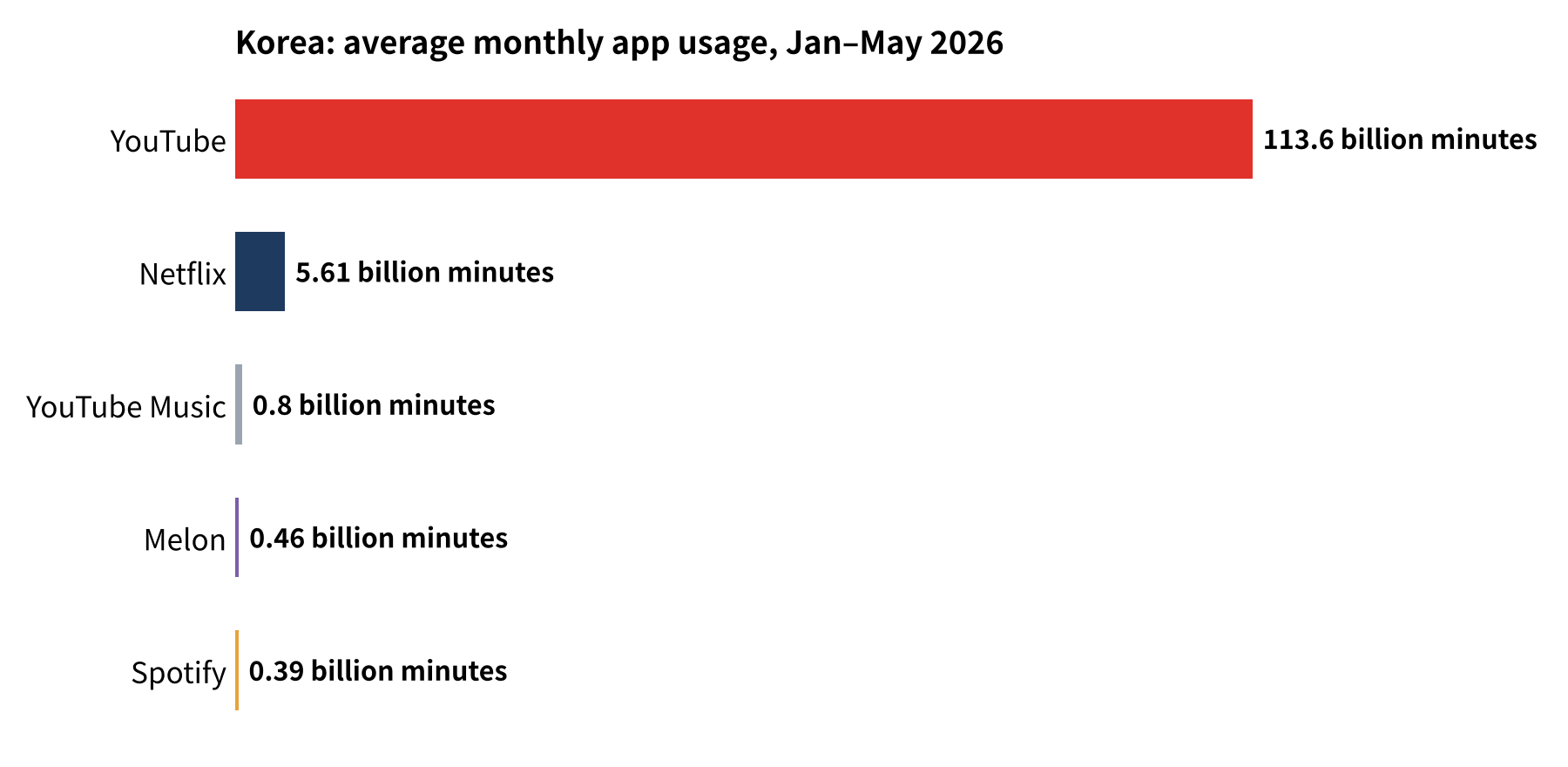
YouTube’s monthly app usage in Korea was more than 20 times Netflix’s in January–May 2026. Source: WiseApp·Retail
Korean broadcasters also face a shrinking revenue base. The financial disclosure for fiscal 2025, released on June 19, put broadcasting revenue at 18.65 trillion won, down 0.8% for a third consecutive annual decline. Broadcast advertising revenue fell 12.3% to 2.01 trillion won. These annual figures cover a different period from the 2026 smartphone usage survey.
Netflix’s 2026 Korea slate includes unscripted shows such as Yoo Jae-suk Camp (유재석 캠프) and producer Na Young-seok’s (나영석) Lee Seo-jin’s Dalla Dalla (이서진의 달라달라). Kim Jo-han (김조한), an executive at NEW ID (뉴아이디), said in a YTN (YTN) radio interview in January that to double its ad revenue in 2026, Netflix needs variety and live programming that brings users back every week whether or not a big title is out. It is the same logic behind Netflix’s U.S. video podcast push.
A practical starting point is to reassess the economics of existing digital programs. U.S. non-exclusive distribution deals show how a producer might retain a YouTube channel while supplying a video edition elsewhere. Additional revenue, however, is not automatically additional profit. Broadcasters must account for re-editing, subtitles, music and performer clearances, delivery costs and any effect on existing advertising and sponsorship income.
Creator collaboration should also extend from guest appearances to joint program development. Broadcasters can contribute production, review, advertising sales and international distribution, while creators retain the voice and audience relationships that made their channels valuable. Channel control, format ownership and subsequent-season rights need to be clear if the relationship is to build a continuing business.
Digital teams need budgets and authority that connect programming, sales and international distribution. Public-service broadcasters and news organizations must also preserve separation between sponsorship and editorial decisions, with clear verification and correction responsibilities. A more conversational format can coexist with the standards on which a broadcaster’s reputation depends.
Rights should be assessed by platform, territory, language and term. An exclusivity payment must be weighed against lost YouTube revenue and sponsorship opportunities. Existing music, footage and performer permissions may not cover streaming or international use. Ad sales, reporting and settlement responsibilities also need to be explicit; a library is only resalable where the relevant rights are available.
The Korean opportunity depends on contracts and execution
A limited distribution pilot offers a practical first step, using talk, entertainment or specialist programs whose rights can be cleared. Short clips can aid discovery, full episodes can build viewing time and live or subsequent episodes can encourage return visits. That sequence is a hypothesis to test against audience behavior and production costs, rather than a template for every program.
Success should be measured beyond views: returning audiences, actual watch time, contribution after production costs, sponsorship renewals and incremental distribution income all matter. Where programs link to an owned streaming or membership service, broadcasters should measure registration and paid conversion separately and establish what audience data each external platform will actually provide.
Competition for YouTube creators may create new buyers for Korean programming. Capturing that opportunity requires contracts that respect creator communities while defining program rights and compensation. Broadcasters will gain more durable value by turning their production experience into a continuing supply of digital programs and securing a fair return on the rights they contribute.
Exchange rate: $1 = 1,327 won (Oct. 28, 2026). Korean amounts are shown in won with dollar equivalents.
Quotation marks indicate reported remarks; unquoted attributions summarize reporting. Bloomberg reporting is cited secondhand.
Sources
Axios, Everyone wants a piece of YouTube (Kerry Flynn·Sara Fischer, 2026.10.27)
Axios, iHeartMedia CEO warns of podcast talent deal "exuberance" (2026.10.20)
Nielsen, TV Viewing Cools Off in Nielsen's August Gauge Reports (2026.10.22)
TheWrap, YouTube Extends Streaming Lead With 14% of TV Viewership in July (2026.9.10)
TheWrap, World Cup, NBA Finals Lift Broadcast Viewership to 19.8% in June
AdWave (Nielsen Gauge recap), Which Streaming Service Has the Most U.S. Viewers in Q1 2026?
AdWave (Nielsen Gauge recap), What Is Netflix’s Share of U.S. TV Viewing in Q2 2026?
PPC Land, Netflix’s Nielsen problem is bigger than a methodology dispute
TheWrap, YouTube TV Viewing Hits Record 15.8% in August (2026.10.22)
PPC Land, YouTube gains record 15.8% of US TV time in Nielsen's August Gauge
The Next Web, Instagram tests 90-minute horizontal videos called Features (2026.10.26)
The Hollywood Reporter, Instagram Tests 90-Minute Horizontal Videos in Major Play for Podcasters and Creators (Caitlin Huston, 2026.10.26)
exchange4media, Instagram takes on YouTube with 90-minute 'Features' (2026.10.27)
Net Influencer, Instagram tests 90-minute videos as it moves into YouTube's territory
Net Influencer, Instagram head says video creator payments lose money
Tecnoandroid, Instagram testa Features, video orizzontali fino a 90 minuti
TheWrap, Netflix Taps Former Apple Exec Steve Wilson to Lead Podcast Division (2026.10.27)
Barrett Media, Why Netflix Hiring Steve Wilson Will Benefit the Entire Podcast, Creator Industry
Disney+ Press, Disney+, Hulu and iHeartMedia Announce Video Podcast Deal (2026.8.10)
PPC Land, Disney and Hulu gain six iHeartMedia podcasts starting August 14
Laughing Place, Las Culturistas Coming to Disney+ and Hulu
SiriusXM, SiriusXM Expands Video Podcast Distribution to Tubi (2026.6.2)
The Hollywood Reporter, SiriusXM partners with Tubi on podcasts
Radio Ink, Conan, Trevor Noah, and More Head to Tubi Via SiriusXM (2026.6.5)
Inside Radio, iHeartMedia Brings Six Video Podcasts to Disney+ and Hulu
The Walt Disney Company, Dude Perfect creative partnership (2026.10.15)
Forbes Argentina, Disney se alía con un gigante de YouTube
Net Influencer, Disney Signs Dude Perfect to Company-Wide Creative Partnership
What's on Netflix, Mark Rober Talks New Netflix Series 'Schooled'
Taipei Times (Bloomberg), YouTube offers creators millions to not work with Netflix (2026.8.23)
Tubefilter, YouTube is reportedly offering creators millions if they don't sign deals with Netflix (2026.8.19)
eMarketer, 700 million video podcast hours on YouTube
Hankyung (WiseApp·Retail), 유튜브 없이 못 사는 한국인들…월 사용시간 1136억분 (2026.6.17)
JKN (Korea Communications and Media Commission), 2025 회계연도 방송사업자 재산상황 (2026.6.19)
YTN, 열린라디오 YTN 김조한 뉴아이디 상무 인터뷰 (2026.1.24)
Netflix Korea, 넥스트 온 넷플릭스 2026 코리아
SlashFilm, Avengers: Doomsday release schedule